




Abstract
The objective of this study was to investigate the effect of ambient temperature on compressibility and recovery of NiTi shape memory alloys as static seals. Experimental results indicated that compressibility and recovery of NiTi alloys were dependent on ambient temperature. At T < Af (the austenite finish temperature), the compressibility and recovery coefficients were almost unchanged when the compression stress was higher than a certain level. The residual strain of NiTi alloys increased with a decrease in temperature at T < Af. The residual strain of NiTi alloys was remarkably high at the temperature below Mf (the martensite finish temperature). The recovery coefficient of NiTi alloys at T > Af gradually increased with increasing compression loading. The compressibility and recovery coefficients of NiTi alloys were insignificantly fluctuated at the temperatures between 60°C and 150°C upon the compression loading. The features of strong deformation and martensite reorientation in the compressed NiTi alloys confirmed the temperature effect.
Introduction
Among shape memory alloys (SMAs), NiTi alloys are considered to be favorable and promising materials for a wide range of applications with the advantages of shape memory effect (SME), superelasticity, good strength, ductility, and excellent corrosion resistance.1,2 So, they have been broadly applied in robotic, automotive, aerospace, chemical, energy, and other industries.3,4 Due to the anti-vibration, damping capacity, and self-regulating properties, NiTi alloys have been considered as candidate materials for static seals to solve the leakage problem in bolted flange connections.5,6 Because of low elastic modulus, superelasticity, and SME, the static gaskets of NiTi alloys can compensate the gaps in bolted flange connections caused by the preloading at the environmental temperatures.7,8 Therefore, the gaskets of NiTi alloys with sufficient self-recovery ability can strengthen the sealing effect and reduce leakage in bolted flange connections. Tanaka et al. 9 first proposed the use of SMAs instead of steel in spiral-shaped gaskets. Efremov10,11 applied SMAs in bolted flange connections and considered that SMAs had negative creep effect which can ensure automatic, continuous, and leak-tight contact between the surfaces of flange and gasket. Hu et al. 12 proposed new clip-angle connections incorporating the bolts of SMAs, which possessed over 60% of recovered total displacement during unloading. Abolmaali et al. 13 showed that energy dissipation of the t-stubs with SMA fastener was higher than those with steel for the particular stress level through low-cycle fatigue tests.
As discussed above, the gaskets of NiTi alloys can recover by themselves from large strains to decrease the leakage by utilizing the superelasticity and SME. During operation, temperature is one of the key factors influencing the complex interaction among gaskets, flanges, and bolts of bolted flange connections. The compressibility and recovery of NiTi alloys are of significant importance in affecting the sealing performance of static seals. To provide the necessary information for the selection of the assembling and operating temperature and enhancing the sealing performance, it is indispensable to establish a relationship between the temperature and the compressibility and recovery performance of NiTi alloys as seal gaskets. However, the investigation on compressibility and recovery of NiTi alloys as static seals seems insufficient to support the design, in particular at different ambient temperatures.
In this article, the compressibility and recovery of NiTi alloys as static seals are thus tested at different ambient temperatures. The corresponding martensitic transformation-induced deformation behavior is discussed together with thermal analysis and microstructure characterization.
Experimental procedure
As-received NiTi alloys (commercial binary Ti-51.1Ni (at. %) alloys) in hot rolled plates with thickness of 1.6 mm were used in the test. The samples were treated with solution at 810°C for 30 min, water cooled to room temperature (RT), and subsequently aged at 300°C for 60 min. Differential scanning calorimetry (DSC) was used to determine the characteristics of the phase transformations. In the DSC measurement, specimens were heated from −60°C to 100°C at a heating rate of 10°C/min and then cooled back down to −60°C at a cooling rate of 10°C/min.
The compressibility and recovery of NiTi alloys were studied through a universal testing machine from MTS Company according to ASTM F36-99 standard. All the specimens were machined with the size of 10 mm (length) × 10 mm (width) × 1.6 mm (thickness). During the test, an ambient chamber was used to control the test temperature. The tests at the temperatures of −40°C, −30°C, −20°C, −10°C, RT (room temperature, 26°C), 60°C, 90°C, 120°C, and 150°C upon the maximum compression loading of 600, 900, and 1200 MPa were conducted. In this study, the initial preloading value was set as 10 MPa, and the specimens were loaded to the maximum loading at a stress speed of 0.5 MPa/s and then completely unloaded at the same speed after holding for 30 s in the maximum loading stress. Before the test, the oxide layer of the specimens was removed and then covered with graphite powder to decrease the slipping. The compressibility and recovery coefficients of NiTi alloys were both calculated in accordance with the formulas in the standard as follows


where C is the compressibility coefficient of NiTi alloys, R is the recovery coefficient of NiTi alloys, I is the thickness upon the preloading, M is the thickness upon the total loading, and B is the recovered thickness of NiTi alloys. And the residual strain was also obtained from the stress–strain curves. The microstructures of NiTi alloys before and after the tests upon the compression loading of 1200 MPa were characterized by an optical microscope (Mode: Olympus DSX510). Metallurgical specimens were ground on silicon carbide papers of 80–2000 grit and then polished. The specimens were etched using the reagents 10% HF, 40% HNO3, and 50% H2O by volume fraction and micrographs were taken at RT.
Results and discussion
DSC measurement and microstructure of NiTi alloys
The DSC curve is measured to systematically study the phase transformation behavior of NiTi alloys, as shown in Figure 1. The DSC curve shows one peak upon cooling and one peak upon heating, which demonstrates one-stage B2-B19′ transformation during cooling and a reverse transformation during heating. It should be noted that the frequently observed R-phase transformation in aged Ni-rich NiTi alloys is absent and multi-stage martensitic transformation is significantly suppressed. As a trigonal phase and another martensite candidate, R-phase involving B2-R-B19′ generally appears between the austenite and martensite, causing multi-stage transformation behavior.14,15 The absence of R-phase transformation in the aged Ni-rich NiTi alloy could be due to that the precipitates lose coherency with the parent phase, to our understanding. As discussed in the previous studies, the formation of precipitates was frequently reported in the materials aged at this temperature range.16–19 The thermodynamically favorable nucleation and growth of precipitates affect not only the local Ni concentration between precipitates but also impose localized coherency stress fields. 20 It is always considered to be responsible for the transformation behavior in aged NiTi alloys. For Ni-rich NiTi alloys aged at both low and intermediate temperatures, a nearly homogeneous precipitation across the whole grain is obtained as a result of large supersaturation, and the multi-stage transformation behavior could thus be suppressed. 21 The characteristic temperatures of phase transformation are obtained from the DSC curve. The austenite starting and finishing temperatures of phase transformations, As and Af, are −17.2°C and −5.1°C, respectively. And the martensite starting and finishing temperatures of phase transformations, Ms and Mf, are −25.6°C and −38.6°C. The microstructure of the aged NiTi alloys is shown in Figure 2. Since micrographs were taken at RT (>Af), it can be concluded that the grains in materials are in austenite phase together with DSC measurement.
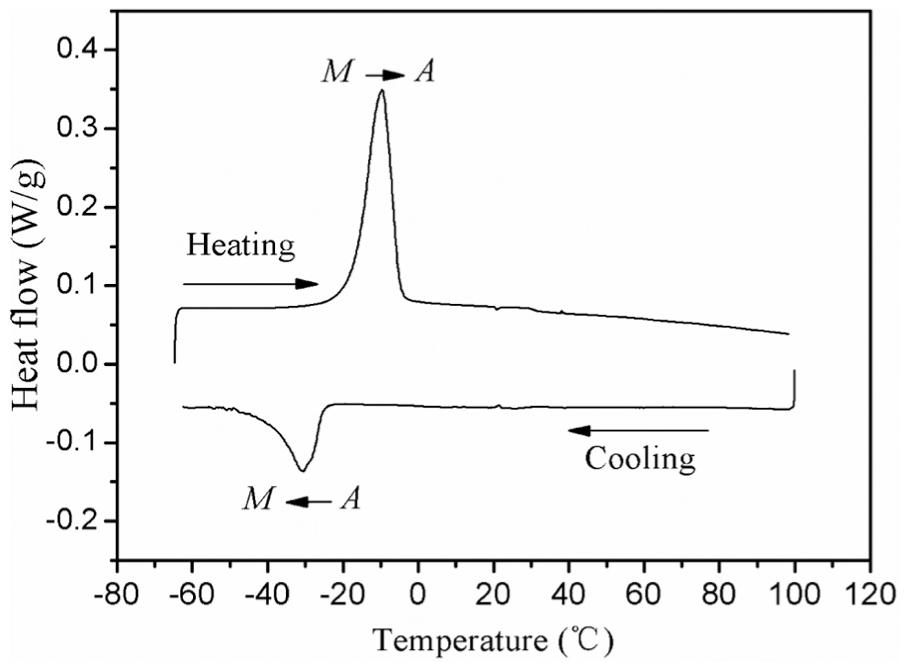
DSC curve of NiTi alloys.

Microstructure of NiTi alloys.
The stress–strain curve
Figure 3 shows the stress–strain curves of NiTi alloys at the test temperatures of −40°C, −30°C, −20°C, −10°C, RT, 60°C, 90°C, 120°C, and 150°C upon the compression loading of 600, 900, and 1200 MPa.

Stress–strain curves of NiTi alloys upon the compression loading: (a) −40°C, (b) −30°C, (c) −20°C, (d) −10°C, (e) RT, (f) 60°C, (g) 90°C, (h) 120°C, and (j) 150°C.
As shown in Figure 3(a)–(d), a similar sloping stress plateau behavior could be observed in the compression stress (PQ section of curves in Figure 3), that is, upon the compression loading of 1200 MPa at the temperatures of −40°C, −30°C, −20°C, and −10°C. It indicates that a plateau-like slope which begins at the transition stress appears when the compression loading exceeds a certain level at these temperatures. Because of the permanent deformation in the compression stress, part of the mechanical energy that is consumed for the deforming of NiTi alloys is lost during the unloading process. It should be noted that the plateau-like slope is significantly related with the temperature. The plateau-like slope becomes lower with decrease in temperature. The specimens were directly cooled from RT to the test temperature in this study. From the DSC measurement, it can be deduced that the thermal-induced martensitic (TIM) transformation does not occur at −20°C and −10°C because the test temperatures are higher than Ms. The materials are in the austenite and martensitic state at −30°C (Mf < T < Ms) and complete martensite at −40°C (T < Mf), which are dependent upon the TIM transformation by cooling. In the situation, the initial flat part in the curves is referring to the deformation of the austenite or/and martensite at these low temperatures. The transition stress becomes lower in the curves, which indicates that the difficulty to accommodate the deformation is increased at the lower temperature. Specially, the detwinning mechanism of the TIM is remarkably dominant during the deformation when NiTi alloys are in complete martensite phase at −40°C (T < Mf).22,23
As shown in Figure 3(e), two plateau-like slopes are observed in the stress–strain curve upon the loading of 1200 MPa at RT. It exhibits remarkable transient characteristics among the curves. As the parent phase is austenite at RT (>Af), it is generally believed that the austenite structure transforms to martensite phase when the applied stress exceeds a threshold level. The austenite is unstable at the onset of stress plateau upon loading and activation energy is required to initiate the stress-induced martensite (SIM) transformation. 24 It had been considered that the critical stress, σcr, is the required stress to induce the martensite transformation and onset of the SIM transformation. 25 A three-stage behavior is therefore contained in the stress–strain curve upon compression loading: elastic deformation of austenite (Region I), the SIM transformation and Lüders-like deformation behavior of the SIM (Region II), and plastic deformation of the SIM (Region III).26,27 Due to the formation of the SIM, the inelasticity is initialed and then further loading leads to yielding of the resulting martensite by detwinning, reorientation of the resulting SIM variants, and eventually dislocation-induced slip deformation of the martensites. 28 In general, the SIM transformation takes place during loading, and the SIM transforms back to the austenite to the stress-free state during unloading. In this study, the two plateau-like slopes observed in Figure 3(e) indicate that NiTi alloys similarly experience the SIM transformation during loading and the SIM back to the austenite during unloading.
As shown in Figure 3(f)–(j), the stress–strain curves of NiTi alloys at the temperatures of 60°C, 90°C, 120°C, and 150°C (T > RT) do not exhibit remarked plateau-like slopes, as a single austenite in materials. However, it does not indicate the absence of the SIM transformation. The strain is quite low when unloading at the stress of 600 MPa, and the curves are steep and smooth at the loading and unloading stages, respectively. With an increase in the stress, an unmarked transition section could be observed in the stress–strain curves upon the compression loading of 1200 MPa. Moreover, the transition section is smooth and the martensite elastic module is nearly the same upon the unloading with increasing temperature. It indicates that the strain related to the transformation is also almost unchanged at these temperatures.
Effect of ambient temperature on the compressibility and recovery of NiTi alloys
Figures 4 and 5 show the relationships between ambient temperature and the compressibility and recovery coefficients of NiTi alloys. The relationships between ambient temperature and residual strain of NiTi alloys were also obtained from the curves, as shown in Figure 6.

The relationship between ambient temperature and compressibility coefficient of NiTi alloys.
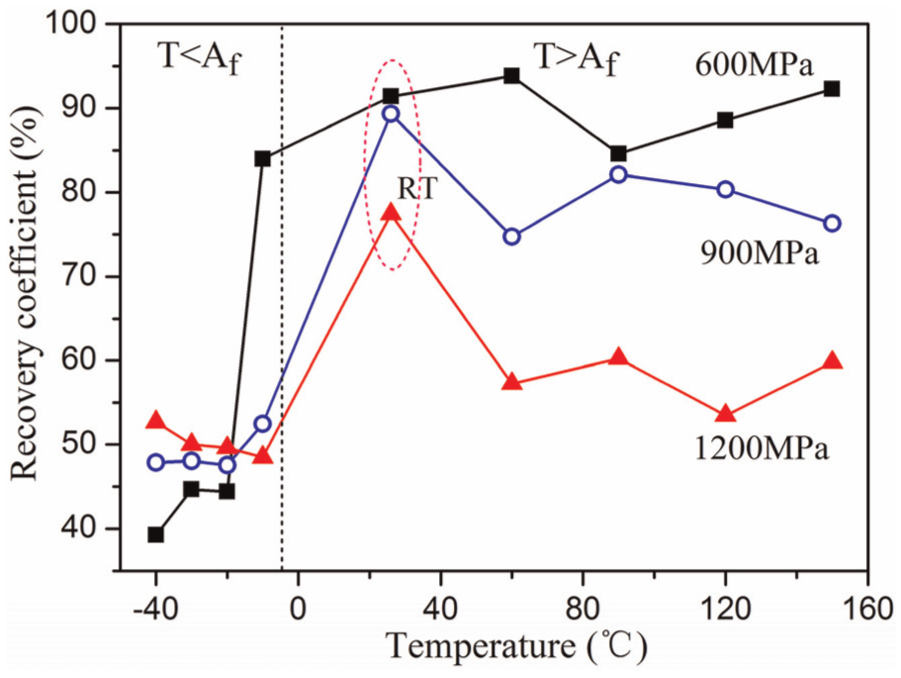
The relationship between ambient temperature and recovery coefficient of NiTi alloys.
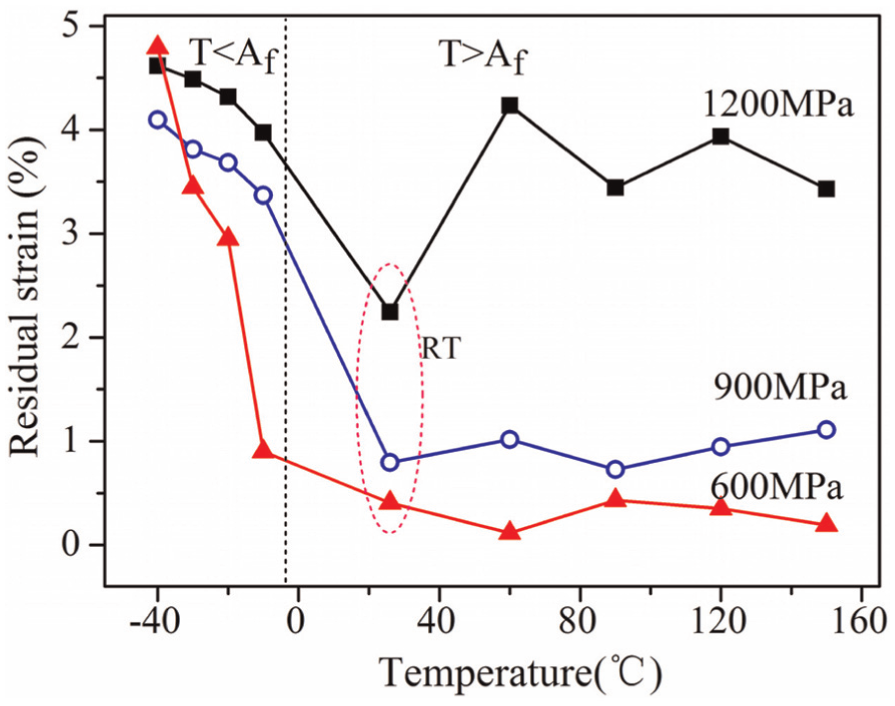
The relationship between ambient temperature and residual strain of NiTi alloys.
At T < Af, the compressibility coefficient of NiTi alloys decreased with an increase in temperature upon the compression loading of 600 MPa. The compressibility coefficient of NiTi alloys is largely the same in the temperature interval from −20°C to −10°C. However, the recovery coefficient of NiTi alloys sharply increased upon the compression loading of 600 MPa at −10°C. Combined with the stress–strain curve in Figure 3(d), it is found that a smooth plateau-like slope at the unloading stage upon the loading of 600 MPa, which indicates that the martensite transformed back to the austenite phase. This might refer to the temperature rise in the specimens under the deformation although the test temperature is less than Af. The heat energy transforms from the plastic deformation could not be conducted away at the limited period of the compression test.25,29 It should also be noted that when the compression stress is higher than a certain level (i.e. upon the compression loading of 900 and 1200 MPa), the recovery coefficients are nearly unchanged at T < Af. With decreasing temperature at this temperature range, the residual strain of NiTi alloys increased upon the compression loading. Furthermore, the compressibility coefficient of NiTi alloys slightly decreased upon the compression loading of 1200 MPa at the temperature range (i.e. −40°C and −30°C, T < Ms). It has been accepted that the TIM transformations dependent on the temperature could occur at the temperature range. The recovery coefficient of NiTi alloys is very low and the residual strain is remarkably high at −40°C below Mf, as the parent phase is in complete martensite state and the yield stress becomes lower. Accompanied with martensite transformation at the temperature range of T < Mf, the drag force of martensite transformation becomes lower and quickly goes into the plastic stage.
At T > Af, the recovery coefficient of NiTi alloys is higher than that at the other test temperature upon the compression loading of 1200 MPa in this study. Upon the compression loading of 900 and 1200 MPa, the recovery coefficient of NiTi alloys at RT is higher than that at the other test temperatures as marked in Figure 5. Also, the residual strain of NiTi alloys at RT is much lower upon the compression loading 1200 MPa, as shown in Figure 6. The compressibility coefficient of NiTi alloys is almost unchanged at the temperatures between 60°C and 150°C upon the compression loading, and the recovery coefficient is fluctuated a little. The residual strain of NiTi alloys is also approximately stable with increasing temperature upon the compression loading. As mentioned above, the parent austenite phase of NiTi alloys is first elastic deformed upon the compression loading at T > Af. When unloading prior to the critical stress, the specimens in the austenite state are recovered back. The compressibility and recovery coefficients of NiTi alloys are high, while the residual strain is low at RT, which lies in the superelastic range. Therefore, the deformation could be recovered when unloading upon the compression loading of 600 MPa. Once exceeding the σcr, the SIM transformation occurs and the deformation precedes by martensite variant reorientation and detwinning mechanisms.22,30 In the situation, the deformation of the SIM in NiTi alloys is dominated. When unloading at the low stress, the reverse transformation takes place and martensite is back to the parent austenite at this stage. 31 Upon the high compression loading (i.e. upon the compression loading of 1200 MPa in this article), the permanent deformation occurs because of the SIM at the temperatures. With increasing temperature, the reverse transformation of martensite back to austenite is restrained to great extent. Hence, the compressibility coefficient, recovery coefficient, and residual strain do not vary significantly upon the compression loading at the temperature range between 60°C and 150°C.
Moreover, we are aware of that the recovery coefficient of NiTi alloys at the low temperatures (i.e. −40°C and −30°C, T < Ms) is much lower than that at the temperature range between 60°C and 150°C upon the compression loading of 600 MPa. At these low temperatures, NiTi alloys could deform through martensite reorientation (or detwinning) due to the TIM transformation. Therefore, these test specimens at the low temperatures (T < Ms) are easier entering into the stage of martensite plastic deformation than that at the temperature range between 60°C and 150°C. As a result, the recovery coefficient of NiTi alloys is correspondingly low at these low temperatures.
Microstructural analysis of the compressed NiTi alloys
Microstructural analysis is carried out to further reveal the effect of ambient temperature on the compressibility and recovery of NiTi alloys. The microstructures of the compressed NiTi alloys after the tests upon the compression loading of 1200 MPa at −40°C, 10°C, RT, and 120°C are shown in Figure 7. As shown, the features of strong deformation and martensite reorientation could be observed in the compressed NiTi alloys after the tests at various ambient temperatures, although the micrographs were obtained at RT where some martensite transformed back to austenite. The feature of martensite at the test temperature of −40°C (T < Mf) seems to be distinctive from other temperatures since the martensite transformation could be induced due to the cooling, namely, the TIM transformation. Some retained martensite could also be clearly observed in the compressed NiTi alloys at the test temperatures of −10°C, RT, and 120°C, as shown in Figure 7(c)–(h). Due to the SIM transformation, the microstructures consist of many oriented martensites in the compressed NiTi alloys at the test temperatures of RT and 120°C (T > Af). As the matter of fact, the structure of the oriented martensite is the same as the TIM, but the orientation of the martensite is different because the twins occur and the reorientation and deformation are related to the martensitic variants in the stress. During compression, NiTi alloys exhibit multiple plastic deformation mechanisms depending on temperatures, such as dislocation slip, deformation twinning, grain boundary slide, grain rotation, dislocation climb, and grain boundary migration.32,33 All the plastic deformation mechanisms do not occur simultaneously. The SIM phase transformation first takes place in the critical stress during the deformation. With increasing plastic strain, deformation twins subsequently occur. The detwinning could accumulate up in the martensite.28,34 Some of them could be recovered by the reverse transformations back to austenite when the applied stress is removed, but part of the martensites are retained in the compressed NiTi alloys.
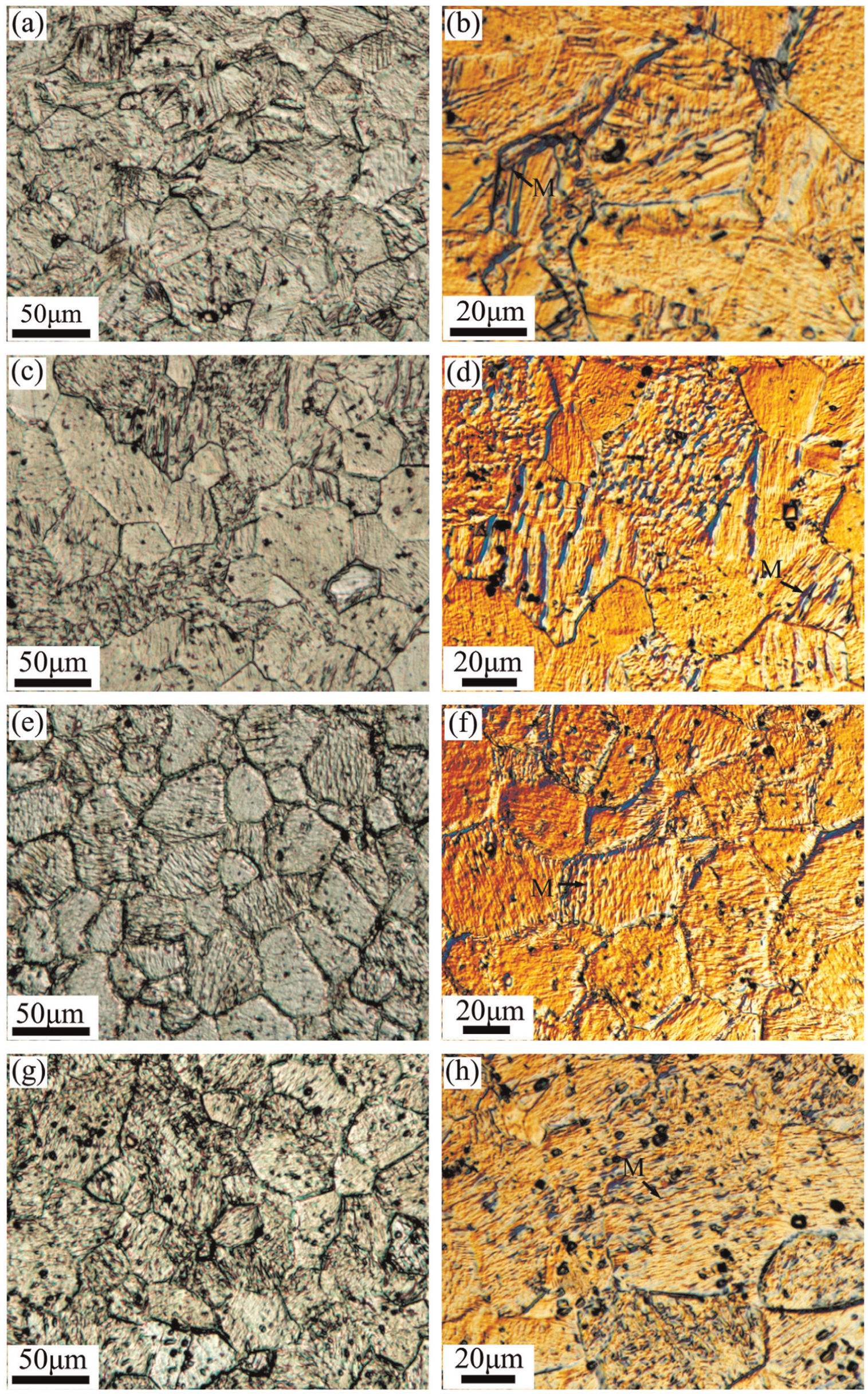
Microstructure of NiTi alloys upon the compression loading of 1200 MPa at (a and b) −40°C, (c and d) −10°C, (e and f) RT, and (g and h) 120°C.
Generally, the high recovery and low residual strain of the gaskets are beneficial for enhancing the sealing performance in bolted flange connections. As discussed above, the compressibility and recovery of NiTi alloys as static seals are different at different temperatures in bolted flange connections, which associate with the deformation of parent phase in different states. Hence, ambient temperature strongly impacts the compressibility and recovery of NiTi alloys as static seals, which would affect the sealing performance. The recovery coefficient of NiTi alloys at T > Af gradually increased with an increase in compression loading. This is related to the SIM transformation. As the applied load less than a certain level is removed, the material returns to austenitic phase. The remarkable improvement in compressibility and recovery results actually from the superelasticity of NiTi alloys. As it is well understood in the design of the bolted flange connections, the pre- tightening force is important to static seals. When pre-tightening force on the seal gaskets is less than a certain level, it is favorable to increase sealing effects. At T < Af, the residual strain of NiTi alloys increased with decrease in temperature. The recovery coefficient of NiTi alloys significantly decreased at the temperature below −10°C. Meanwhile, the residual strain of NiTi alloys is remarkably high and the yield stress becomes lower at the temperature below Mf. Therefore, the effect of ambient temperature on NiTi alloys as static seals should be taken into account in practical engineering.
Conclusion
The main results obtained in this article and the conclusions are summarized as follows:
At T < Af, the sloping stress plateau is observed in the stress–strain diagram when exceeding the stress level and tends to become higher with an increase in temperature. At T > Af, two sloping stress plateaus are observed at RT (>Af) and unmarked transition section at the temperature range between 60°C and 150°C upon the compression loading of 1200 MPa.
The compressibility and recovery coefficients are almost unchanged at T < Af when the compression stress is higher than a certain level. The residual strain of NiTi alloys at T < Af increased with decrease in temperature. The residual strain of NiTi alloys is remarkably high at the temperature below Mf.
The recovery coefficient of NiTi alloys at T > Af gradually increased with an increase in compression loading. The recovery coefficient of NiTi alloys at RT is higher than that at the other temperatures when the compression stress is larger than a certain level. The compressibility and recovery coefficients of NiTi alloys are insignificantly fluctuated at the temperatures between 60°C and 150°C upon the compression loading.
Microstructural analysis confirms that the features of strong deformation and martensite reorientation are observed in the compressed NiTi alloys at various test temperatures.
It is recommended that the effect of ambient temperature on the compressibility and recovery performance of NiTi alloys should be taken into consideration in the design of static seals in the bolted flange connections.
Footnotes
Academic Editor: M Ravichandran
Declaration of conflicting interests
The author(s) declared no potential conflicts of interest with respect to the research, authorship, and/or publication of this article.
Funding
The author(s) disclosed receipt of the following financial support for the research, authorship, and/or publication of this article: This work was financially supported by the Natural Science Funds of Jiangsu Province (No. BK20131411) and Shanghai Materials Genome Initiative Program (14DZ2261205).