In this article, a numerical efficient method for fractional mobile/immobile equation is developed. The presented numerical technique is based on the compact finite difference method. The spatial and temporal derivatives are approximated based on two difference schemes of orders and , respectively. The proposed method is unconditionally stable and the convergence is analyzed within Fourier analysis. Furthermore, the solvability of the compact finite difference approach is proved. The obtained results show the ability of the compact finite difference.
The governing equation of transport was derived based on Fick’s law and is commonly called the advection-dispersion equation (ADE).1 The ADE will predict a breakthrough curve (BTC) that can be described by a Gaussian distribution function from an instantaneously releasing solute source.1 The interested readers can find more details in previous studies.2–7 Also, the mobile/immobile model is considered in previous studies.8–12
Here, the time fractional mobile/immobile equation is studied to the following form12,13
when the boundary conditions are
and the initial condition is
where is the Caputo fractional derivative of order . For getting more information on fractional PDEs the interested readers can refer to.21–25
Some numerical methods have been developed for the solution of equation (1) such as finite difference (FD) method12,13 and meshless method.14 Also, the fractional equation is studied by several methods, for example, high-order FD scheme for modified anomalous fractional sub-diffusion equation15,16 and FD method for a class of fractional sub-diffusion equations.17
The main aim of this article is to see the performances of the compact FD for the fractional mobile/immobile equation. The article is organized as follows. In section “Compact FD scheme,” we develop a high-order FD scheme. Section “Stability analysis” presents the stability analysis for the proposed difference scheme. In section “Convergence analysis,” the convergence analysis is studied. Some numerical results are presented in section “Numerical results.” Finally, a brief conclusion is written in section “Conclusion.”
Compact FD scheme
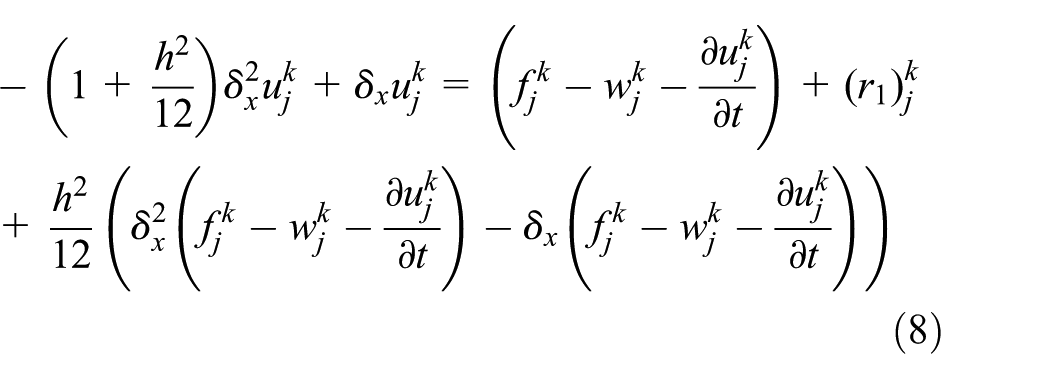
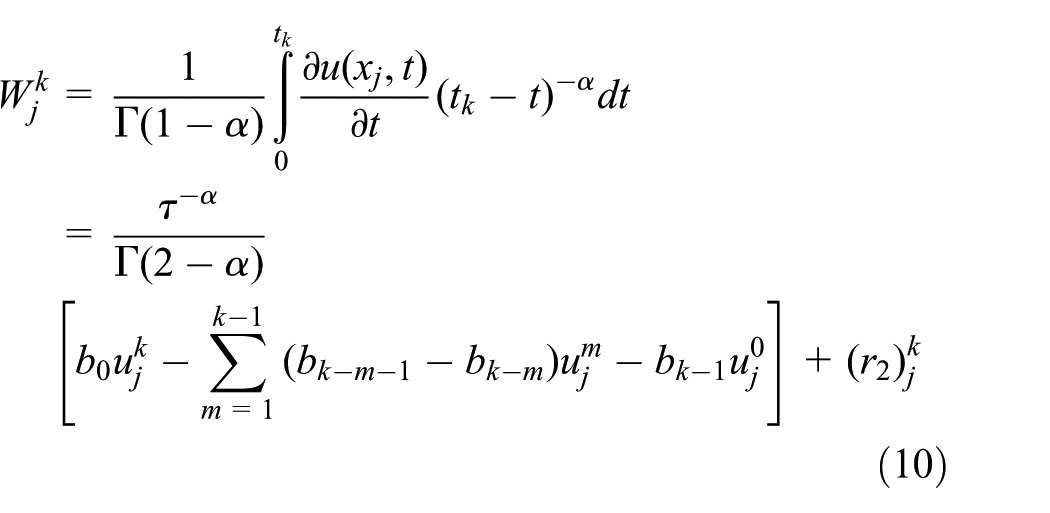
Let and be the step sizes of spatial and temporal variables, respectively. So, we can define spatial and temporal nodes as , for and , for
The exact and approximate solutions at the point are denoted by and , respectively. We introduce the following notations
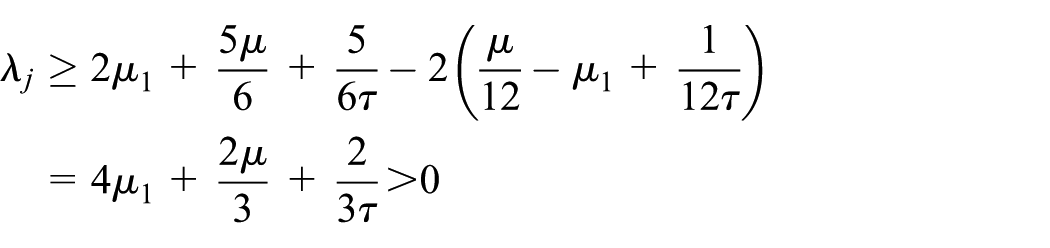
the eigenvalues of A can be written as with non-zero real part . For the case
if we have
and if
Since thus A is non-singular matrix.
Theorem 1
For the appeared scheme in equation (14), there is a unique solution.
Proof
We must solve linear system of equations at each to obtain the numerical solution. Since for any and , the coefficient matrix A is invertible so the solution of scheme in equation (14) exists and is unique.
Stability analysis
Let be the approximated solution of equation (14). Consider
With this definition and regarding equation (14), we can obtain the round-off error equation as
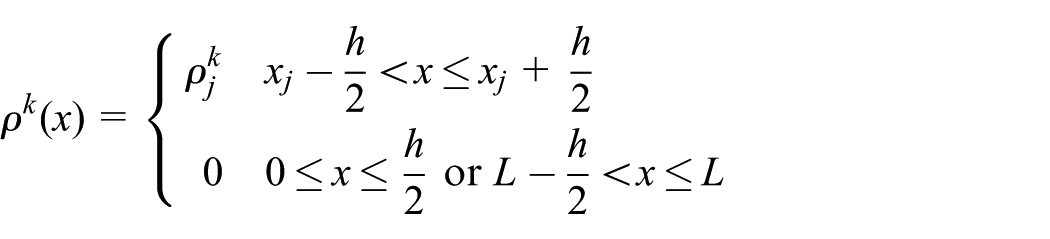
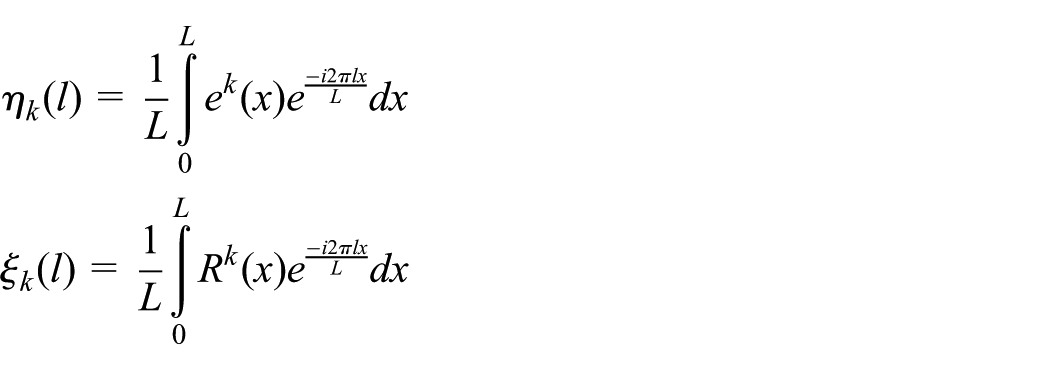
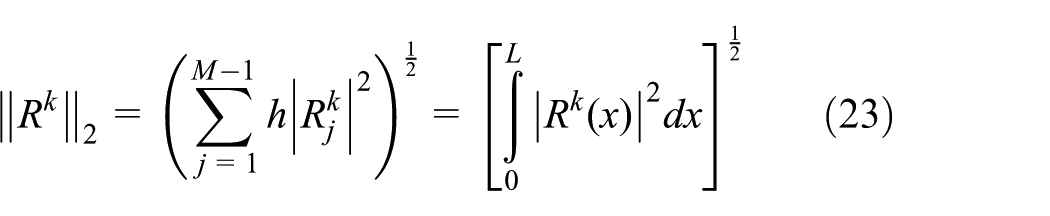
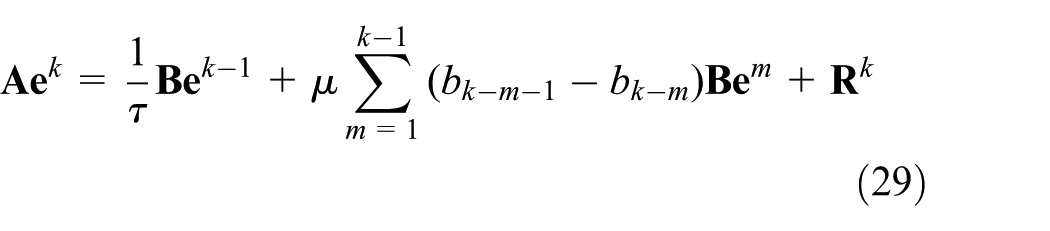
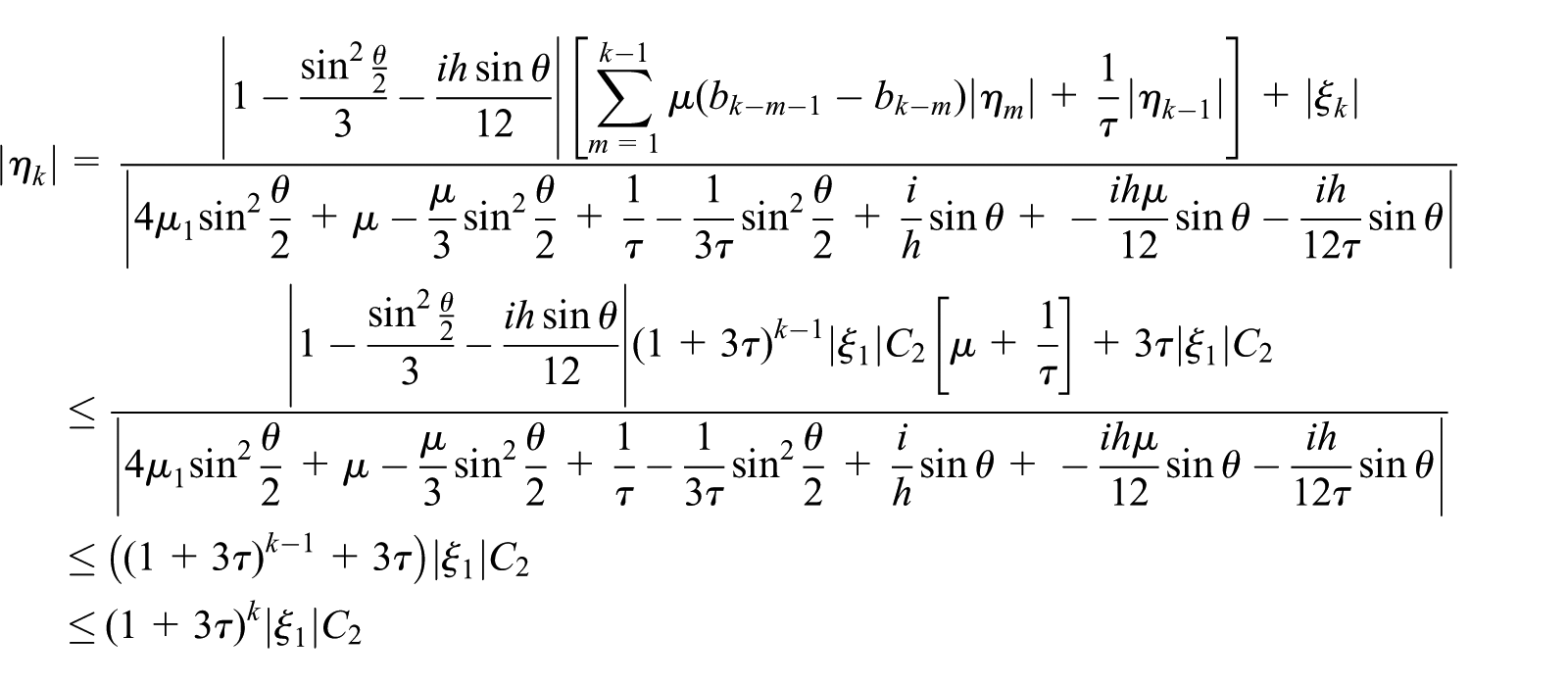
Here, we analyzed the compact difference scheme (14) in terms of convergence. We will show the relation (14) has the spatial accuracy of fourth order. For this end, we need some lemmas and theorems that will be expressed. First, we consider definitions of and in Chen et al.20 Thus, for and are
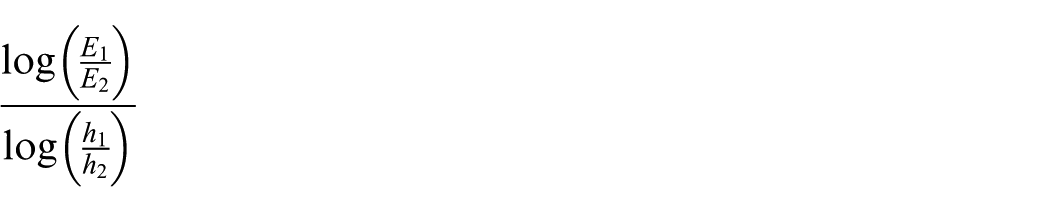
Here, we present some test problem to verify the developed method. To demonstrate the accuracy of this method, we use norm for computing errors. Also, the computational orders of the presented method (denoted by C-Order) is calculated using the following formula
where is the error value that corresponds to grid with mesh size .
Test problem 1
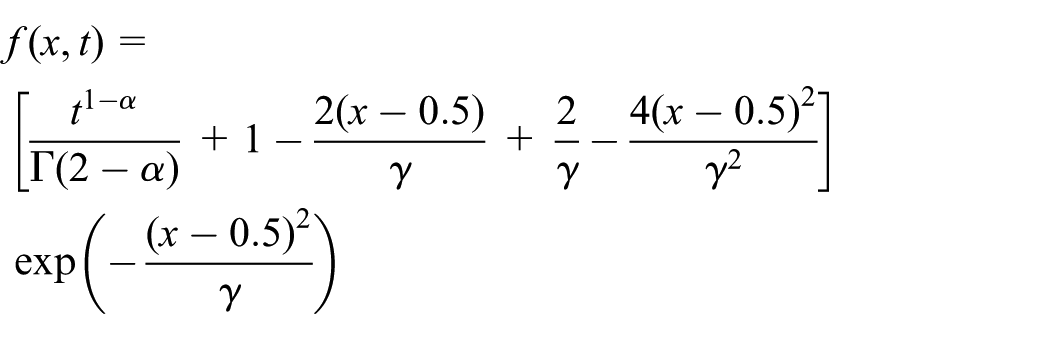
We consider the time fractional mobile/immobile equation with the form described in equation (1), where
where exact solution is a Gaussian pulse with t height centered at , that is
boundary and initial conditions can be obtained from the exact solution.
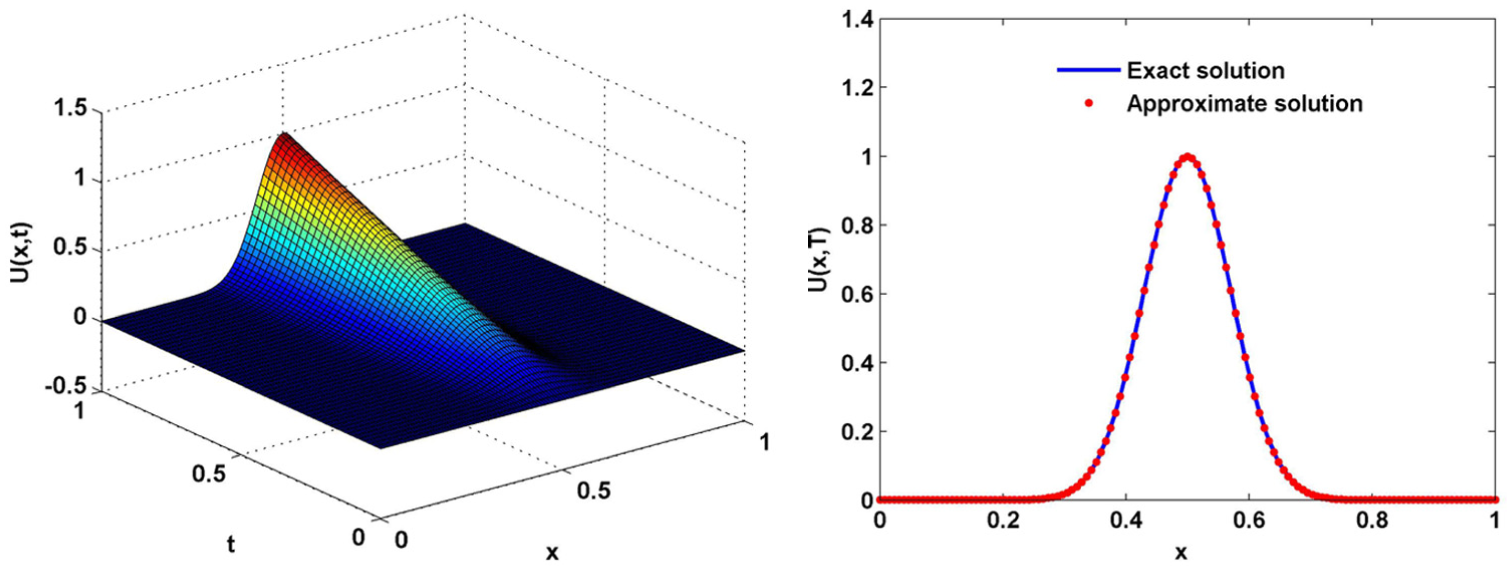
Table 1 demonstrates the error, computational order and total central processing unit (CPU) time (in second). The computational order of Table 1 is closed to the theoretical results. Figure 1 is based on , , and . Also, the used parameter in Figure 2 is , , , and .
Evaluated computational orders and errors with and , for Test problem 1.
h
CPU time (s)
C-order
C-order
−
−
CPU: central processing unit.
Approximated solutions and obtained errors for different values of using presented method from (a) to (h) for Test problem 1.
(Left) Surface plot of approximated solution; (right) exact and approximated solution with , , , and for Test problem 1.
Also, in Table 2, we can see error obtained with and different values of for this problem.
Test problem 1 error values obtained for different parameters.
Test problem 2
Again, we consider the time fractional mobile/immobile equation with the form described in equation (1) with source term
when boundary and initial conditions are of the following form
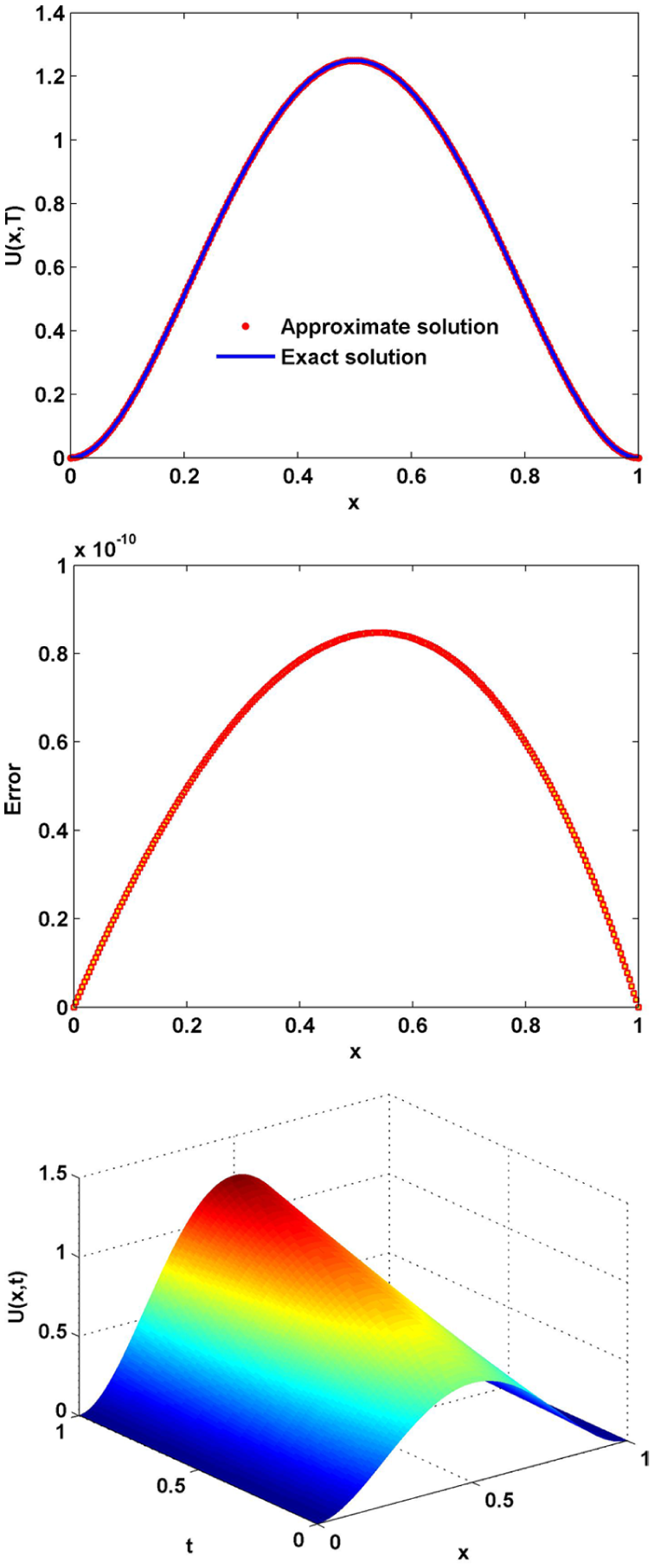
In this case the exact solution is as follows (Figure 3)
Graphs of exact and approximate solution, absolute error, and surface plot of approximated solution with parameters , , and , for Test problem 2.
In Table 3, we compare the errors obtained with the method of this article and method of Zhang et al.12 where . We see that the present method has good results in comparison with the method of Zhang et al.12 Computational order, error and CPU time (in seconds) are shown in Table 4. Also, Table 5 presents the error of numerical results for this problem with different values of parameters and . Figure 3 demonstrates graphs of exact and approximate solution, absolute error, and surface plot of approximated solution with parameters = 0.45, = 0.025, and h = 1/256, for Test problem 2.
Comparison of numerical solutions and errors obtained with for Test problem 1.
Evaluated computational orders and error values with for Test problem 2.
h
CPU time (s)
C-order
C-order
−
−
CPU: central processing unit.
Error values obtained with different values of and for Test problem 4.
Conclusion
In this article, we built a compact difference scheme for the solution of time fractional mobile/immobile equation. We proved the unconditional stability property and convergence by Fourier analysis. It was shown that the numerical simulations obey the theoretical results. Examples are given and when the results obtained using this method with exact solutions are compared, this method shows applicability and efficiency.
Footnotes
Acknowledgements
The authors are very grateful to reviewers for carefully reading this article and for their comments and suggestions which have improved the article.
Academic Editor: Praveen Agarwal
Declaration of conflicting interests
The author(s) declared no potential conflicts of interest with respect to the research, authorship, and/or publication of this article.
Funding
The author(s) received no financial support for the research, authorship, and/or publication of this article.
References
1.
BearJ.Dynamics of fluids in porous media. New York: American Elsevier Publishing Company, 1972.
2.
BaugetFFourarM.Non-Fickian dispersion in a single fracture. J Contam Hydrol2008; 100: 137–148.
3.
BerkowitzB.Characterizing flow and transport in fractured geological media: a review. Adv Water Resour2002; 25: 861884.
4.
ChenZQianJZhanH. Mobile–immobile model of solute transport through porous and fractured media. Manag Groundw Environ2011; 341: 154–158 (proceedings of ModelCARE 2009, Wuhan, China, September 2009, IAHS Publ.).
5.
CoatsKHSmithBD.Dead-end pore volume and dispersion in porous media. SPE J1964; 4: 7384.
6.
ScherHLaxM.Stochastic transport in a disordered solid. Phys Rev1973; B7: 44914502.
7.
TorideNLeijFJvan GenuchtenM Th. The CXTFIT code for estimating transport parameters from laboratory or field tracer experiments (version 2.1). Research report 137, April1999. Riverside, CA: U.S. Salinity Laboratory, Agricultural Research Service, U.S. Department of Agriculture.
8.
BensonDASchumerRMeerschaertMM. Fractional dispersion, Levy motion, and the MADE tracer tests. Transport Porous Med2001; 42: 211–240.
9.
DengZ-QBengtssonLSinghVP.Parameter estimation for fractional dispersion model for rivers, Environ. Fluid Mech2006; 6: 51–475.
10.
KimSKavvasML.Generalized Ficks law and fractional ADE for pollutant transport in a river: detailed derivation. J Hydrol Eng2006; 11: 80–83.
11.
GaoGZhanHFengS. A mobile–immobile model with an asymptotic scale-dependent dispersion function. J Hydrol2012; 424–425: 172–183.
12.
ZhangHLiuFPhanikumarMS. Numerical analysis of the time variable fractional order mobile-immobile advection-dispersion model. In: Proceedings of the 5th symposium on fractional differentiation and its applications, Hohai University, 2012.
13.
LiuFZhuangPBurrageK.Numerical methods and analysis for a class of fractional advection-dispersion models. Comput Math Appl2012; 64: 2990–3007.
14.
LiuQLiuFTurnerI. A RBF meshless approach for modeling a fractal mobile/immobile transport model. Appl Math Comput2014; 226: 336–347.
15.
AbbaszadehMMohebbiA.A fourth-order compact solution of the two-dimensional modified anomalous fractional sub-diffusion equation with a nonlinear source term. J Comput Math Appl2013; 66: 1345–1359.
16.
MohebbiAAbbaszadehMDehghanM.A high-order and unconditionally stable scheme for the modified anomalous fractional sub-diffusion equation with a nonlinear source term. J Comput Phys2013; 240: 36–48.
17.
ZhaoXSunZZ.A box-type scheme for fractional subdiffusion equation with Neumann boundary conditions. J Comput Phys2011; 230: 6061–6074.
18.
SunZZWuXN.A fully discrete difference scheme for a diffusion-wave system. Appl Numer Math2006; 56: 193–209.
19.
ChenSLiuFZhuangP. Finite difference approximations for the fractional Fokker–Planck equation. Appl Math Model2009; 33: 256–273.
20.
ChenC-MLiuFTurnerI. Numerical methods with fourth-order spatial accuracy for variable-order nonlinear Stokes first problem for a heated generalized second grade fluid. Comput Math Appl2011; 62: 971–986.
21.
BagleyRTorvikP.A theoretical basis for the application of fractional calculus to viscoelasticity. J Rheol1983; 27: 201–210.
22.
DiethelmKFordNJ.Analysis of fractional differential equations. J Math Anal Appl2002; 265: 229–248.
23.
MetzlerRKlafterJ.The restaurant at the end of the random walk: recent developments in the description of anomalous transport by fractional dynamics. J Phys A2004; 37: R161–R208.
24.
OldhamKBSpanierJ.The fractional calculus. New York; London: Academic Press, 1974.
25.
PodulbnyI.Fractional differential equations. New York: Academic Press, 1999.
26.
MohebbiAAbbaszadehM. Compact finite difference scheme for the solution of time fractional advection-dispersion equation. Numer Algorithms2013; 63(3): 431–452.