




Abstract
Traditional fragmentation warheads are usually initiated on the axis, producing a uniform fragment distribution around the warhead, but only little portion of them can be imposed on the targets. The aimable warhead, on the other hand, using the off-axis initiations or the structure deforming, can improve the warhead energy utilization highly. Seeking methods to both enhance the fragment velocity and density has significant value for improving the target damage probability. In this article, a warhead shaped as hexagonal prism was studied using arena experiment and numerical modeling and compared with the traditional cylindrical structure. The fragment velocities and target hit patterns of the two types of warheads under axial initiation and asymmetrical initiation are obtained. It is revealed that for the hexagonal prism warhead, the asymmetrical initiation can enhance the fragment velocities by 27.71% and enhance fragment density by 34.09% compared to the axial initiation. The fragment velocity enhancement is close to that of the cylindrical warhead, but the fragment density enhancement is far above the cylindrical warhead. This indicates that the asymmetrically initiated hexagonal prism warhead is a very effective aimable warhead.
Keywords
Introduction
Ordinary fragmentation warheads are usually cylindrically shaped explosive charge and initiated on the axis. When they are detonated, circumferential uniformly distributed fragment patterns are generated. 1 Because only small portion of the fragments can be driven to the target, the warhead energy utilization rate is low. As a method to improve the warhead energy utilization rate, the aimable warhead makes use of the off-axis initiation or warhead structure design to enhance the fragment velocity in the aiming direction or drive more fragments to the target. Among the existing aimable warhead concepts, asymmetrically initiated warhead and the detonatively deformable aimable warhead are the two easier accessible types. This is because they need much less aiming time, and their aiming precises satisfy the application requirements. 2 Asymmetrically initiated aimable warhead is accomplished by the detonations of the one or two initiation lines opposite the target. The initiation lines are usually composed of multiple initiators, distributing axially between the warhead charge and the shell. This off-axis initiation could enhance fragment velocity by about 30% in the target direction, but has little effect on the fragment density. 3 Detonatively deformable aimable warhead is composed of main charge, fragment casing, deforming charge and barrier. In the endgame encounter, the deforming charge in the target direction is firstly detonated, making the fragment casing and the main charge deform into a D-shaped geometric configuration, and then the main charge is detonated opposite the target direction, pushing 30%–50% of the fragment casing to the target. 4 The fragments coming out from the flat portion of the D-shaped configuration flies almost parallel, producing small dispersion angle; thus, the fragment density is greatly enhanced. 1 Compared to the asymmetrically initiated aimable warhead, although deformable warhead can obviously enhance the fragment density, the deforming process needs time and its technical achievement is more difficult. The asymmetrically initiated aimable warhead is much easier to achieve, but only the fragment velocity has the enhancement.
Therefore, how to go a step further to enhance the fragment density based on the asymmetrically initiated warhead that could only enhance the fragment velocity in the aiming direction is an important research issue. The US-UK “Programmable Integrated ordnance Suite” project, 5 BAE company’s ABRAHAM C-RAM rocket, 6 and Waggener 7 revealed a warhead structure of hexagonal prism. It could be predicted that the six faces of the hexagonal prism warhead are just like the deformed flat face of the deformable warhead, and on detonating it could produce six dense fragments beams. Applying asymmetrical initiation to this warhead structure could further increase the fragment velocity in the aiming direction, enhancing the damage probability. That is to say, the asymmetrically initiated hexagonal prism warhead could not only increase the fragment velocity but also enhance the fragment hit density, and moreover, the aiming time is shorter and the technical difficulty is lower than the deformable warhead. The detailed performance of this hexagonal prism warhead is studied in this article by arena test and numerical simulation, and the fragment velocities and target hit density are obtained and compared with the ordinary cylindrical warhead.
Experiments
Warheads design
Hexagonal prism warhead and cylindrical warhead are designed, as shown in Figure 1. They are both composed of main charge, aluminum liner, tungsten alloy premade fragments, steel endplates, and steel casing.

Structures of hexagonal prism warhead and cylindrical warhead.
The initiation of these warheads is accomplished by the multi-point initiation system, which is made up of a six-output explosive logic circuit, six “one-input four-output” linear synchronous initiation circuits, and the initiation control system, as shown in Figure 2.

Prototype of the initiation system.
The multi-point synchronous initiation circuit is shown in Figure 3. It is made up of mild detonating fuze, adapter, and output pellets. In order to guarantee the reliability of its initiation capability, the output pellets are sized ϕ10 mm × 9 mm and pressed with booster explosive JO-11C with density of 1.7 g/cm3.

“One-input four-output” synchronous initiation circuits.
The used explosive logic circuit has six outputs, which can be connected with the inputs of the synchronous initiation circuits. The design drawing and the prototype filled with booster explosive tracks are shown in Figures 4 and 5, respectively.

Design drawing of the six-output plosive logic circuit.

Prototype of the explosive logic circuit.
Two initiation ways can be achieved, the top center initiation and the asymmetrical multi-point initiation. When asymmetrical initiation is chosen, the adjacent two hydro initiation lines are detonated, that is, asymmetrical eight points are detonated. Figure 6 shows the assembled prototypes of the two types of warheads.

Prototypes of the assembled warheads.
The charge densities, charge ratios, fragment numbers, and masses of the four warheads are listed in Table 1.
Parameters of the warheads.

Arena test layout
The warheads are placed vertically on the supporting frames of 1000 mm high, and 10 steel plates are arranged 10 m away. The laser screens are used to measure the fragment velocities. Two laser screen sets are located back and forth along the aiming direction (for asymmetrical initiation). The aiming direction is toward the steel plate numbered 5. In order to maximally protect the laser test equipment, the target steel plate 5 is placed a little further, so that the laser screen can be safely arranged. The layout is shown in Figure 7 and the arena arrangement is shown in Figure 8.

Layout design.

Arena layout.
The trigger signal of initiation is sent by cable from the upper computer located 100 m far away. It controls whether the warhead is top center initiated or asymmetrical eight-point synchronously initiated. The laser screen velocity measure sets are triggered by the on–off signal from the wire wrapped around the warhead body.
Experiment results
Fragments density
The four warheads were tested, and the typical fragment hit pattern on the steel target is shown in Figure 9.

Fragment hit pattern of target plate 5.
A virtual mesh is placed on the target plate to obtain the exact fragment hit positions. After every test, the fragment hit positions on every steel target are marked using different symbols, and then the steel plates are photographed. Through counting the perforation fragment number and the hit fragment number, the fragment hit and perforation amounts of every steel plate of every test are listed in Table 2.
Results of target hit and perforation on each plate.
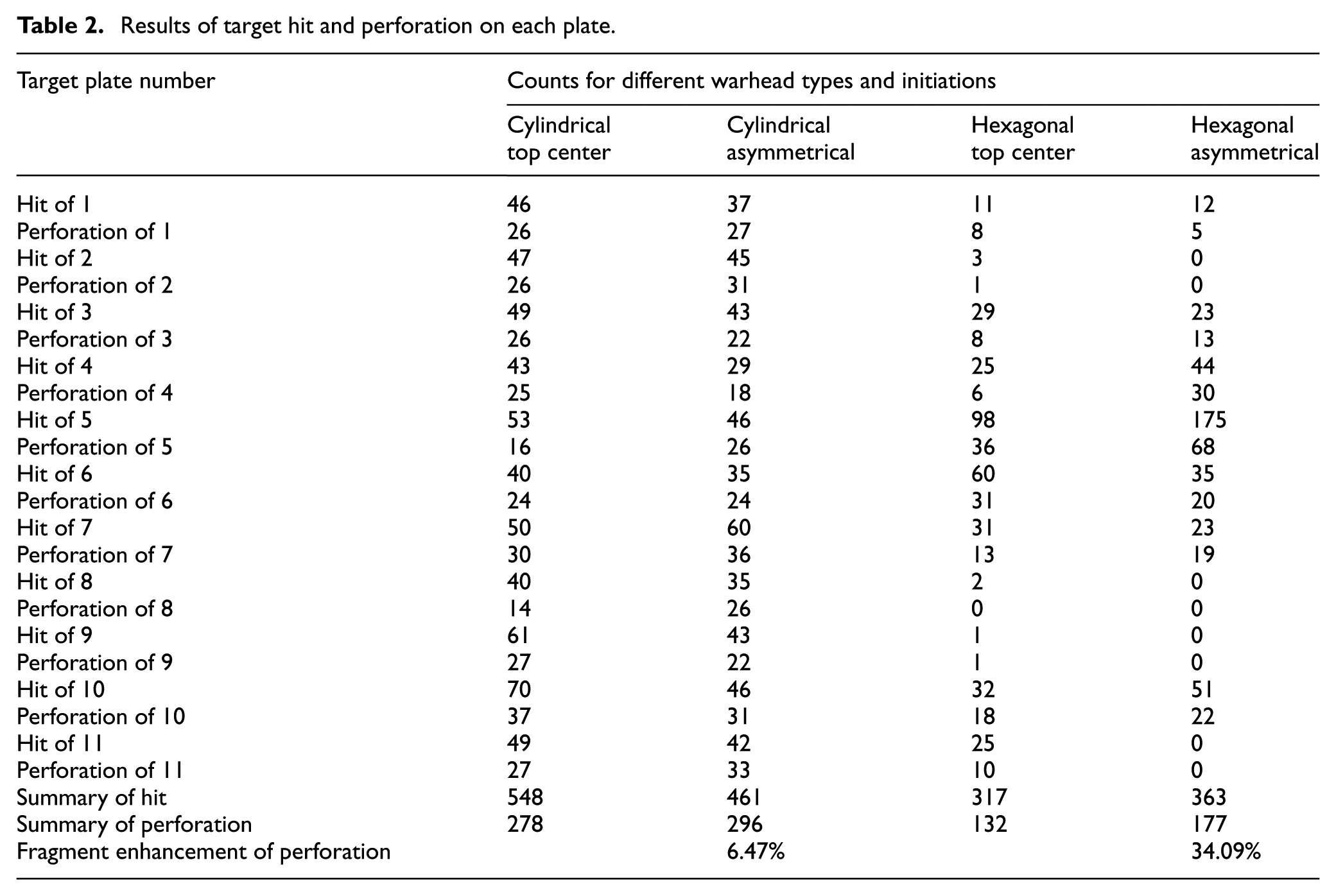
It can be seen from Table 2 that compared to top center initiation, asymmetrical two-line eight-point initiation could increase the fragment perforation density of cylindrical warhead by about 6.47%, but increase that of hexagonal prism warhead by 34.09%. The effective fragment density enhancement of hexagonal prism warhead is much higher than cylindrical warhead. During the processing of the experiment results, every steel plate photograph is attached a virtual mesh to help locate the exact fragment hit positions. The fragment hit positions of every target plate are obtained and put together to redraw the hit patterns, as shown in Figure 10.

Fragment hit pattern: (a) top center–initiated cylindrical warhead, (b) asymmetrically initiated cylindrical warhead, (c) top center–initiated hexagonal prism warhead, and (d) asymmetrically initiated hexagonal prism warhead.
From Figure 10, as expected, the cylindrical warhead under central initiation produces radial uniformly distributed fragment shower, so the fragment hit pattern on the target plate is radially uniform. The fragment hit pattern on the target of asymmetrically initiated cylindrical warhead is denser than the top center initiation. This is reasonable because asymmetrical initiation increases the fragment velocities opposite the initiators, and thus the number of fragments hitting the target plates increases. Unlike the cylindrical warhead, the fragment hit patterns of the hexagonal prism warhead are collective and not so uniform. There are blank spaces not hit by the fragments, which are laying on both sides of the fragment hit regions. This means that the fragment beams from the hexagonal prism warhead are narrow, and there are gaps between the six fragment beams. The fragment hit pattern from the asymmetrically initiated hexagonal prism warhead is much denser than that of top center initiated hexagonal prism warhead.
Also can be seen from Figure 10 is that under top center initiation style, the vertical centers of fragment patterns on the target are lower than those of the asymmetrical initiations. The top center initiation changes the fragment dispersion angles, making fragments have downward velocity. The asymmetrical initiation does not change the vertical dispersion angles of fragments. The vertical centers of the fragment hit patterns under asymmetrical initiations are laying on where they are expected to be, although there exist gravity forces of fragments.
Fragment velocities
The laser screen velocity measure sets were placed back and forth at 7.5 and 11 m, respectively, to obtain the fragments’ initial velocities. However, it turns out to be that the records of the two laser screen sets do not correspond, and the fragments cannot be tracked individually. Fortunately, the measure recording was triggered by the wire on–off signals caused by the warhead casing’s expansion; thus, the flying time of the fragment from the warhead to the laser screens can be obtained. And, this time information can be used to calculate every recorded fragments’ initial velocities and fragment velocity attenuation coefficients. The recorded fragments’ velocities by the different laser sets and their flying times are listed in Tables 3 and 4.
Test results of fragment velocities of cylindrical warheads.

Test results of fragment velocities of hexagonal prism warheads.

If the gravity force of the fragment is ignored, the air resistant force of fragment 8 is

Therefore, the moving equation of fragment can be deduced as

Integrating equation (2), the following two equations can be obtained


where vx is the fragment velocity at distance x, v0 is the fragment’s initial velocity, a = CDρaS/(2mf) is the fragment velocity attenuation coefficient, CD is the drag coefficient, ρa is the air density, S is the cross-sectional area of the fragment at right angles to the flight direction, and mf is the fragment mass.
As the fragment flying distance x, the fragment flying time t, and the fragment velocity vx at distance x are known, equations (3) and (4) are combined to solve the fragment velocity attenuation coefficient a and initial velocity v0. Data of Table 3 are processed, and the initial velocities and attenuation coefficients are obtained, as shown in Table 5.
Fragment initial velocities and attenuation coefficients of cylindrical warheads.
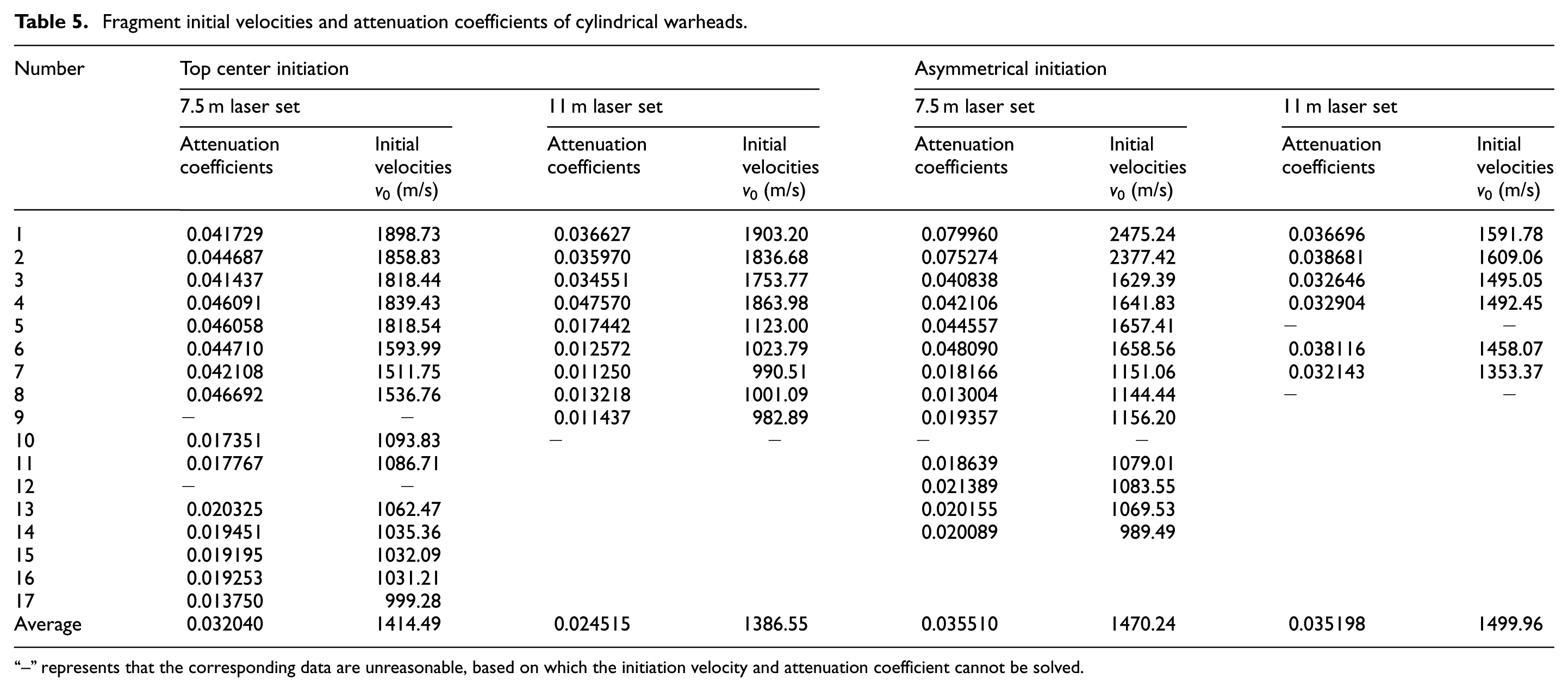
“–” represents that the corresponding data are unreasonable, based on which the initiation velocity and attenuation coefficient cannot be solved.
As the two laser screen sets (7.5 and 11 m) are placed in the same direction, their measure results are that of the same direction. It can be seen from Table 5 that under top center initiation of the cylindrical warhead, the maximum initial velocity is 1903.20 m/s and the average value is 1404.01 m/s; under asymmetrical initiation, the maximum initial fragment velocity is 2475.24 m/s and its average value is 1479.63 m/s. Therefore, compared to the top center initiation, the asymmetrical initiation could enhance the cylindrical warhead’s maximum fragment velocity by 30.06% and enhance the average velocity by 5.39%.
Also from Table 5, the average fragment velocity attenuation coefficient is 0.029218 for the top center–initiated cylindrical warhead, while for the asymmetrical initiation, the average attenuation coefficient is 0.035411, which is bigger than that of top center initiation. In the same arena test condition, a bigger attenuation coefficient represents a bigger drag coefficient. The bigger drag coefficient reveals that the deforming of the fragment during its acceleration process is bigger. This is consistent with the expectation that under asymmetrical multi-point initiation, the detonation waves collapse and produce higher pressure.9,10 This higher pressure makes the fragments deform largely, so its aerodynamic condition is bad and the attenuation coefficient is larger.
Similarly, the measured results of hexagonal prism warheads are processed, and its fragments’ initial velocities and attenuation coefficients are listed in Table 6.
Fragment initial velocities and attenuation coefficients of hexagonal prism warheads.

For the hexagonal prism warhead, the top center initiation made the maximum fragment velocity to be 2038.65 m/s and the average fragment velocity in the aiming direction to be 1474.45 m/s; the asymmetrical initiation made the maximum fragment velocity to be 2192.02 m/s and the average fragment velocity to be 1546.79 m/s. The maximum fragment velocity enhancement of asymmetrical initiation compared to center initiation is 7.52%, and the average fragment velocity enhancement is 4.91%. One thing to notice is that for the asymmetrical initiation, the average attenuation coefficient value of the 7.5 m laser screen set’s results 0.055579 is much higher than that of 11 m laser screen set. This is not reasonable, and they actually should almost be equal. This inconsistency of attenuation coefficients indicates that the measured results of the asymmetrically initiated hexagonal prism warhead may be not accurate. As we already observed from Figure 10(d), the fragment density in the aiming direction of the asymmetrically initiated hexagonal prism warhead was very high, which may cause confusion of the laser screen measuring set to distinguish or recognize individual fragment. The recorded arriving time may not be that of certain one fragment but a cluster of them. Thus, its measured results may not be accurate.
According to the warhead parameters, the filling explosive mass and ratio of charge mass to fragments are both smaller for the hexagonal prism warheads, but the fragment velocities of hexagonal prism warhead under top center initiation are higher than those of cylindrical warhead. This indicates that the hexagonal prism warhead is more efficient. The fragment velocity of asymmetrically initiated hexagonal prism warhead is also expected to be higher than that of cylindrical warhead, but unfortunately, the test results of its fragments velocities are not ideal.
Numerical simulation
In order to fully investigate the detonation process and the fragment dispersion of the warheads, numerical simulations were conducted using LS-DYNA software. According to the dimension parameters of the tested warheads, their element models were established as shown in Figure 11. The other half amount of the fragments, the outer casing, and the endplates are not shown for illustrating the structure of the established element model. The explosive logic circuit was modeled as a plate, and the multi-point initiations were accomplished by setting the keyword *INITIAL DETONATION.11,12

Element models of warheads: (a) top center–initiated cylindrical warhead, (b) asymmetrically initiated cylindrical warhead, (c) top center–initiated hexagonal prism warhead, and (d) asymmetrically initiated hexagonal prism warhead.
Giving the multi-point initiation and the complex interaction of the detonation product and the lots of fragments, fluid–solid interaction algorithm was adopted. The explosive and the air domain were established as Euler mesh, and the remaining parts such as fragments and liner were modeled as Lagrange mesh. In order to guarantee the right interaction of Lagrange and Euler mesh and seek a balance between the computer time and simulating accuracy, different element sizes are tested, and eventually, Euler and Lagrange size is selected to be 0.25 mm. The main charge Comp. B was modeled using the material model of *MAT HIGH EXPLOSIVE BURN and the Jones–Wilkins–Lee (JWL) equation of state. The parameters 13 are listed in Table 7.
Material parameters of Comp. B.

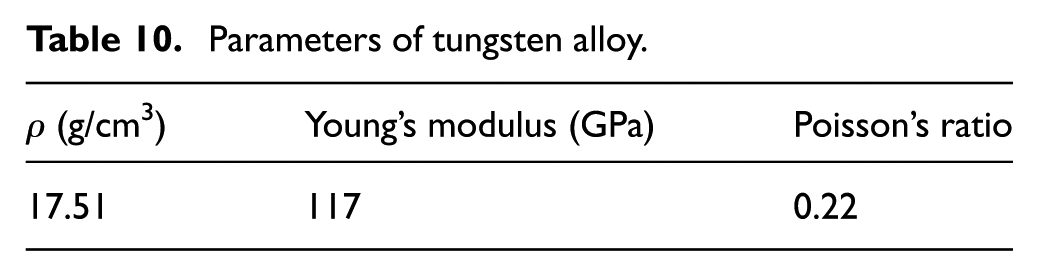
The liner and endplates are LY-12 aluminum made and can be presented as material model of *MAT PLAS-TIC KINEMATIC. The air was modeled using *MAT NULL and linear polynomial equation of state. Although there is the protection of the liner, 4 fragments may still deform a little 14 due to high detonation pressure or impact between fragments. Accounting for the huge computing time, if the fragments were modeled by deformable material model, the fragments are modeled using the rigid material model. The detailed material parameters 15 of the above materials are presented in Tables 8–10.
Parameters of LY-12 aluminum.

Parameters of air.

Parameters of tungsten alloy.
Under top center initiation, the detonation wave propagates from top to bottom of the warheads, and so do the detonation product’s expansion. While asymmetrically initiated, the detonation waves of the warheads propagate from the initiation side to the aiming direction and they collide, making regular and Mach reflections.16–18 The detonating statuses of the warheads at 20 µs are shown in Figure 12.
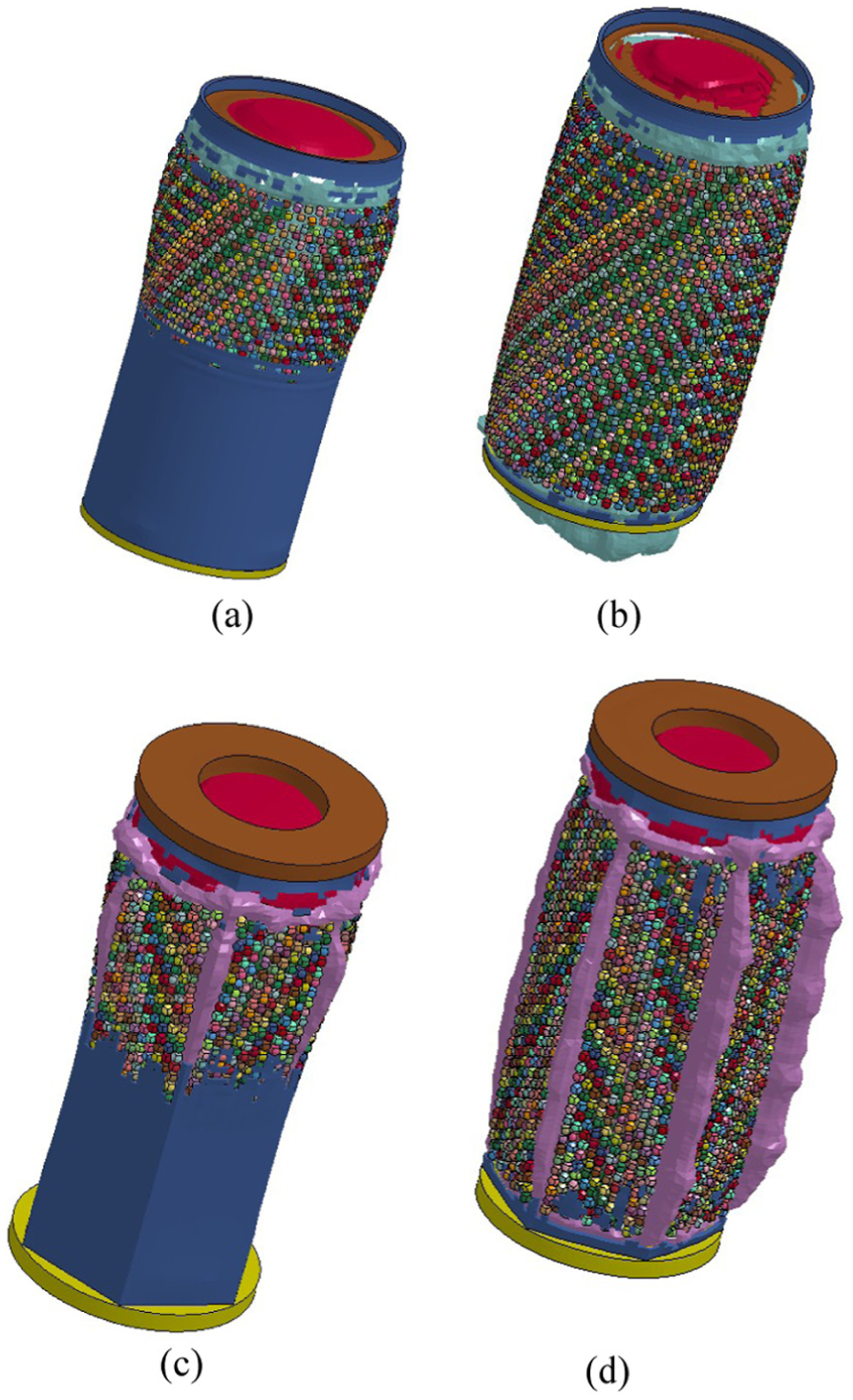
Detonating statuses at 20 µs: (a) top center–initiated cylindrical warhead, (c) top center–initiated hexagonal prism warhead, (b) asymmetrically initiated cylindrical warhead, and (d) asymmetrically initiated hexagonal prism warhead.
The fragment dispersions of the warheads at 200 µs are shown in Figure 13.

Fragment dispersions of warheads at 200 µs: (a) top center–initiated cylindrical warhead, (b) asymmetrically initiated cylindrical warhead, (c) top center–initiated hexagonal prism warhead, and (d) asymmetrically initiated hexagonal prism warhead.
As observed from Figure 13, hexagonal prism warhead exactly produced six dense fragment beams. And due to higher velocities in the aiming direction by asymmetrical initiations, the fragments in the aiming direction are flying further than other fragments. The fragment dispersions of cylindrical and hexagonal prism warheads under top center initiations are both radially symmetrical about the warhead locations. The six dense fragment beams may require higher precision of the fuze sensor 19 in order to encounter the targets.
Extracting the numerical simulation’s results, the maximum fragment velocity of cylindrical warhead under top center initiation is 1982.31 m/s, and the maximum fragment velocity of cylindrical warhead under asymmetrical initiation is 2431.88 m/s. These results are coincident well with the experiment results with an error of 4.16% and −1.75%, respectively. For the hexagonal prism warhead, the maximum fragment velocity under center initiation is 1913.87 m/s, and the maximum fragment velocity under asymmetrical initiation is 2444.27 m/s. Compared with the corresponding test results, the errors are −1.22% and 11.51%, respectively. Except for the asymmetrically initiated hexagonal prism warhead, the errors of numerical simulation results and experiment results are all less than 5%. The modeling result of the velocity enhancement of asymmetrical initiation compared to center initiation is 27.71%, which can be a reference for the actual velocity enhancement of asymmetrically initiated hexagonal prism warhead. For the simulation results of fragment distribution, the fragment hit pattern on the target is used as a reference. As the arena layout, simulation results, fragment velocity attenuation coefficients and target size are already known, the external ballistics of every fragment can be calculated. And taking account for the gravity’s effect, the theoretical fragment hit pattern on the target can be obtained, which is shown in Figure 14.

Theoretical fragment hit pattern on the target: (a) top center–initiated cylindrical warhead, (b) asymmetrically initiated cylindrical warhead, (c) top center–initiated hexagonal prism warhead, and (d) asymmetrically initiated hexagonal prism warhead.
Comparing Figures 10 and 14, the fragment hit pattern results of numerical simulation and experiment are consistent with each other. The fragment hit regions lay a little lower on the target for the up center initiation and lay exactly around the center of target for the asymmetrical initiation. Compared to the test result, the hit pattern of asymmetrically initiated hexagonal prism warhead disperses a little bigger.
Conclusion
Due to the structure, the hexagonal prism warhead produces six dense fragment beams. Under asymmetrical multi-point initiation, its fragment velocities in the aiming direction are enhanced and also the fragment density is further promoted. The fragment density enhancement of hexagonal prism warhead under asymmetrical initiation compared to center initiation is much higher than that of cylindrical warhead, that is, 34.09%–6.47%. Just because of the dense fragments, the fragment velocities of asymmetrically initiated hexagonal prism warhead were not accurately measured by the laser screen sets.
The test warheads were also numerically simulated, which gives a clear vision of the detonation wave propagation and the fragment dispersion. Regarding the fragment velocities and the hit patterns on the targets, the numerical simulations correspond well with the arena experiments. And the simulation gives a velocity enhancing result of 27.71% for the hexagonal prism warhead under asymmetrical initiation compared to top center initiation. This value can be a reference for the actual velocity enhancement of asymmetrically initiated hexagonal prism warhead.
Footnotes
Academic Editor: Anand Thite
Declaration of conflicting interests
The author(s) declared no potential conflicts of interest with respect to the research, authorship, and/or publication of this article
Funding
The author(s) received no financial support for the research, authorship, and/or publication of this article.