




Abstract
The energy efficiency of a deep hollow blade disk turbine in unbaffled mixing vessel is determined in this article via numerical simulations. The vessel is filled with xanthan gum solutions, which have a shear thinning behavior with yield stress (viscoplastic). The Herschel-Bulkley law is used to model the fluid behavior. Three-dimensional calculations are achieved by the computer tool CFX (version 16.0), and the computational domain is meshed using the software ICEM CFD (version 16.0). Mixing is achieved at low impeller rotational speeds which correspond to the laminar and transitional flow regimes. Our main purpose is to explore the effect of blade size (width and height), Reynolds number, and fluid properties on the mixing efficiency of deep hollow bladed impellers. A validation test of our predicted results with experimental data of a previous study was done, and it has shown a good agreement.
Introduction
Agitators are widely used in many industries such as chemical, pharmaceutical, food, petroleum industries, to accomplish numerous processes such as the mixing of miscible/immiscible liquids, dispersion of gas in liquid, suspension of solids in liquid. A vessel equipped with a rotating agitator mounted on a vertical shaft is the basic mixing system which is widely employed in several industries. Depending on the desired mixing product, the vessel may contain vertical baffles, and it may be spherical, square, or cylindrical with a flat or a dished bottom.
From all components of the mixing system, the impeller is perhaps the most critical element since it is considered as the source of mixing energy. The flow structures, pumping flow rates, and power consumption depend strongly on the blade design and its location inside the vessel. However, a perfect impeller that performs all functions of stirring and that provides all desired mixing characteristics does not exist. Therefore, researchers still continue to redesign the stirrer blade in order to obtain efficient systems in terms of energy, mixing time, and product quality.1–4
Recently, many researchers focus on the performance of impellers with curved blades, and some works have been achieved using this type of impellers to study the flow pattern generated with rheological complex fluids.5–13 Other researchers interested to Newtonian fluids with curved blade impellers in single or dual arrangements.14–16
Concerning the curved blades, all of these studies used a Scaba 6SRGT, a Scaba 3SHPI, HE-3, Lightnin A320, or a Maxflo turbine. However, the semi-elliptical blade remains less investigated, and there is, in our knowledge, just one article published by Xinhong et al. 17 who used the traditional particle image velocimetry (PIV) and time-resolved particle image velocimetry (TRPIV) to determine the Newtonian turbulent flows in the stirred vessel.
A thorough survey in the literature has revealed that no study has been performed on mixing of viscoplastic fluids by deep hollow blade impellers (DHBIs). Therefore, we investigate here the performance of a DHBI having six semi-elliptical blades mounted on a disk. The main objective is to explore the influence of Reynolds number, fluid properties, and blade size on the flow fields, power number, flow number, and the pumping efficiency.
Geometry of the agitation system
A cylindrical unbaffled and flat bottomed vessel having a height (H) and a diameter (D = H = 400 mm) is used (Figure 1). The stirrer having six semi-elliptical blades fixed on a disk with 8 mm of thickness is mounted at the central position in the tank on a vertical shaft with a diameter ds/D = 0.05. The clearance of the impeller from the tank bottom is c = D/2. The blade height (h) is h/D = 0.1, and the blade depth (bd) is bd/D = 0.13.

Stirred vessel.
Theoretical background
Xanthan gum solutions having a viscoplastic behavior are considered, and the Herschel–Bulkley model is used to describe their rheology 18

where
The Reynolds number (Rey) and the power number (Np) are given as


where N is the impeller rotational speed, Ks is the Metzner–Otto’s constant, ρ is the fluid density, and P is the power.
The pumping flow number (Nq), pumping effectiveness (ηe), and pumping efficiency (λp), respectively, are defined as


where Qp is the pumping flow rate.
Based on the measurements performed by Saeed and Ein-Mozaffari, 19 properties of the two solutions used in this article are summarized in Table 1.
Rheological properties of xanthan gum solutions.

Numerical issues
To perform simulations, the CFD package CFX 16.0 (ANSYS CFX, Inc.) was used. A preprocessor (ANSYS ICEM CFD 16.0) was used to create the geometry of the mixing system and generate meshes. In our work, a tetrahedral form for meshes is used (Figure 2). The mesh density near the vessel and impeller walls was increased in order to obtain detailed information on fluid flows. Effects of the number of mesh elements on the computational results were also explored. Three meshes were tested, namely, M1, M2, and M3 with the following corresponding grid elements: 180252, 370623, and 760215, respectively. As observed, the number of elements has been increased by about two times. In a comparison between M2 and M3, the difference in predicted results for power number and flow number did not exceed 2.5%. Therefore, in terms of high accuracy and reduced computational time, M2 is selected for the next calculations. Further details are available in our previous article. 20
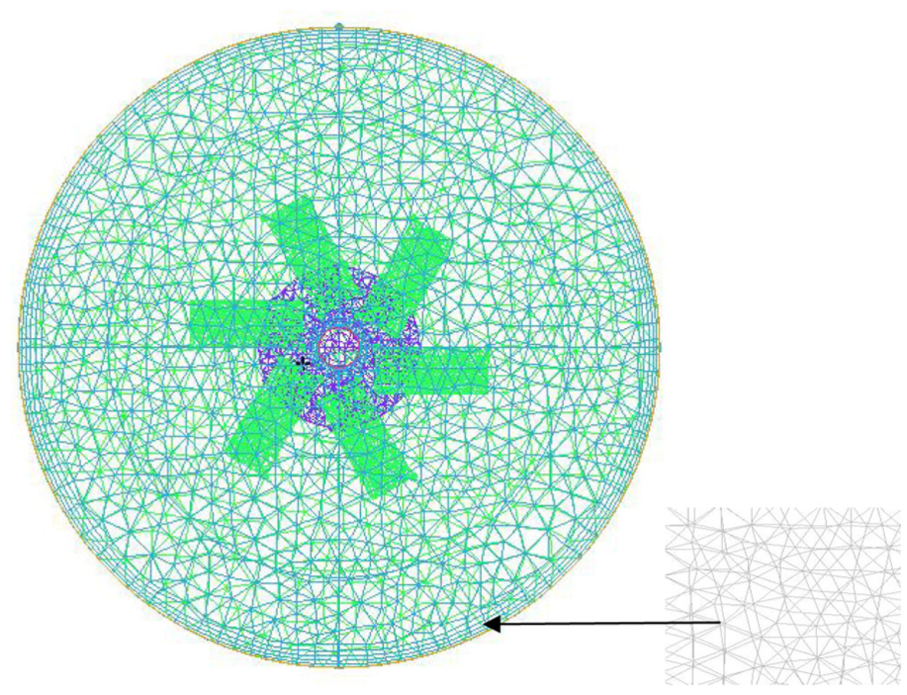
Meshes generated (tetrahedral mesh).
Two cases were studied for fluid flows. Case 1: the Newtonian fluid is flowing in the turbulent regime, and the shear stress transport (SST) model is used. Case 2: the viscoplastic fluid is flowing in a range of Reynolds number varied from 0.1 to 100. Several authors21,22 reported that the macro-instabilities occurring in the transitional flow regime close to the laminar regime can be neglected. So, the lower part of the transitional regime can be modeled as laminar.
For all simulations, the residual target chosen to obtain convergence is 10−6. Calculations were performed in a computer having Core i7 with 12.0 GB of RAM and 2.20 GHz of central processing unit (CPU). Most simulations required 3–4 h and 2000–3000 iterations for convergence.
Results and discussion
To check the accuracy of the computational fluid dynamics (CFD) tool and numerical model, our computed results were compared with an experimental data of Xinhong et al.
17
The radial velocity (

Radial velocity versus tank radius for
Effect of Reynolds number
Figure 4 shows the flow structures for laminar (Rey = 10) and transitional flow regimes (Rey = 60 and 150). This figure is plotted along the vertical plane (r–Z) passing through the middle of the impeller. As clearly shown, the deep hollow blade yields a radial jet of fluid toward the vessel wall. When approaching the wall, the flow is deflected to create two streams: the first is oriented to the free surface of liquid and the second toward the vessel base.

Velocity fields (
For the laminar flow, two small recirculation loops are formed near the blades with stagnant zones elsewhere. With the increase in Reynolds number, the transitional flow patterns reveal an increase in the size of recirculation loop and a reduction in the stagnant region area. The axial circulation will be more enhanced with much higher impeller rotational speed (Figure 4).
Effect of fluid rheology
The rotational motion of the impeller generates a pumping phenomenon: the fluid is entrained toward the blades and then it is pumped away from there, creating thus an axial, a radial, or an intermediate flow. In order to determine the pumping capacity at different blade sizes and rotational speeds, the flow number was calculated.
For the two solutions of xanthan gum, Figure 5 presents the change in power number (Np) versus Reynolds number (Re). The trend in Np is found to be similar to that obtained by Galindo and Nienow 6 for the Scaba 6SRGT stirrer. In a logarithmic scale, values of Np change linearly with a slope of −1 when Re is <10. For higher values of Re, that is, in the transitional regime, Np varies slightly with Rey.

Index structural influence on the power number for h/D = 0.14 and d/D = 0.4.
Figure 6 shows the variation of flow number (Nq) versus Re for both solutions. As observed, Nq decreases with increased mass concentration of the solution, that is, with increased yield stress. The flow number is found to be very weak in the laminar regime, and it increases with increasing Rey. On reaching the maximum value for Nq in the transitional regime at Rey = 70, Nq appears to be constant at 0.81.

Scaba flow number versus Reynolds number for xanthan gum solutions at 0.5% and 1.5%, h/D = 0.14 and d/D = 0.4.
The same trend for power number and flow number versus Reynolds number has been observed by Pakzad et al. 8 with Scaba 6SRGT impellers. Other useful parameters which may be employed to determine the effectiveness of a rotating stirrer are the pumping effectiveness, ηe (equation (5)), and the pumping efficiency, λ p (equation (6)). These parameters have been used in a previous work by Wu et al. 23 for disk turbines.
Figure 7 presents the changes in the two cited parameters versus Rey. Both parameters change with a similar trend, and they increase until reaching maximum values (ηe = 0.23, λp = 0.41) in the transitional flow region.
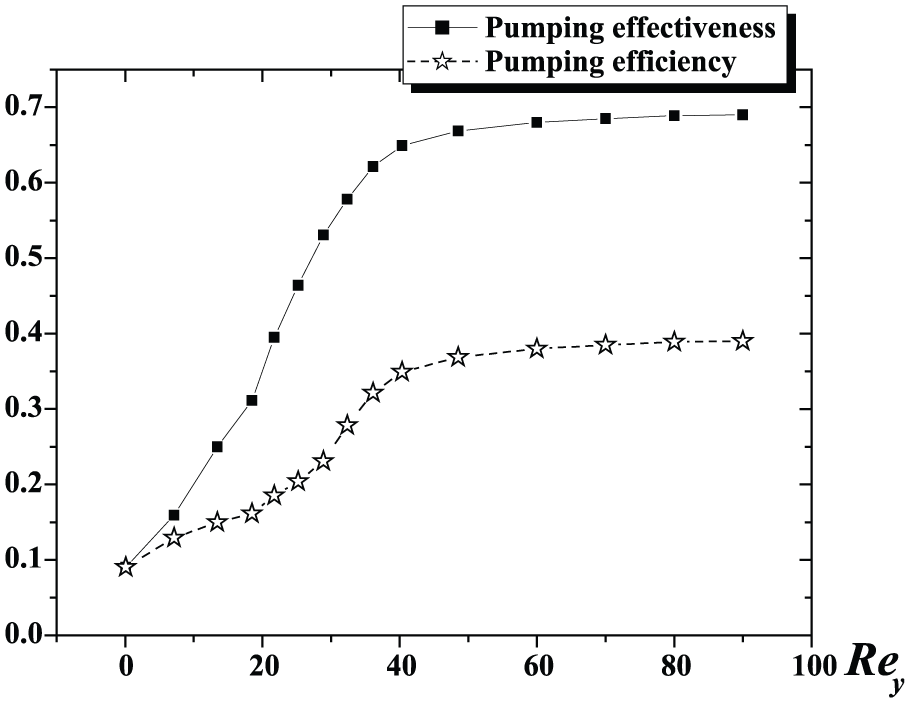
Comparison between the pumping effectiveness and the pumping efficiency for h/D = 0.14 and d/D = 0.4.
Effect of blade width
In our previous article, 9 we have studied the effect of blade curvature on the power consumption, and the obtained results have revealed that the increase in blade curvature requires less power consumption. The comparison between a flat blade turbine and a curved blade turbine shows the superiority of hollow blade impeller in terms of reduced power consumption.
The impeller design plays a great role in the performance of a mixing system; in order to check this knowledge, we have realized four geometrical configurations by changing the radial dimension (d/D = 0.3, 0.4, 0.5, and 0.6, respectively) and four others by changing the axial dimension of the blade (h/D = 0.06, 0.1, 0.14, and 0.18, respectively).
The predicted results concerning the effects of blade width (d/D) are detailed in this section. Changes in Np and Nq versus d/D are presented in Figures 8 and 9, respectively. It is clear that values of Np and Nq will be greater with increased blade width.

Power number versus blade width for solution 2, h/D = 0.14.

Flow number versus blade width for solution 2 in the laminar (Rey = 5) and transitional regimes (Rey = 90), h/D = 0.14.
However and for all cases studied concerning the blade width, Nq is weak in the laminar regime and higher in the transitional regime. We note that for the laminar regime, Reynolds number is varied from 0.1 to 30, and the transitional regime begins from this value. This is confirmed by other authors for this kind of fluids. 24 The same trend in power number may be obtained for solution 2.
Effect of blade height
The results about the effects of second geometric parameter investigated in this study are presented by the following.Figure 10 shows the pumping effectiveness (ηe) versus the blade height (h/D). We remark that ηe is almost constant at the value 0.27 in the transitional regime (Re > 30). At low Re (Re < 30), an increase in h/D yields an increase in ηe, with the biggest influence remarked at h/D = 0.06 to h/D = 0.1, that is, the ratio of ηe = 1.8, whereas from h/D = 0.14 to h/D = 0.18, the ratio is 1.1. This finding reveals that an optimum value of h/D should be reached where further increases would create a decrease in ηe.

Effect of blade height on the pumping effectiveness for solution 2, d/D = 0.4.
Figure 11 shows that the pumping efficiency (λp) of the deep hollow impeller increases with increased blade height (h/D).
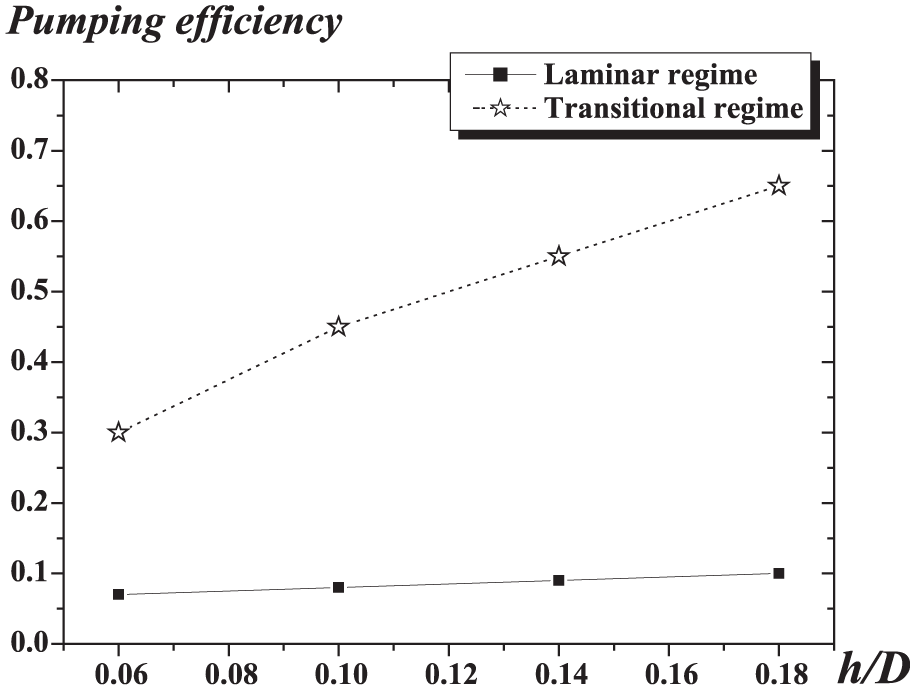
Effect of blade width on the pumping efficiency for solution 2, d/D = 0.4.
Concluding remarks
This article summarized computed results on mixing of complex viscoplastic fluids by a deep hollow blade disk turbine. Numerical predictions of the flow structures, power number (Np), flow number (Nq), pumping effectiveness (ηe), and pumping efficiency (λp) when varying the Reynolds number (Rey), the xanthan gum concentrations, and the blade size have been presented. From the previous findings, the following conclusions can be listed:
Increases in the blade size yield increases in Np, Nq, ηe, and λp;
For all cases studied concerning the blade size, Np was high in the laminar regime and weak in the transitional region;
Pumping effectiveness has revealed some sensitivity to changes in the blade size in the laminar region, and it was observed to be almost constant at 0.27 in the transitional regime.
Footnotes
Academic Editor: Pietro Scandura
Declaration of conflicting interests
The author(s) declared no potential conflicts of interest with respect to the research, authorship, and/or publication of this article.
Funding
The author(s) received no financial support for the research, authorship, and/or publication of this article.