




Abstract
This article provides a comprehensive review about the use of nonlocal theory in modeling of the vibrations of the carbon nanotube resonators. It is fully described how the nonlocal effect has been exploited by researchers to mathematically model vibrations of carbon nanotube resonators. Fusion of different classical beam theories with nonlocal theory is discussed. Also, the article presents the combination of nonlocal models with different physical phenomena which have influence in the vibrations of carbon nanotube resonators.
Introduction
Discovery of carbon nanotubes (CNTs) by Iijima 1 in 1991 was an important step toward developing different scientific fields. In 1991, in the revolutionary article by Iijima, he reported a new type of finite carbon structure including needle-like tubes. His significant article in Nature originally introduces extraordinary materials with exceptional properties which fascinate researchers to exploit them in a wide range of applications from mechanical engineering to medicine. From the early stage of CNTs discovery, interest about better understanding of their properties was highly stimulated, and accordingly, researchers had too many speculations and ideas about these extraordinary materials. As a result, scientists have been prompted to scrutinize different features of CNTs considering different points of view. In addition, they broached different techniques for synthesis of CNTs. Table 1 briefly describes few of the principal and revolutionary articles about CNTs, and the first steps in the road of the CNTs exploration.
Principal works toward exploring of CNTs.

CNTs: carbon nanotubes.
The aforementioned fundamental works reveal peculiar features of CNTs. Providing an extensive review about fundamental works in CNTs is beyond the scope of this review article. This review article aims to provide information about the utilization of nonlocal effect in vibration analysis of CNTs. In the next section, a few principle works for vibration modeling of carbon nanotube resonators (CNTRs) are presented, and then, we only focus on the nonlocal theory and its application in CNTRs.
Vibration theory for CNTRs modeling
Extraordinary mechanical properties of the CNTRs have prompted vibration researchers to explore their vibrational features. CNTRs have been experimentally and theoretically studied by many researchers for the purpose of having better understanding from the peculiar behavior of CNTRs. For example, the pioneering effort of Treacy et al. 19 results in finding exceptionally high Young’s modulus of the CNTs. Another primary endeavor for vibration exploring of the CNTs is an article by Sumpter and Noid. 20 They showed the significance of the nonlinear resonance to positional stability in CNTs. The fundamental resonance of arc-produced multi-walled CNTs induced by an electric field in transmission electron microscopy (TEM) was initially measured by Poncharal et al. 21 By the beginning of 21st century, trends of publication in the field of vibration analysis of CNTRs drastically increase. During this time, a group of researchers at University of Alberta was working on the theoretical modeling of CNTRs. In one of their principal work, they formulated coaxial vibrations of the multi-walled CNTRs. Their proposed model is mathematically described by the following equations 22
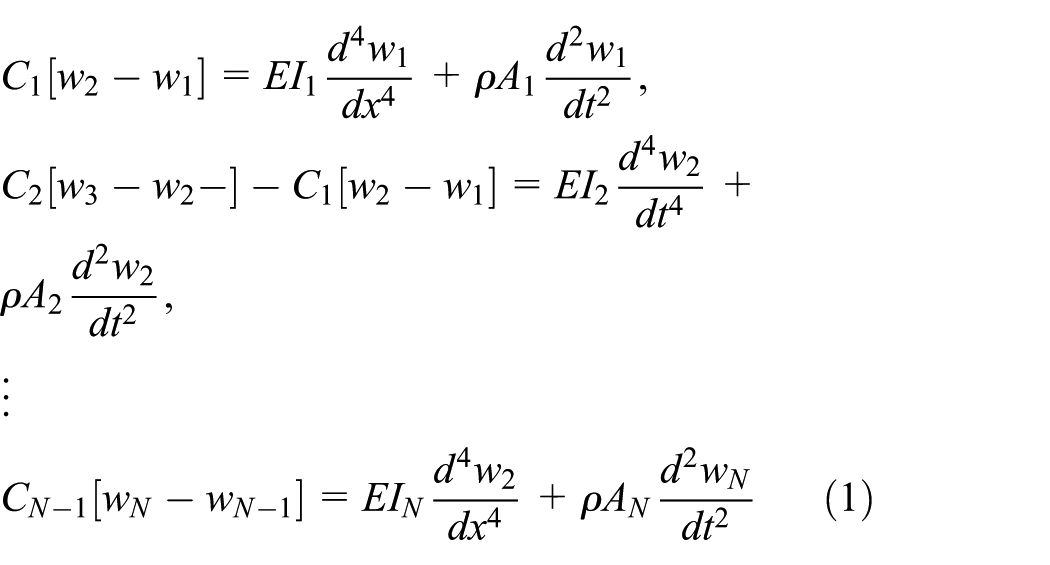
where x represents the axial coordinate; t is the time;
Vibrations models for CNTRs: early stage of developments.

CNTs: carbon nanotubes; CNTRs: carbon nanotube resonators.
To develop a mathematical model for the nonlinear vibrations of CNTRs, Liu et al. 34 derived the governing equation and obtained effect of rippling mode on resonance of CNTRs. Vibrations of suspended nanotube oscillator were studied by Ustunel et al., 35 considering nonlinearity. It was shown that the frequencies of such systems are extremely sensitive to the slack. All of the above-mentioned proposed models are based on the local continuum theories. However, all of these models cannot accurately predict CNTRs vibrations due to the ignorance of the small length scales of the material micro-structures such as lattice spacing between individual atoms. This is indeed the major shortcoming of the continuum theory for vibration analysis of CNTRs. The weakness of continuum theory instigated researchers to develop a new way for mathematically modeling of CNTRs. This leads to a fundamental work by Peddieson et al. 36 They first used the nonlocal continuum theory for developing a new version of Euler–Bernoulli beam model which overcomes shortcoming of the continuum theory for modeling of the nanostructures. 36 Their pioneering work attracts attention of the researchers to use the nonlocal continuum theory for modeling of CNTRs considering different physical phenomena. This article aims to provide an extensive review regarding the use of nonlocal theory in the vibration analysis of CNTRs. We briefly illustrate the nonlocal theory, and then, the focus of the article will be on the implication of nonlocal theory in CNTRs.
The nonlocal continuum theory was first introduced by Eringen in 1972. The Eringen nonlocal elasticity theory illustrates that the stress state at a reference point x in the body is considered to be reliant on both the strain state at x and also on the strain states at all other points of the body. 37 We can observe similar concept in both atomic theory of lattice dynamics and also phonon dispersion. 37 To provide a mathematical view from nonlocal continuum theory, we write its formulation for homogeneous and isotropic elastic solids as follows 37



where

(a) Considered beam model and (b) a differential element of the beam.
V and M show the shear force and the bending moment, respectively. The prime represents differentiation with respect to x. Based on Figure 1(b), we can easily write the relation between the applied force, shear force as well as bending moment, as Peddieson et al. 36 reported in their article. Accordingly, one could have

and

Combining equations (7) and (8) results in

Implementing the Hook’s law based on equation (2), we reach

where
A small deflection is supposed for the considered beam; thus, the following relation is derived between strain and the curvature as follows

where w shows the displacement of the beam. Equation (11) is combined with equation (10), and it results in

The moment resultant of the stress distribution of the considered beam is obtained by the following equation

After a few mathematical procedures, the following equation is obtained

Peddieson et al. 36 called equation (14) as nonlocal Bernoulli/Euler beam deflection equation. Substituting equation (14) into equations (2) and (3) results in

and

The above formula is called nonlocal Euler–Bernoulli deflection equation. The above-mentioned equations illustrate the basis of utilization of nonlocal theory for CNTRs. Next section provides detail about the nonlocal Euler–Bernoulli beam theory and the implications of this method for CNTRs modeling.
It must be noted that appropriate selection of the nonlocal parameter plays a critical role for having an accurate analysis from vibrations of CNTs. Accordingly, it is highly necessary to use the calibrated nonlocal parameter in the modeling and the numerical analysis. Interesting and technical information related to the calibration of the nonlocal parameter can be found in Ansari et al., 38 Ansari and Rouhi, 39 Duanna et al., 40 and Ansari and Sahmani. 41
Nonlocal Euler–Bernoulli beam theory
The focus of this part will be on the nonlocal Euler–Bernoulli beam theory and its implementation in modeling of the CNTRs. One of the primary endeavors to utilize nonlocal Euler–Bernoulli theory is an article by Zhang et al. 37 Their developed mathematical model considers vibrations of double-walled carbon nanotubes (DWCNTs). The developed formulation has the following form

and

where C is the intertube interaction coefficient per unit length between two tubes and is obtained using equation (19)

Wang has played an important role for mathematical modeling of CNTs using the nonlocal theory. In one of his article, he utilized nonlocal Euler–Bernoulli beam theory to study CNTs characteristics. 42 In his pioneering article, he obtained the ratio of phase velocity between the nonlocal and the local Euler–Bernoulli beam theory as equation (20) 42

where

His paper shows that by increasing the small-scale parameter, the velocity ratio decreases. In addition, the reduction of the wave length results in decrement in the velocity ratio. Figure 2 shows the effect of the above-mentioned parameters based on Wang. 42
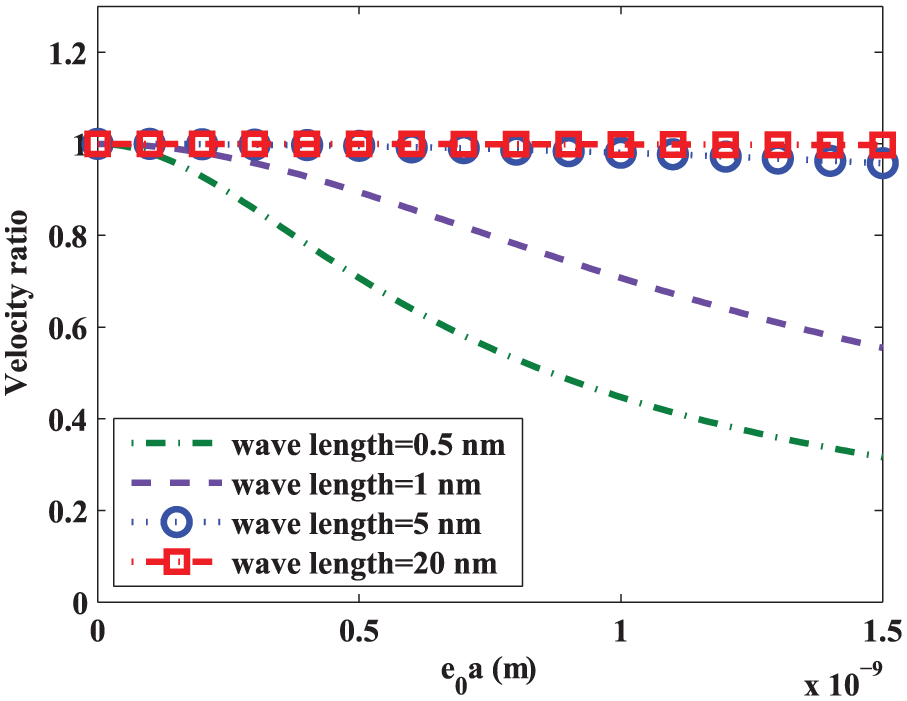
Small effect on wave velocity by Euler–Bernoulli model. 42
In another article, Wang and Varadan show the influence of the small length scale on the frequency ratio. Based on their paper, ratio of the frequency of the CNTRs considering nonlocal and local theory is obtained by the following equation

where
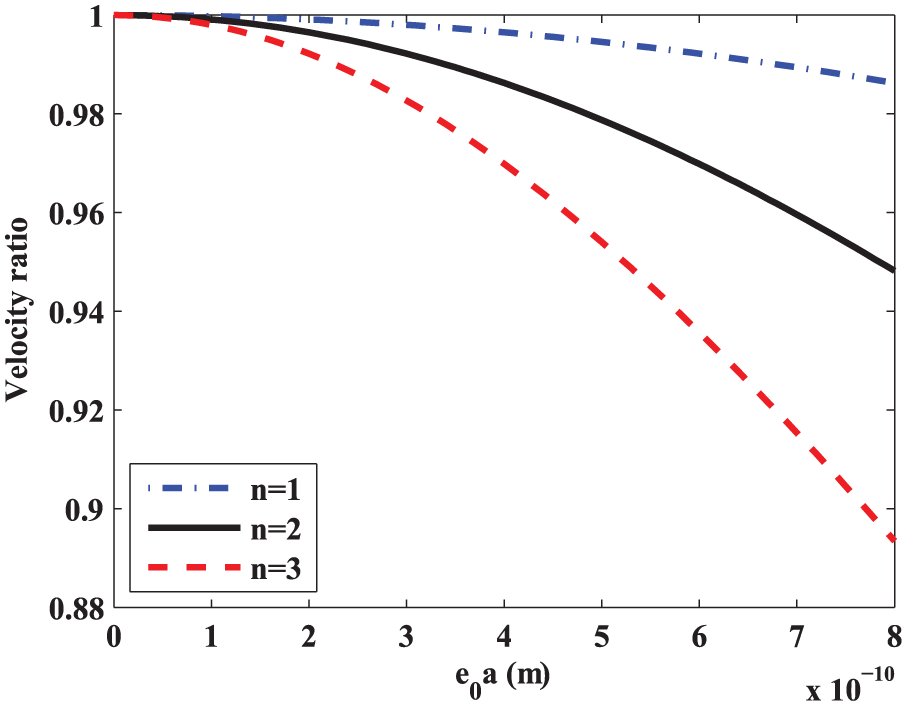
Effect of the small length scale on the frequency for
An interesting paper by Reddy 44 provides detailed formulation of the nonlocal higher-order theories. Reddy’s paper provides useful information about various beam theories, including the Euler–Bernoulli, Timoshenko, Reddy, and Levinson beam theories. The paper presents a combination of classical beam theories with nonlocal differential constitutive relations of Eringen. For the nonlocal Euler–Bernoulli theory, his paper proposes the following formulation

where w, E, I, N, and

where
Nonlocal Euler–Bernoulli beam models.
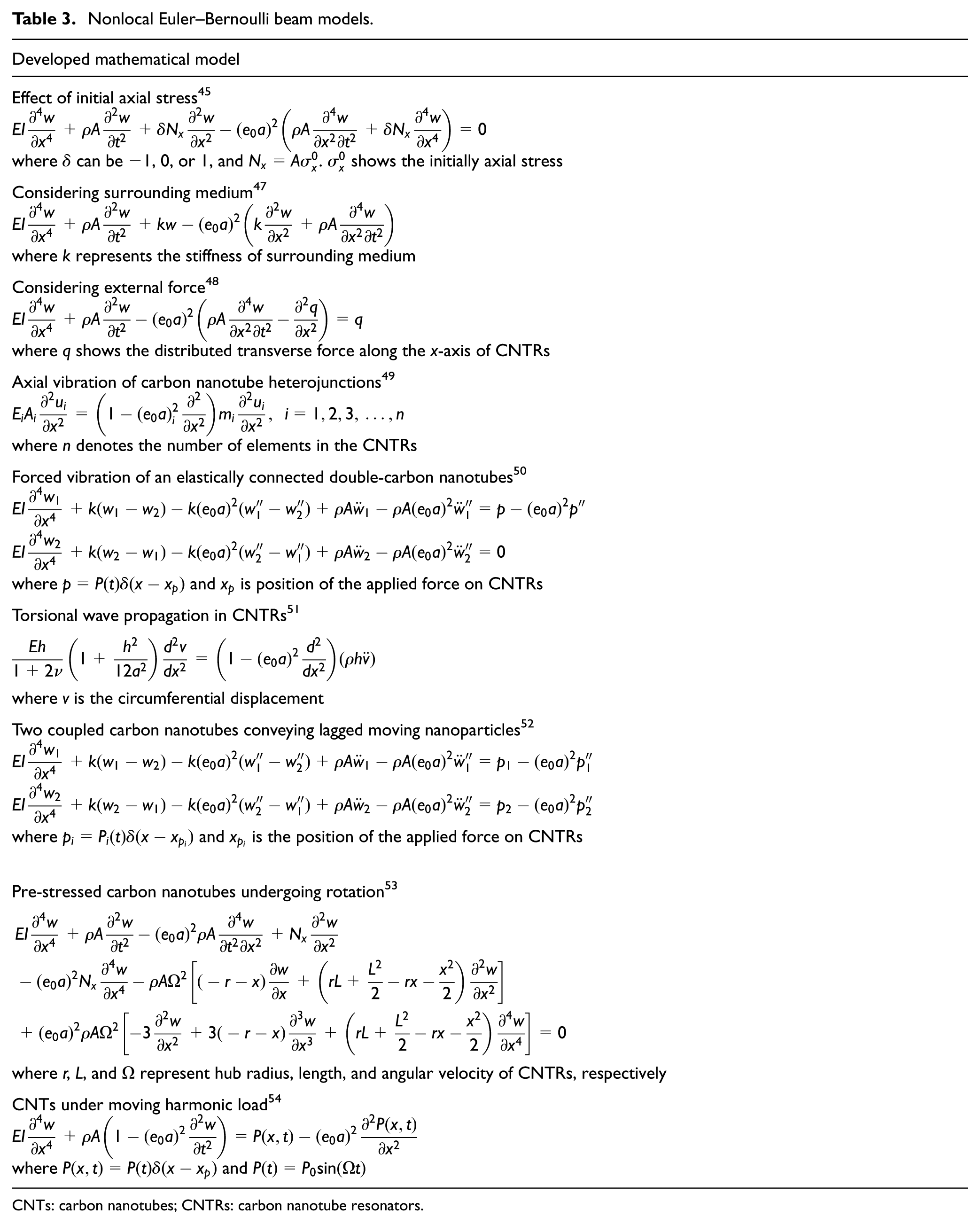
CNTs: carbon nanotubes; CNTRs: carbon nanotube resonators.
Nonlocal Timoshenko beam theory
This section provides specific focus on the utilization of nonlocal Timoshenko beam theory for the vibration modeling of the CNTRs. One of the earliest attempts for vibration analysis of CNTRs using nonlocal Timoshenko theory can be found in Wang and Varadan 43 in which the following model was developed for CNTRs

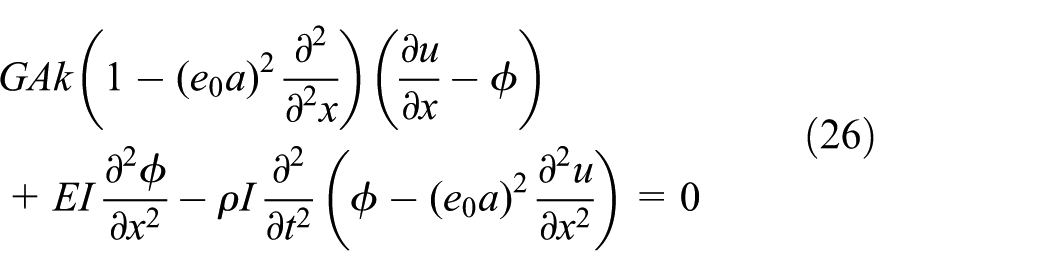
where

and it is apparent that the strains

and

Lu et al. 55 have considered axial loads in their model and obtained the following governing equation for their considered system as


where

where

Equations (34) and (35) represent
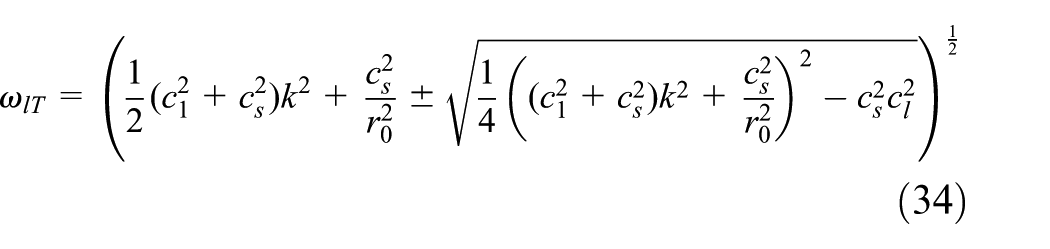
and Lu et al. 55

As another example in which the natural frequency of the CNTRs was obtained based on nonlocal Timoshenko beam theory, we can refer to a paper by Lee and Chang 56 in which they obtained the following equations as the natural frequency of CNTRs

where

Influence of small-scale effect

Influence of the small-scale effect

Effect of aspect ratio and chirality of carbon nanotube on the values of ratio
In Table 4, we provide different models for CNTRs based on the nonlocal Timoshenko beam theory.
Nonlocal Timoshenko beam models.

CNTs: carbon nanotubes; CNTRs: carbon nanotube resonators; DWCNTRs: double-walled carbon nanotube resonators.
Nonlocal Rayleigh beam theory
Rayleigh beam theory is another way for modeling CNTRs. This section provides an illustration about nonlocal Rayleigh beam theory. In comparison with Timoshenko and Euler–Bernoulli beam theories, nonlocal Rayleigh beam theory is rarely used for modeling of CNTRs. The main difference between Euler–Bernoulli and Rayleigh beam theories is in a term which is related to the rotational inertia of cross section, it is considered in the Rayleigh beam theory. Equation (37) represents the nonlocal Rayleigh beam model which has been modeled by Mustapha and Zhong 60

In their model, they considered Winkler and Pasternak type foundations.

where

The following equation was obtained as the natural frequency of the considered system for the case of free vibrations 64
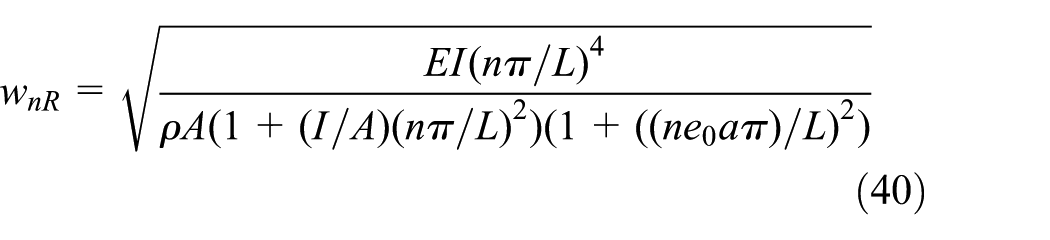
Pourseifi et al. 65 actively controlled the vibrations of CNTRs under the action of a moving nanoscale particle using nonlocal Rayleigh beam theory. They considered the following form for the applied force

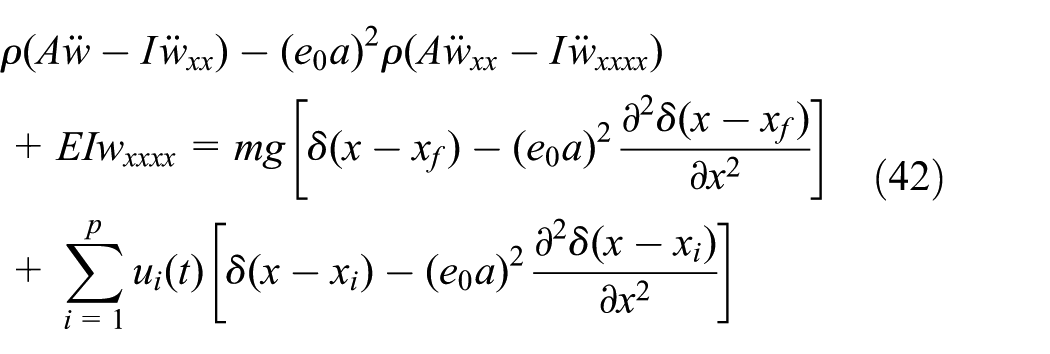
Based on the above equation, their paper presents a linear classical optimal control algorithm with a time varying gain matrix and displacement–velocity feedback to suppress vibrations of CNTRs. 65 The nonlocal Rayleigh beam theory has been used in modeling of CNTRs under magnetic field and also fluid-conveying CNTRs. In addition to the above-mentioned works, a few researchers focused on the axial vibration analysis of CNTs. For example, M Aydogdu 66 studied axial vibrations of CNTs using nonlocal theory. Results of his paper show that the axial vibration frequencies of SWCNT embedded in an elastic medium highly over estimated by the classical rod model. In another paper, M Aydogdu 67 studied axial vibrations of CNTs considering van der Waals (vdW) effect and nonlocal parameters.
Modeling of nonlinearity
Due to the small scale of CNTRs, a small perturbation may lead to strong nonlinearity in the dynamical behavior of the CNTRs. Thus, it is critical to have a precise mathematical model for vibration analysis of the CNTRs. Generally, there could be five main potential reasons for emerging nonlinearity in the vibrations of CNTRs: (a) nonlinearity due to the material properties, (b) large amplitude vibrations and geometrical nonlinearity, (c) nonlinear elastic medium, (d) nonlinear electromagnetic and electrostatic force, and (e) intermolecular interaction such as vdW force. This section presents mathematical models of CNTRs in which we can observe nonlinearity due to the first three above-mentioned potential reasons. One of the earliest modeling of nonlinearity in the vibration of CNTRs was formulated by Liu et al. 34 Based on their mathematical model, they scrutinized the effect of a rippling mode on the resonances of CNTRs. Their developed mathematical model has the following form

where

and F is the driving force. After a few mathematical procedures, they reach well-known Duffing equation. 68 Wang et al. 69 proposed a nonlinear model for CNTRs to study their bending modulus with considering the rippling deformation. Based on their proposed mathematical model and nonlinear analysis, the effective bending modulus ratio of the CNTRs has the following relation with D/L (Figure 7)

where

where

Equation (47) was then solved by Askari et al. 70 using homotopy analysis and variational iteration method and obtained the following equation as the natural frequency of the considered system 70


The corresponding relation between
Figure 8 shows the effect considering nonlinearity in the vibrations of CNTs and the linear stiffness. As depicted from Figure 8, having an elastic medium increases the natural frequency of the vibrations of CNTs. Accordingly, it helps the stability of their vibrations especially when CNTs convey fluid. A lot of papers have been published so far about the effect of the elastic medium on the vibrations of CNTs. A few important examples include Mustapha and Zhong, 60 M Aydogdu, 66 Fu et al., 71 Murmu and Pradhan, 72 and Zhen and Fang. 73
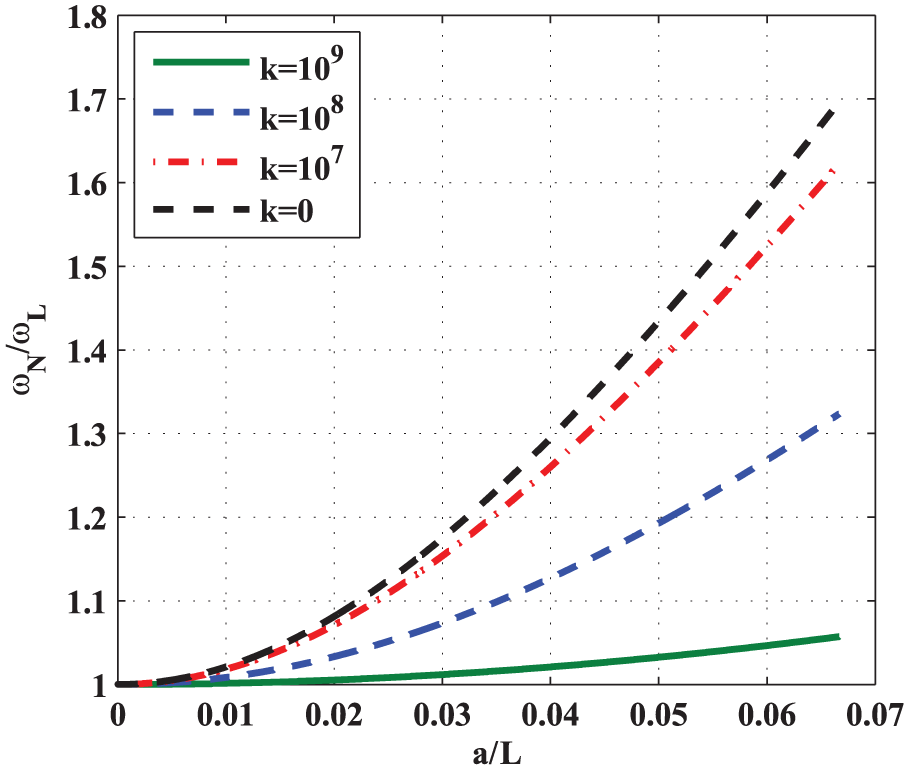
Variations of frequency ratio with respect to the initial amplitudes. 71
Ke et al. 74 used nonlocal Timoshenko beam model to investigate the influence of nonlinearity and have a better insight into its dynamical behavior. One of the crucial results of their paper shows that at a given vibration amplitude, an increase in nonlocal parameter leads to smaller linear and nonlinear frequencies but a higher nonlinear frequency ratio. In addition, it was illustrated that the nonlocal parameter almost has no influence in the nonlinear mode shape for the hinged–hinged DWNTs. Their model is presented in section pertinent to vdW force. An elastic continuum approach for modeling the nonlinear vibration of DWCNTs under harmonic excitation was developed by Hawwa and Al-Qahtani. 75 They developed the model based on the Euler–Bernoulli beam theory. The source of nonlinearity in their model is vdW force. Nonlinear free vibration of DWCNTs based on the nonlocal elasticity theory was studied by Fang et al. 76 They considered two sources of nonlinearity in their model including vdW force and also geometrical nonlinearity. An important result of the paper is relevant to simultaneously considering two sources of nonlinearity. Based on the conclusions of the paper, the amplitudes of the noncoaxial vibration increase with the increase in the noncoaxial frequency. Inversely, by only considering the nonlinear vdW forces, the amplitudes of the noncoaxial vibration decrease with the increase in frequency, and the amplitudes are larger than those considering both the geometric nonlinearity and the nonlinear vdW forces for frequency less than a certain value. Wang and Li 77 studied damping effect in the vibrations of CNTRs using a nonlinear nonlocal Euler–Bernoulli beam theory. Their developed mathematical model is as follows

Employing the Galerkin procedure, they obtained Damped-Duffing equation as follows 77

where

Using the Galerkin procedure, the principal mode vibration equation was obtained based on the above-mentioned mathematical model

Interested readers can find the mathematical formulation of


Accordingly, the primary and secondary resonances of CNTRs can be found in Askari.
79
Figure 9 shows the effect of the chirality on the primary resonance of the vibrations of CNTRs. Figure 10 shows the effect of surface effect on the vibrations of nanoresonators considering Armchair (20, 20) CNTRs. In Figure 10,

Effect of the chirality on the primary resonance of CNTRs.

Effect of the surface effect on the ratio of nonlinear frequency to the linear frequency.

Effect of position of applied force on the primary resonance of the CNTs. 79
Thermal effect
Study of the temperature variation influence in the vibrations of CNTRs is an interesting topic for researchers, and many different theoretical, numerical, and experimental methods have been developed so far to scrutinize the thermal effect in CNTRs. For example, Cao et al. 83 used molecular dynamics simulation to study the natural thermal vibration behaviors of SWCNTs. One of the earliest mathematical models in which thermal effect was considered can be found in a paper by Hsu et al. 84 They used Timoshenko beam theory and developed the following equation for their system considering the thermal effect

where

where

where

Figure 12 shows the variation of the natural frequency with considering temperature effect. The considered temperature is 800 K. We can see the effect of chirality on the natural frequency of the CNTRs vibrations. Euler–Bernoulli beam model was developed for the vibration and instability analysis of fluid-conveying SWCNTs considering the thermal effect by Wang et al. 85 Results of their work indicate the dependence of natural frequencies on the flow velocity as well as temperature change. One of the earliest studies, in which nonlocal Timoshenko beam theory was used for modeling CNTR considering thermal effect, is a paper by Benzair et al. 86 In their mathematical model, they have added the following term to the nonlocal Timoshenko beam equation which is pertinent to the thermal effect

where

and


Effect of the aspect ratio and chirality on the linear frequency of CNTRs considering temperature. 84

Effect of the mode number and temperature on
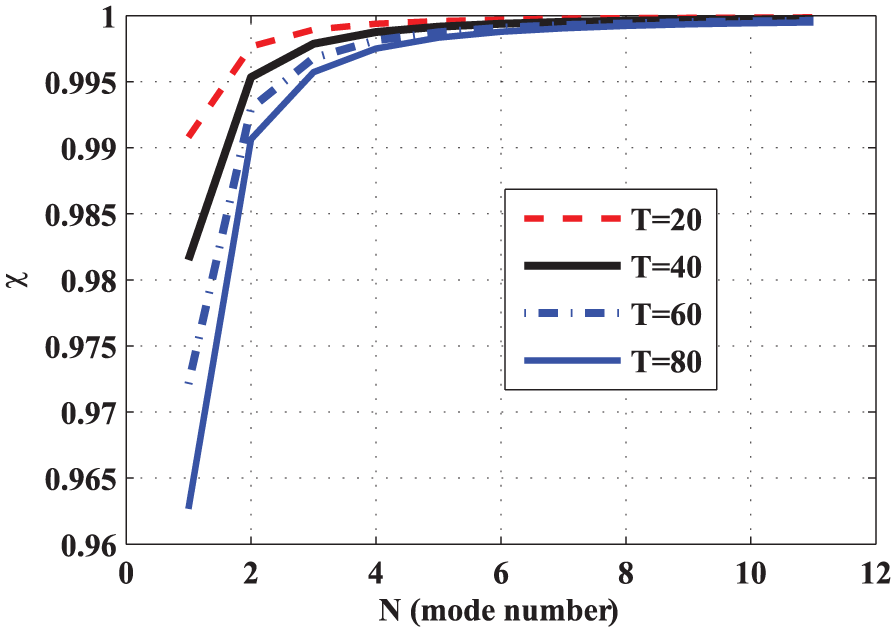
Effect of the mode number and temperature on
Another interesting model considering temperature was developed by Murmu and Pradhan. 72 They obtained the following governing equation for their system based on the nonlocal Euler–Bernoulli beam theory considering thermal effect as well as Winkler foundation

where
Thermal effects in vibrations of CNTRs.

Fluid-conveying CNTRs
Vibration analysis of fluid-conveying CNTRs has attracted great attention. Many researchers have focused on them to study the effect of fluid on their vibrations. The main reason of the high attention of researchers to fluid-conveying CNTRs is because of its applications in nanofluidic devices. In this section, we briefly go over different proposed nonlocal-based mathematical models for vibrations of CNTRs considering fluid effect. The topic of this section can be comprehensively considered in another review article with special focus on vibrations of fluid-conveying CNTRs. One of the first analytical models for the vibration analysis of the fluid-conveying CNTRs was developed by Yoon et al. 25 Results of their paper show the dependence of resonant frequencies on the flow velocity. Furthermore, they showed that the internal moving fluid could substantially affect resonant frequencies especially for suspended longer CNTs. Their developed mathematical model can be found in Table 2. In another work, Yoon et al. 95 studied flow-induced flutter instability for a cantilever CNTRs. In their work, they showed that the internal moving fluid substantially affects vibrational frequencies and the decaying rate of amplitude especially for longer cantilever CNTs. Reddy et al. 96 considered the following model for the vibrations of CNTRs

where

In their work, they showed that obtaining the natural frequency of CNTRs is particularly useful to estimate the mass flow rate of fluid. One of the earliest attempts for the vibration analysis of fluid-conveying DWCNTs can be found in a paper by Wang et al. 98 Using the Euler–Bernoulli beam theory, they obtained the following model for the vibrations of their objective system


Results of their paper indicate that the effect on the critical dimensionless flow velocity of the slenderness ratio is significant in the fluid-conveying DWNTs, in contrast to the SWCNTs conveying fluid. In addition, their paper shows that as the spring constant k is increased, the critical dimensionless flow velocity becomes higher, both for the first and second modes. 98 There are plenty of papers in which authors used local theory for vibrations of the fluid-conveying CNTRs. It is actually beyond the scope of this review article to focus on them. Model presented in equations (65) and (66) was then modified by Wang 99 using nonlocal theory to investigate the effect of small length on its vibrations. The mathematical formulation of his model is as follows

and

One of the critical results of Wang’s paper is related to the effect of the small length scale on the critical velocity. The paper indicates that the small length scale is not influential on the critical flow velocity. It means that the local theories can provide a good estimation from the critical flow velocity. As depicted in the above equation, the term related to the fluid effect is completely similar to the local theory. In 2009, Tounsi et al. have shown that the above model is incomplete and modified it using nonlocal Euler–Bernoulli beam theory as follows 100

and

In their paper, they reported that previously published papers missing the fluid terms concerning the nonlocal effects. Table 6 presents a few mathematical models for vibrations of the CNTRs considering fluid interaction. In this part of the article, we focus on a model which has been recently developed by Askari 79 for vibrations of fluid-conveying CNTRs

where

Fluid effect in the vibrational models of CNTRs.

CNTRs: carbon nanotube resonators; FSI: fluid–structure interaction.
In Figure 15, we can see the effect of the type of the fluid on the nonlinear behavior of the CNTRs based on the model developed by Askari. 79 As depicted from the figure, increasing the fluid density results in decreasing the amplitude of the oscillations. In Figure 16, the effect of fluid velocity is presented on the linear natural frequency of the CNTRs. As evidenced in Figure 16, there is a fluid velocity in which the natural frequency of the CNTRs is zero. This velocity is called critical fluid velocity. The highest critical fluid velocity occurs when the boundary conditions of CNTRs are clamped–clamped (CC). Combining equations (59) and (71), we can have both thermal and fluid velocity effects. Figure 17 represents the effect of both temperature and fluid velocity for Armchair (20, 20) CNTRs. It shows that increasing the temperature results in an increase in the critical fluid velocity.

Effect of the fluid type on the frequency behavior of CNTRs. 79
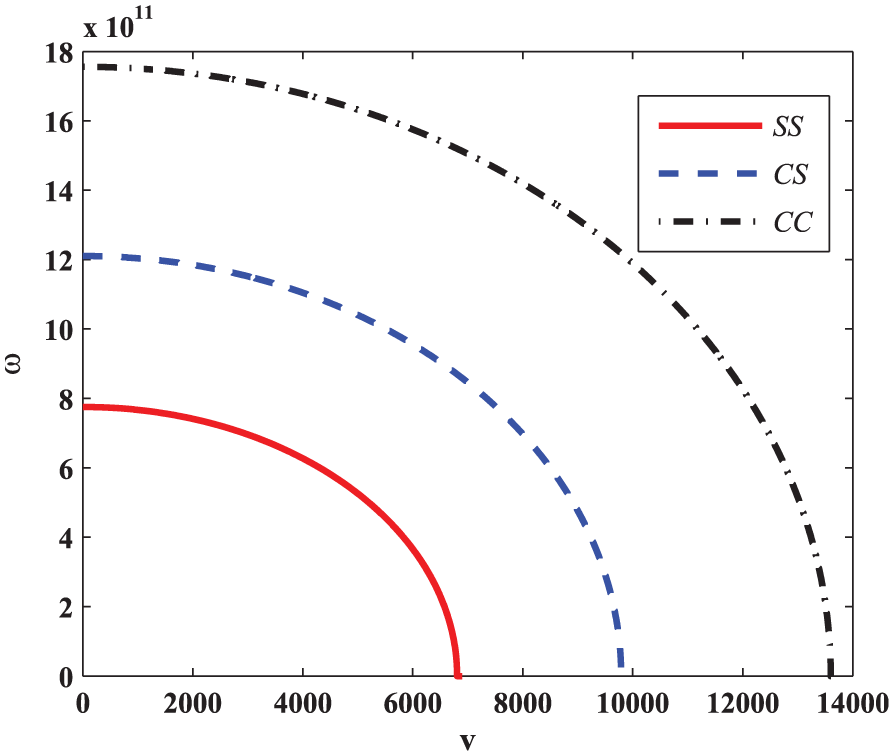
Effect of the fluid velocity and boundary conditions on the frequency behavior of CNTRs (Armchair (20, 20)) 79 (CC: clamped–clamped, CS: clamped–simply, SS: simply–simply).

Effect of the fluid velocity and boundary conditions on the frequency behavior of CNTRs (Armchair (20, 20)). 79
Electromagnetic field effect
Electromagnetic field effect on the vibrations of CNTs was investigated by many researchers in the field of vibration analysis of nanostructures. The Maxwell’s equations can easily describe the distribution of the electrical and magnetic fields within the nanostructures. The main four parts of Maxwell’s equations can be illustrated by the following equation




where E, H, J, B, and D are the electric field intensity, magnetic field, current density vector, magnetic field density, and the displacement current density, respectively. Formulating of the Lorentz force is the main part for the vibration analysis of CNTs considering electromagnetic field effect. The Lorentz force is formulated in terms of the displacement field of the CNTs and also the strength of the magnetic field as below


where W is the lateral motion of CNTs in ZX-plane. Karlicic et al. 110 investigated the free transverse vibration analysis of nanosystem composed of multiple single-walled carbon nanotubes (MSWCNT) embedded in a polymer matrix and under the influence of an axial magnetic field. Vibration of a double viscoelastic CNTs conveying viscous fluid coupled by visco-Pasternak medium under longitudinal magnetic field was studied by Arani et al. 111 They showed that increasing the magnetic field significantly increases the stability of the system. Accordingly, the magnetic field can be used to control stability of CNTs.

Schematic of horn-shaped CNTs under longitudinal magnetic field. 109
vdW force
The focus of this part will be on the vdW force and mathematical modeling of CNTRs considering the above-mentioned force. The topic of this part includes plenty of research works and it has the potential to be investigated in a separate review article. Accordingly, we just illustrate one example based on the nonlocal continuum theory. Originally, Ruoff et al. 9 reported the effect of the vdW force on CNTs. The result of their paper shows that the vdW force between two adjacent nanotubes can deform them substantially. This result has stimulated researchers to study the vdW forces on the properties of CNTs, especially their vibrational characteristics. One of the well-known models for vibrations of CNTRs considering vdW force was developed by Ke et al. 74 In their model, they have used nonlocal Timoshenko beam theory to model vibrations of CNTRs. Their obtained governing equation for CNTRs is as follows


and

In the above equation,

and

As we illustrated before, vdW interaction can be a potential reason for emerging the nonlinearity in the vibrations of CNTRs. It may cause geometrical nonlinearity in CNTRs or interacting force as follows 112

where


where U is the interlayer potential per unit area, which can be expressed in terms of the interlayer spacing

where
Conclusion and future works
A comprehensive review was provided about vibrations of the CNTRs considering different effects based on the nonlocal continuum theory. Three different nonlocal beam theories including Timoshenko, Euler–Bernoulli, and Rayleigh were illustrated and their potential for modeling the vibrations of CNTRs was shown. Several mathematical models were tabulated considering different parameters such as nonlinearity, thermal effect, fluid–solid interaction, and also vdW forces. It was shown how the above parameters can be influential on the dynamical behavior of CNTRs. Despite many published articles based on the nonlocal theory for the vibrations analysis of the nanoresonators, there is lack of knowledge about a few specific and critical subjects in the field of vibration analysis of nanoresonators, and researchers can focus on these topics. In the last lines of these review articles, we provide a list of topics which can be useful for future research:
It is necessary to have an accurate mathematical model from the curvature of CNTRs, and there is lack of models which can predict the waviness of CNTRs accurately. Recently, Askari et al. 115 proposed a non-uniform rational basis spline (NURBS)-based mathematical model which can be considered by the researchers to use it for mathematical modeling of CNTRs waviness.
Chaotic vibrations analysis of CNTRs is another subject which needs more attention. 116 Chaos may emerge in the vibrations of CNTRs due to the axial load, thermal effect, and also FSI.
The use of CNTRs for small mass sensing is a hot topic and rapidly growing. Many researchers have focused on the application of CNTRs in mass sensing such as Cho et al. 117 and Murmu and Adhikari. 118 But still, there is a high demand for having a precise mathematical model of nanosensing instrument with ultra-high resolutions based on CNTRs.
In spite of many published articles about vibrations of CNTRs, there is lack of research about control and vibration suppression of these highly sensitive resonators. There is a high demand for designing passive and adaptive controller to suppress CNTRs vibrations due to their high sensitivity to very small perturbation.
Vibration analysis of other types of nanoresonators such as nanowires is another interesting topic for the researchers. It is critical to have an accurate mathematical model for the vibrations of nanowires. The area of researches about vibrations of nanowires is rapidly growing. The use of nanowires for energy harvesting still needs more research.
Also, researchers can focus on the vibration analysis of piezoelectric CNTRs. Nonlocal theories are currently being used for the vibration analysis of CNTRs and the field is steadily expanding.
Mathematical modeling of vibrations of CNTRs for drug delivery, gas sensing, and also bio-sensing might be considered as an interesting topic for the researchers in the field of vibrations of the nanoresonators.
Nonlocal shell theory has been used so far by many researchers to investigate vibrations of CNTs. A few crucial examples include works done by Ansari and colleagues,38,39,119 Wang and Varadan, 120 Ansari and Arjangpay, 121 Soltani et al., 122 Arash and Ansari, 123 Fazelzadeh and Ghavanloo, 124 Ansari et al., 125 and Ansari and Arash. 126 Shell theory is a highly efficient method for vibration analyzing of CNTs, and comparison with beam theories can be an interesting topic for future research.
As we reported in the paper, the differential form of the Eringen nonlocal theory of the elasticity has been widely exploited in the vibration analysis of nanostructures. There are some inconsistencies in the models based on the above-mentioned differential. Recently, Fernndez-Saez et al. 127 developed a new static bending model with combination of Euler–Bernoulli and Eringen integral constitutive equations. The novel model can be implemented by researchers to overcome the above-mentioned issue pertinent to the application of the differential form of the Eringen nonlocal theory in the dynamic analysis of nanostructures. Recently published papers by Khodabakhshi and Reddy 128 and Tuna and Kirca 129 include detailed analysis about the Eringen integral constitutive equation.
Higher-order gradient elasticity theories have been exploited by many researchers such as Ansari et al.113,130,131 for vibration modeling of CNTs. These theories have the potential to be implemented by researchers for modeling of nanoresonators with sensing applications. In addition, a comprehensive review article about the applications of the higher-order gradient elasticity theories in nanoresonators is highly beneficial for future works.
The field of vibration analysis of nanoresonators is beyond the above-mentioned topics, and every day, a new concept emerges in this field.
Footnotes
Academic Editor: Luís Godinho
Declaration of conflicting interests
The author(s) declared no potential conflicts of interest with respect to the research, authorship, and/or publication of this article.
Funding
The author(s) received no financial support for the research, authorship, and/or publication of this article.