




Abstract
In this article, fault diagnosis of bearing based on relevance vector machine classifier with improved binary bat algorithm is proposed, and the improved binary bat algorithm is used to select the appropriate features and kernel parameter of relevance vector machine. In the improved binary bat algorithm, the new velocities updating method of the bats is presented in order to ensure the decreasing of the probabilities of changing their position vectors’ elements when the position vectors’ elements of the bats are equal to the current best location’s element, and the increasing of the probabilities of changing their position vectors’ elements when the position vectors’ elements of the bats are unequal to the current best location’s element, which are helpful to strengthen the optimization ability of binary bat algorithm. The traditional relevance vector machine trained by the training samples with the unreduced features can be used to compare with the proposed improved binary bat algorithm–relevance vector machine method. The experimental results indicate that improved binary bat algorithm–relevance vector machine has a stronger fault diagnosis ability of bearing than the traditional relevance vector machine trained by the training samples with the unreduced features, and fault diagnosis of bearing based on improved binary bat algorithm–relevance vector machine is feasible.
Keywords
Introduction
It is very significant to study the reliable fault diagnosis method to prevent the bearing from malfunction. 1 Generally, the features of bearing vibration signal have a great influence on the diagnosis results of bearing, so it is necessary to select the appropriate features to improve the diagnosis effects. In addition, it is well known that good classifier is helpful to obtain good diagnosis results. Recently, the classifiers, such as Bayesian networks,2–4 artificial neural networks, and support vector machine (SVM), have been widely applied in fault diagnosis field, among which SVM is a machine learning method based on structure risk minimization principle, and it can solve the classification problems with small training samples, high dimensions, and nonlinearity. Until now, SVM has been applied in fault diagnosis of rolling-element bearing, 1 fault diagnosis of turbo-pump rotor, 5 fault diagnosis of rotor-bearing system, 6 fault diagnosis of power transmission system, 7 and so on.
Relevance vector machine (RVM) is an intelligent learning technique based on sparse Bayesian framework. 8 The number of relevance vectors in RVM is much smaller than that of support vectors in SVM; thus, compared with SVM, RVM has a sparser representation. In addition, there is no need to set the penalty parameter in RVM, which makes RVM more convenient to use than SVM. Therefore, RVM has a better application prospect in fault diagnosis for bearing. As the selection of the features and the kernel parameter of RVM has a certain influence on the diagnosis results of RVM, the improved binary bat algorithm (IBBA) is used to select the appropriate features and kernel parameter of RVM. In the traditional binary bat algorithm, the change of the probabilities of changing their position vectors’ elements lacks the purpose and is in the state of disorder when the position vectors’ elements of the bats are unequal to the current best location’s element, which is unhelpful for the solution optimization. Therefore, the new velocities updating method of the bats is presented in the IBBA in order to ensure the decreasing of the probabilities of changing their position vectors’ elements when the position vectors’ elements of the bats are equal to the current best location’s element, and the increasing of the probabilities of changing their position vectors’ elements when the position vectors’ elements of the bats are unequal to the current best location’s element, which are helpful to strengthen the optimization ability of binary bat algorithm.
Therefore, fault diagnosis of bearing based on relevance vector machine classifier with improved binary bat algorithm (IBBA-RVM) is proposed in this article. Here, three IBBA-RVMs trained by the training samples with the respective appropriate features are employed to establish the diagnosis model with the form of binary tree in order to recognize the four states of bearing, including normal state, inner race fault, outer race fault, and ball fault. The traditional RVM trained by the training samples with the unreduced features can be used to compare with the proposed IBBA-RVM method. The experimental results indicate that IBBA-RVM has a stronger fault diagnosis ability of bearing than the traditional RVM trained by the training samples with the unreduced features, and fault diagnosis of bearing based on IBBA-RVM is feasible.
RVM classifier
Let

where

The detailed description of RVM binary classifier can be shown in a study by Tipping. 8 Radial basis function (RBF) kernel function is employed in this RVM, which can be expressed as follows

where
The improvement for the traditional binary bat algorithm
Binary bat algorithm is a kind of swarm-based binary intelligent optimization method inspired by the echolocation behavior of bats with the variations of pulse emission rates and loudness; 9 each bat represents a solution in the population, and binary coding for the solution to be optimized is performed in the binary bat algorithm. In the traditional binary bat algorithm, the velocity of each bat can be updated according to equations (4) and (5)


where
A v-shaped transfer function and position updating rule 9 can be shown as follows


where
The v-shaped transfer function is used to map the velocities of the bats into the probabilities of changing their position vectors’ elements. The probabilities of changing their position vectors’ elements should decrease when the position vectors’ elements of the bats are equal to the current best location’s element, and the probabilities of changing their position vectors’ elements should increase when the position vectors’ elements of the bats are unequal to the current best location’s element. However, in the traditional binary bat algorithm, the velocities of the bats keep invariability when the position vectors’ elements of the bats are equal to the current best location’s element; the velocities’ values
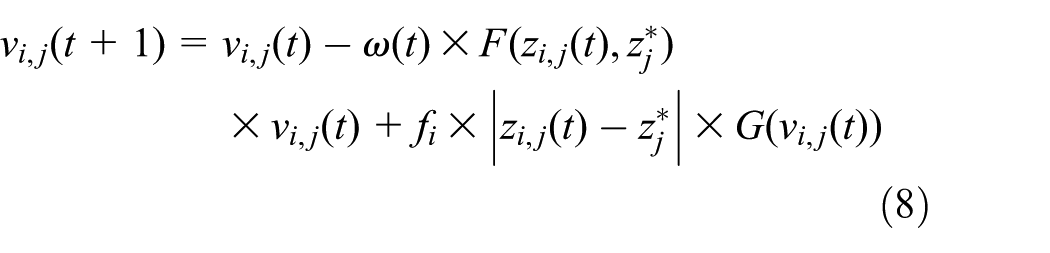
In order to solve this problem, the new velocities updating method of the bats is presented in the IBBA, which can be shown as follows



subject to the constraints


where
It can be seen that the probabilities of changing their position vectors’ elements decrease when the position vectors’ elements of the bats are equal to the current best location’s element, and the probabilities of changing their position vectors’ elements increase when the position vectors’ elements of the bats are unequal to the current best location’s element in the new velocities updating method of the bats. The nonlinear variable weight
IBBA-based feature selection and parameter optimization of RVM classifier
As the selection of the features and the kernel parameter of RVM has a certain influence on the diagnosis results of RVM, the IBBA is used to select the appropriate features and kernel parameter p. The process of the selection of the features and the kernel parameter of RVM by using the IBBA can be described as follows
Step 1. Code the features and kernel parameter p by binary mode. The features and kernel parameter p are been coded as
Step 2. Initialize the pulse emission rate
Step 3. Define the objective function and evaluate the performance of the location (solution) of each bat. Here, the hybrid method of 5-fold cross validation and 10-fold cross validation is used to define the objective function.
First of all, the training samples are divided equally into five subsets of samples, among which four subsets of samples are used to train the RVM model, and the remaining subset of samples are used to validate the RVM model. Each subset can be used once for validation. The total validation accuracy

where
Then, the training samples are divided equally into ten subsets of samples, among which nine subsets of samples are used to train the RVM model, and the remaining subset of samples are used to validate the RVM model. Each subset can be used once for validation. The total validation accuracy

where
Here, the objective function can be given as follows

where

The smaller the value of the objective function is, the better the solution is. Then, obtain the global best location (solution)
Step 4. Update the velocity vectors’ elements of the bats according to equation (4) and equations (8)–(13), and update the position vectors’ elements of the bats according to the v-shaped transfer function and position updating rule given by equations (6) and (7).
Step 5. Produce a random number rand, if
Step 6. Evaluate the new solution according to the objective function given by equation (16).
Step 7. Produce an another random number rand, if


where
Step 8. Update the current best solution
Step 9. The same procedures from Step 4 to Step 8 are repeated until the maximum iteration is reached.
Step 10. Decode the best solution, and the optimized features and kernel parameter can be obtained.
In order to obtain excellent optimization results, the optimization process can be repeatedly carried out several or many times.
Fault diagnosis process of bearing based on RVM classifier with IBBA
Fault diagnosis process of bearing based on RVM classifier with IBBA is given in Figure 1. First, three-level decomposition for bearing vibration signal is performed based on wavelet packet transform; each wavelet packet coefficient’s reconstructed signal represents a decomposed signal based on wavelet packet transform, and eight wavelet packet coefficients’ reconstructed signals of the third level are obtained; then, the relative Shannon entropies of eight wavelet packet coefficients’ reconstructed signals of the third level are computed by equation (20), and the eight relative Shannon entropies are obtained.

where

Fault diagnosis process of bearing based on relevance vector machine classifier with improved binary bat algorithm.
Then, the appropriate features and kernel parameter of RVM can be obtained by using the IBBA, and RVM is trained by the training samples with the appropriate features. Three IBBA-RVMs trained by the training samples with the respective appropriate features are employed to establish the diagnosis model with the form of binary tree in order to recognize the four states of bearing, including normal state, inner race fault, outer race fault, and ball fault, among which IBBA-RVM1 is used to separate normal state from fault state, IBBA-RVM2 is used to separate inner race fault from other faults, and IBBA-RVM3 is used to separate outer race fault from ball fault. Finally, the proposed IBBA-RVM model can be tested by the testing samples.
Experimental analysis
Here, the bearing vibration data are obtained from “bearings vibration data set” of Case Western Reserve University. 10 The experimental data used here are collected under the condition of motor speed: 1772 r/min, among which the fault data are collected under the condition of single-point faults with fault diameter of 0.014 inches. 720 samples composed of 180 samples representing normal state, 180 samples representing inner race fault, 180 samples representing outer race fault, and 180 samples representing ball fault are employed in this study. Lots of training samples are helpful to obtain the optimized feature set. Therefore, in this study, the first 130 samples of each state are used as the training samples, and the remaining 50 samples of each state are used as the testing data; thus, the 200 samples are used as the testing samples altogether. Here, the eight wavelet packet coefficients’ reconstructed signals of one of the samples representing normal state can be shown in Figure 2.

Eight wavelet packet coefficients’ reconstructed signals of one of the samples representing normal state.
The appropriate features and kernel parameter of RVM can be obtained by using the IBBA. In the IBBA, the initial pulse emission rate is set to 0.1,the initial loudness is set to 0.8, and
The traditional RVM trained by the training samples with the eight relative Shannon entropies can be used to compare with the proposed IBBA-RVM method. Here, grid method is used to select the kernel parameter of the traditional RVM; the value range of the kernel parameter is [1, 210−1], and the intervals of the adjacent values are 1. Three traditional RVMs trained by the training samples with the eight relative Shannon entropies are employed to establish the diagnosis model with the form of binary tree, among which RVM1 is used to separate normal state from fault state, RVM2 is used to separate inner race fault from other faults, and RVM3 is used to separate outer race fault from ball fault. The kernel parameters of RVM1, RVM2, and RVM3 are respectively selected by grid method; that is, RVM1, RVM2, and RVM3 have respective kernel parameters.
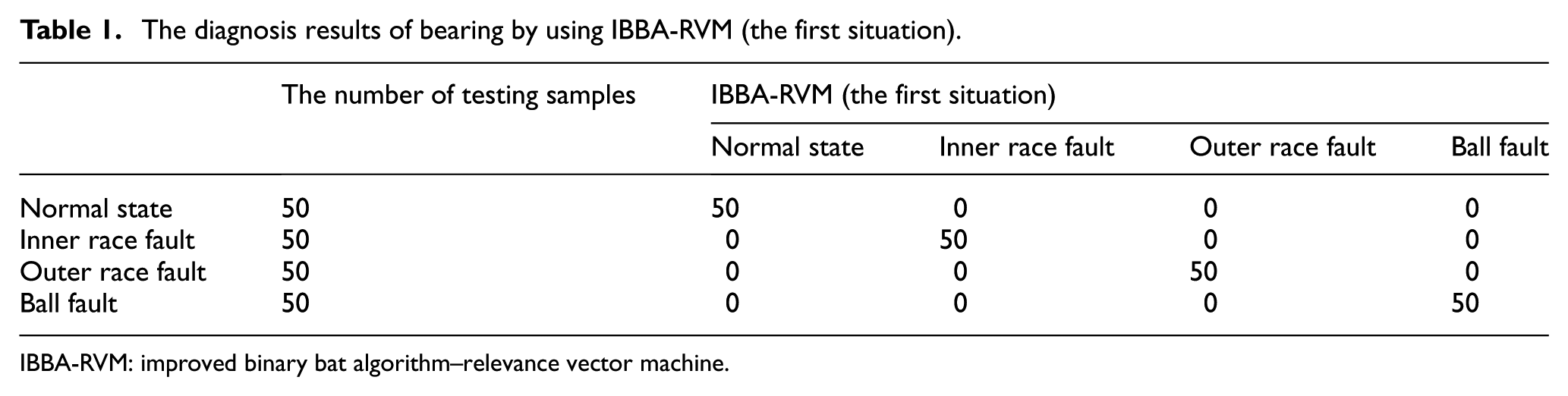
Two kinds of IBBA-RVMs with different diagnosis results of bearing can be obtained by a series of repeated experiments, which can be defined as IBBA-RVM (the first situation) and IBBA-RVM (the second situation), respectively. Table 1 gives the diagnosis results of bearing by using IBBA-RVM (the first situation). As shown in Table 1, all the testing samples are correctly classified by using IBBA-RVM (the first situation). Thus, the diagnosis accuracy of IBBA-RVM (the first situation) for bearing is 100%. Table 2 gives the diagnosis results of bearing by using IBBA-RVM (the second situation). As shown in Table 2, only one sample representing inner race fault is misclassified by using IBBA-RVM (the second situation). Thus, 199 testing samples are correctly diagnosed in the 200 testing samples by using IBBA-RVM (the second situation), and the diagnosis accuracy of IBBA-RVM (the second situation) for bearing is 99.5%. It can be seen that IBBA-RVM can excellently recognize the four states of bearing. That is because three IBBA-RVMs including IBBA-RVM1, IBBA-RVM2, and IBBA-RVM3 have their respective appropriate features and kernel parameters, which make them have a strong classification ability.
The diagnosis results of bearing by using IBBA-RVM (the first situation).
IBBA-RVM: improved binary bat algorithm–relevance vector machine.
The diagnosis results of bearing by using IBBA-RVM (the second situation).

IBBA-RVM: improved binary bat algorithm–relevance vector machine.
Table 3 gives the diagnosis results of bearing by using the traditional RVM. As shown in Table 3, the traditional RVM with the eight relative Shannon entropies can excellently recognize normal state and outer race fault; however, the fault type of 12 samples representing inner race fault is misclassified as ball fault, and the fault type of 8 samples representing ball fault is misclassified as inner race fault. It can be seen that the traditional RVM with the eight relative Shannon entropies cannot excellently recognize inner race fault and ball fault. Thus, 180 testing samples are correctly diagnosed in the 200 testing samples by using the traditional RVM with the eight relative Shannon entropies, and the diagnosis accuracy of the traditional RVM with the eight relative Shannon entropies is 90%.
The diagnosis results of bearing by using the traditional RVM.

RVM: relevance vector machine.
The experimental results indicate that IBBA-RVM has a stronger fault diagnosis ability of bearing than the traditional RVM trained by the training samples with the unreduced features, and fault diagnosis of bearing based on IBBA-RVM is feasible.
Conclusion
In this article, fault diagnosis of bearing based on RVM classifier with IBBA is proposed, and the IBBA is used to select the appropriate features and kernel parameter of RVM. In the IBBA, the new velocities updating method of the bats is presented to ensure the decreasing of the probabilities of changing their position vectors’ elements when the position vectors’ elements of the bats are equal to the current best location’s element, and the increasing of the probabilities of changing their position vectors’ elements when the position vectors’ elements of the bats are unequal to the current best location’s element, which are helpful to strengthen the optimization ability of binary bat algorithm. Three IBBA-RVMs trained by the training samples with the respective appropriate features are employed to establish the diagnosis model with the form of binary tree in order to recognize the four states of bearing, including normal state, inner race fault, outer race fault, and ball fault. The traditional RVM trained by the training samples with the unreduced features can be used to compare with the proposed IBBA-RVM method. The experimental results indicate that IBBA-RVM has a stronger fault diagnosis ability of bearing than the traditional RVM trained by the training samples with the unreduced features, and fault diagnosis of bearing based on IBBA-RVM is feasible.
The bearing vibration data used here are acquired under the condition of steady load; however, it is very significant to study on fault diagnosis of bearing under varying load conditions; thus, the feasibility of application of IBBA-RVM in fault diagnosis of bearing under varying load conditions will be studied in the future.
Footnotes
Academic Editor: Davood Younesian
Declaration of conflicting interests
The author(s) declared no potential conflicts of interest with respect to the research, authorship, and/or publication of this article.
Funding
The author(s) disclosed receipt of the following financial support for the research, authorship, and/or publication of this article: This project is supported by National Natural Science Foundation of China (grant no. 51305076).