




Abstract
Experimental investigations on the influence of different amounts of polyacrylic ester and silica fumes on the mechanical properties of mortar such as the compressive strength, splitting tensile strength, bonding strength, and abrasion resistance are presented in this article. The results show that the compressive and splitting tensile strength of mortar can be improved with the addition of polyacrylic ester and silica fumes. Results obtained from both the direct tensile bond test and flexural bond test indicate that the addition of polyacrylic ester and silica fumes improves the bond strength significantly, and the enhancement is more obvious with polyacrylic ester paste as interfacial adhesives. Furthermore, mortar incorporation of polyacrylic ester and silica fumes shows superior abrasion resistance compared to the control mortar. Therefore, the correct combination of polyacrylic ester and silica fumes to produce mortars has been shown to have synergistic effects, which results in excellent properties including high bond strength and superior abrasion resistance. Mortars containing polyacrylic ester and silica fumes are ideal for repairing concrete especially for hydraulic concrete structure.
Introduction
Concrete is a composite material with low tensile strength and weak impact resistance. 1 However, it is one of the most widely used construction materials due to its high compressive strength and low cost. Concrete utilized in hydraulic structures is always exposed to harsh marine environment all year round, which usually leads to severe degradation after construction such as aging, spalling, and cracking of the cover concrete.2–4 The related studies have pointed out that the deteriorated concrete structures with high-quality cement-based repair materials are an economical and practical way to extend their service life in comparison to the reconstruction of the structures.5,6 Therefore, repair materials with an excellent mechanical performance are greatly demanded.
Polymers have been used for improving mechanical properties, adhesion with substrates, and waterproofing properties of mortars and concretes. Polymers such as styrene–butadiene rubber (SBR), polyacrylic ester (PAE), styrene–acrylic ester (SAE), and vinyl acetate–ethylene (VAE) have been utilized in mortars and concrete. Ramli et al.7,8 demonstrated that the presence of SBR, PAE, and VAE in the mortars greatly enhanced the pore structure of the paste and resulted in an increase in the impermeability of the polymer cement system, which was excellent to be applied as repair materials for concrete structures. Furthermore, Aggarwal et al. 9 found that the addition of epoxy emulsion to cement mortars improved workability, increased flexural strength, and decreased water absorption, carbonation, and chloride ion penetration. However, research showed that the incorporation of polymer tended to reduce the compressive strength of cementitious materials.10,11 In recent years, PAE has gained more application and has been proven to improve various engineering properties of mortars and concretes, such as workability, water absorption, flexural strength, and crack resistance.
Pozzolanic materials can partially substitute Portland cement in order to enhance the properties of concrete and mortars such as mechanic- and durability-related properties. Silica fume (SF) is an industrial by-product and has been widely used as mineral admixture in concrete and mortar, mainly to improve the mechanical properties and reduce the porosity.12,13 Cakır and Sofyanlı 14 observed continuous and significant improvements in the compressive and splitting tensile strength of recycled aggregate concretes due to the incorporation of SF. Moreover, its durability properties such as sulfate resistance, chloride iron impermeability, and freeze-thaw resistance could also be enhanced.15–17 However, the addition of SF increases the water required for a given degree of workability and the shrinkage of cement-based materials.
The combination of polymer and SF has been shown to have synergistic effects on concrete and mortar. Gao et al. 18 found that the compressive and flexural strength of cement mortar could be improved with an addition of SF and polymer because of the water-reducing effect of polymer and pozzolanic reactions of SF. De Almeida and Sichieri carried out the mineralogical study 19 and the tensile bond strength test 20 of the mortar containing SAE and SF. The interaction between polymers, cements, and the extent of pozzolanic reactions of mortars with SF was analyzed, and the result of the tensile bond strength indicated that this mortar could be applied to fix porcelain tile.
Based on the above literature survey, it can be seen that the addition of polymer and SF to mortars results in excellent properties, which are ideal for repairs. However, present studies on mortar containing polymer and SF are very limited. Very little research has been conducted on the mechanical characteristic of mortar containing PAE and SF. Few studies focus on the utilization of mortar incorporation of PAE and SF as repairing materials especially for repairing hydraulic concrete structure. The information about the abrasion resistance of mortar containing polymer and SF is also very limited, which is one of the most significant performances for hydraulic concrete structure. To facilitate the use of mortar containing PAE and SF as a repair material, a better knowledge of the mechanical properties is essential. In this article, the influence of PAE and SF on the mechanical properties of mortar such as the compressive, splitting tensile, bonding, and abrasion resistance strength was discussed. In order to assess the bond characteristics, two kinds of testing techniques including the direct tensile bond test and flexural bond test were employed. The aim is to increase the knowledge regarding mortars containing PAE and SF as repairing materials and its potential application in repairing hydraulic structure surfaces.
Experimental programs
Materials
Cement and SF
In this study, ordinary Portland cement (OPC) was obtained from China Cement Plant. SF was marketed by Meibao New Materials Limited Company in Shanghai. The average diameter and the specific surface area of SF used in the study were 0.15 µm and 20.0 m2/g, respectively, which was the usual application type in the concrete engineering. The characteristics of OPC and SF are shown in Table 1.
The characteristic of OPC and SF.

OPC: ordinary Portland cement; SF: silica fume.
Aggregates
The natural river sand was used as fine aggregates. Sieve analysis and physical properties of fine aggregates are presented in Table 2.
Sieve analysis and physical properties of fine aggregates.
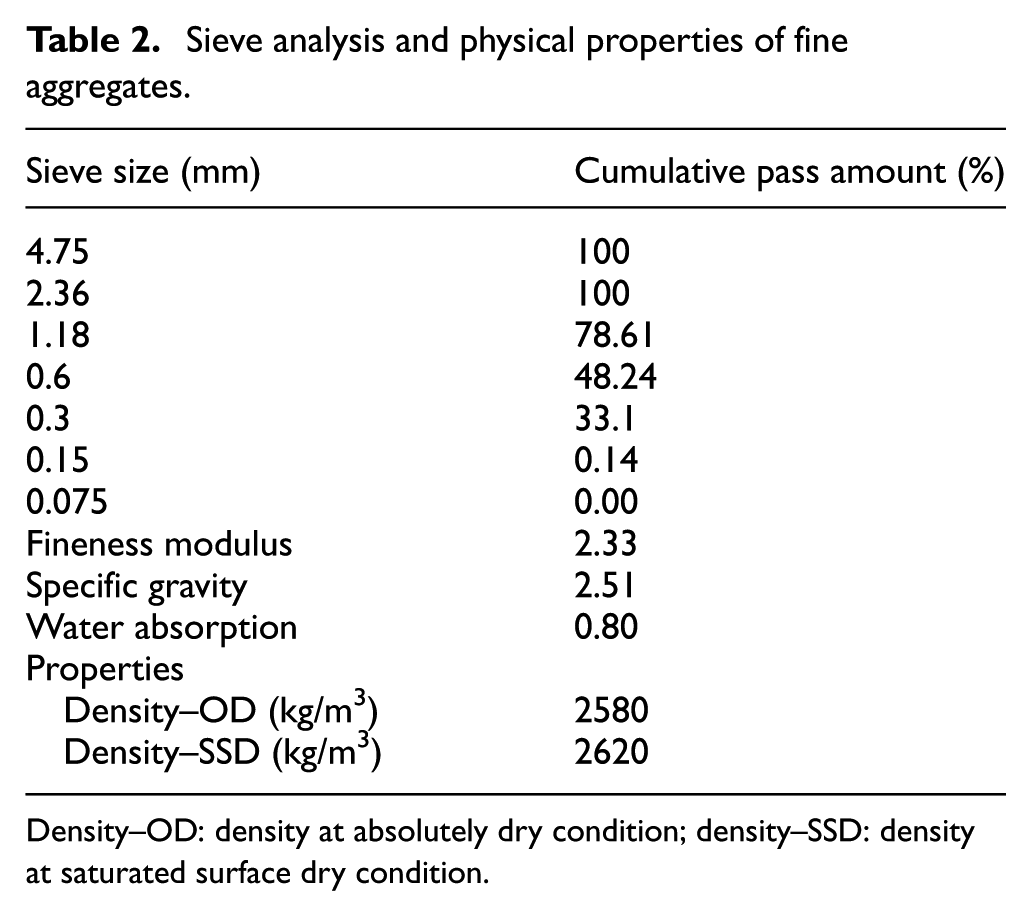
Density–OD: density at absolutely dry condition; density–SSD: density at saturated surface dry condition.
Superplasticizer
A sodium salt of polynaphthalene sulfonic acid superplasticizer (SP) with 2%–4% sodium sulfate was used to maintain the workability of fresh mortar. The SP is yellow powder, and its active ingredients are >97%. It is soluble with 7–9 pH value, 1.5% water absorption, and <0.2% chloride content. The SP was added in proportion of 1% by weight of cement.
Polymer materials
The polymer used in this experiment was PAE emulsion provided by Hydraulic Research Institute in Nanjing, China. It was a milk white emulsion liquid with 2–6 pH value and 39%–41% solid content.
Mixture proportions
A total of seven mortar mixtures were prepared, including one control mortar (M0) and six repair mortars with PAE and SF. The cement–sand ratio of 1:1.5 by mass was adopted for the mortars. The dosages of PAE and SF mentioned were the weight percent of cement content. For all the mixtures, the water–cement ratio (w/c) was adjusted to maintain a constant flow between 140 and 150 mm, which was determined from the flow table test. Details of the mixture proportions of the mortar are shown in Table 3.
Mixture proportions of the mortar.

PAE: polyacrylic ester; SF: silica fume; SP: superplasticizer.
By weight of cement.
Preparation and curing conditions of samples
First, the components of the mortar mixture were batched by weight, and cement, sand, and SF were premixed with the dry mixing for 1 min. Then, water or water together with PAE and SP were added into the mixture and mixed for another 3 min. The fresh mortar was cast in different molds for corresponding tests. Then, all the specimens were cured at a temperature of 20°C ± 3°C and humidity over 80%, covered by a polyethylene film to prevent moisture loss. Subsequently, all the samples were removed from the molds after 24 h. The specimens of M0 were cured in a standard condition with a temperature of 20°C ± 3°C and humidity over 95% immediately. The other specimens containing PAE should be cured in a standard condition for 7 days and then be kept in the curing chamber with a stable temperature of 20°C and humidity 60% until testing. In this study, every test result consists of the average of three replicate tests except six replicate tests for direct tensile bond strength.
Testing methods
Compressive and splitting tensile strength
The compressive and splitting tensile strength specimens with a size of 100×100×100 mm3 were tested according to GB/T 50081-2002 at different curing periods. The compressive strength was tested at 3, 7, 28, 90, and 180 days, and the splitting tension test was carried out at 3, 7, and 28 days, respectively.
Direct tensile bond test
The bond strength test was conducted according to DL/T5150-2001. In the test, first, half of the specimens of the substrate mortar with the same material composition and mix proportion as the old mortar were prepared with the ratio of cement:sand:water (1:3:0.5), cured at 20°C ± 3°C and 90% ± 5% relative humidity for 14 days. Then, the half of the specimens were placed into their respective molds prior to filling the remaining halves with the new mortar. The composite specimens were completed as shown in Figure 1. Interfacial adhesives including PAE paste with the proportion of cement:PAE (2.5:1) and SF paste with the proportion of cement:SF:water (0.34:0.056:1) were utilized, respectively. The bond strength between the repair mortar and the substrate mortar was calculated by

where
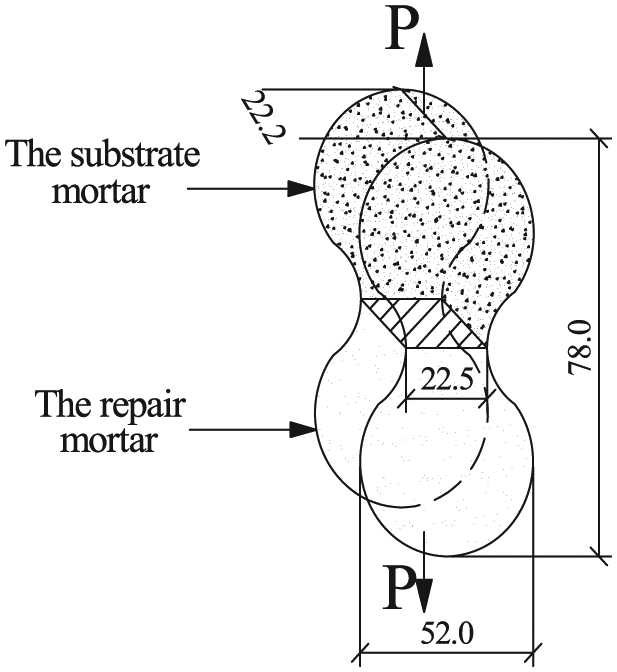
Composite specimen for direct tensile test.
Although this method evaluates the bond characteristics through a direct way, it is difficult to control the experimental process, and instabilities may occur in the data obtained from the test. Thus, the flexural bond test is also employed in order to assess the interfacial bonding comprehensively.
Flexural bond test
Alexander used flexural bond testing for the first time in 1965. As an indirect way to test the bond strength between the new repair mortar and old substrates, it was also adopted by Mallat and Alliche. 21 In this research, the flexural bond test was used as the second method to evaluate the interfacial bonding between the repair mortar and the substrate mortar at 28 days. In the test procedures, the new repair mortar was cast and bonded to substrates to form prism specimens with the size of 40×40×160 mm3, as indicated in Figure 2. Interfacial adhesives used for flexural bond test was the same as that of direct tensile bond test. The flexural bond strength was calculated using equation (2)

where
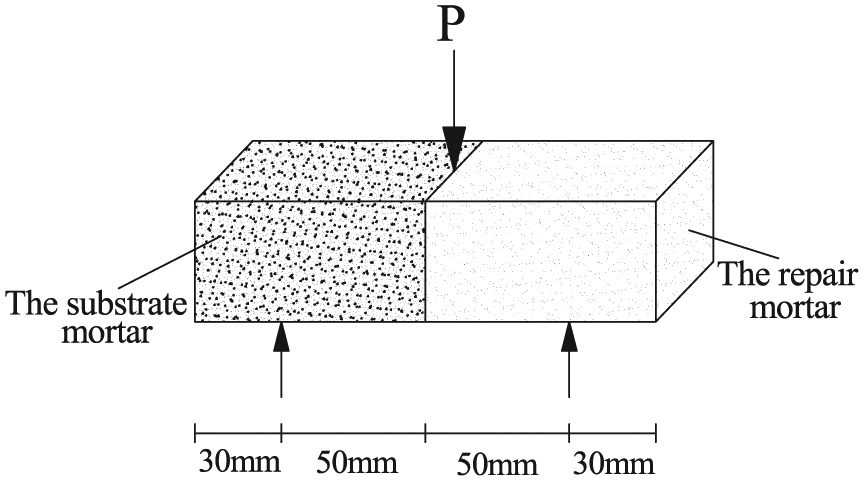
Composite specimen for flexural bond test.
Abrasion resistance
The abrasion resistance of the mortar specimens was tested according to ASTM C 1138/97 (an underwater method). The cylinder specimens with a size of φ300 × 100 mm2 were abraded by underwater steel balls for a period of 72 h, and the weight of the mortar before and after the test was obtained. The weight loss was calculated as

where L is the weight loss after abrasion (%),
The abrasion resistance strength was determined by

where
Results and discussion
Compressive strength
Table 4 shows that the compressive strength development of the mortar specimens in different curing periods. The compressive strength of specimens can be improved with the addition of SF and polymer. When adding 10%, 20%, and 30% PAE separately and 10% SF, compressive strength of mortar increases 14.12%, 9.32%, and 5.12%, respectively, at 28 days compared with M0. However, the compressive strength decreases with the content of PAE increase which indicates that the addition of polymer causes a decrease in the compressive strength. Similarly, Ma and Li 11 found that the incorporation of polyacrylate (PA) and polyurethane-modified PA (PU/PA) negatively influenced the compressive strength of mortar. Ukrainczyk and Rogina 22 reported that styrene–butadiene latex-modified calcium aluminate cement mortar also showed a decrease in the compressive strength. This can be explained as follows: polymer modification of cement mortar is a process that polymer film forms in their binder phase and then fills the pores in specimens. However, the elastic modulus of polymer is much lower than that of cement mortar. As a result, when specimens are under compression, the polymer phases in the mortar can be observed as pores, resulting in a lower compressive strength. Furthermore, high air content of mortar specimens due to the addition of polymers also causes the decrease of compressive strength. 23 However, the addition of SF improves the compressive strength of mortar. When adding 30% PAE and 5% and 10% SF separately, strength effectiveness is 5.12% and 15.24% at 28 days. The average diameter of SF used in this study is 0.15 µm which is only about 1.0%–1.5% of that of cement particles. Fine particles of SF can be considered a supplementary cementitious material that improves the mixture particle packing and the compactness of the mixture. Fine particles of SF can be filled between cement particles with good grading, leading to micro-filling or particle packing which can contribute to an increase in compressive strength. Moreover, being a highly pozzolanic material, SF forms additional calcium silicate hydrate by reaction with calcium hydroxide formed on cement hydration which contribute to a significant increase in the compressive strength. This compensates the negative effect of PAE on compressive strength of mortars.
Compressive strength test results of the mortar.

PAE: polyacrylic ester; SF: silica fume.
SE (%) = ((strength of mortar containing PAE and SF − strength of the control mortar)/strength of the control mortar) × 100%.
Splitting tensile strength
The splitting tensile strength of mortar specimens at 3, 7, and 28 days is shown in Figure 3. It is clear that the use of PAE and SF has an obvious positive effect on the splitting tensile strength. As an example, when adding 10%, 20%, and 30% of PAE separately and 5% SF, the splitting tensile strength increased 21.55%, 33.53%, and 42.92% at 28 days for repair mortar compared with control mortar. However, when SF content is 10%, the corresponding increase in splitting tensile strength is 24.92%, 36.92%, and 46.90%. Previous studies demonstrated that the addition of polymer could improve the splitting tensile strength of cementitious materials. Aliabdo et al. 24 reported that the concrete including SBR showed a 21%–29% increase in splitting tensile strength compared to the control sample. Medeiros et al. 25 stated that splitting tensile strength increased with the addition of VAE copolymer and acrylate polymers due to the water-reducing effect of polymer. Moreover, the formation of polymer films in mortar contributes to the mortar constitutes, integrating with each other’s compactly and thus leads to strength improvement. The filling and pozzolanic effects of SF also work in improving mechanical properties of mortars.

Splitting tensile strength of the mortar specimens in terms of curing time.
Direct tensile bond strength
Figure 4 presents the results of the direct tensile bond test. Note that the bond strength tends to increase with increasing both the PAE and SF contents in the mortar. This is an interesting observation and indicates that the quality of the bond is enhanced by the additives. At the SF contents of 5%, the bond strength of mortars without adhesives increases by about 15.33%–42.15% with PAE-cement ratio ranging from 10% to 30%. Corresponding bond strength increase is about 19.54%–47.51% when the content of SF increases to 10%. Mirza et al. 26 confirmed that mortar including SBR and acrylics showed a better bond strength characteristics. The reason for the increase in bond strength is that the polymer addition decreases the water/cement ratio. Besides, the polymer forms linking bridges that improve the adhesion. Furthermore, the fine particles of SF can be filled between cement particles with good grading, which improve compactness of cement mortar. At the same time, hydrates of cement, such as Ca(OH)2, react with active SiO2 in SF. The reaction not only decreases the quantity of Ca(OH)2 but also decreases the volume of large pores, increases small pores, and then reduces continuous pores in cement paste. The directional distribution of Ca(OH)2 decreases around the aggregates and interfacial, which results in the increase in interfacial microhardness. As a result, the adherence between the repair mortar and the substrate is improved due to the greater area of contact and lower porosity. De Almeida and Sichieri 19 showed that additions of SF and polymer reduced the air-voids content and enhanced the hydrated products as a result of the pozzolanic reactions and latex effect. A coherent polymer film was formed at the interface and formed linking bridges between the repair mortar and the substrates, thus improving the mechanical interlock and eventually enhancing the bond strength. Synergistic effects of polymer, cement, and SF contributed to the bond strength improvement.

Direct tensile bond strength between the repair mortar and the substrates: (a) no adhesives, (b) PAE paste, and (c) SF paste.
Interfacial adhesives improve the bond strength of specimens further. Compared with the specimens without adhesives, the bond strength of specimens using PAE paste as adhesive increased by about 9.35%–12.87%. While it can be observed that the enhancement in bond strength is less effective with using SF paste compared with PAE paste as adhesives. With SF paste, the augmented percentage of the bond strength of specimens is in the range from 2.34% to 4.98%, compared with corresponding specimens without adhesives.
Flexural bond strength
Figure 5 shows the flexural bond test results. Similar to the direct tensile bond test results, the addition of PAE and SF has a positive influence on the interfacial bonding between the repair mortar and the mortar substrates. Under the conditions of PAE-cement ratio of 30% and SF content of 10%, the bond strength reaches the maximum value, namely, 10.4 MPa for specimens without adhesives, 11.4 MPa for specimens with PAE paste, and 10.9 MPa for specimens with SF paste. Corresponding bond strength values for M0 are 5.5, 6.1, and 5.8 MPa, respectively. What is more, the addition of adhesives enhances the interfacial bonding further, and it still can be observed that the enhancement in interfacial bonding is less effective using SF paste compared with PAE paste as adhesives. Besides, during the flexural bond test, specimens show three different failure modes (Figure 6), namely (a) pure interfacial failure, (b) interfacial failure with the substrate mortar failure, and (c) failure in the substrate mortar. Results show that when the bond strength is in the range of 5.5–7.4 MPa, specimens mostly fail at the interface, where no cracking and fracturing can be observed in both the substrate mortar and the repair mortar. When the bond strength ranges from 7.4 to 8.8 MPa, bonding for the specimens is generally strong since most interfacial failures of the specimens occur after the substrate mortar suffering a certain degree of damage, such as M2 and M4 with PAE and SF paste.

Flexural bond strength between the repair mortar and the substrate mortars: (a) no adhesives, (b) PAE paste, and (c) SF paste.

Failure modes of specimens obtained from flexural bond test: (a) pure interfacial failure, (b) interfacial failure with the substrate mortar failure, and (c) failure in the substrate mortar.
Abrasion resistance
Figure 7 shows the abrasion resistance test results, indicating that the addition of PAE and SF improves the abrasion resistance of specimens. The higher admixture contents lead to the lower weight loss and the higher abrasion resistance strength. The weight loss and abrasion resistance strength of M0 are 6.87% and 23.18 h/(kg/m2), respectively. For M6, namely, with PAE contents of 30% and SF contents of 10%, the weight loss decreases to 4.75%, and the abrasion resistance strength increases to 35.78 h/(kg/m2), which is 54.35% more than M0. The test by Mirza et al. 26 showed that after an abrasion–erosion test, the weight loss of SBR-modified cement-based mortars decreased by about 62.26%–71.70%, compared with the control sample without any addition. Sadegzadeh et al. 27 have pointed out that abrasion resistance was determined by the pore structure. In fact, polymer modification of cement mortar is a process where polymer film forms in their binder phase and then fills the pores in specimens, which prevent the segregation of aggregates. Moreover, SF is constituted of very fine particles and can thus fill between cement particles, 28 subsequently leading to improved pore structure of specimens. As a result, the abrasion resistance of mortar is enhanced.

Abrasion resistance test results of mortar specimens: (a) weight loss and (b) abrasion resistance strength.
Conclusion
The experimental study on the influence of PAE and SF on the mechanical properties of mortar reveals the following conclusions:
The compressive and splitting tensile strength of mortar can be improved with the addition of PAE and SF. When PAE content is 30% and SF content is 10%, the compressive and splitting tensile strength of specimen increased to 15.24% and 46.92%, respectively, at 28 days compared with the control mortar.
Due to the cohesion of polymer phases, the pozzolanic effect, and filling effect of SF, both the direct tensile bond test and the flexural bond test reveal that the addition of PAE and SF significantly improves the bond strength of repair mortar. The use of interfacial adhesives enhances the interfacial bonding further, and the enhancement is more effective using the PAE paste compared with SF paste as adhesives. Furthermore, the addition of PAE and SF to the repair mortar leads to superior abrasion resistance, with PAE contents of 30% and SF contents of 10%, and the abrasion resistance strength can be achieved up to 35.78 h/(kg/m2), which is 54.35% more than the control mortar.
Correct combination of PAE and SF to produce mortars has been shown to have synergistic effects, resulting in excellent repair materials, including high bond strength and superior abrasion resistance, which is significant for repairing hydraulic concrete structure. Thus, mortars containing PAE and SF are ideal for repairing concrete especially for hydraulic concrete structure.
Footnotes
Academic Editor: Veeramani Anandakrishnan
Declaration of conflicting interests
The author(s) declared no potential conflicts of interest with respect to the research, authorship, and/or publication of this article.
Funding
The author(s) disclosed receipt of the following financial support for the research, authorship, and/or publication of this article: This work was supported by the Natural Science Foundation of China (grant no. 51409088), the Natural Science Foundation of Jiangsu Province (grant no. BK20151496), and the Fundamental Research Funds for the Central Universities (grant no. 2014B06414).