




Abstract
Chain formation model is very useful to characterize the magneto-rheological phenomenon and prepare good magneto-rheological fluids. The single-chain model is common to explain the process of chain formation for ferromagnetic particles under magnetic field. With the increment of magnetic field and ferromagnetic particle content, the chain will transit from the single chain to multi-chains. However, there are few literatures involved in this phenomenon. This study investigates the effect of magnetic field and ferromagnetic particles content on the transition. The static yield stresses at different magnetic fields were measured under quasi-static mode for different magneto-rheological fluid samples. The results show that the transition of chain model can be identified on two parameters including the amplitude of static yield angle,
Keywords
Introduction
Magneto-rheological fluid (MRF) is a kind of smart material.1,2 MRF possesses the salient characteristics such as rapid response, reversible, and low power requirement, which has some primary engineering applications.3–5 To depict the mechanical rheological property of MRF, there are two categories of models: continuous models6,7 and discrete models8,9 in general. Comparing with the former ones, the latter models are based on the basic physical law, and thus, it is more general. 10 Within the discrete models, the chain mechanism of ferromagnetic particles based on the magnetic dipole theory is a relatively effective method to depict the micro-macro mechanism of magneto-rheological (MR) material. Great efforts have been made in the analysis and prediction of the dynamic behavior of MRF with magnetic dipole theory. For example, Bossis and Lemaire 11 developed a dipolar-sphere model based on the calculation of forces between two particles without considering the influence of nonlinear magnetization. Ginder and Davis 12 applied the Frolich–Kennelly equation to depict the nonlinear magnetization when further to investigate the model. Li et al.13,14 performed the numerical simulation of the chain-formulation process of MRF. Lemaire et al. 15 studied the effect of Brownian forces on the internal structure of the aggregates. To investigate the angle distribution of inclining chains in MRF, Peng and Li 16 proposed a micro-macro model. Guo et al. 17 proposed a yield shear stress model with an exponential distribution of angles. The mentioned above belongs to the single-chain model which is simple and effective to understand the dynamic rheological behavior. However, the single-chain model neglects the interaction among the adjacent chains. In fact, the formed chain structures are changing dependent on magnetic field and ferromagnetic particles content.18–20 Xu et al. 21 proposed a kind of double-chain model and the results were more accurate than single-chain model while characterizing an MR damper. Tao 22 discovered that the built chain structures had a body-centered tetragonal lattice structure in some cases. It can be found that both the single-chain model and the complex multi-chain models can effectively describe the micro-dynamics of ferromagnetic particles in the presence of magnetic field in some cases. It is natural to hypothesize that there might be a transition from the single chain to multi-chains. However, there are few researches about this.
Consequently, the purpose of this study is to figure out the transition mechanism of micro-dynamics of ferromagnetic particles under magnetic field and its impact factors through the experimental method for MRF. To implement the purpose, the static yield shear stress of MRFs was first analytically derived on the basis of the magnetic dipole theory. A kind of quasi-static method was then used to determine general inclined angles of built chains with MCR 301 magnetorheometer. The impact factors of transition mechanism of micro-dynamics of ferromagnetic particles from single to multi-chains are analyzed. At last, the distribution of the inclined angles of the chains was applied to find out the transition point from single chain to multi-chains and predict yield stress. The study consists of four sections. The following section will address the research background and some theoretic foundation. Experiments and the corresponding results and discussions are performed in section “Experiments.” The conclusion is made in section “Conclusion.”
Background
The model used in this study derives from the research of Peng and Li.
16
The uniformly sized spherical particles disperse in carrier oil acting as dipolar particles which aggregate to single chains aligning along the local magnetic field, H. Each particle is assumed as a sphere with same radius R and owns a magnetic moment m under corresponding field with magnetic susceptibility

where

Stretch of formed and deformed single chain.
Concerning that not all chains incline with the same angle, when subjected to magnetic field and shearing, normal distribution of θ is introduced. Therefore, one obtained the shear stress

where µ is the mean and σ is the standard deviation which depict the general inclination and distribution of inclined angles of all chains, respectively, and P accounts for the number of chains in per unit area with
In order to apply equation (2) to different MRFs, Song et al.
23
and Tian et al.
24
added shear stress

For determination of magnetic susceptibility

to calculate
In above equations, local magnetic field H is a critical factor. However, in practical measurement result, external magnetic field

where


where
There are inevitably various dimensional and shaped particles, which result in the difficulty about the confirmation of δ. According to equation (2), let

where
Experiments
Materials and measurements
The base carrier medium are lubricating grease which are made from dimethyl silicone oil (350cst, Dow Corning (Zhangjiagang) Silicone Co., Ltd, China) and lithium soap thickener (powder, Hin Leong Trading (Pte) Ltd, China). The base matrix and carbonyl iron (average radius R = 5 µm, the particle density is about 7.86 g/cm3, Beijing Xing Rong Yuan Technology Co., Ltd, China) are mixed. Two MRFs with 13 wt% thickener in the base greases are prepared. The produce process of the first group contains two thickening processes in 150°C and 190°C while the second one does not. This distinction results in different base carrier medium for the two group samples. According to the particle volume fraction, the first group samples are named after MR1-05, MR1-10, MR1-15, MR1-20, MR1-25, and MR1-30, while the second group ones after MR2-05, MR2-10, MR2-15, MR2-20, MR2-25, and MR2-30, respectively.
The MRFs are sheared in parallel-plate geometry with a diameter of 20 mm and a gap of 1 mm under 25°C on a commercial rheometer (MCR 301, Anton Parr, Austria) with a magneto-controllable accessory MRD 180. The tests are all in the quasi-static shear mode in which shear rate is constant and very low under different magnetic field. Initially, sample is homogenized at 50 s−1 for 100 s. Then, desired magnetic field is applied without shearing for 120 s. At last, a very low shear rate is applied and the stress–time data are recorded at the same time.
Results and discussion
Yield angle
and single-chain model area
Figure 2 shows the stress–time relationship of MR1-05 under various external magnetic field. This study is performed at a constant shear rate of 0.01 s−1. The results indicate that there are three regimes: pre-yield, in-yield, and post-yield regimes. In the pre-yield, shown in the inset of Figure 2, shear stresses have a linear relationship with the time, while shear stresses are nearly unvarying in the post-yield regime. This is in accordance with the former report.
27
The in-yield regime is a transitory regime between pre-yield and post-yield regimes. This regime is important for the chains from the complete chains to the broken. To describe this complex dynamic behavior easily, an imaginary yield point is introduced. The imaginary yield point is the intersection of two lines, which is shown in Figure 3. The two lines are fitted, respectively, by the pre-yield regime and post-yield regime. X-coordinate value

where the Y-coordinate value

Stress–time curve at constant shear rate of 0.01/s with increasing external magnetic field of MR1-05. The inset figure shows the pre-yield regime with its fitted straight line, in-yield regime, and post-yield regime.

Yield point in the shear–time curve.
Yield angles of MR1 and MR2.

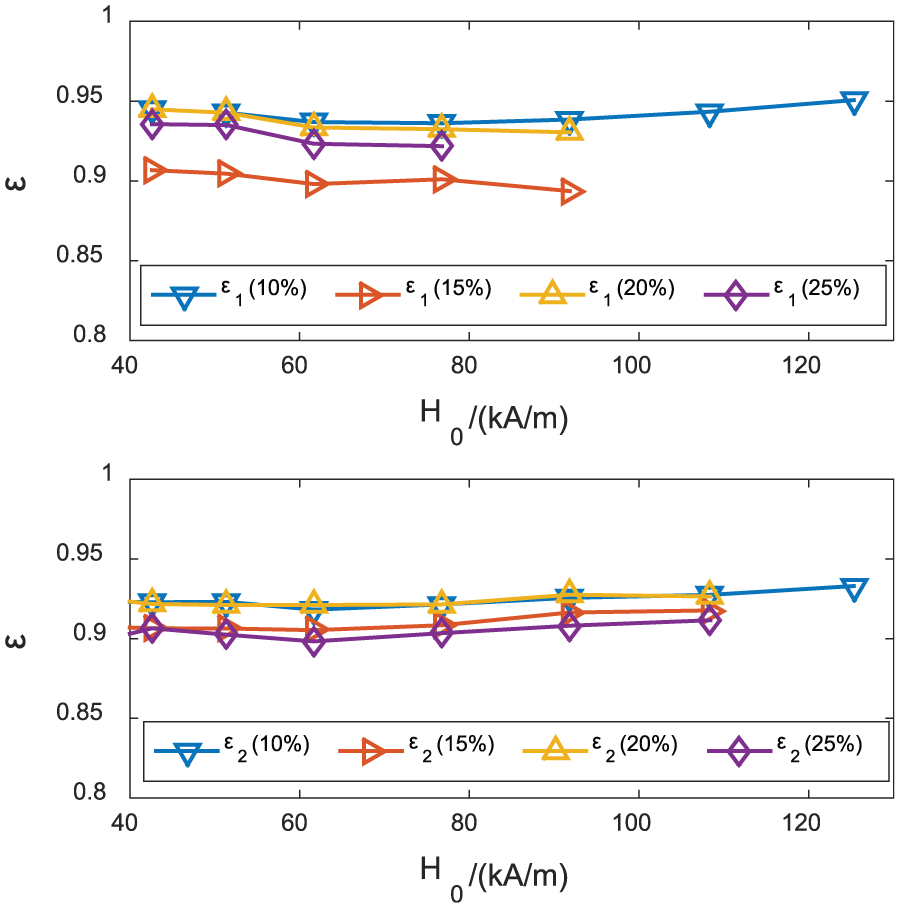
Figure 4 shows the variation of

Variation of

Stress–time curve at constant shear rate 0.01/s of (a) MR1-30 and (b) MR2-30.
In the beginning, samples exclusive of the 30 vol% are discussed. In the initial-reduction regime, the magnetic field is so low that it is hard to build the intact chain model. Thus, the value of

The nonlinear M-H relation of the pure iron.
Thus, the single-chain model area is found based on the value of
Angle distribution σ
Referring to equation (3), static yield stress

where

The relation of
However, checking the regime of MR1-05 below 30.9 kA/m in Figure 7, the value of
Focusing on first-constant regime of

where ai, mi, and bi are constants, and i = 1 or 2 represents MR1 and MR2, respectively. Thus, the

while model of MR2-05 is

The σ of MR1 and MR2.

Figure 8 shows the relationship of

and

The
The value of
The values of a of MR1 and MR2.

Hither, based on the above analysis and experiments, theoretical values of τ0 in the first-constant regime of
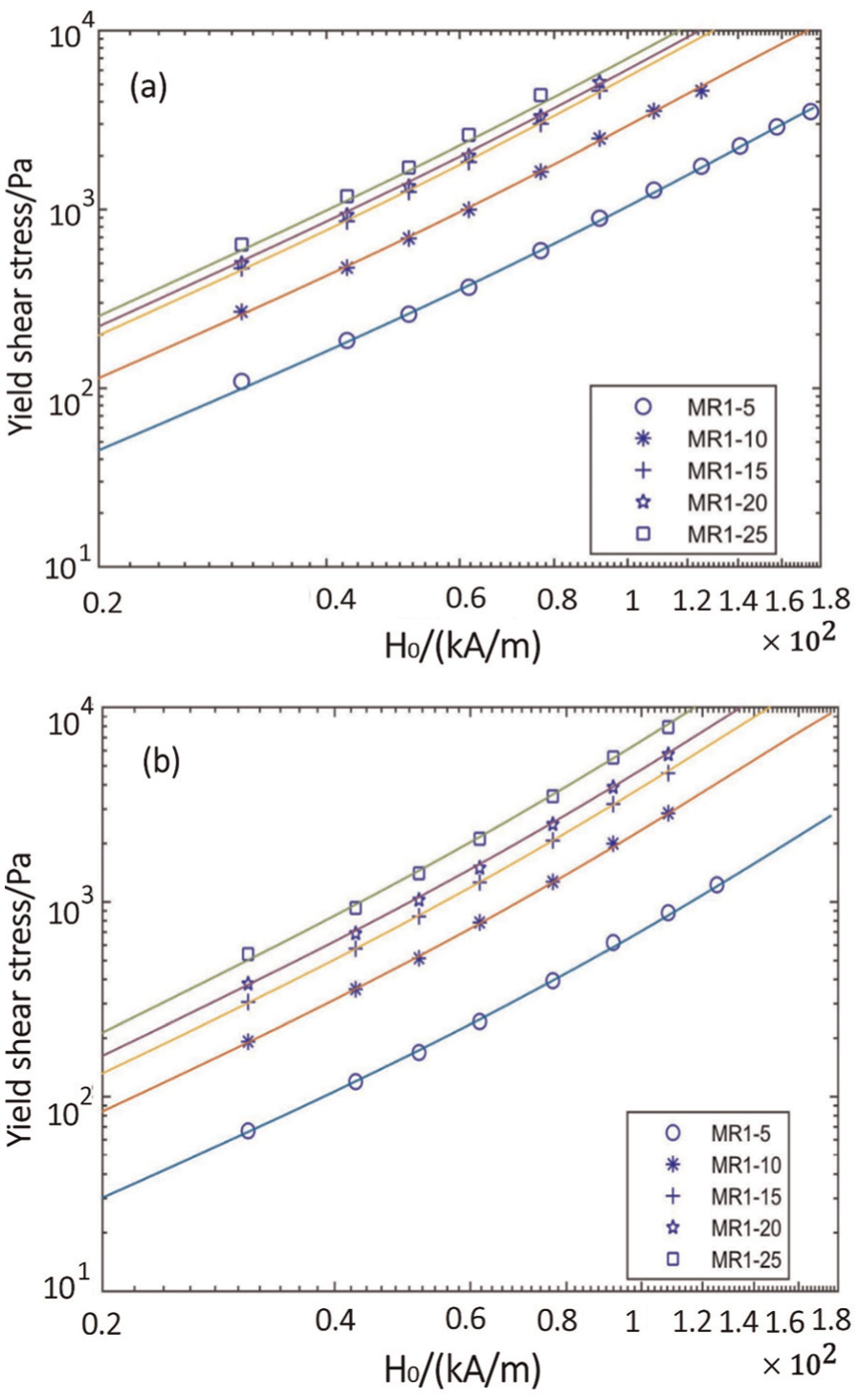
Comparison of the static yield stress of (a) MR1 and (b) MR2 from experimental results and equation (2).
Conclusion
The chain mechanism of ferromagnetic particles based on the magnetic dipole theory can depict the performance of MR material very well. In this study, the model is applied to identify the transition from single-chain model to multi-chain model. Some analysis and experiments are investigated. Some conclusions can be made in the following:
It is possible to identify different chain models of MRF according to the value of yield angle. The existed area of the single-chain model can be found, which is at low external magnetic field and below 30 vol% composition of ferromagnetic particles.
The carrier medium has significant effect on the mechanical properties of MRFs which have different mean value and deviation of the chain distribution.
With ferromagnetic particle content and magnetic field increasing, the whole inclined-angle distributions will be more and more concentrated. Meanwhile, they possess a series of similar mathematic models.
Footnotes
Acknowledgements
We would like to thank the authors of the references for their enlightenment.
Academic Editor: Michal Kuciej
Declaration of conflicting interests
The author(s) declared no potential conflicts of interest with respect to the research, authorship, and/or publication of this article.
Funding
The author(s) disclosed receipt of the following financial support for the research, authorship, and/or publication of this article: This research was financially supported by the National Natural Science Foundation of People’s Republic of China (Project nos 51275539 and 51675063), the Fundamental Research Funds for the Central Universities (No. CDJZR14115501), the Program for New Century Excellent Talents in University (No. NCET-13-0630), and Chongqing University Postgraduates’ Innovation Project (No. CYB15017). These supports are gratefully acknowledged.