




Abstract
Nanopost arrays are generally used in applications of reflection gratings and in changing material surface wettability. Nanopost arrays can be used as a passive component to induce dendritic self-organized hierarchical architectures. In this study, through the use of a phase-field model, we performed a three-dimensional numerical simulation to demonstrate that nanopost structures affect the expanding speed of the surface of a dendritic self-organized structure in the growing path of a hierarchical structure. Additionally, we demonstrated that the nanopost array arrangement on the surface changed the hierarchical structure branching. Finally, introducing an externally applied force to the system enabled the use of a nanopost as an active component. Nanopost surroundings were determined to significantly affect the final distribution of dendritic structures and induce hierarchical structures after an external force was introduced to the system.
Introduction
The formation and control of self-organized architecture on microstructures have recently attracted considerable attention.1–4 Self-assembly technology without external driving forces can assemble molecules of a special nature from a disordered state into an ordered construction. 5 The interest is due to the low cost and the spontaneous self-organization of the formation process. 6 The advantage of self-organization is the predictable spontaneous formation.7,8 However, whether the structures can be formed through appropriate induction remains to be determined.
Researchers are interested in dendritic structures because their hierarchical architecture, which employs the self-organizational process, is commonly observed in various structure formations. The dendritic pattern is the foundation for constructing aspects of living organisms, such as animal blood vessels and leaf venation. These structures play vital roles in any type of transportation system. In recent research, dendritic structures have been applied to increase the sensitivity of biosensors, in addition to being used as template models for biomimic structures.9–12 However, the formation and control of dendritic structures have yet to be researched as fundamental science studies. Numerous people and a large amount of work are still required for implementing the engineering application of biomimic structures.
Research has revealed that the arrangement of nanopost arrays can enable developing a passive component to induce the branching distribution of self-organized dendritic inorganic salt structures. 13 Working on these nanostructure-related topics requires expensive equipment because the fabrication process is difficult. The structural arrangement in nanopost arrays can affect the branching angle distribution in microscale dendritic structures quickly without sufficient and complicated environmental control.
The most difficult part of fabricating self-organized structures is the limit of strategies that can be used for fabrication control. Experimentation has revealed that the arrangement of a nanopost array can affect the branching angle of the dendritic structure. This shows that applying a strategy that entails using a passive component to change the dendritic structure through nanopost array geometric arrangement is possible. The design of nanopost array distribution is still an open topic. However, how these nanoposts become active components and affect the self-organized structure is still unknown.
The self-assembly of a structure typically occurs on a nanoscale. Previous researchers have attempted to form a structure or observe a structure using an extremely accurate instrument and measuring the material properties on a tiny scale. However, in Chang et al.’s 13 research, the self-assembly structure was observable on a microscale, which is relatively large. Dendritic structure formation can be extended to a millimeter scale. This is unique among previous research about self-organized structures. Previous research has used a nanoscale structure to induce the structure formation on a microscale. However, some limitation still exists for observing these structures. The limitations of scanning electron microscopy and transmission electron microscopy are that a vacuum environment is required and that structure observation is generally conducted under a static condition. Thus, a dynamic condition cannot be observed. Only a few indirect experiments can be performed to facilitate speculating how these structures are formed. Particularly, if the structure formation is related to a phase change, such as the concept of liquid turning to solid, employing an instrument and observing the dynamics are difficult. Because of these technical limitations, we performed an independent numerical simulation analysis to contribute toward future basic studies of architecture formation.
In recent years, the phase-field model has been widely used for simulating hierarchical self-organized formation.14,15 In addition to covering the isotropic properties of a hierarchical structure, this model can be coupled with other differential governing forces; this can extend the research of hierarchical structure growth to various types of material. However, the manipulation of the formation method of hierarchical structures is still lacking for engineering purposes. We used the phase-field model as our fundamental model and through simulation investigated the role nanoposts play in structure formation. We sought to study how these nanoposts as passive components influence the hierarchical structure formation. In our simulation, the heat flux was introduced to the edge of the nanoposts to cause them to become active components. According to our simulation results, when these nanoposts became active components, the desired hierarchical structures could be induced.
The main goal of this research was to use an independent three-dimensional (3D) numerical simulation to study how precursor passive geometric structures or active induction can affect the self-organized formation process of dendritic structures. The methods involved in microstructure formation can be mainly categorized into two types. (1) Active: such methods include the employment of an electric field or heat source to control the arrangement of molecules (using an external force to change the morphology of molecules or material). (2) Passive: such methods include the formation of material structures through predesigned components. A self-assembly study can be extensively applied to various nanomaterials to determine the influence of the self-organized process, such as the addition of dielectric particles in the coating solution to form a solid film that can facilitate energy saving. Therefore, a numerical simulation was conducted to study this problem for use in the current and future research.
Numerical methods
Phase-field model
The process of dendritic structure formation is usually involved in two-phase change. The first step of model construction is the process of phase change. The phase-field model is based on the continuum models of phase transitions that have appeared in various research works. The first work using numerical tool to study solidification phenomena is an unpublished derivation by Langer.14,15 We can use a defined phase function
Because the mutual interaction between the formation of dendritic structure and surrounding system is more complicated, we first want to focus our attention on the relevance of formation process of dendritic structure and the geometric arrangement of nanopost arrays. Also, the external driving force urging the phase transition is important, for example, the phase-field model of dendritic structure which is commonly seen in liquid alloy under super cool condition. 16 Based on the above motivation, the phase-field model coupled with the heat transfer is our simulation fundamental. This passive nanopost array and active external heat transfer are two key factors for dendritic architecture growth.
Governing equations
To describe the growth of dendritic structure,


where
Anisotropy in the surface energy and in the kinetics is incorporated via the functional dependence of


where

is the normal direction to the interface. F is the phenomenological free energy defined by Ginzburg–Landau

Here the interface thickness

For computational purpose

The generation of latent heat function

A 3D model of dendritic growth from phase-field model is described in this section. In 3D, the Gibbs–Thomson condition without kinetics simply becomes

where

where the underlying cubic symmetry of the surface energy is expressed by

where



As the part of energy conservation, we assume heat balance affects the solid growth. From general advection–diffusion equation, to any conserved quantity

where

where h is the enthalpy with mixed solid and liquid state

Assume there is no fluid flowing so that liquid velocity

Hence, the final forms of two-dimensional governing equations are


where

Results and discussions
In this work, a commercial package COMSOL
17
Multiphysics software is adopted as our simulation platform and processed in a non-dimensional form. Based on Karma and Rappel’s
14
phase-field model, a 3D partial differential equation model contains phase
Boundary condition and mesh
The whole simulation domain is a circular domain with a radius of 80 units. Since it is only a thin film solidification, the height of the domain is set as 5 units. The computational domain outside boundary is set to zero flux which means there is no energy exchange with outside system. Our work is divided into two parts: in the first part, the relation between nanopost arrays and dendritic self-organization structures is studied; in the second part, a negative heat flux is introduced into nanopost structures to decrease the surrounding temperature and have a mutual interaction with dendritic structures. The average mesh size is 0.5 units, and there are around 2,000,000 meshes in the computational domain.
Choice of interface thickness
A step function is given to the center of the simulation domain for the initial condition, and this region is assigned to be a solid state
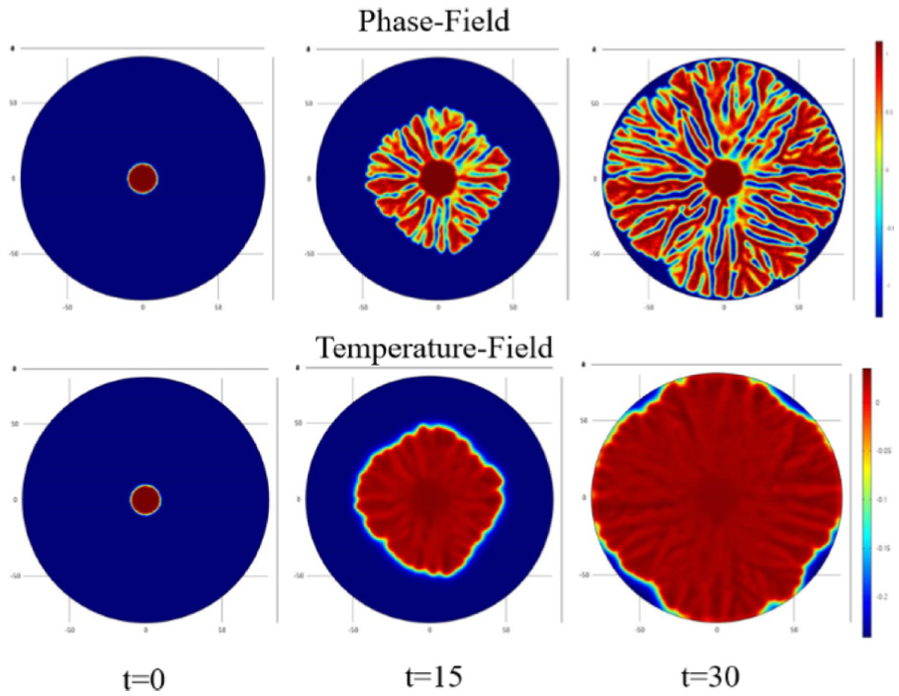
The top view (xy plane) of phase field and corresponding temperature field of the dendritic structure at interface thickness

Dendritic structure at different interface thicknesses: (a)–(c) represent the dendritic structure self-organization growth at the same simulation conditions and the same growth time for
Nanopost array arrangement
To understand how these nanoposts become obstacles in space and how they affect the hierarchal structure formation, specific geometrical structures are added to become space obstacles. Based on the available structures laser interference lithography (LIL) exposure fabrication can create, we chose two different geometric shapes as our obstacles. 13 In Chang et al.’s 13 experiments, nanoposts created by two subsequent periodic exposure of the same ultraviolet (UV) light can be circle (when two lines rotated by an angle, θ = 90°) and elliptical (when two lines rotated by a non 90° angle). Shapes of circle and ellipse are chosen as the obstacles in our simulation. 15 Dendritic structure can only grow in a free space in our simulation. The area of circular and elliptical shapes is forbidden for dendritic structure growth as a space obstacle in analogy to arrays of nanoposts on the substrate. The ratio of major axis and minor axis is fixed at 2 to adjust the spacing for analog LIL double-exposure angle of 28° and 38° nanopost arrays (for all details of nanopost array shape and size, refer to Figure 3). Figure 4 shows the 3D computation domain. Gray part is our computational domain which allows the dendritic structure formation, and the transparent hollow part is the nanopost obstacle which is treated as boundary.

(a) Circular arrays, the diameter of circular is 5 units and spacing is 10 units, (b) ellipse28, the major radius of elliptical is 5 units and minor radius is 1.5 unit, the longitudinal spacing is 20 units and lateral spacing is 9.96 units, and (c) ellipse38 elliptical arrays, the major radius of elliptical is 5 units and minor radius is 2.5 units, the longitudinal spacing is 20 units and lateral spacing is 13.76 units.

Schematic of computation domain: (a) circular nanopost arrays, (b) ellipse28 nanopost array, (c) ellipse38 nanopost array, (d) 3D side view of circular nanopost array, (e) 3D side view of ellipse 28 nanopost array, and (f) 3D side view of ellipse 38 nanopost array.
It is difficult to quantify the branching tendency from our simulation results. However, it is still qualitatively seen from Figure 5(a) that the circular nanopost array positioned regularly and dendritic structure formation followed the preferred anisotropy properties. The dendritic architecture growth starts from the center of the simulation domain and tries to go along the shortest path. Vertical and horizontal dendritic architectures are found near the vertical and horizontal axes. Figure 5(b) shows that the dendritic structure prefers growing at the horizontal direction on the ellipse28 nanopost array surface. From the horizontal axis rotating 76° counterclockwise, there is another identical branching found. In Figure 5(c), because of the larger dislocated displacement between ellipse38 surface, the dendritic structure finds more gaps to grow and shows different patterns compared to previous cases. It clearly shows the dependence of nanopost arrays to dendritic structure which is also in a good agreement with Chang et al.’s 13 experiment though two of them are different systems.

The dendritic self-organization structure at (a) circular nanopost array surface, (b) ellipse28 nanopost array surface, and (c) ellipse38 nanopost array surface.
Effect of the third direction
In our previous research, we treat the whole dendritic structure as a quasi two-dimensional structure. However, in real situation, the dendritic structure is a 3D architecture. To study the effect of nanopost array, we still need the third direction to study the dendritic growth. Figure 6(a)–(c) shows the growing dendritic structures under no nanopost array guidance at t = 0, 2, and 4 s. Figure 6(d) and (e) shows the growing dendritic structures with nanopost array guidance at t = 0, 2, and 4 s. It clearly shows without nanopost array, the dendritic structure is suspended in mid-air and growing. However, under the guidance of nanopost arrays, the dendritic structure will grow along the bottom surface and extend its branch. Also, from Figure 6, the growing speed decreases while there are nanopost arrays behaved as obstacles in space.

Side view of dendritic structure growth: (a) no nanopost at t = 0 s, (b) no nanopost at t = 2 s, (c) no nanopost at t = 4 s, (d) with nanopost at t = 0 s, (e) with nanopost at t = 2 s, and (f) with nanopost at t = 4 s.
Figure 7 shows the phase field of dendritic structure on the surface with circular nanopost arrays at t = 0–15 s. The formation starts from the center of the domain and exceeds to outside. It is found that dendritic structure will pass through the edge of nanopost and keep the structure-preferred direction if there is capable space for growing. It means the formation path on the surface with nanopost structures is longer than the surface without structures.

The phase field of dendritic structure on the surface with circular nanoposts at t = 0–15 s: dendritic structure will pass through the edge of nanopost and keep the structure-preferred direction if there is capable space for growing. Top: top view, Bottom: side view.
Figure 8(a) shows the scanning electromicrograph (SEM) image of self-organization dendritic architecture. 13 It is shown the height of self-organization dendritic structure is about the nanopost height. The formation fills up the gap from the bottom which is also found in our simulation results seen in Figure 8(b).

(a) Scanning electromicrograph (SEM) images of self-dendritic organiztion 13 and (b) phase-field simulation result.
Effect of heat flux
Because of the material anisotropic property, the self-organization dendritic structure is difficult to fill all of the space domain. There will be lots of space which is not filled while dendritic structures grow on the surface with nanopost arrays. When the heat flux is introduced into the boundaries of nanopost arrays, it allows nanostructures to change the surface temperature field. It is seen the more space will be filled by dendritic structures thoroughly as the heat flux introduced into the system. It demonstrates that the dendritic architecture needs external energy to get fulfilled structures when material is anisotropic.
In our phase-field model, the temperature difference between the interface of dendritic structures and surrounding environment is the driving force which drives the self-organization dendritic structure formed. When a negative heat flux is led into the system, it keeps cooling the surface to assure the driving force forming dendritic structure on the surface. In this model, the change of temperature field decided by the nanoposts with introducing heat flux can further induce the distribution of solid phase.
From Figure 9(a)–(d), hollow circle symbol represents the solid phase

Volume fraction with two phases: (a) no heat flux on nanopost arrays, (b) heat flux = −1e−3, (c) heat flux = −1e−2, and (d) heat flux = −1e−1 (hollow circle symbol represents the solid phase
Figure 10 is the self-organization dendritic structure formation with negative heat flux −1e−1 applied at the nanopost arrays at t = 15 s. Comparing with Figure 7, it is found that the gap between nanopost arrays with negative heat flux imposed are more filled up with solidification architecture.

Top view of the self-organization dendritic structure formation enhanced while negative heat flux introduced to the nanopost arrays at t = 15 s.
Conclusion
The simulation results indicate that employing nanoposts as a passive component induced hierarchical structure growth not only through designed distribution but also by becoming an active component through an external driving force to affect the self-organization distribution when a specific mutual interaction was applied to the nanopost surface. We also determined that the formation of dendritic structures is mainly based on anisotropic properties and that the geometric constraint engendered by nanopost arrays is another crucial element to inducing dendritic structure growth. This phase-field 3D simulation clearly demonstrates that the dendritic architecture was suspended in mid-air and grew without nanopost arrays. However, under the guidance of nanopost arrays, the dendritic structure grew along the bottom surface and extended its branches. In summation, when a nanopost is imposed as an external driving force and interacts with a self-organized structure, it further induces the structure.
This work can provide an indicator for the development of smart self-organized architecture. The development of new and even more complex models with different dynamics is an active area of research. The major challenge for future research is to develop models for complex growth processes in which the dynamics of interfaces are driven by more than one physical phenomenon.
Footnotes
Academic Editor: Xiaotun Qiu
Declaration of conflicting interests
The author(s) declared no potential conflicts of interest with respect to the research, authorship, and/or publication of this article.
Funding
The author(s) disclosed receipt of the following financial support for the research, authorship, and/or publication of this article: This work was supported in part by Taiwan National Science Council Grants NSC 102-2622-E-007-015 (C.C.).