




Abstract
This article analyzes the node importance in linear wireless sensor networks, which can be used to identify the key states of nodes that affect the wireless sensor network performance most. First, the sensor energy can be divided into energy of sensing event, energy of transmitting packets, and energy of receiving packets. The node residual energy of after data flow transmission in linear wireless sensor networks from source nodes and relay nodes is evaluated. Second, the node state is divided into four states based on the data packets transmitting. From the view of reliability theory, a data-flow model is analyzed to calculate the state probability of source node and relay node in the time period [0, t]. Third, the node importance is analyzed, and the ranking of node importance values can be used by designers and managers to identify the most important node for improving the wireless sensor network system reliability. At last, a numerical example is given to demonstrate the proposed methods.
Introduction
Advanced developments in wireless communication technology and microelectronic technique encourage the production and wide application of wireless sensor networks (WSNs). To overcome the low-power dissipation of the wireless sensor nodes, the linear WSNs are used to monitor long linear critical structures such as pipelines, rivers, railroads, international borders, and high-power transmission cables.
For the researches on the reliability of WSNs, Mohamed et al. 1 developed an analytical model to provide reliability analysis for linear WSNs. Jawhar et al. 2 studied the classification of the linear WSNs. Wang et al. 3 modeled the reliability of wireless sensor nodes under three different scenarios, contributing toward reliability analysis of WSN systems. Zonouz et al. 4 gave the reliability of two different types of sensor nodes: (1) energy harvesting sensor nodes and (2) battery-powered sensor nodes in single-path routing protocols of WSNs.
In real life, multi-state systems are more realistic. Lots of systems can work even under states which are not functioning perfectly. The node states in WSNs are also multiple, which are identified by receiving and transmitting data packets. Many works have been done to evaluate the multi-state system reliability and performance. Cui and Li 5 discussed the reliability of the multi-state system with dependent components operating in a common random environment. Cui et al. 6 discussed the developments and applications of the finite Markov chain imbedding approach in multi-state systems. Ding et al. 7 proposed a multi-state system structure called hierarchical weighted multi-state k-out-of-n systems. In such a system, the structure of the system can be decomposed into different hierarchical levels. Wang et al. 8 proposed a throttling-inside-piston multi-stage hydraulic cylinder to improve the performance of multi-stage cylinder to achieve rapid and steady extension. Li et al. 9 presented a support vector machine method for structural reliability analysis with multiple limit state functions. The sensor energy can be divided into energy of sensing event, energy of transmitting packets, and energy of receiving packets. 10 When the available energy of a sensor node reduces below a threshold level, the node will lose its function. In order to prolong the lifetime of the WSN, it usually introduces the global power-saving strategy to balance the energy consumption of all nodes. So, it is necessary to identify the key state of nodes to make the effective decision.
Importance measures were first introduced by Birnbaum 11 in 1969. The Birnbaum importance measure gives the contribution of the component reliability to the system reliability. A wide range of importance measures have been introduced since Birnbaum’s work. Ramirez-Marquez and Coit 12 proposed a mean absolute deviation importance measure to incorporate state probabilities into the computation of multi-state reliability importance. To maximize system reliability improvements, Ramirez-Marquez and Coit 13 developed a component allocation heuristic using Monte-Carlo simulation together with the max-flow min-cut algorithm as a means to compute component composite importance measure. Zio et al. 14 modeled the railway network within a multi-state perspective and used importance measures to most effectively improve the performance of the rail network. Natvig et al. 15 presented an importance measure for repairable systems and applied it to an offshore oil and gas production system. Si et al. 16 describe the impact of each component state on the system performance in the multi-state system. Dui et al.17,18 discussed the changes of the system performance due to component failures for the multi-state system lifetime and extended the evaluation from Markov process to Semi-Markov process for multi-state systems.
In this article, the node energy of a data flow in linear WSNs from source nodes and relay nodes is evaluated at first. Based on the data packets transmitting, the node state is divided into four different states. From the view of reliability theory, a data-flow model is analyzed to compute the state probability of source node and relay node in the time period [0, t]. The study results illustrate how the sensor energy affects the node reliability and provide guidance for improving the design of WSNs.
Node state reliability
Here, we consider a data flow with a source node (0), N relay nodes (1, 2, …, N), and a sink node (N + 1) in a linear WSN. The sensor node generates data packets by sensing event and transits the packets to the sink node through the N relay nodes. Except for the sink nodes, all other nodes do not guarantee their functioning over the time and they are normally equipped with low-voltage batteries that limit their lifetime. Without loss of generality, the initial energy available for the source and relay nodes can be denoted as
The definition of the source node
In order to prolong the lifetime, the source node is usually operated in power-saving strategy to save energy consumption. Only one packet is sent to the next relay node for each event. At this strategy, the source node operates either in active mode (i.e. sensing or transmitting) or in sleep mode. Since sensing is an energy-consuming operation, the source node generally has its own duty cycle, for instance 1% which corresponds to 10 µs sensing per second. Thus, the energy consumed by the sensor node to sensing event from time 0 to time t can be given by

The definition of the relay node
To save energy, the relay nodes also operate in power-saving strategy and switch between the sleep mode and the active mode. In most cases, the relay nodes are kept in sleep mode and the radio module is shut off. Under the sleep mode, an analog block stays awake and acts as the radio detector. Once a radio signal is detected, the signal is converted to a control signal which, in turn, is sent to power control electronics to wake up the radio module. So, we only consider the energy consumed while relay nodes are transmitting or receiving in active mode. Similar to the source node, the energy consumed by the packet transmission can be shown as
As we know, WSNs are expected to be deployed in harsh environments characterized by extremely poor and fluctuating conditions. Therefore, all nodes of WSNs are failure-prone, and they may fail independently. Without loss of generality, in this article the component failure rate of each node is assumed to be a power function which we denote by
Analysis of the data-flow model
In this article, the model will be analyzed from the view of reliability theory. The source node and the relay nodes are different, and relay nodes 1, 2, …, n are the same. For the sake of analysis, we only analyze the simple model with source node 0 and relay node 1. As a result, the data-flow model will be regarded as a series system with source node 0 and relay node 1. Obviously, the source node and relay node have a dependent relationship. It is assumed that the series system is studied in the time period [0, t]. At first, the node states are identified as follows:
Failure: state 0;
Normal and without data packets to transmit: state 1;
Normal and with data packets to transmit and the data packets can’t be transmitted: state 2;
Normal and with data packets to transmit and the data packets is transmitted: state 3.
The performance level is the total number of data packets successfully transmitted during [0, t]. Now we will analyze the node state probabilities as follows.
The failure density function of source node caused by environmental factors is as follows

where
The probability of failure-free operation of source node during [0, t] is
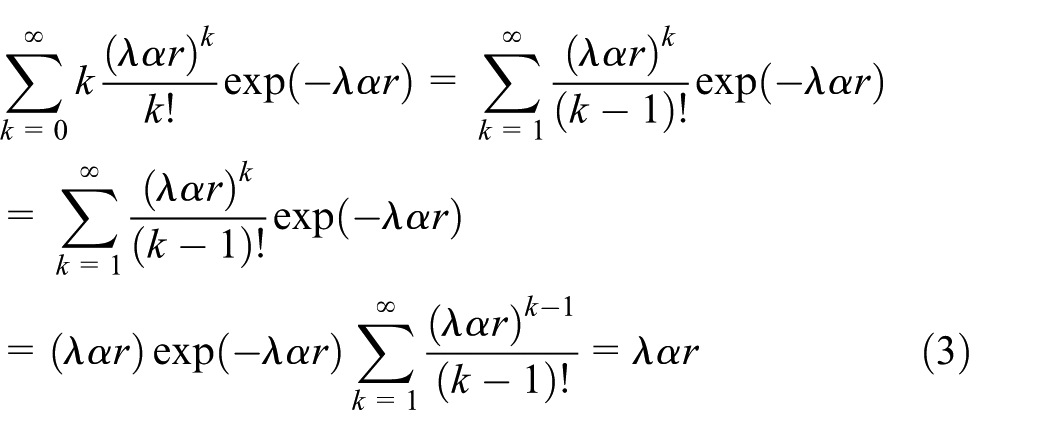
So, we have
As a result, the energy consumption of source node in [0, t] is
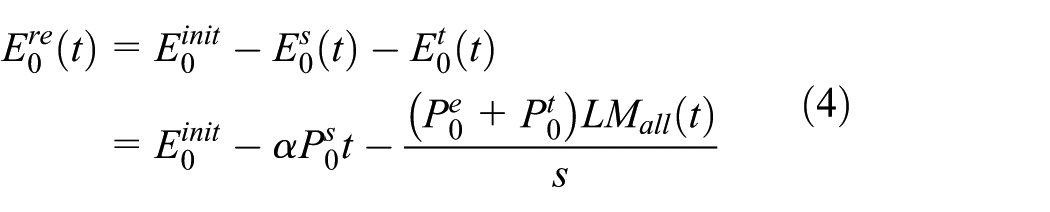
Consequently,
So we have
The
Conversely, failure probability of source node during
The duration of a duty cycle of source node is r, and there will be
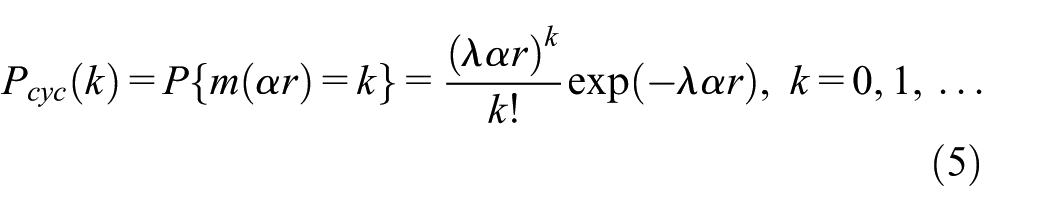
Then, the distribution of the number of data packets sensed by source node 0 during [0, t] is

where

If node n is transmitting a packet to node n + 1, the receiving signal quality can be measured as the received signal-power-to-noise power ratio (SNR) value,

where

The following studies the state probability of relay node. Note that states of source node decide whether relay node works or not. The expectation of data packets sensed by

The residual energy of relay node is

Then

So we have

where

So state probabilities of relay node is as in

where

Then, we have

Node importance analysis
The calculation method of node importance is given based on the works above and the generalized equations of classical importance measures in series systems with only two components as follows: 19
Probability importance


Mean absolute deviation

where
If

Here,

Numerical example
There is a three-node flow data in WSNs, and the initial energy of source node 0 and relay node 1
Parameters of nodes 0 and 1.

In order to calculate the importance of nodes as quickly as possible, the values of

Behavior of
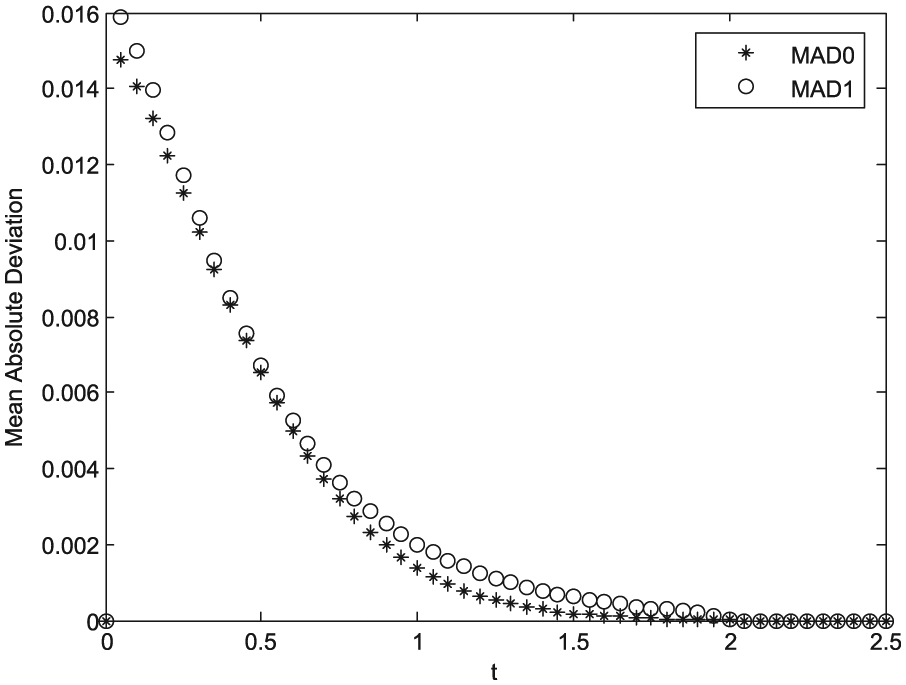
Behavior of

Behavior of
From Figure 1, we can get that
Because
From Figure 3,
Conclusion
This article gives the model of a three-node data flow and proposes the method which evaluates node importance in a data flow in WSNs. A numerical example of a three-node data flow is given to illustrate the process of calculating the state probabilities of nodes and the node importance. The results show that the energy consumed by detecting events affect the node reliability in WSNs, and the node state reliability is related to the distribution of the number of the detecting events.
Footnotes
Academic Editor: Yongming Liu
Declaration of conflicting interests
The author(s) declared no potential conflicts of interest with respect to the research, authorship, and/or publication of this article.
Funding
The author(s) disclosed receipt of the following financial support for the research, authorship, and/or publication of this article: The authors gratefully acknowledge the financial support for this research from the National Natural Science Foundation of China (Grant no. 71401016) and the Fundamental Research Funds for Central Universities of Chang’an University (Grant nos 310822161001 and 310822161016).