



Abstract
In this work, an eigenfunction expansion approach is used to study the dynamic response of a cable-stayed bridge excited by a continuous sequence of identical, equally spaced moving forces. The nonlinear dynamic response of the cable-stayed bridge is obtained by simultaneously solving nonlinear and linear partial differential equations that govern transverse and longitudinal vibrations of stay cables and transverse vibrations of segments of the deck beam, respectively, along with their boundary and matching conditions. Orthogonality conditions of exact mode shapes of the linearized cable-stayed bridge model are employed to convert the coupled nonlinear partial differential equations of the original nonlinear model to a set of ordinary differential equations by using the Galerkin method. The dynamic response of the cable-stayed bridge is numerically solved. Convergence of the dynamic response from the Galerkin method is investigated. Effects of close natural frequencies, mode localization, the distance between any two neighboring forces, and geometric nonlinearities of stay cables on the forced dynamic response of the cable-stayed bridge are captured using a convergent modal truncation.
Keywords
Introduction
Dynamic vehicle–bridge interaction (VBI) problems have attracted much attention of investigators for over a century.1–4 Researchers focused on the development of models of vehicle–bridge systems and computational methods, which were mainly dependent on the power of computers at that time. Most earlier studies associated with VBI problems focused on very basic and simple cases, where moving force or moving mass models were considered with basic beam models.1–4 The basic beam models were described by partial differential equations, and their analytical or closed-form solutions are available.
In the past decades, cable-stayed bridges have been widely used all over the world due to their economic advantages and aesthetic qualities. Many studies have focused on VBI problems of cable-stayed bridges since this type of bridges can exhibit interesting dynamic behaviors, such as energy transfer between different vibration modes and the beating phenomenon. 5 With the advent of high-speed computers, computationally efficient numerical techniques have been developed to model and analyze VBI problems of complex cable-stayed bridges. The finite element method is one of the most versatile numerical methods used by most researchers. However, the finite element method is time-consuming and inconvenient for parameter studies due to large numbers of elements and amount of input data. Hence, the modal superposition method was used to study dynamic behaviors of VBI problems formulated by finite element models, which truncated higher vibration modes and considerably reduced numbers of equations.4,6–9 For instance, Madrazo-Aguirre et al. 9 employed this method to conduct dynamic analysis of an under-deck cable-stayed bridge with steel-concrete composite decks subjected to a moving load. On the other hand, due to much computational time and model complexity, new strategies such as a substructure method were developed to model complex bridge structures.10–14
Close natural frequencies and mode localization often occur in complex structures that are composed of several components. Pierre 15 found that mode shapes are strongly localized in nearly periodic structures with weak coupling. Wei and Pierre16,17 found the same phenomenon in shrouded blade assemblies with cyclic symmetry. Natsiavas 18 used a perturbation method to investigate the mode localization phenomenon in a 2 degree-of-freedom damped linear oscillator. Further investigations of similar systems were performed in Balmes. 19 Cao et al. 20 studied the free vibration of a cable-stayed bridge that consists of a simply supported four-cable-stayed deck beam and two towers for various symmetrical and non-symmetrical bridge cases with regard to sizes of components of the bridge and initial sags of cables and found that there are very close natural frequencies when the bridge model is symmetrical and/or partially symmetrical, and mode shapes tend to be more localized when the bridge model is less symmetrical.
As mentioned by Wei and Pierre, 17 neglecting the localization phenomenon caused by small mistuning may lead to qualitative errors in the forced response of a periodic structure. However, to the authors’ best knowledge, effects of closed natural frequencies and mode localization on the vehicle-induced vibration of the cable-stayed bridge have not been investigated. Dynamic analysis of a beam excited by a sequence of moving mass loads has attracted many researchers21–24 since it has many practical applications such as a train traveling on a railroad track.
In this work, an eigenfunction expansion approach is used to study the dynamic response of a cable-stayed bridge subjected to a continuous sequence of identical, equally spaced vehicles traveling at a constant speed across the bridge deck. For simplicity, the vehicles are modeled as moving forces. Geometric nonlinearities of stay cables are taken into consideration. Nonlinear and linear partial differential equations that govern transverse and longitudinal vibrations of the stay cables and transverse vibrations of segments of the deck beam, respectively, are derived, along with their boundary and matching conditions. The exact natural frequencies and mode shapes of the linearized undamped cable-stayed bridge model are used to spatially discretize partial differential equations of the original nonlinear cable-stayed bridge model with damping. The dynamic response of the cable-stayed bridge is obtained by solving the resulting nonlinear ordinary differential equations (ODEs) via a numerical method. Convergence of the Galerkin method for the dynamic response of the cable-stayed bridge subjected to a continuous sequence of moving forces is investigated. Effects of closed natural frequencies, mode localization, the distance between any two neighboring forces, and geometric nonlinearities of stay cables on the forced dynamic response of the cable-stayed bridge are captured using a convergent modal truncation.
Problem formulation
As shown in Figure 1, a cable-stayed bridge consists of a simply supported four-cable-stayed deck beam and two towers subjected to a continuous sequence of moving concentrated forces. The deck beam consists of seven segments separated by its junctions with the stay cables and towers. The following assumptions are made in the formulation of the vibration problem of the cable-stayed bridge model subjected to a continuous sequence of moving forces: (1) the cable-stayed bridge is modeled as a planar system. (2) Both the cables and the deck beam are considered as a homogeneous one-dimensional continuum having linear elastic behaviors. (3) The two towers, to which the stay cables are attached, are built on a hard rock foundation and can be assumed to be rigid;20,25 they are connected to the deck beam through roller supports. (4) The concentrated forces are equally spaced and have the same amplitude, moving from the left end of the deck beam to its right end; the initial displacement and velocity of the stay cables and deck beam are all zeros.
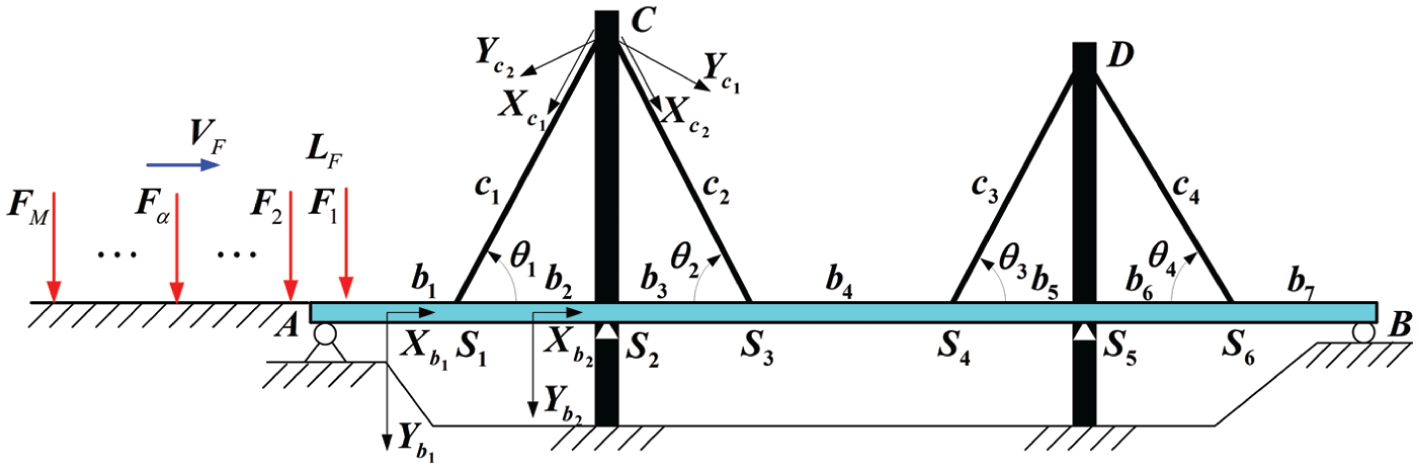
Schematic of a cable-stayed bridge that consists of a simply supported four-cable-stayed deck beam and two rigid towers, subjected to a continuous sequence of identical, equally spaced moving forces.
The four stay cables are anchored to the deck beam at junctions S1, S3, S4, and S6, and the two towers are connected to the deck beam at junctions S2 and S5. The junctions S1, S2, …, S6 divide the deck beam into seven segments b1, b2, …, b7. The length, mass per unit length, elastic modulus, and cross-sectional area of the stay cable
Let
The following nondimensional variables are introduced

where

where

respectively.
The Newtonian method is used to derive both the nonlinear equations of motion of the cable-stayed bridge model and a full set of boundary and matching conditions. Assuming that cable longitudinal inertial forces


where a prime and dot denote differentiation with respect to nondimensional local abscissae

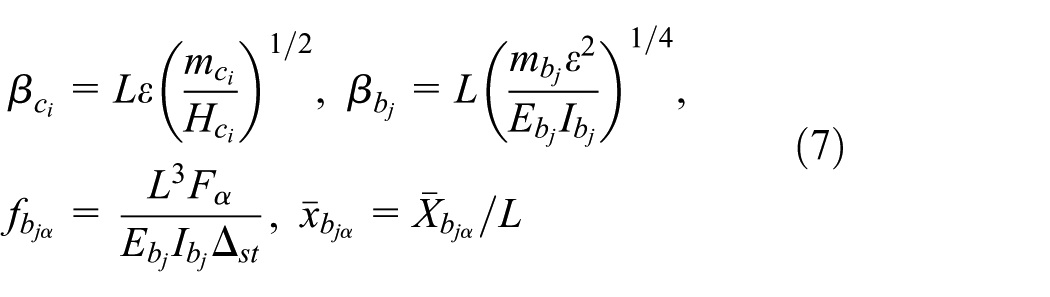
in which

The functions




The matching conditions at the junction



The matching conditions at the junction



Equations (4) and (5) together with the boundary and matching conditions in equations (9)–(19) describe the nonlinear forced vibration of the cable-stayed bridge. The equations governing the small amplitude free vibration of the cable-stayed bridge can be obtained by linearizing equations (4)–(19) and neglecting the structural damping and external loadings in the neighborhood of the equilibrium configuration. The rth undamped natural frequency
Solution method
The Galerkin method is used to analyze the vibration of the cable-stayed bridge. The dynamic response of the stay cable


where
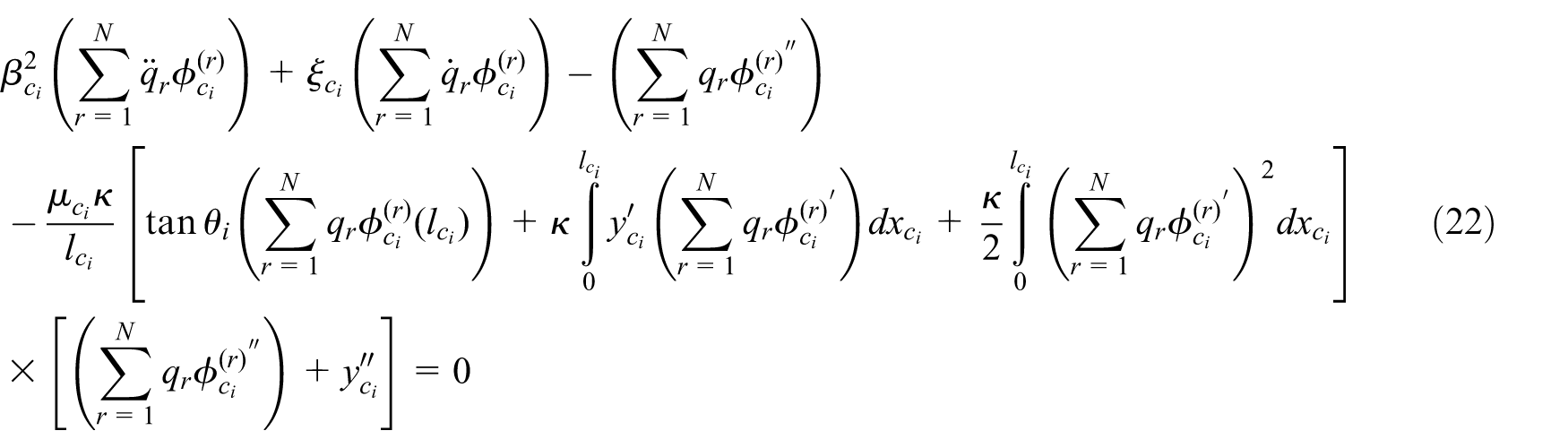
Substituting equation (21) into equation (5) and recalling equations (1) and (7)–(8), one has

Multiplying equation (22) by
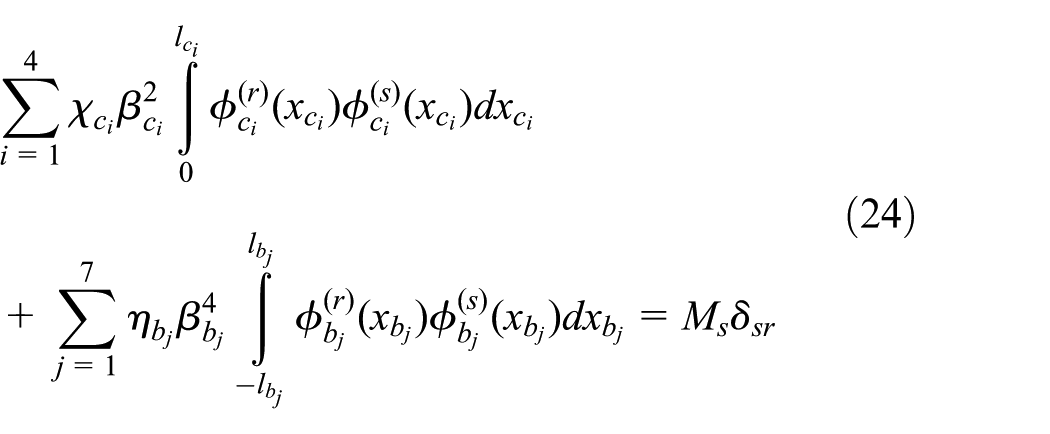

where

where


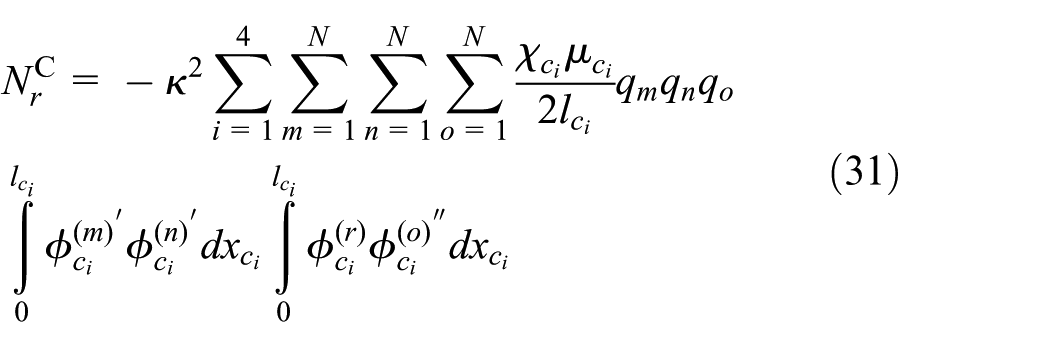

respectively. Equation (26) is a set of nonlinear, coupled second-order ODEs. If one ignores the geometric nonlinearities of the stay cables, then equations (30) and (31) become
Numerical results and discussion
Geometric and physical parameters of a cable-stayed bridge are listed in Table 1. The first 20 natural frequencies of the cable-stayed bridge and their corresponding mode shapes are calculated using the method in Cao et al.
20
and listed in Figure 2. It can be seen that symmetrical and anti-symmetrical mode shapes alternatively occur since the bridge model is symmetrical. An index
Geometric and physical parameters of the cable-stayed bridge.


The first 20 natural frequencies of the cable-stayed bridge and their corresponding mode shapes.
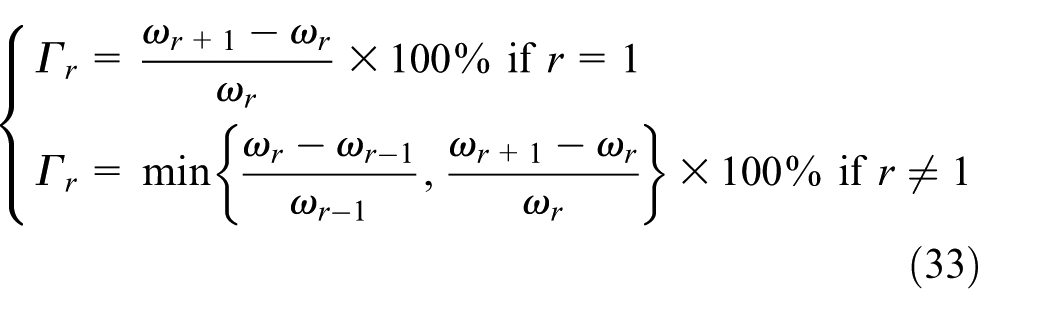
An index

The degree of localization of the rth mode shape of the deck beam can be measured by
The degrees of localization of the mode shapes of different components and the closeness degrees of the natural frequencies.

When the distance between any two neighboring forces (LF) is 30 m, the transverse displacement of the mid-point of the deck beam with two different velocities (VF) of the moving forces, namely, VF = 17 m/s and VF = 100 m/s are shown in Figure 3(a) and (b), respectively. The number of Galerkin truncation terms is set to 10, 20, and 50. The results presented in Figure 3 and other results for a large number of cases that are not reported here for the sake of brevity show that Galerkin truncation with 20 terms yields rather accurate results for the dynamic response of the cable-stayed bridge subjected to a continuous sequence of moving forces when the value of LF is larger than 30 and the value of VF is smaller than 100. In the following numerical examples, the first 20 modes of the linearized undamped cable-stayed bridge model are used in the Galerkin method.

Dynamic response of the mid-point of the deck beam for different numbers of Galerkin truncation terms when LF = 30 m: (a) VF = 17 m/s and (b) VF = 100 m/s.
For
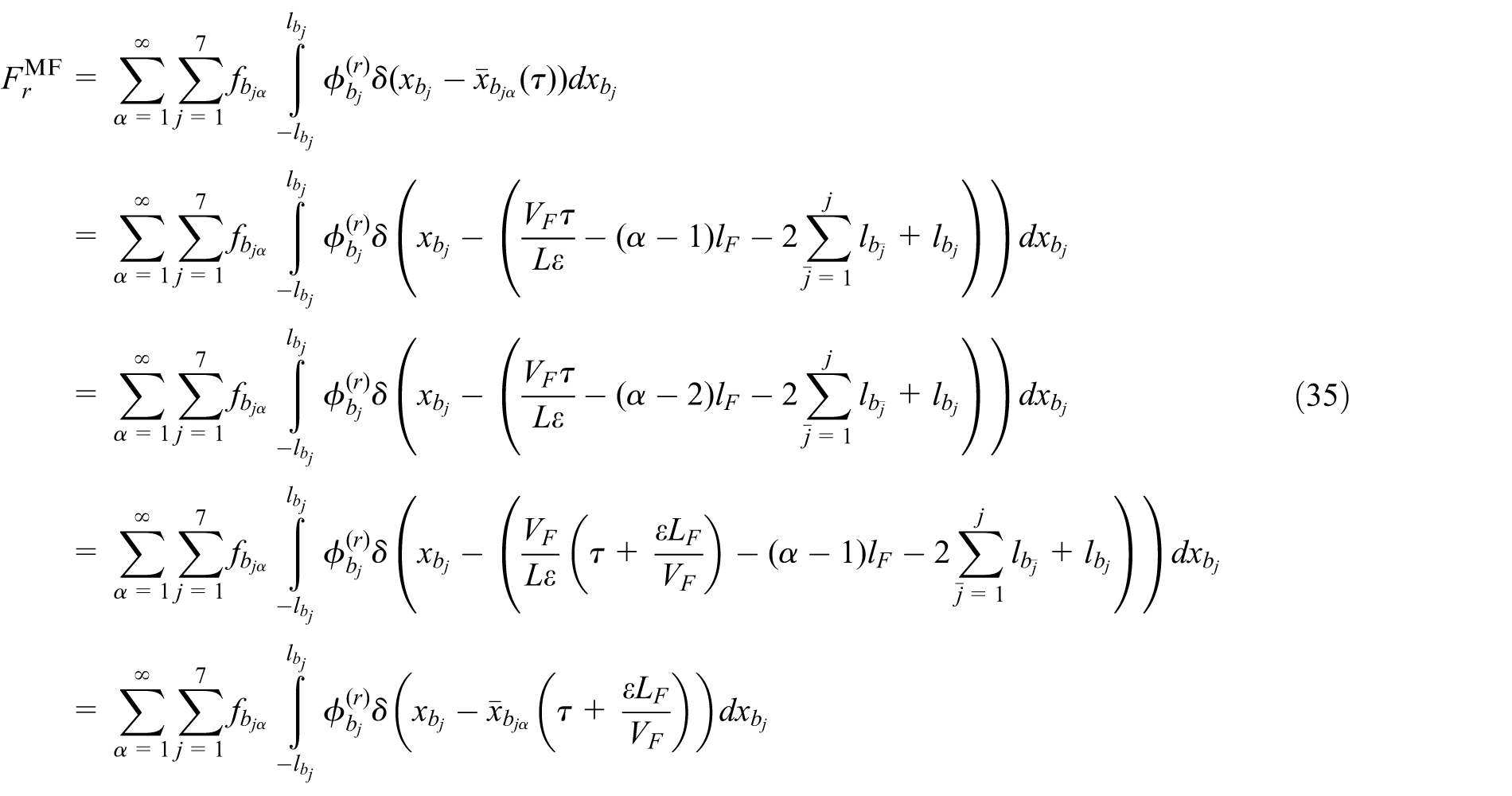
a continuous sequence of identical, equally spaced moving forces can be regarded as a periodic force with a nondimensional period T that equals to εLF/VF. Hence, resonance may occur if the moving velocity of the forces is

Amplitude of the steady-state response of the mid-point of the deck beam versus the velocity of the moving forces; LF = 30 m. A vertical dashed line indicates that resonance occurs when the velocity of the moving forces is that shown in the expression near it there.
Values of the first 20 resonant velocities when LF = 30 m.

Resonance can also occur when the velocity of the moving forces is the product of a unit fraction and a resonant velocity, which can be seen from the peaks when the velocity of the moving forces is Vω1/2, Vω1/3, Vω13/2, and Vω19/4 on the linear solutions in Figure 4. The reason for this lies in the fact that there are higher harmonics with frequencies equal to integer multiples of the fundamental frequency 2π/T in the Fourier series

for the periodic force
Figure 5 shows the amplitude of the steady-state response of the mid-point of the deck beam versus the distance between any two neighboring forces when the velocity of moving forces is the first resonant velocity. It can be seen that there are a critical distance LF = 193 m. In the region LF < 193 m, the amplitude of the steady-state response of the mid-point of the deck beam generally increases with LF and in the region LF > 193 m decreases with LF. However, there are fluctuations at some LF. It can also be seen from Figure 5 that the geometric nonlinearities of the stay cables have some influence on the dynamic response of the cable-stayed bridge.

Amplitude of the dynamic response of the mid-point of the deck beam versus the distance between any two neighboring forces.
Conclusion
The dynamic behavior of a cable-stayed bridge that consists of a simply supported four-cable-stayed deck beam and two rigid towers subjected to a continuous sequence of identical, equally spaced forces moving at a constant velocity has been investigated. The dynamic response of the cable-stayed bridge is calculated using the Galerkin method via MATLAB. Some conclusions from the numerical simulation are as follows: (1) the moving forces with a resonant velocity corresponding to a mode of the cable-stayed bridge, whose natural frequency is close to those of its neighboring modes and whose mode shape is localized on the stay cables, cannot excite the vibration of that mode. This means that modes with close natural frequencies, whose mode shapes are localized on stay cables, play a minor role in the dynamic response of the cable-stayed bridge. (2) The geometric nonlinearities of stay cables can generally have some influence on the dynamic response of the cable-stayed bridge, but have almost no influence on that when the velocity of the moving forces is around the resonant velocity corresponding to a mode whose mode shape is localized on the deck beam. (3) Resonance can also occur when the velocity of the moving forces is the product of a unit fraction and a resonant velocity. (4) There is a critical distance between any two neighboring forces below which transverse displacements of the cable-stayed bridge generally increase with the distance.
Footnotes
Academic Editor: Nikolaos Nikitas
Declaration of conflicting interests
The author(s) declared no potential conflicts of interest with respect to the research, authorship, and/or publication of this article.
Funding
The author(s) disclosed receipt of the following financial support for the research, authorship, and/or publication of this article: This work was supported by the National Natural Science Foundation of China under Grant Nos 11302087 and 11442006, Natural Science Foundation of Jiangsu Province under Grant No. BK20130479, Research Foundation for Advanced Talents of Jiangsu University under Grant No. 13JDG068, and National Science Foundation under Grant No. CMMI-1000830.