In this article, we consider the identification problem of a class of nonlinear multiple-input single-output output-error autoregressive systems. First, a recursive generalized least squares algorithm using the auxiliary model identification idea is developed. Then, using the filtering technique, the identification model is decomposed into a filtered sub-identification model and a noise sub-identification model. For solving the difficulties that the filter is unknown and the information vectors contain the unknown variables, the interactive estimation theory and the the idea of replacing the unknown variables with their corresponding estimates are employed: the recursive least squares method is again used for identifying the system and noise model parameters, and the parameter estimates of the noise model are used to construct the estimated filter. Finally, a nonlinear example is given to verify the effectiveness of the algorithms, and the simulation results show that the recursive least squares algorithm using the filtering technique can produce more accurate parameter estimates under larger noise variances.
Nowadays, a wide range of recursive parameter estimation methods have been developed for system identification such as recursive least squares methods,1,2 gradient methods,3,4 Kalman filtering methods,5–7 and Newton methods.8–10 Compared with the gradient methods, recursive least squares methods take advantage of fast convergence rates, but when the system is contaminated by the colored noises, the performance of these methods, such as estimation accuracy, will decline if the colored noises are not well handled. One way to improve the estimation accuracy under the noise environment is to include the noise information into the information vector. Based on that idea, the recursive extended least squares algorithms and the recursive generalized least squares algorithms have been developed for identifying the parameters of linear systems and nonlinear systems. For example, Wang11 presented a hierarchical parameter estimation algorithm for a class of multiple-input multiple-output (MIMO) Hammerstein systems based on the reframed models, and Wang and Zhang12 improved the least squares identification algorithm for multivariable Hammerstein systems. Hu et al.13 proposed a recursive extended least squares algorithm for Wiener nonlinear systems with moving average noises.
The filtering technique is effective in noise reduction and has been applied in various areas,14 including fault detection,15 signal processing,16–18 acoustic echo cancellation,19 and filter design.20–22 Recently, a multi-innovation stochastic gradient identification algorithm has been presented for Hammerstein-controlled autoregressive autoregressive systems based on the filtering technique;23 an auxiliary model-based least squares algorithm has been presented for a dual-rate state-space system with time-delay using the data filtering.24
Multiple-input single-output (MISO) systems are a special class of multivariable systems,25,26 which have various applications in the industrial processes, communication systems,27,28 and so on. In the literature, in order to improve the convergence rate, Liu developed a stochastic gradient algorithm for MISO systems using the multi-innovation theory.29 The least square–based algorithms for identifying MISO systems can be found in Zhang.30 In this work, we extend the previous work from considering the identification problems for a class of single-input single-output (SISO) linear-in-parameter systems31,32 to MISO linear-in-parameter systems with the autoregressive noises and propose a recursive least squares algorithm using the data filtering technique. For the purpose of comparison, an auxiliary model-based recursive generalized least squares algorithm is developed. The simulation results show that the filtering-based least squares algorithm can provide more highly accurate parameter estimation under the colored noises.
The rest of the article is organized as follows. Section “Problem formulation” introduces a class of linear-in-parameter MISO autoregressive systems and derives the identification model. Section “Recursive generalized least squares algorithm” proposes a recursive generalized least squares algorithm using the auxiliary model idea. Section “Filtering-based recursive least squares algorithm” presents a recursive least squares algorithm using the data filtering technique. Section “Example” provides an illustrative example to show the effectiveness of the algorithms. Finally, concluding remarks are given in section “Conclusion.”
Problem formulation
Let us define some symbols. The symbol denotes an identity matrix of order n; denotes an n-dimensional column vector whose elements are 1; the superscript T denotes the matrix/vector transpose.
Consider the following MISO stochastic system shown in Figure 1
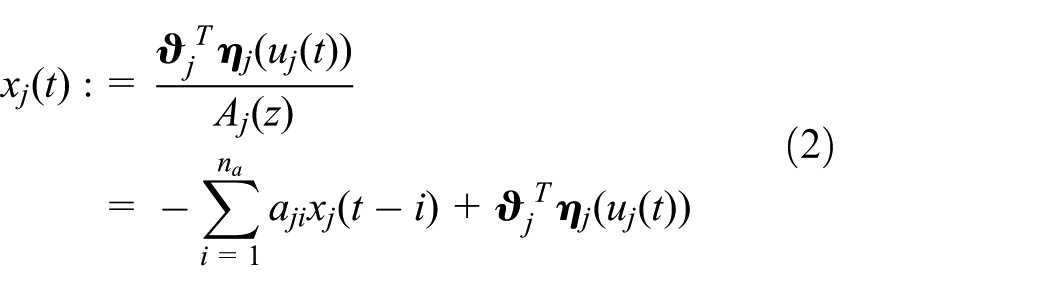
where is the system output, are the system inputs, is the stochastic white noise with zero mean. and are polynomials, of known orders , in the unit backward shift operator , and defined by
where , , and are the unknown parameters to be estimated. Note that system (1) represents a class of linear-in-parameter systems. When is a linear function of and , system (1) reduces to a linear MISO output-error system.29 In this work, we assume that is a nonlinear function of , for example
In the next paragraph, we develop new identification algorithms for estimating the parameter vector and the parameters of and for system (1) by utilizing the input-output measured data . Without loss of generality, assume that , , and for .
Equation (6) is the identification model of system (1), and parameter vector consists of all the parameters of the system. In order to further develop the filter-based algorithms, in next section, we first introduce the recursive generalized least squares algorithms using the auxiliary model identification idea.
Recursive generalized least squares algorithm
Define a quadratic criterion function
Minimizing and letting the partial derivative of with regard to be zero, we obtain the least squares estimate of
In order to recursively compute , we define the covariance matrix and the vector as
The recursive algorithm (9)–(11) cannot be implemented because the intermediate variables and in are unknown. To deal with the difficulties, we adopt the auxiliary model identification idea.31 Let and be the estimates of and at time t, substituting into and into , we can construct the estimated vectors and , and form . Replacing in equation (4) with its estimate , we can compute through
Replacing on the right-hand side of the above equation with their estimates , we can compute through
Replacing in equations (9)–(11) with its estimate , we can summarize the following auxiliary model-based recursive generalized least squares algorithm for identifying (the MISO-AM-RGLS algorithm for short)
To initialize the algorithm (12)–(20), we set , , and for , and , .
Filtering-based recursive least squares algorithm
Define the filtered variables
and the filtered information vectors
System (1) can be rewritten as
Multiplying both sides of the above equation by gives
Equations (4) and (21) are the noise identification model and the filtered identification model of system (1), respectively. Minimizing two quadratic cost functions
leads to the following recursive parameter updates
Equations (22)–(27) cannot be implemented because the filtered vector is unknown due to the unknown filter and the noise items in is unmeasurable. Here, we employ the interactive estimation theory and the idea of replacing the unknown items with their corresponding estimates. Let , , and be the estimates of the parameters , , and , and and be the estimates of and . Define the estimated information vectors
Then, we compute the estimates of the filtered variables and through
and form the estimates of the filtered information vectors
Replacing in equations (23) and (24), in equations (26) and (27), in equation (23), and in equation (26) with their corresponding estimates , , , and leads to the following filtering-based least squares algorithms for identifying and (the MISO-F-RLS algorithm for short)
The steps of computing and involved in the algorithm are summarized as follows:
An example is given to demonstrate the effectiveness of the proposed algorithms. Consider the following nonlinear MISO autoregressive system
Here, the inputs and are taken as uncorrelated persistent excitation signal sequences with zero means and unit variances , and as a white noise sequence with zero mean.
Using data and applying the MISO-AM-RGLS algorithm in equations (12)–(20) and the MISO-F-RLS algorithm in equations (32)–(46) to estimate the parameters of this system, we have the parameter estimates of each algorithm and their errors shown in Table 1. The parameter estimation errors of each algorithm are illustrated in Figure 2. We also investigate the performance of two algorithms under a relatively high noise level with noise variance , and the corresponding simulation results are shown in Table 2 and Figure 3.
Parameter estimates and errors of two algorithms ().
Algorithm
t
MISO-AM-RGLS
100
−0.40225
1.88121
−0.39152
1.51705
0.45924
7.67723
200
−0.43206
1.86657
−0.42636
1.50374
0.44105
8.72618
500
−0.38271
1.88901
−0.45826
1.50328
0.48582
8.95445
1000
−0.37510
1.88141
−0.42254
1.54181
0.43925
6.91840
2000
−0.38450
1.90960
−0.39575
1.57727
0.45323
5.28890
3000
−0.37168
1.91495
−0.38149
1.63437
0.43828
2.98169
MISO-F-RLS
100
−0.43547
1.81912
−0.40881
1.49686
0.36082
9.74465
200
−0.45862
1.82965
−0.43603
1.54089
0.38822
8.59276
500
−0.40191
1.85752
−0.46840
1.58530
0.45769
6.83482
1000
−0.38905
1.86563
−0.43613
1.62300
0.41933
4.87697
2000
−0.39383
1.89119
−0.40581
1.65900
0.43787
2.95343
3000
−0.38217
1.90506
−0.39399
1.71096
0.42758
1.47377
True values
−0.37000
1.92000
−0.36000
1.71000
0.43000
Estimation errors versus t ().
Parameter estimates and errors of two algorithms ().
Algorithm
t
MISO-AM-RGLS
100
−0.40998
1.83268
−0.40413
1.37836
0.45969
13.14586
200
−0.48425
1.80825
−0.47401
1.34306
0.43978
15.66428
500
−0.39221
1.85506
−0.54720
1.31548
0.48580
16.76624
1000
−0.37927
1.84093
−0.47480
1.39148
0.43886
13.09249
2000
−0.39923
1.89834
−0.42556
1.45855
0.45334
9.91290
3000
−0.37302
1.90946
−0.39826
1.56997
0.43839
5.48722
MISO-F-RLS
100
−0.46335
1.80848
−0.43694
1.32093
0.43259
15.89646
200
−0.51580
1.78277
−0.48750
1.40339
0.42127
14.59524
500
−0.41998
1.81901
−0.52449
1.49352
0.47407
11.19835
1000
−0.39289
1.82251
−0.46778
1.54505
0.43058
8.31758
2000
−0.40320
1.87261
−0.41948
1.58831
0.44654
5.57759
3000
−0.37874
1.89413
−0.39523
1.68482
0.43475
1.93488
True values
−0.37000
1.92000
−0.36000
1.71000
0.43000
Estimation errors versus t ().
From Tables 1 and 2 and Figures 2 and 3, we can draw the following conclusion:
The parameter estimation errors are becoming smaller as t increases.
Both algorithms can provide high-accuracy parameter estimation, and the filtered algorithm achieves better estimation accuracy over the non-filtered algorithm under different noise variances.
Conclusion
In this article, we have presented two recursive least squares algorithms, an auxiliary model-based generalized least squares algorithm, and a filtered recursive least squares algorithm for a class of nonlinear MISO output-error autoregressive systems. The illustrative example shows that the filtering-based least squares algorithm can produce more highly accurate estimates over the recursive generalized least squares algorithm. The proposed methods can be extended to nonlinear systems with colored noise32–35 and applied to other fields.36–38
Footnotes
Academic Editor: Umberto Berardi
Declaration of conflicting interests
The author(s) declared no potential conflicts of interest with respect to the research, authorship, and/or publication of this article.
Funding
The author(s) disclosed receipt of the following financial support for the research, authorship, and/or publication of this article: This research work was supported by the National Science Foundation for Young Scientists of China (grant no. 61603156), Open Projects of the State Key Laboratory (grant no. RCS2016K008), Science Foundation for Young Scientists (grant no. JUSRP115A26), and Jiangsu province prospective research project (grant no. BY2015019-29).
References
1.
ChuZHuJ.An improved recursive least square–based adaptive input shaping for zero residual vibration control of flexible system. Adv Mech Eng2016; 8: 1–14.
2.
DingFWangXChenQ. Recursive least squares parameter estimation for a class of output nonlinear systems based on the model decomposition. Circ Syst Signal Process2016; 35: 3323–3338.
YoonYJLiKHHLeeJS. Real-time precision pedestrian navigation solution using inertial navigation system and global positioning system. Adv Mech Eng2015; 7: 1–9.
6.
ShiYFangH.Kalman filter-based identification for systems with randomly missing measurements in a network environment. Int J Control2010; 83: 538–551.
7.
PanJYangXCaiH. Image noise smoothing using a modified Kalman filter. Neurocomputing2016; 173: 1625–1629.
8.
XuL.A proportional differential control method for a time-delay system using the Taylor expansion approximation. Appl Math Comput2014; 236: 391–399.
9.
XuL.Application of the Newton iteration algorithm to the parameter estimation for dynamical systems. J Comput Appl Math2015; 288: 33–43.
10.
XuLChenLXiongW.Parameter estimation and controller design for dynamic systems from the step responses based on the Newton iteration. Nonlinear Dynam2015; 79: 2155–2163.
11.
WangD.Hierarchical parameter estimation for a class of MIMO Hammerstein systems based on the reframed models. Appl Math Lett2016; 57: 13–19.
12.
WangDZhangW.Improved least squares identification algorithm for multivariable Hammerstein systems. J Frankl Inst2015; 352: 5292–5307.
13.
HuYLiuBZhouQ. Recursive extended least squares parameter estimation for wiener nonlinear systems with moving average noises. Circ Syst Signal Process2014; 33: 655–664.
14.
DingFLiuXMaX.Kalman state filtering based least squares iterative parameter estimation for observer canonical state space systems using decomposition. J Comput Appl Math2016; 301: 135–143.
15.
ChenJMaCSongD. Failure prognosis of multiple uncertainty system based on Kalman filter and its application to aircraft fuel system. Adv Mech Eng2016; 8: 1–13.
16.
MateoJTorresAGarcíaMA. Robust Volterra filter design for enhancement of electroencephalogram signal processing. Circ Syst Signal Process2013; 32: 233–253.
17.
LeeBMKimY.An adaptive clipping and filtering technique for PAPR reduction of OFDM signals. Circ Syst Signal Process2013; 32: 1335–1349.
18.
LiZGMaZH.A new approach for filtering and derivative estimation of noisy signals. Circ Syst Signal Process2014; 33: 589–598.
19.
MahbubUFattahSA.A single-channel acoustic echo cancellation scheme using gradient- based adaptive filtering. Circ Syst Signal Process2014; 33: 1541–1572.
20.
ZhaoSShmaliyYSHuangB. Minimum variance unbiased FIR filter for discrete time-variant systems. Automatica2015; 53: 355–361.
21.
ZhaoSHuangBLiuF.Linear optimal unbiased filter for time-variant systems without apriori information on initial conditions. IEEE T Automat Contr2016; PP: 1.
22.
ZhaoSShmaliyYSLiuF.Fast Kalman-like optimal unbiased fir filtering with applications. IEEE T Signal Process2016; 64: 2284–2297.
23.
MaoYDingF.Multi-innovation stochastic gradient identification for Hammerstein controlled autoregressive autoregressive systems based on the filtering technique. Nonlinear Dynam2015; 79: 1745–1755.
24.
DingFLiuXGuY.An auxiliary model based least squares algorithm for a dual-rate state space system with time-delay using the data filtering. J Frankl Inst2016; 353: 398–408.
25.
WangYDingF.Novel data filtering based parameter identification for multiple-input multiple-output systems using the auxiliary model. Automatica2016; 71: 308–313.
26.
WangYDingF.Filtering-based iterative identification for multivariable systems. IET Control Theory A2016; 10: 894–902.
27.
AldanaCHde CarvalhoECioffiJM.Channel estimation for multicarrier multiple input single output systems using the EM algorithm. IEEE T Signal Process2003; 51: 3280–3292.
28.
MoustakasALSimonSH.Optimizing multiple-input single-output (MISO) communication systems with general Gaussian channels: nontrivial covariance and nonzero mean. IEEE T Inform Theory2003; 49: 2770–2780.
29.
LiuYXiaoYZhaoX.Multi-innovation stochastic gradient algorithm for multiple-input single-output systems using the auxiliary model. Appl Math Comput2009; 215: 1477–1483.
30.
ZhangY.Unbiased identification of a class of multi-input single-output systems with correlated disturbances using bias compensation methods. Math Comput Model2011; 53: 1810–1819.
31.
WangCTangT.Recursive least squares estimation algorithm applied to a class of linear-in-parameters output error moving average systems. Appl Math Lett2014; 29: 36–41.
32.
WangCTangT.Several gradient-based iterative estimation algorithms for a class of nonlinear systems using the filtering technique. Nonlinear Dynam2014; 77: 769–780.
33.
DingFLiuXLiuM.The recursive least squares identification algorithm for a class of wiener nonlinear systems. J Frankl Inst2016; 353: 1518–1526.
34.
MaoYDingF.A novel parameter separation based identification algorithm for Hammerstein systems. Appl Math Lett2016; 60: 21–27.
WangYDingF.Recursive parameter estimation algorithms and convergence for a class of nonlinear systems with colored noise. Circ Syst Signal Process2016; 35: 3461–3481.
37.
JiYLiuX.Unified synchronization criteria for hybrid switching-impulsive dynamical networks. Circ Syst Signal Process2015; 34: 1499–1517.
38.
FengLWuMLiQ. Array factor forming for image reconstruction of one-dimensional nonuniform aperture synthesis radiometers. IEEE Geosci Remote S2016; 13: 237–241.
39.
WangTWuHNiM. An adaptive confidence limit for periodic non-steady conditions fault detection. Mech Syst Signal Pr2016; 72–73: 328–345.