




Abstract
In this article, kinetics equation of the metal surface oxidation is presented using the perturbation approach. A moving boundary is converted into a fixed one by Landau transformation. The perturbation results show that (1) the solution of the zeroth-order stands for the quasi-steady state and that of the first-order is instantaneous and (2) the reaction rate, diffusion coefficient, and the thickness of the initial oxide layer have important effects on the oxidation kinetics. If the chemical reaction is supposed to be instantaneous, our results are reduced to the classical parabolic law, no matter whether there exists the initial oxide layer or not. Moreover, the kinetic coefficient of the parabolic law is analytically presented. The proposed perturbation scheme can be easily extended to the higher order, and the higher order solution will provide a method to correct the error offered by the classical model.
Introduction
Metals or complex alloys are widely used in the industry as a construction material.1–6 When they are exposed to an oxidizing environment at high temperature, their surface will be gradually oxidized, and this leads to the degradation of the composites through the formation of a brittle oxide layer on the metal surface. If the produced oxides can form a relatively thick and adherent layer over the metal surface, metals or alloys will be protected by oxides. On the contrary, metals or alloys will proceed to be further oxidized. Thus, the extent of erosion will be accelerated, and the lifetime of metals or alloys will be shortened. The lifetime of metals or alloys is affected by many factors, and the oxidation is one of the most important factors. As well known, oxidation strongly depends on the velocity of the oxidation erosion, that is, the oxidation kinetics. Therefore, it is essential to investigate the oxidation kinetics of the metals.
Wagner 7 first originated and developed the important theoretical formulation about the oxidation kinetics. Subsequently, much progress has been made in investigating the oxidation of metals. At present, the existing work is mainly experimental. However, the experimental kinetic coefficient “kp” is valued on the basis of instantaneous reaction and diffusion. Kim and Moorhead, 8 Bellosi et al., 9 and Osborne and Norton 10 found that the chemical reaction or diffusion controls the oxidation and the kinetics of the oxidation satisfies the well-known linear rate, parabolic rate, and so on. In fact, the kinetic of the oxidation is also related to the temperature, oxygen partial pressure, volume, and the initial thickness of the oxide scale. Recently, Chou and colleagues11,12 proposed a new kinetic model to describe the oxidation reaction under the all kinds of possible conditions and analytically expressed the reacted fraction as a function of oxidation time, temperature, and oxygen partial pressure. However, Chou only considered the oxidation kinetics controlled by the chemical reaction.
In addition, most research assumed that oxygen diffuses through the oxide and then reacts with the metal at the oxide/metal interface, that is, internal oxidation.13–15 In the internal oxidation, some researchers thought that no oxygen dissolves into metal and others considered oxygen diffusion into the metal.1,2,16 However, in the practical engineering, the oxidation process is sometimes controlled by metal ion diffusion. Namely, metal ion diffuses through the oxide layer and arrives at the oxygen/oxide surface and then reacts with oxygen and further forms a fresh oxide. For example, nickel will be oxidized at the surface when the temperature is higher than 1370 K and an oxygen partial pressure is between 0.2 and 1. 17 In addition, zinc ions will diffuse in ZnO.18,19 Therefore, metal surface oxidation should be paid more attention.
One of the important characters during the oxidation is nonlinear moving boundary, as discussed in Hu and Shen. 20 However, linear fixed boundary21–25 is usually considered for the sake of the simplification. During the process of the oxidation, volumetric expansion or contraction occurs because the density of the oxide is typically less or larger than that of the metal. This effect is measured by the Pilling–Bedworth ratio (PBR) defined as ratio of the molar density of the metal to the molar density of the oxide. 26 If the value of PBR is greater than one, there is volume expansion, while if the value of PBR is less than one, the oxide shrinks. Due to this volumetric expansion or contraction, and the growth of the oxidation scale, their interface (metal–oxide interface or the oxide–oxygen interface) will move. Thus, the fixed boundary is unreasonable.
Based on these above, the aim of this article is to investigate the surface oxidation kinetics by adopting perturbation approach without assuming instantaneous reaction at the oxide/oxygen surface. The moving boundary is converted to be the fixed one by Landau transformation. The effects of the reaction, diffusion, and the initial thickness of the oxide layer on the kinetic of the metallic oxidation are discussed.
Analysis
Surface oxidation mechanism of the metals is described, as shown in Figure 1. Suppose that the thermodynamic equilibrium occurs at the surface and the chemical reaction happens at the oxygen/oxidation surface, where the oxidation of metal proceeds to form a fresh oxide. For simplicity, only the first-order chemical reaction is assumed as follows


Scheme for oxidation of the metal.
Suppose that the solution of metal in the metallic oxidation is dilute, that is,

where
To each point at the oxide/oxygen surface, the jump mass balances 27 for the metal and oxidation require


where k is the reaction coefficient,
In order to solve equation (2), the corresponding initial and boundary conditions are given in the following equations


where
For simplicity, the following dimensionless variables are introduced

Then, equations (2)–(7) can be rewritten as follows


Equations (11) and (12) are related to the moving boundary, and the difficulty in solving this problem is that the boundary conditions involving H are an unknown function of time, which is named as the nonlinear boundary. The nonlinearity can be removed by introducing an appropriate transformation proposed by Landau. 28 The moving boundary can be transformed into a fixed one through the following Landau transformation

which was originally developed to describe the phase change and was mainly applied to remove the nonlinearities in the boundary condition. Using equation (13) and the following chain rule




Equations (9)–(12) can be transformed into





It is noted that equations (16) and (17) become the fixed boundary conditions after Laudau transformation.
In equations (14) and (17), the parameter

which can stand for the volume variation as described by Pilling and Bedworth 26 and Oh. 29
Obviously, the equilibrium concentration of the metal ion in the oxidation is much smaller than that of the metallic oxidation in most practical cases, that is,
To facilitate the perturbation solution, the variable of equation (14) is expressed as a power series of the parameter

Substituting equation (20a) into equation (14) yields

Zeroth-order perturbation
From equation (20b) and the corresponding boundary condition, one can obtain the equation terms of order



Solving equation (21) consistent with equations (22) and (23) yields

Substituting equation (23) into equation (17) yields

Integrating equation (25), one obtains

where
Using equation (8), equation (26) can be changed into the dimensional form as follows

where

Note that the zero-order solution
First-order perturbation
In the same way, the first-order perturbation solution can be also investigated. Substituting equation (20) into equation (14) and equating terms of order



The solution of equation (29) consistent with equations (30) and (31) is as follows

Again using equation (17), the kinetics of oxidation can be derived as follows

Integrating equation (33) yields

where

Equation (34) describes the thickness of the oxide layer as a function of time corrected up to the first-order perturbation and can be easily extended to the higher orders. However, due to the limitation of space, we only restrict our analysis up to the first order. The term
When the initial oxidation thickness is zero, that is,

Using of equation (8), equation (34) can be changed into the following dimensional form

Seen from equation (36), the oxidation kinetics is obviously related to the chemical reaction coefficient, diffusion coefficient, and the thickness of the initial oxide scale.
In the following, two special cases of equation (36) will be discussed in the dimensional form:
1. If the chemical reaction is instantaneous (

that is

where

2. If the chemical reaction is instantaneous (

It is concluded from the two special cases that for instantaneous reaction, the oxide kinetics obeys the parabolic law, no matter whether there exists the initial oxide layer or not, which is consistent with the classical assumption. Moreover, the oxidation kinetic coefficient
Discussion
k dependence on oxide thickness
In order to discuss how k influences on the oxide thickness, parameter values are taken as the same order in Oh
29
and Peng et al.:
31

The variation of oxide thickness for different reaction coefficient k. In this calculation, we have taken
dependence on oxide thickness
Let

The variation of oxide thickness for different
D dependence on oxide thickness
Figure 4 depicts how the oxide thickness is affected by the diffusion coefficient D. The same parameters are used as in section “k dependence on oxide thickness” except for
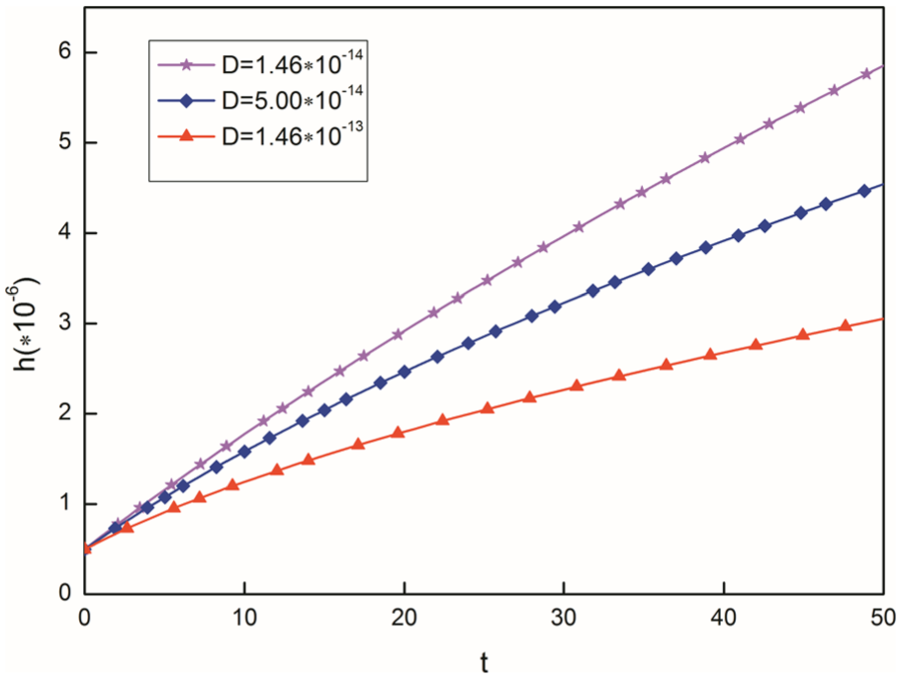
The variation of oxide thickness for different D. In this calculation, we have taken
Conclusion
In this article, the moving boundary taking into account volumetric variation during the metal surface oxidation is transformed into the fixed one by Laudau transformation. Then, perturbation approach is employed to analyze the metal surface oxide, and the ratio
Footnotes
Academic Editor: Xiaotun Qiu
Declaration of conflicting interests
The author(s) declared no potential conflicts of interest with respect to the research, authorship, and/or publication of this article.
Funding
The author(s) disclosed receipt of the following financial support for the research, authorship, and/or publication of this article: This study is supported by NSFC (grant no. 11402054), Natural Science Basic Research Plan in Shaanxi Province of China (nos 2015JM1011 and 2016JQ1032), Scientific Research Program Funded by Shaanxi Provincial Education Commission (no. 16JK1504), 2016 Open Projects of Key Laboratory for Strength and Vibration of Mechanical Structures (no. SV2016-KF-18) and Project Funded by China Postdoctoral Science Foundation (no. 2015M570552).