




Abstract
This article researches on the characteristics of air traffic flow with guidance information to improve operation efficiency and safety for terminal control areas. First, several microscopic air traffic flow models are proposed based on aircraft’s behavior and operation rules in terminal areas. Second, a traffic flow guidance strategy is developed to optimize aircraft’s flight routes and velocities with several guidance decision factors, which include guidance strength, node saturation, runway coordinate coefficient, and so on. Finally, the proposed guidance strategy is verified using simulation with an airport terminal area in China. The simulation results show that the proposed guidance strategy helps in controlling the air traffic flow in a more safe, smooth, and efficient manner by changing the relationship among traffic flow parameters. In addition, the average arrival delays and the average departure delays decrease by 56.3% and 29.4%, respectively, and the total number of conflict resolution behavior also decreases remarkably. It is also found that the runway coordinate coefficient has an important influence on optimization results, and that a certain runway coordination coefficient value (2.5) can help minimize air traffic delays. These results indicate that the proposed guidance strategy helps to remarkably improve air traffic operation safety and efficiency in the terminal area.
Keywords
Introduction
The rapid growth in air transportation demand has led to increased air traffic control load and caused serious air traffic problems. Such problems could include air traffic congestion, large numbers of flight cancelations and delays, even aircraft confliction and accidents, and so on, which typically occur in an air traffic terminal control area. Air traffic management (ATM) in terminal control area is becoming an extremely difficult problem. Building more infrastructures and optimizing operation of airport runway provide an important means to enhance the capacity and efficiency in ATM. However, such solutions may need a long time to take effect and are very difficult to sustain. In fact, air traffic congestion is not only related to the capacity of the airport and airspace system, but also closely related to air traffic flow characteristics and its management performance. Studies on the air traffic flow characteristics provide a theoretical foundation of ATM and may contribute to revealing mutual relations between parameters involved, as well as the mechanism of its spatiotemporal evolution.1,2 In doing so, one can move forward with exploring rules of air traffic congestion formation, devolution, and dissipation. These rules provide the theoretical basis for airport and airspace planning and design, air traffic flow management, and air traffic control. They will play an important role in solving air traffic problems.
There have been a large number of research efforts made to study the traffic flow characteristics up to now; however, they mainly focused on vehicle traffic flow. It is a common method to establish traffic flow models to analyze traffic operation phenomena and traffic congestion rules,3–5 particularly in the field of intelligent transportation system based on information guidance. A series of route guidance algorithms, traffic guidance information release strategies, and optimal location of traffic guidance information releasing devices were proposed.6–12 For example, Yu et al. aimed at stop-skipping strategy, lane network design, and routing problems for bus operations. They conclude that the time-based strategy is better than the deficit-based strategy and the bi-level model proposed performs well with regard to the objective of reducing travel time costs.13–19 Wei et al. 20 studied the impact of different guidance information on traffic flow with different traffic volumes and different induction rates. Khanjary et al. 21 elaborated an autonomous combined traffic signal controller and route guidance system, and their simulation results showed that the system improved the average speed of vehicles significantly. Such research studies can provide some references for relevant research on air traffic operation characteristics and congestion rules.
However, compared to the vehicle traffic, less research efforts have been devoted to air traffic flow theory so far, not to mention that many studies focusing just on modeling. Menon et al.22,23 proposed a simplified Eulerian network model of air traffic flow, and studied the liner control problems derived from an Eulerian network model. Bayen et al.24,25 proposed an Eulerian network model of air traffic flow, and studied the liner control problem derived from the model. Lee et al. 26 presented a complexity model based on traffic flow disturbance. Zhang and Wang 27 discussed on the stability of air traffic flow operation system and some basic characteristics of air traffic flow. Wang et al. 28 built an air freeway flow model by considering the microscopic plane-following performance. To deeply analyze the air traffic characteristics, Zhang et al. 29 developed a microscopic model based on aircraft generalized following behavior in a terminal control area, and preliminarily presented the phase-transition laws of air traffic flow with a simulation method. Xu et al. 30 proposed a dynamic model to describe potential behaviors including following, holding, and maneuvering and obtained time distributions and interrelationships of the basic parameters. Although no detailed studies have focused on the evolution law of air traffic flow so far, all of these research studies presented above have built solid foundations for further studies on air traffic flow theory.
Currently, air traffic controllers (ATCs) are mainly responsible for air traffic safety and efficiency using some controlling methods, which include the adjusting aircrafts’ speed, changing their altitudes and separations, scheduling their time and order, their real-time flight status, and air traffic information from the communications, navigation and surveillance system (CNS). However, an intelligent air traffic control and operation will be the future of ATM. There is an increasing number of research efforts made focusing on the research field based on a new air traffic operation concept of four-dimensional (4D) trajectory-based operation. 31 Under the concept, aircrafts are able to choose optimal flight routes automatically to avoid conflicts and congestion based on real-time air traffic information. For example, Ramasamy et al. 32 proposed a basic operation concept, and also architecture and trajectory optimization algorithms for the next generation flight management system. Nikoleris 33 presented a queuing model for arriving flights under trajectory-based operations, and analyzed flights’ expected delays, stochastic delay, and deterministic delay in a capacity-constrained area. Alexander and Teller 34 focused on pilot and controller issues linked to alternatives for absorbing delays in metering conditions under the concept of 4D trajectory-based operations. Idris et al. 35 developed some decision-making metrics for preserving user trajectory flexibility, and also investigated air traffic complexity using these metrics. In summary, it is very important to research on air traffic flow with guidance information for the future of ATM. As such, this article focuses on the characteristics of air traffic flow with guidance information to improve operation efficiency and safety in the terminal control area. It is expected that the models built, algorithms developed, and conclusions made could lay solid theory foundation and provide useful references for future research in the field of intelligent ATM.
The rest of this article is organized as follows. Section “Air traffic flow models” presents several air traffic flow microscopic models based on operation rules and aircraft’s behavior in terminal area. Section “Hypothesis” presents several guidance decision factors and a traffic flow guidance strategy to optimize aircraft’s flight routes and velocities with a guidance control rule. The simulation results of simulation analysis are reported in section “Simulation and analysis.” Some conclusions and implications are presented in section “Conclusion.”
Air traffic flow models
In terminal areas, arrival aircrafts should sequence, descent, and adjust speeds before landing. Meanwhile, the departures should take off, climb, and enter into routes after receiving ATC clearances. Their specific behaviors are related to traffic flow distribution, structure of approach routes, performance of airborne equipment and control strategies, etc. The operation procedures of air traffic flow in the terminal area are shown in Figure 1.

The operation procedures of air traffic flow in terminal area.
It is assumed that aircrafts i and j fly along the same air route at time t, where aircraft i is the aircraft in the front and aircraft j is the one behind. It is also assumed that no difference in the aircraft acceleration performance is considered, namely
Speed adjusting model
Aircrafts fly along air routes with a constant acceleration rate to descent or ascent during final approach or climbing provided safety separation. Let

Aircrafts can also adjust their speeds to maintain their safety separation in the following ways.
If
If
Considering that the former aircraft flies at a constant speed, let

Once the following behavior satisfies equation (2), the aircraft behind should decelerate and follow the former to maintain the basic safety separation, otherwise the aircraft behind needs to be in maneuvering flight mode.
Considering that the former aircraft flies along the air route at a constant deceleration rate to reach the target speed

Maneuvering model
If no satisfactory separation can be obtained in equations (2) and (3), the safety separation cannot be maintained by adjusting speed. The maneuvering strategy should be developed. Assuming that the position of approach fix point is
Considering that the former aircraft flies with a constant speed, an equation is given in (4) to obtain the minimum deviation angle of the aircraft behind
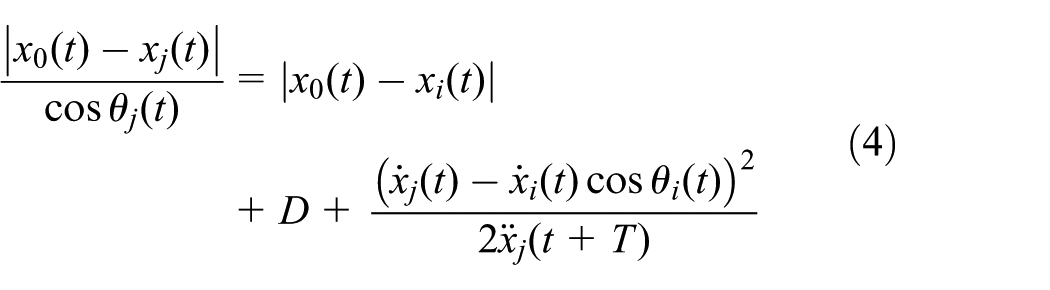
Obviously, the minimum deviation angle could be calculated as follows
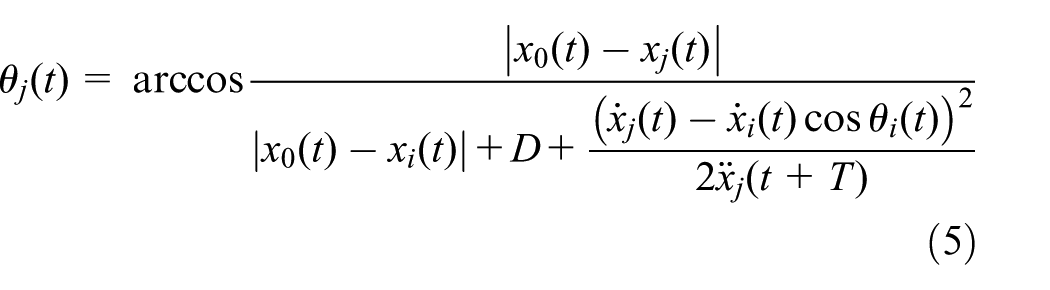
The aircraft behind turns out to maneuver with the deviation angle
Considering that the former aircraft flies along route at a constant deceleration rate, likewise, the minimum deviation angle of the aircraft behind should meet the following equation

where
Arrival–departure coordination model
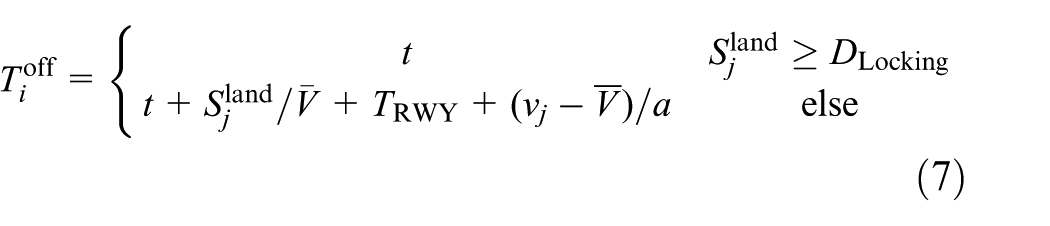
It is a common tactic to preferentially allocate runways for approaching aircrafts. Assuming that the departure aircraft i can reach a runway at time t, the distance between the approaching aircraft j and the runway threshold is
Air traffic flow guidance strategy
Hypothesis
Terminal control area is a complex system. The arriving and departing flights are required with strict operation performance. The CNS/ATM systems must cooperate closely with each other to keep flights safe and efficient. To obtain a simple and effective guidance strategy, three reasonable hypotheses are given as follows: (1) aircrafts meet the required performance; and all arrivals and departures are conducted according to navigation points; (2) the communication delay between pilots and controllers is ignored; (3) pilots always expect to fly at the highest speed to minimize delays.
Assuming that an aircraft i locates at node
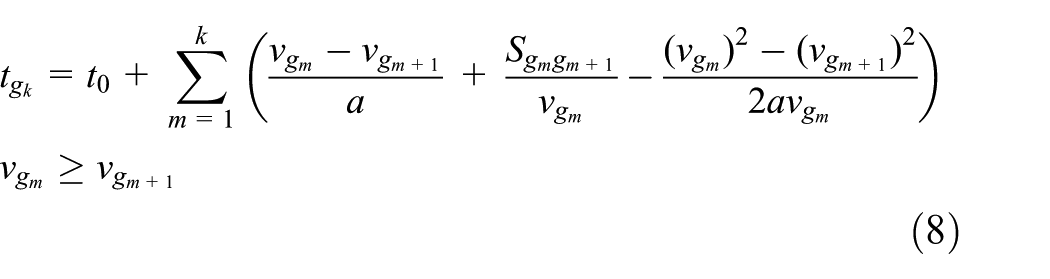
An aircraft will approach at the highest speed based on the hypothesis (3). So the time of passing a node can be predicted in the following ways. Let
Guidance decision factors
Air traffic is always under the control of CNS/ATM system, from which the air traffic operation data can be easily collected. These data are numerous, various, and accurate, and as such, it is difficult to use them to optimize air traffic flow without processing. To optimize air traffic flow in terminal area, four guidance decision factors are designed based on operation data as follows:
Guidance strength
According to the description of air traffic flow phase division,
29
in free flow phase, the air traffic flow speed is large, the density is low, the average interval of aircrafts is big enough, and the interaction between aircrafts is insignificant. The air traffic flow density is defined as acr (i.e. the average aircraft per unit distance). The average density is taken as the decision variable of guidance strength. Let the congestion traffic density be
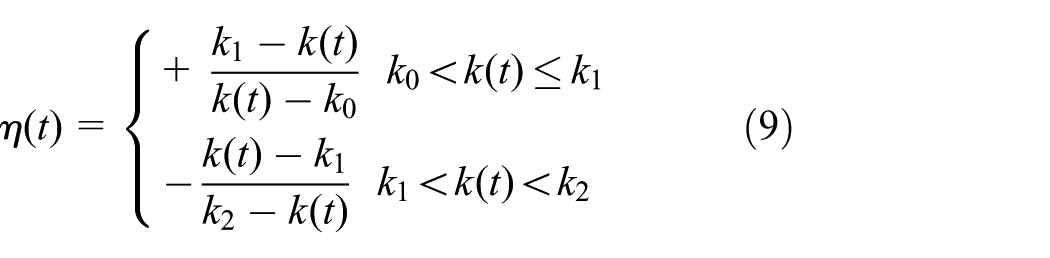
As positive guidance strength increases, the limitation of aircrafts entering terminal area decreases, and the possibilities of pilots’ deceleration or acceleration increase. Conversely, when the negative guidance strength increases, the limitation of aircraft entering the terminal area also increases. Therefore, pilots have larger possibility to decelerate in advance, and controllers will strictly require pilots to approach according to a specific flight path.
Node saturation
First, a concept of node acceptance rate

If a large number of aircrafts pass over a node, the possibility of potential confliction will increase. So the node saturation can be defined as a ratio which can be calculated using equation (11)

where

When holding appears at the next nodes, the value of node saturation is 1. It means that the downstream traffic is congested, and controllers should take strong control measures, as well as other aircrafts must operate with standard instrument approach procedures and controlled speeds.
Runway coordination coefficient
An RCC is used to balance arriving and taking-off. RCC is a dynamic ratio of the total number of arrivals to the total number departures at a moment, which can be defined using equation (13)

where

Departure holding number
Departure holding number (DHN) has two forms: the actual holding number and theoretical holding number, which are denoted as

where
To avoid air traffic congestion from becoming more severe, flights that will be transferred from contiguous sectors outside of the terminal area should be controlled. Normally, when the holding number increases, the transfer interval

where
Guidance control rule
Aircrafts are conducted based on three kinds of operation rules in terminal areas, namely, basic rules, confliction rules, and guidance rules. The basic rules and conflict rules play an important role in keeping aircrafts safe. The guidance rules are mainly used to optimize aircraft behavior parameters with guidance decision factors and send optimal parameters to aircrafts, including the optimal transfer interval, optimal speeds, and optimal route. The process of guidance control rules is shown in Figure 2.

The process of guidance control rule for air traffic flow in terminal area.
Transfer and holding control
An aircraft is able to decide the best time to enter the terminal area according to the current transfer interval. Let aircraft i pass the transfer node

where
Speed guidance rules
Commonly, the transferred aircraft will adjust its speed according to the node limitation speeds in its flying route. These speed adjustments are mainly based on pilots’ experience and may be quite different from pilot to pilot. Also the speed adjustment rules may have a great influence on the terminal area operation efficiency. Let an aircraft fly from node
(a) When
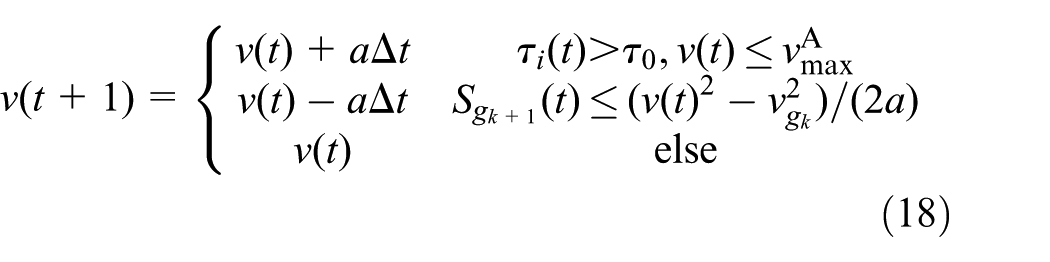
(b) When
If

and set

If

Then aircraft self-acceleration speed is as follows

(c) When

Optimal route search algorithm
When air traffic is congested in which traffic density is high and flight conflicts are frequent, aircrafts apply the earliest deceleration strategy to relieve traffic congestion. When air traffic flow is under the free flow condition in which traffic density is low and the average interval is large, aircrafts apply the latest deceleration or acceleration strategy to approach fast. In addition to applying the strategy, it is also an important method to optimize aircrafts’ flight paths in order to approach efficiently and economically.
Let the set of aircraft i path nodes be
To obtain equitable optimization results, aircraft is permitted to fly directly only when
Step 1. Load the set of current path
Step 2. Load the time window
Step 3. Calculate the sequence number of aircraft passing node k; if
Step 4. Evaluate the maneuverability of the flight path. If the change in the heading angle
Step 5. Evaluate the safety separation between the former aircraft and the direct flying node k. If
Step 6. Check whether the next node q is an initial approach fix (IAF) or an intermediate fix (IF). If node q is the IAF or IF, go to Step 7, or q = q + 1 and go back to Step 2;
Step 7. Aircraft flies to node q − 1 directly. Update the flight path.
Simulation and analysis
Simulation sample
According to the air traffic flow operation procedures, aircrafts are designed to be agents with various flying behavior based on the simulation platform NetLogo. To be consistent with the models as previously presented, a busy airport terminal area running with Regional Area Navigation (RNAV) program is chosen as the simulation environment, and the guidance control rules are loaded to optimize and analyze the air traffic flow operation. In the case presented in this article, there are three routes for arrival flights and four routes for departure flights in the terminal area. The basic airspace structure is shown in Figure 3, in which these points named NOPIN, LRU, and ZHO are for arrivals, and points named NOPIN, P278, KAMDA, and AKOMA are for departures. There are 396 flights from a typical day flight plan, consisting of 197 arrivals and 199 departures. The basic simulation optimization parameters (Table 1) are referred to as standard parameters used in the actual ATC regulations including transfer interval, space headway, holding pattern, safety separation, and so on.
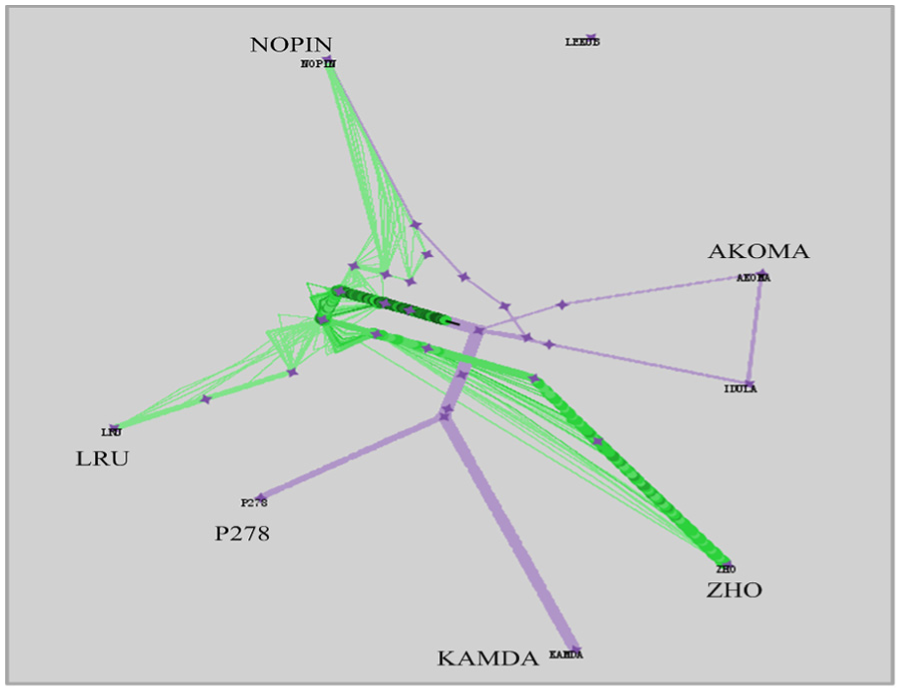
The airspace structure and simulation interface.
Simulation optimization parameters.

Traffic flow parameters
Air traffic flow speed is defined as the average speed of all aircrafts. Particularly, the speed of holding aircrafts is defined as 0 for their circular flight trajectory (whose unit is km/h). Traffic flow density is defined as aircraft acr per unit distance, namely linear density (which has a unit of acr/10 km). Let q be the equivalent flow based on the assumption of
Speed–density relationship
Based on the simulation platform of air traffic flow, a large number of air traffic flow instantaneous speed and density values are collected before and after using the guidance method. And then a speed–density relationship curve is plotted by further analyzing these data, which is shown in Figure 4. The Figure 4(a) is the original speed–density scatter diagram without using the guidance method. It shows that the variation trend of speed and density is obvious. To clearly compare the speed–density relationship between the guidance method and the normal method, the speed–density scatter data (in Figure 4(a)) are processed to a relationship curve as shown in Figure 4(b) by selecting typical data and using smooth curves.

(a) Original speed–density scatter diagram and (b) speed–density relationship curve.
As one can see from both relationship curves in Figure 4(b), the air traffic flow gradually forms several time-varying regimes, including the free flow, smooth flow, congestion flow, and congestion dissipation flow phases. In the free flow phase, the traffic flow speed decreases slowly as the density increases. And then the traffic flow changes to the smooth flow phase gradually. As the density further increases and reaches its limit value, the traffic flow turns into the congestion phase. When high-density arrival flights disappear, the density no longer increases and traffic flow enters the congestion dissipation phase, in which the speed increases gradually as the density decreases.
Comparing the difference between the two speed–density relationship curves, one can see the traffic flow limit density reduces from 0.53 to 0.42 using the guidance method, the average speed increases from 431 to 556 when traffic flow reaches congestion phase, and traffic congestion dissipates more rapidly. This indicates that the air traffic congestion propagation has less influence on flight delays. As such, it is clear that the guidance model helps in controlling air traffic flow in a more safe, smooth, and efficient manner.
Flow–density relationship
Likewise, the two flow–density relationship curves are obtained and shown in Figure 5. It shows that air traffic flow generally appears during the same phases as shown in Figure 4(b). In the free flow phase, traffic flow increases as the density increases, and it tends to be stable even slowly decreases in the smooth flow phase. And then traffic flow and density together increase quickly to limit values in the congestion flow phase, and decrease together in the last phase. In addition, it is apparent that the traffic density decreases remarkably with the guidance method, while its flow is no less than the flow with the normal method. The result shows that the guidance method can not only prevent air traffic congestion from getting worse but also with high operation efficiency.
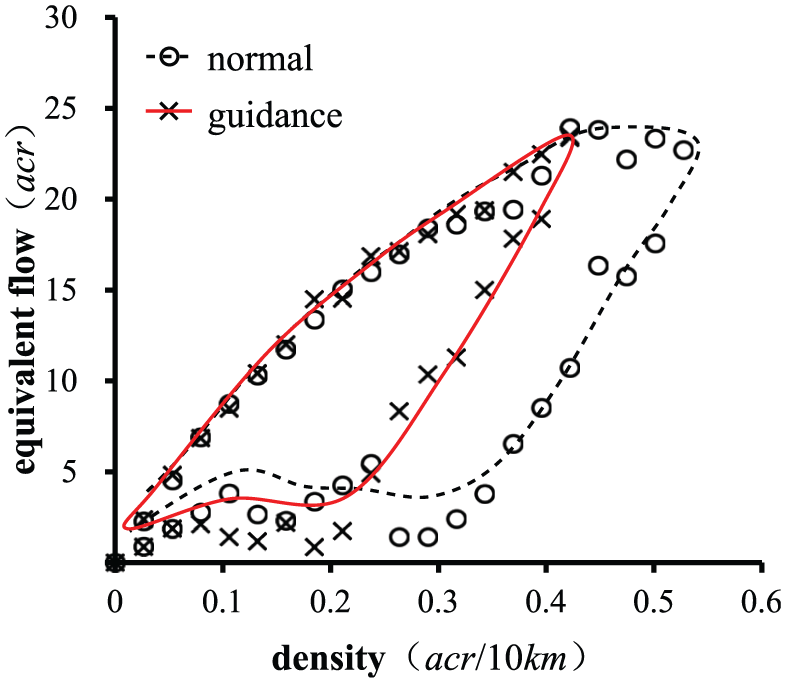
Flow–density relationship curves.
Flow–speed relationship
The same conclusions can also be drawn for the flow–speed relationship as shown in Figure 6. The relationship curve under guidance method is smoother than the curve under normal method, and most of its speed values are larger than those under normal method. Therefore, the guidance method can help to accelerate traffic flow operation and dissipate traffic congestion.
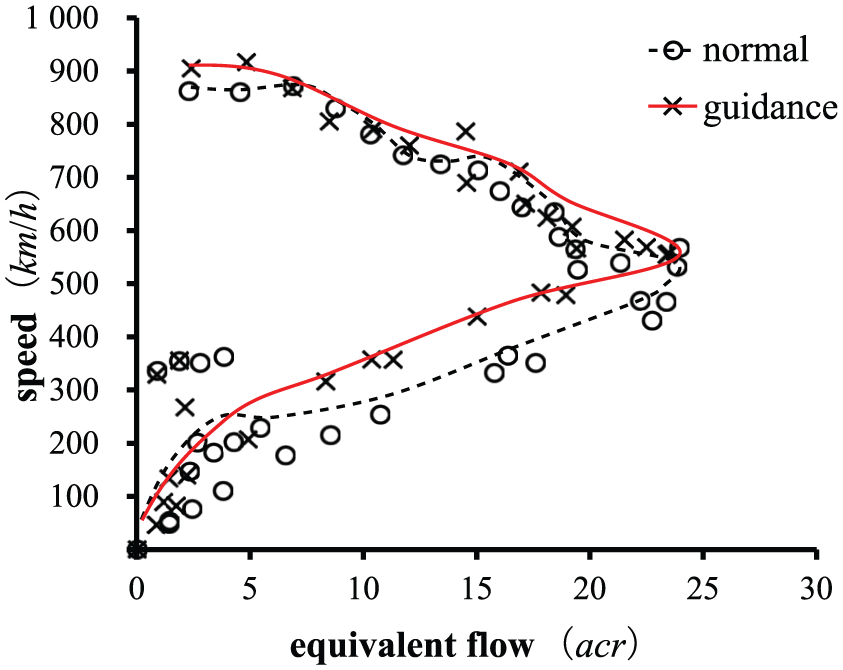
Flow–speed relationship curves.
Optimization performance
Delay performance
The arrival delay is a time difference between the estimated and actual total flight times for arrival flights in terminal area, and the departure delay is a time difference between the estimated and actual times of taking-off. The varying trend curves for average arrival and departure delay times are shown in Figure 7(a) and (b). It is clear that the arrival delay is reduced by a wide margin under the guidance method, and even reduced by 56.3% at a point. Furthermore, the time-varying trend curve of the guidance method is smoother and steadier than the curve of normal method. Meanwhile, the average delay time of departure is also clearly reduced under the guidance method, reduced by 29.4% and from 3.06 to 2.16 min. This is because the RCC has balanced arriving and taking-off. These results show that the guidance method can minimize flight delay, and keep air traffic operating stably.

(a) Delay time of arrivals and (b) delay time of departures.
Confliction performance
Aircrafts will resolve conflicts by holding, maneuvering, and adjusting-speed behavior, called conflict resolution behavior. By further comparing aircraft behavior changes under the two methods, it is found that the numbers of conflict resolution behavior decreased remarkably under the guidance method. The comparing results are shown in Table 2. The number of holding aircrafts is reduced by 40%, the number of maneuvering aircrafts is reduced by 57.8%, and the number of adjusting-speed aircrafts is reduced by 51.1%. Therefore, these results show that the guidance method performs very well in improving air traffic operation safety and easing ATC workload.
Confliction optimization results.

Parameters influence
It is apparent that some parameters can have influence on the guidance results. One can use the RCC

Delay changes with different
The influence of RCC on the air traffic flow parameters can also be analyzed. Let us take the velocity and density as an example. As one can see from Figure 9, it is clear that the velocity–density relationship curve changes significantly with different RCC values. The same conclusion can be drawn in which air traffic congestion dissipates more quickly when

Speed–density relationship with different
Conclusion
This article focuses on air traffic flow optimization based on a guidance method in terminal area. Several conclusions have been drawn as follows.
These proposed air traffic flow microscopic models (consisting of speed adjusting model, maneuvering model, and the AD coordination model) comply with aircraft flying behavior and air traffic operation rules in terminal control area. The air traffic flow gradually forms four time-varying regimes, named the free flow, smooth flow, congestion flow, and congestion dissipation flow phases. The guidance method can help to manage the air traffic to flow safer, smoother, and more effective than the normal method, and its optimization performance on reducing delays and conflicts is improved remarkably.
These proposed guidance decision factors, especially the RCC, have an important influence on the optimization results. There is an influence trend on flight delay as the RCC value changes. It appears that the delay increases slowly in the beginning, then quickly reduces, and maintains stability in the end. Furthermore, there is a certain RCC value that can minimize air traffic delays, and the delays can be controlled by adjusting the RCC value according to the ratio of arrivals and departures crossing the terminal area.
Further research could focus on the air traffic flow situation awareness. There should be a comprehensive index system to be used to evaluate traffic flow operation situations. The index system provides an important base for the air traffic flow congestion detection, prediction, and optimization control. It is also necessary to delve into 4D trajectory prediction or re-planning technologies. Using these technologies, ATCs can obtain more accurate aircraft trajectories and air traffic operation situations. This further research should help to promote the development of intelligent ATM.
Footnotes
Academic Editor: Gang Chen
Declaration of conflicting interests
The author(s) declared no potential conflicts of interest with respect to the research, authorship, and/or publication of this article.
Funding
The author(s) disclosed receipt of the following financial support for the research, authorship, and/or publication of this article: This work was supported in National Natural Science Foundation of China 61104159 and 61573181, the Natural Science Foundation of Jiangsu Province BK20131366, and the Fundamental Research Funds for the Central Universities NS2014068.