




Abstract
Space antennas with high gain and high directivity are in great demand for future communication and observation applications. Deployable cable-mesh reflector antennas are required to be tensioned in a self-equilibrated state through form-finding design. In order to ensure the cable-mesh reflector antennas’ high performances, both surface accuracy requirements and tension uniformity should be considered in the form-finding design process. To effectively implement the form-finding design for asymmetric cable-mesh antennas, a two-step uniform-tension form-finding approach is presented. In step 1, with the cable tension and membrane stress being considered simultaneously, an iterative design technique which combines force density method and surface stress density method is presented. In step 2, considering the asymmetry between the rear and front nets, the nodal z-coordinates and cable tensions of the rear net are designed with the combination of the equilibrium matrix method and force density method. Finally, an offset AstroMesh antenna is designed using the proposed method. For the obtained antenna, the cable tension and membrane stress of the front net are completely uniform, and the maximum tension ratio of the rear cable net is 1.06, which are very satisfactory.
Keywords
Introduction
Large cable-mesh deployable antennas are widely used for space applications.1–5 The AstroMesh antenna, one popular kind of cable-mesh antennas, has the advantages of light mass, high packing efficiency, and good thermal stability. An AstroMesh antenna 5 mainly consists of a deployable rim truss, two curved nets placed back-to-back across the truss, some vertical tension ties, and a reflective mesh stretched across the convex side of the front net.
AstroMesh antennas must be tensioned in equilibrated state to achieve on-orbit task, so form-finding design is indispensable. Moreover, on-orbit antennas are affected by time-varying thermal environment, and the stability of their surface shape is dependent on the tension uniformity of the cables. Therefore, study on AstroMesh antennas, which considers both surface accuracy requirements and tension uniformity, becomes a hot issue in recent years.6–9 Currently, there are mainly two research approaches to address this problem: approach I, “tension-finding for given shape”6,7 and approach II, “shape-finding for given tension.” 8 Based on approach I, the initial tensions of AstroMesh antennas were designed with the geometry unchanged using the equilibrium matrix method (EMM) in Yang and Shi 6 and Yang and Duan, 7 but the maximum tension ratio is relatively large for asymmetric offset AstroMesh antennas. To improve the tension uniformity, employing force density method (FDM), an iterative form-finding technique was presented in Morterolle et al., 8 on the basis of approach II. In this study, cable tensions of the front and rear nets were designed to be completely uniform, under the assumption that the two nets were symmetric. However, in practical engineering, the front and rear nets of AstroMesh antennas are always asymmetric, which results in that the method in Morterolle et al. 8 cannot implement the form-finding of the rear net. In addition, as the reflective mesh (taken as membrane structure) is an indispensable part of AstroMesh antennas, the influence of membrane stress on the stability of surface shape cannot be ignored. Thus, membrane stress uniformity of the AstroMesh should be considered in the form-finding design. Unfortunately, the existent form-finding methods for AstroMesh antennas only considered the tensions of the cables, with the stress of the reflective membranes not taken into account.
To implement the form-finding design of asymmetric AstroMesh antennas, a two-step uniform-tension form-finding method is presented with the combination of “tension-finding and shape-finding.” Step 1 is for the front net: to consider both cable tension and membrane stress simultaneously, an iterative design technique which combines FDM and surface stress density method (SSDM) is presented based on the works of Morterolle et al. 8 and Maurin and Motro, 10 through which both the cable tension and membrane stress are designed to be uniform. In step 2, the rear net of asymmetric AstroMesh antennas is considered. EMM and FDM are combined to implement the form-finding process of the rear net as follows: first, the horizontal components of cable tensions are designed using EMM; second, the cable force densities are determined according to the horizontal components of cable tensions and cable lengths; then, the nodal z-coordinates and cable tensions are obtained based on FDM.
Proposed form-finding method
In this section, equations and design process of the two-step form-finding method are presented. The proposed method is implemented under the following assumptions: (1) all the front net nodes should be on the ideal paraboloid to meet the reflector’s accuracy requirements, (2) there is no accuracy requirement on the rear net, and (3) all the vertical tension ties must be kept vertical throughout the two-step form-finding process.
Form-finding of the front net
The front net is a cable-membrane structure, of which the cables are taken as two-node liner elements and the meshes are taken as three-node triangular plane stress membrane elements.10–12
As shown in Figure 1, a free node c of the front net is connected by

where

Internal forces at node c.
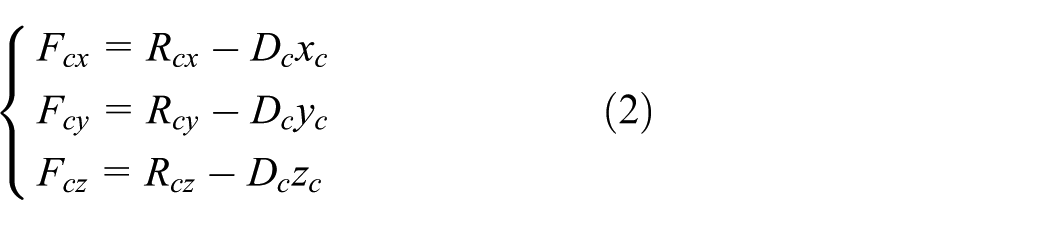
By expressing the vectors
where

For the front net of AstroMesh antennas, there is no external loads at node c in x- and y-directions, so

It should be noted that all the front net nodes should be on the ideal paraboloid to meet the reflector’s accuracy requirements, so the z-coordinate of node c must be modified according to the paraboloid equation in the form-finding process. 8 Then, the required force in the vertical tension tie connected to node c can be calculated as

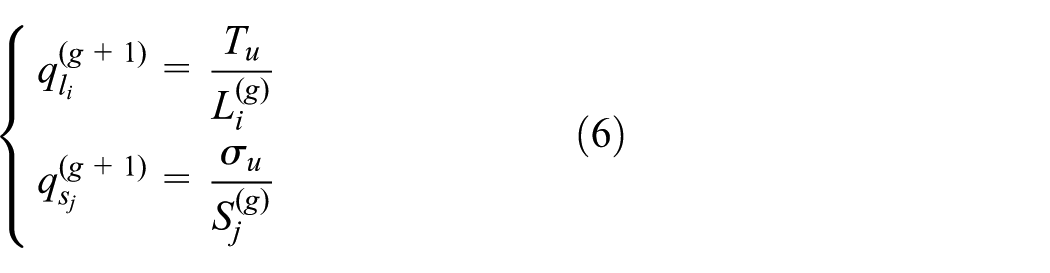
To obtain uniform cable tension and membrane stress, iterative strategy is adopted. Denoting the required uniform cable tension and membrane stress by Tu and
where
In the design process, force density and surface stress density of the front net cables and membranes are iterated according to equation (6) until it converges. The iteration design process of the front net is illustrated in Figure 2, and the detailed design process is as follows:
Step 1. Give the required uniform cable tension Tu and membrane stress
Step 2. Give the initial geometry topology and node coordinates of the front net.
Step 3. With the uniform cable tension Tu and membrane stress
Step 4. According to the ideal paraboloid equation, calculate the z-coordinates of the front net nodes.
Step 5. Calculate the tensions of the vertical tension ties by equation (5).
Step 6. Update the node coordinates of the front net, and calculate the lengths and tensions of the front net cables.
Step 7. Judge whether the coordinates of the front net nodes in the equilibrium state do not vary in the iteration process. If yes, the iteration process has converged, and the current form is the required form under the given uniform cable tension and membrane stress. Otherwise, modify the force density and surface stress density by equation (6) and return to Step 3 until the iteration process converges.

Iteration design flow chart of the front net.
Form-finding of the rear net
After the form-finding process in section “Form-finding of the front net,” the front net node coordinates
The equilibrium equations of the rear net node i in x- and y-directions are written as


where cable element ij connects node i and node j, and
According to the geometric relationship shown in Figure 3, the relationship between the axial and horizontal components of the tension and length of cable ij can be obtained as


The axial and horizontal components of the tension and length of cable ij.
Then, the equivalent equilibrium equations of (7) and (8) can be expressed as


where
In the horizontal projection plane oxy, the geometry of the rear net is determined by the front one. According to equations (10) and (11), the equilibrium equations of all the rear net nodes in oxy plane can be written in matrix form as

where
For equation (12), the rank of matrix

There two cases for the solution of equation (12). If
For cable-mesh antennas structures, it is always satisfied that

Thus, there are always multiple solutions for equation (12), and it can be solved through optimization method to make the cable tensions of the rear net as uniform as possible. The optimization model is established 7 as



where
The optimum solution

where
According to FDM, when cable force densities are given, z-coordinates of the rear net free nodes can be obtained as 13

where
To calculate

where
Thus, one can get

Since
In practical engineering, although there is no accuracy requirement on the rear net, AstroMesh antennas always have height restrictions to reduce stowed volume, and z-coordinates of the rear net nodes are constrained by the antenna height. Here, the height of the rear net

Obviously,
Correspondingly, according to the obtained rear net node coordinates and force densities, cable tension vector

where
Numerical simulations
An offset AstroMesh antenna is employed to demonstrate the effectiveness of the proposed method. The initial geometry configuration is shown in Figures 4(a) and 5(a), whose specifications are as follows: the optical aperture is 10 m, the focal length and offset distance of the front net are both 6 m, and the initial rear net is symmetric with the front one. In this example, for the front net, Tu is 40 N and

Comparison of the top view of the AstroMesh antenna (a) before and (b) after form-finding design.

Comparison of the front view of the AstroMesh antenna (a) before and (b) after form-finding design.
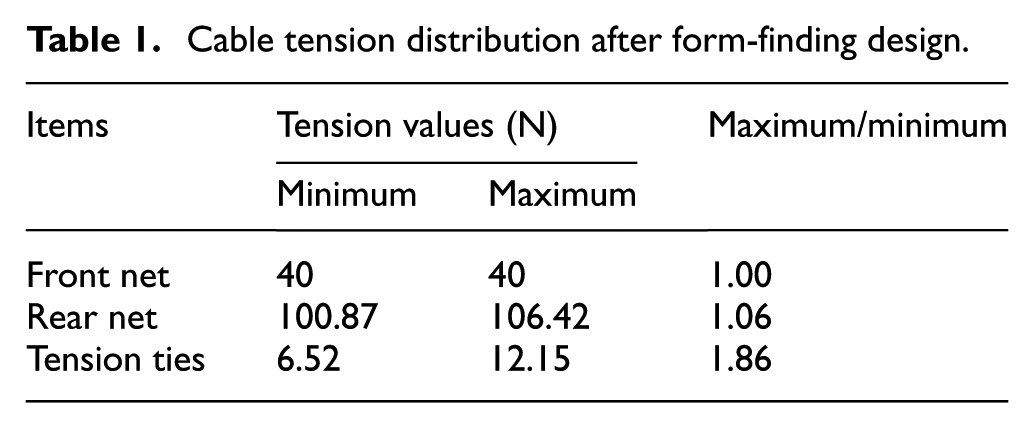
First, the form-finding design of the front net is implemented using the proposed iteration method. The top views of the AstroMesh antenna before and after form-finding design are compared in Figure 4. It can be seen that x- and y-coordinates of the front net nodes deviate from the initial ones to achieve the uniform cable tension (40 N) and membrane stress (50 KPa). Meanwhile, the maximum and minimum tensions of the vertical cables are 12.15 and 6.52 N, respectively.
Then, according to the results of the front net, nodal z-coordinates and cable tensions of the rear net are designed. In this example,
Cable tension distribution after form-finding design.
Conclusion
In this study, a uniform-tension form-finding method is presented for AstroMesh antennas. First, the front net is designed iteratively with the combination of FDM and SSDM, by which the front net is obtained with uniform cable tension and membrane stress. Then, according to the results of the front net and the relationship between the front and rear nets, form-finding of the rear net is implemented through the combination of EMM and FDM, from which the obtained tension uniformity of the rear net is satisfactory and the height of the rear net is effectively reduced. Numerical simulations validate the effectiveness of the proposed method. In this article, the proposed method is focused on the initial form-finding design of the cable-mesh antennas, in which the uncertain errors in the actual manufacturing process are not taken into consideration. There are always two major aspects of uncertain error sources: one is the manufacturing error, and the other is the assemble error. Thus, the influence of the uncertain errors on the reflector surface accuracy and cable tensions will be further studied in our future work.
Footnotes
Academic Editor: Filippo Berto
Declaration of conflicting interests
The author(s) declared no potential conflicts of interest with respect to the research, authorship, and/or publication of this article.
Funding
The author(s) disclosed receipt of the following financial support for the research, authorship, and/or publication of this article: This work was supported by the National 973 Program under Grant No. 2015 CB857100 and the National Natural Science Foundation of China under Grant Nos 51490660 and 51475349.