




Abstract
This work analyzes the second-law characteristics of heat transfer due to laminar forced convection of a stationary fluid flow between concentric rotating cylinders. The momentum and energy balance equations are discretized by the finite volume method. The effects of boundary conditions and different flow parameters on entropy generation are presented. The obtained results show that irreversibility due to fluid friction is neglected compared to entropy production due to thermal conduction. It is also observed that entropy creation is practically not affected by the angular velocity of the inner cylinder.
Introduction
Analysis of entropy creation and exergy loss is an effective way to evaluate second-law performance and to minimize irreversibility in energy conversion devices. The entropy generation and its minimization are investigated by many researchers. Bejan1,2 and San et al. 3 are the first who proposed different analytical solutions for the entropy generation equation in several simple flow situations. They introduce the concept of entropy production number and irreversibility distribution ratio, presenting spatial distribution profiles of entropy generation. Ever since these studies were carried out, entropy generation has been used as a reference for evaluating the significance of irreversibility related to heat transfer and friction flow in thermal systems. Bejan 4 studies laminar flow in rectangular flasks, showing that entropy generation is proportional to work loss in the system. Mahmud and Fraser 5 study the effect of steady laminar forced convection on entropy generation inside channel with circular cross section and channel made of two parallel plates. Ko and Ting6,7 and Ko 8 present numerical investigations to calculate entropy creation and irreversibility profiles for different geometrical configurations, flow situations, and thermal boundary conditions. Ben Nejma et al. 9 numerically examine combined gas radiation and laminar forced convection in participating media through two parallel plates. They give some special attention to the impact of geometrical and thermodynamic parameters on entropy generation. Mazgar et al. 10 develop the profiles of local and global entropy creation due to combined natural convection and non-gray gas radiation at the entry of a circular duct. Ben Nejma et al.11,12 perform numerical analysis to establish entropy generation profiles through non-gray gas radiation inside a cylindrical and a spherical enclosure, respectively. They show that the volumetric radiative entropy production is more developed in heating configuration, while the wall radiative entropy production is more developed in case of cooling. The analysis of Mazgar et al. 13 evaluates entropy generation due to combined gas radiation and mixed convection in participating media through a vertical cylindrical annulus. They conclude that the volumetric radiative entropy generation is distinctly developed compared to wall radiative entropy production and to entropy generation due to fluid friction and thermal conduction.
Concerning the analysis of entropy generation induced by the flow and heat transfer between two rotating cylinders, there are few studies that are discussed in the following. Yilbas 14 determines the heat transfer characteristics and resulting entropy generation across annuli with outer cylinder rotating. He finds that the point of minimum entropy generation in the fluid moves away from the outer cylinder wall as the Brinkman number increases. Mahmud and Fraser 15 perform a second-law analysis of the rotating concentric cylinder problem in the presence of heat transfer and fluid motion to obtain analytical expressions for dimensionless entropy generation number, irreversibility distribution, and the Bejan number. Mahmud and Fraser 16 apply the first and second laws of thermodynamics to forced convection inside a cylindrical annular space using both isothermal and isoflux boundary conditions and assuming a relative angular rotation is present between the cylinders in a concentric arrangement. They note that the velocity ratio affects entropy generation number significantly. Mirzazadeh et al. 17 study the entropy generation induced by the flow and heat transfer of a non-linear viscoelestic fluid between rotating cylinders. They show that the total entropy generation number increases as the fluid elasticity decreases, as well as it decreases with a decrease in the Brinkman number. Mahian et al. 18 analytically examine entropy generation due to flow and heat transfer of nanofluids between co-rotating cylinders with constant heat flux on the walls to find the optimum performance conditions of the system. Mahian et al. 19 investigate the influence of magnetohydrodynamic (MHD) flow on entropy creation due to nanofluid forced convection flow within two isothermal rotating cylinders. They show that the entropy generation increases with a decrease in the MHD magnetic field flow. Moreover, they also conclude that the decrease in the entropy generation is higher for greater radius ratios.
A review of the literature shows that the study of entropy generation due to laminar forced convection of a stationary fluid flow between concentric rotating cylinders has not been adequately studied, even less for thermo-dependent gas. The main aim of this work is to evaluate entropy generation owing to laminar forced convection flow of overheated water vapor confined between two rotating cylinders.
Problem formulation
This study presents a numerical analysis of a stationary non-established forced convection heat transfer of overheated water vapor confined in concentric annuli. The concentric cylinders are isothermal and rotate with arbitrary angular velocities denoted by Ω1 and Ω2 for the inner and the outer cylinders, respectively (Figure 1).

Physical domain.
The working fluid is considered to be Newtonian and in a laminar flow. The effect of buoyancy forces has been neglected and therefore, the effect of gravity is ignored. Furthermore, we will adopt the approximation of boundary layers, considering the relative axial motion between the two cylinders. Moreover, the radial velocity component is neglected compared to the tangential one. At the entrance of the duct, the gas is assumed to be isothermal and in an established flow condition (Poiseuille flow). Bearing in mind these assumptions, the thermal transfers are described by the following conservation equations


The pressure gradient is determined using these last equations in association with the conservation equation of the mass flow rate given as follows

where

Normally, we choose a duct with a relatively large length, ensuring the establishment of the flow and taking zero-gradient conditions at the outlet. Moreover, it is important to select the inlet velocity carefully to avoid the generation of turbulence.
The two local Nusselt numbers corresponding to heat exchanges between surfaces are defined as follows


where

From these expressions, we can deduce the corresponding average Nusselt numbers


The boundary conditions for the considered problem are presented by the following system of equations

where

Dimensionless numbers have not been utilized because of the enormous variations of the fluid physical proprieties as given by Sacadura. 20
In this article, we investigated a numerical study to evaluate entropy generation due to laminar forced convection flow in the entrance region of a concentric cylindrical annulus. Like all thermodynamic systems, entropy is generated from the interplay between irreversibility due to heat transfer and fluid friction. At a given location, the local volumetric entropy production is thus formulated as follows

where
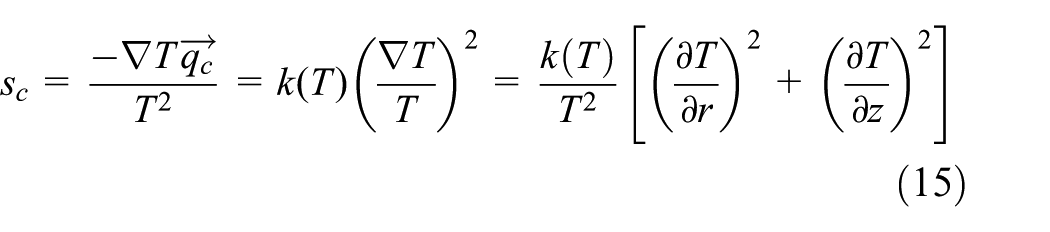

where Φ is the viscous dissipation.
The total entropy generation is obtained by integrating equation (14) over the annulus volume

Accuracy assessment
In order to transform the differential equations into algebraic forms, they are integrated over the finite control volumes. The obtained equations are iteratively solved by the Gauss–Seidel algorithm. Tables 1–3 show the respective values of the average Nusselt numbers and the global entropy production for different grids (Nr, Nz). At first blush, the choice of a mixed grid system defined by 400 uniform nodes through radial direction and 400 Chebyshev nodes through axial direction seems to be sufficient to obtain accurate results. For this study, we decided finally to use the grid (Nr = 500, Nz = 1000) in order to overcome the potential problems related to the thermo-dependent characteristics of the working fluid.
Effect of grid on average Nusselt number Nu1 (0 − z = 5 m)

P0 = 2atmT0 = 500KT w =700KU0 = 0.1ms−1R1 = 0.1mR2 = 0.2mΩ1 = 1rds−1Ω2 = 1rds−1
Effect of grid on average Nusselt number Nu2 (0 − z = 5 m).

P0 = 2atmT0 = 500KT w =700KU0 = 0.1ms−1R1 = 0.1mR2 = 0.2mΩ1 = 1rds−1Ω2 = 1rds−1
Effect of grid on global entropy generation S (0 − z = 5 m).

P0 = 2atmT0 = 500KT w =700KU0 = 0.1ms−1R1 = 0.1mR2 = 0.2mΩ1 = 1rds−1Ω2 = 1rds−1
In order to validate our numerical code, we have chosen an established flow configuration, and we have compared the corresponding results to those computed for a Couette–Poiseuille flow. Therefore, solving the conservation equations allows us to determine analytically the different profiles for an established flow. The axial velocity is thus given as

Similarly, the tangential velocity profile will be
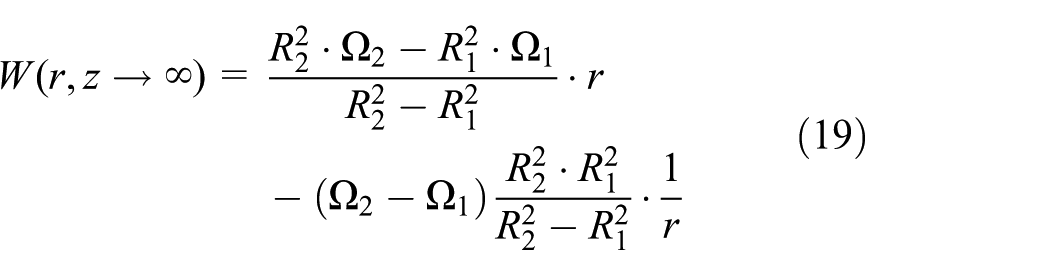
and the pressure profile is given as follows

where

Examination of Figure 2 shows a reliable agreement between our results and those calculated for an established flow conditions. This checks the successful implementation of our numerical code.

Validation of the model.
Results and discussion
A selected set of graphical results are given in Figures 3–11 to present an easy understanding of the effect of geometrical and thermodynamic parameters on entropy generation. Figure 3 shows the radial profiles of the axial velocity through different sections of the duct. As has been noted, weak deformations are observed in the velocity profiles at the entry of the duct. These deformations are going to be amplified through the sections of the duct to evolve toward the profiles corresponding to the Couette–Poiseuille flow. In reality, these deformations are the result of the inertia forces which appear when the fluid begins to rotate (Figure 4), pushing it through the outlet surface and increasing the pressure in the vicinities of this wall (Figure 5). This forms an obstacle to the axial fluid flow, thus decreasing the axial velocity in these zones. Quite the contrary, the axial velocity increases in the vicinities of the inner wall as the result of the mass flow conservation. It is worth noting that the global increase signaled in the axial velocity results from the gas expansion due to heating (Figure 6). As regards profiles of the tangential velocity presented in Figure 4, a progressivity is shown in the tangential movement of the fluid. In fact, sufficient time should be allowed to the viscous forces to drag the fluid and to induce its rotation. The pressure curves given in Figure 5 show monotonous profiles according to the radial position with maximums located in the vicinities of the outer cylinder. These profiles evolve continually until reaching the particular aspect of the Couette–Poiseuille flow.

Axial velocity profiles.
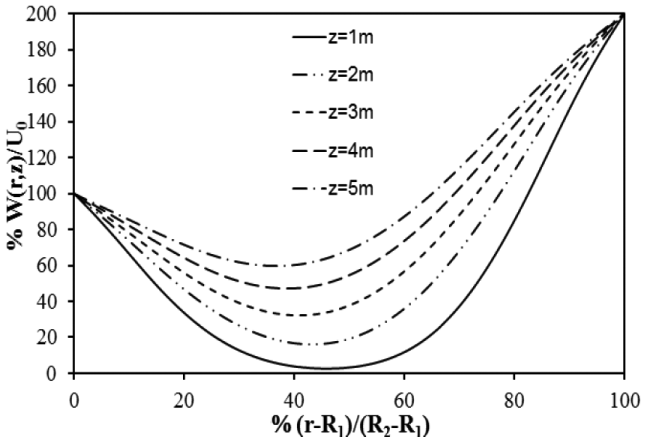
Tangential velocity profiles.

Pressure profiles.

Temperature profiles.

Local entropy generation profiles.

Effect of the flow rate.

Effect of the outer radius.

Effect of wall temperature.

Effect of the angular velocity of the inner cylinder.
By taking a close look at Figure 6, we can classify the corresponding profiles into three zones. Two zones of high-temperature gradients are visible in the vicinities of the cylindrical walls, corresponding to heat exchanges between the fluid and the hottest surfaces. The third zone is situated at the center of the duct where the temperature of the fluid remains unchanged, resulting from the fact that thermal conduction effect is not yet felt by the fluid.
In Figure 7, we draw the profiles of entropy generation due to heat conduction and viscous effects. As has been noted, irreversibility due to fluid friction is negligible compared to entropy production due to the heat transfer. Moreover, relative maximums are observed in the vicinities of walls, as a consequence of strong gradients of temperature and high tangential velocity in these locations. The corresponding maximums are attenuated and migrate to the central zone of the flow as well as advancing through the duct. It is interesting to notice the asymmetry in the profiles of entropy creation with respect to the central zone of the flow. In fact, the centrifugal force effect leads to a thickening of the fluid in the vicinities of the outer wall (Figure 5) and provides for better fluid circulation in the vicinities of the inner wall. In other words, even if temperature fields (Figure 6) seem to be symmetrical, strong temperature gradients are developed in the vicinities of the inner wall, thus advantaging entropy generation in these locations.
Figure 8 profiles the impact of the flow rate on entropy production and average Nusselt numbers. We notice that accelerating the fluid flow increases the Nusselt numbers and entropy generation. In fact, raising the average velocity increases the fluid velocity of all pipe sections, in particular in the vicinities of walls. This rapidly ensures adequate fluid renewal in the vicinity of walls, thus maintaining strong temperature gradients. Heat transfers are then accentuated, enhancing entropy production and increasing Nusselt numbers.
Figure 9 illustrates the variations of global entropy generation and average Nusselt numbers according to the outer radius of the annular width. It can be noted that raising the radius of the outer cylinder increases heat transfer area which implies an accentuation in heat transfers, thus enhancing entropy generation and raising the Nusselt numbers.
Figure 10 mentions the effect of the wall temperature on irreversibility and heat transfers. The results show that decreasing the temperature difference between gas and walls leads to low-temperature gradients, diminishing heat transfers and thus reducing irreversibility. Additionally, the use of high wall temperature decreases the Nusselt numbers. This can be explained by the temperature dependencies of thermal conductivity and heat capacity of the fluid.
Computation results using the variation of the angular velocity of the inner cylinder are presented in Figure 11. As you can see in this diagram, practically there is a dissociation of the cylinders rotation from thermal transfer phenomena, in particular in vicinity of the outer cylinder. Nevertheless, an increase in the angular velocity of cylinders leads to a thickening of the fluid in the vicinity of the outer wall. This induces singular pressure drops, slowing the fluid flow in the vicinities of the outer wall and accelerating the fluid particles in the vicinities of the inner one.
Conclusion
Entropy generation due to forced convection within a rotating cylindrical annulus is numerically investigated. This study is focused on a laminar flow of a temperature-dependent fluid bounded between two concentric and isothermal cylinders. The global entropy production profiles are illustrated with a variety of boundary conditions. Based on the obtained results, the following points can be made:
Irreversibility owing to fluid friction is neglected compared to entropy generation due to heat transfer.
Entropy generation and Nusselt numbers are not affected by the angular velocity of the inner cylinder.
Increasing the radius of the outer cylinder enhances entropy generation and raises the Nusselt numbers.
Diminishing the flow rate leads significantly to lower entropy generation.
The use of high wall temperature results in a significant increase in entropy production and a decrease in the Nusselt numbers.
Footnotes
Appendix 1
Academic Editor: Oronzio Manca
Declaration of conflicting interests
The author(s) declared no potential conflicts of interest with respect to the research, authorship, and/or publication of this article.
Funding
The author(s) received no financial support for the research, authorship, and/or publication of this article.