




Abstract
Compared with the conventional single web disk, the twin-web disk has been designed as the future trend of the high-pressure turbine disk by the US Integrated High Performance Turbine Engine Technology program due to its breakthrough in weight loss, strength, and heat transfer efficiency. However, as a crucial component, the high-pressure turbine disk of aerocraft needs a high reliability and a steady quality at the same time. The traditional deterministic multidisciplinary design of optimization method sometimes could not be able to satisfy both the two requirements and depends heavily on the selection strategy of safety factor. In this article, reliability-based multidisciplinary design optimization has been performed to find a proper shape of twin-web disk with the minimum weight. The structural strength reliability analysis is performed using Monte Carlo simulation and set as the constraints in order to ensure the stability and safety. Kriging approximation is performed to reduce the computational cost. Then, the optimal points obtained by reliability-based multidisciplinary design optimization and common multidisciplinary design optimization are compared. The results show that the reliability-based multidisciplinary design optimization can obtain a better performance and less weight, which could be a reference in designing the twin-web disk for industry.
Keywords
Introduction
The twin-web high-pressure turbine disk (TWD) has advantages in internal cooling and weight loss. 1 As the future substitute of the conventional single web turbine disk (SWD), the TWD still lacks scientific design technique. Previous investigation of TWD design focused on shape optimization.2–4 But in these studies, the thermal load was ignored or just obtained by empirical formula, which is unpractical when suffers an extreme high turbine inlet temperature (TIT). And the scatter in dimensions, material properties, and loading can also degrade the stability and safety of the TWD.
Multidisciplinary design optimization (MDO) is a suitable technique solving the problems especially in the case of multi-physics working conditions and intense coupling of multiple disciplines. 5 For decades, MDO has obtained success in many aero industrial products.6–8 As a deterministic optimization, MDO is driven to the limit of the deterministic constraints. However, designs without consideration of the model and physical uncertainty are unreliable and could lead to systematic failure.
At this point, the reliability-based multidisciplinary design optimization (RBMDO) has been performed for the evaluations of performance probabilities and the formulations of the probabilistic constraints. RBMDO has been widely studied in recent years.9–14 However, traditional RBMDO method is inefficient which often requires a huge computational resource. The design of experiment (DOE) procedure is a way to develop the scientific strategy in design variables selection and reduce the design space. 15 Then, surrogate model, which is used to approximate the unknown implicit function or high-fidelity finite element analysis (FEM) process, is also known as a way to reduce the computation cost. Kriging approximation is widely applied as an efficient and accuracy method and makes it possible for reliability analysis.9,16–20
In the optimization process, parameterization provides a rapid and automated manipulation of the analysis model. A high-quality parameterization has two conflicting objects: (1) ensure a bigger design space and (2) avoid any failure in establishing model. A bigger design space could lead to a higher possibility of modeling failure. Through a further study of the geometry characteristic of the TWD, a new parameterization approach is proposed in this article and could reduce the error rate of modeling to 0% and amplify the design space by at least 50% compared to our previous work. 21 Therefore, we obtained an even better optimal result.
In this article, a developed parameterization with a series of methods used in RBMDO, including DOE analysis, Kriging approximation, and MCS for reliability analysis, are developed to search the optimal shape of TWD with objective of minimum weight under the probabilistic constraints. The thermal data are transferred to the structural analysis by the inverse distance weighted (IDW) interpolation method. Then, the deterministic MDO is also conducted as a comparison. The RBMDO procedure proposed in this article can be an inspiration and reference for researchers and designers in designing of the TWD disk.
Proposed methodology
Review of the RBMDO
Multidisciplinary systems are characterized by two or more disciplinary analyses. The solution of these coupled disciplinary analyses is referred to as a system analysis. A typical deterministic MDO problem can be formulated as follows 22



where

The deterministic MDO framework.
A conservative safety margin of the deterministic designs is required to ensure design safety. However, these measures may be not sufficient to provide information on design reliability. Based on this MDO method, the hard constraints are replaced with reliability constraints in RBMDO


where

The framework of the random RBMDO.
Monte Carlo simulation
In reliability analysis, the state limit function g is defined as

where g is the performance function and
With MCS, performance function is executed in a considerable number N, then the probability of failure is expressed as

where Nf is the number of failure events. The accuracy of MCS largely depends on the number of simulation cycles. Its acceptance as a way to compute the failure probability depends mainly on its efficiency and accuracy. According to Lian and Kim, 23 there is a 95% probability that the probability of failure estimated with the MCS will fall into the range 10−4 ± 2 × 10⁻⁵ with 1 million simulations.
Kriging model
Kriging surrogate model is widely used in approximating finite element model (FEM). It can be written as a combination of a regression model and a random process

where y(x) is the unknown polynomial function of x, P(x) is a known polynomial function of the n-dimensional variable x, and Z(x) is the realization of a normally distributed stochastic process. P(x) approximates the global design space, while Z(x) relates to the localized deviations.
However, the initial Kriging model cannot be used directly for its unacceptable error. Therefore, additional study points located in the region of interest are selected for learning and then rebuild the surrogate model in each iteration. This method increases the predictive accuracy of the surrogate model in the points of interest while sacrificing the accuracy in other region.24,25
In this article, the interest region is the region of lower weight of TWD. The additional points for rebuilding the Kriging model are selected by the possibility of existing in this region. According to the previous works,17,20 in order to set the convergence tolerance

For clarification, the overall procedure of constructing the Kriging surrogate model is organized as the following steps:
Step 1. Generate the initial sample points by Latin Hypercube technique.
Step 2. Calculate the response at all the initial points using high-fidelity solver, such as FEM.
Step 3. Construct the initial Kriging surrogate model based on all the sample points and its corresponding responses.
Step 4. Searching the optimal point using the constructed Kriging model. A number of optimal points set can be then used as the additional learning points.
Step 5. Calculate the actual responses of the additional points and check the convergence. If satisfy, stop; otherwise, add these points into the sample points set and go to step 3.
RBMDO for TWD
Developed parameterization method of the TWD
According to the concept of Brujic et al., 26 the developed parameterization method is shown in Figure 3. After the correctness analysis of the parameterized model, the new parameterization approach could reduce the error rate of modeling to 0% and amplify the design space by at least 50% compared to our previous work. In this article, model is established with the three kinds of parameters: (1) the design variables (shown in Table 1), (2) the random parameters (shown in Table 2), and (3) the constant parameters. The model of the TWD for fluid, thermal, and structural analysis and all the design conditions are based on previous work. 21
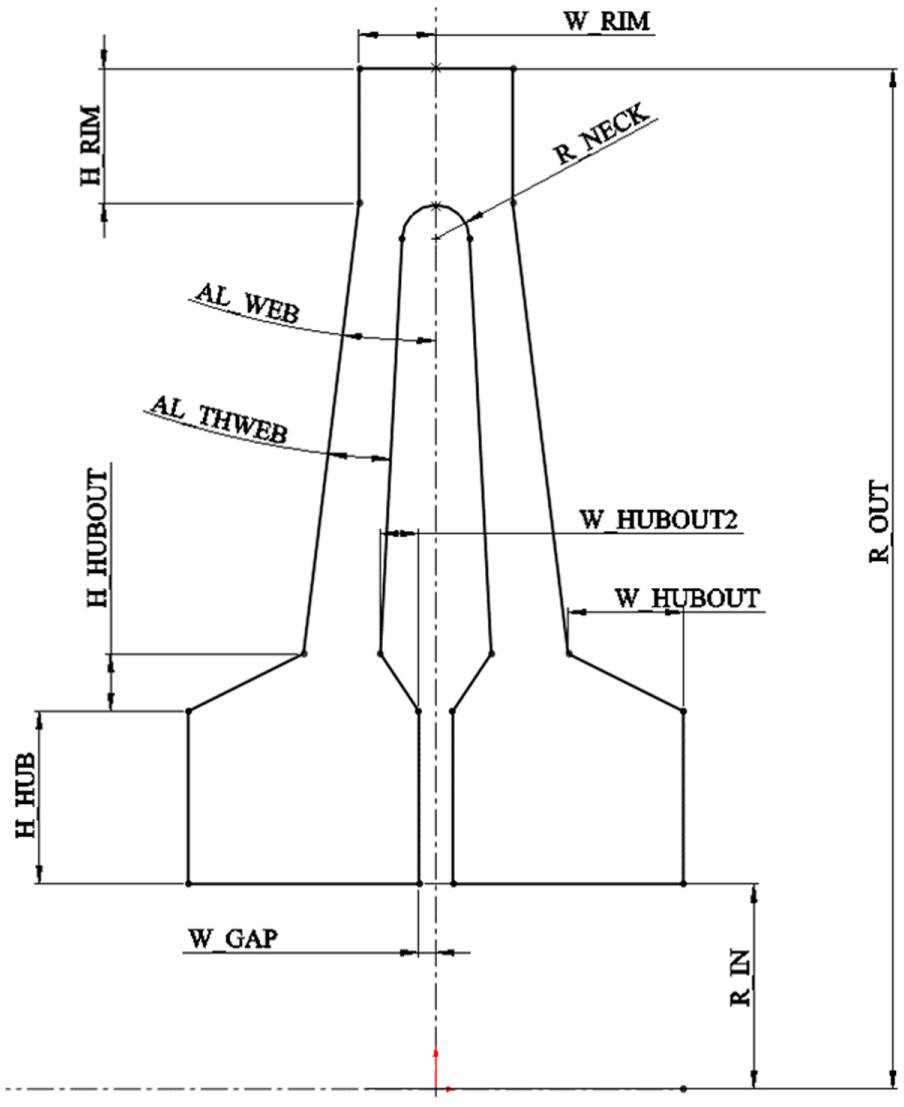
The design variables of the TWD in developed parameterization.
Deterministic design variables.

Random variables in material and operation conditions.

CV: coefficient of variation.
Random variables
The schematic drawing of the TWD, including the solid and fluid region for fluid, thermal, and structural analysis, is shown in Figure 4 and all the design conditions are based on previous work. 21

Schematic drawing of the TWD disk optimization models. White region: solid domain; gray region: fluid domain.
A stochastic coefficient number is introduced by a linear formula

where
Constraints and objective
Generally, the safety requirements of the aero turbine disk are set as follows: 3
Maximum hoop stress at disk hub
Maximum radial stress of web
Average hoop stress on meridian plane
Average radial stress of web
Maximum von Mises stress
In the deterministic optimization, the safety factors of the strength limits or the yield limits of the material are often considered as the deterministic constraints. Therefore, the key factor that influences the optimal results is how to select the safety factors. The bracket “[ ]” indicates the value with the consideration of safety factor. The deterministic constraints of the MDO can be then set as follows

where x stands for the design variables and W(x) is the weight of TWD.
Based on standard, the reliability of stress is required to be greater than 0.999. Therefore, the probabilistic optimization problem is
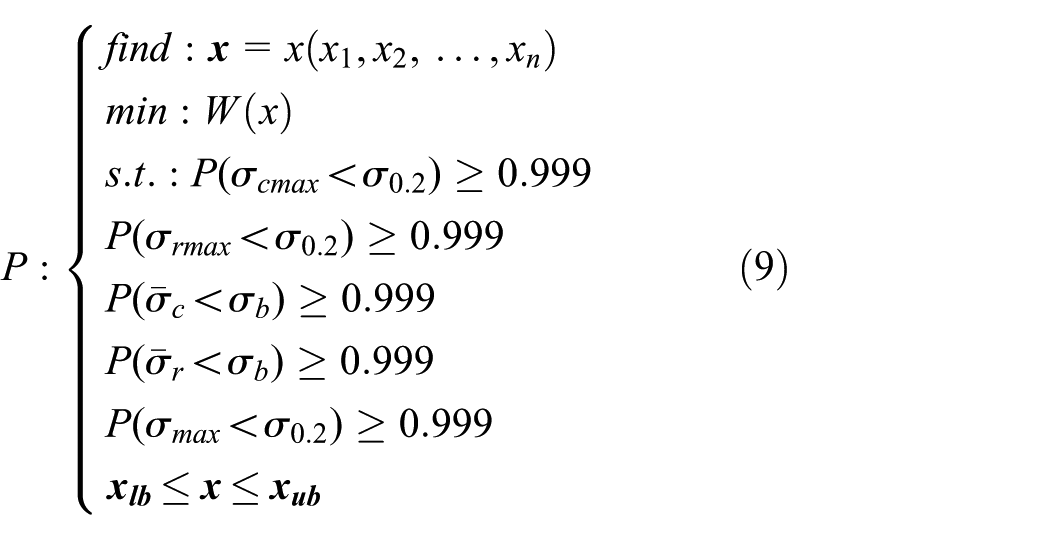
Block process building
DOE analysis for initialization of the start point can accelerate optimization convergence by decreasing the number of variables. The commerce software CATIA is used for geometry parameterization. The design variables, mainly related to the shape of the TWD, are changed by ISIGHT optimization software and FORTRAN. The mesh is developed in ICEM for thermo-fluid analysis and in PATRAN for structural analysis. ANSYS CFX and MSC Nastran are used for thermo-fluid and structural analysis. IDW method is used for data transfer in coupling disciplines. 27 Due to the small amounts of design variables, the MDF method is adopted as the MDO system. In the reliability loop, the random variables and reliability constraints are obtained by MCS. After the optimization, we calculate the probable optimal points using FEM. Figure 5 shows the overall optimization framework.

System optimization framework.
Results
DOE analysis
In this part, the sensitivities of both design variables and random variables are analyzed by DOE.
1. The design variables
The design variables, which manipulate the shape of the TWD, are changed during the optimization. A total of 25 sample points are selected by the Latin Hypercube method. The Pareto effects of design variables on (a) max von Mises stress and (b) weight are shown in Figure 6. The changes in the angle of web mostly influence the stress, and the width of disk rim has great effects on disk weight. They instruct us to amplify the design space of these variables in optimization process.

Pareto effects of design variables on (a) max von Mises stress and (b) weight.
2. The random variables
The random variables, which mostly manipulate the working condition and the material properties of the TWD, are changed during the MCS. A total of 25 sample points are selected by the Latin Hypercube method. The Pareto effects of random variables on (a) max von Mises stress and (b) weight are shown in Figure 7. The rotational speed of the disk and the density of the material have the positive effects on disk stress. Because a higher speed means a larger centrifugal stress

And with the same volume V, higher density

According to equation (4), the higher density also means a larger centrifugal stress.

Pareto effects of random variables on (a) max von Mises stress and (b) weight.
Only the density value of the material influences the disk weight. Based on equation (5), the density and mass are linear correlation. Based on the results, the Poisson coefficient
Kriging surrogate model error analysis
Kriging surrogate model is established by the MATLAB toolbox DACE. 28 After the DOE analysis, eight design variables and nine random variables are used as the inputs to establish the Kriging surrogate model. The high-fidelity process includes mesh generation, thermal fluid analysis, temperature interpolation and structural analysis. With 32 core central processing unit (CPU), each calculation lasts for about 11.5 min. The mean iteration number of the computation for thermal fluid using ANSYS CFX is about 400. A total number of calling FEM is 410 for constructing Kriging surrogate. The initial sample points set are also generated by Latin hypercube method. Then, the genetic algorithm (GA) is selected as the optimization technique. After 11 optimized iterations, the final Kriging model is constructed. It spends about 72 h on constructing the Kriging model. Then, we select the most two effective variables on Mises stress and weight for error analysis, shown in Figures 8 and 9.

Kriging model error analysis for deterministic design variables: (a) effects on von Mises stress and (b) effects on weight.
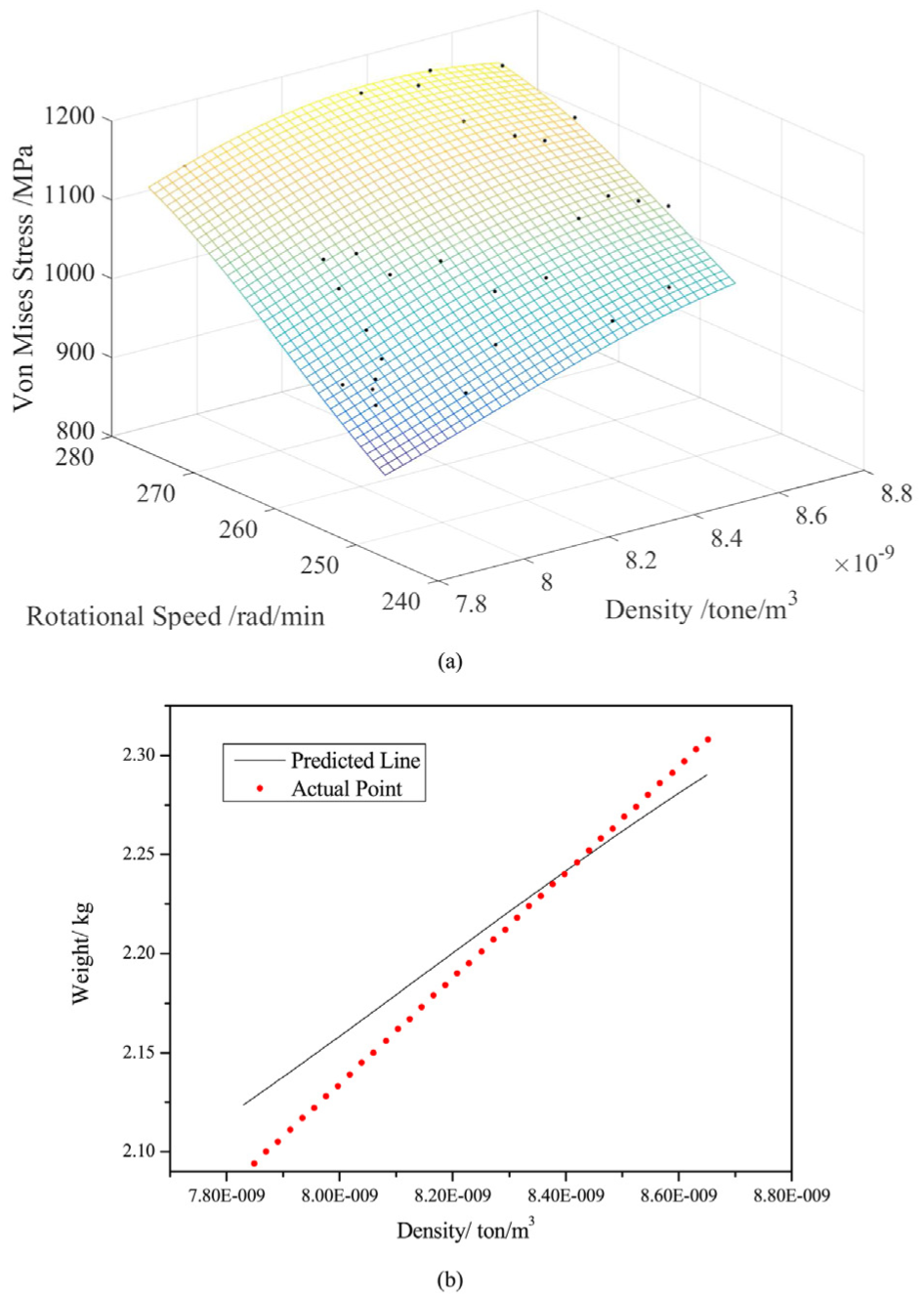
Kriging model error analysis for random variables: (a) effects on von Mises stress and (b) effects on weight.
The response surface is built by Kriging model. A total of 40 actual points are selected in Latin Hypercube method shown as the dots in the following figures. Density is the only one random variable that influences the disk weight, so Figure 9(b) shows them in a line-symbol two-dimensional (2D) figure. All the figures show that the accuracy of Kriging model can be acceptable.
Optimization results
After 150 optimized iterations, the optimal results are obtained. The optimal searching history by RBMDO is shown in Figure 10. Where the red dot indicates that this design point is infeasible and the green dot means the optimal point. We can observe that RBMDO obtains the minimum weight of the disk. It demonstrates that the common deterministic optimization is a conservative method.
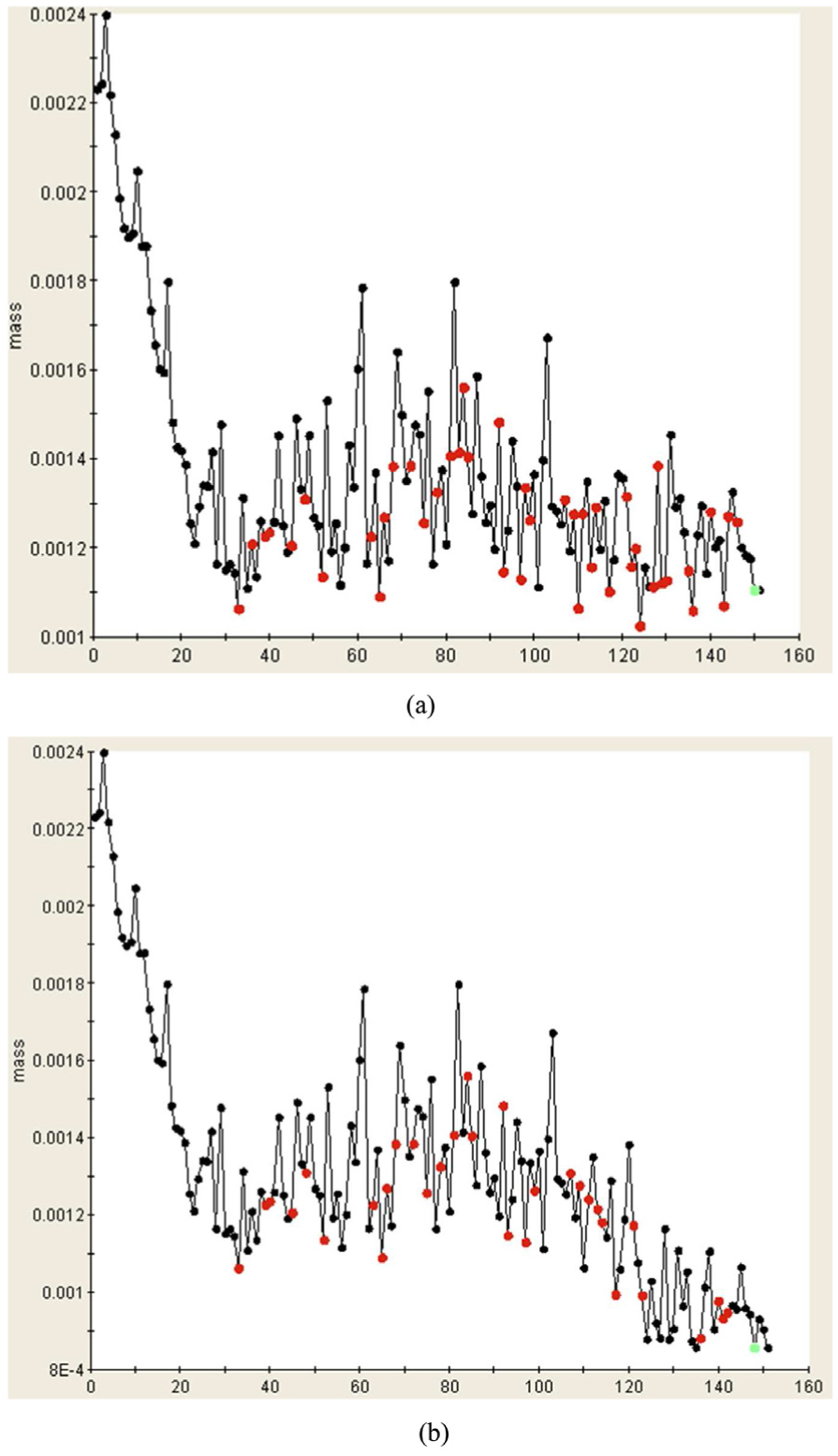
Optimal searching history of (a) MDO and (b) RBMDO.
Then, the high-fidelity FEM is used to calculate the optimal point and several feasible points around the optimal one obtained by Kriging surrogate model. Among these probable design points obtained by surrogate model, the Max von Mises Stress of RBMDO is beyond the deterministic upper limit, which is infeasible in deterministic optimization. But in fact, the stress is not beyond the material upper strength limits. The probability-based optimization does not depend on a deterministic safety factor and shows its advantages in optimal point searching. In this study, the stricter safety factor is used, so this RBMDO’s optimal point is not feasible in MDO. One optimal point for each method (RBMDO or MDO) is then obtained, respectively. Then, three design points, including the start point, the MDO’s and the RBMDO’s optimal point, are studied in the following part.
Figures 11–13 show the stress distribution of the three design points. The MDO and RBMDO both can decrease the maximum stress. The figures of the MDO’s optimal point show that the web is the most probable failure region, especially in the region of junction between the rim and the web (shown in Figure 11(a) and (c)). Therefore, the uniform stress distribution and enhancement should be considered. And the figures of the RBMDO’s optimal point show that the stress distribution is ameliorated in RBMDO’s optimal point. RBMDO obtained a smaller maximum von Mises stress in the region of disk hub and a more uniform stress distribution in web. This development is brought by the decrease in hub weight and the increase in web thickness.

Stress distribution of the start point: (a) radial stress, (b) hoop stress, and (c) von Mises stress.

Stress distribution of the MDO’s optimal point: (a) radial stress, (b) hoop stress, and (c) von Mises stress.
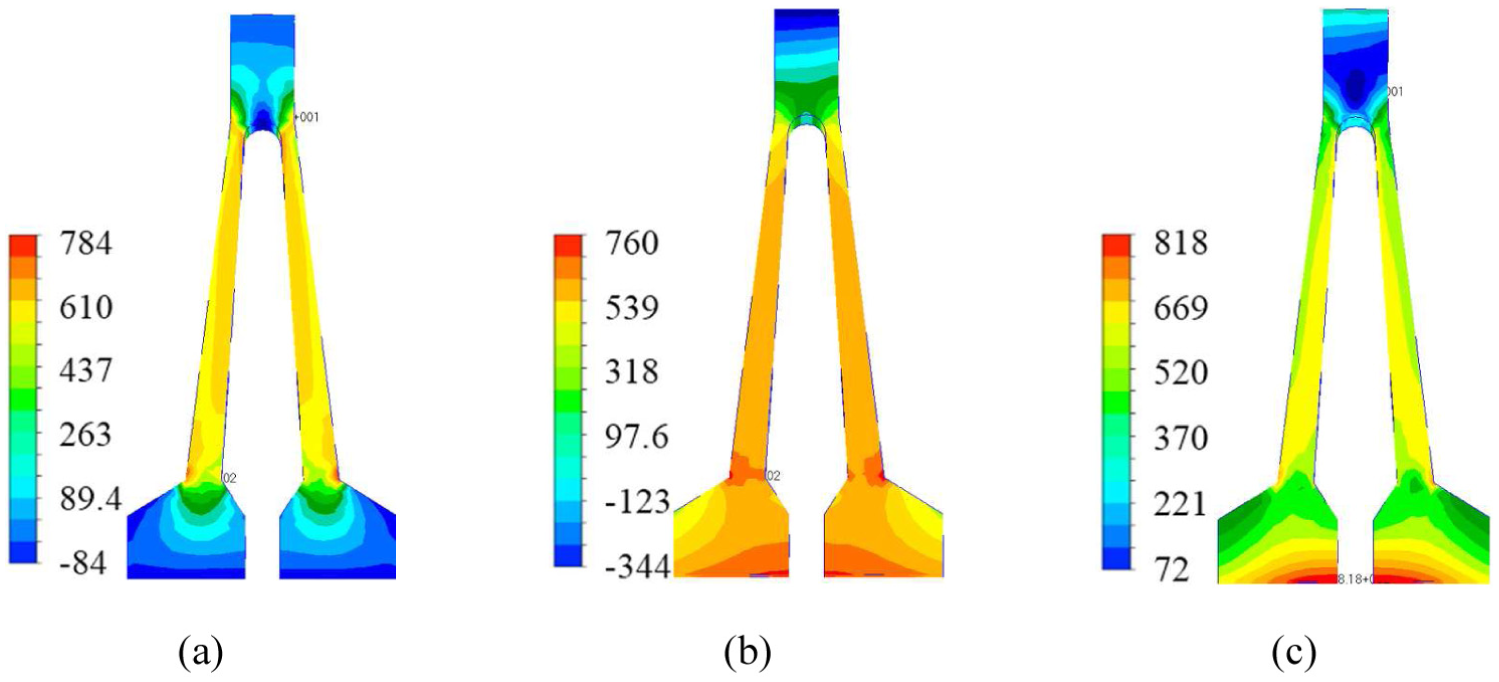
Stress distribution of the RBMDO’s optimal point: (a) radial stress, (b) hoop stress, and (c) von Mises stress.
Table 3 shows the details of the optimal design results of the three points. All the parameters are normalized in the further study. The AL_THWEB and the H_HUB are the most different between the two optimal points. With the thicker web and the higher hub, the RBMDO’s optimal point obtains the lighter weight, compared to the MDO method.
Optimum design results of RBMDO and MDO.
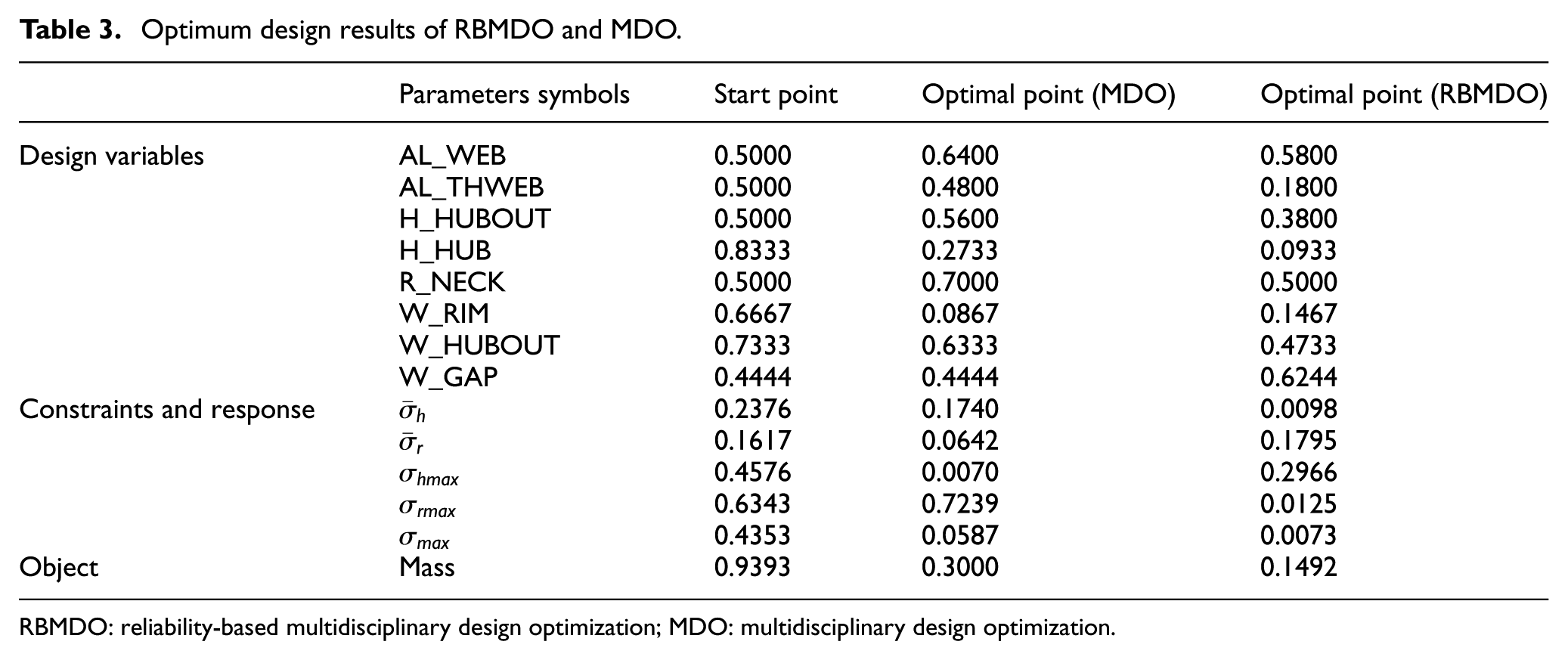
RBMDO: reliability-based multidisciplinary design optimization; MDO: multidisciplinary design optimization.
Table 4 shows the rate of change in all the responses and objectives. Based on the start point, the weight by MDO and RBMDO method can be decreased by 36.06% and 44.57%, respectively. Besides, the von Mises stress of the MDO and RBMDO can be decreased by 13.79% and 15.67%.
Optimum design results of RBMDO and MDO (baseline: start point).

RBMDO: reliability-based multidisciplinary design optimization; MDO: multidisciplinary design optimization.
The reliability analysis results in start and the optimal points are obtained by MCS and Kriging surrogate model. The maximum iterative number for Monte Carlo is 105. Table 5 shows the mean value, standard deviation, and the reliability of the three points. The reliability of maximum hoop stress and radial stress in the start point and the reliability of maximum radial stress in MDO’s optimal point are beyond the constraints while the reliability of all responses of the RBMDO’s optimal point satisfies the probability constraints. It demonstrates that the deterministic optimal point would be infeasible for reliability requirement when the lower safety factor is selected. Besides, the standard deviation of RBMDO’s optimal point is the lowest, which shows a steady product quality.
Reliability analysis results.

RBMDO: reliability-based multidisciplinary design optimization; MDO: multidisciplinary design optimization.
Bold significance that, the reliability values is smaller than the safety value (0.999), which indicates that the design point locates in the failure domain.
Conclusion
The use of the novel TWD can decrease the weight up to a maximum of 44.47% based on this study, which is significant for the turbine performance. However, as a crucial component, the high-pressure turbine disk of aerocraft needs a high reliability and a steady quality at the same time. The traditional deterministic MDO method sometimes could not be capable to satisfy both the requirements and depends heavily on the selection strategy of safety factor.
In this article, the RBMDO method and common MDO method are both adopted to search the minimum TWD’s weight. The probable and determinate constraints are integrated in the optimization process. Using the Kriging model, we get several probable optimal points. Then, after high-fidelity FEM calculation, the final optimal points are obtained. Some important conclusions are listed as follows: (1) after DOE analysis, some crucial design variables (the width of rim and the angle of webs) and random variables (the density and rotational speed) are obtained, which is of significant effects on alleviating the optimization cost; (2) the accuracy of the Kriging model proposed in this article is dependable according to the error analysis; (3) with the thicker web and the higher hub, the lighter weight is obtained by the RBMDO method, compared to the MDO method; (4) based on the start point, the weight by MDO and RBMDO method can be decreased by 36.06% and 44.57%, respectively. Besides, the von Mises stress of the MDO and RBMDO can be decreased by 13.79% and 15.67%; and (5) the standard deviation of RBMDO’s optimal point is the lowest, which shows a steady product quality. Because of the universality of MCS and the efficient surrogate model, the RBMDO method can be used in wide range without any particular restriction. Above all, the RBMDO provides a better way to meet the requirement of optimal minimum weight and steady quality for the TWD design. The probability design for TWD could be a reference for further industrial product design.
Footnotes
Academic Editor: Yongming Liu
Declaration of conflicting interests
The author(s) declared no potential conflicts of interest with respect to the research, authorship, and/or publication of this article.
Funding
The author(s) received no financial support for the research, authorship, and/or publication of this article.