




Abstract
Underwater explosion experiments were conducted to determine the optimal performance of cyclotrimethylenetrinitramine (RDX)-based aluminized explosives with an aluminum content of 0%, 15%, and 30%. Free-field blast output energies of the three types of explosives were measured between 0.3 and 0.8 m. The shock wave energy, bubble energy, detonation energy, and energy heat release rate were measured. A new calculation method was based on the experimental results to simulate the bubble pulse process and pressure changes inside the bubbles of non-ideal explosives. The specific distance at which maximum total energy was achieved for the underwater explosion was determined.
Keywords
Introduction
Extensive developmental research has been carried out on explosives used in underwater weapons, such as RS211 (RDX64/TNT19/Al17), H-6 (RDX45/TNT30/Al20/D2wax5), HBX-1 (RDX40/TNT38/Al17/D2wax5), HBX-3 (RDX31/TNT29/Al35/D2wax5), and polymer-bonded explosive (PBX)-111 (AP43/RDX20/Al25/HTPB12). 1 RDX/TNT/Al and RDX/Al/wax are explosive types that have been used extensively in underwater explosions. Research on propagation rules of RDX-based aluminized explosives is of vital significance to improve the technical approaches to explosive energy. Energy release from classic and basic non-ideal aluminized explosives can be divided into the heat of detonation and combustion, where the latter is generated by burning fuel-rich products that are created by the detonation. 2
The energy output of aluminized explosives after detonation includes three parts: shock wave energy, bubble energy, and thermal loss. The three-part energy distribution and attenuation variation when propagating in water must be taken into account to design explosives.
Al in aluminized explosive slows down the attenuation of detonation pressure and improves the bubble energy by secondary combustion reactions. RDX-based aluminized charge has a long reaction zone and a low detonation energy release process. Accurate numerical modeling of this process is challenging. Ideal explosives undergo shock-to-detonation transition promptly over a wide range of input shock pressures, and reaction-rate effects on detonation wave propagation can mostly be ignored. 3 Heavily aluminized explosives change the length and timescale of the chemical reactions. Some researchers have conducted experimental studies on the equation of state of aluminized explosives to investigate the Jones–Wilkins–Lee equation of state (JWL EOS).4,5 JWL EOS parameters can be determined from a cylinder test for ideal explosives since the reaction time is 5 µs and the metal acceleration ability can be calculated for 35 µs. RDX-based aluminized explosives have a slow heat release process and require more than 35 µs reaction time. The reaction of detonation gas and Al has not been established, and further studies are required to evaluate whether the JWL EOS is effective for underwater explosions. For non-ideal explosives, detonation product expansion is non-isentropic from the Chapman–Jouguet point and the polytropic exponent of detonation products changes with time. Kennedy and Jones 6 described PBXW-115 (AP43/RDX20/AL25/HTPB12) detonation phenomenon experiments and found that the detonation reaction range for PBXW-115 exceeds that for conventional explosives. Davydov 7 studied the axial and radial expansion velocity of RDX/Al explosives. He found that Al powder starts to burn behind the detonation wave front based on test results of speed and temperature. Non-ideal detonation reaction models are generally characterized by three models: 8 a secondary reaction, inert thermal dilution, and chemical heat dilution model. They all have some application limitations, but the secondary reaction model agrees well with the experimental phenomena.
Underwater experiments have been conducted to establish the influence of Al content, Al/oxygen (O) ratio, and particle size (nanometer to micrometer) on underwater explosion performance, including the temperature, pressure profiles, and thermal decomposition.3,9–16 These studies indicate that there is a connection between the total energy and the specific distance for the same based non-ideal explosives.
We have conducted underwater explosions in a liquid tank and have focused on three main objectives: (1) to characterize the propagation of blast waves for RDX/Al explosives. Shock pressure–time curves and total impulse were estimated at different locations and compared for different Al contents. (2) To study the problems of bubble oscillation simulation according to the test results and to provide a newer, simpler one-dimensional (1D) model to simulate bubble motion precisely. (3) To analyze the characteristics of output energy structure and to determine the specific distance of maximum total energy.
Detonation experiments
Experimental method
To analyze the different energy outputs (shock wave energy, bubble energy, and heat release), underwater explosion experiments were conducted in a cylindrical 3-m-deep water pool of 2 m diameter. In all, 15 g of three types of cylindrical charges of 20.00 ± 0.20 mm diameter were used with Al contents of 0%, 10%, and 30% (termed JH0, JH10, and JH30, respectively) as shown in Figure 1(a). The experimental setup for pressure measurements is shown in Figure 1(b). Aluminum powders of 10 and 2 µm are added to explosives with the ratio of 2:1. In order to observe the morphology of the aluminum powder samples used in this study, S4700 Hitachi was used to analyze all the samples by scanning electron microscopy (SEM), as shown in Figure 2(a) and (b).

Experimental setup for pressure measurements: (a) Charge construction and (b) Diagram of small explosion water pool.
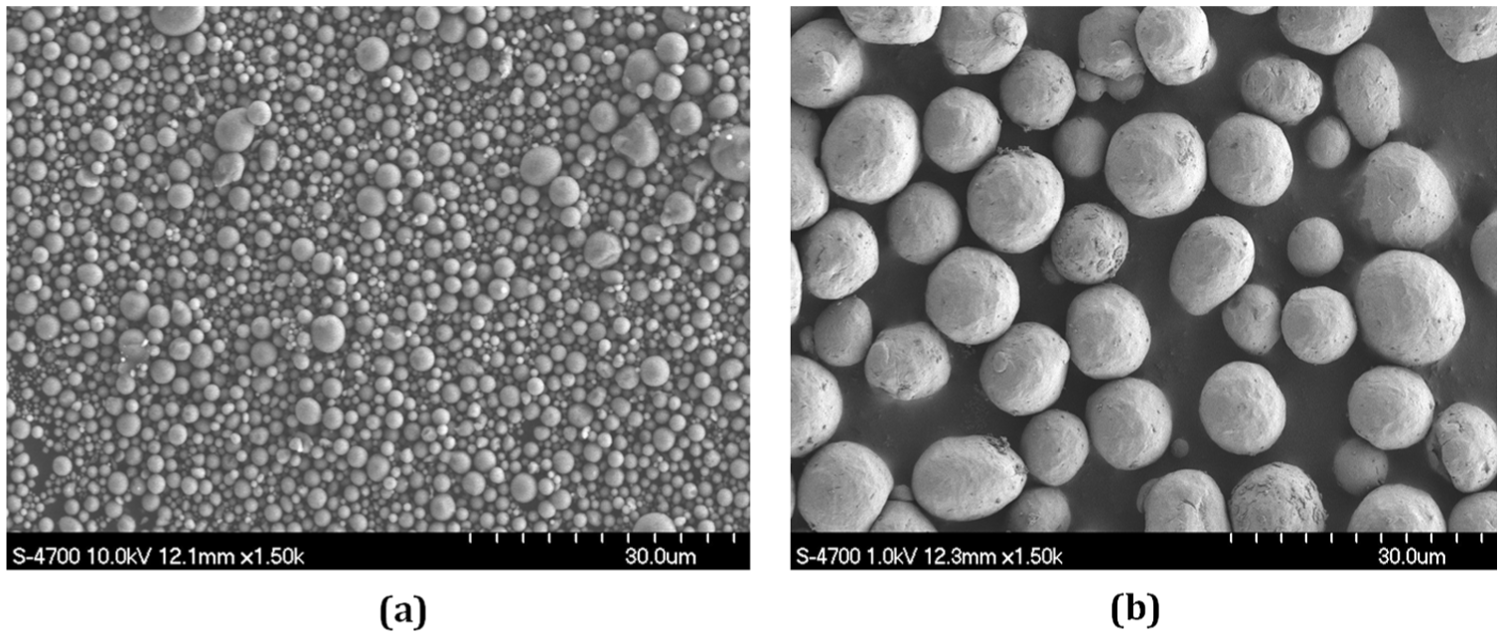
Micron aluminum SEM pictures: (a) GC-1 (2 µm) and (b) GC-2 (10 µm).
The pool has windows on four sides to observe the experimental phenomena. A high-speed camera was placed in front of the observation window to capture the bubble pulse changes. Four high-pressure transducers (PCBW138), a data collection instrument, and an adapter were used according to the Chinese military standards (GJB772A-97).
In Table 1, contents refer to the mass ratio of each component; ρ and D are the density and viscosity of the explosive, respectively; PCJ is the detonation pressure; Al/O is the molar mass ratio of Al to O; and QV is the explosion heat.
Characteristics of RDX/Al composite explosives. 17

Detailed characteristics of the RDX/Al composite explosives are presented in Table 1. For the same charge, a study of six different specific distances, from 0.3 to 0.8 m, was conducted by orthogonal experimental methods. The RDX/Al charges were located 1 m below the water-free surface and consistent with the pressure transducer heights. Pressure–time curves were measured three times at each location for each explosive. Explosives were detonated in the end face center using a No. 8 industrial detonator (GB8031-2005) with 7.35 mm diameter and the length of 50 mm. To ensure accuracy, three initial underwater tests on the detonator (RDX 96.5%/binder 3.5%) were used to correct the sensitivity coefficients of the pressure sensor, k1 and k2, which are the standard value and the experimental value ratio. The measured specific shock energy trinitrotoluene (TNT) equivalent and specific bubble energy TNT equivalent of a detonator fitted using theoretical values yielded k1 = 1.01 and k2 = 3.26 × 10². The detonator energy should be deducted when calculating a specific shock energy and the specific bubble energy of explosives JH0, JH15, and JH30.
Results for underwater performance
Figure 2 shows the change in pressure with time for 15 g RDX-based aluminized explosives at 0.3, 0.5, and 0.8 m. The inserted curves are magnified figures of the overpressure. Data in Figure 2 are recorded by the sensor for 400 ms and are used to ensure that the bubble period occurs during the measurement range. Pressure–time curves display two maximum values caused by shock wave and bubble pulsation. Tables 2 and 3 show the significant parameter-based pressure curves in Figure 3 and the results obtained from equations (1) to (4). Triplicate pressure curve was obtained for the same explosive in the same specific distance.
Output energy of RDX/Al explosives for different distances. a
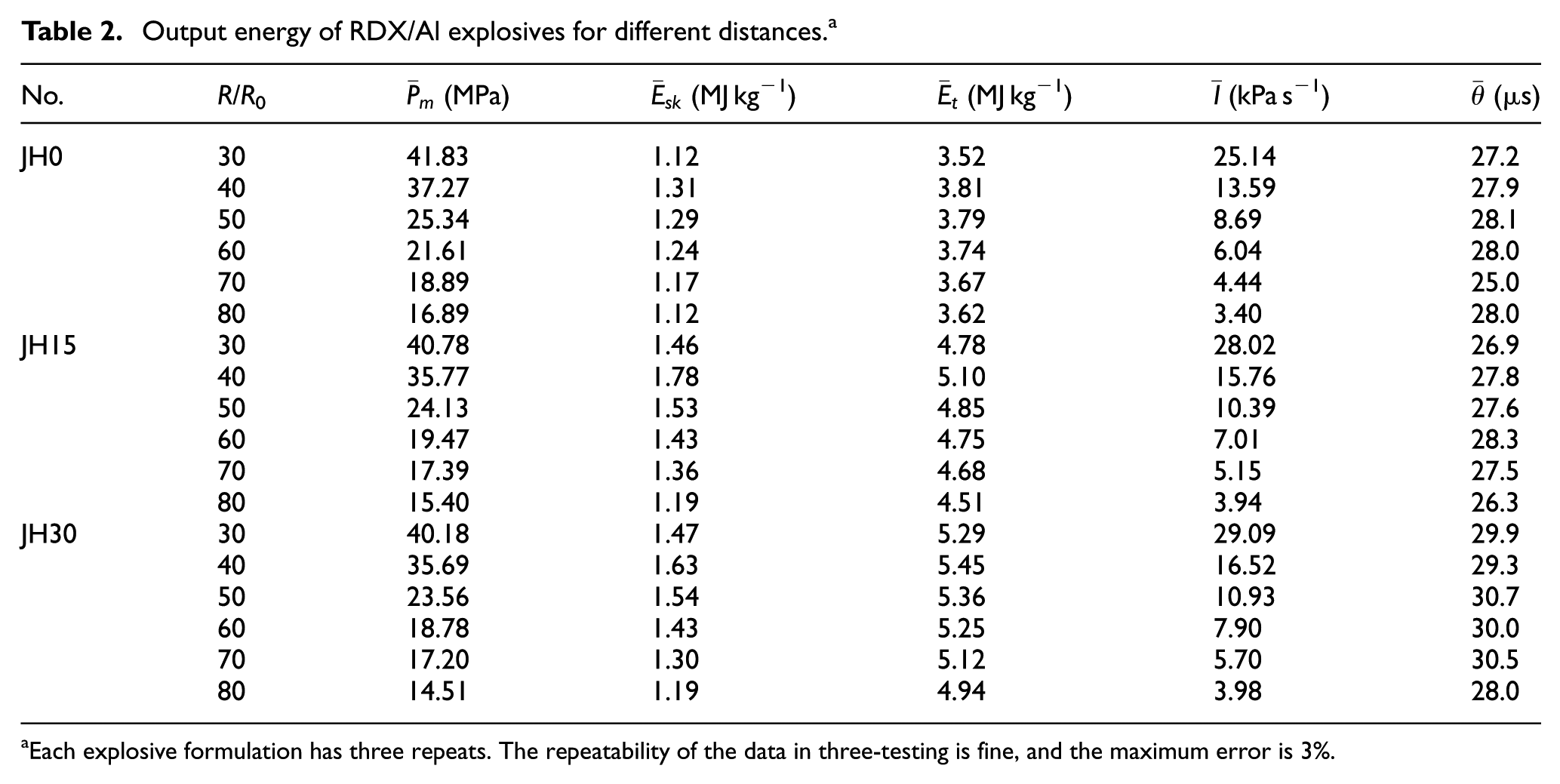
Each explosive formulation has three repeats. The repeatability of the data in three-testing is fine, and the maximum error is 3%.
Results of bubble energy output of RDX/Al explosives. a

Each explosive formulation has three repeats. The repeatability of the data in three-testing is fine, and the maximum error is 3%.
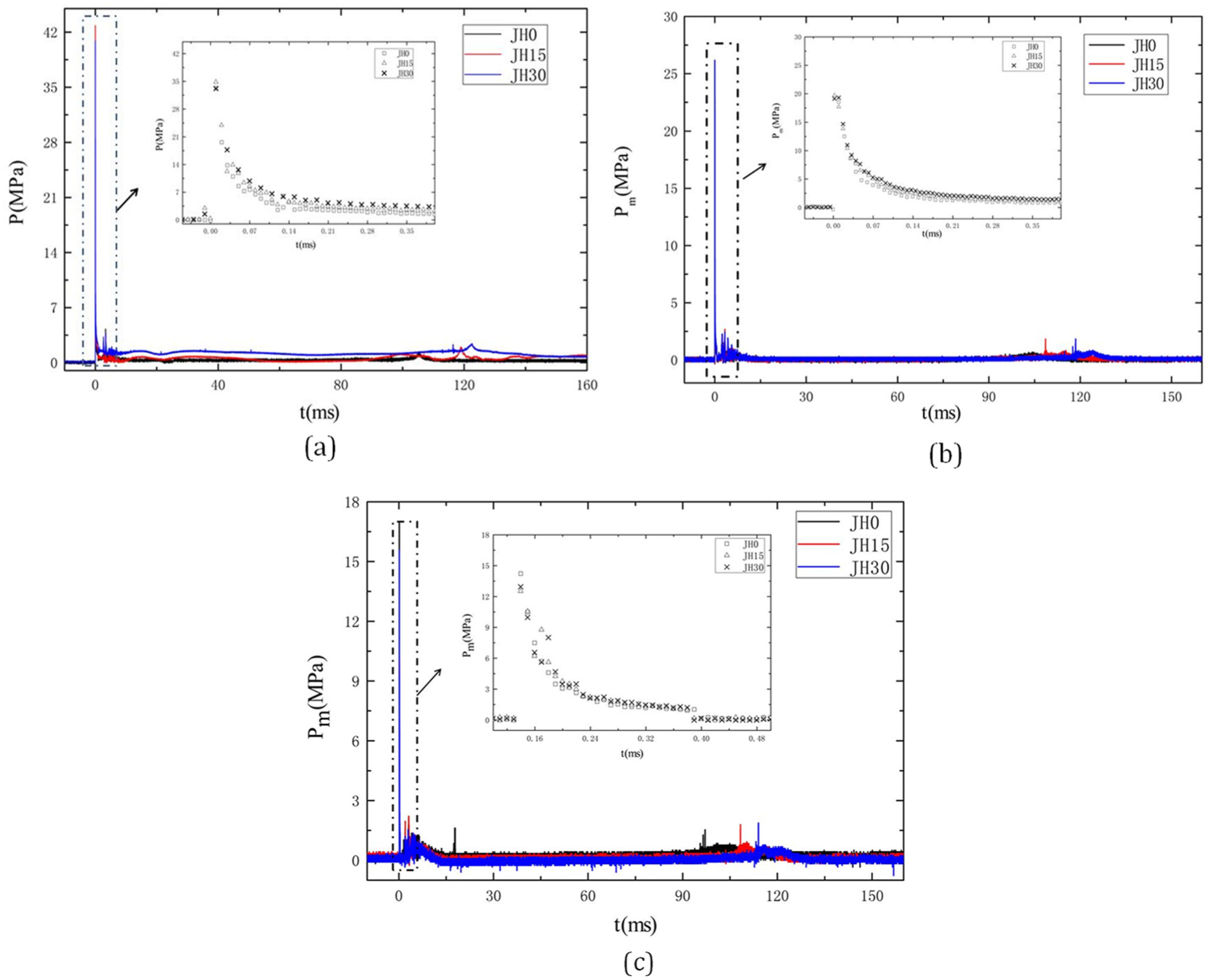
Shock wave pressure profile for a specific distance of (a) 30, (b) 50, and (c) 80.
The parameters in Tables 2 and 3 are the average values calculated using the three curves measured under the same conditions. R/R0 is the specific distance, the specific distance between the charge center and the sensor (R/m) divided by the explosive radius (R0/m), and


where K1 represents the calibration coefficient of a specific shock wave energy, K2 is the calibration coefficient of a specific bubble energy, W is the explosive quality (kg), ρ is the water density (1000 kg m−3), c is the velocity of sound in water (1450 m s−1), P(t) is the explosive shock wave pressure (Pa), and T is the bubble pulsation period (s). Among them, the most important parameter to measure explosive performance is the explosive potential (energy content per unit mass).
The output explosive energies for different Al contents are given in Table 2. For a specific distance from 30 to 80, the shock wave and total energy reach a maximum when the specific distance (R/R0) equals 40 for the same explosive. Manner et al. 10 conducted similar research on HMX-based Al explosives and found that R/R0 equals 27 for a specific distance between 18 and 55. Lin et al. 9 studied the specific distance from 70 to 150 and found that the specific shock wave energy decreased with increasing R/R0. Therefore, for a specific distance from 30 to 150, RDX-based aluminized explosives have a maximum output energy at 40.
Table 2 shows the
Explosion energy release rate
The expansion work provided per unit mass in a charge detonation can be calculated from equations 18 (5) to (7)


where A0 is the total specific output energy (MJ kg−1); µ is the coefficient related to detonation velocity, explosion pressure, and charge density; and Kf is the charge geometry factor. Kf varies between 1.02 and 1.10 for a non-spherical shape, and η is the energy release rate.
As shown in Table 4, Al powder addition reduces the energy release rate of underwater explosion. The higher detonation heat generated by explosion in water produces a higher heat loss. More energy is consumed to heat the surrounding water medium and the energy release rate will decrease simultaneously. Heat losses constitute 4%, 5%, and 6% of energy release. Most energy is used to do useful work. Therefore, an improvement in explosive heat is the most important index in explosive formula design.
Series of JH aluminized explosive detonation parameters.

Similar law of shock wave
For explosives detonated at a distance R, the similar law (an empirical formula that describes the relationship between shock wave overpressure (Pm) and specific distance (R/R0)) was adapted to several types of explosives 14

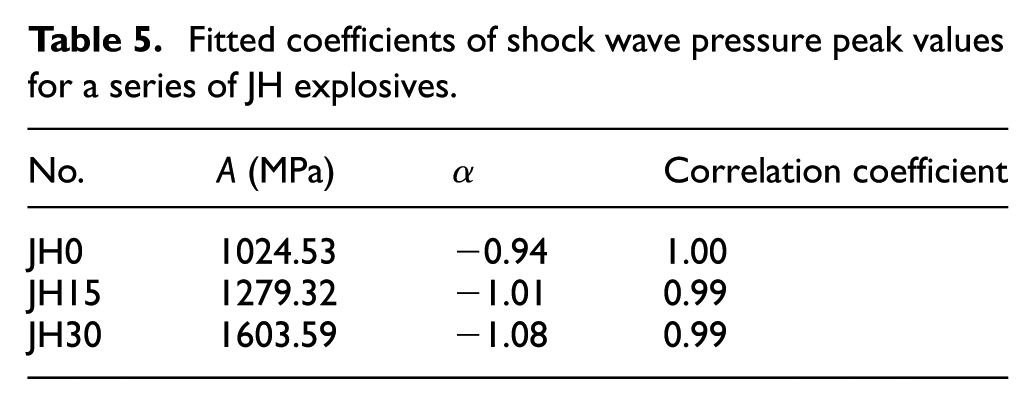
Figure 3 shows the pressure attenuation over a specific distance from 0.3 to 0.8 m, where (a), (b), and (c) represent JH0, JH15, and JH30, respectively. The peak pressure of the composite explosives shows no regular change with R/R0. As shown in Figure 4, the measured pressure attenuated with specific distance shows a bad correlation with data calculated from equation (8). An exception to the similar law of shock waves is the specific distance 40. The overpressure at 40 is higher than the calculated values for JH0, JH15, and JH30. If the overpressure at the specific distance 40 is not taken into account, the overpressures of RDX-based aluminized explosives in the primary shock wave are fitted in Figure 5 and the coefficients are given in Table 5.

Pressure peak value: R/R0 curves: (a) Peak pressure vs. scaled distance with the specific distance 40 and (b) Peak pressure vs. scaled distance without the specific distance 40.
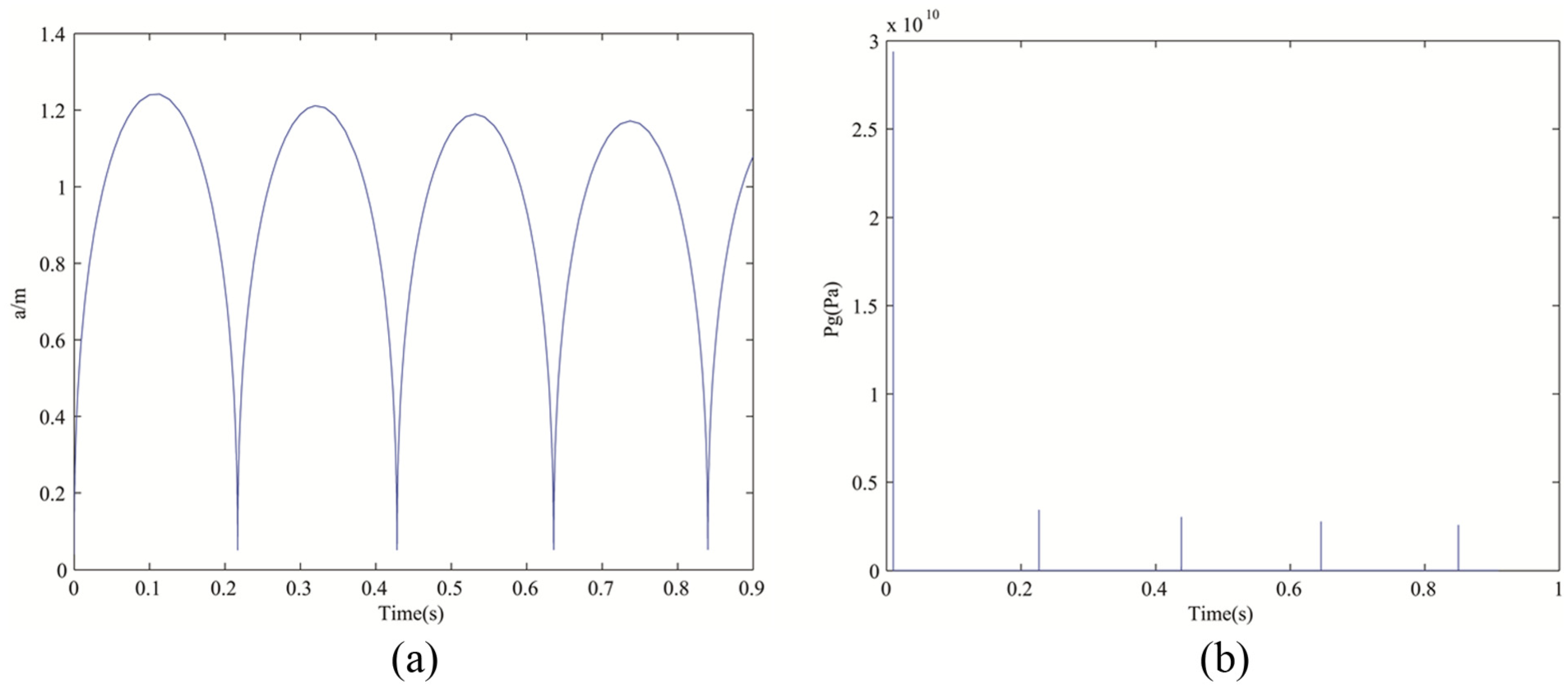
(a) Variation in bubble radius with time and (b) variation in pressure inside the bubble.
Fitted coefficients of shock wave pressure peak values for a series of JH explosives.
Australian researchers 6 have already noticed the situation that the shock wave energy changes with the measuring point. They believe that this phenomenon is caused by the reflection of the boundary of the pool. But this statement does not explain the linear correlation between shock wave energy and distance of ideal explosive TNT under the same test conditions. We speculate the reason is the secondary reaction of aluminum powder instead of test condition.
Numerical simulation of bubble oscillation
Spherical bubble dynamics analysis
Output energies can be distinguished from the bubble size and spray height. The most straightforward experimental phenomenon caused by underwater explosions is the bubble size. Rayleigh first derived the bubble boundary momentum equation in 1917 and predicted an undamped oscillation of constant period

where a is the bubble radius, ρl is the density of water, P∞ is the far-field pressure in water, and P denotes the pressure. Subsequently, numerous researchers, such as Plesset and Prosperetti, 19 Herring, 20 Keller and Kolodner, 21 and Geers and Hunter, 22 improved the equation by modifying the hypothetical conditions. The equation deduced by Keller and Kolodner is still used extensively in simulations today and can be expressed as equation (10)
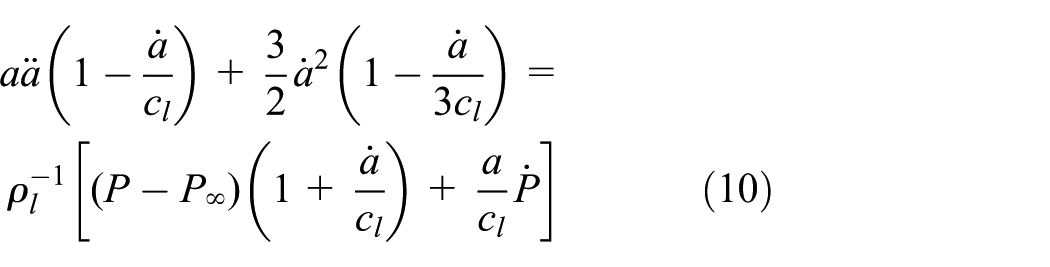
where cl is the acoustic velocity of water, which is assumed constant. Equation (10) takes into account the influence of compressibility on pulsation, and a damped period was built. The JH0 explosive bubble pulsation curve and the variation in shock wave changes with time calculated by equation (10) using the fourth-order Runge–Kutta equation are shown in Figures 5 and 6, respectively. They differ significantly from the experimental results.

Bubble pulsation predicted by new calculation method: (a) bubble pulse radius obtained by the new method and (b) bubble pulse velocity obtained by the new method.
The simulation curves are influenced significantly by the choice of initial value. The significant deviation between the simulation curve and the experimental results does not agree even if the initial radius


where
Establishment of new parameters
The choice of initial value (J, K, and Kc) determines whether the simulation and experimental results are consistent or not. So the point of this article is to determine the physical parameters of RDX-based aluminized explosives. The goal of this article is to simulate the experimentally measured change of bubble radius and pulsation period by equations (9) and (11)–(13).
Detonation product expansion is non-isentropic from the Chapman–Jouguet point and the polytropic exponent of detonation products changes with time. The most difficult part in the simulation of cavity evolution is the selection of polytropic index appearing in equation (13). The aluminized explosives have a less steep isentropic slope. Al and detonation gas continue to react at a timescale of the order of microseconds after detonation. Table 6 and equation (16) 23 show the parameters of detonation products and the calculation method for γ. Gilev and Anisichkin 24 confirmed that the reaction of Al powder and the explosive detonation products is of the microsecond level. Tao 12 proposed that 5–8 µm diameter Al powder reacts completely in less than 15 µs. Baudin 25 and Guirguis and Miller 26 considered that the reaction time of the Al powder varies between tens and hundreds of milliseconds. These theories induce a negligible Al powder reaction time of far less than the bubble pulsation period. The assumption of constant polytropic ratio of specific heats is acceptable when the ratio of explosive density and the gas products density is more than 8. 27 Therefore, the final value of the reaction of Al powder is considered to be an initial value in the process of bubble oscillation. Table 7 shows the content of detonation products calculated by Becker–Kistiakowsky–Wilson EOS. According to equation (14) and the data provided by Tables 7 and 8, the calculated polytropic index of JH0, JH15, and JH30 are listed in equations (15)–(17), respectively. The well-known Rayleigh–Plesset mode is ordinary differential equation and can be solved by MATLAB using fourth-order Runge–Kutta method with parameters shown in Table 8


Polytropic index of detonation products and Al2O3. 21

Detonation products content calculated by Becker–Kistiakowsky–Wilson EOS.

Initial simulation parameters used in the simulations.

The curves in Figure 6(a) are changes in bubble radius with time simulated by new method, and Figure 6(b) shows the radial pulsation velocity. Since the simulation is based on the data obtained from the experiment, the results agree well with the experimental results.
Due to the size effect of non-ideal explosives, this article selects 1-kg RDX-based aluminized explosives to verify the feasibility of the new method. The comparison between the calculated data by the new method, simulation results, and experimental values of the bubble pulsation parameters is shown in Table 10.
Compared with experimental data, the simulating results have errors of bubble period in Tables 9 and 10. The causes of errors mainly included two aspects, the truncation error of initial value (J, K, and Kc) and the selection of polytropic index (γ). The reaction of aluminum powder has not been finished during bubble pulsation. Therefore, γ as a certain value causes larger fitting errors for aluminized explosives. The error is very small (0.10% for 1-kg RDX/Al explosives and 1.00% for 15-g RDX/Al explosives) for ideal explosives.
Numerical and experimental parameters of RDX-based aluminized explosives.

The bubble parameters of 1-kg RDX-based aluminized explosives. a

Conclusion
Underwater explosion experiments and simulation of an explosive with an Al content of 0%, 15%, and 30% were carried out. The following conclusions are made:
We have shown the influence of Al on detonation performance behavior. The addition of Al powder improves the explosion heat and reduces the energy release rate.
Experiments were carried out in a water tank to study the relationship between maximum total energy and specific distance. The total energy of underwater explosion reaches the maximum value when the specific distance was 40.
For three kinds of RDX-based aluminized explosives, the variation in shock wave changes with time, and the shock wave energy, bubble energy, and total energy for six specific distances were given.
A new model for bubble pulsation of aluminized explosives underwater blast effects has been proposed. Its values agree well with pressure history and bubble characteristics of experimental values. It avoids tedious iterations, solves problems of simulation error, and increases the bubble radius monotonically by choice of initial value.
Footnotes
Academic Editor: Filippo Berto
Declaration of conflicting interests
The author(s) declared no potential conflicts of interest with respect to the research, authorship, and/or publication of this article.
Funding
The author(s) received no financial support for the research, authorship, and/or publication of this article.