




Abstract
To study frictional property of mechanical seals when distributing dimples with varying parameters along the radial face, friction experiments, including seal faces with varying dimple diameter in various types, invariable dimple diameter, and without dimples, were carried out on end-face tester under different loads and rotation speeds. The results show that the introduction of dimples on seal face does reduce friction coefficient efficiently, but its anti-friction effect is closely related to the arrangement manner of dimple diameter and the operation condition. The type with increasing dimple diameters along the radial face from the inner to the outer diameter should be more suitable for the design of seal faces for its smaller friction coefficient when comparing with the type with optimum invariable dimple diameter. On the other hand, the operation condition, including loads and rotation speeds, must be taken into account to determine how to increase the dimple diameter along the radial face from the inner to the outer diameter. The results could be a good start for further theoretical study to search for the optimum varying dimple parameters of mechanical seals.
Keywords
Introduction
Mechanical seals with dimples are defined as processed micron-sized dimples with a certain shape and distribution on seal faces, whose original model was set up by Etsion and Burstein 1 in 1996. It provides a new choice for people to search for high cost-effective mechanical seals, due to its better sealing performance, simpler structure, lower price, and easier to change the shape and size of the dimples. Thus, scholars at home and abroad have done a whole bunch of studies systematically on steady-state performance,1–16 dynamic performance, 17 and critical open characteristic 18 of mechanical seals with the dimples to investigate the influence of the structure, distribution, and geometric parameters of the dimples in the last few years. It is well accepted that the improvement in the performance of mechanical seals is dependent on the optimum dimple parameters, including dimple depth, diameter, pitch, aspect ratio or depth-to-diameter ratio, shape, area density, and position of placement. Some good reviews of the studies can be seen in Ahmed et al. 19 and Gropper et al. 20 Although promising results have been obtained, finding optimum dimple parameters is still very challenging due to the large number of variables and the optimal dimple design seems to highly depend on the type of contact and operating conditions. 19 The emphasis of this article is the optimum dimple distribution along the radial seal face, whose typical studies were listed as below. On the basis of dimpled seal faces proposed by Etsion and Burstein, 1 Hoppermann and Kordt 8 compared the tribological property when the dimples were arranged on both seal faces with those only on one face. The results showed that texturing both seal faces increased the friction by 100% while texturing just one face reduced friction by 40% compared to the non-textured case. Etsion and Halperin 9 put forward the thought of seal faces with partial dimples, namely, the dimples were arranged only on high-pressure side of the seal face, which were proved to have higher carrying capacity than that when the dimples were distributed on the whole face. Zhao et al., 10 Liu et al., 11 and Wu et al. 12 further analyzed the tribological property when distributing the dimples along the circumferential direction in the forms of discontinuous sector, incline sector, and helical shape, respectively. And the optimum values of the parameters such as incline angle, spiral angle, and open-length ratio of the dimples in the circumferential and radial direction were obtained under certain conditions. Bai et al.13,14 proposed a new type of mechanical seal whose faces were processed with directional elliptic-shape dimples in the radial direction and carried out the research of influence of the parameters including incline angle, depth and area density of the dimple, longer-shorter axis ratio of elliptic section on sealing performance under various velocities, seal pressures, and gaps based on theoretical analysis and experimental research. Their study discovered that the new arrangement of the dimples with proper parameters could increase the opening force significantly. Based on this, Bai and Bai 15 further put forward a seal face with double-row elliptical dimples, whose inclined directions were opposite in the inner and outer parts of mechanical seals. The experimental results showed that it had a 59% decrease in friction coefficient and a 58% decrease in face temperature rise, which led to a more profound hydrodynamic effect as well as a lower chance of surface contact and wear. And the authors pointed out that the distribution parameters significantly affected frictional performance. Wang et al. 6 studied the effects that combining the sparsely distributed dimples with diameter 350 µm and small square dimples of side length 40 µm with higher area density on SiC sliding in water and the increase in load-carrying capacity can be achieved through the experimental results.
According to the researches up to now, the studies of mechanical seals with the dimples were carried out on the basis that all the dimples were taken as a whole, in the manner of sector, helical shape, and so on, and then the whole effect was discussed. As a part of the whole, each dimple was distributed on seal faces uniformly and even had the same size along the circumferential and radial direction. However, how will the frictional property of seal faces with varying dimple parameters, such as with varying dimple depth, diameter, or density be? Will it be more effective than that with invariable dimple parameters? A similar thought was reflected in Zhu et al.’s 21 study; they observed the friction reduction effect of piston ring–cylinder liner with varying dimple density along the reciprocating stoke experimentally, based on the variable motion characteristics of the friction pair. And the results showed that the varying dimple density, specifically, lower dimple density in the middle and higher dimple density at both ends of the stoke, could get a better frictional performance than the invariable dimple density. Moreover, they noted that the variation should be in an appropriate range under different conditions.
In view of this idea, this article did an exploration experimentally on the friction property of mechanical seals with varying dimple parameters. Specifically, during the tests, dimple diameters were set to be varied gradually in various types along the radial seal faces while the dimple depth and density were kept constant. And seal faces with invariable dimple diameter and without dimples were taken as the references. The preliminary results showed a better anti-friction effect of seal faces with increasing pore diameter along the radial face from the inner to the outer diameter under various loads and rotation speeds, and the mechanism was also discussed.
Experimental procedures
The experiments were carried out on MMU-2 friction and wear testing machine, whose schematic diagram can be seen in Figure 1. The upper ring was mated to the lower ring and driven by a motor with a constant rotational speed. The load was applied on the lower ring by a servo motor and ball screw mechanism, which had a closed-loop control with a load cell for load measurement. Friction torque between the end faces of the two rings was measured by a torque senor. The original rings in the study were all actual products applied in a specific type of pump, which showed a good stability in material property and dimension. The lower rings were made of tungsten–cobalt cemented carbide YG8, with outside diameter 63 mm, inside diameter 50 mm, Hardness Rockwell A (HRA) 91, and roughness of the surface Ra 0.02 µm. While the upper ones were made of graphitic carbon M106K, with outside diameter 61 mm, inside diameter 53 mm, Shaw Hardness (HS) 90, and roughness of the surface Ra 0.03 µm.

Schematic diagram of the experimental apparatus.
The dimples with circle shape, whose cross section is shown in Figure 2, were then fabricated on the faces of the upper rings using semiconductor laser marking machine with laser wavelength 1064 nm by controlling the electrical current of 10 A and frequency 4 kHz. The polishing process was conducted after the laser fabrication to eliminate the negative influence of bulge around the dimple produced during laser processing, and organic acetone was used to clean the surfaces for all the specimens.
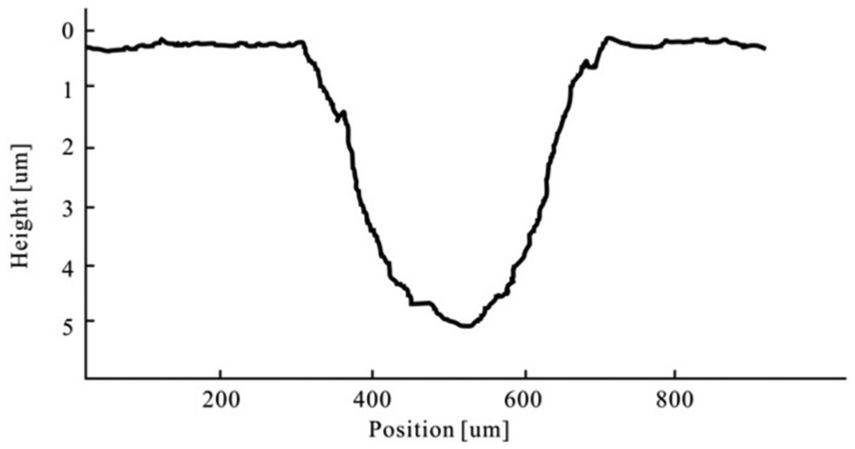
Cross-sectional view of the dimple with diameter 400 µm.
During the study, the dimple diameter was set to be variable while dimple density and depth were kept the same for all the specimens and were approximately equal to 20% and 5 µm, respectively. The dimple density was defined as the area ratio of the dimples and the seal face, which can be written as
The types of seal faces with varying dimple diameter along the radial direction are shown in Table 1, that is, types 1–8. As shown in the table, there were four fundamental types named as decreasing, increasing, increasing first and then decreasing, as well as decreasing first and then increasing, respectively, along the radial seal face from the inner to the outer diameter. And there were two categories for each fundamental type to differentiate diameter increment of the adjacent dimples. The maximum and minimum dimple diameters were set as 800 and 200 µm, respectively. The parameter Δd in Table 1 was defined as the diameter difference of the adjacent dimples in the radial direction, whose values were set as 100, 200, and 300 µm, respectively, based on the requirements of different types. The seal faces with optimum invariable dimple diameter and without dimples were taken as the references, that is, types 9 and 10 in Table 1. As an example, Figure 3(a) shows the picture of the fabricated upper samples with the dimple diameters decreasing gradually in the radial seal face from the inner to the outer diameter.
Types of seal faces with varying dimple diameter and the corresponding friction coefficients.


Specimens of mechanical seals with (a) decreasing dimple diameter from inner to outer diameter and (b) invariable dimple diameter 800 µm along the radial face.
For comparison, seal faces with invariable dimple diameter were studied experimentally at first to obtain the optimum invariable dimple diameter (type 9 in Table 1). The dimples with invariable diameters 0, 200, 300, 400, 500, 600, 700, and 800 µm were fabricated on the seal faces, respectively. And dimple diameter 0 µm corresponds to the type of seal faces without dimples (type 10 in Table 1). The specimen of the seal faces with invariable dimple diameter 800 µm is shown in Figure 3(b), as an example.
Friction tests were conducted under the load of 40 N corresponding to the contact pressure 0.06 MPa and rotational speed of 200 r/min corresponding to the sliding speed of 1.18 m/s at the average contacting radius of 53.6 mm. And the relative lower pressure and velocity would make the friction pairs in hydrodynamic lubrication region. N32 engine oil was used as the lubricant at room temperature, whose kinematic viscosity is 31.2 cst at 40°C. The duration of each tribology test was set to be 10 min, and all the friction pairs, submerged in the oil, were entering into steady-wear state for the time being. The changes in friction coefficient were recorded timely (one record for 1 s) and three repeatability tests were conducted for each of the friction pairs.
Results and discussion
A typical example of time behavior of friction coefficient during the tests is shown in Figure 4. As can be seen, the friction coefficient decreases first due to the running-in effect and flattens gradually, which is consistent with the general change rule of friction coefficient in tribotests. The friction coefficient value for each test was calculated by averaging the values of friction coefficient from the time when the value became stable to the end of the test. The average value of friction coefficients of three repeatability tests was then taken as the friction coefficient value for each type listed in Table 1.

A typical example of friction coefficient variation with time.
Frictional performance of seal faces with invariable dimple diameter
The frictional property of the seal faces with invariable dimple diameter was studied first. As shown in Figure 5, the friction coefficients are different for different dimple diameters. Specifically, with the increase in dimple diameter, the friction coefficient decreases first and then increases gradually. The minimum friction coefficient is achieved when the invariable dimple diameter is around 500 µm.

Changes in friction coefficient with invariable dimple diameter.
To search for a relatively accurately optimum invariable dimple diameter, especially for the corresponding value of minimum friction coefficient so as to compare with varying dimple diameter along the radial seal face, some additional experiments were conducted subsequently. The invariable dimple diameters 450, 470, 490, 510, 530, and 550 µm were selected, and the results of friction coefficient under various dimple diameters also could be seen in Figure 5. As shown in the figure, the optimum invariable dimple diameter should be 510 µm, corresponding to the value of minimum friction coefficient 0.01225, which was type 9 as listed in Table 1.
The result in Figure 5 indicates that the machined dimples on the seal face do reduce friction of mechanical seals, by comparing the non-textured surfaces (corresponding to dimple diameter is 0) with other textured surfaces (corresponding to dimple diameter is not 0), which is consistent with the studies on mechanical seals with the dimples in hydrodynamic lubrication region. This reduction is mainly due to the dimple’s improvement on load-carrying capacity of frictional pairs. Each dimple acts as a hydrodynamic micro-bearing while the fluid is driven and flows over the dimpled surface. The pressure increased in the converging region could be greater than that of the pressure decreased in the diverging region of the texture since cavitation happens there. Therefore, this asymmetric hydrodynamic pressure distribution generates an additional load-carrying capacity for sliding surfaces. The optimum invariable dimple diameter is 510 µm in this study, whose corresponding optimum aspect ratio is around 0.01, which is also in accord with Shi et al.’s 16 study.
Frictional performance of seal faces with varying dimple diameter along radial direction
The value of friction coefficient and its fluctuation in the amplitude for each type in Table 1 is displayed in the form of histogram, as shown in Figure 6. It can be seen that types 1–8 with varying dimple diameter along the radial seal face have lower friction coefficient than type 10 that without dimples, which is a result similar to the seal faces with invariable dimple diameter. This illustrates that the introduction of dimples does improve the frictional performance of mechanical seals effectively in the hydrodynamic lubrication region, whatever the dimple distributions along the radial face. As stated before, it is mainly due to the improvement of dimples on load-carrying capacity.

Histogram of friction coefficient of various seal faces.
From Figure 6, we can also find that the anti-friction effects are different for different types of varying dimple diameter along the radial faces, and some of them have considerable differences. To make the results more intuitive and easier to analyze, Table 1 lists the values of friction coefficient for all types and the friction coefficient ratio of other types to type 9 in the two right-most columns, respectively. As can be seen, the friction pairs with largest or smallest dimple diameters in the middle part of the radial seal faces (types 5–8 in Table 1) have almost the same friction coefficients, which are all larger than the friction coefficients of the seal faces with other varying dimple diameter distributions (types 1–4 in Table 1). Especially, their friction coefficients are more than three times as large as the friction coefficient of the seal face with optimum invariable dimple diameter (type 9 in Table 1), which shows a poor effect in reducing friction. On the other hand, types 1–4, when the dimples were distributed with increasing diameters or decreasing diameters along the radial seal face, have a good anti-friction effect, as shown in Figure 6 and Table 1. More specifically, types 3 and 4 with the increasing dimple diameter along the radial seal face have a better performance, the friction coefficient of which are 86.3% and 67.5% of type 9 with optimum invariable dimple diameter, respectively. Moreover, the fluctuations in the amplitude of friction coefficient for types 3 and 4 are also smaller than the other types, as can be seen in Figure 6. It is a pretty exciting result which shows that an appropriate type with varying dimple diameter along the radial face, in the way that increasing dimple diameter from the inner to the outer diameter in this study, should be more suitable for the seal faces than the type with invariable dimple diameter to reduce friction. Conversely, the types with varying dimple diameter in an improper way are not as efficient as the types with optimum invariable dimple diameter in friction reduction, although they may have a better performance than the types with invariable dimple diameter that is not close to the optimum value, just as types 1 and 2.
The authors think that the reason for the experimental results is mainly the matching between the optimum dimple parameters and working conditions. It should be realized that different positions on the seal face will be in different working conditions, such as different circumferential velocities in the radial direction, boundary conditions, temperatures, and deformations. On the other hand, it is the common ground that there are strong dependencies between the optimal dimple parameters and working conditions. 20 Thus, the optimal parameters of the dimples, in different positions of seal face, should match with the corresponding different conditions. Namely, the optimal dimple parameters should be varying along the seal face.
Specifically for the tests, the dimples at different positions along the radial seal face have almost the same circumferential velocities and boundary conditions, while the main difference for them lies on the difference of thermal deformation caused by different temperature values along the radial seal face during the relative rotation of the two rings, which leads to different seal clearances for dimples at different radial positions. According to Gao et al.’s 22 study, the seal clearance increases gradually along the redial seal face from the inner to the outer diameter, for the temperature difference, which can be shown schematically in Figure 7. It can be seen that the relationship for seal clearance h3 > h2 > h1 > h0 is obtained from the inner to the outer diameter. On the other hand, for each dimple, the corresponding optimum diameter increases with the increase in seal clearance based on the authors’ study, 23 displayed in Figure 8. Thus, to ensure the best performance for each dimple, the dimples on the radial seal face should be arranged with increasing diameter from the inner to the outer diameter. Then, the result that types 3 and 4 with such distribution in this study have better anti-friction performance can be explained. Especially for type 4, due to the best match with the working conditions, it is even better than type 9 with optimum invariable dimple diameter.

Schematic diagram of the clearance variation for seal faces (h3 > h2 > h1 > h0).

Change law of friction coefficient with dimple diameter under various seal clearances (h0—seal clearance). 23
Performance of seal faces with varying dimple diameters under various loads and rotation speeds
Additional tests under higher loads and rotation speeds, listed in Table 2, were carried out to investigate the performance of seal faces with varying dimple diameters. The specimens and test procedure were the same as described above. It is important to note that the optimum invariable dimple diameter for the reference type 9 in Table 1, whose value is shown in Table 2, was different under different loads or rotation speeds, and so as the corresponding friction coefficient.
The optimum invariable dimple diameter for various loads and rotation speeds (µm).

Similar results are obtained for the additional tests, which demonstrate that except for types 3 and 4 with increasing dimple diameter along the radial face from the inner to the outer diameter, type 9 with optimum invariable dimple diameter always has a better performance than other types with varying dimple diameter. Thus, the analysis below is mainly on the comparison of type 9 with types 3 and 4 under various loads and rotation speeds.
Figure 9 shows the friction coefficients of types 3, 4, and 9 under various rotation speeds when the load was 200 N. As can be seen, with the increase in rotation speed, both types 3 and 4 have the lower friction coefficient than type 9, which further suggests the effectiveness of the seal face with increasing dimple diameter along the radial face from the inner to the outer diameter. Specifically, type 3 has the best anti-friction performance when the rotation speed increases up to 2000 r/min.

Friction coefficients of types 3, 4, and 9 under various rotation speeds (200 N).
The friction coefficients of types 3, 4, and 9 under various loads are presented in Figures 10 and 11 when the rotation speeds were 800 and 2000 r/min, respectively. By the comparison of the two figures, it is shown that with higher rotation speed, the decrease in load makes the reduction in effectiveness of the seal face with increasing dimple diameter along the radial face from the inner to the outer diameter, even though type 3 or type 4 has the best performance in most cases. For example, the friction coefficients for both types 3 and 4 are higher than for type 9 under load 40 N and rotation speed 2000 r/min, as seen in Figure 11.
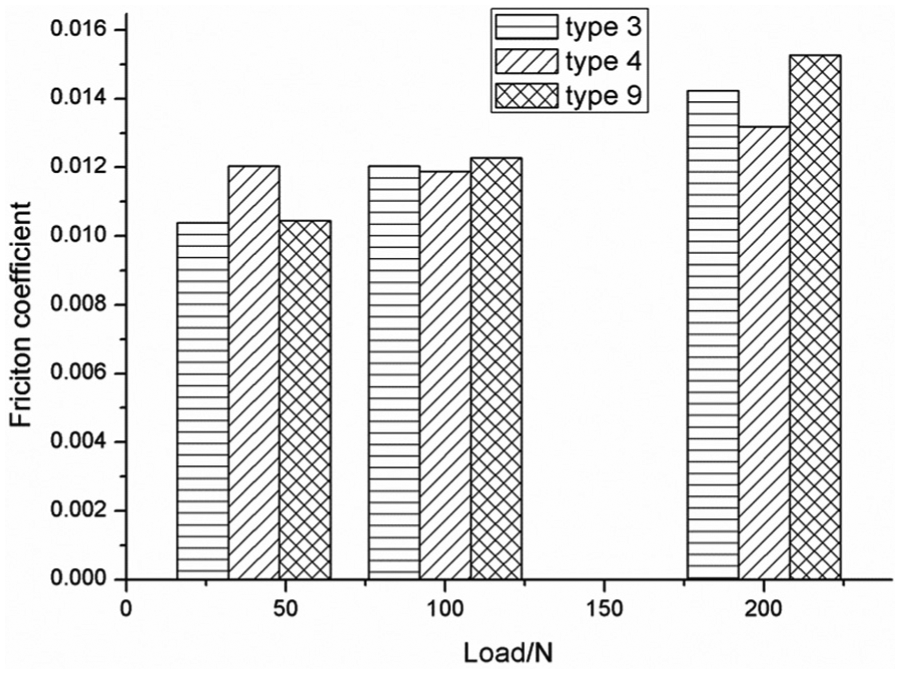
Friction coefficients of types 3, 4, and 9 under various loads (800 r/min).

Friction coefficients of types 3, 4, and 9 under various loads (2000 r/min).
The reason for the different change laws under various loads and rotating speeds is mainly because increasing dimple diameter along the radial face from the inner to the outer diameter was only a necessary condition to obtain the optimum dimple distribution. While how to increase the dimple diameter gradually, including how to determine the initial dimple diameter for the inner diameter of the seal face and diameter increment between adjacent dimples, is another key issue, which is closely related to the loads and rotating speeds. In other words, as the load and rotating speed change, the relationship for seal clearance h3 > h2 > h1 > h0, in Figure 7, still holds, while the specific values of the seal clearance such as h0, h1, h2, and h3 change, leading to the change in the corresponding optimum diameter for each dimple. But the increasing manner of dimple diameter in types 3 and 4 is the same for all the loads and rotating speeds in this study, thus the performance of types 3 and 4 is not always better than type 9. Taking the operation condition with load 40 N and rotation speed 2000 r/min as an example, the optimum invariable dimple diameter is 230 µm, as shown in Table 2. Then, the values of the varying dimple diameters should not be very far from 230 µm, which is not satisfied by types 3 and 4. Therefore, this is less effective for types 3 and 4 than for type 9. The same reason can be used to explain the better performance of type 3 than of type 4 when the rotation speed is 2000 r/min and the load is 200 N.
It should be noted that because of the limited number of experimental studies, even though it has the lowest friction coefficient in most of the operation conditions, type 3 or 4 may not be the optimum distribution for the varying dimple diameter, which could be solved by further theoretical modeling and numeric simulation analysis by taking the operational conditions into account. However, the advantage of seal faces with varying dimple parameters can be shown through this experimental study, and the theoretical research will be carried out in our further study.
Conclusion
Experimental study was carried out to investigate the friction property of mechanical seals with varying dimple diameter along the radial face under various loads and rotating speeds. The initial conclusions can be summarized as follows:
The distribution of dimples with varying parameters along the radial face can reduce friction effectively, but its effect is closely related to the type of distribution and operation condition.
Due to the best match with working condition, the type with increasing dimple parameters along the radial face from the inner to the outer diameter should be more suitable for the design of seal faces.
On the basis of the manner of increasing dimple parameters along the radial face from the inner to the outer diameter, the operation condition, including loads and rotation speeds, must be taken into account to determine how to increase the dimple diameter, which will be studied deeply by theoretical methods.
Footnotes
Academic Editor: Pranab Samanta
Declaration of conflicting interests
The author(s) declared no potential conflicts of interest with respect to the research, authorship, and/or publication of this article.
Funding
The author(s) disclosed receipt of the following financial support for the research, authorship, and/or publication of this article: This work was supported by the Natural Science Foundation of Jiangsu Province (grant no. BK20130976), the Undergraduate Training Programs for Innovation and Entrepreneurship of Jiangsu Province (grant no. 201410298011Z), and the National Natural Science Foundation of China (grant nos 51375245 and 51505230).