



Abstract
This article discusses about new product design patterns in the big data era, gives designer a new rational thinking way, and is a new way to understand the design of the product. Based on the key criteria of the product design process, category, element, and product are used to input the data, which comprises concrete data and abstract data as an enlargement of the criteria of product design process for the establishment of a big data-driven product design pattern’s model. Moreover, an experiment and a product design case are conducted to verify the feasibility of the new pattern. Ultimately, we will conclude that the data-driven product design has two patterns: one is the concrete data supporting the product design, namely “product–data–product” pattern, and the second is based on the value of the abstract data for product design, namely “data–product–data” pattern. Through the data, users are involving themselves in the design development process. Data and product form a huge network, and data plays a role of connection or node. So the essence of the design is to find a new connection based on element, and to find a new node based on category.
Introduction
Data is becoming an important tool in the transformation of industrial economy to knowledge economy and is also becoming a key element of production factors and product form. Data not only represents the productivity, but also will become an important asset. 1 The famous O’Reilly Company has claimed, Data is the next “Inside Intel.” The future belongs to the company and people who convert data into products. 2 Currently, most of the work on big data is focusing on business, application, and information processing levels, such as data mining and analysis. 3
Design pattern utilizing the traditional model employing individual expert knowledge acts as the center. Now, it is converted to the self-organizing mode against the center. Starting from the field of Internet technology, design is being driven from the individual’s skill-driven scenario to the group’s data-driven scenario. 4 Using the data and applying them into the design and development process, user groups can achieve the connection between the product and the user. Data have linked users and enterprises, enterprise could provide users with better services from data mining, so as to create new type of products. At present, a lot of information products in China are derived based on the virtual Internet data, such as Taobao data cube, Baidu forecast, and so on. The data in the physical world is now on the horizon. It arises in the field of data collection, data storage, data mining, and data products. In the future, the focus will be redirected from the storage and transmission of data to data mining and its application. 5
Data had played an important role in the whole process of new product development (NPD), data expressed by characteristic had been a bridge of communication among the multiple disciplines, 6 and by data’s connection, it managed the whole product life cycle. Product information could take the form of data, 7 data aided supply chain management, 8 product manufacture, 9 product marketing strategy, 10 product selling processes, and so on. 11 Data had been able to efficiently support the design and management of large set of complex requirements, based on user feedback to enhance customer satisfaction. 12 Data plays a critical role in organization and management of project for product innovation and development. 13 Currently, intelligent product is in the ascendant, wherein the data is an important intermediary to carry out product lifecycle management. 14 The data sources are different from the traditional in era of big data, user data received more attention, and it is being mining and utilized by use case, 15 and user recommendation and sharing is becoming a basis for product development.16–18
The understructure of the product design pattern based on big data and its flow from the virtual digital world to the real physical world. 19 Data is a base medium between the network and the physical space, and from the initial data to the big data’s applications toward integrated, complex queries and intelligent prediction analysis, and so on. 20 But in the field of design, especially industrial design, there is no clear application. This article attempts to study the application of the big data in product design and to explore innovative product design pattern.
The novelty of this article presented the basic idea of product design on data-driven scenario, constructed design model, cleared the data’s connection role in product design, proposed the design pattern of “product–data–product” and “data–product–data,” and finally proved design pattern’s feasibility based on cases. Therefore, the contribution of this article is that it gives designer a new rational thinking way from a design view, it is a new way to understand the design of the product, and it is clear that the essence of design task based on data is to discover new nodes and new connections.
Basic idea and design model of product design based on data-driven scenario
Basic idea of product design
Design pattern is an abstract solution to repeated design problems. 21 Design pattern spans the traditional centralization pattern like the foundation of individual expert knowledge to the self-organization pattern, and design is transforming the individual skill-driven scenario to the groups data-driven scenario. 3 There are two dimensions of data-driven product design: one is the data support for product design, which is composed of real-time market data and user data for product development and predictable iteration. The other is the value of data which acts as the standard of product design, and the goal of product development is the value of data, so the data become a part of the product.
In accordance with the data’s existing form, data is composed of “abstract data” and “concrete data.”“Abstract data” belongs to the concept data, and it does not exist in the reality. “Concrete data” is already in the reality and can be collected and dealt with. In this article, the default is that “abstract data” provides support for product design and the value of “concrete data” marks the value of product design.
Category, element, and product are the key criteria of product design process. As shown in Figure 1, the data and the criteria construct a relationship between input and feedback. Among those, “category” expresses the basic characteristics of product,8,22 and “data” predicts “element,” and “element” is then the basic component of product while “element” constitutes “product.”

Key criteria of data-driven product design.
Design pattern of product design
Site “A,” as shown in Figure 1, category is design’s starting point, which is to input “concrete data” based on the intention of users from category to predict elements. After product enters into the market, it can feedback new data based on the intention of users to support product development, so as to constitute a “concrete data” cycle. As shown in Figure 2, based on category, we can input product 1, and through “concrete data” to output product 2, which is ultimately a new product, and “product–data–product” innovative design pattern can then be obtained.

“Product–data–product” innovative design pattern.
Site “B,” as shown in Figure 1, category is originated from the value analysis of “abstract data,” and by inputting “abstract data” as the design’s starting point, we can then collect “concrete data” based on the intention of users from category to predict elements, to complete product development, to feedback new data, and to finally accomplish new innovative cycle. As shown in Figure 3, based on contextual space to input data 1, and by going through the product design process, output data 2 can be derived as a new product and a new data, so “data–product–data” innovative design pattern can be obtained.

“Data–product–data” innovative design pattern.
The purpose of the “data–product–data” pattern is to use data to act as the means of product to realize the value of innovative cycle for abstract data. Need to point out, abstract data in contextual space is the target of analysis, contextual space is a space that abstract data exist in. And in the process from category to the new product, it can be used as traditional design methods, as well as design pattern as shown in Figure 2, for the purpose of feed backing data from new product comprising “abstract data” or “concrete data.” By utilizing “data–product–data” pattern, new product carries the value of both product and data. By data feedback, new data can be obtained for the realization of its value in the innovative cycle.
Design model of product design
From the point of view of product, for “product–data–product” design pattern, using data as basis for the continual development of products is feasible. It can be used for product substitution or product upgrade; for “data–product–data” design pattern, product category is originated from the value of data, and it can be used for new product design. From the point of view of data, for “product–data–product” design pattern, data guides product development and generates new “concrete data”; for “data–product–data” design pattern, it generates new “abstract data” and new “concrete data.” Based on these two patterns for the integration of product and data, product design model based on data-driven scenario can be obtained as shown in Figure 4.

Product design model based on data-driven scenario.
Through data, two patterns are connected as one, and through data, it forms two cycles. Cycle 1 is “product–data–product” design pattern; it achieves new products according to concrete data based on the intention of users. With new product output concrete data, a NPD cycle is accomplished; cycle 2 is “data–product–data” design pattern, based on abstract data in contextual space, new product can be developed which can then release new data (including “abstract data” and new “concrete data”), and it could be submitted to new round of test via cycle 1 or cycle 2 to execute product design process cycle based on data-driven scenario.
Design pattern process and practice of “product–data–product”
Design pattern process of “product–data–product”
Based on “product–data–product” design pattern to implement product design and development, the operating process is as follows:
Designer define category;
Based on category, search concrete data based on the intention of users about design;
Classification, analysis, mining for concrete data;
Based on concrete data to predict element, begin to design;
Design adjustment according to data change in real time in design process;
Based on data of users to carry out product development.
Practice of “product–data–product”
To conduct verification for “product–data–product” design pattern based on data-driven scenario, we will apply one product design case. There is a company that provides service of design and manufacturing for light emitting diode (LED) lighting products for a certain brand enterprise.
To define category, based on already existing conditions for product development, we will define the category which is LED lighting products, and subsequently, we have to search concrete data of the intention of users about design. To analyze concrete data based on category, according to the company’s financial report and market situation, as shown in Tables 1 and 2, we have to define specific type of product, which is ceiling lamp.
Number of all types of lamps of brand enterprise in 2014.

Number of new products in other European brands.

Through analysis of concrete data based on product brand, in connection with design elements of associated products (such as product style, product material, product color) for data analysis, as shown in Figure 5, we have summarized the style of product elements by comprehensive analysis of the certain brand enterprise ceiling lamps; as shown in Table 3, we have summarized style of product elements by comprehensive analysis of five brands of other different companies, so as to conclude these elements of ceiling lamp in current market.

Statistical analysis of style elements to brand enterprise products.
Analysis results of main product elemental for ceiling.

Integration all concrete data of design elements for establish a product design plan, as shown in Figure 6, the design plan have appeared concise style. It had continued product’s gene of the simple curve from SLV’s product family and adopt a basic geometric shape and aluminum material, and classic black and white color. The design plan based on data analysis had obtained customer’s acceptance.

First design plan of ceiling based on data-driven scenario.
Adjust the design plan based on data change: The design plan had won the customer’s affirmation, however, according to market changes in the terminal, there is a need to increase the number of lamp cap from one to three, so we arrive at a final product solution, as shown in Figure 7.

Final design plan of ceiling lamp based on data-driven scenario utilizing user feedback.
Design iterative based on user feedback: The design plan have been put on the market according to user feedback, the product may be a series that can be received from elements of product. The series is another type of lamp, so based on the product elements and style, a series of product iterative innovative solutions had been developed, as shown in Figure 8.

A series of product iterative innovative solutions utilizing user feedback.
Innovative design pattern of ‘product–data–product’ is based on already existed category, using the data of users to design iteration, and using data of users to determine those such as product subject, product style, expression techniques, and other product elements, such process reflects the fact that data is the means acting as an auxiliary tool to achieve innovative product by sustainable data collection and compilation.
Design pattern process and practice of “data–product–data”
Design pattern process of “data–product–data”
Product design based on abstract data-driven the data is not big data that exists in reality, but data category exists in the concept of brain, every data category has a lot of numerical, such as “number of people” is a concept of abstract data, and there will be a specific numerical, large or small, depending on the contextual space, if a class contextual space, number of people is likely to be dozens, if a country contextual space, a specific numerical may be hundreds of millions.
In the contextual space, there are many abstract data. Abstract data that composed of all kinds of concrete data, is the headline of the data type, it’s an abstract concept that represent a certain category of data, we can select the certain one in the large number of abstract data to carry out an value analysis. First, the function of product is defined by abstract data before the product development is carried out; then, concrete data that is a by-product that generated during the process of using the product, and carry out another new product innovation and development by data mining, as shown in Figure 9. Therefore, this design pattern can also be expressed as “data–product–data–product.”
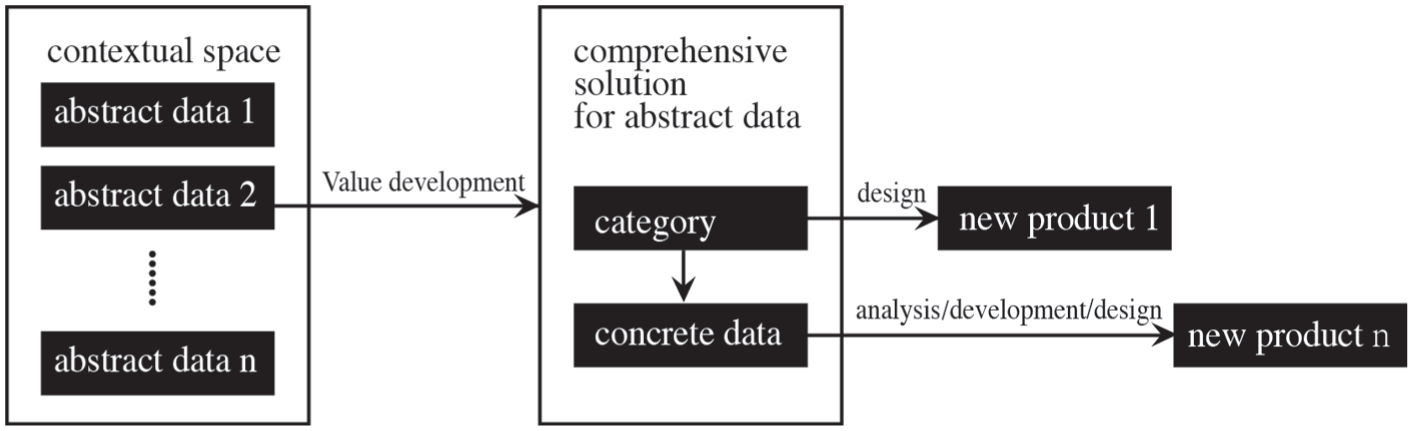
Deduction of value realization of “data–product–data.”
The core of the model is that abstract data has driven the definition of the product functions, obtain concrete data on the use of the product, optimize product development by data mining, and the operating process is as follows:
Define contextual space;
Define valuable abstract data in contextual space;
Put forward a solution for using abstract data;
Product design and development;
Obtain concrete data on the use of the product;
Innovate and optimize for NPD by data mining.
In this pattern, abstract data is the main body. Then, based on abstract data, through method of product, concrete data could be obtained. At present, the abstract data becomes the method that is the purpose of the concrete data. New product types are obtained ultimately by deriving specific solutions via abstract data, and then, product innovation and development are carried out by concrete data obtained from the use of product.
Practice of “data–product–data”
Confirm contextual space: As case verification, select supermarket as contextual space, research valuable abstract data in the supermarket space, based on the value of data to analyze and develop new products, and based on new product to collect valuable new data.
Choose valuable abstract data: After brainstorming, as shown in Table 4, it is potential data in the supermarket space. Through further research, we found out that “customer’s waiting time for payment at cashier desk” is an important factor affecting customers’ shopping experience and shopping efficiency. So, we choose “customer’s waiting time for payment” as a valuable data for design innovation.
Potential data in supermarket space.

Comprehensive solution for using abstract data: “Customer’s waiting time for paying while shopping in supermarket” is actually the combination of merchandises scanning time and customers’ money paying time. Scanning and money paying are the core of the solution based on data. In the shopping process, customers can be allowed not to pay directly but to prepay automatically until leaving supermarket, so merchandises scanning and customers’ money paying time acting as factors distributed to customers’ shopping procedure, and finally, there is no longer anxiety of lining up for payment, which in turn improves largely their shopping experience. Simultaneously, to gather various types of new data in customers’ shopping process and to conduct design development according to the new data as shown in Figure 10, it is the overall solution to products and systems.

Integrated solution of “long waiting time for customers to pay while shopping in supermarket.”
Product design and development: The solution requires a new shopping cart and payment completion sensor, and it also requires a cloud service data system for product operation and data storage to be built. New shopping cart and payment completion sensor are new products based on the new value of data, and to do product design by integrating elements as shown in Figure 11, it is a design plan comprising functional description for shopping cart for the scanning of the merchandises’ information.

Design plan of shopping cart for scanning goods information.
Product optimization development based on concrete data: The solution has solved the problem of customer’s long waiting time for payment; moreover, there will be all kinds of concrete data based on the use of the product, such as information of movement of shopping cart, frequency of in and outs for merchandises, differences between prepayment and direct payment, and so on. We can do data analysis and data mining, so new service or new products can be obtained as shown in Figure 12, such as to optimize the placement of goods through information of movement of shopping cart, to judge the popularity of goods by frequency of in and outs for merchandises, and to understand the motives of consumers by differences between prepayment and direct payment. So, based on concrete data, we can optimize products and promote sales. By executing the above, we have achieved an innovation cycle between the new product design and the use of concrete data, that is, “data of data.” 23

Network based on data and product. Data always plays a role of connection or node.
This solution for the coping of “waiting time” existing in the supermarket space is the data of the physical world. The integrated solution have achieved the value of data in two aspects; the first aspect is the demand for the product function, it has been solved the problem of customer’s long waiting time for payment, this is the value of product. The second aspect is the requirement for data, as well as the collection of the data that is generated from the product in use inside the store with the cloud system for the data mining and analysis functions, and to predict the next step of market behavior, to finalize and improve the product development and its required services which, in turn, explain the utmost importance of the value of data.
Essence of design pattern based on data: In the product design pattern based on big data, using data to make sure product type and product elements, product and data have composed a network, as shown in Figure 12, data always plays a role of connection or node. In the product–data–product pattern, the product is the node and data plays a role in the connection as shown in Figure 12(a); in the data–product–data pattern, the data is the node and the product acts as the connection as shown in Figure 12(b). The essence of the design task is to find a new connection based on element and to find a new node based on category.
Conclusion
For product innovation by two design patterns based on data-driven scenario, user groups have involved in the design and development process through the data collection and compilation. They have achieved the connection of data comprising product and users, and the data has been generated by product that is connected between the company and users. Company could provide better service for users by data mining and could finally create new types of products. It is a new way of data application in product design, and it is also a new approach acting as the innovation of product design pattern, and it is practically verified by theory analysis as well as case testing.
As the involvement of all these complex and vast quantity of data, data itself, acting as a tool, is still just a tool for design activities and for supportive function, 24 the key of innovation of design is the human’s creative activity, such as the designer’s innovative consciousness and design attainment in the different phases such as confirmation of product category, value analysis of data; the expertise of selecting data by products category and elements in design discipline, and the professional design training for design quality while integrating different elements into the product. Therefore, for the two innovative patterns of product design to be conducted, the creativity of human being is very important, and so is the science of design. To conclude, the method based on data-driven scenario is a tool, a method, and a way of thinking.
Footnotes
Academic Editor: Teen-Hang Meen
Declaration of conflicting interests
The author(s) declared no potential conflicts of interest with respect to the research, authorship, and/or publication of this article.
Funding
The author(s) disclosed receipt of the following financial support for the research, authorship, and/or publication of this article: This work was supported by the National Science Foundation of China (Grant No. 51505405).