




Abstract
In order to solve the reliability assessment of braking system component of high-speed electric multiple units, this article, based on two-parameter exponential distribution, provides the maximum likelihood estimation and Bayes estimation under a type-I life test. First of all, we evaluate the failure probability value according to the classical estimation method and then obtain the maximum likelihood estimation of parameters of two-parameter exponential distribution by performing and using the modified likelihood function. On the other hand, based on Bayesian theory, this article also selects the beta and gamma distributions as the prior distribution, combines with the modified maximum likelihood function, and innovatively applies a Markov chain Monte Carlo algorithm to parameters assessment based on Bayes estimation method for two-parameter exponential distribution, so that two reliability mathematical models of the electromagnetic valve are obtained. Finally, through type-I life test, the failure rates according to maximum likelihood estimation and Bayes estimation method based on Markov chain Monte Carlo algorithm are, respectively, 2.650 × 10⁻⁵ and 3.037 × 10⁻⁵. Compared with the failure rate of a electromagnetic valve 3.005 × 10⁻⁵, it proves that the Bayes method can use a Markov chain Monte Carlo algorithm to estimate reliability for two-parameter exponential distribution and Bayes estimation is more closer to the value of electromagnetic valve. So, by fully integrating multi-source, Bayes estimation method can preferably modify and precisely estimate the parameters, which can provide a certain theoretical basis for the safety operation of high-speed electric multiple units.
Keywords
Introduction
The continuous operating rate of high-speed electric multiple units (EMUs), which is one of the important railway transportations in China, has reached more than 350 km/h. And the high-speed EMUs of China can meet transport demands of long distance, large capacity, high density, and short travel time. As the speed of EMUs increases, the requirements for the braking system also increase. The safety of high-speed EMUs operation depends on the reliability of the system including the one of parts. Although the EMUs braking system components are high reliability products, major accidents may occur once one component loses effectiveness. Therefore, it is worth evaluating the reliability of EMUs. High-speed EMUs braking system is composed of many components and subsystems which cooperate with each other, and the running safety of the vehicle will be influenced if one link fails. After a long operation time, reliability of the electromagnetic valve and other components of EMUs braking system which are prone to failure reduced. For example, if the emergency braking magnetic valve loses power due to failure, the valve won’t release, which will lead to serious consequences. 1 According to statistics, failure number of electromagnetic valve in half a year’s operation occupied 3.8% of total braking system failure, which made bad effects on the vehicle operation. 2 The braking system parts can also play a key role in running trains. This article will evaluate the reliability life of the electromagnetic valve, which can, to some extent, ensure the safe operation of high-speed EMUs.
At present, for high-speed EMUs braking system components, the research on failure assessment is not common. Dong 3 makes the multi-Bayes estimation, under zero-failure data for the failure rate of key part of urban rail vehicle braking system whose life follows a one-parameter exponential distribution. Additionally, based on Bayesian theory, the reliability of the bearing is evaluated based on Weibull distribution in Zhu and Liu, 4 and the mathematical model for failure probability is obtained. In order to solve the high-dimensional integral problem of a posteriori estimation of Bayesian estimation, some scholar sampled using Markov chain Monte Carlo (MCMC) algorithm for the posterior distribution. Liu et al. 5 discussed the development of MCMC method to modern Bayesian in the era of big data. But for product with long life, small sample is more appropriate, which can reduce the test cost and cycle. Iba et al. 6 discussed multicanonical MCMC as a method of rare event sampling and applied multicanonical MCMC to data surrogation which showed a successful implementation in surrogating time series. In addition, MCMC algorithm was used to conduct the parameter estimation for Weibull distribution.7–9 Fernando and Livia 10 used the MCMC method for the Bayesian analysis for the exponential-logarithmic distribution model. Singh et al. 11 studied the maximum likelihood estimation (MLE) and Bayes estimation procedure for the shape and scale parameter of Poisson-exponential distribution for complete sample. And then, Bayes estimation under loss function was obtained using MCMC technique. For product with high reliability, many studies employed censored test in view of the long cycle and high cost of reliability test. And in Ng, 12 the estimation of parameters based on a progressively Type-II censored sample for a modified Weibull distribution was studied, and the estimators in this article based on a least-squares fit were compared with the MLE via Monte Carlo simulations, through whose simulation study some recommendations were made. However, based on small sample, the related research on two-parameter exponential distribution may be limited.
From the foregoing discussion, it is clear that less attention was given to apply MCMC algorithm to Bayes estimation method to avoid high-dimensional integral operation of the posterior distribution for two-parameter exponential distribution. For the braking system components with superior reliability, this article, based on the small sample and zero-failure data theory, carries on the type-I life test to make parameter estimation for two-parameter exponential distribution based on the two methods. The two methods include MLE and Bayes estimation, and MCMC is applied to the Bayes estimation. Finally, the reliability mathematical model of two-parameter exponential distribution is obtained so that the reliability assessment of electromagnetic valve of high-speed EMUs braking system is realized.
Reliability assessment model of electromagnetic valve of high-speed EMUs braking system
The electric-pneumatic blend braking mode is used in the braking system of single car of EMUs, and the brake control unit (BCU) whose performance directly affects the performance of the whole braking system is the core part of the braking system of a single car. The electromagnetic valve is an important part of the BCU, which converts brake signal instructions received by the BCU into the corresponding brake pressure instructions. 13 We focus on the electromagnetic valve as the research object to evaluate its reliability.
In engineering practice, type-I life test (time truncation censoring life test) is a method often used for reliability testing because it is easy to control the test time and test workload. For products with high reliability, the type-I life test with the advantage of shorter testing time and lower cost plays an important role in the research under small sample on data reliability analysis because there are often zero-failure test sample or few samples within the prescribed truncated time. 3 The electromagnetic valve of high-speed EMUs braking system belongs to the high reliability products with longer average life and lower failure rate, and that is the reason why we adopt the type-I life test here to analyze the reliability.
The following model is assumed in this article: in the type-I life test which includes m times, there are


For the type-I life test, there are two processing methods in engineering: one is to approximately regard type-I life test data as the number truncation censoring lifetime test data, and the zero-failure information obtained will be ignored so that the BLUE or GLUE method can be used to process the data; the other method is to take advantage of the MLE method to deal with type-I life test data. First of all, the MLE method is used for data processing of test results in this article.
For some products, zero failure may occur during the test due to its high reliability and the limited test time, so research is conducted on zero-failure data under small sample. To solve such problems, researchers generally adopt the Bayes estimation method for analysis so that the test cycle and cost can be reduced. The basic idea of Bayes method is to treat the past research on the same or similar problems and statistical data or experience as prior information and then make a statistical inference for the population distribution trend and parameter selection combining with test data. So this article, according to Bayesian theory, carries on the estimation analysis for time truncation test data.
The simplified Bayes formula can be expressed as follows

where
The method of reliability assessment
Under the type-I life test, this section studies the modified MLE and Bayes estimation which is based on MCMC sample for parameters of two-parameter exponential distribution.
The MLE of µ and θ
The modified likelihood estimation method is proposed by Wang and Wang 15 under zero-failure condition and applied to the parameter estimation of exponential distribution and Weibull distribution. Hu 16 proved that the traditional MLE has failed for the zero-failure data condition. Hence, the modified likelihood function of zero-failure data is adopted by the article as follows

where C is a constant,
And then the modified logarithmic likelihood function is obtained

Now, the modified logarithmic likelihood function equation is as follows


By equation (6), the MLE of parameter θ can be obtained:
From equation (7), the parameter µ cannot be directly solved. For two-parameter exponential distribution, it can be acknowledged that


This article uses the classic estimation method to estimate failure probability pi under zero-failure condition. According to Han,
18
the estimation of failure probability


where
Bayes reliability assessment
Based on the small sample theory, we make use of MCMC method to sample the prior on the basis of which Bayesian theory can be applied to estimate the reliability of products. 19
The key to applying the Bayes method is to select the prior distribution. So the article assumes that two parameters obey prior distribution 7


where
According to equations (5), (12), and (13), the kernel of the joint posterior probability density is obtained

And then the posterior density kernel functions of parameters µ and θ are as follows 7


Bayes method is one of the most influential methods, but it may need a high-dimensional integral to a get posteriori distribution, which can be difficult to be solved directly. The approximation method is chosen to get parameters µ and θ in this article, and the stochastic simulation method is a kind of approximation method. The birth of stochastic simulation can be traced back to the needle problem solved by Buffon who was a French mathematician in the 19th century and used a simulation method to solve the reliability problem. The core of stochastic simulation is to sample a distribution, and common sampling methods include acceptance-rejection sampling, importance sampling, MCMC algorithm, and so on. Both acceptance-rejection sampling and importance sampling are independent samplings which mean the samples are independent. This kind of sampling has low efficiency, for example, many of the samples are invalid through acceptance-rejection sampling. In contrast, the MCMC method is association sampling, that is, the next sample has a relationship with this sample, which makes the samples more efficient. In this article, the MCMC method is used, and its basic idea is to establish a Markov chain of a stable distribution as the distribution required to sample, on the basis of which, all kinds of statistical inferences are made. Metropolis algorithm is brought to sample equations (15) and (16), and according to Markov Chain algorithm, the samples of kernel function obtained by sampling obey the statistical sample of the posterior distribution.8,10 The concrete steps of the algorithm are as follows: 8
Randomly generate the initial values of
According to Metropolis algorithm, generate
Generate a random number
Calculate the acceptance rate
If
Generate the alternative point
Generate a random number
Calculate the acceptance rate
If
Repeat steps (2) to (9) until
Based on Monte Carlo algorithm, calculate the sample estimation value after
where
The reliability assessment of the electromagnetic valve of braking system
On the basis of two estimation methods, this section specifically makes a reliability life assessment for electromagnetic valve of high-speed EMUs braking system.
Suppose that the life of electromagnetic valve of high-speed EMUs braking system components obeys two-parameter exponential distribution. In addition, there is a group of test data of electromagnetic valve containing a sample size n = 30, which includes 10 type-I life tests. Table 1 shows the specific data, where the unit of time is second, and the test results are zero-failure data.
The zero-failure data of electromagnetic valve.

Table 2 shows the estimation
The estimation

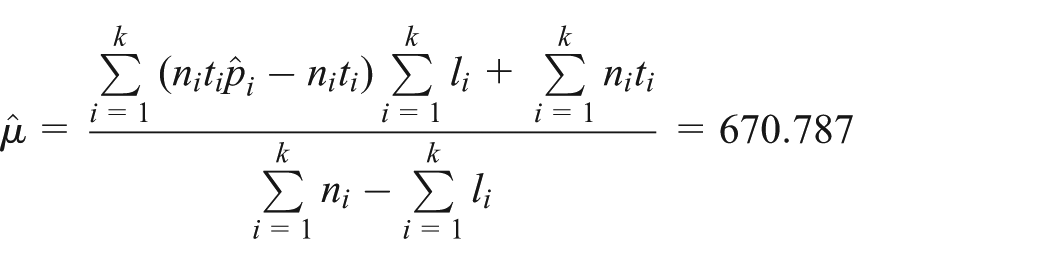
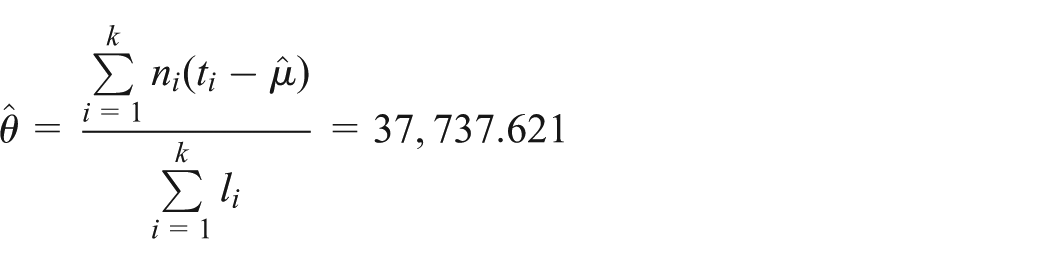
Based on equations (8) and (9), the MLE
In the Bayes estimation method, the hyper-parameter is difficult in general, or not observed, but in some cases the hyper-parameter selection may have little impact on the reliability assessment result.
16
We choose


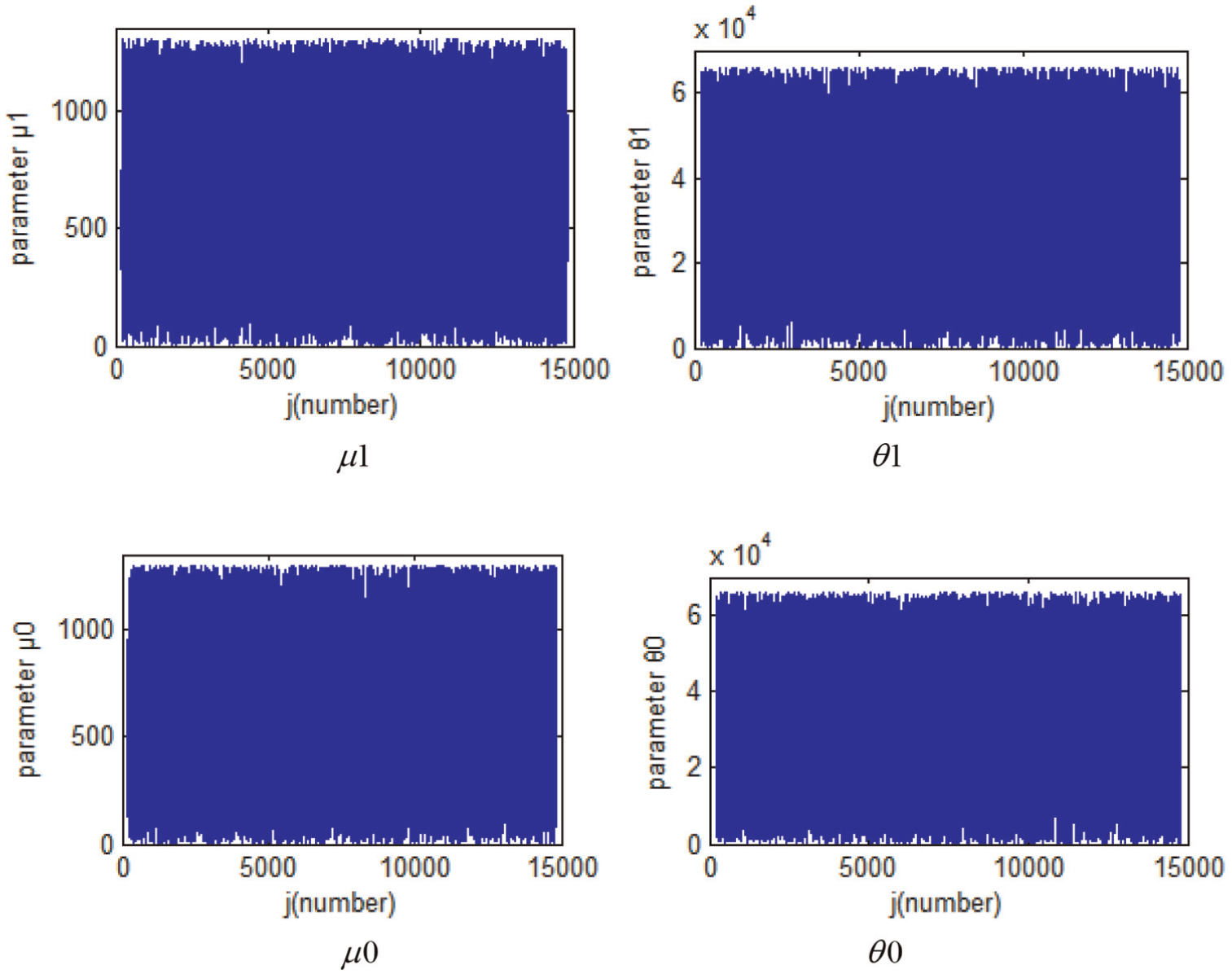
The Markov chain of parameters µ and θ.

The sampling histograms of parameters µ and θ.

The contrast figure of reliability curves about MLE and Bayes estimation for electromagnetic valve.

The contrast figure of density function curves about MLE and Bayes estimation for electromagnetic valve.
Conclusion
For products with long lifetime, it becomes easier to appear zero-failure data within the prescribed test time, and that is the reason why type-I life test gets more extensive application. According to the reliability model of electromagnetic valve obtained in this article, it can be seen when the life of electromagnetic valve reaches 2000 h, the reliability can reach 55.60%, indicating the advantage of censored test, that is, it can replace the complete life test under certain conditions. So under type-I life test, this article evaluates the parameters for two-parameter exponential distribution in two methods under zero-failure data, which reduced consumption of resources, saved test time, and had a certain research value.
The failure rate of a electromagnetic valve of EMUs braking system is 3.005 × 10⁻⁵, and the estimations according to MLE method and Bayes estimation method based on MCMC algorithm are, respectively, 2.650 × 10⁻⁵ and 3.037 × 10⁻⁵, both of which are ideal. In addition, the MLE without using a priori information may be more suitable to non-information situations. Compared with the MLE, it can be seen from the estimation results that the Bayes estimation is more closer to the value of the electromagnetic valve, which testifies Bayes estimation method fully integrating multi-source can preferably modify and more precisely estimate the parameters. What is more, based on MCMC algorithm, Bayes estimation method owns higher computational efficiency.
The modified maximum likelihood function is used in this article, which makes a correction on the reliability assessment, so that the parameter estimation making use of modified MLE is conducted. From the results of MLE in part 3, the estimation values of µ and θ are 670.787 and 37,737.621. So the reciprocal (failure rate) of θ can be obtained as 2.65 × 10⁻⁵ h−1, which means the average failure number per hour. Compared with exponential distribution with single parameter, two-parameter exponential distribution adds location parameter µ. And the MLE
According to Bayesian theory, this article evaluates the reliability life of electromagnetic valve of high-speed EMUs braking system which obeys two-parameter exponential distribution and samples based on MCMC algorithm. The Bayes estimation results are shown in Figures 3 and 4, which prove that Bayes estimation based on MCMC sampling can be applied to two-parameter exponential distribution. In addition, in the condition of the prior distribution selected by this article, the values of hyper-parameters shown in Figures 1–4 had little impact on the result of mathematical model which illustrates that this method has good robustness, according to which the life reliability of other components can be predicted. But the Bayes estimation method in this article needs to include more objective factors due to certain subjectivity. At the same time, it can be observed in Figures 1 and 2 that the sampling of parameters tends to form a uniform distribution, which needs further research. Furthermore, the reliability methods in this article can be applied to life assessment of other products to explore its versatility.
Footnotes
Academic Editor: Yongjun Shen
Declaration of conflicting interests
The author(s) declared no potential conflicts of interest with respect to the research, authorship, and/or publication of this article.
Funding
The author(s) disclosed receipt of the following financial support for the research, authorship, and/or publication of this article: This paper has been supported by the National Science Fund project (51175028), Great scholars training project (CIT&TCD20150312), and Beijing outstanding talent training project (2012D005017000006).