




Abstract
For the stable and reliable operation of centrifugal pump, the transient flow must be studied and the separation region should be avoided. Three-dimensional, incompressible, steady, and transient flows in a centrifugal pump at specific speed within 74 were numerically studied using shear stress transport k-ω turbulence model, and an improved explicit algebraic Reynolds stress model–rotation-curvature turbulence model was proposed by considering the effects of rotation and curvature in the impeller passages in this work. Steady and transient computations were conducted to compare with the experiments. The comparison of pump hydraulic performance showed that the explicit algebraic Reynolds stress model–rotation-curvature turbulence model was better than the original model, especially between 0.6QBEP and 1.2QBEP; the improved model could enhance the head prediction of pump by about 1%–7% than that with the original model. Then, the visualization of the vortex evolution was observed to validate the unsteady simulations. Good agreement was investigated between calculations and visualizations. It is indicated that the explicit algebraic Reynolds stress model–rotation-curvature model can successfully capture the separation flow.
Introduction
Rotation and curvature are common characteristics in the flow passages of turbo-machinery, especially in the flow passages of low specific speed centrifugal pump impeller with long blade and narrow flow passages.1–3 Influenced by the rotation and curvature, it is available to generate various separations near the wall or on the cross section, which always cause a huge hydraulic loss. In addition, the separation areas could also increase the flow resistance and decrease the efficiency of energy exchange. It is the most direct and effective approach to study the separation flow structures and adjust the geometric parameters to weaken or eliminate the separation flows by experiments. However, it is difficult to realize due to a considerable investment. Recently, with a fast growth of computing power and more and more intensive use of the turbulence-resolving approaches (large eddy simulation (LES), detached eddy simulation (DES), scale adaptive simulation (SAS), etc.), the Reynolds-averaged Navier–Stokes (RANS) equations still remain the most widely used approach in industrial computational fluid dynamics (CFD). Among various RANS or unsteady RANS (URANS) approaches, the linear eddy viscosity model (LEVM) has received the most consideration and has been applied to many problems, due to its simple form and affordable computation cost. However, an LEVM eventually fails to represent many complex features of turbulent flows like separation flows. It is because LEVM introduces an isotropic scalar field variable like the kinematic eddy viscosity υt. Thus, it leads to major limitations that include the following:
The eddy viscosity hypothesis proposed by Boussinesq holds that the Reynolds stress components are linearly proportional to the mean strain rate tensor. As it turned out, that hypothesis does not agree with facts in the flow field with separation, streamline curvature, rotation, and high shear rate area. 4
The isotropic υt is too rough. For complex flows, especially in the near wall, it is proved that υt is sensitive to direction. Therefore, the definition of υt is not valid for all complex flow, that is, υt should not be isotropic. 5
There continues to be considerable interest in the development of nonlinear eddy viscosity models (NLEVMs) within the framework of the RANS approach in order to overcome the limitations of traditional LEVMs. Gerolymos and Vallet, 6 Mor-Yossef, 7 and Li and Cao 8 adopted the differential Reynolds stress models (DRSM) to predict the turbulent flow. It is well known that such approaches consider the turbulence anisotropy, but, after all, they include too many theoretical models, and whether such models are accurate are not verified, even may need a large amount of computing resources. Therefore, DRSM is not in wide use. Nowadays, there is a considerable renewed interest in developing various forms of explicit algebraic approximations for transport equations of anisotropy tensor, see, for example, the works by Pope 9 and Gatski and Speziale. 10 The explicit algebraic Reynolds stress model (EARSM) proposed by Wallin and Johansson 11 has been proven to give important improvements over LEVM in flows with strong effects of streamline curvature, adverse pressure gradients, separation flow, or system rotation.
In fact, it can compromise the performance of the linear constitutive modeling when combined with an EARSM. The numerical cases, such as the flow in a channel with U-turn, the flow around airfoil or in a stirred tank verified by Rumsey et al., 12 Zhang et al., 13 and Feng et al., 14 using the EARSM combined with k-ε turbulence model, and the results all showed that the EARSM combined with an LEVM is better than the LEVM for the prediction accuracy. In particular, the popular k-ε turbulence model was not able to accurately predict the flows with strong adverse pressure gradients and separation. Therefore, Menter’s shear stress transport (SST) k-ω turbulence model is selected to be recalibrated in conjunction with the EARSM constitutive model, for example, see the works by Malone, 15 Lorentzen and Lindblad, 16 and Hellsten and Laine 17 However, it still has weakness in capturing the effects of streamline curvature and system rotation, which play a significant role in many turbulent flows of practical interest.
In this article, a new modified EARSM (explicit algebraic Reynolds stress model–rotation-curvature (EARSM-RC)) turbulence model was proposed, which was modified from SST k-ω turbulence model. The idea of the EARSM-RC turbulence model was given as follows: first, the Reynolds stress and the eddy viscosity of SST k-ω turbulence model were calculated by EARSM. Then, the production terms in SST k-ω turbulence model modified by Smirnov and Menter 18 approach were used for considering the effects of rotation and curvature. Finally, the extended intrinsic mean spin tensor introduced by Huang and Ma 19 replaced the mean spin tensor to the above turbulence modeling in a non-inertial frame of reference. The EARSM-RC turbulence model was used to simulate the flow field of a centrifugal pump. The results based on the EARSM-RC turbulence model were compared with the experimental results and original SST k-ω turbulence model simulation results.
EARSM-RC turbulence model formulation
Reynolds-averaged equations and single-point closures
For LEVMs, the mean momentum equation is closed using a Boussinesq-type approximation between the turbulent Reynolds stress and the mean strain rate tensors

Extension of current LEVMs
As shown above, equation (1) takes only zeroth- and first-order terms of the velocity gradients into account. Thus, the existing linear eddy viscosity two-equation models often cannot correctly predict the complex dynamics of inter-component transfer. In flows with strong streamline curvature, adverse pressure gradients, separation flow, or system rotation, such models may fail to give accurate predictions.
In order to sensitize LEVMs to rotational and streamline curvature effects, it is necessary to extend the linear Boussinesq assumption (equation (1)). In this article, an EARSM is applied to account for system rotation and streamline curvature. The EARSM replaces the Boussinesq eddy viscosity assumption by a more general constructive relation for the second-order correlation in the RANS equations. In this way, the linear Boussinesq hypothesis is extended by higher order terms. Menter’s SST k-ω turbulence model is selected to combine the EARSM as a constitutive model, and the Reynolds stress in EARSM is defined as

Here, the expressions of both the turbulent eddy viscosity


where ωm is the vector form of angular velocity (m = 1, 2, 3, representing x, y, and z direction, separately); εjim is the permutation symbol.
Rotation-curvature correction for the current LEVM
One of the most serious weaknesses of existing LEVMs is that they are not capable of capturing the effects of streamline curvature and system rotation, which play a significant role in turbulent flows of pumps. An efficient approach for resolving this issue is proposed by Smirnov and Menter. The approach of applying the modification to the production term Pk of SST model is multiplied by a coefficient, and it is defined by


where the empirical constants cr1, cr2, and cr3 involved in above equation (6) are set equal to 1.0, 2.0, and 1.0, respectively. The variables r* and
In this work, fr is applied as a multiplier of the production term Pk in original SST model as follows

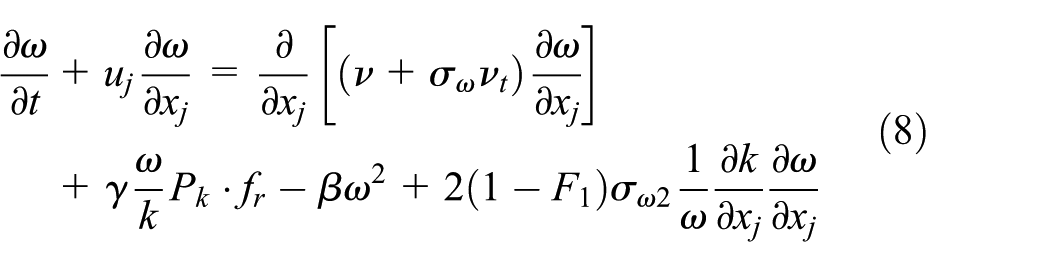
where the production term Pk reads as

where F1 is the blending function, and the coefficients in the SST model are σk1 = 0.85, σω1 = 0.65, β1 = 0.075, β* = 0.09, κ = 0.41,
Additionally, Sij and Ωij in the expressions of the variables r* and
System rotation correction
Huang and Ma 19 pointed out that the intrinsic mean spin tensor in the equation (4) developed in the inertial frame of reference was frame indifferent, namely, objective. Therefore, when modeling the turbulence in a non-inertial frame of reference, the intrinsic mean spin tensor could not properly capture the rotation effects caused by the Coriolis force since it involves no parameters that are related to the rotation rate of the frame of reference. In recent work, the notion of the extended intrinsic mean spin tensor for turbulence modeling in a non-inertial frame of reference was introduced by Huang et al., and it was shown that it is frame dependent and it can properly account for the rotation effect induced by the Coriolis force. In this study, the intrinsic mean spin tensor should be replaced by the extended intrinsic mean spin tensor, and it is defined as follows

As such, the nonlinear turbulence model employed in this article is given as follows: first, the EARSM model is used to solve the Reynolds stress and the isotropic υt of SST k-ω turbulence model. Then, the production terms of SST k-ω turbulence model were modified by Smirnov and Menter method. Finally, the intrinsic mean spin tensor is replaced by the extended intrinsic mean spin tensor. Therefore, a new nonlinear turbulence model combining the EARSM model and SST k-ω turbulence model is improved, namely, EARSM-RC turbulence model.
Test case
Pump parameters
In this study, the investigated centrifugal pump run with a specific speed of ns = 74 (

The hydraulic model of impeller (mm).

The hydraulic model of volute (mm).
Simulation conditions
The solvers used in this work for both steady-state simulation and transient simulation in OpenFOAM are, namely, MRFSimpleFoam and pimpleDyMFoam, respectively. The modified turbulence model is added to both MRFSimpleFoam solver and pimpleDyMFoam solver, and the steady-state case result as initial condition for the unsteady simulation. All the calculations are completed on the high performance cluster. For the steady-state simulation, the boundary conditions are set to velocity inlet and pressure outlet. The upwind discretization scheme is used to discretize the advection term. For the unsteady-state simulation, the convergence criterion is 10−4. Each time step spanned Δt = 4.138e−4s. The chosen time step was related to the rotational speed of the impeller and it was small enough to get the necessary time resolution and to capture the phenomena of the pressure fluctuations. Sampling begins when it is stable after calculation for six cycles.
To ensure the mesh grid of wall layer for the turbulence model selected in this article, the local refined mesh is applied to near wall. The y+ near the boundary wall is lower than 50. Before the simulation, the grid independency was studied, and the data for studying grid independency are shown in Table 1. While the grids are larger than about 1.57 million in Table 1, the pump head fluctuates little with the increase in grids. So, Scheme 3 of grid is adopted.
Grid independency study data.

The grids of impeller and volute are shown in Figure 3.

Grids of pump model.
Particle image velocimetry test system
The test was performed in the laboratory of the Research Center of Fluid Machinery Engineering and Technology of Jiangsu University. The particle image velocimetry (PIV) system is used to observe the flow field in the impeller passages, which is shown in Figure 4. It mainly includes the following components: the US New Wave’s YAG200-NWL pulse laser, whose laser pulse frequency is 30 Hz; the 610,035 laser pulse synchronizer, whose trigger timing accuracy is up to 1 ns; the 630,059 power-view plus 4M PIV camera with 2048 pixel × 2048 pixel resolution and maximum frame rate with 16 frames/s; the Insight 3G software, which is used in data acquisition and analysis and displays software platform; the 610,015 light arm and light source lens; and the tracing particles made of hollow glass and have a diameter of about 20–60 µm and a density of 1.05 kg/m3.

PIV test system.
Parameters are set in the Insight 3G software first. Sequence capture mode is used to collect 200 correlation images under each flow rate. Cross-correlation technique is used to treat 200 images under different flow rates. Also, “Multi-pass,”“Window offset,”“Standard deviation,”“Median test,”“Secondary peak,” and “Local median” technologies are used to amend these images. Finally, the average of 200 vector files is computed in Tecplot software. Meanwhile, the relative velocity, the radial and circumferential component of absolute velocity is obtained separately by the program that is compiled with C++ codes.
Results and discussion
Performance of the pump
In order to verify the precision of EARSM-RC turbulence model in predicting the pump performance, the model pump within the flow rate levels of 0.4QBEP–1.2QBEP were calculated by the EARSM-RC turbulence model and the SST k-ω turbulence model with steady and unsteady simulation, respectively. Results are shown in Figure 5.

Comparison of hydraulic performance.
The results in Figure 5 show that both the modified model EARSM-RC and SST k-ω turbulence model are similar on the prediction of head during 0.4QBEP–0.6QBEP. Here, ΔH by EARSM-RC turbulence model is at about 3.66% (0.4QBEP) and 1.17% (0.6QBEP). Meanwhile, Δη by EARSM-RC turbulence model is at about 2.5% (0.4QBEP) and 1.78% (0.6QBEP). Then, starting from 0.6QBEP, with the flow rate growing, EARSM-RC turbulence model improves the prediction accuracy of head by original model. For example, ΔH is minimal under 0.8QBEP with 0.57% and Δη is about 2.82%; ΔH is maximal under 1.2QBEP, and it decreases to −7.25% compared to the original model. In addition, the discrepancies caused by EARSM-RC under 1.0QBEP are about −2.2% (ΔH) and 1.16% (Δη). Overall, the discrepancy caused by EARSM-RC is lower than that by SST k-ω turbulence model under most of the flow conditions. Therefore, the result of the EARSM-RC turbulence model is more realistic.
Inner flow analysis and comparison
In order to verify the prediction accuracy by EARSM-RC deeply, comparisons are performed by EARSM-RC, SST k-ω, and experimental data from PIV. The test region of impeller is illustrated in Figure 6, and the six different flow passages are named as passage 1 to passage 6. Three sections of impeller passages are selected as measuring zones, as shown in Figure 7. Sections 1, 2, and 3 in Figure 7 are presented for near shroud section, the middle section, and near hub section, respectively. The flow field near those sections under different flow rates at t = 0 s are investigated. Due to limited space, here only the flow field distributions near Section 1 are selected.

Schematic diagram of testing region.

Schematic diagram of testing section (unit: mm).
The flow field distribution near the shroud section
The flow field distributions near the shroud section by both simulation data and PIV data are illustrated in Figure 8. The flow field distributions presented by EARSM-RC turbulence model agree well with PIV result. The EARSM-RC turbulence model can capture the onset of separation flow in the impeller accurately. The vortex begins to occur under 0.6QBEP and appears near the pressure side of passage 1 and passage 5. Then, the single vortex in passage 1 under 0.4QBEP develops to twin vortices. There is also a jet-wake structure near the impeller exit by EARSM-RC turbulence model simulation data. The vortices in the impeller performed by SST k-ω turbulence model have some difference compared with PIV data. The separation flow can be observed by SST k-ω turbulence model, but the location and numbers of vortex seem a little different. So, EARSM-RC turbulence model is superior over SST k-ω turbulence model in terms of predictions of the flow field near the shroud section.

Comparison of flow field near the shroud section: (a) PIV, (b) SST k-ω, and EARSM-RC.
The comparison between PIV test and the modified model
In order to further validate the modified model, the development of the unstable flow under 0.6QBEP by EARSM-RC turbulence model is compared to PIV test. Then, the flow velocity on shroud section under 0.6QBEP is selected as research subject, which is shown in Figures 9 and 10.

Comparison of flow field near the shroud section: (a) 0T, (b) 1/6T, (c) 2/6T, (d) 3/6T, (e) 4/6T, and (f) 5/6T.

The flow field near the shroud section under 0.6QBEP by EARSM-RC: (a) 0T, (b) 1/6T, (c) 2/6T, (d) 3/6T, (e) 4/6T, and (f) 5/6T.
It can be seen from the above figures that the flow field in impeller passage 1 and 5 have the maximum variation with the impeller rotating by both PIV test and EARSM-RC transient simulation. At t = 0 s, there is a small vortex near the pressure side in impeller passage 1 and passage 5 by both PIV and EARSM-RC simulation. With the trailing edge of the blade in impeller passage 1 sweeping the cut-water, the vortex in the impeller passage 1 is disappearing. Then, while the cut-water is directly against the exit of impeller passage again, and the flow near the pressure side in this impeller passage moves toward the suction side. In addition, while the cut-water appearing at about the middle position of impeller passage, the vortex begins to show up. Then, the vortex is detected by both PIV test and EARSM-RC again at 4/6T.
In PIV test, the vortex in impeller passage 5 at t = 0 s disappears very rapidly with the impeller rotating. However, the flow separation still exists in the next moments. Meanwhile, influenced by the vortex in passage 5, there is a small vortex in passage 4 both at t = 2/6T and t = 4/6T. However, in the EARSM-RC simulation, it is clearly recognized that the vortex in passage 5 begins to decrease, and then, it disappears at t = 3/6T. In this process, the flow separation begins to generate in passage 4, and during the next impeller rotation, the position and size of vortex is hardly changed.
As a result, although the flow field distribution by the EARSM-RC simulation data cannot entirely be consistent with that by PIV test data near the shroud section under 0.6QBEP, the unsteady flow varying with time is very similar to those two data. It is shown that the data simulated by EARSM-RC turbulence model get close to test data. It is also illustrated that the modified model is reliable in predicting the flow distribution in pump.
Conclusion
A modification of the shear stress transport turbulence model was suggested based on adaptation of the EARSM of Wallin and Johansson and the rotation-curvature correction of Spalart and Shur. The modified model (EARSM-RC) was tested for a low specific centrifugal pump flow with system rotation and streamline curvature. The main conclusions were as follows:
In terms of the pump hydraulic performance, compared to the original model, the EARSM-RC turbulence model improved the accuracy among 0.6QBEP–1.2QBEP, especially for the flow rate at 1.2QBEP, ΔH of EARSM-RC turbulence model decreased about 7% and Δη decreased about 4%. In addition, ΔH of EARSM-RC turbulence model under 1.0QBEP dropped about 7% and Δη dropped about 2%.
In terms of the flow field at impeller shroud section, for the EARSM-RC turbulence model, the streamlines are smooth near the shroud section under 0.8QBEP–1.2QBEP, and it is consistent with PIV test. In addition, there is a vortex beginning both in the impeller passage 1 and impeller passage 5 under 0.6QBEP, which is also detected by PIV. Moreover, the vortex near the impeller inlet in the passage 5 and the vortex in passage 6 are in agreement with PIV data. All these show that the modified model is effective for the prediction of inner flow in impeller passage with rotation and curvature.
In terms of the onset and development rule of unstable flow, the original model predicted vortex under each flow rate. Therefore, the original model has a great discrepancy in predicting the onset of vortex. By contrast, the generation location of vortex predicted by the EARSM-RC turbulence model was approximate with PIV test data.
Footnotes
Appendix 1
Academic Editor: Mario L Ferrari
Declaration of conflicting interests
The author(s) declared no potential conflicts of interest with respect to the research, authorship, and/or publication of this article.
Funding
The author(s) disclosed receipt of the following financial support for the research, authorship, and/or publication of this article: The authors gratefully acknowledge the support from the Natural Science project of Zhejiang Province, respectively, titled “Research on unsteady separation flow in centrifugal pumps based on an anisotropic IDDES method” and “Research on unsteady flow control in centrifugal pumps based on RSM-NSGA II inverse design method” (Nos LQ15E090005 and LQ15E090004); the National Natural Science project of China, respectively, titled “Studies on the mechanism of internal flow instability of centrifugal pumps and its control strategy” and “Mechanism and unsteady dynamic characteristics of cavitating flow in radial impeller of process pump” (Nos 51536008 and 51409233); the Postdoctoral Science Foundation of China titled “Gas-liquid Mixed Unsteady Flow Structures and Excitation Characteristics in Self-priming Pumps” (No. 2016M590546); the Natural Science project of Zhejiang University of Technology titled “Studies on the mechanism of internal flow stability of centrifugal pumps based on nonlinear PANS model” (No. 2014XZ015); and the project of Zhejiang Department of Education titled “Research on the optimization for numerical model of centrifugal pumps and its experimental verification” (No. Y201432222).