




Abstract
Based on the analysis of the relationship between the process of product innovation design and knowledge, this article proposes a theoretical model of quality function knowledge deployment. In order to link up the product innovation design and the knowledge required by the designer, the iterative method of quality function knowledge deployment is refined, as well as the knowledge retrieval model and knowledge support model based on quality function knowledge deployment are established. In the whole life cycle of product design, in view of the different requirements for knowledge in conceptual design stage, components’ configuration stage, process planning stage, and production planning stage, the quality function knowledge deployment model could link up the required knowledge with the engineering characteristics, component characteristics, process characteristics, and production characteristics in the four stages using the mapping relationship between the function characteristics and the knowledge and help the designer to track the required knowledge for realizing product innovation design. In this article, an instance about rewinding machine is given to demonstrate the practicability and validity of product innovation design knowledge support technology based on quality function knowledge deployment.
Keywords
Introduction
Innovation is the essence and soul of product design, 1 and innovation design is based on knowledge. The enterprises have increasingly invested resources in the product innovation design in this knowledge economy era. The foundation of product innovation design depends heavily on the amount of knowledge and the usage of knowledge. How to retrieve relevant knowledge from many knowledge resources accumulated by the enterprises to support product design process has become an urgent issue to be solved in the knowledge management system and aided innovation design system.
The key to achieve problem solving through stimulating innovation design process is to acquire a large number of effective knowledge. 2 However, the innovation design based on knowledge is not simply to acquire the knowledge and reuse knowledge, but more importantly to stimulate innovation design and guide the designers to produce innovative solutions through the innovative applications about knowledge superposition and knowledge migration utilization. In traditional product design, the designers follow handbooks, formulas, and previous design cases to make decision on the design process. However, with the growing knowledge of product design and increasing demand of product performance from the customers, the traditional methods of acquiring knowledge cannot meet the needs of modern product design. Enterprise must ensure that the knowledge acquired by the designer is comprehensive, complete, accurate, and updated. Many domestic and foreign scholars have conducted massive researches on product design based on knowledge to make effective use of knowledge in product innovation design process. These studies mainly focused on knowledge organization and retrieval based on ontology,3,4 knowledge driving and navigation based on context,5,6 case-based knowledge acquisition of product design, 7 computer-aided innovation design based on patent knowledge, 8 functional case modeling for knowledge-driven conceptual design, 9 product development based on knowledge maps, 10 the knowledge management for process, 11 and so on. These studies raise the efficiency of product design in some extent. However, those methods still have some limitations on carrying out creative design practically, which cannot match knowledge retrieve with each stage of product innovation design and cannot assist the designers systematically in the whole process of product innovation design.
To solve the above-mentioned problems, quality function knowledge deployment (QFKD) as a new method for acquiring knowledge was proposed in this article to help the designers to track knowledge, acquire knowledge, and apply knowledge in the process of product innovation design. QFKD will match mapping function characteristics of different stages and the required knowledge in the whole life cycle of product design and push feasible knowledge for the designers to help them realize product innovation design using required knowledge, which can assist the designer to get innovative solutions to apply in the existing knowledge resources.
Design knowledge and knowledge retrieval for product innovation design
Knowledge connotation for innovative design
The innovation design knowledge is the summary of information and experience required for product innovation design. 2 According to the characteristic and the different effects of knowledge for product innovation design, knowledge can be divided into scientific effect knowledge, factual knowledge, innovation design principle and method, and individual tacit knowledge. 12 Product innovation design process starts with meeting market requirements and ends with the product design scheme. It is accompanied with the application of knowledge in the entire product design cycle. Thus, product innovation design is accompanied by the flow of knowledge, as shown in Figure 1.

Product innovation design process and the knowledge required.
The knowledge flow runs through the entire product innovation design process. First, in the requirement analysis stage, the designer needs to understand the relevant situation about market requirements and main rivals. Second, in the stage of determining design tasks, the designer needs to be aware of the knowledge on social background, technology development, and cost control. Third, in the conceptual design stage, since this stage determines the final level of product innovation, which has great impact on the quality and cost of the product,13,14 the designer should take into account a variety of design constraints and grasp every aspect of product design at the macroscopic level, including the knowledge of innovative design, scientific effects database, patent database, case database, domain knowledge, design standards, design specifications, comprehensive knowledge, and so on. Fourth, in the structural design stage, the designer needs to use the material selection, mechanical assembly, computer-aided design (CAD) technology, and related design experience skillfully. Fifth, in the detailed design stage, the designer needs to master the structural analysis, mechanical analysis, process design, optimization design, and related design experience. Sixth, in the prototype testing stage, the designer must grasp the knowledge about design verification, simulation, design evaluation, modification, and other aspects. Finally, in the production stage, the designer should have knowledge of production management, resource scheduling, and other aspects of production.
Product innovation could be acknowledged as a knowledge-intensive process driven by a series of decisions. 15 Decision-making process is a process to confirm the product design schemes, which includes the determination of a series of programs and the completion of a series of product design tasks. Thus, the designer needs to make a reasonable solution to the design task in each stage of product innovation design process before determining the final scheme of product innovation design. This process requires the support of knowledge.
Product design innovation based on QFKD
The process of product design is a process for a designer to search, organize, and use the required knowledge continuously in each stage of product design. 16 It includes two parts. First, it needs a design theory or system which can be used in the whole life cycle of product design; second, this design theory or system must link up the knowledge required and design tasks in different design stages in order to avoid the blindness of the designers in the process of knowledge research.
Quality function deployment (QFD) is a theory that combines the customer requirements on products into the entire life cycle of product design using the form of house of quality (HoQ). 17 Through this HoQ, the specific design tasks in each stage of product design could be displayed and the design knowledge required would be clear. Therefore, QFD plays a significant role in the research of product innovation design based on knowledge.
What is more, QFD is a typical tool for requirement conversion. It starts from the customer requirements, and then it converts the voice of the customer into the voice of the designer. 18 The core of QFD is requirement conversion by HoQ.19,20 A typical HoQ is shown in Figure 2(a).
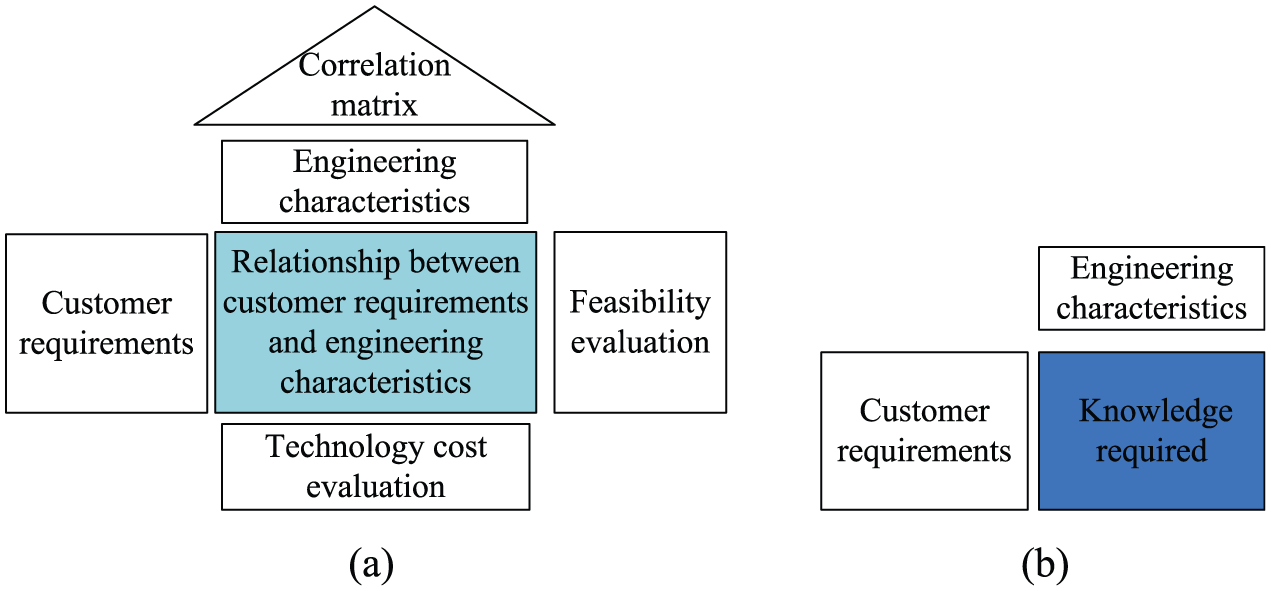
HoQ model: (a) typical HoQ and (b) knowledge requirement HoQ.
The conversion from “what is needed” into “where do respect” will be completed after establishing the HoQ. The HoQ will consider the relationship between customer requirements and technical characteristics and let the designer know how to meet customer requirements using the technical characteristics. However, it has some limitations. Generally, these technical characteristics are only considered as a reference in the specific application of the information or in determining the technical characteristic importance. It did not provide an effective method to achieve these technical characteristics. What is more, QFD theory only illustrates the technical characteristics that are needed to be fulfilled, but it does not provide knowledge and methods required to achieve these technical characteristics. Moreover, it ignores the linked role of knowledge between the customer requirements and technical characteristics. For instance, the customers ask for beautiful appearance of the products. In order to achieve this requirement, the designers will consider the knowledge from the aspects of material selection, shape design, mold, and product assembly accuracy, involving the material, process planning, mold selection, and assembly. The designers must acquire this knowledge rapidly and apply them flexibly to meet customer requirements.
To solve these problems, we can add a mapping relation of “knowledge” between the “requirement” and “function.” QFKD model just uses the frame of QFD model; the key is to use function characteristics to guide the designers to acquire the required knowledge. Then, the knowledge required in each stage of product innovation design would be clear. Thus, we can establish the knowledge mapping relationship based on the typical HoQ model and propose the QFKD theory model. The HoQ model for knowledge requirement is shown in Figure 2(b).
Knowledge tracing HoQ is the improvement of typical HoQ. In the knowledge tracing HoQ, the correlation matrix, feasibility assessment evaluation matrix, and technology assessment matrix are removed, and the relation matrix is changed into knowledge requirement correspondence matrix. Thus, the knowledge required for taking the corresponding engineering measures which is to meet customer requirements will be displayed in the knowledge requirement correspondence matrix.
The implementation of QFD can be divided into four stages, which are conceptual design, components’ configuration, process planning, and production planning. 21 Knowledge requirement iteration of QFKD can also be divided into four stages, as shown in Figure 3. When a designer constructs the relation matrix of HoQ, the knowledge required in different stages of the product design process could be presented at the same time. When the designer tracks product performance through the implementation of QFD, the knowledge required for product design will been tracked at the same time, which shows the direction of acquiring the knowledge required for the designer. Thus, product design and knowledge required link together via QFD. And QFD will also transform into QFKD, which turns “what to do” with the HoQ into “how to do” by the successor of HoQ. The innovation of QFKD is to increase the mapping between the function characteristics and the required knowledge, which is different from the traditional QFD model. In this content, QFKD contains two basic mapping relationships:
Q-F mapping: requirement–function mapping mode. After analyzing the user requirements, this mapping model will convert them into technology requirement information of engineering characteristics, components’ characteristics, process features, and production characteristics in different stages of product design. It will help the designer to meet the requirements of users from different aspects, which means it will tell the designers “what needs to be done.”
F-K mapping: function knowledge mapping mode. The mapping mode establishes the relationship between “function” and “requirement” through utilizing the linkage function of knowledge. It converts “what needs to be done” into “how to do” through continuous iteration and using knowledge required in the various stages of design.

QFKD iterative process.
Knowledge retrieval model for innovation design
At present, “design directory-design knowledge” is a common knowledge retrieval, which is a keyword retrieval mode of point to face. This retrieval model is a simple structure which is easy to achieve. However, as the design of directory organization of design knowledge is generally abstract, it is difficult for the designer to extract design catalog in the process of innovative design. It leads to retrieval failure, which is not conducive to the generation of innovative design. 2 Thus, according to the characteristics of knowledge retrieval in innovation design knowledge, a “design process-knowledge push-knowledge modules” as a face-to-face knowledge retrieval model with three layers of mapping relationship will be proposed in this article. It is shown in Figure 4.

Knowledge retrieval model for innovation design.
Design process layer
The product design process can be divided into four stages, which are conceptual design, components’ configuration, process planning, and production planning. There is a relationship of progressive and feedback in each design stage. And then the design task in each design stage can be divided into several sub-tasks, and the completion of each design task needs the support of knowledge.
Knowledge push layer
In this layer, the foundation of knowledge push is the iterative process of QFKD and the tracking process of design knowledge. Knowledge push has two forms: active knowledge push and passive knowledge push. In the active knowledge push, the system will push the knowledge of design requirements to the designer according to the current process when a new stage of design task turns up. In the passive knowledge push, the designer can request knowledge acquisition in the system to obtain the knowledge required for product design when the knowledge from active push could not meet the current design requirements. 5
Knowledge module layer
This layer includes the design process database and knowledge base. In the design process database, each stage of product innovation design will be summarized through the iterative process of QFKD, and the typical instances will be extracted, and then the design process database will be established. In order to organize and manage the design task effectively, it is necessary to establish the knowledge tracking model which takes design stages as the nodes. It will be used to describe the relationship between design process and knowledge. The main purpose of knowledge tracing is to build up the relationships between product design process and the knowledge required. Thus, it is necessary to establish the mapping relation between the design process and knowledge accurately.
In order to help the designer to obtain the knowledge required rapidly and effectively, the knowledge base must be established, and the knowledge push approach should be provided. In addition, in order to facilitate the management of knowledge, the knowledge base should be linked to the QFKD iterative process. And the acquisition of different knowledge in the different stages of product design will be satisfied.
Knowledge support technology based on QFKD
Acquisition of knowledge in product innovation design process
The acquisition of knowledge includes three basic steps: (1) determining what knowledge resources are required, (2) identifying who owns these knowledge resources, and (3) retrieval of knowledge resources required. 22 In order to link up the required knowledge and QFKD iterative process, the knowledge supply chain model based on node will be established from the process of product innovation design to assist the designers to use knowledge resources in this article. It is shown in Figure 5.
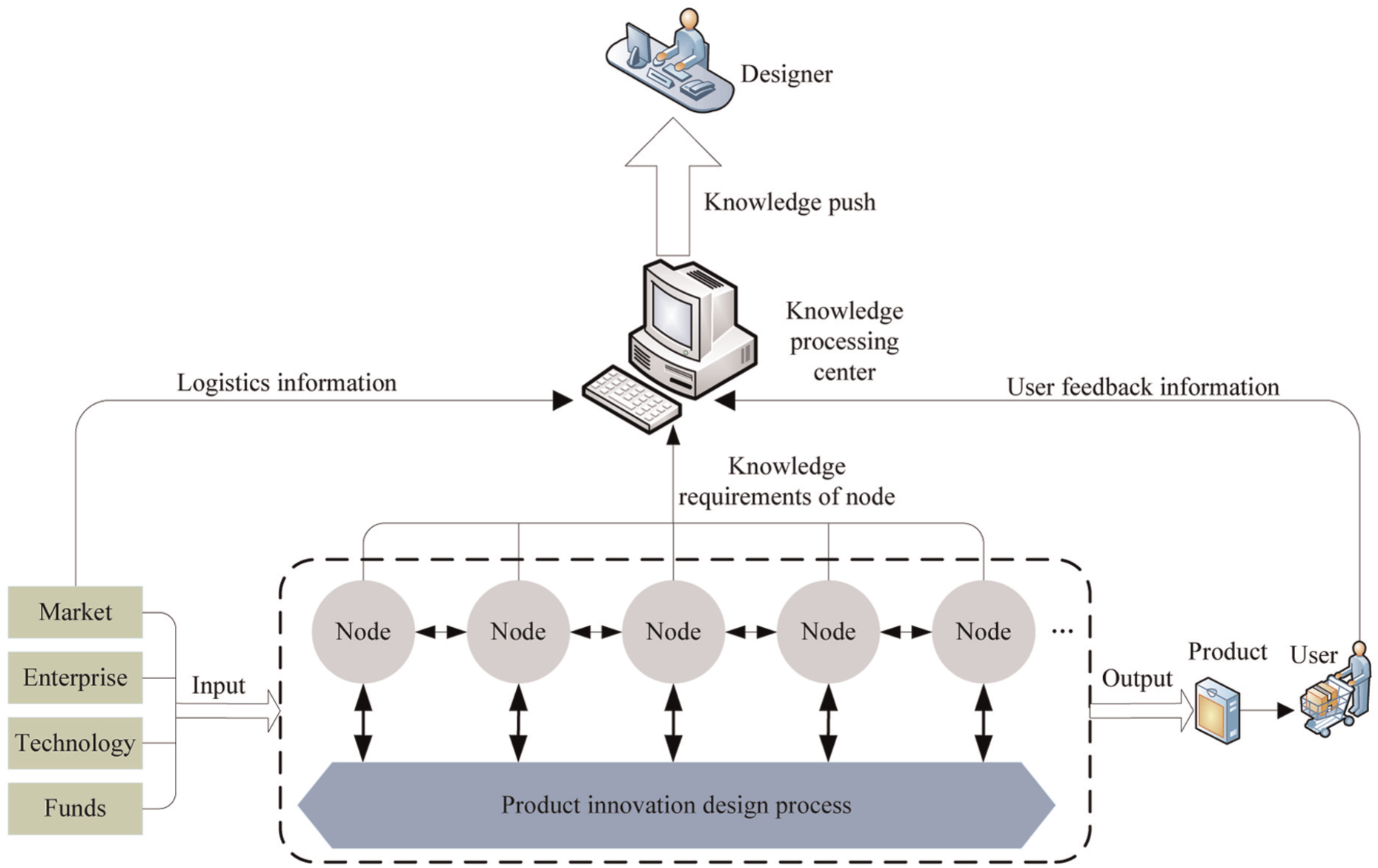
Knowledge acquisition model based on knowledge supply chain.
The internal construction of knowledge supply chain is based on the specific process for product innovative design. First, the designer receives the knowledge from supply chain and then applies it in product innovation design. Thus, the knowledge flow will run from the knowledge base to the designer and then to the product. Actually, the specific knowledge requirement of designers is originally from the specific process of product innovation design. If the direct connection between product innovation design process and knowledge supply chain is established, the direct feedback relation between knowledge requirement and product innovation design process will be established. And it will improve the efficiency of knowledge retrieval for the designer. It is similar to the division of different stages in product innovation design which is established in the nodes of knowledge supply chain during product innovation design process; the whole knowledge supply chain is also based on the nodes. And the designer’s knowledge acquisition becomes a correspondence between design process and node knowledge.
The main task of the knowledge processing center is to analyze and respond to knowledge requirement of the nodes. The contents and forms of the required knowledge are different to each other in different nodes. It means that there should be disposition for identification and classification after the knowledge provided by the knowledge supply chain enters in, so that the specific knowledge required for each node is refined. The knowledge processing center is helpful to ensure the consistency of supply and demand of knowledge and reduce the deviation of supply and requirement of knowledge between knowledge providers and the node. In addition, designers can increase the required knowledge constraint with keywords’ retrieval artificially to filter the retrieval result of knowledge when there is conflict, which will eliminate contradiction of knowledge. The knowledge processing center is able to analyze knowledge requirements of node and sends them to knowledge suppliers on time. This function is helpful to improve the efficiency and accuracy for operation of knowledge supply chain.
After the knowledge processing center finishes the identification and classification of the collected knowledge, the node knowledge will be formed. It corresponds to the specific stage in product innovation design process, and this corresponding node knowledge will be used in the different stages and steps of product innovation design. Node knowledge must be re-expressed before it is stored in the database. Because there is original design knowledge in the knowledge base, and the integration of the new node knowledge and the original node knowledge must be reconstructed in specified expression and storage mode in the knowledge base. Thus, a kind of knowledge organization—node knowledge tree—will be formed, and the mapping between the product innovation design process and the knowledge required will be fulfilled as shown in Figure 6.

Mapping model between the product innovation design process and the knowledge required.
There is a cyclic process that the integration of node knowledge tree for new node knowledge and original knowledge in knowledge base. When the new node knowledge enters into the knowledge base, it will be integrated with the existing node knowledge tree, and a powerful node knowledge tree is formed. The specific stage of product innovation in the design process will correspond with the node knowledge tree. After the designer engages the product innovation design activities with the node knowledge tree, the feedback of the knowledge requirement will be sent to the knowledge processing center. Then the knowledge processing center will assess the operational effectiveness of the entire knowledge supply chain according to the feedback information.
Knowledge tracking model for product innovation design based on QFKD
In the structure of HoQ, the relationship matrix in the conceptual design stage presents the strength of association between the customer requirements and the engineering characteristics, the relationship matrix in the components’ configuration stage presents the strength of association between the engineering characteristics and the component characteristics, the relationship matrix in the process planning stage presents the strength of the association between the component characteristics and the process characteristics, and the relationship matrix in the production planning stage presents the strength of the association between the process characteristic and the production characteristic. Each characteristic of the product corresponds with the required knowledge which is used to ensure the realization of the characteristic. And the designer can take the corresponding measures to make sure these related characteristics are used in the corresponding knowledge.
Based on Figure 3, “what to do” is supported by knowledge. In this article, the existing knowledge is stored as the pattern of text, images, and other ways. The joint iteration between the typical HoQ and the HoQ for knowledge requirement is made, and the knowledge required in each stage of product design is tracked down constantly, and then the tracking result of knowledge requirements is fed back in time. Thus, the knowledge involved in each stage of product design is delivered to the designer in order, and the designer can obtain the knowledge required rapidly in the knowledge base. Finally, the knowledge support technology for product innovation design is realized, and the specific process is shown in Figure 7.

Knowledge tracking model for product innovation design based on QFKD.
In the product design process, as long as the designer finds out the knowledge in the matrix corresponding with the knowledge requirement, then he can take some corresponding engineering measures for product design. And then the direct relationship between the product design process and the knowledge requirement will be established. In addition, in the process of knowledge tracing, the designer can verify the rationality of engineering measures taken with constant feedback on knowledge and avoid the mistakes in the process of product design. And the efficiency and success rate of the product innovation design will be improved.
Knowledge support model for product innovation design based on QFKD
After determining the design tasks, first of all, the designer needs to identify the customer requirements and determine the necessary function of products according to the customer requirements. Second, the designer needs to ensure that the components must match the required function through the configuration of the product components. Third, the corresponding process plans should be formulated for the specific components. Finally, the processor should get production and processing in accordance with the prescribed process to manufacture products. The specific implementation in each stage of product innovation design can be carried out using QFKD technology. Product performance and knowledge required could be tracked constantly with the continuous establishment of HoQ, and the knowledge required in the each stage of product design will be listed in relation matrix, so that it can guide the designer to use knowledge and ensure that product performance matches the customer requirements. Then knowledge support model for product innovation design based on QFKD will be established, and then the relation between the product innovation design process and the application of knowledge will be established with the link of QFKD, as shown in Figure 8.

Knowledge support model for product innovation design based on QFKD.
Conceptual design stage
This stage is the starting point of the whole product design life cycle, which is the planning of the product design from the customer requirements. The success of construction for HoQ in the stage will affect the implementation for QFKD directly in the next three stages. It can be said that the overall performance and key technical indicators of the product are identified in this stage. Therefore, the application of QFKD in the conceptual design stage is particularly important.
In the conceptual design stage, the designer determines the customer requirements according to the design tasks. The ways to get customer requirements can be included: (1) the market research, which is helpful to understand customer requirements for product performance through questionnaires or face-to-face communication with customers; (2) the quality information, which is useful to understand product performance need to improve through the information of warranty record or quality maintenance for product in the past; (3) the design experience, which plays the role to determine customer requirements for product performance with design experience and the designer’s overall grasp for the product performance; and (4) the experts’ prediction. Generally, the customers are not always able to express their requirements for product performance fully. Some potential performance or product performance with prospective market needs the expert’s forecast on the market environment and to make a trade-off on product performance. As the expression of the customer requirements is not all standardized, it is necessary to regulate the expression of customer requirements after obtaining them and displaying them in professional terms. Then the designer needs to determine the important degree for customer requirements and the appropriate engineering characteristics according to the customer requirements and complete the relationship matrix. Finally, after analyzing the relationship matrix, the designer needs to evaluate the market feasibility and technological competitiveness and determine the direction of product innovation design on this basis.
Components’ configuration stage
Based on the HoQ of the conceptual design stage, the HoQ of the components’ configuration stage is mainly used to determine the detailed design, structure design, and related technical requirements. At the same time, the components’ configuration stage has a guiding significance for ensuring the preliminary product quality requirements and determining the characteristic indexes of main components.
The “customer” in this stage is the engineering characteristics determined in the last stage. The purpose of building HoQ in this stage is to export the component performance which can match the requirements of the engineering characteristics. The components’ configuration scheme which is used to meet the characteristic requirements will be determined according to the engineering characteristics determined previously. Then the important degree of the engineering characteristics and the corresponding component performance will be determined, and the relationship matrix will be completed. Finally, the key engineering characteristics and the components required which are used to achieve these key characteristics of the components will be identified through analyzing and evaluating the HoQ. It is necessary to re-define the components’ configuration scheme if the result of the assessment is not reasonable, until the designer determines the final components’ configuration scheme and determines the characteristics of these components on this basis.
Process planning stage
After the establishment of the HoQ for components’ configuration, the corresponding process plans used for the detailed design of components could be made according to the component characteristics. The HoQ in process planning stage plays a pivot role in the whole product design, and it undertakes the research and development (R&D) design and production and processing of the product.
The “customer” in this stage is the component characteristics determined in the last stage. The purpose of building HoQ in this stage is to determine the process parameters which can meet the requirements of the component characteristics. The process constraint events used to meet the characteristic requirements will be determined according to the component characteristics determined previously and the important degree. Then the process parameters will be listed and the relationship matrix will be completed. Finally, the key component characteristics and the process parameters required used to achieve these key characteristics are identified through analyzing and evaluating the HoQ. It is necessary to re-define the process parameters if the result of the assessment is not reasonable, in order to ensure the output of the parameters can meet the requirements of the component characteristics.
Production planning stage
After the establishment of the HoQ for production planning, the corresponding production and processing plans which are used for the production and processing of components could be made according to the process parameters. The HoQ in production planning stage plays a key role in ensuring the performance of the products. As long as the processing performance of the components is granted, the whole product design to meet customer requirements is granted.
The “customer” in this stage is the process parameters determined in the last stage. The purpose of building HoQ in this stage is to ensure the components to meet up the requirements of the process parameters. The production control characteristics which are used to meet the process parameters will be determined according to the process parameters determined previously and the important degree. Then the relationship matrix will be completed. Finally, the reasonable production control measures will be made through analyzing and evaluating the HoQ, and the production and processing will be implemented.
Product innovation design process is directed by QFD theory and achieved using the continuous establishment of HoQ. And the required knowledge is obtained by push of knowledge requirement tracing model for product innovation design. The designers could retrieve the required knowledge according to different design stages and then utilize the required knowledge according to the specific design task. What is more, the knowledge required in the stage of conceptual design mainly includes scientific effect knowledge and the knowledge of innovative design principles, strategies, and methods. The knowledge in the three stages later is mainly factual knowledge, which includes the knowledge of product design standards, mechanics analysis knowledge, structure design knowledge, mechanical and electrical control knowledge, production and processing knowledge, and so on.
An application example of QFKD
Design task: Design a rewinding machine system for adhesive tape.
Design requirements: The device is used for processing the special adhesive tape, which needs to process polytetrafluoroethylene (PTFE) thin film (hereinafter referred to as the thin film) and to gum the single side of the thin film. The thin film to be processed will pass through the processing device with a constant linear velocity. The linear velocity is in the range of 1–3 m/min, which can be adjusted according to the customer requirements. When the thin film passes through the processing device, tension should be constant and can be adjusted in a certain range. In addition, the coating surface of the thin film should be in contact with only few objects.
Conceptual design stage of rewinding machine
The purpose of this stage is to establish the relation between the function requirements of the rewinding machine proposed by the customer and the engineering characteristics required by the system and to evaluate all the engineering characteristics of the rewinding machine, to ensure the engineering measures taken by the designer to meet the customer requirements for the rewinding machine.
The designers could get the customer requirements for the rewinding machine through market research, quality information, design experience, and experts’ prediction. The customer requirements mainly include stable and adjustable velocity, stable and adjustable tension, without deviation, the working surface protection, small volume, light weight, convenient transportation, convenient repair, durable, beautiful appearance, convenient operation, environmental protection, corrosion resistance, and so on. The important degree of the customer requirements was determined through expert evaluation. After getting the design requirements (including customer requirements, engineering requirements, components configuration requirements, and process planning requirements), the experts will evaluate the important degree with scores from 1 to 5; the higher the score, the greater the importance. Then the designers can determine the important degree of the design requirements according to the evaluation results from the experts. In order to meet the customer requirements, the designers need to take a series of measures to implement the corresponding engineering and technical characteristics. Through expert assessment, the designers can get the engineering characteristics, which include material, product standards, the assembly precision, measurement technology, appearance shape, gear, packaging, color, operating voltage and ambient temperature, and so on. In order to show the correlation degree between the customer requirements and engineering characteristics, the designers need to grade relationship matrix use a few score (from 1 to 9) according to the expert evaluation; the higher the score, the greater the relevance. The HoQ of rewinding machine in conceptual design stage is shown in Figure 9.
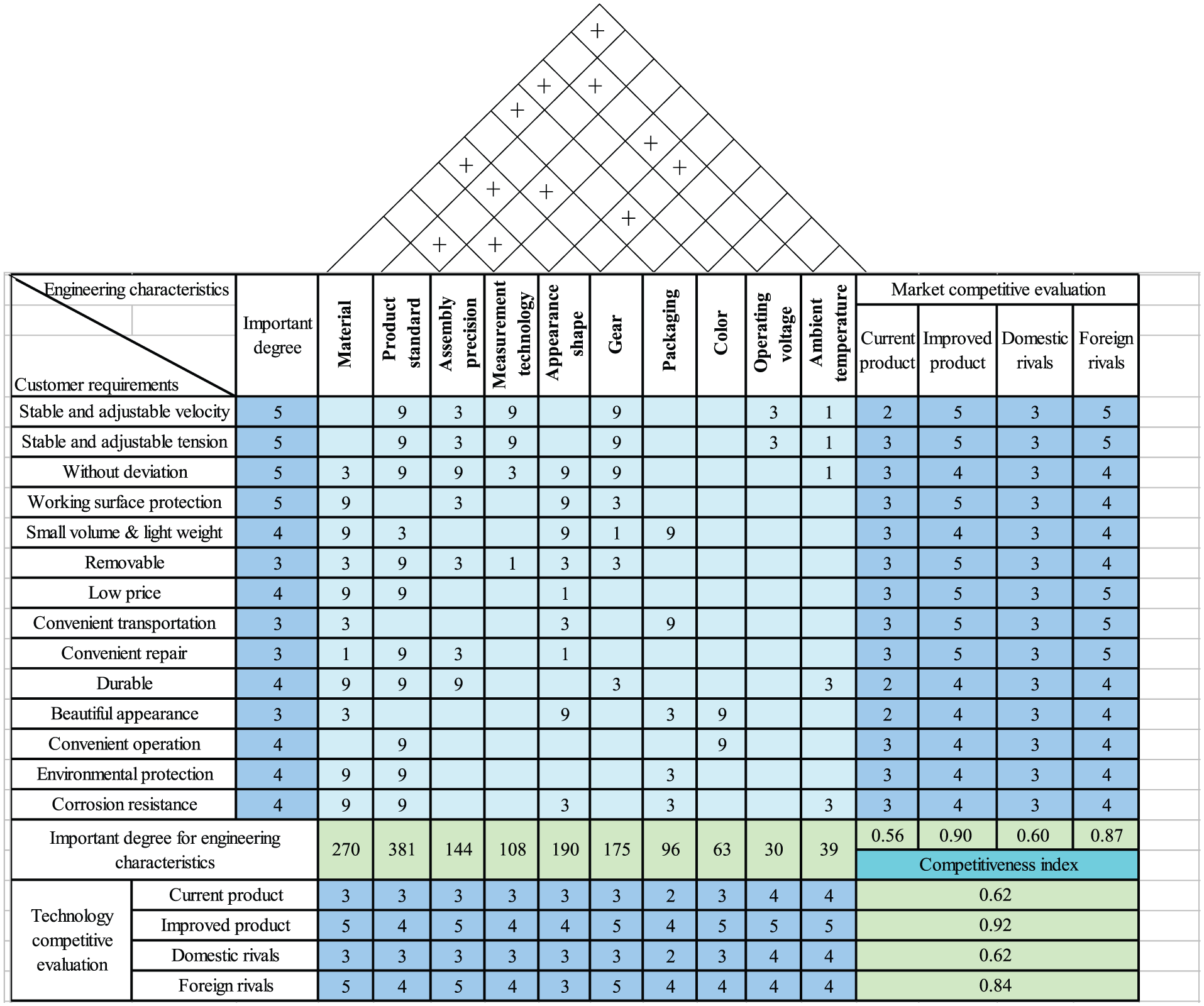
HoQ of rewinding machine in conceptual design stage.
In this rewinding machine system, the most important customer requirements include stable and adjustable velocity, stable and adjustable tension, without deviation, and the working surface protection, as shown in Figure 9. Therefore, the designers should focus on the evaluation for velocity, tension, deviation, and the working surface protection of the thin film in the working process of the rewinding machine and then evaluate the innovation design according to the complete effect of these design requirements.
For the rewinding machine system, the designers need to establish a two-dimensional table to clearly identify the operational variable, as shown in Table 1. The first column of the table represents the design requirements (including customer requirements, engineering requirements, components configuration requirements, and process planning requirements). The first line of the table represents the corresponding design measures (including engineering and technical measures, components’ configuration measures, process planning measures, and production planning measures). The intersections of ranks represent the specific required knowledge for taking the corresponding measures to meet one of the design requirements. The design requirements and the measures used for meeting the design requirements have been pointed out in the first line and first column in the table; therefore, the specific knowledge can be determined according to design experience of the experts. For example, Kij represents the required knowledge for the design measures (Mj) to meet the design requirements (Ri).
Acquisition of knowledge variable.

Determining the engineering characteristics needs the support of the corresponding knowledge. The knowledge which is related to the material includes material properties, material selection, and application of material and other related knowledge; the knowledge which is related to the product standard is the choice of product design standard; the knowledge which is related to assembly precision includes assembly control and selection of components and other related knowledge; the knowledge which is related to measurement technology includes the selection of checking fixture and the monitoring and control and other related knowledge; the knowledge which is related to appearance includes structural design and exterior design and other related knowledge; the knowledge which is related to gear includes drive control and the selection of gear knowledge and other related knowledge; the knowledge which is related to packaging is packaging design; the knowledge which is related to color includes exterior design and color discrimination and other related knowledge; the knowledge which is related to operating voltage is the electrical control; the knowledge which is related to environmental temperature includes thermoregulation knowledge; and so on.
In the process of determining the engineering characteristics, the specific required knowledge needs to correspond with the customer requirements according to Table 1 with the aid of experts. The details are as follows.
The engineering characteristics which are related to velocity control of rewinding machine include product standards, assembly precision, measurement technology, gear, the operating voltage, ambient temperature, and so on. Therefore, the designer can consider velocity control from these aspects. Accordingly, the knowledge which is required for velocity control includes product design standards’ knowledge, assembly control knowledge, knowledge of components selection, knowledge for selection of checking fixture, drive control knowledge, electrical control knowledge and thermoregulation, and so on.
Similarly, the engineering characteristics which are related to tension of rewinding machine also include the product standards, the assembly precision, measurement technology, gear, the operating voltage, and ambient temperature. The knowledge which is required for tension control also includes product design standards’ knowledge, assembly control knowledge, knowledge of components selection, knowledge for selection of checking fixture, drive control knowledge, electrical control knowledge, thermoregulation, and so on.
In order to ensure the rewinding machine without deviation in the control process, the designer should take the material of the rewinding machine, product design standard, assembly precision, measurement technology, appearance shape, gear, the temperature of the environment, and other aspects into consideration. The involved knowledge includes material selection, selection for design criteria, assembly control knowledge, components’ selection knowledge, knowledge for selection of checking fixture, exterior design knowledge, drive control knowledge, thermoregulation, and so on.
In the process of protecting the thin films’ working face of the rewinding machine, the designer should take the material of the rewinding machine, assembly precision, appearance shape, and the gear into consideration. The required knowledge includes material selection knowledge, assembly control knowledge, components’ selection knowledge, structure design knowledge, drive control knowledge, and so on.
The engineering characteristics which are related the volume weight of the rewinding machine include material, product design standards, product appearance, gear and pack, and so on. The involved knowledge includes material selection, selection for design criteria, structure design knowledge, exterior design knowledge, device selection knowledge for gear, and packaging design knowledge.
If the removable rewinding machine is required, the designer needs to consider the engineering characteristics which include the material of the rewinding machine, product design standard, assembly precision, measurement technology, exterior design, and gear. The required knowledge includes material selection knowledge, selection for design criteria, assembly control knowledge, components’ selection knowledge, selection of checking fixture, structure design knowledge, gear selection knowledge, and so on.
In the process of controlling the cost of the rewinding machine, the designer needs to take the material of the rewinding machine, product design standard, and the product appearance into consideration. The required knowledge includes material selection knowledge, selection for design criteria, structure design knowledge, and so on.
In order to facilitate the transport of the rewinding machine, the designer needs to consider the engineering characteristics which include material, appearance shape, and the packaging. The required knowledge includes material selection knowledge, structure design knowledge, exterior design knowledge, and packaging design knowledge.
In order to make the rewinding machine easy to repair, the designer needs to consider the engineering characteristics which include material, product design standard, assembly precision, exterior design, and so on. The required knowledge includes material selection knowledge, selection for design criteria, assembly control knowledge, components’ selection knowledge, structure design knowledge, and exterior design knowledge.
In order to improve the durability of the rewinding machine, the designer needs to consider the engineering characteristics which include material, product design standard, assembly precision, gear, and ambient temperature. The required knowledge includes material selection knowledge, selection for design criteria, assembly control knowledge, components selection knowledge, drive control knowledge, thermoregulation, and so on.
In order to make the rewinding machine appearance beautiful, the designer needs to consider the engineering characteristics including the material, appearance shape, packaging, color, and so on. The knowledge required includes material selection knowledge, structure design knowledge, exterior design knowledge, and packaging design knowledge.
In order to operate the rewinding machine more easily, the designer needs to consider the engineering characteristics which include product design standards, color, and so on. The required knowledge includes selection for design criteria, color discrimination knowledge, and so on.
In order to make the rewinding machine has the function of environment protection, the designer needs to consider the engineering characteristics which include material, product design standards, packaging, and so on. The required knowledge includes material selection knowledge, selection for design criteria, and packaging design knowledge.
In order to make the rewinding machine with antirust function, the designer needs to consider the engineering characteristics which include material, product design standards, appearance shape, packaging, the environment temperature, and so on. The required knowledge includes material selection knowledge, selection for design criteria, exterior design knowledge, packaging design knowledge, thermoregulation knowledge, and so on.
Based on the above analysis, the required knowledge is determined by the designer to meet the engineering characteristics in the stage of conceptual design. It is shown in Figure 10.

Knowledge required for rewinding machine in conceptual design stage.
In the conceptual design stage of rewinding machine, the designer can obtain the required knowledge according to Figure 10. The specific applications are as follows:
Material selection. The frame material is industrial aluminum profiles, which has the advantages of environmental protection, convenient assembly and disassembly, saving time and cost, variety, all specifications, without welding, convenient adjustment, change the structure size easily, high size tolerance, high surface finish, convenient and quick assembly, high productivity, corrosion protection, avoid spraying, beautiful and generous and can increase the added value of products. The guide rail material is of 304 L stainless steel bar, which has the advantages of good corrosion resistance, heat resistance, low temperature, high strength, punching, bending, other thermal processing, and no heat treatment hardening (usage temperature reaches −196°C to 700°C).
Product standard. In order to reduce the cost of product manufacture and to repair and to improve the degree of standardization, the standard parts should be selected as standard as possible, namely, the general-purpose mechanical parts and components.
Assembly precision. Utilize the interchangeable assembly method, method of installment via repairing, and adjustment assembly method comprehensively to ensure the assembly precision of rewinding machine.
Measurement technology. The measurement of mechanical system requires the use of tolerance. The measured object of the electromagnetic system is characteristic electromagnetic quantities, which include the basic parameters, such as voltage, power, frequency, impedance, attenuation, and phase shift.
Appearance shape. The rewinding machine is adopted frame structure and external skin, which are both to ensure enough space inside the device and to ensure a friendly user interface.
Packing. The rewinding machine is adopted stainless steel skin and close–open the door of frame style, to ensure a good user interface and maintainability.
Color. Use yellow stainless steel skin and silver aluminum frame to give the users reliable, warm feeling.
Operating voltage. Use domestic 380 V, 50 Hz industry voltage widely, to meet the motor needs of the rewinding machine.
Ambient temperature. The working environment of the rewinding machine is constant temperature, clean room, and no extreme environments. There is no need to consider environmental tolerance of the device.
Gear. The gear of rewinding machine includes winding side and unwinding side. The gear determines directly the speed and the tension of the rewinding machine is stable adjustable.
In the conventional rewinding machine, the system parameter which is needed to improve is the volume of the winding side (i.e. wants to accumulate more and more thin film). At the same time, the parameter deteriorated is the linear velocity (with the increase in the volume of the winding side, the linear velocity is also increased). In this system, the principle of intermediary in theory of inventive problem solving (TRIZ) is used to ensure a constant linear velocity.19,23 The thin film and the feed roll shaft contact closely through the winding mode by way of adding two exactly the same feeding roll shafts, and its wrap angle is equal to about 180°. It is shown in Figure 11.

Feeding roll shaft.
As the two feeding roll shafts provide power through the same motor, its surface linear velocity is the same. The movement of the thin film is under the action of friction from the feeding roll shaft and will reach a common speed eventually. And the speed is equal to the magnitude of the surface line speed of the feeding roll shaft. If you need to adjust the running speed of the thin film, you just have to adjust the motor speed through the converter. And regulating the surface speed of the feeding roll shaft can achieve the purpose of adjusting the thin film speed.
In order to ensure the stability of the unwinding and winding process and the quality of the final winding reel of rewinding machine, it is necessary to ensure that the thin film has a certain tension in the process of unwinding and winding. Tension is ensured relying on magnetic clutch, magnetic particle brake, and tension controller. A tension sensor is provided in the unwinding side. And it can measure the actual tension in the thin film and provide feedback to the tension controller. When the difference between the actual tension and the desired tension occurs, the tension controller will change the input to the magnetic particle brake excitation current, thereby changing the resistance of unwinding side, to achieve the goal of constant tension in the control system.
As the designer acquires engineering features by QFKD, the acquisition of knowledge is highly appropriate. The knowledge can support the specific design process, improve the designer’s knowledge store, provide numerous alternative plans, and improve the efficiency of innovation design, which makes the product design to better meet customer requirements. The working principle of the rewinding machine is shown in Figure 12.

Working principle of the rewinding machine.
Components’ configuration stage of rewinding machine
The role of this stage is to select an optimal scheme in multi-design by means of the engineering characteristics obtained in the last stage and to make use of components’ configuration matrix to change the engineering features into key component characteristics, and then to guide the designer to make components’ configuration for the rewinding machine. In the process of determining the component characteristics, the specific required knowledge needs to correspond with the engineering characteristics according to Table 1 with the aid of experts. In this stage, the knowledge required for components’ configuration is shown in Figure 13.

Knowledge required for rewinding machine in components’ configuration stage.
Process planning stage of rewinding machine
The role of this stage is to determine the corresponding process parameters and to formulate the process planning for the key components of the rewinding machine to assist the detailed design of the components. In the process of determining the process characteristics, the specific required knowledge needs to correspond with the component characteristics according to Table 1 with the aid of experts. In this stage, the knowledge required for process design is shown in Figure 14.

Knowledge required for rewinding machine in process planning stage.
Production planning stage of rewinding machine
Aiming to the process parameters of the components of the rewinding machine, the designer can make the corresponding production and processing plan in this stage for processing production of the components. In the process of determining the production characteristics, the specific required knowledge needs to correspond with the process characteristics according to Table 1 with the aid of experts. In this stage, the knowledge required for production planning is shown in Figure 15.

Knowledge required for rewinding machine in production planning stage.
The designer can complete the innovative design and manufacture of the rewinding machine using the knowledge listed in each matrix. The three-dimensional renderings and physical map of rewinding machine are shown in Figures 16 and 17, respectively.

Three-dimensional renderings of rewinding machine.

Physical map of rewinding machine.
The rewinding machine has been put into use in a clean and heated workshop of a company which is in Chengdu, China. Based on case validation, the designers found the tension controlling winding side constant; it makes tension of thin film even in the processing device, which is conducive to ensure the constant tension in the unwinding side. This kind of design method realizes the stable tension as a whole and solves the problems of uneven velocity and the working surface protection for the thin film completely. Currently, this rewinding machine can produce around 1000 m special tape daily and has brought a good economic effect for the company.
Conclusion
In this article, knowledge support technology for product innovation design based on QFKD is proposed. The iterative process of QFKD is established with the analysis of the engineering characteristics which are used to meet the product performance required by the customer. When the designer is constructing the relation matrix of HoQ, the required knowledge in different stages of the product design process could be shown at the same time. Thus, the relation between the product design and the knowledge required is established with the link of QFKD, and the required knowledge for product design is tracked. An example about rewinding machine system is given to demonstrate the practicability and validity of product innovation design knowledge support technology based on QFKD. The performance and parameters of each stage in the design process of rewinding machine system are analyzed in detail with the help of QFKD theory, and the required knowledge which is used to take relevant measures to ensure these performances is presented to the designer, to assist the designer complete the design and manufacturing of rewinding machine system. Knowledge support technology for product innovation design based on QFKD is a new idea. How to build a better knowledge database and achieve QFKD iterative process and the mapping of required knowledge are the priority researches for the author in the near future.
Footnotes
Academic Editor: ZW Zhong
Declaration of conflicting interests
The author(s) declared no potential conflicts of interest with respect to the research, authorship, and/or publication of this article.
Funding
The author(s) disclosed receipt of the following financial support for the research, authorship, and/or publication of this article: This work has been supported by the National Natural Science Foundation, China (Grant Nos 51435011 and 51175357) and Sichuan Province Science Technology Support Program (Grant No. 2014GZ0121).