




Abstract
Interaction of current with circular cylinders near a rigid bed is significant in the design of offshore structures, such as pipelines. Pipelines are buried to the seabed to be protected from damages caused by hydrodynamic forces or human activities. The pipeline laid on movable bed can be buried due to local scouring. A vertical plate on pipeline, called spoiler, has been developed to increase the rate and extend of scouring. In this study, the two-dimensional turbulent flow around a smooth pipeline with a spoiler was investigated at Re D = 9500 near the bed. The governing equations for the current problem were solved using ANSYS® 11.0-Flotran program package based on finite element method. The performance of the standard k–ε, standard k–ω, and shear stress transport turbulence models were examined on five computational meshes with different densities. The results obtained were compared with the published experimental measurements in literature. Present results showed that the attachment of a spoiler caused a large separation area in both upstream and downstream of the pipeline. The attachment of spoiler on top of the pipe increased the drag and decreased the lift force on pipe. Moreover, the spoiler causes non-zero downward lift. It is concluded that the k–ω turbulence model on the finest mesh is found relatively better in simulation of the flow field.
Introduction
The interaction between the fluid flow and the bluff bodies near to erodible bed is important in engineering applications, that is, submarine pipelines. It is crucial for the engineering designs to define the flow field around the body and the hydrodynamic forces. The flow around a circular cylinder without a spoiler (wall affect, vortex shedding, vortex suppression, flow area, etc.) has been investigated experimentally1–7 and theoretically8–12 by many researchers in the past.
Submarine pipelines laid on the seabed are exposed to the current causing local scour on the erodible bed below the pipeline. Consequently, free spans can develop or be formed as gaps between the bed and pipeline. The onset and mechanism of scour have been studied by Mao, 13 Chiew, 14 Sumer and Fredsoe, 15 Kolmp et al., 16 Liang and Cheng, 10 Dey and Singh, 17 Zang et al., 18 Cheng et al., 19 Gao and Luo, 20 and Arya and Shingan. 21
The pipelines are often buried or trenched, to be protected from hydrodynamic forces or from human activities such as fishing gear. The trenching or burial of pipelines underneath the seabed, by all means, increases the cost of a pipeline projects. Past studies10,13–19 showed that pipelines can be buried naturally under convenient situations. A vertical plate called “spoiler” attached on top of the pipeline has been developed to accelerate the self-burial of the pipeline and to increase extend of scour hole. It is reported that22–24 attaching a spoiler on a pipeline not only increases the amount and intensity of scours but also leads to 10 times faster self-burial compared to a pipeline without spoiler.
The theoretical and experimental studies25–27 reported that the main factors causing an increase in the amount of the scours are blockages effect and the increase in the rate of the flow between the bed and pipeline due to the inserted spoiler. It is stated that the spoiler on a pipeline increases the width of the wake and delay or suppressed the appearance of regular vortex shedding by disrupting the interaction between the vortex pairs, and besides, it is necessary to take into consideration the mentioned points related to designing a pipeline with a spoiler since it influences the hydrodynamic force distributions on a pipeline. Moreover, it is known that attaching a spoiler to a pipe increases the dimensions of upstream and downstream separation areas. Therefore, more energetic vorticity regions are formed due to the increase in the separation areas resulting with speeding up seepage transpiring on the seabed and, thus, increasing the intensity and amount of scours.13,28
It is observed that although pipelines with spoiler are practiced in tens of projects, the data published in literature regarding the effect of a spoiler mounted on a pipeline are still not sufficient; thus, a study on this subject has a great importance in terms of industrial application. In this study, the analyses of flow field around a circular cylinder with spoiler are investigated numerically, with gap ratio G/D (G: gap between the bed and the pipe; D: diameter of the pipe) = 0.0, 0.1, 0.2, and 0.3 at Re D (= u0D/ν) = 9500. The numerical velocity fields, drag, and lift coefficients for a pipeline with spoiler were determined using the ANSYS® 11-CFD program package, and numerical results are compared with experimental measurements of Zdravkovich, 2 Cheng and Chew, 27 Öner, 28 Öner and Kırkgöz, 29 Öner et al., 7 and Choi and Lee. 3 Moreover, the influence of mesh density on computational results using standard k–ε, standard k–ω, and shear stress transport (SST) turbulence closure models is evaluated.
Governing equations
In this study, the flow field around a pipeline laid on a plane is modeled using the incompressible two-dimensional (2D) Reynolds-averaged continuity and Navier–Stokes equations


In equations (1) and (2),

where k is the turbulence kinetic energy, δij is the Kronecker delta, and η is the turbulent or eddy viscosity coefficient. Various turbulence closure models in computational fluid dynamics (CFD) simulations have been used to determine the turbulent viscosity, η, in equation (3).30–34 In the present numerical simulation, standard k–ε, 32 k–ω, 33 and SST 34 turbulence closure models were employed.
Standard k–ε turbulence closure model is a well-known two-equation turbulence model which expresses the turbulence viscosity in terms of kinetic energy, k, and its dissipation rate, ε. Another two-equation turbulence closure model is the k–ω model which is less commonly used compared to the k–ε model. k–ω turbulence closure model was reported to have the advantages near the walls to predict the turbulence length scale (ℓ ~ k1/2/ω) accurately in the presence of adverse pressure gradient boundary layer flow. 33 To combine the advantages of k–ε and k–ω models, Menter 34 presented the SST turbulence closure model that uses a blending function, F1, which ensures smooth transition between the k–ω model near the wall regions and k–ε away from the wall. Thus, SST model coefficients reduce to the k–ω and k–ε model coefficients in their respective regions. The reader is referred to Launder and Spalding, 32 Menter, 34 Wilcox,31,33 and Akoz et al. 35 for details.
Liang and Cheng 10 investigated the effect of turbulence closure models on the simulation of flow around a pipeline and concluded that k–ω model with no-slip boundary condition on the cylinder surface gave better results compared to the wall function boundary conditions in predictions of shedding of the vortices. Kırkgöz et al. 36 investigated 2D flow around a smooth cylinder near a rigid bed with G/D = 0.3 and Re D = 9500. Kırkgöz et al. 36 compared the k–ε, k–ω, and SST turbulence closure models on different mesh densities. Kırkgöz et al. 36 concluded that in the simulation of the flow field around the cylinder, k–ω and SST turbulence closure models for the best mesh gave almost equally best predicted computational results. Aköz and Kırkgöz 37 studied numerically and experimentally the flow around a horizontal wall-mounted circular cylinder and compared the effect of turbulence closure models on results. They indicated that numerical modeling using k–ω and SST turbulence closure models is reasonably successful, and the computational results predicted by k–ω and SST are similar to each other. Kazeminezhad et al. 38 investigated the force components and vortex shedding frequency of a pipe exposed to steady current. Kazeminezhad et al. 38 numerically solved the flow area around a pipe using the Reynolds-averaged Navier–Stokes equations with the k–ε turbulence closure model. They indicated that the model well predicted the velocity profile around the pipe, whereas slightly over-predicts the mean force coefficients and Strouhal number.
Numerical method and solution domain
Numerical method
The numerical solution of the Reynolds-averaged continuity and Navier–Stokes equations (equations (1) and (2)) are obtained using ANSYS®/FLOTRAN CFD package based on finite element methods. In the finite element discretization, the conservation forms of equations (1) and (2) were used. There, for a transferable fluid property, ϕ is defined per unit mass in a unit control volume as

In equation (4),
Solution domain and boundary conditions
In this study, a rectangle with 2.0 m length and 0.32 m width was considered as the solution domain that was identical with experimental conditions of Öner 28 in the channel. As seen in Figure 1, a circular cylinder with a diameter of D = 50 mm and a height of 10 mm spoiler was mounted on the channel bed, center of the cylinder is located at x = 1500 mm (30D) in the domain from the left and 500 mm (10D) from the right. Long distance of calculation domain was considered in front of the cylinder to compute the deformation of the flow around cylinder accurately. 39 All velocity components (u, v) were specified as zero, known as no-slip boundary condition, on the lower boundary and cylinder surface. The inlet condition has inlet velocity with a component in horizontal direction of u0 = 0.190 m/s determined from the measured velocity distribution. The velocity component in the vertical direction is equal to zero. The upper and the outflow boundary of the solution domain were exposed to atmospheric pressure (zero gauge pressure, p = 0, at the free surface and tunnel opening).

Schematic diagram of the numerical domain, boundary conditions, and subdomains.
Computational meshing
The fine mesh around the cylinder can accelerate the solution convergence and avoid any solution divergence and errors in this critical area. 39 Therefore, relatively finer meshes were used near the lower boundary and the cylinder surface, where high magnitude vortices and high-gradient velocity distributions are created due to wall friction. Taking this fact into account, the computational domain was divided into six subdomains in which different mesh densities of either uniform or compressed meshes were used. The mesh structures for all subdomains are shown in Figure 2.
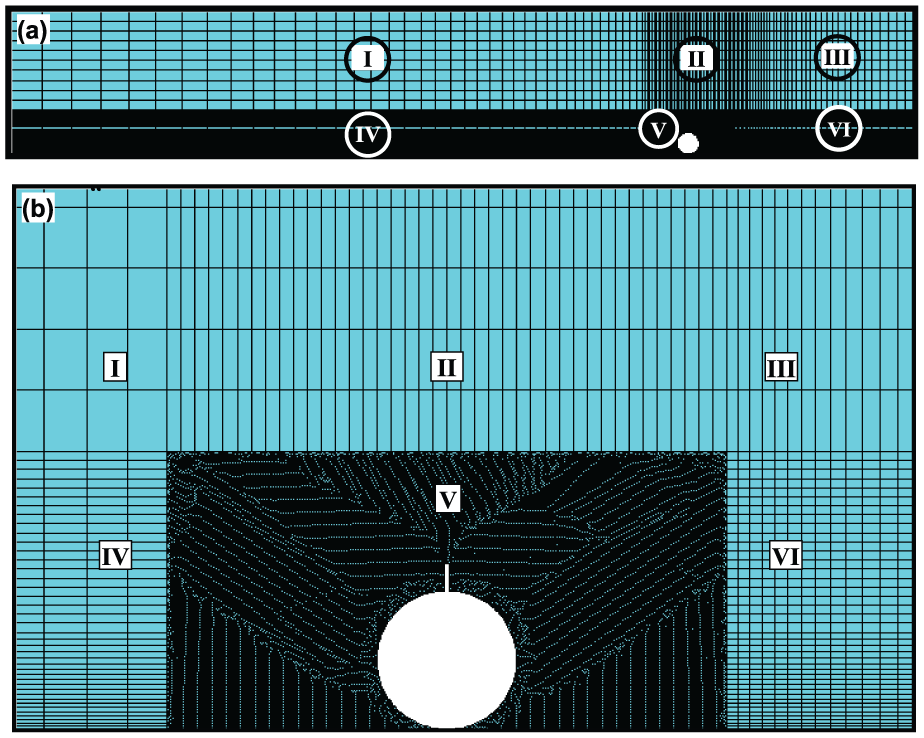
(a) The whole mesh system and (b) local mesh around the pipe.
The number of cells in subdomains, where the flow is unaffected or slightly affected by the presence of the cylinder, was 40 × 10, 40 × 10, 40 × 10, 40 × 40, and 40 × 40 for subdomains I, II, III, IV, and VI, respectively. The shape of elements used for these subdomains was rectangular. The meshes in subdomains I, III, IV, and VI were compressed in x direction toward the cylinder. Furthermore, compressed meshes were also used for subdomains IV and VI in y direction near the channel bed, and uniform mesh structure was used in subdomain II. As seen in Figure 2, finer meshes were used in subdomain V, where the flow is affected by the cylinder. Uniform triangular elements were used in this subdomain to prevent the amorphous structured elements near the cylinder due to the circular shape of the cylinder. Five different meshes were used to investigate the effect of mesh density on computational results by changing the density of mesh in subdomain V. The size of the elements in subdomain V was 4, 3, 2, 1, and 0.5 mm for Mesh 1, Mesh 2, Mesh 3, Mesh 4, and Mesh 5, respectively.
Near-wall treatment
The wall function and two-layer approaches were developed for modeling the nearby wall region. The processing time and the storage requirements for the solution of the problem can be significantly reduced using the wall function. Because in this approach, the first grid point near the wall is located outside the viscous sublayer for which the calculations of quantities are not required. The quantities at this first grid point are related to friction velocity based on the assumption of logarithmic velocity distribution. However, the use of wall functions in separated flows is questionable. 40
In two-layer approach, extremely fine grids are needed to resolve the viscous sublayer and the buffer layer. The first cell near the wall should be adjusted in the viscous sublayer where the linear viscous relations take place between the dimensionless velocity u+ = u/u* and dimensionless distance y+ = u*y/ν, where u* (= (τ0/ρ)1/2) is friction velocity at the nearest wall, τ0 is boundary stress, y is the distance from the wall, and ν is the kinematic viscosity of the fluid. Past observations30,35,41 indicated that the value of the non-dimensional distance from the wall dominated by viscous shear is varied about y+=20–40. Akoz et al. 35 limited the viscosity-affected region using the value of y+=30 as a criterion to evaluate the adequacy of the mesh size nearby the bed with no-slip condition. On this basis, the size of the wall of an adjacent cell was adjusted for the two-layer model. The values of y+ for the different meshes used in this study are given in Table 1. As can be seen from Table 1 that Meshes 3, 4, and 5 are found to be adequate since the values of y+ remain below 30 as suggested by previous researchers.30,35,41
Values of y+ (u*y/u) for different computational mesh sizes.

Two-layer approaches with the mixing-length modification scheme of Van Driest
42
is used with no-slip boundary condition in the study. Van Driest
42
modified the mixing length,

In equation (5), κ is the von Kármán constant (κ = 0.4) and A is constant (A = 26).
Mesh independence was achieved by comparing the velocity distributions of numerical and experimental results at (N = 8) points on a line located equally spaced at the gap between the bed and pipe for G = 10 mm. Also, the turbulence closure models are compared using the root mean square error (RMSE) criterion which is given in Table 2. RMSE is defined as follows

Mean square error statistics for different turbulence closure models on different computational meshes.

SST: shear stress transport.
In equation (6), N is the total number of data and
Numerical results
As with the results of Akoz et al., 35 the flow fields around the cylinder computed by k–ω and SST turbulence closure models are found to be similar to each other. Therefore, in sections “Streamlines” and “Velocity distribution in the gap,” the computational time–averaged velocity fields obtained using only the k–ω and the k–ε turbulence models on Mesh 4 are given and compared with the experimental results of Öner. 28
Streamlines
Figure 3 shows a comparison between the streamline patterns of a flow around a cylinder with and without spoiler at Re D = 9500 for different gap ratios obtained by particle image velocimetry (PIV) technique, reported by Öner. 28 As can be seen from Figure 3, attaching a spoiler on a pipe caused the stagnation point to move upward due to the increase in size of the upstream separation region. In addition, the extension of separation zones at the upstream and downstream side of the cylinder will augment the concentration of the vorticity, thus speeding up the scouring process. 28
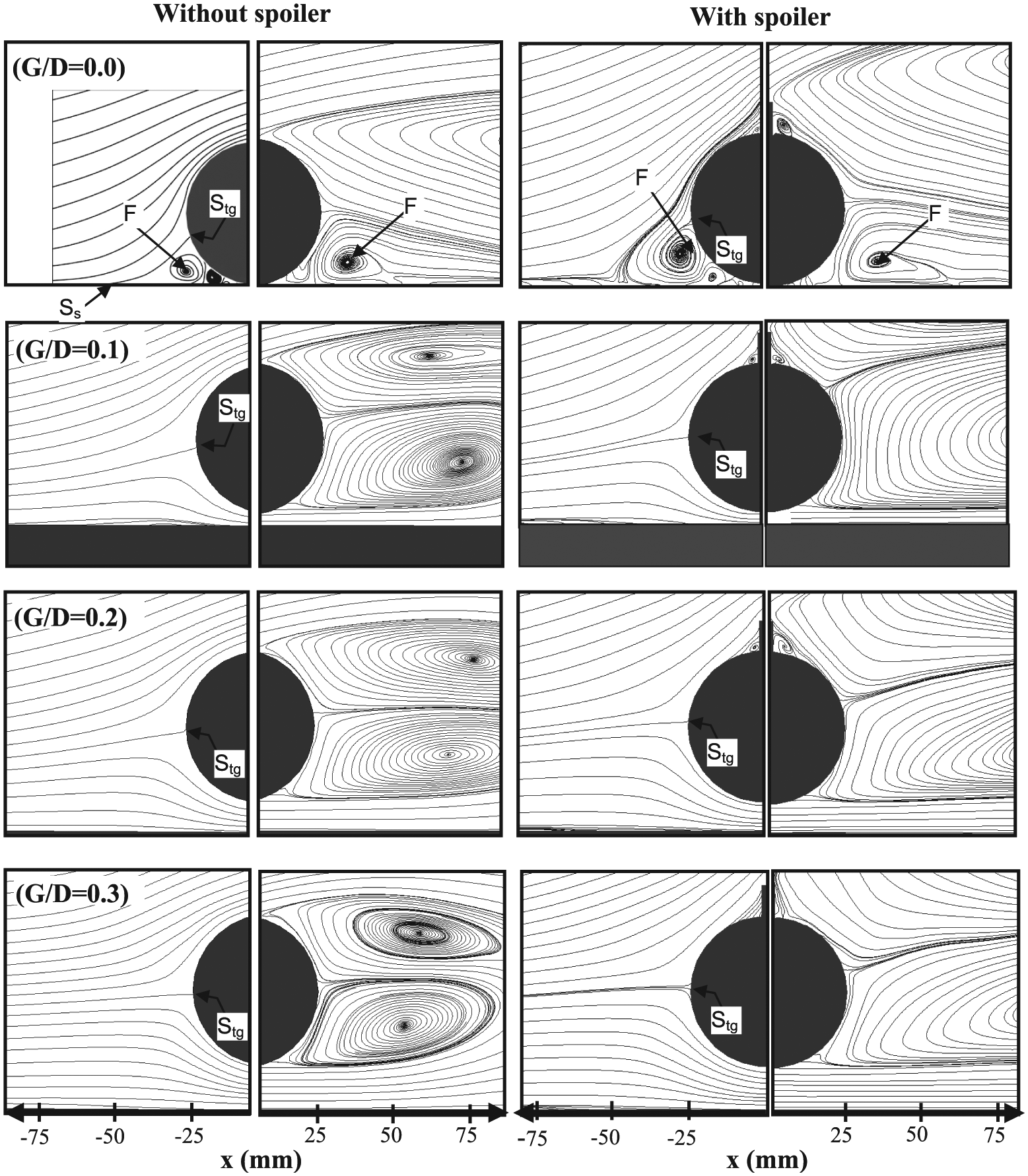
As can be seen from the streamlines given in Figure 3, there is a primary separation zone adjoining the pipe at the upstream side of the cylinder and a large separation zone with a secondary region between the pipe and bed for G/D = 0.0 with and without spoiler. It can be observed from Figure 3 that the presence of a spoiler increases the size of the separation zones. In addition, for a pipe lying on the bed, the initial point of separation zone, Ss; upward and downward faces of the cylinder; and a well-defined focus points, F, can be clearly seen from the experimental results given in Figure 3. Unfortunately, the focus points of the wake cannot be seen from the measured flow area for G/D = 0.0. In Figure 3, for G/D = 0.1, the upstream separation zone tends to disappear, regardless of the presence of spoiler. For G/D = 0.2, there is no upstream separation zone for the cylinder without spoiler. On the other hand, the separation region reserves its existence at the upstream side of the cylinder with spoiler. Similar observation can be made for G/D = 0.3 from Figure 3.
Figure 4 shows the simulated time–averaged streamline patterns of flow around a pipe without and with spoiler that is mounted on the bed (G/D = 0.0) using k–ε and k–ω turbulence models for Re D = 9500. It can be seen from Figure 4 that for a pipe without a spoiler, there is a primary separation zone at the upstream side of the pipe, and on the downstream side, there is a large separation region with a secondary separation zone adjoining the pipe. Also, in Figure 4, agreeable with the experimental results given in Figure 3, when the spoiler was attached on top of the pipe the size of the separation zones increases. This expansion of the separation regions moved the stagnation point to an upward direction. It can be observed from Figure 4 that the simulated initial point of separation zone, Ss, and the focus points of the separation areas agree quite well with the measured flow results reported by Öner. 28 It can also be observed from Figure 4 that the separation zones, both at the upstream and downstream sides of the cylinder, obtained by k–ε are relatively smaller in size than those predicted by k–ω.

Computational time–averaged streamlines of flow around a cylinder without and with spoiler using: (a) k–ε and (b) k–ω turbulence models at G/D = 0.0.
The simulated time–averaged streamline patterns of flow around a pipe without and with spoiler at G/D = 0.1 are presented in Figure 5. It is clearly seen from Figure 5 that a saddle point (Sp) and focus points of the wake occur at the downstream of the pipeline. Moreover, it is also observed that the boundary layer separates from the wall on the downstream side of the cylinder and forms a separation zone with a clear focus point. Figure 5 shows that the upstream separation region tends to disappear, except for the pipe with spoiler computed by k–ω turbulence closure model. It is observed from Figure 5 that the sizes of the separation zones obtained by k–ε turbulence model get smaller similar to Figure 4.

Computational time–averaged streamlines of flow around a cylinder without and with spoiler using: (a) k–ε and (b) k–ω turbulence models at G/D = 0.1.
The computed time–averaged streamline patterns of flow area for G/D = 0.2 are presented in Figure 6. For this gap ratio, the flow area resembles the flow around an isolated pipe without a spoiler case. However, when the spoiler is mounted on the cylinder, the upstream separation region and the wall boundary separation at the downstream side of the cylinder occur and the computed sizes of the separation regions obtained by k–ε model gets smaller, similar to observation made from Figures 4 and 5.

Computational time–averaged streamlines of flow around a cylinder without and with spoiler using: (a) k–ε and (b) k–ω turbulence models at G/D = 0.2.
The time-averaged streamline patterns of the computed flow area for G/D = 0.3 is given in Figure 7. Figure 7 shows that the effect of wall boundary on the flow around the cylinder decreases as the gap increases, and the flow area around the pipe without spoiler looks like to an isolated pipeline for this gap ratio. No separation region occurs on the bed neither on the upstream nor on the downstream of the pipe. Figures 4–7 show that agreeable with the experimental results, attaching a spoiler on a pipe increases the size of the upstream separation zone and this caused the stagnation point to move to an upward position. It is obvious that the movement of the stagnation point angle due to the presence of the spoiler caused a change in the drag and the lift forces.

Computational time–averaged streamlines of flow around a cylinder without and with spoiler using: (a) k–ε and (b) k–ω turbulence models at G/D = 0.3.
Velocity distribution in the gap
The comparison of time-averaged computed and measured horizontal and vertical velocity distributions at different locations of gap flow for a pipe with spoiler is shown in Figure 8.
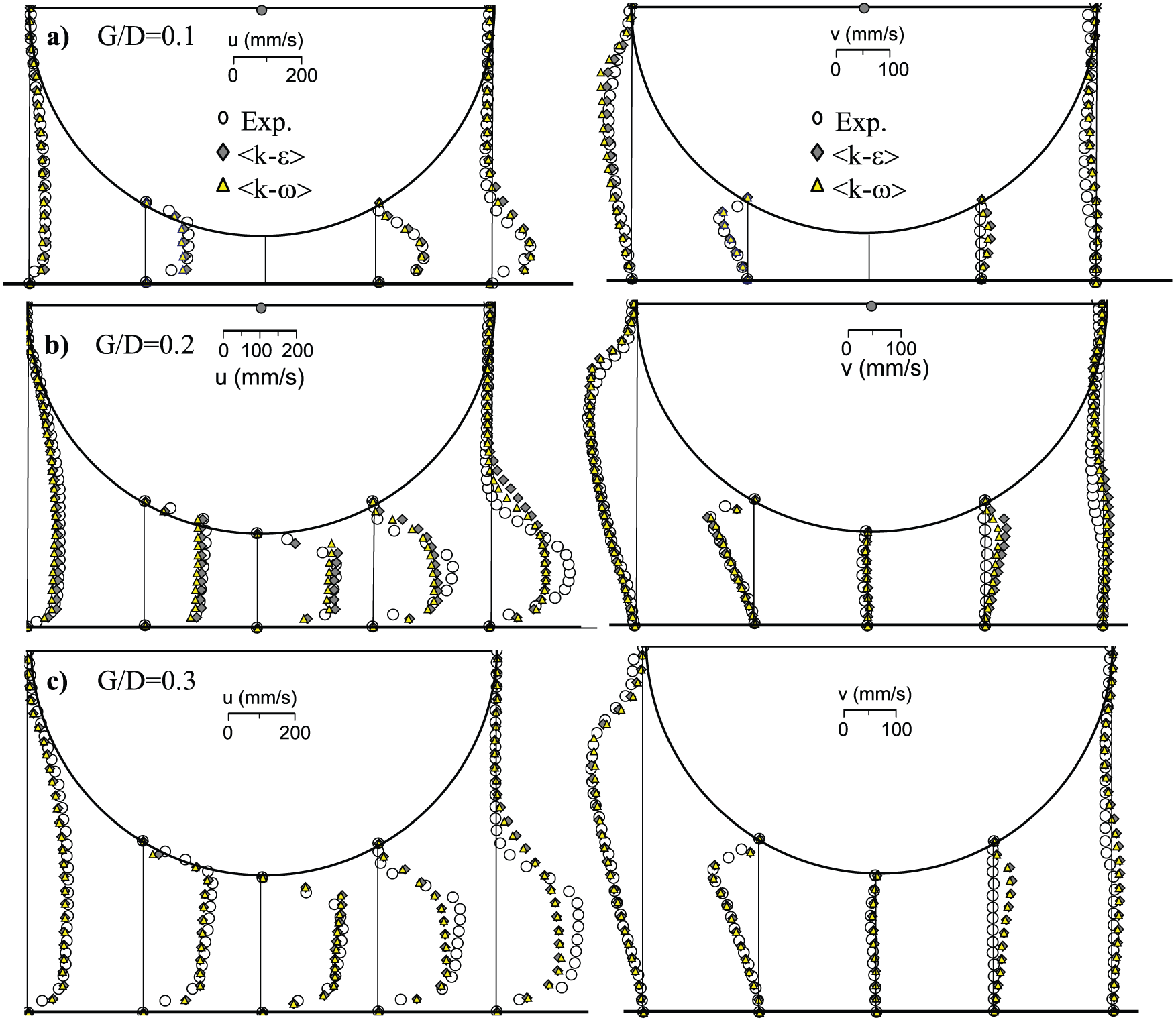
Horizontal and vertical velocity distributions of computed and measured flow at different locations of gap: (a) G/D = 0.1, (b) G/D = 0.2 and (c) G/D = 0.3, with spoiler.
Figure 8 shows that the general computed horizontal and vertical velocity distributions of the gap flow looked similar to measured velocity distributions. However, it seems that numerical velocity distributions obtained by k–ω turbulence model provide slightly better predictions than k–ε model.
Force coefficients
The comparisons of computed and measured results confirm that the computations using the k–ω turbulence model on Mesh 4 predict the flow around a pipe with and without spoiler well. Therefore, in this section, the drag and lift coefficients for the force on the pipe with and without spoiler computed using k–ω on Mesh 4 is presented and compared with the experimental results of Cheng and Chew 27 and Choi and Lee. 3 The drag and lift coefficients CD and CL are given as follows


The drag and lift forces (FD and FL per unit length on the cylinder) in equations (7) and (8) were calculated as follows


In equations (9) and (10), p is the pressure, τ0 is the shear stress on the cylinder surface, and θ is the angle of the axis of the cylinder in clockwise direction.
Zdravkovich 2 and Lei et al. 8 reported that in artificial thick boundary layers, there was a negative downward lift force acting on the pipe. Also, it is known that attaching a spoiler on the top of a pipe causes the force coefficient of drag force to increase and lift force coefficient to decrease.24,27,43 The decrease in the lift coefficient caused a downward force. Bijker 43 reported that this reversed hydrodynamic lift force pushes and pulls the pipe downward. Thus, the downward lift force caused by the presence of the spoiler on top of the pipe seems to be one of the most important parameters of the self-burial process.
Figure 9 presents the change in computed drag coefficients with G/D for a pipe with and without spoiler. Figure 9 shows that in contrast to indications of Cheng and Chew 27 that the addition of the spoiler increases the drag coefficient, CD, significantly for all gap ratios considered in their study, the value of the drag coefficient is found to be smaller for G/D = 0.0, and it is almost equal to the value obtained without a spoiler case for G/D = 0.1 in this study. However, a close observation from Figure 9 shows that the addition of a spoiler on top of a pipe increases the drag coefficient on pipe similar to observations made in the past2,24,27,43 for G/D > 0.1. The simulated results given in Figure 9 show that the general trend in increasing the drag coefficient of the pipe is found to be similar to the past studies.2,24,27,43 However, the values of the drag coefficients with and without spoiler cases obtained in this study were found to be smaller than those of the past observations.2,24,27,43 Different results about drag coefficient can be found in the literature particularly for pipes without spoiler. For instance, Cheng and Chew 27 reported that their numerical predictions overestimated the drag coefficient for a single pipe case. They claimed that three-dimensional (3D) effect was the main reason for the difference between experimental and numerical results as it was explained by Lei. 44 Lei 44 reported that the value of predicted drag coefficient by a 3D model was about 1.1, while the 2D model gave 1.45. The reasons for the differences between results obtained for the drag coefficient in the literature may be various; these are flow conditions, experimental or numerical methods, diameter of the pipe, gap ratio (G/D), and so on.

Figure 10 shows the computed lift coefficients versus different gap ratios without spoiler case and the computed results obtained from this study compared with the observations of Cheng and Chew 27 and Choi and Lee. 3 It is seen from Figure 10 that the lift coefficient decreases as the gap ratio increases. This is mainly due to the effect of boundary layer and the separation areas occurred at upstream of the pipe that caused the stagnation point to move upward position and also the suppression of vortex shedding for small gap ratios. Figure 10 indicates favorable agreements between the results reported by Cheng and Chew, 27 Choi and Lee, 3 and computational results of this study. Kazeminezhad et al.’s 38 observations also confirmed the results of this study. Kazeminezhad et al. 38 obtained the lift coefficient for G/D = 0.0 as a value between 0.6 and 0.83. Kazeminezhad et al. 38 also reported that the CL was increased as the thickness of the boundary layer decreased, particularly for the smaller gap ratios.

Figure 11 illustrates the computed lift coefficients versus gap ratio and compares them with the results of Cheng and Chew 27 obtained for different spoiler lengths and Reynolds numbers. The present computed results are in good agreement with the observations of Cheng and Chew. 27 As can be seen from Figure 11, attachment of a spoiler on top of a pipe decreases the lift coefficient. Furthermore, CL has negative values in the presence of the spoiler, and this depicts a non-zero downward lift. Cheng and Chew 27 reported that the increase in the pressure between θ = 0° and 90° and the decrease in the pressure between θ = 90° and 180° are the main reasons for the non-zero downward lift acting on the pipe.

Comparisons of the computed lift coefficients between this study (Re D = 9500) and observations of Cheng and Chew 27 for different spoiler sizes and different Re numbers for gap ratio with spoiler case.
Conclusion
In this study, the flow around a near-bed pipeline with a spoiler has been simulated at Re = 9500. The Reynolds-averaged Navier–Stokes equations with k–ε, k–ω, and SST turbulence closure models have been employed to investigate the effect of spoiler on streamline patterns, on velocity distributions passing through the gap between the pipe and the bed, and on the force coefficients. The computed results were compared with experimental and numerical data given in the past.2,3,7,27–29 As a result, the following conclusions were made from the study:
The separation zones obtained by k–ε are relatively smaller in size compared to those predicted by means of the k–ω and the SST models. This can be explained by the fact that the k–ε turbulence closure model has difficulties to simulate accurately the flow area in the presence of adverse pressure gradient boundary layer flow, therefore it does not predict the onset of separation accurately. 34
Computational results of horizontal and vertical velocity distributions of the gap flow obtained using k–ω and k–ε turbulence models are found to be in agreement with the measured results. Besides, velocity distributions obtained by k–ω turbulence model provide slightly better prediction results than those of k–ε model.
The comparisons of the numerical and experimental results show that the k–ω turbulence closure model on the best mesh design predicts the flow around a pipe with and without spoiler well.
CL coefficient decreases as the gap increases for a pipe without spoiler. The present computations show that the values of CL are 0.63, 0.2442, 0.1801, and 0.1339 for a pipeline without spoiler at G/D = 0.0, 0.1, 0.2, and 0.3, respectively, whereas for a pipeline with a height of 0.2D spoiler the values are −0.018, −0.319, −0.53, and −0.788. The computations show that attaching a spoiler on the pipe caused CL to have negative values, which depicts a non-zero downward lift which forced the pipeline downward.
As a summary, based on the results obtained from this study, the self-burial process of the pipeline on the seabed can be explained as follows. When a spoiler is mounted on a pipe, more energetic vorticity regions are formed in both upstream and downstream sides of the pipe resulting in speeding up seepage transpiring on the seabed and thus increasing the intensity and amount of scours.
It is clear that this process stimulates the scouring mechanism and decreases the bearing capacity of the seabed, and then, the downward lift force pushes the pipeline into the seabed resulting in “self-burial” of the pipeline.
Footnotes
Academic Editor: Pietro Scandura
Declaration of conflicting interests
The author(s) declared no potential conflicts of interest with respect to the research, authorship, and/or publication of this article.
Funding
The author(s) disclosed receipt of the following financial support for the research, authorship, and/or publication of this article: This work was supported by the Scientific and Technological Research Council of Turkey through Project 107M641.