




Abstract
The mapping and projective method is extended to investigate a nonlinear (2 + 1)-dimensional coupled breaking system by introducing expansion and nonlinear transformation, and some exact propagating solutions with variable separation are constructed for the system. The propagating solitons are first observed by setting properly the arbitrary functions in the solutions. The different forms of multi-soliton evolution with Weierstrass p function could be achieved.
Introduction
In recent years, many researchers have studied solitons and other structures with chaotic evolvements in nonlinear equations via the variable separation method.1–7 Using linear variable separation and mapping method, Chen et al. 1 and some researchers have realized variable separation for some (3 + 1)-dimensional systems, such as Jimbo–Miwa system. Multiple soliton solution and chaotic behaviors of (2 + 1)-dimensional breaking soliton (BS) equation were introduced by Lei et al. 8 L-H Jiang et al. 9 have studied soliton solutions and its evolvements for the (3 + 1)-dimensional Burgers system. However, these so-called new solutions in the literature6,7,10–20 also depend on each other and the effective solution is identical to the universal formula, and the (2 + 1)-dimensional BS system is defined as follows

Equation (1) describes the cross interaction of wave propagating along the x-axis and y-axis. It seems to have been investigated extensively where overlapping solutions have been derived.
The mapping and variable separation method is extended to investigate a nonlinear (2 + 1)-dimensional coupled breaking system in this article. Some exact propagating solutions with variable separation are constructed for the system. By setting properly the arbitrary functions in the solutions, the propagating solitons are observed first and the different forms of multi-soliton evolution with Weierstrass p function are used. The shape of soliton changes with different parameters.
Projective mapping method principle
The nonlinear physical equation is defined as follows

The general solution of the following form is defined as

In which

Equation (4) has the general solution as follows

where
Coupled breaking system and its exact solution
Consider the following nonlinear coupled breaking system 8

where

where the alphabets


where
Substituting equation (7) and (8) into equation (6), The analytical solution of (2 + 1)-dimensional breaking equation could be got as follows8,19,20


And the potential function of equation (11) is achieved as follows 8


Soliton and its evolution
Dromion soliton
In the (2 + 1)-dimensional soliton systems, local area structure is bell-shaped dromion soliton, its characteristic is the soliton amplitude in the x-axis and y-axis according to the index law of diminishing as equation (13), and set

Choosing the parameters

Dromion soliton.
Multi-soliton
Define the Weierstrass p function as follows

When the parameter n = 10, its response is shown in Figure 2.

The response of Weierstrass p function.
And selecting the function

With the parameters

The
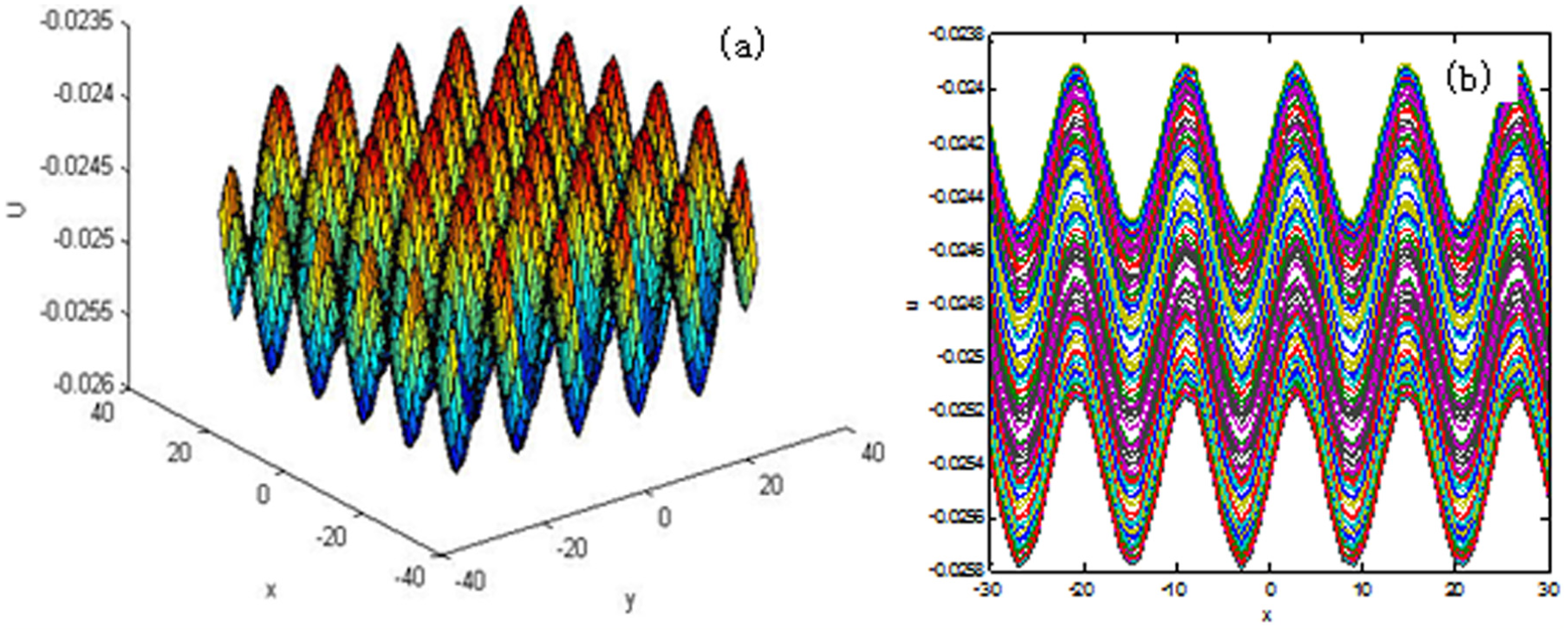
From Figures 3 and 4, it can be seen that the multi-solitons could be achieved by selecting the Weierstrass p function.
Conclusion
This article has described the mapping and variable separation method to investigate a nonlinear (2 + 1)-dimensional coupled breaking system. By setting properly the arbitrary functions in the solutions, the different forms of multi-soliton evolution with Weierstrass p function are obtained. The shape of soliton changes with different parameters, and the simulation results verify the flexibility of its operation. And the derived analytical expressions of its multi-soliton can be used in the development of fiber communication system. The potential application of multi-soliton will be of great interest in future research in consideration of its unique evolution characteristics.
Footnotes
Academic Editor: Mark J Jackson
Declaration of conflicting interests
The author(s) declared no potential conflicts of interest with respect to the research, authorship, and/or publication of this article.
Funding
The author(s) disclosed receipt of the following financial support for the research, authorship, and/or publication of this article: This work was supported by the National Natural Science Foundation of China under Grant 61471192, 61371169 and also funded by the priority Academic Program Development of Jiangsu Higher Education Institutions.