




Abstract
In this article, an ad hoc microsat constellation based on secondary launches is proposed to meet the demands for the constellation characteristics. Research on its structural design and characteristics is carried out. First, constellation characteristic indices are proposed, including the coverage characteristics, health stability, and aggregation degrees, in order to analyze the feasibility of ad hoc microsat constellations. Then, several characteristic indices of ad hoc microsat constellations are compared with those of the traditional constellation, “Walker.” Research results show that ad hoc micro satellite constellation based on secondary launching not only meets the requirements of the traditional constellations but also saves the launch costs, a feature which has important practical significance.
Introduction
Microsats are product of the development of aerospace science and technology. With new design concepts and modern design methods, a new generation of small satellites with high performance density has been developed. 1 Microsats have a number of advantages, including small size, light weight, low cost, short development cycle, high performance, and fast and flexible launch mode, and have shown unique advantages in the fields of communication, earth observation, and scientific exploration. 2 Microsats have become an increasingly viable scientific platform for the constellation elements of low-Earth orbit. 3
The concept of ad hoc constellation is proposed with respect to traditional satellite constellation.4,5 Traditional satellite constellation sends each satellite to a predetermined position by the carrier rocket. Thus, the launch of the traditional satellite constellation requires a dedicated launch vehicle—an expensive requirement. Ad hoc constellation deployment uses secondary payload launch opportunities instead of a dedicated launch vehicle and offers more launch opportunities. Each microsat acts as a secondary payload in reference to the hierarchy of orbit choice and launch vehicle requirements, which can minimize the cost to satellite launch and make the constellation deploying and updating highly flexible.
At present, the research on ad hoc microsat constellations focuses on the communication and storage capacity of the constellation to demonstrate its feasibility. The configuration of microsat constellation occurs mostly in the traditional stage, and the uncertainty of the satellite orbit based on microsat as a secondary payload is barely taken into account. In addition, although there have been several studies on ad hoc and reconfigurable constellations that take into account revisit and coverage parameters, the effect of ad hoc constellation performance after a long-term evolution for a particular area has not been considered fully. Aiming to address the aforementioned gaps in the research, this article further studies the structure design and performance analysis of the microsat constellation using secondary launch. Studying the performance index of microsat constellation system for a specific area, the system constitutes the feasibility for a specific area, coverage characteristic, revisit characteristic, the aggregation degree of constellation space, the stability, and long-term evolution performance of the constellation and other key technologies. Research on these techniques can enhance the realization of the constellation system, provide the reference for low-cost constellation layout in the future, and provide technical support for the development of a constellation system which can meet the needs of low cost, high speed, continuity, and availability.
This article first introduces the development status of microsat and the background of ad hoc constellation and compares the basic requirements of the traditional satellite constellation and ad hoc constellation. This article next introduces the secondary launches of microsat and shows the statistics of the small satellites, based on launches in China in 2014. Then, the performance measurement index for ad hoc microsat constellation is proposed, and the performance index of ad hoc microsat constellation for a specific area is proposed. In addition, this article compares the coverage characteristics between the traditional satellite constellation and the ad hoc microsat constellation. This article concludes with a summary of the methodology and results. According to the research and simulation analysis, the ad hoc microsat constellation can meet the requirements of the traditional constellation while also reducing launch costs. The research on ad hoc microsat constellation using secondary launch has important practical significance.
Traditional satellite constellation and the ad hoc microsat constellation
Traditional satellite constellation
One of the traditional regular constellations is rule circular orbit constellation, usually referred to as the Walker Delta Pattern constellation. This constellation has an associated notation to describe it, i: t/p/f, where i is the inclination, t is the total number of satellites, p is the number of equally spaced planes, and f is the relative spacing between satellites in adjacent planes. The change in true anomaly (in degrees) for equivalent satellites in neighboring planes is equal to
Walker constellation has two distinctive features: 7
Since the motion of each satellite is basically similar, each satellite is subject to the same perturbation, the mutual position of the satellite remains unchanged, and the overall shape of the constellation remains unchanged.
The satellite of the constellation uses nearly circular orbits, meaning that the angular velocity of satellite operation remains substantially constant, which is favorable for the global uniform coverage.
Therefore, Walker constellation is used widely in practical applications.
Ad hoc microsat constellation and Walker constellation
Table 1 shows a comparison of the launching requirements, launching cost, deployment requirements, satellite networking speed, maintenance requirements, and satellite ability requirements between traditional satellite constellation and ad hoc microsat constellation.
Comparison between traditional satellite constellation and ad hoc microsat constellation.

As Table 1 indicates, ad hoc constellation is less demanding and easier to implement in both launching and deployment requirements. The launch costs and maintenance costs are relatively low, the ad hoc constellation has a quick response time, and the capacity requirements of the satellite are relatively low. All of these qualities are more in line with current demands for the satellite constellation.
Ad hoc microsat constellation using secondary launches
Microsat launch of ad hoc constellation
Secondary launch refers to when a rocket carries other spacecraft, which launch using the remaining space, during the implementation of a satellite or other important spacecraft missions which complete the main task of the spacecraft (commonly known as primary payload). Since that remaining space is generally small, it is more suitable to be used for microsat launches. The secondary payload saves in transmission costs, but must adapt to the launch conditions and orbit of the primary payload. 8 Because the overall design of the microsats must adapt to the launch conditions of the primary payload and minimize the influence on the technical state of carrier, it is equipped with limited opportunities. When the performance density of a microsat increases and its volume becomes smaller, manufacturing costs of microsats are higher, and launching a microsat separately will result in a high cost. In order to make the process less expensive, most of the microsats use secondary launches.
A microsat constellation which uses secondary launch has an uneven distribution of the orbital plane, and the phase space of the satellite is not the same even within the same orbital plane. This ad hoc microsat constellation is highly dependent on launch opportunities. The deployment method of the ad hoc microsat constellation is different from the traditional constellation, in that it only utilizes the secondary payload launch opportunities—that is, the primary payload determines the specific parameters of each orbit. Therefore, in order to explore the feasibility of constituting ad hoc microsat constellation, satellite launch opportunities must be considered first.
Chinese microsat launch opportunities and carrying analysis
This article analyzes the feasibility of constituting ad hoc microsat constellation. The microsat missions used as case studies here are constrained to Chinese launch vehicles from 2014. Table 2 shows statistics for these launches. Since ad hoc microsat constellation using secondary launches is highly dependent on launch opportunities, the primary payload determines the orbit of each microsat. Further analysis is needed in order to determine the basic constellation parameters. With the increase in the investment in astronautics fields all over the world, the frequency of secondary launch opportunities is expected to increase in future years.
Secondary-launched satellites in China in 2014.

In view of the hybrid orbital characteristics of the ad hoc microsat constellation, statistics for the actual orbit situations of China’s secondary payload launches in 2014 provide context to establish the traditional orbital elements of microsats. The orbit parameters of China’s microsats as secondary payloads are shown in Table 3.
Orbit parameters of secondary-launched satellites in China in 2014.

The satellite orbital distribution is shown in Figure 1.
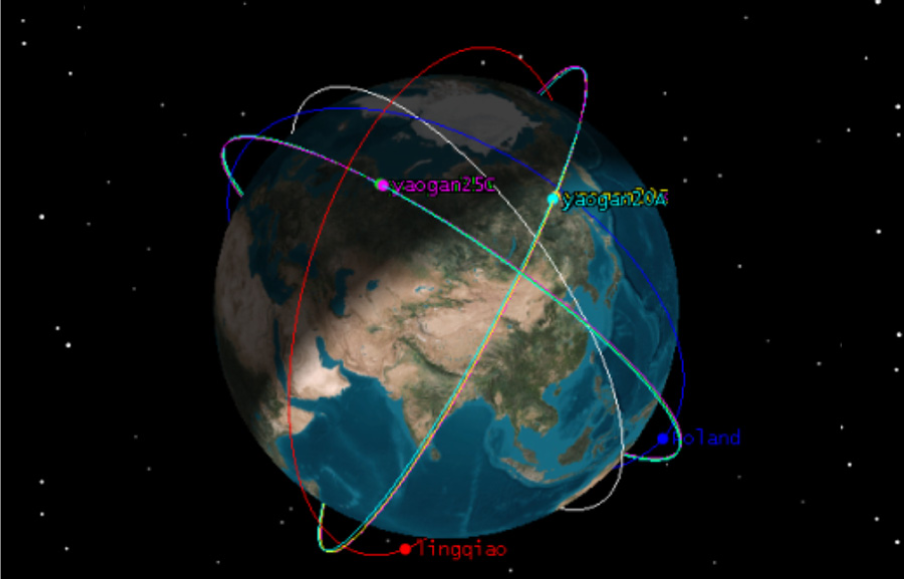
China satellite orbital distribution in 2014.
As we can see from the above statistics, Chinese satellites carried a total of nine microsats as secondary payload in 2014, roughly distributed on four tracks. The orbital plane is an irregular distribution, which can be composed of the satellite constellation. Nine microsats had an orbit altitude in the range of 450–1100 km and an inclination between 63° and −99°, meaning that they are low-Earth orbiting satellites (LEOs). These microsats can cover different locations at different times with varying degrees, including both the North and South poles. With six of them distributed on two orbits, three microsats on each orbit are very similar in their tracks, offering mutual backup for each satellite.
Performance index for ad hoc microsat constellation
Satellite constellation design should aim at covering the designated areas with a minimal number of satellites and take the coverage index into consideration, including revisit time. Traditionally, when designing constellations, satellites with similar types and functions are distributed on similar or complementary orbits and accomplish the assigned task under a sharing control. 9 For ad hoc constellation, because of the uncertainty of the orbit and the uneven distribution of the satellite in the constellation, the degree of aggregation of the constellation space must be considered. In addition, the indicator should also be designed to measure whether the operation of the constellation is healthy and stable for the study of constellations.
Constellation coverage
First, we studied the coverage performance of constellations and chose a certain area as the target. Then, we calculated the coverage parameters of satellite constellation for the area points. 10 The underlying assumption for the constellation coverage requirements in this article is that the view type of the microsat sensor is simple conic, and the cone half angle of the simple conic is 90°.
Coverage time: The coverage time metric provides the time in which a constellation covers an area within the given zone. It shows the residence time in which the constellation is over and near the given area. We computed coverage time percent, which indicates a percentage of the cumulative time zone covered by the total time in the statistic. The coverage time percent can be used as a basis upon which to judge the satellite constellation’s effective coverage of the target area.
Revisit time: The revisit time metric provides the time interval in which a region does not have coverage. There are several metrics involved; the option selected here determines the metric based on the maximum revisit time in this article. This option computes the maximum revisit time of all gaps in a certain time. A constellation’s ideal value for revisit time is zero, as this value would indicate that no coverage gaps exist and there is an area of continuous coverage.
Response time: The response time metric provides the time interval from when the receiver receives the random request to observe the target to the beginning of observation. We chose to use average response time, which involves computing the average response time of each satellite. The average response time is the average of the regional network points’ average time.
The aggregation degree of constellation
The traditional Walker constellation is equally distributed in space. When each Walker constellation parameter is certain, the number of orbits, the number of satellites in each orbit, and the relative spacing between satellites in adjacent planes are all certain, and the degree of aggregation of the overall constellation in the space is not affected by time. The clustering of constellations in space can be derived by t/p/f. When studying the performance indicators of traditional constellations, one can ignore the satellite aggregation degree in the space and only take the coverage index into account. Because of the special nature of ad hoc microsat constellation using secondary launches, however, the microsats cannot select their own orbits. Some of the satellites may be too densely constellated at a certain time and too sparse at another. When the aggregation degree of one constellation is similar to that of another, as shown in Figure 2, the question becomes how to compare the degree of aggregation between them.
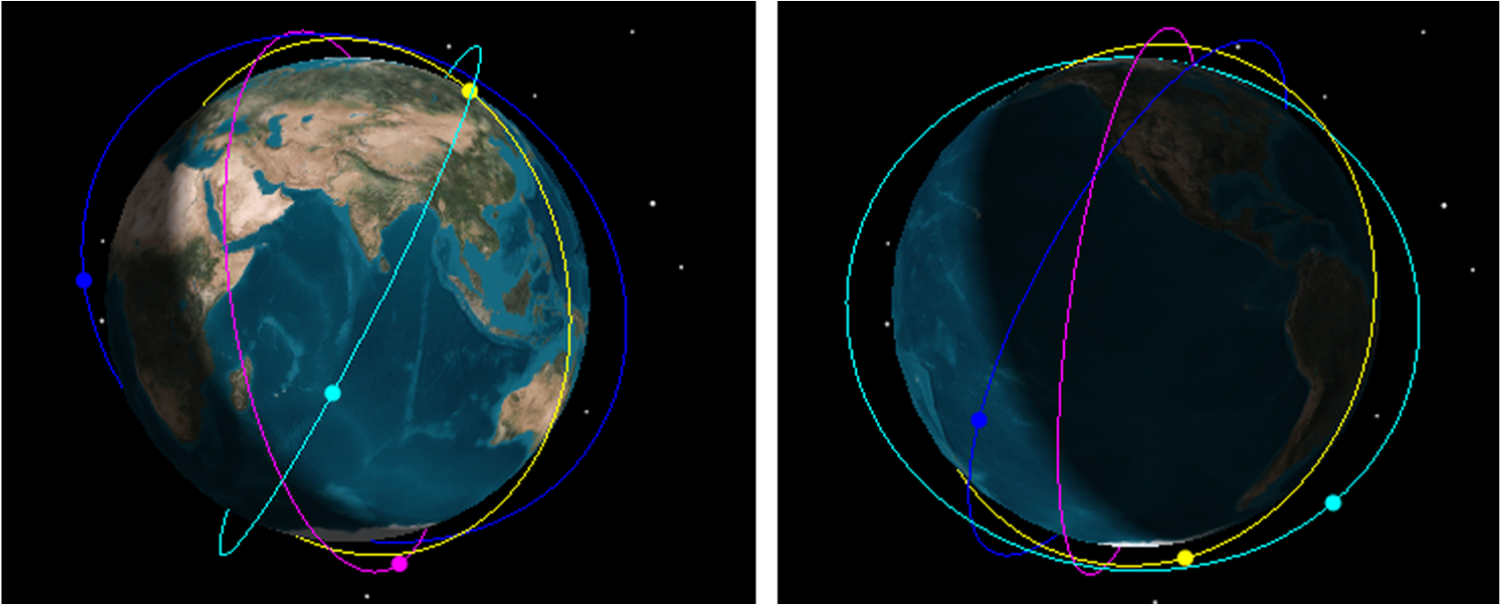
Two cases of different space distribution.
This uncertainty of constellation spatial configuration caused by satellite orbit uncertainty needs to be measured by a specific index, which is defined as aggregation degree. At present, most of the studies on the aggregation index are the research of spatial objects, but few of them specifically focus on ad hoc constellation. This section highlights studies from the existing spatial aggregation index, extends them to researching ad hoc constellation, and discusses, selects, and improves the index.
Traditional spatial aggregation method
In 1990s, Li Tiansheng and Zhou Guofa proposed an aggregation index algorithm based on distance, which takes full account of the individual distance in the space and their correlation. Their method can also accurately reflect the distribution patterns of individuals in space. 11 In recent years, the research on the aggregation degree of the regional spatial entities distribution has been calculated by the proximity distance, 12 which is simple and convenient. Based on the proximity distance aggregation degree formula, X Geng et al. 12 improved the index using a map algebra distance transformation in 2006.
Although these methods are able to describe the degree of aggregation of spatial point sets, they are all based on perspective of statistics. This approach is suitable for many spatial point and dense spatial point sets, such as insects in a certain area or buildings in a certain space, and is not suitable for measuring the aggregation degree of ad hoc constellation in space. In order to research the aggregation degree of ad hoc constellation, a new method must be considered.
Aggregation degree of constellation
In March 2013, GG Zohar 5 proposed a calculation method of the aggregation degree index using a satellite separation angle for the constellation which had same orbital plane of the satellite. Aggregation degree J is given by the following formula

where N is the number of satellites,

The formula is simple in calculation and clear to understand. Aggregation degree is defined between 0 and 1. Satellites at maximum separation result in a metric value of 0, and those with no separation result in 1. Comparing the constellation in the degree of aggregation becomes clearer through this calculation of the index. The formula also conforms to the requirements of ad hoc constellation for the degree of aggregation index. For the ad hoc constellation, one goal is to achieve and maintain a minimal degree of aggregation.
In-depth study of the constellation aggregation index shows that the above formula (1) has a clear deficiency, however. Formula (1) is defined based on true anomaly separation of the satellite from the same orbital plane. Such a definition is only applicable to the same orbital plane and is not relevant for different orbit planes of the satellite constellation. In addition, taking this definition into consideration, when satellites are at no separation as the satellite is gathered at one point will result in a metric value of 1. The research process found that when the number of satellites is equal to or greater than 5, the aggregation degree index value is more than 1 in the conditions of
For the sake of argument, assume that an ad hoc constellation is composed of five satellites in the same orbit plane, including four satellites gathered at a point, and that the true anomaly separation between them and the fifth is 180°. Then, through formula (1)

In this case, the aggregation degree is greater than all the satellites gathered to a point.
Taking a mathematical geometry approach in this discussion, it is not difficult to find the applicable conditions for the formula:
The algorithm for calculating the constellation aggregation degree is therefore simple and easy to understand, but its application range is very narrow. It is only suitable for constellations in the same orbital plane and those in which the number of satellites number in the constellation is less than or equal to four. These limitations mean that the algorithm falls far short of meeting the requirements of aerospace applications, which need further improvements of the aggregation degree index.
The improvement of constellation aggregation degree
Based on the above analysis, we defined the concentration aggregation degree index as J, improving the algorithm of the aggregation degree index as follows

where n is the number of satellites,

With this formula, the aggregation degree measures whether satellites in the constellation are evenly distributed. Aggregation degree is defined between 0 and 1, in which satellites at maximum separation will result in a metric value of 0 and maximum gather will result in 1. Measuring latitude and longitude instead of anomaly separation of the moving satellites can extend the one-dimensional plane to the two-dimensional space, so that the satellites in different orbital planes of constellation can be considered using the same indicators, broadening the application range of the constellation aggregation degree index.
However, considering the mathematical nature of formula (4), the mathematical principle is the same as that which underlies formula (1). Since the scope of application for formula (1) is
In order to make the application of the index more extensive, when

The satellite groups.
We calculated the average value of the aggregation degree of each group as a whole aggregation degree of N satellites’ constellation. The averaged aggregation metric has the same trends as the one presented in earlier sections, but after the modification, it can calculate the constellation aggregation degree of any number of satellites (include N > 5) and can be used to measure the spatial deployment of ad hoc microsat constellation.
Using this definition, the aggregation degree is a “point in time” metric, but it is often needed to investigate the nature of a period for the constellation while in the process of spacecraft operation. To solve this problem, we use the concept of consistency of aggregation degree as an interval-based metric to measure the time interval of the constellation aggregation level as follows.
Consistency of aggregation degree: “Consistency of aggregation degree” tracks the aggregation degree of the constellation over time. The concept shows the development of deployment satellites of constellation in space as time goes by. It is not a quantitative index, but rather a concept of investigation. The consistency is considered to be good when the aggregation degree of the constellation has a high concentration as time passes.
Health stability index of constellation
In addition to these two types of indicators, emergency situations and constellation satellite fading should be investigated. Constellation satellite orbit will change over time, and these changes may even cause failure or malfunction. When there is a microsat or a few microsats fading or in a state of failure, the coverage of the ground will be changed immediately. The health stability index of constellation is used to compare the coverage between the entire constellation and a few satellites of constellation that are in failure. The index is defined between 0 and 1, where complete failure of satellites leading to non-coverage will result in a metric value of 0, and the coverage status of the entire constellation that remains unchanged when a few satellites fail will result in 1. A constellation’s health stability index is defined using

where n is the number of failed satellites of the constellation,
Characteristic analyses of ad hoc satellite constellation
In order to accomplish the planned task, the satellite constellation must maintain its geometrical configuration within a certain range of accuracy. 13 However, the satellite’s position can deviate from its originally designed orbit due to the influences of various perturbation factors. Thus, the relative phases between satellites are deviated, affecting the characteristics of the whole constellation. 14 In this section, a satellite J4 perturbation model in STK is selected to analyze the characteristics of a constellation. In this model, perturbation factors contain nonspherical perturbation, the sun-moon three-body gravitational perturbation, solar radiation pressure perturbation, and atmospheric drag perturbation. 15
We built two groups of satellite constellations using China’s secondary-launched micro satellites in 2014 and analyzed their characteristics. Among these nine microsats, Yao Gan 20A, 20B, and 20C remain in the same orbital plane; Yao Gan 25A, 25B, and 25C also stay in the same orbital plane; the orbital plane of the Tian Tuo small satellite nearly coincides with that of the Poland small satellite; and Ling Qiao stays in an individual orbit plane. First, we chose one satellite from each orbital plane to build Constellation 1: Yao Gan 20A, Tian Tuo, Ling Qiao, and Yao Gan 25A. Then, we used all these nine satellites to build Constellation 2. There were, therefore, more satellites in one orbital plane in Constellation 2 than in Constellation 1. The orbit parameters of two constellations are shown in Table 4.This section will analyze the characteristics of these two constellations and compare them with traditional constellations to prove their feasibility.
Orbit parameters of Constellation 1 and Constellation 2.

Analysis of coverage characteristics
We selected Location A, as the coverage area and compared the coverage indices of ad hoc satellite constellations with that of a single satellite. The main coverage indices considered were maximum revisit time, average response time, and coverage time percent, all of which are shown in Table 5.
Coverage parameters of microsat constellation.

Compared with a single satellite, constellations consisting of satellites from different orbital planes have much shorter maximum revisit times, shorter average response time, and longer coverage time over specified area. In addition, with the increase in the number of satellites in the same orbital plane, the maximum revisit time and average response time are reduced, but the coverage time accordingly increases.
Analysis of constellation aggregation degree index
Aggregation degree
The latitudes and longitudes of nine satellites at 04:00 am on 30 March 2015 are shown in Table 6.
Location of satellites at specific time.
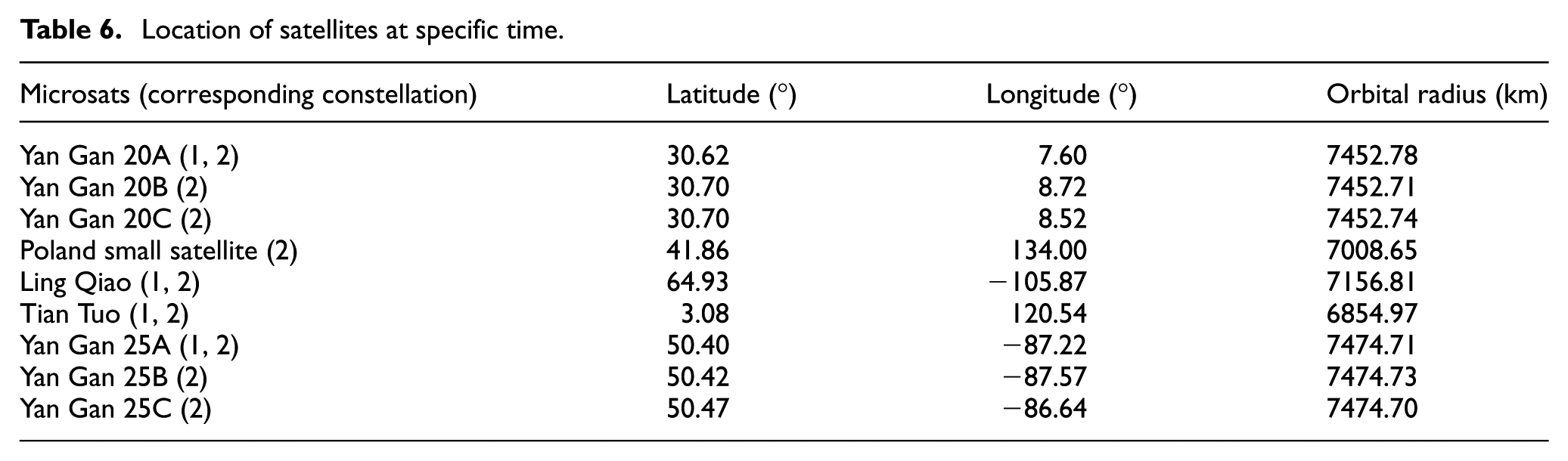
Using the method of the improvement of constellation aggregation degree mentioned in section “The improvement of constellation aggregation degree,” we calculated the aggregation degrees of Constellation 1 and Constellation 2 at this time:
Consistency of aggregation degree
Similarly, as in section “Aggregation degree,” we calculated the aggregation degrees of Constellation 1 and Constellation 2 at 04:00 am each day from 30 March 2015 to 30 April 2015 and then draw a comparison figure. The changes of the aggregation degree indices of Constellation 1 and 2 in the 32 days are plotted in Figure 4.

Changes of aggregation degrees of Constellation 1 and Constellation 2.
Figure 4 shows that the aggregation degree of Constellation 1 has relatively larger fluctuations and lower consistency. This means that four satellites in Constellation 1 can be either more gathered or more dispersed. Constellation 2 has higher consistency of aggregation degree than Constellation 1, and most of the time, it is more intensive. The space structure of Constellation 2 is relatively more stable.
Health stability index of constellation
According to the definition in section “Health stability index of constellation,” we calculated the value

The health stability of Constellation 2 is higher than that of Constellation 1, so the characteristic of Constellation 2 is not easily affected by a single satellite failure.
Long-term characteristics of attenuation analysis
The deviation from actual to nominal orbit can become larger and larger due to the influence of atmospheric drag on satellites. The characteristics of the whole constellation will be attenuated to this deviation, so the long-term characteristics of the attenuation of the constellation need to be analyzed during its survival time.
The service life of the secondary-launched microsats in China in 2014 is about 3–5 years under the circumstances that the satellite atmospheric drag coefficient is Cd = 2.2 and the atmospheric density model is assumed as Jacchia Reference Atmosphere. First, we calculated the long-term changes to revisit parameters and response parameters of Constellation 1 from 30 March 2015 to 30 March 2018, and the results are shown in Figures 5 and 6. We then selected two time periods, from 04:00 am at 29 September 2015 to 4:00 am at 30 September 2015, and from 4:00 am at 30 March 2018 to 04:00 am at 31 March 2018, in which to observe the long-term coverage percent changes of Constellation 1, which are represented with Figures 7 and 8.
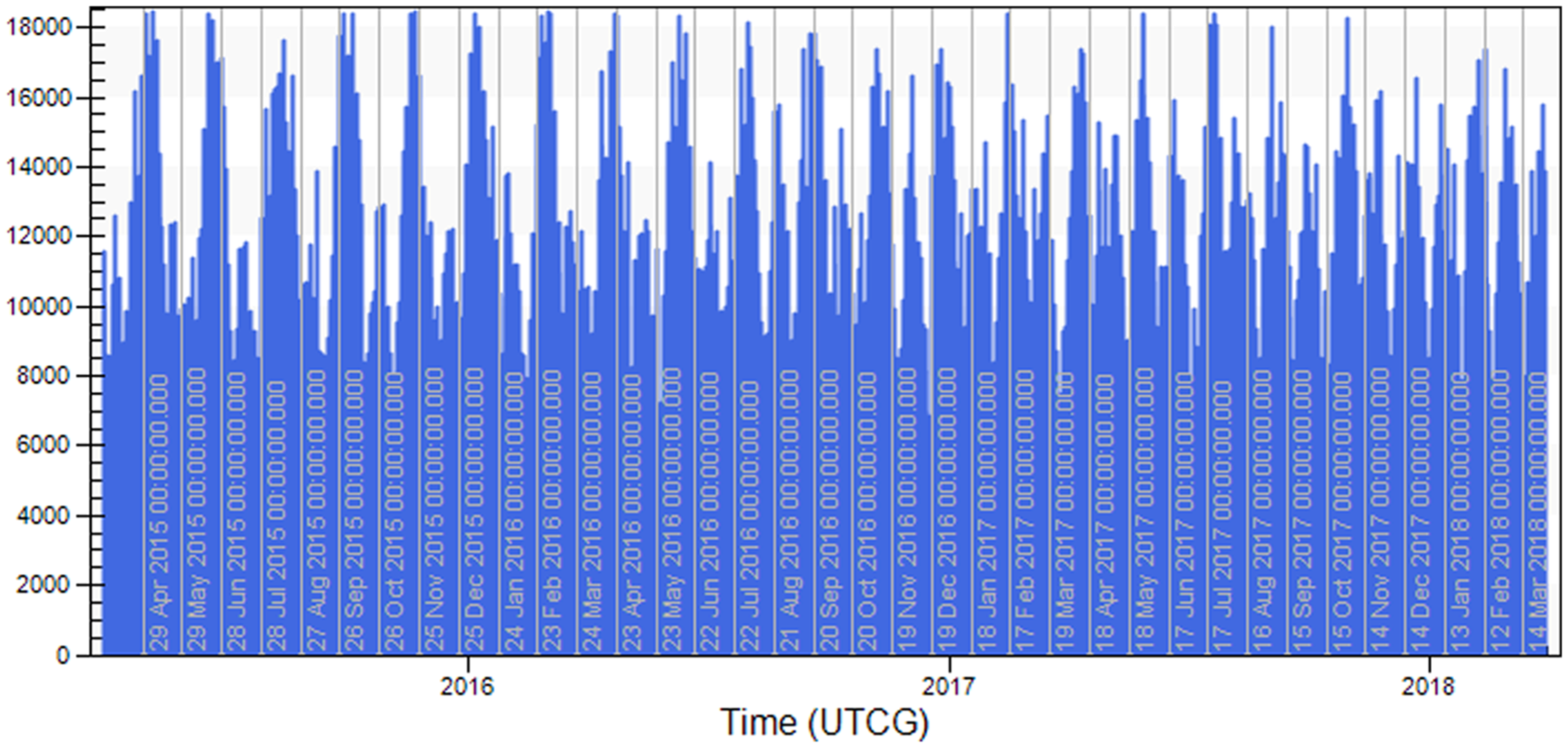
Changes of revisit parameters of Constellation 1 during 3 years.
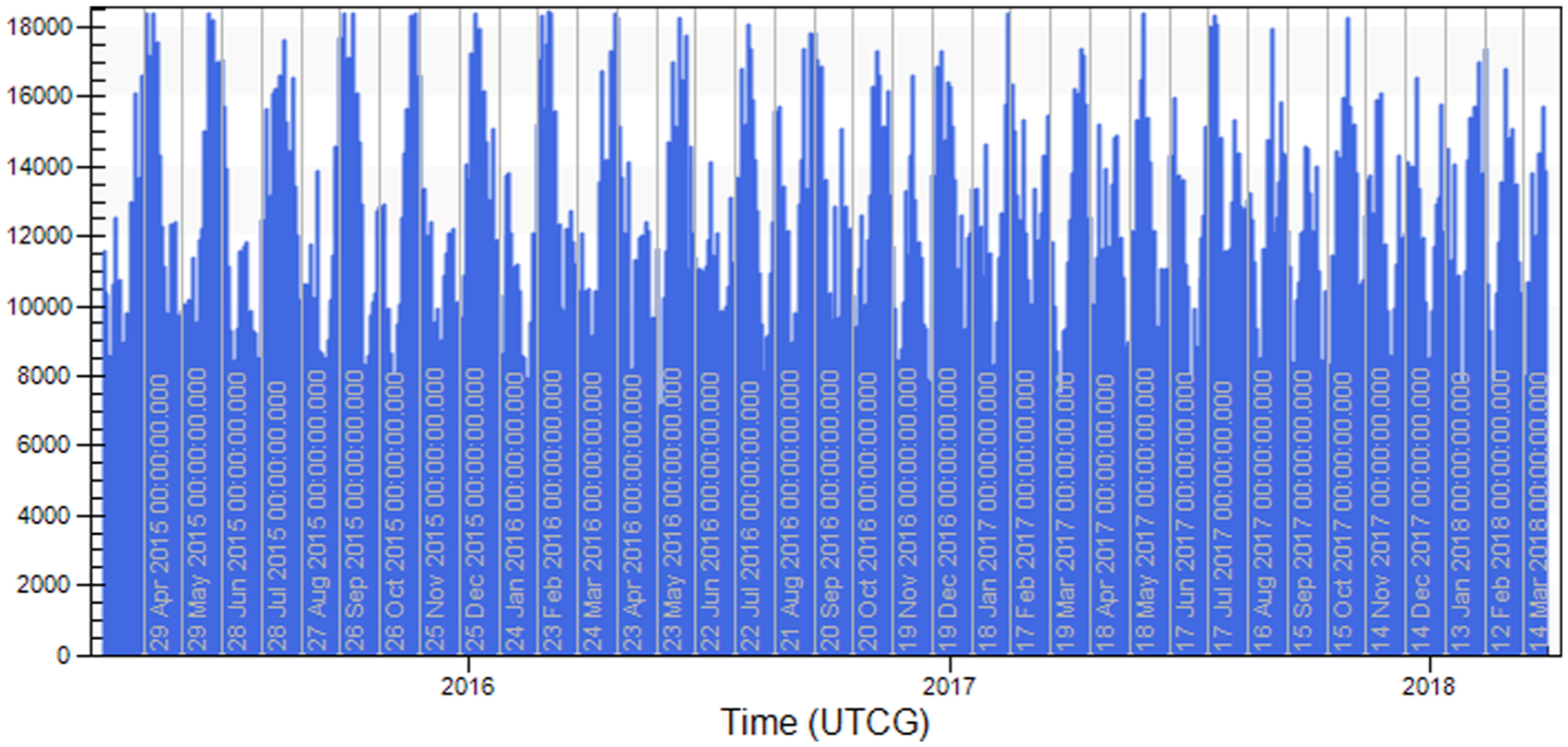
Changes of response time of Constellation 1 during 3 years.

Coverage of Constellation 1 (201509).

Coverage of Constellation 1 (201803).
Figures 5–8 show these characteristic periodic trends over time. The maximum revisit time and average response time of Constellation 1 change periodically, the revisit parameters undergo a few changes, and, with the increase in time, the coverage percentage gets a bit less.
Calculated parameter data of two selected time periods are shown in Table 8.
Analysis of long-term performance attenuation of constellation.

The data of Table 8 indicate that the coverage time decreased by 3%, but that the revisit and response times changed very little. Thus, the attenuation of ad hoc satellites is not that serious, meeting the requirements of coverage characteristics.
Comparison between ad hoc constellations and traditional Walker constellation
From the above results, we can construct three groups of constellations: two ad hoc satellite constellations and one traditional Walker constellation. The two ad hoc satellite constellations have been shown in the above, and the Walker constellation is shown below.
Walker constellation: 60:4/4/1, which means that the constellation contains four satellites and four orbital planes. The phase factor equals 1, and each orbit’s inclination angle equals 60°.
Since the aggregation degree of constellation is designed for ad hoc constellation, and the Walker constellation can ignore this index from section “The aggregation degree of constellation,” this article compares the coverage characteristics and health stability information between ad hoc constellations and Walker constellation.
Comparison of coverage characteristic between ad hoc constellations and Walker constellation
We then selected three ground stations—the Location A, Location B, and Location C—and analyzed the coverage characteristics of constellations over these three areas. The results of this comparison are shown in Table 9.
Coverage characteristics of microsat constellations.

From Table 9, we can observe that the coverage time of ad hoc satellite constellation is longer than that of traditional Walker Constellation. As for the maximum revisit time and average response time, the differences are not significant.
Comparison of health stability between ad hoc constellations and Walker constellation
According to the definition in section “Health stability index of constellation,” we calculated the value

Comparing Tables 7 and 10, the health stability of the Walker constellation is similar to the Constellation 1, and both of them are worse than Constellation 2. These differences indicate that the health stability of the ad hoc constellation is not worse than the traditional Walker constellation and that the more satellites that are in the constellation, the better the health stability.
All the above analyses show that the ad hoc satellite constellation has coverage characteristics similar to those of traditional satellite constellations and is therefore able to meet the requirements of constellations. In addition, ad hoc microsat constellation has lower requirements for satellites under the same coverage characteristics of ordinary constellations, and its launching costs are much lower than that of the secondary launch opportunities. Given these qualities, further development of ad hoc microsat constellation is of great significance.
Conclusion
In this article, an ad hoc micro satellite constellation was proposed, based on research on the status of small satellites and the demands of constellation characteristics. Ground cover characteristics and two newly proposed indices for constellation aggregation and health stability measurements were analyzed using constellations consisting of the secondary-launched microsats in China in 2014. Analysis showed that the ground cover characteristics of ad hoc microsat constellations over specific areas offer clear superiorities to those of one single satellite. The newly proposed aggregation degree index and health stability index were effective and of great significance for the consideration of operational parameters of constellations. In addition, all the performance indicators of the ad hoc constellation showed promise, and their attenuations are not serious. Finally, microsat constellations were compared with traditional satellite constellations, showing that they can meet the requirements of traditional ones while saving the launch costs. Therefore, the design of ad hoc microsat constellations is feasible. Based on these findings, the study of launch trajectory and running trajectory can also be taken into consideration in future research.
Footnotes
Academic Editor: Nam-Ho Kim
Declaration of conflicting interests
The author(s) declared no potential conflicts of interest with respect to the research, authorship, and/or publication of this article.
Funding
The author(s) disclosed receipt of the following financial support for the research, authorship, and/or publication of this article: This work was supported by the Fundamental Research Funds for the Central Universities (grant number NS2015086).