




Abstract
In this research, an experimental setup was built based on using K-type thermocouples inserted in a cylindrical vessel and coupled with a computer system to enable online reading of flame speed for propane-air mixtures. The work undertaken here has come up with data for laminar burning velocity of the propane-air mixtures based on three initial temperatures Tu = 300, 325 and 350 K, three initial pressures pu = 0.5, 1.0 and 1.5 bar over a range of equivalence ratios ϕ between 0.6 and 1.5. The results obtained gave a reasonable agreement with experimental data reported in the literature. Results showed that laminar burning velocity increases at low initial pressures and decreases at high pressures, while the opposite occurs incase of temperatures. The maximum values of the laminar burning velocity occur at T = 350 K, pu = 0.5 and ϕ = 1.0, respectively, while the minimum values of the laminar burning velocity occur at T = 300 K, pu = 1.5 and ϕ = 1.2. Also, the influence of flame stretching on laminar burning velocity was investigated and it was found that stretch effect is weak since Lewis number was below unity for all cases considered. Based on experimental results, an empirical equation has been derived to calculate the laminar burning velocity. The values of the laminar burning velocity calculated from this equation show great compatibility with the published results. Therefore, the derived empirical equation can be used to calculate the burning velocities of any gas of paraffin gas fuels in the range of mixture temperature and pressure considered.
Introduction
Boilers, heat engines and industrial plants are systems that mainly involve rapid oxidation and generate heat. This research is restricted to this part of combustion. The study of laminar and turbulent flame propagation is important to the analysis of the confined flame (i.e. when the combustion process takes place in a limited size) and unconfined flame which may occur when the combustion process takes place in an open vessel or in an unlimited size. 1
Laminar burning velocities play an important role in combustion applications such as in designing burners, predicting explosions and the combustion in spark ignition engines. Properties such as heat release rates, flammability limits, propagation rates, quenching and emissions characteristics are associated entirely with laminar premixed flames. Therefore, the production of accurate measurements of laminar premixed flames plays a key role in the process of understanding a large range of flames. 2 A laminar burning velocity is of importance in validating chemical reaction mechanism and in modelling of turbulent combustion and design of combustion devices. Also, in internal combustion engines, initial combustion is laminar. Therefore, there is a need for the laminar burning velocity. There are several methods that have been used for measuring the laminar burning velocity. These methods may be classified into two categories as follows:
1. Class 1: the stationary flame.
In this method, a stream of premixed gas flows into a stationary flame with a velocity equal to burning velocity. 3 Several methods that come under this classification were carried out by many researchers. Such as Bunsen burner and flat flame burner methods,4,5 slot burner method,6,7 and the nozzle burning method.8,9
2. Class 2: the non-stationary flame.
In this method, the flame moves through the initially quiescent mixture. 3 The methods classified under class (2) are tube method,10,11 constant volume bomb method which was applied by many researchers12–14 and finally soap-bubble method which was applied by Lewis and Von Elbe. 15
Previous studies
Burning velocity is a physical constant for a given combustible mixture. It is the velocity relative to the unburned gas, with which a plane, one-dimensional flame front travels along the normal to its surface as reported by Andrews and Bradley. 16 The reaction zone is often called the flame zone, flame front or reaction wave. Within the flame zone, rapid reactions take place and light is usually (but not always) emitted from the flame. 17 The measurement of flame speed needs a special technique for detecting the flame front arrival along a certain space. Therefore, many investigators worked hard to find out different techniques for measuring flame speed and burning velocity. These techniques for flame speed are as follows: optical technique,1,2 thermocouple technique,10,11 visual technique 18 and ionized probe technique.19,20 For measuring burning velocity, the techniques used are as follows: density ratio method, 21 pressure measurement, 20 double kernel method, 14 hot wire technique 22 and counter flow method.23,24
Several parameters have an effect on burning velocity for combustible mixture. These parameters are as follows: mixture ratio, adding additives, pressure, temperature, thermal diffusivity and specific heat, and nitrogen dilution. Turns 25 studied the effect of mixture ratio on the burning velocity for hydrocarbon fuels and found that the peak of the burning velocity occurs at slightly rich mixture and fall off on either side. Also, he concluded that very lean and very rich mixtures fail to support a propagated flame because there is too little fuel or oxidant to maintain a steady deflagration wave. Thus, there exist upper and lower flammability limits. The effect of additives on combustible mixture was investigated by Odger et al. 10 whom their measurements have been made for propane-oxygen mixtures diluted with nitrogen, carbon dioxide, helium or Argon. Metghalchi and Keck 26 studied the effect of adding simulated combustion products to stoichiometric iso-octane-air mixtures for diluent mass fraction. Yu et al. 27 and Refael and Sher 28 studied the effect of adding a small amount of hydrogen to methane and propane-air mixtures. They found that adding a small amount of hydrogen supplement to a hydrocarbon fuel might produce a very lean combustible mixture.
The effect of pressure on the burning velocity for combustible mixture was investigated by many researchers, among these, Lewis and Von Elbe.
15
They studied the effect of pressure on the burning velocity of various hydrocarbon-air mixtures. They developed a power law
The initial temperature dependence on burning velocity was investigated by different researchers13,20,31,32 using tube method and constant volume vessel. They showed that burning velocity of hydrocarbon-air mixtures increases with the initial mixture temperature and is mainly due to the preheating effect which increases the heat release rate as a result of increasing the initial enthalpies of reacting materials. Over the temperature ranges studied, it was shown that the burning velocity could be linearly correlated to the initial fuel mixture. Also, the maximum burning velocity is a function of the final flame temperature (
K Kuo 17 carried out a set of experiments to study the effect of thermal diffusivity and reaction rates on burning velocity. He measured the flame propagation speed of methane in various oxygen-inert gas mixtures where the volume rate of the oxygen to inert gas is (0.21:0.79). The inert gases used were helium (He) and argon (Ar). He suggested that the thermal diffusivity and burning velocity of the mixture increase. However, thermal diffusivity may have a negative effect in which burning velocity decreases. Also, he found that the lower the specific heat of the inert gases, the higher the flame temperature and burning velocity of the mixture.
It has been well established for laminar flames that their burning velocity is reduced by straining the velocity field. Tsuji and Yamaoka 33 investigated the rich and lean extinction of methane and propane-air mixtures in counter flow, twin flames. They attributed the laminar flame stretch extinction to the outflow of heat by conduction from the reaction zone towards the unburnt mixture, outweighing the inflow of the deficient reactant by diffusion from the unburnt gas into the reaction zone. This was a Lewis number effect. Daneshyar and Mondes-Lopes 34 showed that the laminar burning velocity decreased as the rate of flame stretching increased. However, stretch may affect the burning velocity in the other way as well. In a later paper, Daneshyar et al. 35 showed that the decrease in laminar burning velocity was more pronounced with an increased Lewis number. Research work by Buckmaster and Mikolaitis 36 and Durbin 37 has employed the mathematical technique of activation energy asymptotic to examine theoretically the reduction of laminar burning velocity that occurs at high straining rate of the gas. Results showed that the Lewis number, associated with either fuel diffusion in a weak mixture or oxygen diffusion in a rich mixture can be considered a significant factor, as well as the activation energy associated with the laminar burning velocity. In his work, Tromans 38 reported that if the Lewis number for the limiting reactants is close to unity, the strain field increases the temperature and concentration gradient; the heat source and reactant sink cannot support these, and the burning velocity falls. It also falls if the Lewis number is greater than unity, for then the relatively greater transport of energy from the flame reduces its temperature.
Studies on flame thickness were carried out by Andrews and Bradley.
29
They measured the flame thickness using Schlieren photograph and obtained results contain large differences relative to the total theoretical results. Kanury
39
assumed a relation between flame thickness and burning velocity as
The effect of nitrogen dilution of propane-air mixtures on laminar burning characteristics has been studied by many researchers. Zhao et al. 42 studied experimentally the nitrogen addition and found linear relationship between the laminar flame speed and the dilution ratio. Similar work by Tang et al. 43 showed that laminar burning velocity decreases dramatically with dilution ratio for equivalence ratios smaller than 1.4, indicating that nitrogen addition decreases preferential diffusion instability. Further work by Tang et al. 44 on nitrogen diluted propane-air premixed flames at elevated pressures and temperatures has shown that normalized laminar burning velocities have linear correlation with nitrogen dilution. Also, hydrodynamic instability increases with the increase in initial pressure and decreases with the increase in nitrogen dilution ratio. Also, they found that laminar burning velocities are increased with the increase in initial temperature.
Akram et al.
45
studied the effect of dilution using CO2 and N2 gases (up to 40%) on C3H8-air burning velocity. The peak burning velocity was observed for slightly rich mixtures even at higher mixture temperatures and the minimum value of the temperature exponent is observed for slightly rich mixtures. Also, the burning velocity was observed to decrease with the dilution of inert gases. The addition of CO2 shows a pronounced decrease in the burning velocity, as compared to N2. Akram and Kumar
46
carried out an experimental work to measure laminar burning velocity of liquefied petroleum gas (LPG)-air mixtures at high temperatures. It was found that an increase in mixture temperature significantly enhances the burning velocity. Maximum burning velocity is obtained for slightly rich mixtures, unlike for the highly rich mixtures reported in the literature. A minimum value of the temperature exponent is observed for slightly rich mixtures. Liao et al.
47
studied the effects of dilute gas on burning velocities at the equivalence ratios from 0.7 to 1.2 for natural gas-air mixtures, and an explicit formula of laminar burning velocities for dilute mixtures was formulated. Further work on natural gas-air mixtures was carried out experimentally by Kishore et al.
48
over a range of equivalence ratios at atmospheric pressure. Also, the effect of CO2 dilution up to 60%, N2 dilution up to 40% and 25% enrichment of ethane on burning velocity of methane-air flames were studied. The experimental results were in good agreement with the published data in the literature. Also, it was found that maximum burning velocity for CH4/CO2-air mixtures occur near to
Jomaas et al.’s 50 experimental work on propane-air mixture at one atmospheric pressure showed good agreement with the work in the literature. Huzayin et al. 51 work on propane-air mixtures over wide ranges of equivalence ratio (Φ = 0.7–2.2) and initial temperature (Ti = 295–400 K) and pressure (Pi = 50–400 kPa) showed that the maximum laminar burning velocity found for propane is nearly 455 mm/s at Φ = 1.1 and the maximum explosion index, commonly called the ‘explosion severity parameter’, is calculated from the determined laminar burning velocity and is found to be 93 bar m/s for propane.
Most burning velocity measurements for a closed vessel have been found to be valid only in the initial stages of combustion (generally taken as
Theoretical analysis
Andrews and Bradley
29
have derived a formula for burning velocity of propane-air mixtures from flame speed measurements in explosions by density ratio method that takes into account the temperature distribution through the flame front. In this work, a computer program in Fortran was written to carry out theoretical calculations. In the programme, the equations of flame thickness correction factor
The general equation for flame burning velocity (S
u
) by Andrews and Bradley
29
is given in equation (1) whereby the flame speed

Flame thickness correction factor
The flame thickness correction factor I 27 can be written as follows

It should be noted here that I makes an allowance for the temperature difference between temperature

We assume that

And the part integral of equation (2) can be evaluated as follows

Equation (5) could be approximated and yields into

Substituting equation (6) into equation (2) resulted into

For a stoichiometric mixture flame, equation (7) gives a value for a correction factor I that is 4% below the value obtained from the graphical integration of the measured profile obtained by Andrews and Bradley. 30
To take the discrepancy of 4% into account, the inclusion of a factor into equation (7) gives the value of I as

The burning velocities reported in this work are based on
Flame thickness
A relation between flame thickness and burning velocity is reported by many researchers25,40 as follows

where


The values of molar mass of the product components


where

where a, b, c and d are constants for each gas of combustion gases that can be found from tables. After computing the parameters
Experimental setup
The study of flame propagation subject needs technically modern systems because of the short period available for measurements, which is not longer than few milliseconds, and this constitutes a big problem in studying such a subject. In this research, a modern technique was used to measure flame front speed, which is considered one of the advanced techniques that determine the flame front location using sets of K-type, 0.5 mm diameter thermocouples. The designed system benefits from the high speed of the computer processer that is connected to the cylinder through a hardware and software interface (computer control system) to enable online reading of flame speed. By doing so time and effort to acquire the required data. The experimental setup facility consists mainly of the following units: the combustion chamber, mixture preparing unit, control system with the ignition unit and finally the flame speed measuring unit as shown in Figure 1. A brief description of the main experimental facility components is given hereafter.

Schematic diagram of the experimental facility setup.
Combustion chamber unit
The combustion chamber unit is a cylindrical test vessel of 300 mm external diameter, 305 mm external length and 10 mm thickness. It is made of solid iron as shown in Figure 2. The cylinder is provided with central ignition electrodes. The cylinder is designed and constructed in a way that makes it easy to study the combustion of different types of gases at different initial conditions.

Combustion chamber unit.
The ignition of the spark is performed by an electronic system away from the cylinder and behind the room’s wall. The six thermocouples are placed radially inside the cylinder, in which the angle between thermocouples T1 and T2 is 45°; thermocouples T3 and T4 is 90° and thermocouples T5 and T6 is 45°. However, their positions with respect to the centre of the vessel are shown in Figure 3.

Schematic diagram of cylindrical vessel with six thermocouples.
Mixture preparation unit
To prepare the mixture (fuel-air), a gas mixer has been designed and constructed for hydrocarbon compounds that have a low partial pressure such as methane, propane, LPG and butane. The main purpose of preparing the fuel-air mixture in the mixing unit rather than in the cylinder is to increase the total pressure of the mixture and consequently to increase the partial pressure of hydrocarbon fuel in order to increase the accuracy. The mixer is made of iron-steel in a cylindrical shape without any skirt to improve the efficiency of mixing operation. Mixer dimensions are 453 mm length, 270 mm diameter and 5 mm thickness as shown in Figure 4. It undergoes a pressure of more than 60 bar and withstands high temperatures.

Schematic diagram of the mixture preparing unit.
Computer control system
The computer control system is designed and used to read flame speed propagation inside the cylinder by means of six k-type thermocouples. Three of them represent start signals

Schematic diagram of the internal structure of cylindrical test vessel with the six thermocouples inserted in the pre-pressure period.
These thermocouples are connected to a computer in order to collect, process and display the data obtained from the thermocouples. Since the electrical voltage signals produced by the thermocouples are very low, and because of very short time of heating due to high speed computer interfacing port circuit. A non-inverting amplifier circuit was designed and built around high precision operational amplifier which has a gain equation. A computer program (control system software) is used to process the data collected. A demonstration for the hardware and software of the control system is shown in Figure 6.

Block diagram of interfacing circuit.
Ignition circuit
In order to produce a spark between the two sparking electrodes, an electronic circuit is used to furnish the power needed by the sparking coil and to have the ability of precious timing of the spark start and end in relation to other parameters in the chamber. The circuit consists of a DC power which is produced by a transformer and this transformer is connected to AC power line (220 VAC). The transformer output is 24 V and the peak DC voltage produced is around 30VDC. This transformer charges a capacitor of 470 µF. Timing and control circuit are designed to produce all signals controlling the timing periods and time delays between events in the whole process from the start of ignition till the transfer of data to the computer.
Experimental procedure
Preparation of the mixture
The process of mixture preparation is performed based on partial pressure of mixture components (propane-air mixture). According to Gibbs-Dalton law, an accurate equivalence ratio can be obtained, which has an effect on flame speed. The preparation of the mixture is done inside the mixer unit. Since the partial pressure of hydrocarbons propane is low, this method is used to increase the partial pressure of the hydrocarbon propane.
Sensors check
Since these sensors are very sensitive, it is very important to check the sensor function. The front end of these sensors may be affected by the high temperature inside the cylinder, so it is very important to check these sensors to see whether they are functioning correctly or not, and to check whether a double flame grows spherically. A procedure is added to the interface software to check whether these sensors function correctly and free from any deficiency.
Calibration
To ensure that all data read from the measuring devices and sensors are correct, a calibration procedure is done to all measuring devices and sensors. This includes the interface circuit, thermocouples and pressure gauges.
Flame speed measurements
The proposed technique simply involves the use of six thermocouples. One of the effective factors of flame speed is the initial temperature. The propane-air mixture initial temperature can be achieved and maintained using a heating system and a digital thermometer. After preparing and admitting the mixture to the cylinder at a pre-pressure period that has been chosen according to the value set by Andrews and Bradley,
29
sensing thermocouples have been inserted in this area (an area within the pre-pressure period). Such that when the flame front moves across the first sensor, an electrical signal is produced, and transferred to the interface electronic circuit where it is amplified and then it is sent to the parallel port of the computer. This signal activates the interface software saved in the computer memory and takes it as a start signal,
Uncertainty analysis
In this study, experiments were conducted at least four times for each condition, and the averaged values were used in the analysis. This procedure was used to ensure the repeatability of the results within the experimental uncertainty (95% confidence level). The accuracy of the thermocouple is 1 K, and the variation in initial temperature is 300 ± 2 K. Thus, the relative error in initial temperature is 0.566%. Mixtures are prepared according to the partial pressure of the constituents. Uncertainties in the pressure measurements of the fuel vapour and air are less than 0.1%. For each condition, six tests were conducted to minimize random errors in the experimentally determined flame speeds. The average value was reported along with 95% confidence intervals from these experiments for each condition.
Experimental results and discussion
In this section, the experimental results for laminar flame propagation are discussed. Experimentally, the spark was fired centrally and the growth of the flame kernel was measured using thermocouples with the aid of a computer. Flame propagation is monitored during the pre-pressure period, and experimental measurements were recorded for both laminar flame speed Sf and flame temperature at different initial pressures and temperatures for propane-air mixtures.
Validation of thermocouple technique
Figure 7 shows the comparison of the laminar burning velocities for propane-air mixture at

Comparison of the propane-air mixture burning velocity
Figure 8(a) shows a comparison of the experimental data for propane-air mixture burning velocity Su at 300 K, and 1 bar with previous work in the literature.26,42,58–61 Also, similar comparisons with the reported literature27,44,51,59,62,63 are shown in Figure 8(b) and (c), respectively. All figures show good agreement with the different literatures; however, the experimental values of this work give lower values than those in the literature. This may be caused by the slower flame propagation at fuel rich mixture conditions and the correspondingly larger downstream heat loss. Furthermore, good agreement of the experimental data with the work carried out by Jomaas et al. 50 for propane gas mixture at atmospheric pressure, and at initial temperature of 350 K.

Comparison of the experimental data for propane-air mixture burning velocity Su at 300 K, 1 bar with work reported by Dugger (367 K) and Tang et al. (370 K).
Effect of pressure
on burning velocity
at fixed equivalence ratio
at different initial temperatures
for propane-air mixture
Pressure is one of the most important parameter considered in this work, because it affects the laminar burning velocity. Figure 9(a)–(c) shows the variation of pressure

(a) Effect of the pressure
Effect of initial temperature
on burning velocity
at fixed pressure
at different equivalence ratios
for propane-air mixture
Figure 10(a)–(c) shows shows the variation of initial temperatures

(a) Effect of the temperature
Effect of the equivalence ratio
on burning velocity
at fixed initial pressures
at different initial temperatures
for propane-air mixture
Figure 11(a)–(c) shows the effect of equivalent ratio on burning velocity

(a) Effect of the equivalence ratio ϕ on burning velocity Su at fixed pressure pu = 0.5 bar for different initial temperatures Tu = 300, 325, 350 K. (b) Effect of the equivalence ratio ϕ on burning velocity Su at fixed pressure pu = 1.0 bar for different initial temperatures Tu = 300, 325, 350 K. (c) Effect of the equivalence ratio ϕ on burning velocity Su at fixed pressure pu = 0.5 bar for different initial temperatures Tu = 300, 325, 350 K.
Figure 11(a)–(c) shows similar trends regarding the effect of equivalence ratio on burning velocity over the range between 0.6 and 1.5. Also, they show that the maximum burning velocity occurs for slightly rich mixtures (i.e. at stoichiometric mixture ϕ = 1.1 on either side), and it decreases at the lean and rich limits. Furthermore, it can be observed that the highest burning velocity values ocuurs at temperature Tu = 350 K for all values of equivalence ratios and pressures. It should be noted here that the highest maximum burning velocity occurs at ϕ = 1.1, Tu = 350 K and pu = 0.5, respectively, as shown in Figure 11(a) and the minimum burning velocity occurs at Tu = 300 K, pu = 1.5 and ϕ = 1.5, as shown in Figure 11(c). Furthermore, it can be seen from Figure 11(a)–(c) that the laminar burning velocity decreases with pressure and the effect is most noticeable at pressure equal to 1.5 bar.
Effect of Lewis number
on burning velocity
Non-uniform diffusion is caused by unequal thermal and mass diffusivities of the deficient reactants. This effect can be qualitatively represented by Lewis number. Lewis number is the ratio of the thermal to mass diffusivity. It is an important parameter in any discussion on flame stretch. Lewis number combined with preferential diffusion (ratio of mass diffusivity of the deficient reactant to excess reactant) is used to represent the non-equilibrium effects on flames. 64 Lewis number, Le, or ‘Lewis–Semenov’ number 65 is given by

where
Effect of equivalence ratio and temperature on Lewis number.

In this work, Lewis number calculated was less than unity over the range of equivalence ratios, temperatures and pressures which means that stretch effect on burning velocity is weak. This range of Le Number would not reduce the laminar burning velocity because Marzouk
68
reported that for a unity Lewis number, mass and heat diffusion rates are equal, and the reaction-diffusion zone is essentially unaffected over a range of weak to intermediate strains. Also, Bechtold and Matalon
69
reported that the enrichment of air will result in the reduction of thermal diffusive coefficient leading to the reduction of Lewis number and this suggests that the flame front trends to more stable at lean mixtures. Also, the experimental measurements were carried out during the pre-pressure period, and the last thermocouple I.C –
Derivation of empirical equation
It was mentioned in the previous section that the laminar burning velocity is affected by many parameters such as equivalence ratio, initial temperature and initial pressure. These parameters

where Su is the dependent variable; p and Tu are the independent variables; and β, α and γ are constants.
The parameters are evaluated by a curve fitting method using linear least square method and are applied using Grapher Software from Golden-Software. Figures 12–14 show the flow charts to calculate β, α and γ, and the results are given as follows









Flow chart for the calculation of constant parameter (α).

Flow chart for the calculation of constant parameter (γ).
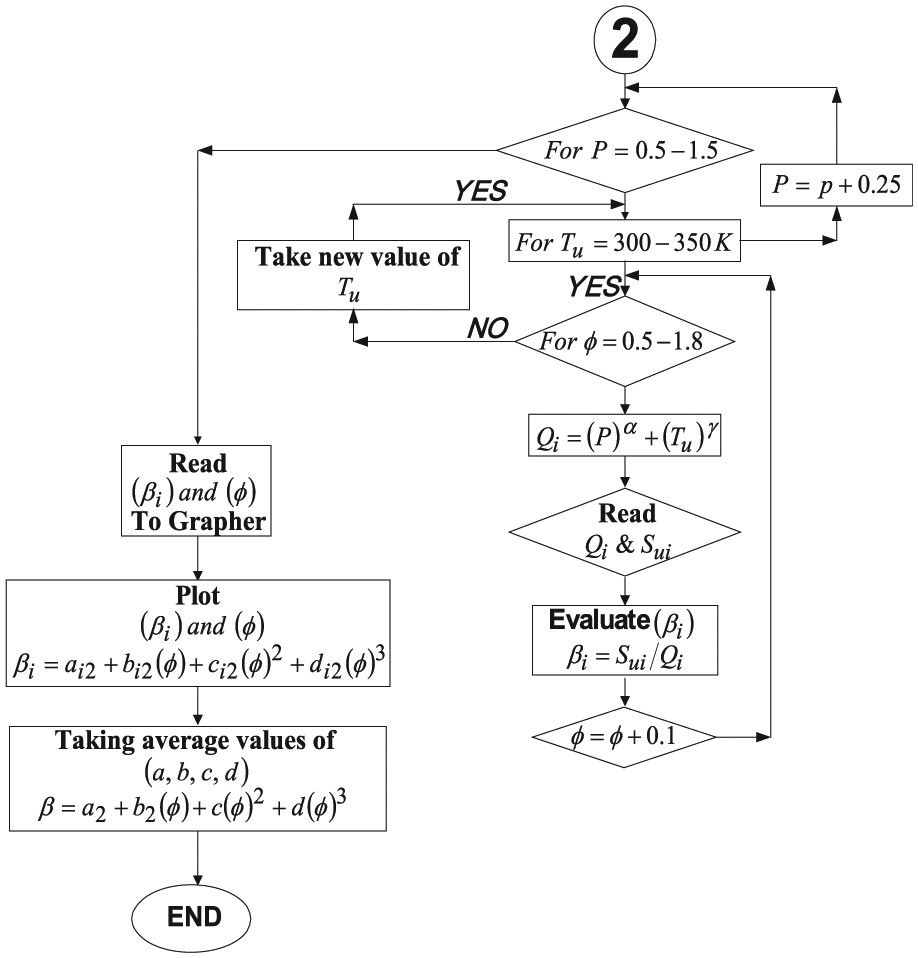
Flow chart for the calculation of constant parameter (β).
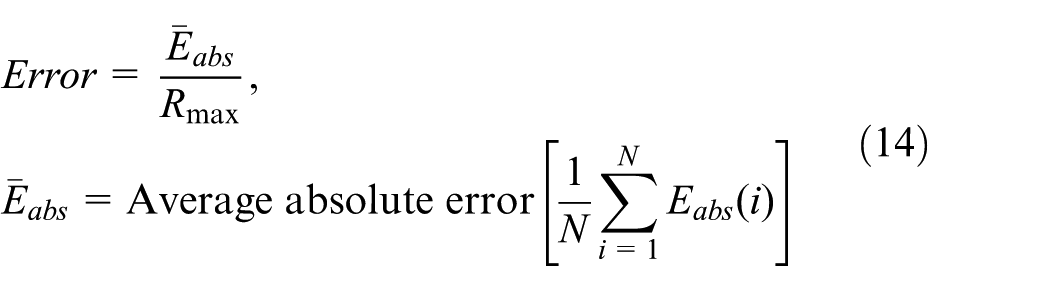
The derived empirical equation can be used with an error about 5.8% and can be calculated as follows:


Comparison between the derived empirical equation with other types of fuels
Figures 15 and 16 show the comparison between the results of the derived empirical equation using a cylinder with the available published results found in Tseng et al., 21 Andrews and Bradley,29,30 Hayder 70 and Stone and Khizer 71 for methane, propane, LPG, and butane-air mixtures at constant Tu = 300 K and ϕ = 1.0. It can be observed that the agreement is acceptable and confirms the validity of the derived equation.

Comparison between present work (empirical equation) for stoichiometric methane-air flames, with selected values from the literature at different pressures.

Comparison between present work (empirical equation) for stoichiometric propane-air flames, with selected values from the literature at different pressures.
Also, Figures 17–20 show the comparison between the results of the derived empirical equation with results from the literature at constant values of Tu = 300 K and pu = 1.0 bar. Again good agreement was found with the work reported in the literature.

Comparison of empirical equation results with the published results for methane-air mixtures.

Comparison of empirical equation results with the published results for propane-air mixtures.
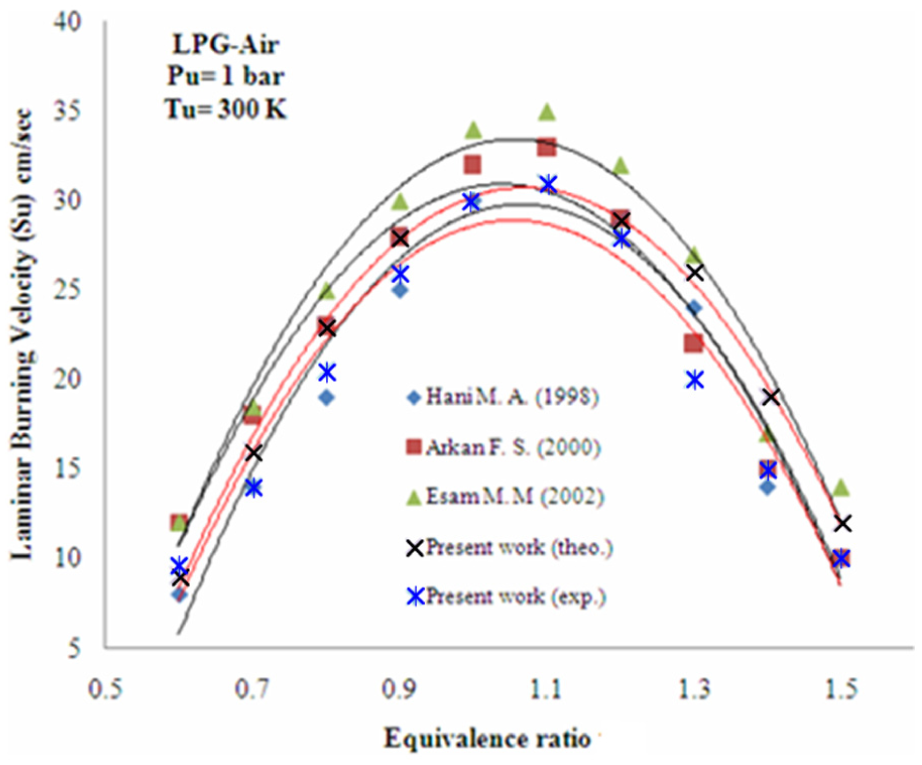
Comparison of empirical equation results with the published results for LPG-air mixtures.

Comparison of empirical equation results with the published results for butane-air mixtures.
A comparison of the results of the derived equation with the published work for ethane-air mixture is shown in Figure 21. It can be observed that they are in agreement with the reported literature. and confirms that the derived empirical equation can be applied to other types of fuel in paraffin family.

Comparison of empirical equation results with the published results for ethane-air mixtures.
Conclusion
A modern measuring system is used whereby thermocouples are inserted in a cylindrical vessel, and a high speed computer has been employed for the measurement of laminar flame speed for propane-air mixture at different initial pressures of 0.5, 1.0 and 1.5 bar, and at different initial temperatures of 300, 325 and 350 K over a range of equivalence ratio between 0.8 and 1.2 to get the best results. The laminar burning velocity has been measured at pressure lower than atmospheric pressure (vacuum pressure); while most published works were measured at a pressure of 1 atm or higher (generally taken as ≤1.1 pu). The results obtained from the present work give very good agreement with the work reported data using other methods.
The laminar burning velocity for propane-air mixture increases linearly with the increase in initial temperature for lean, stoichmetric and rich propane-air mixture; the trends are different as the laminar burning velocity appears near stoichiometric mixture ϕ = 1.0. Also, the laminar burning velocity increases at low initial pressure and decreases at high pressures, while the opposite occurs for the temperatures. The maximum value of the laminar burning velocity occurs at Tu = 350 K, pu = 0.5 and ϕ = 1.0 and minimum value of the laminar burning velocity occurs at Tu = 300 K, pu = 1.5 and ϕ = 1.2. The maximum laminar burning velocity appears near stoichiometric mixture ϕ = 1.1 on either side and decreases at the lean and rich limits for all values of initial temperatures and pressures. It was found that Lewis number Le was below unity for all cases considered. This range of Le number would not reduce the laminar burning velocity.
Empirical equation has been deduced from the experimental results that take into consideration the effects of equivalence ratio, initial pressure and initial temperature upon the laminar burning velocity. The values of laminar burning velocity calculated from this equation show an acceptable agreement with the published work. So this empirical equation can be used to calculate the burning velocities of any gas of paraffin family with an estimated error of ±5.8%.
Footnotes
Appendix 1
Academic Editor: Jiin-Yuh Jang
Declaration of conflicting interests
The author(s) declared no potential conflicts of interest with respect to the research, authorship and/or publication of this article.
Funding
The author(s) received no financial support for the research, authorship and/or publication of this article.