




Abstract
The friction brake works as an indispensable guarantee for regular work and safety operation of vehicles and industrial equipments. Friction and wear behaviors of brake’s friction materials are considered as an important subject. In this article, friction materials were classified by matrix categories, and their major components were introduced first. Then, the advantages and disadvantages of each friction material were summarized and analyzed. Furthermore, the micro-contacting behaviors on friction interface and the formation mechanism of various friction films were discussed. Finally, the influential rules and mechanism of braking conditions (temperature, pressure, and velocity) on the friction and wear behaviors of friction materials were summarized. It is concluded that the friction film, an intermediate product in braking, is greatly beneficial to protect friction materials from being seriously abraded. The braking conditions have complicated influences on friction and wear behaviors of brake. Generally, the friction coefficient tends to be fairly low while the wear rate increases rapidly under a condition with high temperature, braking pressure, or initial braking speed.
Introduction
As an important part of transportation and industrial equipments, the friction brake is a significant guarantee for their regular work and safety operation. Due to the friction of brake pair, the braking is generally considered as a process of transferring kinetic energy into heat energy. Friction will produce heat, and some of them are radiated through conduction and convection of brake pair, while others are absorbed by physical–chemical reactions and wear behaviors on friction interface. With the technological advancements and increasing safety concerns, higher requirements were put forward on the security, intelligence, eco-friendliness of brake systems, and operating comfort of mechanical devices. Therefore, it is vitally important for mechanical engineers to develop novel brake’s friction materials with excellent tribological properties and to explore their friction and wear mechanisms in braking as well. In this article, the research progress on this field in recent years was investigated and summarized.
Summary of brake’s friction materials
Presently, friction brakes were widely used in various traffic and transportation equipments (automobiles, trains, planes, etc.) and industrial devices (mine hoisters, elevators, etc.). For example, the application of brake disk in mine hoisters is shown in Figure 1. As an important part of friction brake, the friction materials (namely, brake shoe, brake lining, etc.) should have high and stable friction coefficient; great thermal conductivity; excellent heat and wear resistances; and weak absorbability of water, oil, or brake fluid. 2
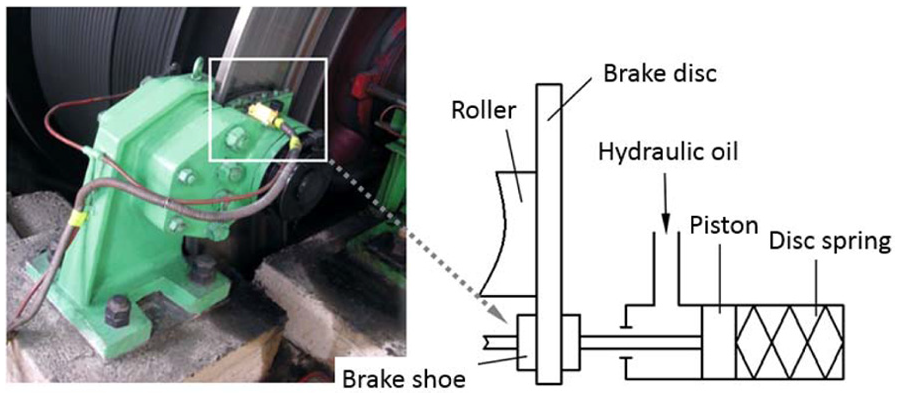
Schematic diagram of mine hoister’s brake disk. 1
Classifications of friction materials
According to matrix material
In the past, asbestos was selected as reinforced fiber of friction materials for its excellent comprehensive performance such as low density, high melting point, high friction coefficient, great mechanical strength, and small damage to brake disk. Nonetheless, the weak thermal conductivity of asbestos tended to reduce its friction performance and increase wear. In addition, it has been proved that the asbestos is carcinogenic to human’s respiratory organs. 3 Therefore, friction materials with asbestos had been removed from manufacturing, gradually. At present, almost all braking devices are made of the friction materials without asbestos. According to the matrix material, brake’s friction materials can be divided into metallic, semi-metallic, and nonmetallic matrix: 2
Metallic matrix. Depending on production technique, the metallic matrix friction materials can be divided into two kinds: monomer metal casting and powder metallurgy.3,4 Monomer casting metal includes steel, cast iron, bronze, and so on. Because of easy adhesion and low friction coefficient at high temperature and speed, the monomer casting metal had already been eliminated. Powder metallurgy friction material mainly includes iron based, copper based, and iron–copper based, which takes iron, copper, and both metal powders as its matrix, respectively. 5 After a uniform mixture with friction additives, these metal powders are pressed and sintered to form powder metallurgy friction material. Among them, iron-based friction material has high temperature strength, hardness, and thermal stability. While copper-based friction material has smaller but more stable friction coefficient. It has greater thermal conductivity and wear resistance. Iron–copper-based friction material which has a nearly same content of iron and copper possesses both above-mentioned characteristics such as excellent mechanical properties, high thermal conductivity, and low wear resistance. 6 Generally, powder metallurgy friction material can be applied in planes, trucks, trains, and any heavy machinery products with a heavy braking load and extremely high speed.
Semi-metallic matrix. The principal components of semi-metallic matrix friction material are metal fiber, ceramic fiber, and copper or iron powder. 5 Semi-metallic matrix friction material has great heat resistance, high power absorption, and excellent tribological properties. However, it also has some shortcomings such as low frequency noise, easy rusting, and serious damage to brake disk. Presently, semi-metallic matrix friction material was widely applied in automobiles, motorcycles, and other light vehicles.
Nonmetallic matrix. In a nonmetallic matrix friction material, modified resins and rubber are used as binder, while organic fibers (kevlar, carbon, etc.) or inorganic mineral materials (glass, wollastonite, etc.) are used as reinforced fibers. 7 They are solidified by hot pressing after uniformly mixed with other friction additives. 8 There are a series of nonmetallic matrix friction materials, among which the carbon–carbon (C-C) and ceramic matrix composite friction materials have extremely excellent tribological properties. For instance, the C-C composite friction material has high strength and toughness, superior thermal stability, and favorable wear resistance. At present, the C-C composite friction material was mainly used in planes and race cars.
According to material source
As a whole, two kinds of friction materials were most widely used in brakes at the present: powder metallurgy friction material and organic friction material. However, there are a few differences between the components of these two kinds of material.
Powder metallurgy friction material is mainly made from matrix, matrix-strengthening materials, friction increment agents, and lubrication materials. 9 The matrix and matrix-strengthening material include several metals (Cu, Fe, etc.). The friction increment agent is used to increase friction coefficient which includes some metal and nonmetal oxides or carbides (SiO2, Al2O3, etc.). 9 Besides, the lubrication material such as MoS2 is often used to improve anti-rub ability and wear resistance of friction material.
Organic friction material was most widely used due to its simple preparation method, excellent tribological properties, and eco-friendliness. Generally, organic friction material consists of binder, reinforced fibers, friction additives, and fillers: 10
Binder. The binder sticks all components together to form a thermostable matrix. The phenolic resin is often selected as a binder because it possesses excellent heat resistance.11,12
Reinforced fibers. The reinforced fibers are used to improve friction performance and strength. The metal fibers (iron, copper, etc.), glass fibers, carbon fibers, and organic fibers (kevlar, cotton, etc.) are commonly used as reinforced fibers. 13
Friction additives. The friction additives can adjust friction properties and control wear behaviors of brake’s friction materials. Generally, the additives can be classified into two types: lubricant and abrasive. The lubricant is always used to reduce the wear of friction material. For example, as an excellent lubricant, graphite can decrease wear rate effectively by reducing the direct contact between surface of friction material and brake disk. 14 However, the abrasive (e.g. metal sulfide) is generally used to increase friction coefficient and strengthen wear resistance of friction material.
Fillers. The fillers are used to improve the processability and reduce the cost of friction material. Generally, the vermiculite, mica, and barium sulfate are often used as fillers. 15
Micro-contact on brake’s friction interface
With the loading of braking pressure, the rough surfaces of friction plate and brake disk are contacted to mesh. A schematic diagram of the contacted interface between a brake pair is shown in Figure 2.
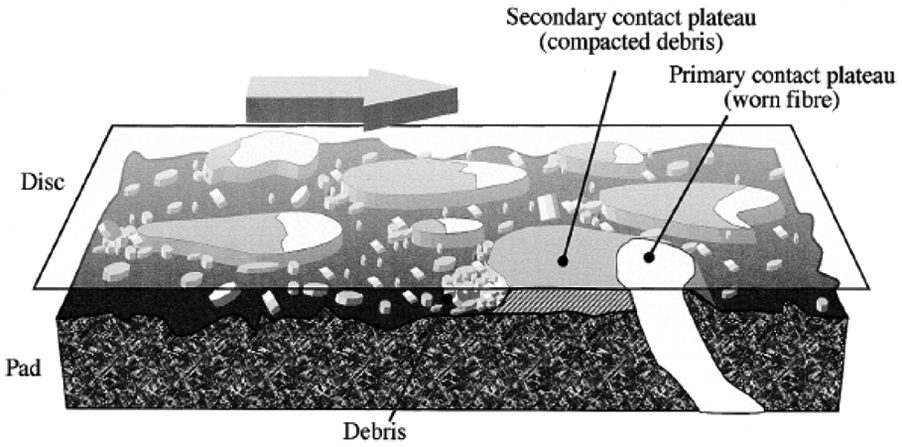
Schematic diagram of the contact interface between a brake pair. 16
Since the hardness of brake disk is far larger than that of the friction plate, humps on the surface of brake disk are pressed into the friction plate. Because the brake disk rotates at a high speed, some friction material is removed by shearing to form debris. Some debris is thrown out of the interface. Others continue to experience the repeated process, namely, deforming, crushing, breaking, and peeling. Finally, they are adhered onto the base surface to form a friction film with a thickness of several to several hundred micrometers. 17 The friction film is an intermediate product of braking. It is also known as a third body or surface film.18,19 The friction film caused by debris has vital influences on the friction and wear performance of brake pair. 20
Friction film
The formation of friction film may be varied according to different environmental conditions and material performance during braking. 21 Generally, the friction film has two morphologies: loose granular film and dense sheet film:
Loose granular film. In the initial stage of braking, the fibers in friction material are adhered onto the brake disk to form a primary contact plateau. By relative sliding, these micro-asperities are deformed, shorn, and dropped to form some loose granular films, which fill the primary contact plateau generated by the fibers.
Dense sheet film. With the increasing braking pressure and surface temperature, these loose granular films are cut, crushed, and even welded to form a dense sheet film called secondary contact plateau. 16 The secondary contact plateau is a major contact area during the whole braking process. Most subsequent debris are growing up and expanding on the basis of the secondary contact plateau.
In fact, the loose granular film and dense sheet film can be transformed dynamically into each other in a braking process. 22 When the debris is deposited behind the fibers of friction materials, they are compacted into dense sheet films. However, with their continuous growing, the fibers will be broken and dropped under the effects of braking pressure and high temperature. As a result, the dense sheet films will be broken to transform into loose granular films.
Other films
Except for the friction film above, some other films with various components and structures are also produced in braking process due to some physical or chemical changes on the contact interface:
Oxidation film. During the braking with a high speed and temperature, the surface materials react easily with the oxygen in air to form an oxidation film on the interface. The oxidation film with low intensity is hard and brittle. It is easily cracked and flaked by friction force to form debris. The wear of friction plate is related to the hardness of oxidation film and friction material’s matrix. A larger difference in hardness between them tends to destroy easily the oxidation film into debris. 23 However, it is remarkable that the oxidation film has a significant effect on protecting the friction material’s surface from contacting directly with brake disk, which decreases the friction coefficient and improves the wear resistance effectively.
Gas cushion film. The friction material often gives out some gases (CO, CO2, CH4, and H2) due to thermal degradations. On one hand, since these gases are hard to be adsorbed by the friction surface, they will form a gas cushion film on the interface. The gas cushion film plays a significant role as a lubricant on the interface to reduce friction coefficient. However, it will also produce an opposing force onto the applied load to reduce the friction force. 24 In addition, due to serious plastic deformations and these gases existing on the friction surface, the so-called cavitation phenomenon occurs easily, which thereby accelerates the breaking and dropping of friction films to cause a new wear. On the other hand, these reductive gases will deoxidize the debris to form a thin metal layer with plenty of iron on the brake’s friction surface. If the adhesive force between the brake disk and the metal layer is larger than that of the metal layer and the friction plate, the metal layer will be broken to cause adhesive wear and abrasive wear. 25
Liquid lubrication film. The organic components of friction materials will be thermally decomposed under an extremely high temperature to generate liquid lubrication films on the contact interface. The liquid lubrication film results in the change in friction mode from dry friction to liquid lubrication friction. Consequently, the friction coefficient must fall off suddenly, although it is beneficial to reduce the wear. Furthermore, as the braking proceeds, the friction temperature keeps increasing and then the liquids are released continuously. The friction coefficient maintains a low value which affects seriously the braking reliability and safety. It has been proved that an abnormal tribological phenomenon called friction catastrophe (FC) is directly related to the lubrication film generated in emergency braking.26–28
Friction and wear behaviors and mechanisms of brake’s friction materials
As it is known, the friction and wear behaviors are not inherent characteristics of friction materials, which may be influenced by many factors such as braking and surrounding conditions. 29 It is believed that the investigations on the friction and wear behaviors of brake’s friction materials must be valuable for controlling friction, reducing wear, developing new fine friction materials, and improving braking reliability. Therefore, a great deal of researches on this field had been carried out in the past years. It was found that the friction and wear behaviors of brake’s friction materials are mainly affected by the following factors:7,13,26–28
Material characteristics: physical, chemical, and mechanical properties of friction materials, and so on.
Braking conditions: braking pressure, initial braking speed, braking times, temperature rise in braking, and so on.
Surrounding conditions: surrounding temperature, humidity, airflow, and so on.
Surface conditions: surface roughness, contact property, and so on.
Structural parameters: shape, size, and contact modality of brake pair, and so on.
Besides the inherent properties of friction materials, the braking condition is generally considered as one of the most important external factors. It can be easily found that the existing researches were mainly focused on these influential factors as following: temperature, braking pressure, and initial braking speed. On one hand, these factors have most obvious influences on the friction and wear performance of friction materials. On the other hand, other factors cannot be easily or clearly detected due to the limitation of existing theories and technologies. In addition, the influence laws and mechanisms of braking conditions on powder metallurgy and organic friction materials are not the same because of the differences between their components. Therefore, the influences of these three factors (temperature, braking pressure, and initial braking speed) on the friction and wear behaviors of these two kinds of brake friction materials (powder metallurgy and organic friction material) were investigated and summarized in the following.
Influence of temperature on friction and wear of brake’s friction materials
The braking can be considered as a process of transferring kinetic energy into heat energy. The friction heat causes a temperature rise which will affect the friction and wear. The surface temperature is not uniformly distributed on the interface.30,31 The temperature of asperities may be much higher than that of surface, which then forms local high-temperature zones. The temperature transfers inside through friction interface, and its distribution is associated with the thermo-physical properties of friction material.32,33 The friction heat affects the oxidation, thermal strength, and thermal plasticity of friction material. It causes the change in surface microstructure (diffusion and adsorption of molecules or atoms on the friction interface) and structural phase transformation of friction materials. It may also affect the interface lubrication to bring qualitative change in interaction characteristics on the interface from boundary friction to dry friction. 34
The friction and wear mechanisms are altered under different temperatures. At a low temperature, the hard asperities, small debris, and piece shape particles exist on the contact interface. The hard asperities may be embedded in a softer matrix, which results in plastic flowing and plowing called furrow effect. 35 With the increasing braking pressure and initial braking speed, the friction temperature will increase to result in several phenomena. First, the matrix resin may be softened and even charred to lose its bonding strength. The reinforced fibers are then pulled and escaped from the matrix, and friction films are formed on the friction surface, 36 which is marked with a red circle in Figure 3. Second, the friction films will be deformed, cracked, and peeled to form small debris which decreases the friction stability, increases the wear, and sometimes even causes severe vibration and loud noise. Third, once the surface temperature exceeds the thermal decomposition temperature of friction material, the heat fading phenomenon will occur, and the friction coefficient will decrease obviously. 33 Besides, the thermal decomposition of organic material will release gases to generate gas cushion films, which weakens the friction greatly. The cavitation phenomenon causes granular or sheet debris fall off, which will reduce the braking torque.

SEM image of friction surface covered with friction films. 36
In general, with the increase in temperature, the friction coefficient increases gradually. Nevertheless, after reaching a certain temperature, the friction coefficient may fall off suddenly. While the wear rate increases continuously as temperature increases. The wear will be more serious at a higher temperature. For example, Öztürk et al. 24 studied the influence of temperature on the friction and wear behaviors of four friction materials with different reinforced fibers: ceramic fiber, rock wool fiber, glass fiber, and steel wool fiber, respectively. It was found that the friction and wear behaviors of these four friction materials have similar influence laws with temperature. For example, the variation of friction coefficient and wear rate with temperature for the friction material filled with steel wool fiber is shown in Figure 4, and scanning electron microscopy (SEM) micrographs of the worn surface of the specimen with steel fibers after testing at 200°C and 350°C are shown in Figure 5. It can be seen that the friction coefficient increases with the temperature at first but starts to decline when the temperature reaches at 300°C. However, the wear rate keeps climbing with the increasing temperature, which demonstrates that the wear of friction material is more serious at a higher temperature, as shown in Figure 5.

Influence of temperature on the friction and wear of an organic friction material. 24

SEM micrographs of the worn surface of specimen with steel fibers after testing at different temperatures. 24
Compared with organic friction materials, the influence laws of temperature on friction coefficient and wear rate of powder metallurgy materials are entirely different. For example, Chen et al. 37 investigated the effect of rubbed surface temperature on frictional behaviors of a Fe-based powder metallurgy friction material. It was found that both the friction coefficient and the wear rate increase first and then decrease with the increase in temperature, as shown in Figure 6.
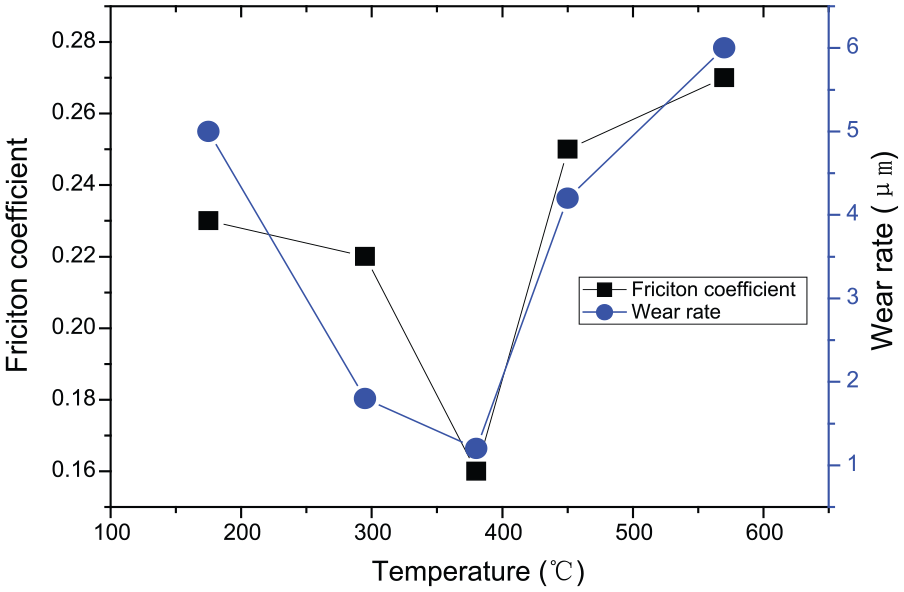
Influence of temperature on the friction and wear of a powder metallurgy friction material. 37
Overall, both the friction coefficient and the wear rate decrease at the beginning period. However, after the temperature reaches a certain value, both the friction coefficient and the wear rate begin to increase with the increase in temperature. In detail, it was pointed out that 37 when the temperature is within a low range, bumps on the interface of friction pair begin to mesh mechanically. Some bumps are broken and then debris is formed on the friction surface, which results in a relatively high friction coefficient and wear rate. With the increase in temperature, the friction interface is oxidized to form oxidation films, which is beneficial to protect the friction material from contacting directly with the weakened asperities of brake disk. The oxidation films have significant effects on lubrication as well. Thus, both the friction coefficient and the wear rate decrease continuously. When the temperature keeps going up, these thickened films will be destroyed and accustomed to hard abrasives. As a consequence, the friction coefficient and wear rate increase gradually.
Influence of braking pressure on friction and wear of brake’s friction materials
The braking pressure affects the friction and wear through the size and deformation of actual contact area. According to modern tribology, the friction force depends on the size of actual contact area. 38 The number and size of the contact point will increase with the increasing braking pressure. If the contact between interface is plastic, the friction coefficient will be independent of braking pressure. Nevertheless, the contact is elastic–plastic actually. Besides, the braking pressure will also affect other factors such as temperature and lubrication. Since the actual contact area is not proportional to the braking pressure, the friction coefficient is not proportional to the braking pressure. 39
Commonly, the influence approach of braking pressure to the friction and wear behaviors of friction materials can be concluded as four types: changing the actual contact area of friction pair, affecting the generation of friction films, influencing the component and organization of friction material, and changing the wear type. 40 Among which, the first two types are generally considered as the most important factors. Under a low braking pressure, the friction films are hard to be formed on the interface. With the increasing braking pressure, the asperities distributed on the contact interface are deformed and broken to form some debris. The debris is easily staved to form some loose granular films to increase the actual contact area. Then, the friction resistance is strengthened, which results in an increment of friction coefficient. 41 When the braking pressure increases to a higher value, more debris will be formed, embedded, stacked, and filled into the worn surface to generate more granular films. Gradually, these loose granular films may connect each other to form a dense sheet film with a larger area. 35 The friction film acts as a lubrication film on the interface, which reduces the meshing force to decrease the friction coefficient. 42 In addition, more heat will be generated under a higher braking pressure, which undermines the material structure to increase the oxidation wear of friction material. 43 For example, Bao et al. 41 studied the friction and wear behaviors of a nonasbestos organic friction material under different braking pressures. The variations of friction coefficient and wear rate are shown in Figure 7, and the SEM micrographs of the worn surface are shown in Figure 8. It can be seen that the friction coefficient increases first and then falls off with the increasing braking pressure. However, the wear rate keeps increasing with the increasing braking pressure.

Influence of braking pressure on the friction and wear of an organic friction material. 41

SEM micrographs of the worn surface under different braking pressures. 41
Many researches about the influence of braking pressure on the friction and wear properties of powder metallurgy materials were also conducted. However, in most researches, the rotation speed of brake disk was kept constant. For example, Wang et al. 44 investigated the variation laws of friction coefficient and wear rate of a copper-based powder metallurgy for train’s brake when the braking pressure is increased from 0.49 to 0.98 MPa while the speed is maintained stationary. It was found from Figure 9 that when the braking pressure is within a low range, the increase in temperature will not be obvious, and the strength of matrix material decreases slightly; so, the friction coefficient is relatively high. 44 With a further increase in braking pressure, the temperature will increase gradually, which decreases the strength of matrix materials. Thus, the friction coefficient declines continuously, and the wear rate keeps increasing.
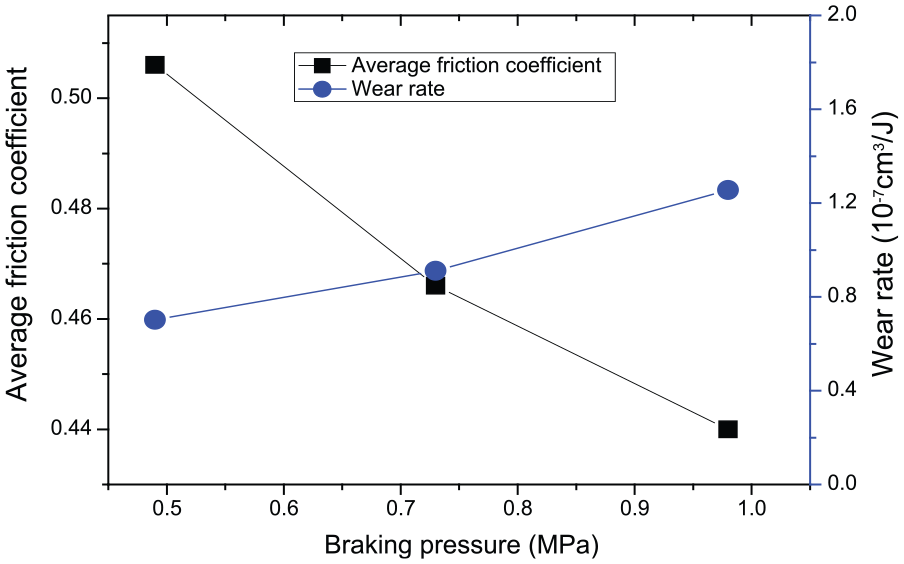
Influence of braking pressure on the friction and wear of a powder metallurgy friction material. 44
Influence of initial braking speed on friction and wear of brake’s friction materials
As the actual contact area of friction pair is much lower than its nominal contact area, the direct influence of initial braking speed on the friction behaviors can be ignored. However, the initial braking speed has greater influences on friction heat, frictional and wear strength, and surface structure. Therefore, the initial braking speed must still have important influences on the tribological properties of brake’s friction materials. For example, Deng et al. 43 studied the friction coefficient and wear rate of a C-C-SiC composite friction material at different initial braking speeds. The results are shown in Figure 10, and the optical microscopy (OM) micrographs of the worn surface at different braking speeds are shown in Figure 11.

Influence of initial braking speed on the friction and wear of an organic friction material. 43

OM micrographs of the worn surface under different braking speeds. 43
It can be found that with the increase in initial braking speed, the friction coefficient increases first. After the speed reaches a certain value, the friction coefficient decreases slowly and finally remains steady. While the wear rate increases continuously with the increasing initial braking speed, it has a slower increasing rate at the medium speed period. The difference in friction and wear behaviors under different braking speeds comes mainly from the friction temperature on the interface. 35 Under the braking with a low speed, the friction films have not yet been formed. The absorbed moisture and oxygen lubricate the contact interface to cause a low friction coefficient and wear rate. 42 When the initial braking speed increases, a higher temperature will evaporate the moisture. 45 In addition, more asperities will be deformed, shorn, and fractured to form friction films, which add the actual contact area and results in an increment of friction coefficient. 46 However, with a further increase in initial braking speed, the surface temperature may be high enough for the surface material to be thermally decomposed, which will then result in the rapid decrease in friction coefficient and an obvious increase in wear rate.
The influence of temperature on the tribological properties of powder metallurgy friction materials is extremely different from that of organic friction materials. Since the temperature increases with the increasing initial speed, both of its influences on the friction coefficient and wear rate are similar. For example, Han et al. 47 investigated the influential relationship between initial braking speed and tribological performance. The influence of initial braking speed on the friction and wear properties of a powder metallurgy material with 6% SiO2 is shown in Figure 12, and the SEM micrographs of the worn surface with different braking speeds are shown in Figure 13.
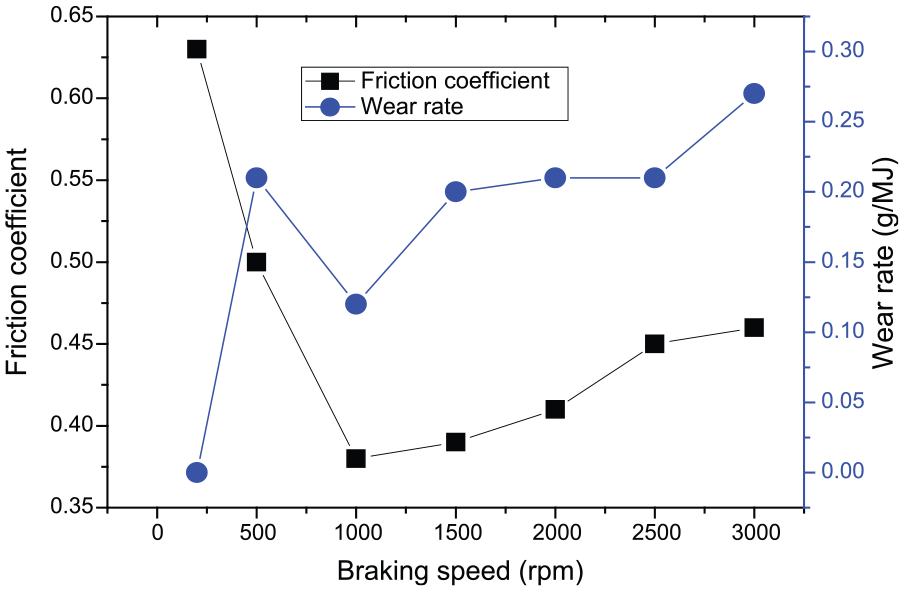
Influence of initial braking speed on the friction and wear of a powder metallurgy friction material. 47
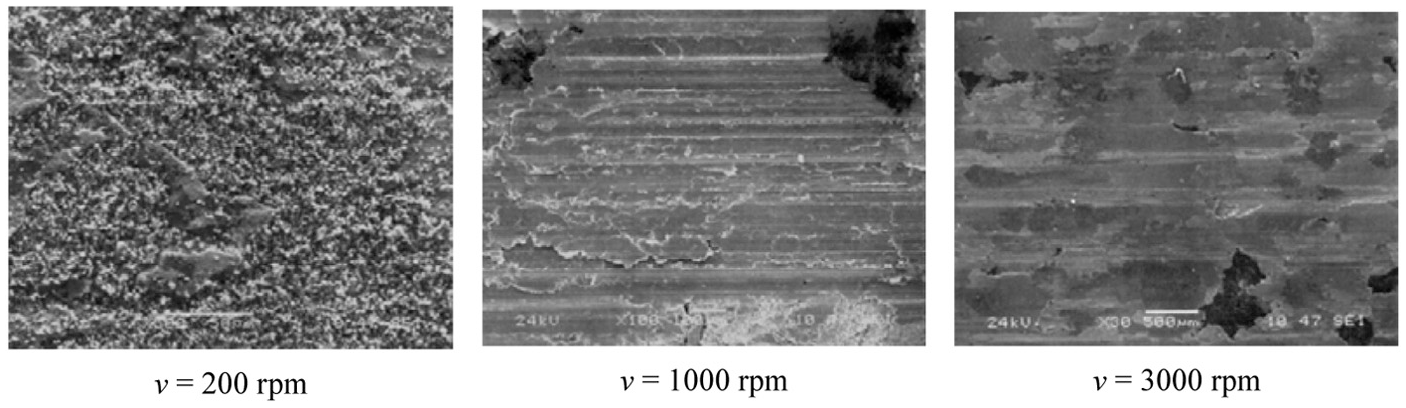
SEM micrographs of the worn surface under different braking speeds. 47
It was found that with the increment of braking speed, the friction coefficient decreases at first and then increases slightly. The wear rate goes up before the speed reaches to 500 r/min, decreases when the speed changes from 500 to 1000 r/min, and then increases slightly again. By analyzing of the friction mechanisms, it can be found that the film developed on the friction surface has an important effect on the friction between interface. When the speed is <500 r/min, there is some granulated debris, which makes the friction coefficient relatively high. Then, with the increase in speed, the debris becomes rather dense and has a role of lubrication. Thus, the friction coefficient decreases and maintains a low value.
Prospects of brake’s tribology
As a dynamic mechanical process, the friction and wear in a braking are affected by many factors along with time. These factors are strongly interacted to form a complex tribological process. Although it had achieved many developments in the brake’s tribology, some further works still should be performed to perfect brake materials:
On one hand, the friction and wear mechanisms of brake’s friction materials should be further explored. For examples, the classical adhesive friction and wear theories should be modified, the forming and evolving mechanisms of friction films should be investigated, 48 the friction surface topography may be characterized by fractal theories 49 or cellular automata, and so on.
On the other hand, instead of being deduced from friction and wear mechanisms, the relationship between tribological behaviors and influential factors may be presented more simply and intuitively based on artificial intelligence technologies such as artificial neural network,50–53 fuzzy algorithm, expert system and gray theory, 54 and so on.
Footnotes
Academic Editor: Francesco Massi
Declaration of conflicting interests
The author(s) declared no potential conflicts of interest with respect to the research, authorship, and/or publication of this article.
Funding
The author(s) disclosed receipt of the following financial support for the research, authorship, and/or publication of this article: This study was financially supported by the National Natural Science Funds of China (grant no. 51205393), the Tribology Science Fund of State Key Laboratory of Tribology (grant no. SKLTKF15A08), the Innovation Funds of Xuyi Mine Equipments and Materials R&D Center of CUMT (grant no. CXJJ201302), and the Priority Academic Program Development of Jiangsu Higher Education Institutions.