




Abstract
A compression ignition engine with a mechanical fuel system was converted into common rail fuel system by means of a self-developed electronic control unit. The engine was modified to be operated with mixtures of diesel and natural gas fuels in dual-fuel mode. Then, diesel fuel was injected into the cylinder while natural gas was injected into intake manifold with both injectors controlled with the electronic control unit. Energy content of the sprayed gas fuel was varied in the amounts of 0% (only diesel fuel), 15%, 40%, and 75% of total fuel’s energy content. All tests were carried out at constant engine speed of 1500 r/min at full load. In addition to the experiments, the engine was modeled with a one-dimensional commercial software. The experimental and numerical results were compared and found to be in reasonable agreement with each other. Both NOx and soot emissions were dropped with 15% and 40%, respectively, energy content rates in gas–fuel mixture compared to only diesel fuel. However, an increase was observed in carbon monoxide emissions with 15% natural gas fuel addition compared to only diesel fuel. Although smoke emission was reduced with natural gas fuel addition, there was a dramatic increase in NOx emissions with 75% natural gas fuel addition.
Introduction
Fast extinction of fossil fuels and increasing oil prices impose engine manufacturers to work on alternative fuels and power trains. 1 Due to the negative effects of petroleum-derived fuels on the environment and human health, studies on alternative, reliable, and environmental fuels have become an inevitable requirement. 2 Nowadays, an important part of the energy requirements in the transport sector is still covered by fossil fuels. In spite of Kyoto Protocol, carbon dioxide (CO2) emissions increased by 27%, while the amount of CO2 emissions stemming from transport vehicles increased by 37% in the world between 1990 and 2004. 3
More rigorous emission regulations are demanding nearly “0” NOx emissions. 4 Despite high efficiency of diesel engines, they have a disadvantage in terms of NOx and soot particles emissions. 5 NOx gases react to form soot and acid rain which are really hazardous for human health. The soot particle emission increases heart and vascular-related death rates, affects lung development in children, and leads to a number of other health problems. 6 Diesel engines use selective catalytic reduction (SCR) and diesel particulate filter (DPF) in order to reduce NOx and soot particle emissions. However, owing to the high cost of catalyst materials, orientation through alternative gaseous fuels has become essential. 7 In parallel with these developments, automotive sector has started to work on the improvement of performance, exhaust emissions, and combustion characteristics with the use of alternative fuels in engines.1,8 Among alternative fuels, alcohols, vegetable oil, liquefied petroleum gas (LPG), compressed natural gas (CNG), liquid natural gas (LNG), air gas, biogas, and hydrogen have been considered.
Alternative fuels should be examined in terms of their potential, source, fuel supply, safety, toxicity, health hazard, engine performance, emissions, storage, and easy availability. Natural gas, satisfying many of these criteria, is an important alternative fuel that may be used as a substitute fuel in internal combustion engines (ICEs). Easy availability, having more reserves than oil, lower costs, cleaner combustion characteristics, lower vehicle emissions in addition to the existence of distribution systems make natural gas an extremely convenient alternative fuel. While the composition of natural gas varies depending on the country, the main component (90%–96%) CH4 (methane). The rest is composed of 2.41% C2H6 (ethane), 0.74% C3H6 (propane), 0.37% C4H10 (butane), 0.78% N2 (nitrogen), 0.16% C5H12 (pentane), and 0.08% CO2. 9 A way to capture the high emission standard in diesel engines is to change diesel fuel with a cleaner, low carbon alternative fuel. 6 Furthermore, although CNG is a fossil fuel, a reduction of up to 25% can be observed in greenhouse gases due to methane’s low C:H ratio. 10
Methane has low flame speed and narrow flammability limits. 7 Reduction in CO2 emissions has been observed compared to gasoline and diesel fuels with the same energy value due to its lower carbon content.11,12 Because of 540°C self-ignition temperature and narrow flammability limits (5%–15%) of CNG (a clean fuel consisting largely of methane gas), ignition is usually provided by pilot diesel injection in diesel engines. 4
Biogas, produced by anaerobic fermentation of organic matter, is another alternative energy source. It mainly consists of methane and contains a high proportion of CO2 and, therefore, considered as a fuel having low thermal energy. Due to its high octane number, biogas can be used to achieve higher efficiency in high compression ratio engines. Therefore, biogas can easily be used in dual-mode diesel engines. However, long ignition delay, lean mixture at low loads, low flame speed, and low thermal efficiency problems are encountered due to high CO2 content. 13 Furthermore, CO amount increases in studies with biogas compared to natural gas and NOx amount decreases. 14
The application of natural gas in vehicles is difficult due to their low range and requirement for a high pressure tank, which may be more suitable for buses. The use of natural gas fuel in city traffic is advantageous in terms of low emissions and soot particles. In addition, through the use of natural gas in spark ignition (SI) engines for typical compression ratios between 10 and 12, the cylinder pressure reaches 90 bar, and spark plug gap tension leads to nearly threefold at full load in a supercharged engine. To overcome this problem, it is more appropriate to ensure ignition by a small amount of diesel pilot injection. 12 Moreover, efficiency reduces due to the usage of natural gas at partial load in SI engines, throttle existence in Otto engines, and low compression ratios. 12
Combustion of methane and diesel at dual mode takes place in three modes: pilot diesel combustion, combustion of methane around the diesel spray, and the progress of the flame in methane–air mixture. Extremely poor mixture, flame extinction zone increase, and incomplete combustion for all three sections at low loads can result with the increase in HC and CO emissions. 10
Homogeneous charge compression ignition (HCCI) engines could be the solution to reducing both NOx and soot emissions because they have very low NOx emission and particulate emission which is almost 0. They carry superior features of diesel and Otto engines. Since premixed and lean mixture self-ignite with high compression rate, HCCI engines have many advantages such as low emission, high thermal efficiency, and high heat rate. However, the biggest disadvantage of them is difficulty in controlling starting point of ignition in a wide range of speed and load. 4 To overcome this challenge of HCCI, the combustion phase has been controlled with variable valve timing (VVT) and exhaust gas recirculation (EGR). However, the most effective method to control combustion is to inject pilot diesel. 10 Studies having the use of natural gas fuel in ICEs are summarized as follows.
Cordiner et al. 15 converted a heavy-duty compression ignition (CI) engine to dual-fuel operation and introduced diesel and natural gas mixture (natural gas charged homogeneously) into a CI engine and small amounts of diesel is injected near top dead center (TDC). A heavy-duty diesel engine is converted to dual-fuel operation in that study. By taking into account of obtained experimental results, they conducted three-dimensional (3D) simulations with modified version of Kiva 3V. Zhang et al. 16 tested influence of dissolved methane in diesel fuel on engine performance and emissions in a single-cylinder, direct-injection diesel CI engine. They observed that maximum heat release rate decreased while ignition delay increased with an increase in methane concentration. Diesel fuel containing dissolved methane releases less NOx, and the released smoke depends on methane concentration. Raihan et al. 17 observed the effect of diesel injection timing, boost pressure, and diesel fuel injection pressure on a diesel–methane dual-fueled engine. They tested diesel–methane dual fuel at 1500 r/min constant engine speed, 80% engine load (5.1 bar indicated mean effective pressure (IMEP)), between 250°crank angle (CA) and 350°CA injection advance, between 200 and 1300 bar diesel injection pressure, and at 1.1–1.8 bar boost pressure. Zhang et al. 18 studied a six-cylinder, diesel-piloted direct-injection natural gas engine at idle condition for two different injection intervals (0.7 and 1 ms) at 4–13 before top dead center (BTDC) natural gas injection advance for three different pressures (15, 18, and 24 MPa). According to their test results, ignition delay shortened with increasing injection pressure and rapid combustion duration extended with the increase in injection advance. Studies using biogas and LPG fuel in ICEs are summarized in next paragraph.
Tira et al. 19 injected 60% CH4 and 40% CO2 by volume into intake manifold. According to their obtained results, NOx, particulate matter (PM), and smoke decreased, but combustion stability has been ruined, and CO and total hydrocarbon (THC) emissions increased. Accordingly, they added synthetic gas to liquid to improve combustion stability emissions. Bora and Saha 20 studied a single-cylinder, four-stroke, direct-injection, naturally aspirated CI engine at full engine load and 16 different combinations (23, 26, 29, and 32°BTDC; 18, 17.5, 17, and 16 CR) with biogas–diesel dual fuel. Best results were obtained thermodynamically with 29°BTDC and 18 CR.
A single-cylinder, naturally aspirated, mechanical injector system, prototype, CI engine is developed for this study in Yildiz Technical University in partnership with the companies of Şahin Metal and Erin Motor. It is converted into common rail diesel fuel system as a first work. By the help of self-developed hybrid electronic control unit (ECU), not only it can operate with only diesel fuel when needed, but it can also operate with diesel–natural gas fuel if necessary. Natural gas mixture is injected into intake manifold of the test engine, and ignition is supplied with diesel injection. In this way, effect of different levels of natural gas on engine performance, emissions, and combustion characteristics is studied in detail at constant engine speed and wide range (0%–75% natural gas on energy basis). Our aim is to experimentally investigate determination of optimum natural gas energy level for natural gas–diesel fuel mixture engine operation mode.
Experimental setup
Test engine and dynamometer
Schematic diagram of the experimental setup is shown in Figure 1. Properties of test engine can be listed as follows: single-cylinder, 1.16 L, naturally aspirated, four-stroke, CI engine. Test engine is developed by Yildiz Technical University. Water cooled, 40 kW dynamometer (American Petroleum Institute (API): eddy current type) was used to load test engine, and varying magnetic field engine brake torque was controlled. During tests, engine speed (r/min) of dynamometer was inspected with convenient proportional–integral–derivative (PID) coefficients experimentally. Table 1 depicts specifications of the test engine and engine dynamometer. Conversion of a single-cylinder, mechanic diesel fueled engine into a common rail fuel system is performed as shown in this figure. An electromagnetic diesel injector (Bosch) is installed perpendicularly to cylinder head, because previous mechanic diesel injector was perpendicular to cylinders. Pulverization angle of diesel injector is the same as mechanical injector (145°) and reaches mechanical injector with regard to pulverization flow rate. By utilizing a fuel pump (Denso) and a fuel rail (for common rail), diesel fuel is stabilized at 1000 bar pressure in rail. Diesel fuel meets EN 590 standards. Natural gas fuel, which is composed of above 90% methane and other gases such as pentane, propane, butane, nitrogen, and so on was purchased from HABAŞ Company at compressed form (200 bar) in steel tanks for this study. Self-developed ECU controls fuel metering control valve of high pressure fuel pump and fuel rail pressure control valve and solenoid injector. After required modifications have been done, a CNG injector (Keihin) was installed on intake manifold. A fuel rail was positioned from outside laboratory till engine. Self-developed hybrid ECU controls both diesel and gas injectors. A miniature oval gear-type flow meter (Biotech, VZS-005-Alu) measures diesel fuel consumption while a hotwire-type mass flow meter (New-flow TMF series) measures natural gas consumption. Cooling water inlet and outlet temperatures and also exhaust temperature are measured by thermocouples (K-type). A pressure-sensor (Kistler 6052C) is used so as to measure cylinder gas pressure. Crank angle was specified via an incremental type encoder. A charge amplifier (Kistler) and a digital oscilloscope (Lecroy) were other equipment utilized during tests. The load cell of eddy current dynamometer, turbine-type diesel flow meter, methane flow meter, an exhaust analyzer (AVL Dicom 4000), and a smoke analyzer (AVL 415S) were linked to data acquisition card (USB type NI6215). By means of LabView software, a program was developed, and NI card was attributed to a personal computer. Tests were performed in the laboratory of Yildiz Technical University. Also, the test cell was adapted for methane gas usage.

Schematic diagram of the experimental setup.
Technical specifications of the test dyno and test engine.

Gas fuel line
Figure 2 illustrates schematic diagram of gas fuel system. A high pressure type steel tank was used to store natural gas at 200 bar gas pressure. A double stage type, stainless steel gas pressure regulator was used to decrease the gas fuel mixture pressure. Steel tank was located outside the laboratory. In order to avoid probable backfiring, a solenoid gas valve (that can also be operated as shut-off valve) was installed on gas fuel system. A quick-connect type equipment acting as a check valve is set before the gas fuel has been injected into intake manifold. A relief valve was placed on gas fuel system to be able to discharge gas fuel out of laboratory if overpressure is seen. Line pressure is regulated by means of a line-type pressure regulator. A rotameter and a thermal mass flow meter were calibrated according to natural gas mixture. Hydrogen is injected into intake port by a CNG injector (Keihin). All equipment (such as fittings, valves, and gas tube) of CNG fuel system is 316 stainless steel. The line is resistant to 350 bar gas pressure.

Schematic diagram of the gas fuel system.
The self-developed hybrid ECU
Figure 3 depicts schematic diagram of self-developed hybrid ECU. Self-developed hybrid ECU was used to control both diesel and gas injectors. Energy of diesel and gas injectors was supplied by a 12-Volt, DC-type power supply. The self-developed ECU operates with a Pic microcontroller. Signals generated by incremental encoder help ECU to control both gas and diesel injectors. Two signal outputs of encoder control both injectors: first one generates 360 pulses per revolution and second one generates a single pulse per revolution (called as zero signal). The zero signal determines reference position of piston. The injection advance of gas injector was set at TDC at the outset of intake stroke. The injection advance of diesel injector was set to 28°BTDC during compression stroke. Two microcontroller boards (Ardunio-Due) were used to change injection duration of both injectors: first one changes the injection duration of diesel injector, and the second one changes the injection duration of gas injector according to obtained signals from encoder.

Schematic diagram of the self-developed hybrid ECU.
Tail-pipe emission measurement
CO, THC, and NOx emissions were measured by exhaust gas analyzer (AVL Dicom 4000), and the smoke emission was measured by smoke analyzer (AVL 415S). AVL Dicom 4000 measures CO and THC emissions as %volume, NOx emissions as ppm. AVL 415S measures as filter smoke number (FSN) or mg/m3. Brake engine torque and brake engine power were fixed at 75.7 N m engine torque and 1500 r/min engine speed, for that reason, emission units were not converted into brake-specific emissions.
Data reduction
Data obtained during experiments are used to calculate the parameters with equations below. A single-zone and zero-dimensional rate of heat release model was used in this study. The combustion process was analyzed via heat release equation as described by Krieger et al. 21

where
Value on load cell is read and brake engine torque is calculated using this value. By measuring arm length, load cell is attached to as follows 22

where T is the brake engine torque (N m), F is the force (N), and b is the arm length (m).
Test engine was loaded by eddy current type dynamometer. Brake engine power was calculated using brake torque and angular speed 23

where Pb is the brake engine power (kW), ω is the angular speed of the engine (rps), and T is the brake engine torque of engine (N m).
Engine brake thermal efficiency (BTE) value is calculated by means of engine brake power, fuel consumption per unit time, and lower heating value (LHV) values 24

where ηBT is the engine BTE value (percentage), Pb is the brake engine power value (kW),
Total brake-specific fuel consumption of the engine was calculated by means of equivalent diesel amount of consumed hydrogen and methane according to lower heating values of natural gas and diesel. Diesel mass flow rate is added to equivalent diesel fuel mass flow rate of natural gas. Total brake-specific fuel consumption (BSFC) was calculated based on equivalent diesel amount as follows 25

where BSFC is the total brake-specific fuel consumption (g/kW h),
Total uncertainty analysis values and measurement accuracies of equipment are calculated using Kline and McClintock method 26

where WR is the total uncertainty value, R is the given function, x1, x2, …, xn are independent variables, and w1, w2, …, wn symbolize uncertainty value of each independent variable.
Modeling of dual-fuel engine
A single-cylinder, four-stroke, naturally aspirated, direct-injection engine is modeled via Boost program at dual-fuel mode. Since the diesel engine will be used in dual mode, an injector is positioned in the inlet manifold in order to send natural gas fuel. One-dimensional (1D) engine model of engine in Boost program is depicted in Figure 4. On the other hand, taking advantage of using MATLAB, model of diesel injector fuel spray pattern has been created and entered into Boost Program. As seen in Figure 5, obtained rate of injection model has been given in AVL MCC injector model. Since results are gathered via a 1D program and high rate of natural gas is used, results are found in an acceptable agreement. Moreover, at all test points, difference between values such as power, IMEP, emission, BSFC does not exceed ±10% deviation.
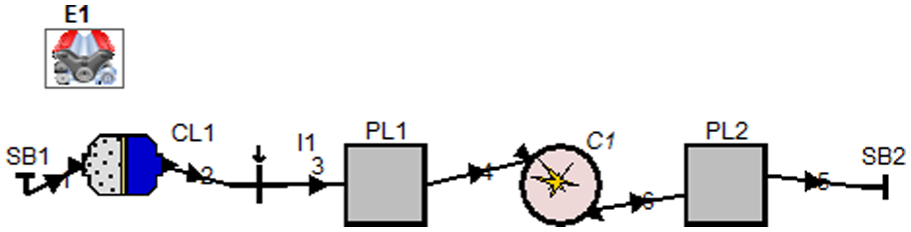
1D engine model of gas fuel mixture + diesel fueled diesel engine with Boost software.

AVL MCC injector model (normalized rate of injection) of diesel injector.
Experimental procedure
All engine tests were carried out at the European stationary cycle (ESC) at 1500 r/min, which corresponds to C engine speed for the CI engine, at different natural gas energy fractions. Obtained results at 0%, 15%, 40%, and 75% natural gas energy content and 100% engine load conditions are compared with each other both experimentally and theoretically. First of all, the CI engine was operated with pure diesel fuel until it reaches the steady-state operating conditions, and then different energy levels of hydrogen and methane gas mixture fuel were tested. Natural gas is sent as 0%, 15%, 40%, and 75% of total fuel energy. The diesel fuel was injected into cylinder and the injection advance of diesel fuel was kept at 28°BTDC during compression stroke. The gas fuel (hydrogen and methane) was injected into intake manifold at TDC during intake stroke. The summary of test conditions is given in Table 2. Backfiring, pre-ignition, or knock problems were not seen during engine tests. Measurement accuracies and calculated uncertainties are shown in Table 3.
The summary of test conditions.

BTDC: before top dead center.
Measurement accuracies and calculated uncertainities.
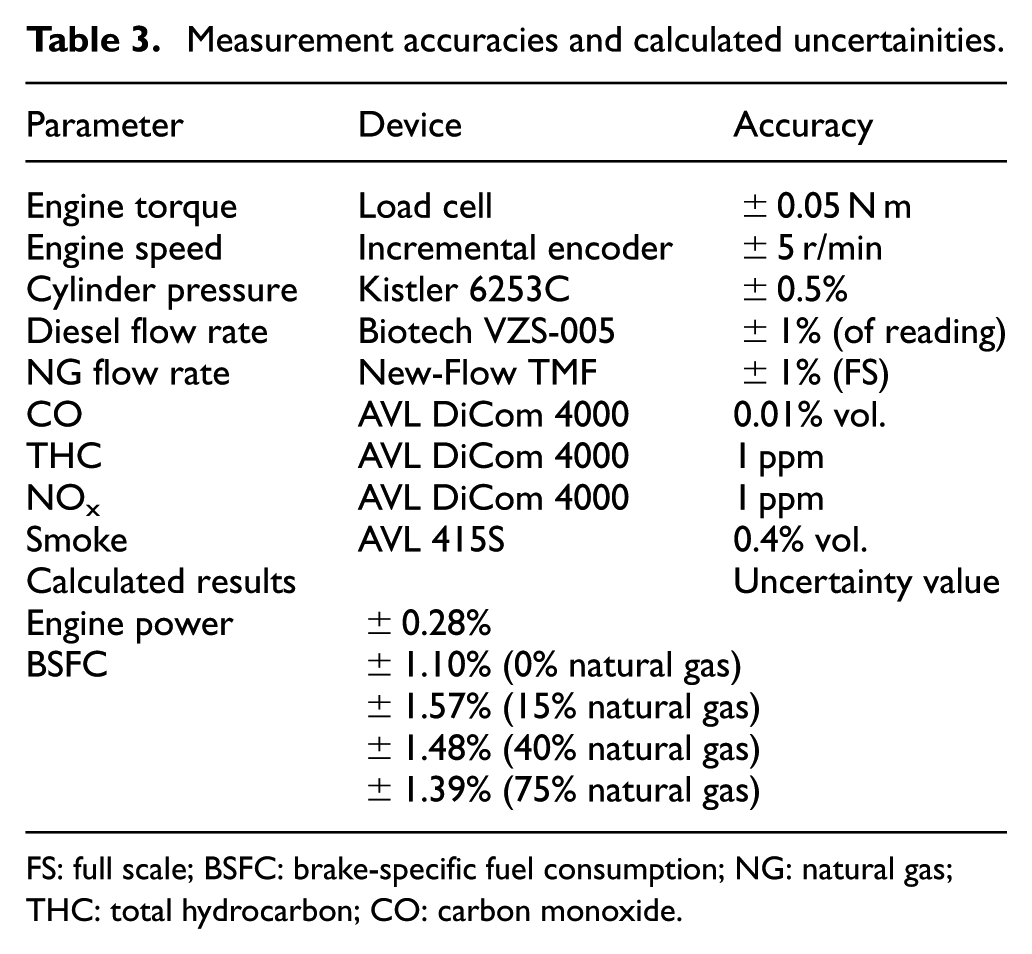
FS: full scale; BSFC: brake-specific fuel consumption; NG: natural gas; THC: total hydrocarbon; CO: carbon monoxide.
Results and discussion
Emissions, performance, and combustion characteristics of a hydrogen and methane enriched diesel engine at 1500 r/min engine speed and 100% engine load are investigated in this study. The test-bench and the CI engine were adapted to operate with hydrogen and methane fuel mixture.
In this study, the effect of 0%, 15%, 40%, and 75% natural gas addition on energy basis is investigated at 1500 r/min constant engine speed (equal to C engine speed of ESC) experimentally. Effect of natural gas delivery into intake manifold by gas injectors on emissions, performance, and combustion characteristics is surveyed in a prototype diesel engine. After required modifications had been done, CI type engine was manufactured as a prototype with a mechanically controlled fuel system which is converted into a common rail fuel system. By means of self-developed hybrid ECU which controls diesel and gas injectors, energy content of gas and diesel fuel is adjusted, and energy content increased to 75%. A small amount of hydrogen is blended with methane (30% of gas fuel in volume basis, energy value extremely low) and is injected via pilot diesel pulverization in diesel engine; consequently, a considerable improvement is achieved in emissions. Due to hybrid controlled ECU technology, gas and diesel injectors are controlled. With simple modifications, actual mechanical diesel engines are being converted. During the experiments, natural gas energy content of the fuel mixture did not exceed 75%, due to the fact that, after this value the engine suffers from combustion stability.
BTE can be described as the percentage of brake power and fuel energy consumed by the engine. It demonstrates how input energy is converted into useful output energy efficiently. 27 The variation of the BTE according to several natural gas energy contents is shown in Figure 6. All BTE values are lower than only diesel fuel at dual-fuel engine operation. BTE value is 24.6%, 17.5%, 19.1%, and 22.7%, respectively, when natural gas is 0%, 15%, 40%, and 75%. Reduction in BTE value is 29%, 22%, and 8% compared to neat diesel fuel with 15%, 40%, and 75% methane addition on energy basis. The natural gas/air mixture is lean at diesel engine operations. It is difficult for pilot fuel to ignite and provide sufficient combustion of the mixture. Thus, the very lean mixture cannot be burned and is released with exhaust, and this situation concludes with poor fuel efficiency and lower BTE. 28 Slower burning rate increases the heat loss during combustion, causing a decrease in BTE due to the slower flame propagation speed. 29 Cheenkachorn et al. 30 researched the effect of dual fuel (diesel fuel and natural gas) between 1100 and 2000 r/min and resulted with a decrease in BTE at all cycles for dual mode. It should be noted that the results of Cheenkachorn et al. 30 are consistent with result of this study in terms of BTE.

Effect of different amount of natural gas addition on brake thermal efficiency.
Figure 7 shows the variation of BSFC according to 0%, 15%, 40%, and 75% natural gas energy contents of total fuel. After energy value of the consumed hydrogen has been calculated in terms of diesel fuel, the total energy value of the consumed fuel was estimated as diesel fuel, as seen in Figure 8. Although BSFC value is higher at all natural gas rates compared to only diesel fuel, as natural gas quantity increases, BSFC value decreases. BSFC value increases with natural gas–diesel fuel dual fuel compared to only diesel fuel. With increasing methane energy content, increase in BSFC value decreases. BSFC value is 343 g/kW h at 0% natural gas, 483 g/kW h at 15% natural gas, 442 g/kW h at 40% natural gas, and 373 g/kW h at 75% natural gas. Increase in BSFC value is 8.8%, 28.8%, and 40.8%, respectively, with 15%, 40%, and 75% methane addition on energy basis compared to neat diesel fuel. Cheenkachorn et al. 30 obtained similar results with this study.

Effect of different amount of natural gas addition on BSFC.
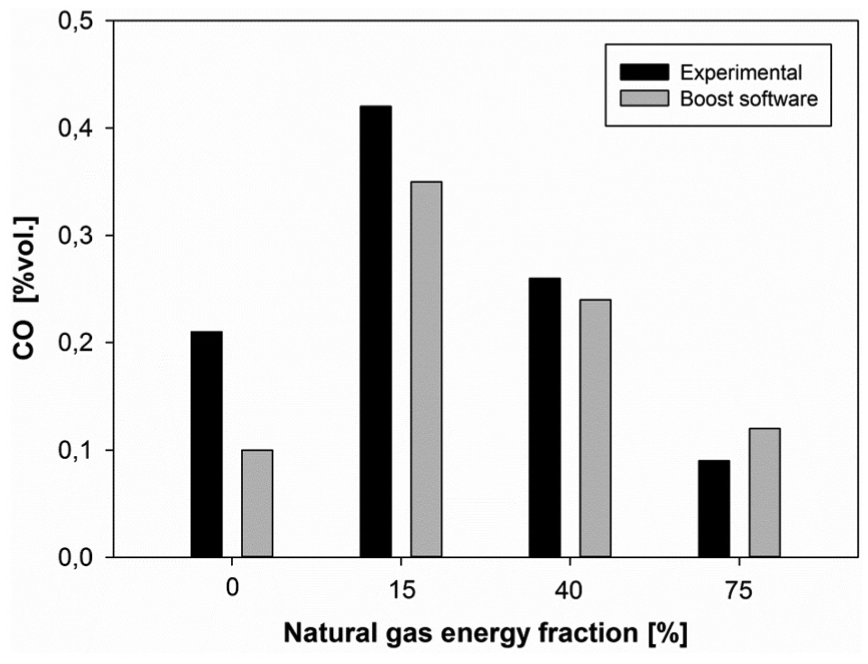
Effect of different amount of natural gas addition on CO emissions.
CO is another harmful emission released from the engine and it is formed as a result of incomplete combustion of fuel. 29 High CO emission is generally generated in rich fuel zone due to lack of oxygen. However, high CO can also be generated in lean fuel zone if the combustion temperature is less than 1450 K. 31 Figure 8 depicts the effect of natural gas addition on CO emissions. Based on obtained results, CO emissions increased by 100% and 23.8%, with 15% and 40% natural gas addition (as energy content) compared to only diesel fuel, respectively, on the other hand, CO emissions decreased by 57.1 % with 75% natural gas addition. Trend curves of experimental results are similar with boost results. Natural gas air mixture is blocked in the crevices, deposits, and quench layer because of a long period stay in the cylinder. 29 Blocked natural gas air mixture is released and cannot be wholly oxidized due to low temperature during the expansion stroke. Thus, CO emission increases remarkably with increasing natural gas mass ratio. Pilot diesel ignites natural gas air mixture under dual-fuel operation, and the flame has to accrue through the charge. In some regions of mixture is too lean to maintain flame accrual. Consequently, local temperature falls, CO oxidation reactions stop, and CO emission increases. 29 Egusquiza et al. 32 studied CO emissions under various substitution ratios of natural gas between 1600 and 2600 r/min engine speeds in a four-cylinder direct injection diesel engine. They realized that CO emission increased at dual-fuel operation mode remarkably. Cheenkachorn et al. 30 investigated CO emissions between 1100 and 2000 r/min in a heavy-duty diesel engine with natural gas/diesel dual fuel. They found out that CO emissions increased at dual-fuel operation for all engine speed ranges compared to normal diesel fuel operation. The results of Egusquiza et al. 32 and Cheenkachorn et al. 30 are parallel with the results of this study.
Hydrocarbons (HCs) are organic compounds formed as a result of incomplete combustion of HC fuel. The level of unburned HCs in exhaust gases is generally named as THC. 33 The variation of the indicated specific THC emissions for different natural gas energy contents is depicted in Figure 9. THC emissions increase in parallel with increasing natural gas energy content. THC value is 12 ppm at 0% natural gas, 36 ppm at 15% natural gas, 84 ppm at 40% natural gas, and 104 ppm at 75% natural gas. THC emissions increase 2, 6, and 7.6 times when compared to neat diesel fuel condition with 15%, 40%, and 75% methane addition on energy basis. Results obtained via Boost program is found to have close values with experimental results and has similar trend curve. Because of the valve overlap period, small part of natural gas air mixture is directly discharged during the scavenging process causing an increase in HC emission. 29 As similar with CO emission formation, HC is trapped in the crevices and flame quenching obstructs the unburned fuel to ignite in the latter part of the combustion process, causing an increase in HC emission. 29 The mixture is so lean and in-cylinder temperature is low especially at low engine load. It is difficult for combustion to proceed throughout the charge and the unburned mixture may result with higher HC emissions. 29 Shioji et al. 34 advised to increase pilot diesel fuel quantity so as to suppress HC emissions at medium and low loads. In studies of Papagiannakis and Hountalas,28,35 HC emissions are superior at full load condition and dual mode (natural gas (NG)–diesel), HC emissions increased at least 100 times at partial loads. Cheenkachorn et al. 30 found out that HC emissions increased significantly at dual mode. It should be seen that the results of Shioji et al., 34 Papagiannakis and Hountalas,28,35 and Cheenkachorn et al. 30 are parallel with the results of this study in terms of HC emissions.

Effect of different amount of natural gas addition on THC emission.
NOx is one of the most hazardous emissions released from diesel engine and it is composed of nitrogen monoxide (NO) and nitrogen dioxide (NO2). The formation of NO in the combustion zone is chemically complex and two typical mechanisms are involved: thermal mechanism (Zeldovich mechanism) and prompt mechanism (Fenimore mechanism). According to thermal mechanism, NO formation is affected by in-cylinder temperature and oxygen concentration. NO formation occurs when the temperature is above 1800 K. Its formation rate increases exponentially with increase of in-cylinder temperature.33,36 The prompt NO formation is only observed under rich fuel conditions where a reasonable amount of HC is anticipated to react with N2. The prompt NO has relatively weak temperature dependence in comparison with thermal NO.37,38 Under diesel engine combustion conditions, thermal mechanism is believed to be the predominant contributor to total NOx formation.39–41
Effect of natural gas addition on NOx emissions is shown in Figure 10. NOx emissions increased with rising natural gas energy content. NOx emissions increased by 14.5%, 2.5%, and 89.4% with 15%, 40%, and 75% natural gas addition compared to only diesel fuel, respectively. On the other hand, in terms of NOx emissions, obtained results via Boost software were quite close to experimental results and had similar trend curves. The specific heat capacity ratio of natural gas is higher than that of air. 29 The addition of natural gas increases the overall heat capacity of the in-cylinder mixture, accordingly, mean temperature at the end of compression stroke and during the overall combustion process reduce. The lower combustion temperature reduces NOx formation. Natural gas injection reduces the amount of air and concentration of oxygen in the cylinder charge, resulting with reduction in oxygen availability for NOx formation. On the other hand, greater intensity of heat release in the premixed combustion stage increases the maximum combustion temperature causing an increase in NOx emissions. 29 No increase is observed in NOx emissions with NG addition until a definite ratio, but NOx emissions increase with 75% NG addition. The reason of sharp increase in NOx emissions with 75% NG enrichment can be explained with two contrary explanations. In the first explanation, the addition of high level of NG (75%) increases heat capacity of mixture and it causes to decrease temperature at the end of compression stroke. In the second explanation, the addition of high level of NG causes to increase peak in-cylinder pressure and in-cylinder temperature due to high adiabatic flame speed and adiabatic flame temperature. According to two inversely correlated situations, the NOx emissions dramatically increased with 75% NG addition due to domination of increase in cylinder temperature. Egusquiza et al. 32 studied the effect of NG addition on NOx emissions in a four-cylinder diesel engine and found out that NOx emissions depend on engine load and NG quantity. Papagiannakis and Hountalas 35 studied on a naturally aspirated single-cylinder engine at two different engine speeds and four different engine loads (between 20% and 80%). NOx emissions reduced at dual mode for all working conditions.

Effect of different amount of natural gas addition on NOx emission.
Diesel particulates include combustion-generated carbonaceous materials (soot). Some of the particulate material occurs from incomplete combustion of HCs in fuel and others from lubricating oil. 33 The formation and oxidation of soot particles are in relationship with local temperature and oxygen concentration. Effect of natural gas addition on smoke emissions is shown in Figure 11. At full load condition, an improvement of 84.8%, 76.4%, and 64.1% is observed in smoke emissions with 15%, 40%, and 75% natural gas addition, respectively. Despite some differences with the experimental results, numerical results, obtained by Boost program, are within acceptable limits.

Effect of different amount of natural gas addition on smoke emission.
During dual-fuel combustion, most of the diesel fuel has been replaced by natural gas where the amount of pilot diesel is too little. 29 So, less diesel fuel is burned in diffusion mode while more fuel is burned in the premixed combustion. Consequently, soot formation is less and PM emissions reduce. Natural gas addition extends the ignition delay and provides more time for better fuel/air mixing. By this way, rich fuel area decreases and initial soot formation is prevented. 42 Since natural gas does not contain C–C bond, aromatics, and sulfur, it is not capable of producing soot emission. Combustion of homogenous natural gas air mixture fastens soot oxidation formed from combustion of pilot diesel, hence PM emission reduces. 29
Liu et al. 43 found out that no smoke is released at dual-fuel mode, low speed and low engine loads, and extremely low smoke is released at high loads compared to only diesel fuel. Liu et al. 44 investigated the effect of pilot diesel quantity on PM emission in another study, and concluded by stating that as pilot diesel quantity increases, PM emissions increase in parallel. Results of study belonging to Liu et al.43,44 are in good agreement with those of this study in terms of smoke emissions.
The summary of experimental results is given in Table 4 for different levels of natural gas enrichment.
Summary of experimental results.

FSN: filter smoke number; NG: natural gas; BTE: brake thermal efficiency; BSFC: brake-specific fuel consumption; THC: total hydrocarbon; CO: carbon monoxide.
Pressure transducers opened to combustion chamber are installed on cylinder head. In-cylinder gas pressure values obtained by these pressure transducers supply information about ignition delay, diesel noise, and in-cylinder pressure characteristics. 33 In-cylinder pressure values also provide data on indicator diagram, in-cylinder temperature values, heat release rate, and fuel burn rate.
Parameters as peak in-cylinder pressure and pressure rise rate are relevant to engine noise, vibration, and service life. 29 Figure 12 illustrates measured in-cylinder pressure data for several natural gas energy values. Maximum cylindrical pressure values are 82.6, 88.1, 98.2, and 104.2 bar for 0% natural gas, 15% natural gas, 40% natural gas, and 75% natural gas, respectively. The peak cylindrical pressure increases by 6.6% at 15% natural gas content compared to 0% natural gas, and it increases by 18.8% and 26.6% for 40% and 75% natural gas energy contents, respectively. The reason of this increase is rapid heat release of premixed mixture near TDC. 45 High flame speed of natural gas increases maximum cylinder gas pressure values based on fast combustion of combustible mixture already in cylinder. 46 Combustion noise increased because of high flame speed of natural gas depending on increase in hydrogen and methane gas mixture rate. Increasing gas fuel quantity converts combustion phase into an explosive-type combustion characteristic. Lounici et al. 45 reported higher peak in-cylinder pressures at dual-fuel operation conditions parallel to this study.

Variation of the in-cylinder pressure with crank angle according to several natural gas energy fractions at a 1500 r/min constant engine speed.
Heat release rate is used for combustion analysis which supplies data about in-cylinder combustion characteristic. To obtain detailed information about in-cylinder combustion characteristic, heat release rate should be interpreted together with emission and performance. So, effect of gas fuel energy content variation on heat release rate is also studied. The effect of different levels of natural gas (0%, 15%, 40%, and 75%) addition on rate of heat release at 1500 r/min engine speed and 100% engine load is shown in Figure 13. The peak heat release rate is 39.7 J/°CA for 0% natural gas, and as 50.5 J/°CA, 31.6 J/°CA, and 37.7 J/°CA for 15%, 40%, and 75% natural gas energy contents, respectively. The peak heat release rate increases by 27.2% at 15% natural gas content compared to 0% natural gas, but it decreases by 20.3% and 5% for 40% and 75% natural gas energy contents, respectively. There are four phases of conventional diesel engine combustion: ignition delay, premixed or rapid combustion phase, mixing controlled combustion phase, and late combustion phase. 33 During dual-fuel combustion mode, most of the diesel fuel is replaced by natural gas. Since the ignition delay is longer, there is a few or no mixing controlled combustion. Combustion characteristic changes totally when energy content of gas fuel reaches at 75%, difference between premixed combustion and mixing controlled combustion phases is no longer recognizable. Papagiannakis and Hountalas 28 found similar results with this study in terms of heat release rate.

Variation of the heat release rate with crank angle according to several natural gas energy fractions at a 1500 r/min constant engine speed.
The summary of combustion results is presented in Table 5 for different levels of natural gas addition.
Summary of combustion results.
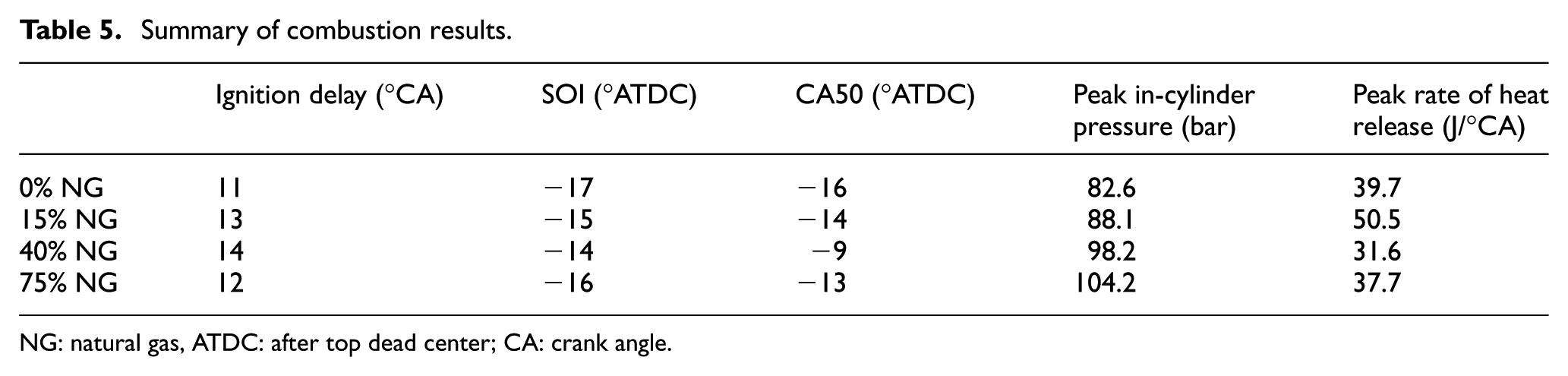
NG: natural gas, ATDC: after top dead center; CA: crank angle.
Conclusion
Engine performance regarding with brake-specific fuel consumption and BTE, and emissions of CO, THC, smoke, and NOx were tested in this experimental study. Combustion characteristic related with cylinder gas pressure and heat release rate was analyzed on a four-stroke, water-cooled, naturally aspirated, single-cylinder CI engine at 1500 r/min engine speed, 100% engine load, and different natural gas energy levels (0%, 15%, 40%, and 75%).
Obtained results are summarized briefly as follows:
The BSFC increased by 40.8%, 28.8%, and 8.8%, respectively with addition of 15%, 40%, and 75% gas fuel (natural gas) compared to only diesel engine.
CO emissions increased by 100% and 23.8%, respectively, with 15% and 40% natural gas addition as energy content compared to only diesel fuel while CO emissions decreased by 57.1% with 75% natural gas addition.
THC emissions increase 2, 6, and 7.6 times when compared to neat diesel fuel condition with 15%, 40%, and 75% methane addition on energy basis.
NOx emissions increased by 14.5%, 2.5%, and 89.4%, respectively, with 15%, 40%, and 75% natural gas addition compared to only diesel fuel.
At full load condition, an improvement of 84.8%, 76.4%, and 64.1%, respectively is observed in smoke emissions with 15%, 40%, and 75% natural gas addition.
Combustion characteristic changes totally when energy content of gas fuel reaches at 75%, difference between premixed combustion and mixing controlled combustion phases is no longer recognizable.
Numerical results were obtained by Boost program. Majority of them were in good agreement with experimental ones within acceptable limits.
Footnotes
Academic Editor: Jose Ramon Serrano
Declaration of conflicting interests
The author(s) declared no potential conflicts of interest with respect to the research, authorship, and/or publication of this article.
Funding
The author(s) disclosed receipt of the following financial support for the research, authorship, and/or publication of this article: This research was supported by the Yildiz Technical University Scientific Research Projects Coordination Department. Project Number: 2014-06-01-DOP05. Also, the authors are indebted to Şahin Metal A.Ş. and Erin Motor for test apparatus and equipment donation. The fifth author would like to thank the “Research Chair Grant” National Science and Technology Development Agency (NSTDA), the Thailand Research Fund (TRF) and the National Research University Project (NRU) for the support.