




Abstract
In this work, the effect of angle of attack
Keywords
Introduction
Energy is the basic ingredient needed to sustain life and development. Social, cultural and economic development of the people is seen to a great extent by the amount of per capita energy consumed and by the potency of the technological means with which it is converted to work.1,2 Conventionally, energy is being extracted from fossil fuels, large hydroelectric systems and fuel wood. The present energy scenario is biased towards the conventional energy sources, although it has been proven that these are finite in nature, economically out of reach to many growing countries and cause environmental degradation.3,4 The energy utilization pattern in the developing countries like India projects a scenario, which is also biased towards the energy available in urban areas. The rural areas are deprived of the calibre, energy sources, therefore making a broad gap between requirement and availability of energy. 5
Rectangular channel is one of the simplest and widely used types of heat exchanger in which heat energy is being exchanged between the heated wall and the air flowing through the system. The major drawback of rectangular channel use is the low overall thermal performance due to low heat transfer rate between the heated wall and the air.6,7 In order to attain higher thermal performance, it is important that the flow at the heat transfer wall should be turbulent. The baffle roughness has been used widely for the augmentation of forced convective heat transfer coefficient of solar air heaters (SAHs).8–10 Use of baffle roughness seems to be an attractive proposition for improving the local Nusselt number. 11 For detailed descriptions of some experimental investigations on rectangular channel with transverse baffle, inclined baffle, delta baffle, diamond-shaped baffle, V-pattern baffle and so on with different shapes, dimensions and orientations, readers may refer to some of the previous works.11–35
Molki and Mostoufizadesh
11
experimentally studied the Nusselt number and friction factor in a rectangular channel with repeated baffle blockages. The baffles are fitted in a staggered fashion with fixed axial spacing. Yeh et al.
12
experimentally and numerically studied the effect of aspect ratio
Lin 16 experimentally investigated the local heat transfer in rectangular channel with baffles and analysed the experimental results of heat transfer for baffle designed with different heights and pores in the event of five Reynolds numbers and three heating quantities. Nasiruddin and Siddiqui 17 investigated a significant Nusselt number in a heat exchanger tube by attaching a baffle into flow. Romdhane 18 studied the solar collectors and gave a comparative study on various techniques that favourize and increase the heat transfer coefficient between the caloporting fluid (air) and the absorber, the manner in which the air flows the absorber and the shape of the collector itself and those of the inlets and outlets. It was found that on introduction of suitable baffles in solar air collectors increases the couple efficiency-increase in temperature. The baffles placed in the air channel situated between the insulator and the absorber have the particularity of extending the trajectory of the circulation, to keep the caloporting air constantly in contact with the absorber, and finally to play the role of wings and improving the heat transfer from the absorber to the caloporting air. Nie et al. 19 studied the effects of a baffle on the Nusselt number from the arithmetical simulations of three-dimensional laminar forced convection stream adjacent to rearward-facing step in a rectangular channel.
Promvonge et al. 20 experimentally investigated the turbulent forced Nusselt number and friction factor loss behaviour in a high aspect ratio channel fitted with 60-V baffle. Sripattanapipat and Promvonge 21 numerically investigated the laminar periodic flow and heat transfer in a two-dimensional horizontal channel attached to two transverse staggered diamond-shaped baffles. The computations based on the finite volume method with the SIMPLE algorithm have been introduced for the fluid flow with Reynolds number ranging from 100 to 600. The author studied the effects of different baffles’ tip angles on heat transfer enhancement and pressure loss in the channel and found that the heat transfer enhancement for the 5° diamond-shaped baffle is 6% higher than that of the flat baffle.
Karwa and Maheshwari 22 experimentally carried out a study on fully and half-perforated baffles with Reynolds number values ranging from 2700 to 11,150. Half-perforated baffles having a relative pitch ratio (P/e) of 7.2 were found to have the utmost enhancement in performance of approximately 68.66% over a smooth wall for equivalent pumping power. Akpinar and Kocyigit 23 experimentally investigated the performance analysis of four SAHs with different obstacles and without obstacles for two air mass rates of 0.0074 and 0.0052 kg/s and compared the basis of the first and second laws of efficiencies. They reported that the efficiency of SAH depends on the surface geometry of collectors and solar radiation of air flow line. The collector efficiency increased with increasing mass flow rate and decreased as the temperature parameters increased.
Sriromreum et al.
24
through experimentally and mathematically studied the effect of the baffle on Nusselt number and friction factor in a rectangular channel having aspect ratio
Sara et al. 30 investigated the Nusselt number and the consequent friction factor over a flat wall in a rectangular channel flow by mounting perforated rectangular cross-sectional block. Karwa et al. 31 experimentally studied the effect of Nusselt number in a rectangular channel with perforated or solid baffle mounted on single of the broad walls. Mousavi and Hooman 32 experimentally and numerically investigated the laminar fluid flow and heat transfer in the entrance region of a two-dimensional horizontal channel with isothermal walls and with staggered baffles. The results were reported for Reynolds number ranging from 50 to 500 and baffle heights between 0 and 0.75. It was observed that the Reynolds number is influential on the location of the periodically fully developed condition, as well as the blockage ratio. The two parameters affect the development in such a way that increasing any of the two will reschedule the development and subsequently increase the Nusselt number. Since the flow reattachment to the channel wall causes the washing of the wall, it results in grater values of the local Nusselt number.
Chamoli and Thakur 33 experimentally investigated the effect of geometrical parameters of the V-pattern perforated blocks on Nusselt number and friction factor of rectangular channel. Alam et al. 34 experimentally investigated the effect of geometrical parameters of the V-pattern perforated baffle on Nusselt number and friction factor of rectangular channel. Table 1 summarizes the experimental investigations of some important baffle arrangements investigated by the investigators.
Experimental investigations of various baffles’ rectangular channel in previous investigations.

The literature review shows that the transverse baffle shape enhances the heat transfer by stream separation and creation of vortices on the upwards and downwards of the baffles and reattachment of stream in inter-baffle spaces. The angle of transverse baffle rises the heat transfer more on account of the movement of vortices along the baffle wall and creation of a secondary stream cell close to the leading end, which results in local wall turbulence. V-down pattern baffle of an extended angled baffle benefits in the pattern of two secondary stream jets as compared to single in case of an angled baffle resulting in still upper heat transfer rate. Making a discrete in the inclined baffle is found to augment the heat transfer by disturbing the secondary stream and produce advanced level of turbulence in the fluid downwards of the baffles. It is hypothesized that discrete V-pattern baffle will rise heat transfer compared to without discrete V-pattern baffle. To the best of the author’s knowledge, the open literature does not contain a similar experimental study on a rectangular air channel with discrete V-pattern baffle on the heated plate.
Experimental details
To study the outcome of discrete V-pattern baffle turbulent promoter on the Nusselt number and friction factor of air flow, an experimental set-up was intended and made up in accordance with the guidelines recommended in American Society of Heating, Refrigerating and Air-Conditioning Engineers (ASHRAE) standard.
35
A schematic illustration and pictorial view of experimental set-up are shown in Figure 1. The air channel is 2000 mm extended with a stream cross section of

Systematic diagram of experimental set-up.
A galvanized iron (GI) sheet of 18 SWG size black painted in order to facilitate the heat transfer is used as a heated wall. Discrete V-pattern baffles were pasted on the base of the heated wall by means of epoxy resin. This plate formed the top wall of the channel. The bottom side of the rectangular channel is covered with smooth face using sun mica sheet. A calibrated orifice meter (having coefficient of discharge 0.62) connected to U-tube manometer using methyl alcohol as manometer fluid was used to measure the mass flow rate of air through rectangular channel. The control valves provided in the lines control the flow. Copper–constantan thermocouples were used for air and absorber plate temperature measurement. Such thermocouples are usually recommended for temperature measurement in the range of 0°C–400°C. 36 The thermocouple output is measured by a Digital Micro Voltmeter, connected through a selector switch to designate the output of the thermocouples in degree centigrade. To ascertain the accuracy of temperature measurement, thermocouples have been calibrated under laboratory conditions against a dry block temperature calibrated instant.
Figure 2(a) shows the photograph of the calibrator. The thermocouple to be calibrated was placed in the calibration bath where a constant temperature is maintained and the responses of the thermocouple and the standard probe were noted with the help of a digital temperature indicator for various pre-set values of the standard probe, and the error between the reading of standard probe and the thermocouple was calculated. If this error is more than certain limit of the calibrator, then the thermocouple is rejected, and if this error is less than the tolerance limit of the calibrator then the thermocouple is accepted. This process was repeated in several steps of increasing as well as decreasing temperature range. The calibration curve is presented in Figure 2(b); temperature scanners have been used to display the temperature of the heated plate and the inlet and outlet of air. The pressure drop through the test section of the rectangular channel was obtained by a micro manometer having a least count of 0.01 mm.

(a) Photographic view of dry block thermocouple calibrated and (b) calibration curve for thermocouple.
Range of parameters
The rectangular channel has an
For an exact roughness type, a family of geometrically alike roughness is possible to recognize by altering angle of attack while maintaining stable

(a) Discrete V-pattern baffle and (b) photographic view of discrete V-pattern baffle.
Range of parameters.

Raw data collection
The data collected have been used to compute convective heat transfer coefficient, Nusselt number and friction factor. Relevant expressions for the computation of the above parameters and some intermediate parameters have been given below.
Temperature measured
Weighted average plate air temperature
The mean temperature of the plate is the average of all temperatures of the heated plate

The mean air temperature

where
Mass flow rate measurement
The mass flow rate of air

where
Velocity of air through channel
The velocity of air

Equivalent hydraulic diameter

Reynolds number
The Reynolds number

Friction factor
The friction factor

where
Heat transfer coefficient
The heat transfer rate

The convective heat transfer coefficient

Nusselt number
The convective heat transfer coefficient

Validation of experimental data
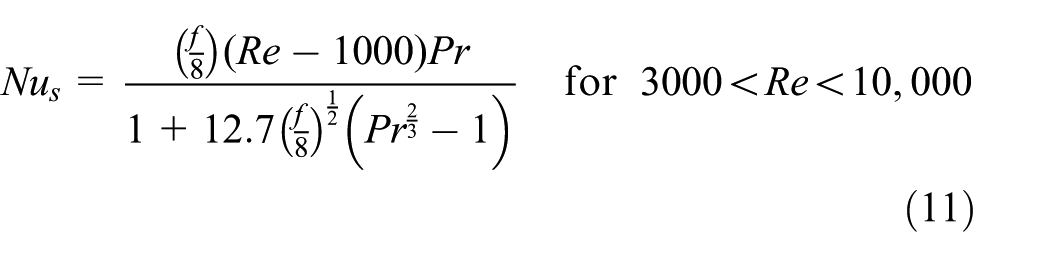
The values of Nusselt number calculated through the experimental outcomes for a smooth channel have been compared with the results obtained from the Gnielinski empirical correlation and Dittus–Boelter equations (equations (11) and (12)) for the Nusselt number.
The Nusselt number for a smooth wall is given by the Gnielinski empirical correlation and Dittus–Boelter equations as

where
The comparison of the experimental and the estimated outcomes of Nusselt number as a function of the Reynolds number is shown in Figure 4. It is observed that the outcomes obtained from the experimental results are in good agreement with the results obtained from equations (11) and (12). This ensures the correctness of the experimental outcomes obtained from this work. For the absolute percentage, deviation of the Nusselt number

Comparison of experimental and predicted values of Nusselt number.
Uncertainty analysis
An uncertainty analysis has been done to determine the errors occurred in experimental data collection. The uncertainty is determined based on the errors associated with measuring equipment. 37 The maximum possible calculated errors in the values of major parameter are shown below:
Friction factor:
Heat transfer coefficient:
Mass flow rate:
Nusselt number:
Reynolds number:
Results and discussion
The effect of angle of attack on Nusselt number and friction factor in a discrete V-pattern baffle channel was examined by plotting the baffle Nusselt number and friction factor as a function of Reynolds number. The outcome concerning the discrete V-pattern baffle channel has been compared with those obtained without baffle channel under similar operating conditions in order to find the augmentation of heat transfer.
Heat and fluid flow
The current experimental outcomes on heat transfer and friction factor in a constant heat flux rectangular channel with discrete V-pattern baffle are obtainable in the form of Nusselt number and friction factor in order to understand the outcome of Reynolds number and angle of attack in discrete V-pattern baffle on Nusselt number. The Nusselt numbers have been plotted as a function of angle of attack for the value of Reynolds number as shown in Figure 5. The other values of baffle parameters are kept as

Effect of Reynolds number on Nusselt number.
The Nusselt numbers obtained under turbulent stream conditions in all cases are represented in Figure 5. The Nusselt number rises with rise in Reynolds number as expected, due to rise in turbulent intensity with streamrise in Reynolds number, which leads to superior heat transfer. This is observed from Figure 5 that flow angle of attack value of 60° yields the greatest heat transfer enhancement. It has been observed that the Nusselt number rises with rise in angle of attack and attains a superior value corresponding to angle of attack value of
The reason for Nusselt number attaining a superior value corresponding to angle of attack of 60° is the separation of the secondary stream resulting through the presence of the baffle and the displacement of the resulting vortices combining jointly to yield best outcome of angle of attack. Due to this reason, by angling the baffle, the flow can move along the baffle with the fluid entry near the leading end of the baffle and coming out near the trailing end, and subsequently joining the mainstream, producing spanwise rotating secondary stream, which are accountable for the significant spanwise variation in the local Nusselt number. V-pattern of a long angled baffle helps in the formation of two secondary streams as compared to the one in the case of an angled baffle resulting in still superior Nusselt number.
Making discrete in the V-pattern baffle allows the release of the secondary stream which mixes with the mainstream through the discrete as shown in Figure 6. This results in its acceleration, which energizes the retarded boundary layer stream besides the wall resulting in the rise in the Nusselt number through the discrete width area behind the baffle. Figure 7 clearly shows that the maximum and minimum values of Nusselt number for discrete V-pattern baffle air channel occur for the angle of attack of 60° and 30°, respectively.

Secondary stream pattern for discrete V-pattern baffle.

Effect of angle of attack on Nusselt number.
Enhancing the Nusselt number by application of baffle roughness will rise the friction factor which boosts the pumping power needs. The variation in friction factor as a function of Reynolds number for different values of angle of attack and kept values of other roughness shape parameters is shown in Figure 8. The value of friction factor rises with an increase in angle of attack and attains an utmost value corresponding to angle of attack value of 60° and decreases with further rise in angle of attack value. In order to elaborate the effect of angle of attack on friction factor, Figure 8 has been replotted as Figure 9. The friction factor rises with rise in angle of attack, attains a maximum value corresponding to angle of attack value of 60° and reduces with further rise in angle of attack value. The least and maximum values of friction factor have been obtained corresponding to angle of attack values of 30° and 60° as compared to other baffle shapes’ rectangular channel.
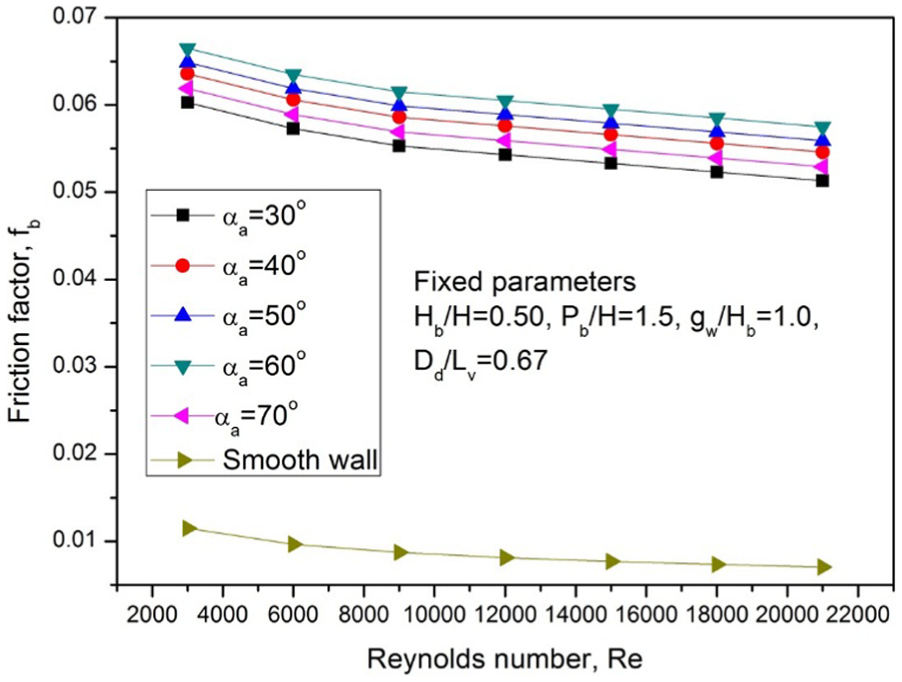
Effect of Reynolds number on friction factor.

Effect of angle of attack on friction factor.
Thermohydraulic performance
The experimental outcomes observed rise in Nusselt number with rise in angle of attack; however, friction factor also rises. The rectangular channel efficiency consequently depends on these two parameters:

Figure 10 shows the overall thermal performance parameter for the rectangular channel with various values of angle of attack for Reynolds number range from 3000 to 21,000. It rises with rises in the angle of attack up to about 60° and then decreases with further rises in the angle of attack at all Reynolds number values. It therefore attained utmost at an angle of attack of about 60°. In order to elaborate the effect of angle of attack on

Effect of angle of attack on thermohydraulic performance with Reynolds number.

Effect of angle of attack on thermohydraulic performance.
The data of

Comparison of various baffle rectangular channels.
Conclusion
An experimental analysis has been carried out to examine air flow friction and heat transfer rate in a high aspect ratio
Footnotes
Appendix 1
Academic Editor: Oronzio Manca
Declaration of conflicting interests
The author(s) declared no potential conflicts of interest with respect to the research, authorship, and/or publication of this article.
Funding
The author(s) received no financial support for the research, authorship, and/or publication of this article.