




Abstract
Effect of main structural parameters of shutter baffle heat exchanger with a triangle tube layout in the shell side on heat transfer and flow resistance performance is studied in the article. A periodic whole cross-sectional computation model is built for the heat exchanger in the numerical study. The effects of structural parameters are analyzed, including assembly mode of shutter baffles, shutter baffle pitch, strip inclination angles, and strip widths. The correctness and accuracy of numerical simulation method are confirmed with a laser Doppler velocimeter experiment. Based on the research results, correlations for heat transfer coefficient and pressure drop in shell side are presented. Using the field synergy principle, the heat transfer enhancement mechanisms of segmental baffle heat exchanger and shutter baffle heat exchanger in shell side are analyzed.
Keywords
Introduction
The shell-and-tube heat exchanger (STHX) is one of the most widely used heat exchangers in many industry fields, such as petroleum, chemistry engineering, energy, power, and so on, for its wide applicability, simple structure, sturdy and durable, less price, and convenient maintenance. 1 Studying on thermodynamic characteristics, structure development, and applications of heat transfer enhancement techniques in STHXs has continually received attentions. Heat transfer enhancement in heat exchangers has been intensively investigated to optimize the condition and configuration of heat transfer system. 2
In the shell side of STHX, baffle is a key component, which affects greatly the characteristics of fluid flow and heat transfer in shell side of STHX. 3 With the development of heat transfer enhancement and equipment manufacture techniques, many novel tube bundle support structures emerged to enhance heat transfer and reduce pumping power, 4 such as innovative segmental baffle, rod baffle, and helical baffle. Vukic et al. 5 performed experiments of STHX with segmental baffle and found that heat transfer strongly depends on the shell side geometry. You et al. 6 experimentally investigated thermo-hydraulic performance in shell side of an STHX with trefoil-hole baffles in the turbulent flow regime. Zhang et al. 7 studied experimentally characteristics in shell side of shell-and-tube oil coolers with overlapped helical baffles and segmental baffles and compared the performances.
Although the segmental baffle heat exchanger is commonly in practices, there are some disadvantages in characteristics in its shell side, such as the high flow resistance, large heat transfer dead region, and so on. By applying rod baffle in shell side, some of the above disadvantages are overcome, but the structure is not compact enough, and the heat transfer performance is worse when fluid Reynolds number is lower in shell side. Due to lots of difficulties during the manufacture and installation process, the helical baffle heat exchanger is not widely used either.8–10
Shutter baffle heat exchanger is a kind of STHX with many merits, which is sketched in Figure 1. In the heat exchanger, shutter baffle is settled in the shell side to support tube bundle. 11 In shell side, fluid flows in an oblique style, which is shown in Figure 2. 12

Shutter baffle heat exchanger.

Oblique flow in shell side.
Fluid channels are constructed by two adjacent oblique strips of the baffle, and the fluid flows at a certain angle with the length axis of tubes. The heat transfer is enhanced by the stronger scouring effect of transversal flow on tubes. Since the global trend of longitudinal flow, some advantages are inherited from that of the heat exchanger with longitudinal flow in shell side, including the lower pressure drop, perfect performance of anti-vibration and anti-fouling, good comprehensive performance, and so on. Effect of some structural parameters, such as assembly mode of shutter baffles, shutter baffle pitches, strip inclination angle on shutter baffle, and strip width, on the fluid flow and heat transfer is analyzed for the shutter baffle heat exchanger with triangle tube layout. The field synergy principle is also adopted to analyze the heat transfer enhancement mechanism of segmental baffle heat exchanger and shutter baffle heat exchanger. The research provides a scientific reference for the structural modification and performance improvement of STHX.
Numerical model and solution
Geometric structure in shell side of the STHX is usually periodic along the fluid flow direction. The whole flow region in shell side can be divided into entrance section, fully developed periodic section, and exit section. Generally, most of the flow and heat transfer region belongs to the fully developed periodic section, and flow and heat transfer performance in this section represents basically the whole performance of the shell side. The fully developed periodic section is often selected as the study object.13,14 With some appropriate simplifications on the geometric structure in shell side, the periodic whole cross-sectional computation model is established. Due to the symmetry of structure, one half of the symmetric whole solid model 15 is adopted to simplify calculation, and the periodic model of shutter baffle heat exchanger and shutter baffles is shown in Figure 3.

Periodic model of shutter baffle heat exchanger.
In calculation, the main structural geometric parameters of shutter baffle heat exchanger model are listed in Table 1. The fluid in shell side is water, and the wall temperature of the tubes is set as a constant value of 393.15K. With different Reynolds number in shell side, the influence of some key structural parameters on fluid flow and heat transfer performance of shutter baffle heat exchanger is studied numerically. The numerical simulations were performed with three-dimensional, steady-state, turbulent flow system. Segregated solver and standard k–ε model were employed, and energy equation was included.
Main structural parameters of shutter baffle heat exchanger model.

Governing equations
The governing equations of fluid flow in the periodic flow unit duct model with no regard of body force are expressed as follows: 16
Continuity equation

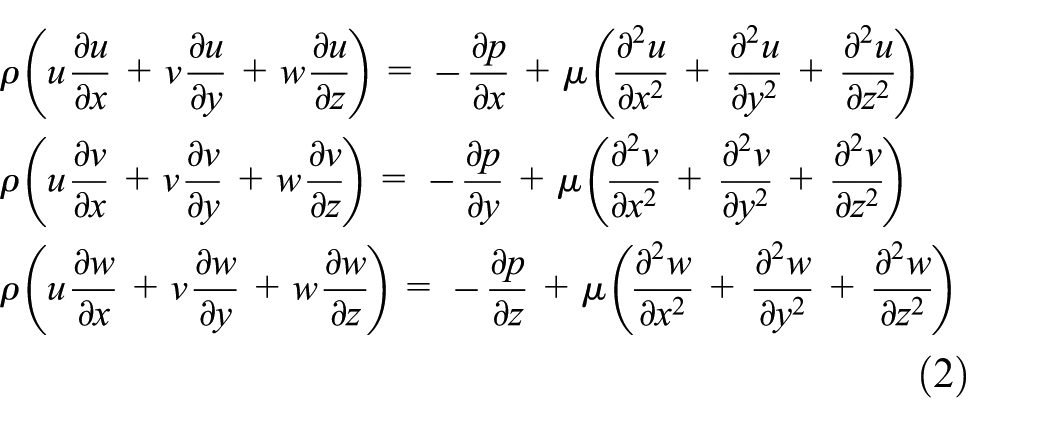
Momentum equation
Energy equation

The standard k−ε turbulence model was used for turbulence flow modeling. The turbulence kinetic energy, k, and the dissipation rate, ε, are obtained from the following transport equations


Verification of numerical calculation
Using the laser Doppler velocimeter (LDV), the fluid velocities in key regions in shell side of the shutter baffle heat exchanger are experimentally tested. The key geometrical size of the experimental model is same as that of numerical simulation model. A triangle tube layout is adopted in shell side, tube pitch is 20 mm, baffle pitch is 150 mm, strip inclination angle is 45°, and strip width is 25 mm. When the flow rate in shell side is 5.5 m3/h, with Reynolds number of 6400, a tested line is selected in the axial direction of the models, and the vertical and longitudinal flow velocity components of simulation results and experimental results along this line are compared. The results are shown in Figures 4 and 5.

Comparison of longitudinal flow velocity component.

Comparison of vertical flow velocity component.
It can be found that experimental data and numerical simulation results are in good agreement. The maximum relative error is 19.71% and the mean relative error is 11.1% for longitudinal velocity component (velocity in tubes length direction), and the maximum relative error is 24.58% and the mean relative error is 14.9% for vertical velocity component (velocity vertical to tubes length direction). The correctness and accuracy of the numerical simulation method and its results are confirmed.
Influence of structural parameters on fluid flow and heat transfer performance
Influence of shutter baffles assembly mode
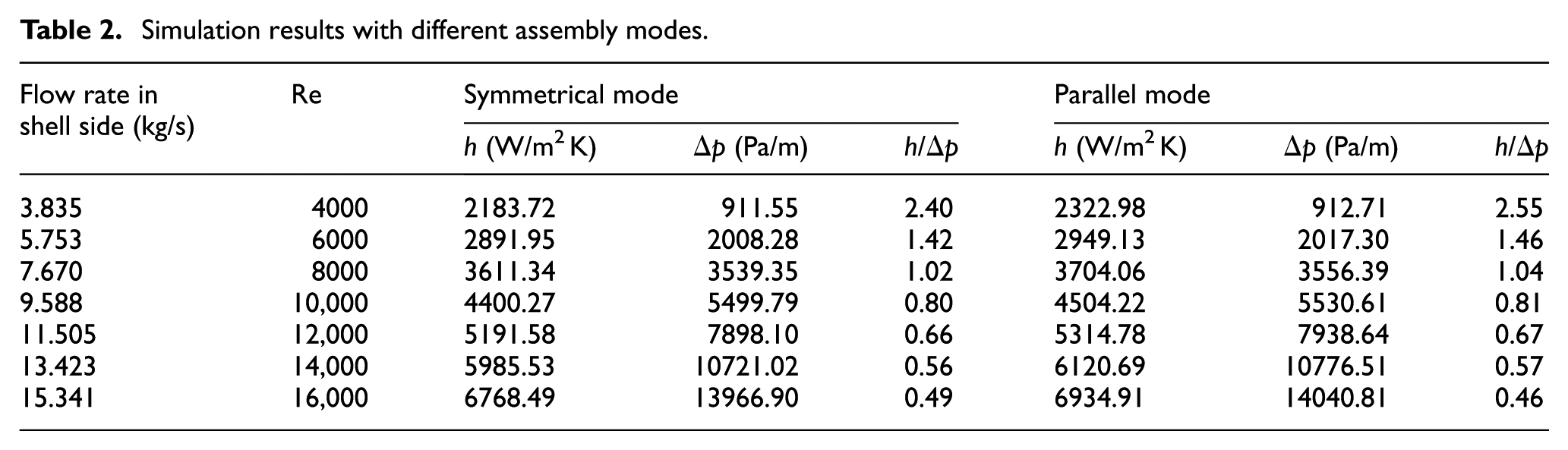
For triangle tube layout in shell side, according to the spatial position of strips on two adjacent baffles, two assembly modes for shutter baffles can be settled, which are parallel mode and symmetrical mode. In the condition that baffle pitch is 100 mm, strip inclination angle is 45°, and strip width is 25 mm, the heat transfer coefficient and pressure drop in shell side with the two assembly modes are studied, and the results are shown in Table 2. There is no obvious difference between the two modes for heat transfer coefficient, pressure drop, or comprehensive performance. Assembly mode can be selected according to the practical process requirement.
Simulation results with different assembly modes.
Influence of baffle pitch
With strip inclination angle of 45°, strip width of 25 mm, and different baffle pitches, the fluid flow and heat transfer in shell side are studied numerically. Heat transfer coefficient and pressure drop for different baffle pitches are shown in Figure 6. In this figure, the structural parameters of shutter baffle mentioned are expressed in the form of “baffle pitch–strip inclination angle–strip width,” such as “100-45-25” means that baffle pitch is 100 mm, strip inclination angle is 45°, and strip width is 25 mm. The heat transfer coefficient decreases with the increase in baffle pitch. Jet flow is caused after the fluid flows through baffle strips, and the fluid is strongly disturbed by the protrusions on the edge of strips, so the turbulent extent of downstream fluid is raised, which is helpful to thin the thickness of boundary layer around tubes. The disturbance function caused by shutter baffles decreases with the increase in shutter baffle pitch, and the turbulent degree of fluid is reduced, which leads to that the heat transfer coefficient decreases with the increase in baffle pitch.

Heat transfer coefficient and pressure drop versus flow rate for different baffle pitches.
The pressure drop decreases with the increase in baffle pitch, as shown in this figure. The pitch is longer, and the form resistance of shutter baffles is smaller, so the pressure drop in shell side is lower.
For all of the three different pitches, the heat transfer coefficient and pressure drop increase with the increase in flow rate in shell side. When the baffle pitch is 100 mm, the flow rate in shell side influences more significantly the heat transfer and flow resistance. When the baffle pitch is 150 or 200 mm, the influence of flow rate in shell side on heat transfer coefficient and pressure drop is less significant. It is indicated that when the baffle pitch is more than 150 mm, increasing baffle pitch to improve the comprehensive performance is not desirable.
Influence of strip inclination angle
With shutter baffle pitch of 100 mm, strip width of 25 mm, and different strip inclination angles, the results of heat transfer and pressure drop in shell side are shown in Figure 7.

Heat transfer coefficient and pressure drop versus flow rate for different strip inclination angles.
The heat transfer coefficient increases with the increase in strip inclination angle, as shown in this figure. This is because when the flow rate in shell side is constant, a larger strip inclination angle leads to a smaller projection area of inclined channels on a cross section in shell side. The average flow velocity in inclination channels increases, and the transverse component of flow velocity scouring tube wall increases as well, which is helpful to thin the thickness of boundary layer around tubes and improve heat transfer performance. However, there is no obvious difference for heat transfer coefficient when strip inclination angle is 45° or 60°, but the pressure drop increases greatly. The result indicates that when the strip inclination angle is >45°, it is not desirable to increase strip inclination angle for improving the heat transfer coefficient. Smaller than 45° is the proper strip inclination angle, which is recommended in this article.
The pressure drop increases with the increase in strip inclination angle. This is because when the inclination angle is larger, the barrier effect on fluid is stronger, and the geometric resistance of shutter baffles is greater. Besides, the recirculation regions appear behind shutter baffles when the inclination angle increases to some degree. The inclination angle is larger, and the total volume of recirculation regions would be larger. Therefore, the pressure drop increases with the increase in strip inclination angle. If the heat transfer performance is satisfied, it is recommended that the inclination angle is decreased for reducing the flow resistance. Contrarily, if the pump or fan power is enough, it is recommended to increase the inclination angle for improving heat transfer performance.
For the above three kinds of structure parameters, the heat transfer coefficient and pressure drop increase with the increase in flow rate in shell side. When the inclination angle is >45°, the flow rate in shell side has more sensitive effect on the heat transfer and flow resistance performance.
Influence of strip width
With shutter baffle pitch of 100 mm, strip inclination angle of 25 mm and different strip widths, the results of heat transfer and pressure drop in shell side are shown in Figure 8.

Heat transfer coefficient and pressure drop versus flow rate for different strip widths.
It is concluded that the strip width has lesser effect on the heat transfer coefficient or pressure drop. The heat transfer coefficient and pressure drop increase slightly with the increase in strip width. This is because the strip width is larger, the barrier effect on fluid and turbulent extent is stronger, and the geometric resistance of shutter baffles is greater. Strip width has a little more significant effect on pressure drop than on heat transfer for higher mass flow rates.
Correlative equations of heat transfer coefficient and pressure drop in shell side
When fluid in shell side is in the turbulent state, the heat transfer coefficient and pressure drop are mainly related with the shell side equivalent diameter de, fluid characteristic constant µ/µw, mean flow velocity u, baffle pitch Lb, and strip inclination angle φ. Using dimensional analysis method, the correlative equations of heat transfer coefficient with fitting degree R2 of 0.989 and pressure drop with fitting degree R2 of 0.616 in shell side are derived. The equations can be used for structure design of the shutter baffle heat exchanger.
Correlative equation of heat transfer coefficient

Correlative equation of pressure drop

Application scope: 4000 ≤ Re ≤ 16,000.
For the tube layout used in this article

where PT is the tube pitch size and do is the tube outside diameter.
Comparative analysis of shutter baffle heat exchanger and segmental baffle heat exchanger with the field synergy principle
The field synergy principle was proposed in 1998 by a Chinese scholar, Guo and his cooperators, which states that the convection heat transfer performance is not only determined by the flow velocity and physical properties of fluid and the temperature difference between fluid and solid wall but also determined by the coordination of fluid velocity field and heat flow field. In the same velocity and temperature boundary conditions, the better the coordination, the higher the heat exchange intensity, and the heat exchange process is more optimal.17–19 The synergy of the two vector fields or the three scalar fields implies that 20 (a) the included angle between the velocity and the temperature gradient or heat flow should be as small as possible, (b) the local values of the three scalar fields should all be simultaneously large, and (c) the velocity and temperature profiles at each cross section should be as uniform as possible. Better synergy among such three scalar fields will lead to a larger value of the Nusselt number.
In the periodic whole cross-sectional computation models of segmental baffle heat exchanger and shutter baffle heat exchanger, two typical points at the same position are selected, which are both on the cross-sectional diameter line and close near the tube wall. The test point line is shown in Figure 9.

Position of tested points in model.
Along the axial direction of models, flow field and temperature field of each point on two tested lines are examined. The fluid in shell side is water with a normal temperature and a constant property. By means of a user-defined function of fluent, the field synergy angle is calculated using the following equation

where β is the field synergy angle between the velocity vector
At the Reynolds number of 10,000, the parameter analysis of flow field and temperature field in shell side is carried out, and the results of average field synergy angle and convective heat transfer coefficient are listed in Table 3.
Average field synergy angle and convective heat transfer coefficient.

The relationship between surface convective heat transfer coefficient and local field synergy angle along tested line 1 is shown in Figures 10 and 11.

Local field synergy angle and surface convective heat transfer coefficient for shutter baffle heat exchanger.
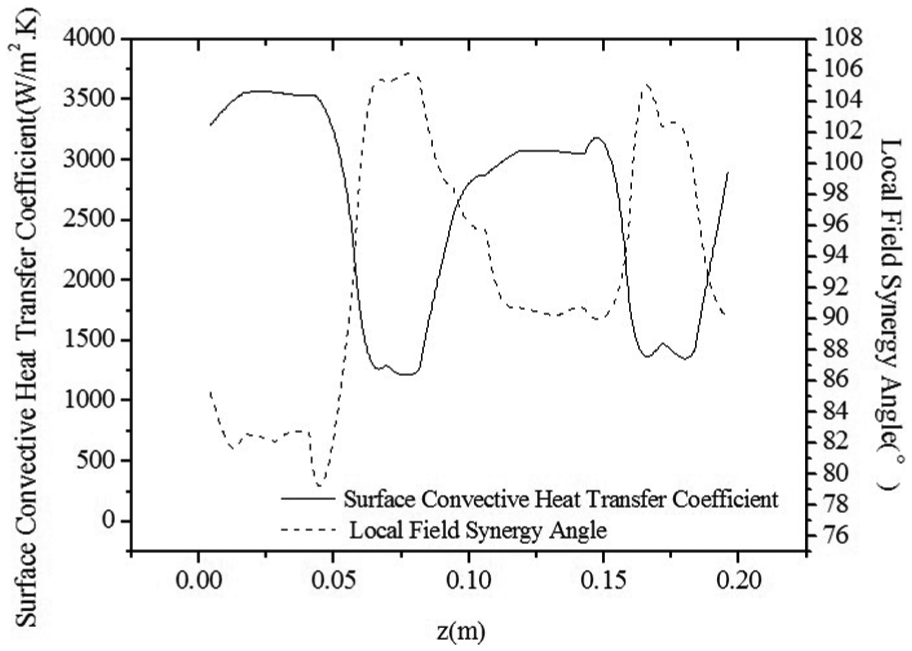
Local field synergy angle and surface convective heat transfer coefficient for segmental baffle heat exchanger.
It is indicated that the local convective heat transfer coefficient is higher at the position where the field synergy angle is smaller. The mean field synergy angle on the two tested lines of segmental baffle heat exchanger is less than that of another, while the convective heat transfer coefficient is higher than that of another. With the triangle tube layout, the fluid turbulent degree in shell side of segmental heat exchanger is higher than that of shutter baffle heat exchanger, and the transverse velocity component is greater than the latter. Since the scouring effect on tubes is stronger, its heat transfer performance is better than the latter. However, the flow velocity distribution in shell side of segmental baffle heat exchanger is not uniform, and there are large flow dead regions in shell side. In shell side of shutter baffle heat exchanger, these large flow dead regions can be significantly eliminated and separated to smaller ones by the special oblique flow, and the flow field is uniformed to a greater degree, which is helpful to reduce pressure drop and increase effective heat transfer area in shell side.
Conclusion
A periodic whole cross-sectional computation model is built for the heat exchanger with shutter baffle, and numerical calculations of fluid flow and heat transfer in the shell side were carried out. Validation of the velocity field is performed by carrying out an LDV experiment of fluid velocities to validate the correctness and accuracy of numerical simulation method and its results. Effect of the main structural parameters of shutter baffle is analyzed. Based on the research results, correlations for heat transfer coefficient and pressure drop in shell side are presented. Using the field synergy principle, the heat transfer enhancement mechanisms of segmental baffle heat exchanger and shutter baffle heat exchanger in shell side are analyzed.
Shutter baffle pitch and strip inclination angle have significant effect on heat transfer and flow resistance performance of shutter baffle heat exchanger with triangle tube layout in shell side, while the assembly mode of shutter baffles and strip width have a little effect. The correlative equations of the heat transfer coefficient and the pressure drop in shell side presented in this article have important significance for its engineering design.
Comparative analysis of shutter baffle heat exchanger and segmental baffle heat exchanger with triangle tube layout in shell side is carried out with the field synergy principle. It is shown that the mean field synergy angle on tested lines of segmental baffle heat exchanger is less than that of shutter baffle heat exchanger, which means that the heat transfer coefficient of oblique flow heat exchanger is slightly lower than that of transversal flow heat exchanger. The analysis results provide scientific reference for the structural modification and performance improvement of STHX.
Footnotes
Academic Editor: Michal Kuciej
Declaration of conflicting interests
The author(s) declared no potential conflicts of interest with respect to the research, authorship, and/or publication of this article.
Funding
The author(s) disclosed receipt of the following financial support for the research, authorship, and/or publication of this article: This work was financially supported partly by the National Natural Science Foundation of China (no. 51476147).