



Abstract
If the lubrication system of a helicopter reducer is compromised, its gears and bearings will be in a working state without lubricating oil, which causes the reducer to be damaged in a very short time. Various 2% additives of T307, T321, T202, and T391 were injected and mixed with DOD-L-85734 aeronautical oil to produce 45-min oil–air lubrication experiments performed upon 12Cr2Ni4A aeronautical steel tribo-pairs. The results show that the best anti-wear effect is produced by oil–air lubrication containing T391: its wear width under jetting oil–air just three times and quantity of oil used only 0.015 mL in 45 min was only 421.32 µm but that of dry friction for 48 s was 629.20 µm. The technology of oil–air lubrication that contains an extreme-pressure and anti-wear additive is thus a feasible way to improve the operational ability of a helicopter transmission system that is out of oil.
Keywords
Introduction
If the lubrication system of a helicopter reducer is compromised, its gears and bearings will be in a working state without lubricating oil, which quickly causes the reducer to be damaged, thereby resulting in disastrous consequences. Many countries such as the United States, Japan, and Russia require helicopters to be able to maintain flight operation for 30–60 min in an oil-out condition.1–4 Handschuh 5 and Morales 6 have been studying aeronautical steel under oil–mist lubrication6,7 containing anti-wear additives. But we find that the anti-wear effect of oil–air lubrication containing anti-wear additives is clearly superior to that of oil–mist lubrication. 8 Oil–air lubrication requires a smaller quantity of oil than that of oil–mist lubrication, which can reduce the mass of the helicopter. Because compressed air can remove a great deal of heat, oil–air lubrication9–13 has demonstrated good anti-wear effect. Until now, the study of extreme-pressure and anti-wear additives has been limited to full lubrication, whereas oil–air lubrication containing extreme-pressure and anti-wear additives has not been given any attention. For this study, we adopted oil–air lubrication that contained extreme-pressure and anti-wear additives in an effort to discover the best anti-wear additive. In order to reduce the cost of testing, a pin-on-disc friction test was used instead of a gear transmission.
Test materials and test details
Test materials
Base oil and additives
The base oil that was used was DOD-L-85734 aeronautical oil (in this article, referred to as DOD). The additives used were sulfurized isobutylene (T321), ammonium thiophosphonate (T307), parathion ding simbo alkyl zinc salt (T202), and ashless organic phosphonate (T391), which are examples of extreme-pressure and anti-wear additives for gear lubricating oil. Various 2% additives were, respectively, injected and mixed with the DOD base oil to acquire five kinds of oil specimens.
Friction pair
The friction pairs used in the study were made of 12Cr2Ni4A. The upper specimens were small cylinders with dimensions of ∅10 mm × 4 mm, and the lower specimens were disks with dimensions of ∅98 mm × 4 mm (Figure 1). The friction pair surface was carburized to a depth of 0.8–1.0 mm, and the surface hardness was not less than HRC60. Before and after testing, the friction pairs were cleaned for 6 min with acetone and dried with drying box. After testing, the upper specimen’s wear width was measured, and its worn surface topography was observed.

Upper cylinder specimen and lower disk specimen.
Test details
The air pressure of the oil–air lubrication generator made in China was 0.4 MPa. The friction device was a universal mechanical tester (UMT) test machine made in the United States. The test load was 100 N (424.4 MPa Hertzian contact pressure). The cylindrical surface of the upper specimen and the lower disk specimen formed a line of contact (Figure 1). During the test, the upper specimen was stationary, while the lower disk specimen rotated at a speed of 1000 r/min. The distance between the friction center and the rotation center was 25 mm, and the relative sliding friction velocity calculated was 2.62 m/s. This was because the volume of the upper specimen was much smaller than that of a helicopter reducer gear, and the upper specimen experienced continuous relative sliding, while each gear tooth only experienced sliding once every revolution.
Before the friction test, the specimen surface was coated with a layer of DOD base oil and then wiped dry with soft paper. During the friction test, when the friction coefficient increased rapidly, oil–air was jetted at the entrance of the friction area. Each period of jetting lasted 5 s, with 0.005 mL of oil used for each period. The temperature of the friction area for the upper specimen near the center of the lower disk specimen was measured with a thermocouple at 7-min intervals, and 0.1°C was the accuracy of temperature measurement. Each period of the test for the oil–air lubrication lasted 45 min.
Results and discussion
Lubrication performance
Five kinds of the friction coefficient curves are shown in Figure 2. The curves for 2%T391+DOD, 2%T202+DOD, 2%T321+DOD, and 2%T307+DOD oil–air lubrication are shown in Figure 2(a)–(d), respectively, while the curve for DOD oil–air lubrication is shown in Figure 2(e). At the start of the friction test, the friction coefficient increased rapidly because there was no oil lubrication. When the friction coefficient reached to 0.14, it then decreased rapidly during the jetting of oil–air. After a period of time, when the lubricating oil dried, the friction coefficient again increased sharply. When the friction coefficient reached to 0.14 again, it then rapidly dropped after the jetting of oil–air. The spikes represent the jetting of oil–air (Figure 2(a)–(e)). The number of times jetting occurred and the quantities of oil used for 45 min are listed in Table 1. The number of times jetting occurred and the quantities of oil used for 2%T307+DOD were the most, which showed that the characteristic of resistance to wear was the worst of the five kinds.

Friction coefficient curves of oil–air lubrication for 45-min test: (a) 2%T391 + DOD, (b) 2%T202 + DOD, (c) 2%T321 + DOD, (d) 2%T307 + DOD, and (e) DOD.
Number of times jetting occurred and oil quantities used for 45 min.

Wear performance
Oil–air lubrication
The upper specimen’s wear widths of oil–air lubrication for 45 min are shown in Table 2 and Figure 3. The smallest wear width was obtained with 2%T391+DOD, which showed the characteristic of resistance to wear was the best of the five kinds. The biggest wear width was obtained with 2%T321+DOD. Of the five kinds of oil–air lubrication tests, the quantity of oil used for 2%T321+DOD was the least, whereas its wear width was the biggest, which was caused by T321 corrosion.
Upper specimen’s wear widths (µm).

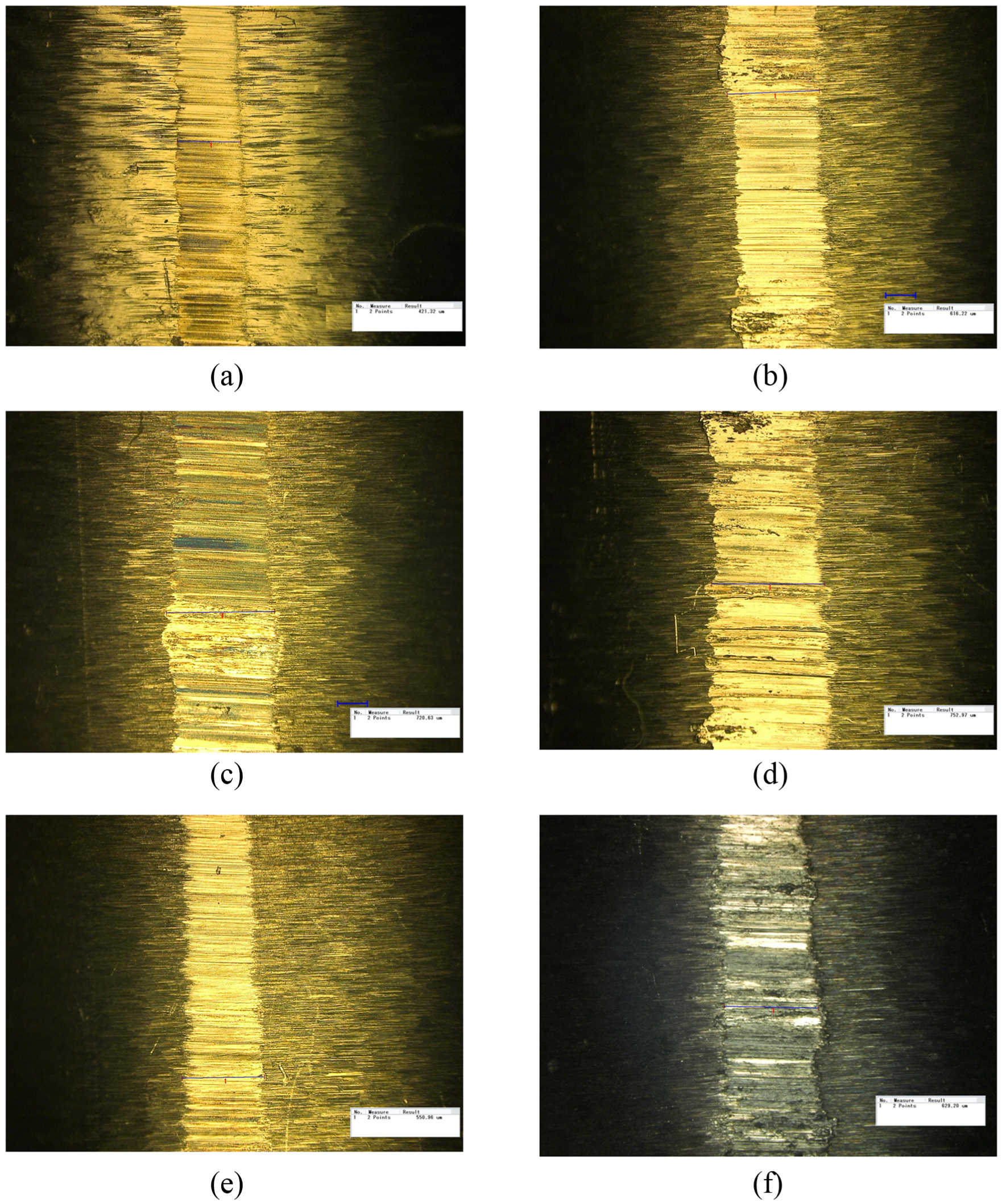
Wear width and wear surface morphology: (a) 2%T391 + DOD oil–air lubrication for 45 min, (b) 2%T202 + DOD oil–air lubrication for 45 min, (c) DOD oil–air lubrication for 45 min, (d) 2%T321 + DOD oil–air lubrication for 45 min, (e) 2%T307 + DOD oil–air lubrication for 45 min, and (f) dry friction for 48 s.
Dry friction
At the start of the dry friction test, friction temperature and friction coefficient increased rapidly because there was no oil lubrication. When the dry friction was for only 48 s, friction coefficient reached to 0.3 and the upper specimen’s wear width reached to 629.20 µm (Figure 3(f)).
Worn surface morphology
The worn surface morphologies for the upper specimens are shown in Figure 3. The best surface quality was produced by oil–air lubrication containing 2%T391. This is because the N contained in T391 can effectively inhibit excessive phosphorus corrosion.
Friction temperature
In our testing, it was found that the friction temperature increased with an increase in friction time. In each test, the highest friction temperature was at the end of the test. The temperature difference before and after each test of oil–air lubrication for 45 min was lower than 30°C, but the temperature difference before and after dry friction for only 15 s was more than 40°C. Obviously, the compressed air of oil–air lubrication could greatly reduce temperature rise.
Mechanism of high anti-wear for 2%T391+DOD
X-ray figures of 2%T391+DOD, 2%T202+DOD, 2%T321+DOD, and 2%T307+DOD showed that these positions of diffraction peaks were almost the same, but intensities of diffraction peaks were obviously different. The X-ray diffraction for the worn surface of 2%T391+DOD (Figure 4) showed that C, Fe5C2, Fe2O(PO4), Fe3O4, Cr2N, Fe3N, and FeN were on the worn surface. Thus, iron phosphide, iron oxide, and enough nitride play the role of friction reduction.
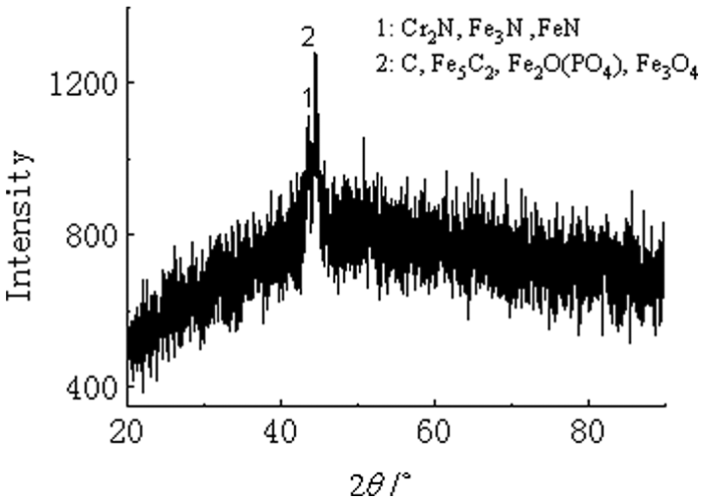
The X-ray diffraction for the worn surface of 2%T391 + DOD.
Conclusion
Of the five kinds of oil–air lubrication tests, the anti-wear effect of 2%T391+DOD was the best.
The wear width of 2%T391+DOD under jetting oil–air just three times and quantity of oil used only 0.015 mL in 45 min was only 421.32 µm, but the wear width of the dry friction for 48 s was 629.20 µm.
The temperature rises of the friction area of the upper specimen for oil–air lubrication for 45 min were less than 30°C, but the temperature rise of the dry friction for only 15 s was over 40°C.
Of the five kinds of oil–air lubrication tests, the worn surface quality of 2%T391+DOD was the best.
In short, oil–air lubrication containing 2%T391 needs only very little quantity of oil to acquire less wear, less temperature rise, and good wear surface quality. The technology of oil–air lubrication containing extreme-pressure and anti-wear additives is a feasible way to improve oil-out operation ability of helicopter transmission system. As a further study, oil–air lubrication tests containing extreme-pressure and anti-wear additives will be needed for helicopter reducer gears.
Footnotes
Academic Editor: Ramiro Martins
Declaration of conflicting interests
The author(s) declared no potential conflicts of interest with respect to the research, authorship, and/or publication of this article.
Funding
The author(s) disclosed receipt of the following financial support for the research, authorship, and/or publication of this article: This work was supported by the National Basic Research Program of China 973 (2007CB607600), Special Fund for theoretical physics Research Program of China (11547215) and Jiangsu Provincial Research Foundation for Basic Research (Jiangsu Provincial Natural Science Foundation; BK20131221).