




Abstract
With the increasing attention of energy saving and emission reduction technology, the recent application of hybrid powertrain technology affects the development of construction machinery industry. This article reviews these publications and provides comprehensive references. This article reviews the state-of-art for the hybrid wheel loader and excavator, which focuses on powertrain configuration, energy storage devices, and energy management strategies. The basis of classification and characteristic of each powertrain configuration are described. Advantages and disadvantages of batteries, supercapacitors, hydraulic accumulators, and flywheel used in hybrid construction machinery are summarized. The existing energy management strategies for hybrid construction machinery are also elaborated. The technological challenges and developing trends in the near future for hybrid construction machinery are discussed.
Keywords
Introduction
Electric technology and hybrid powertrain technology are two effective technologies of energy conservation and emissions reduction and have achieved great success in automobile field.1–4 However, because of the heavy-load, low-speed and periodically operation mode, electric technology can not be applied directly in construction machinery. Therefore, in order to decrease the high fuel consumption rate of construction machinery, hybrid powertrain technology is increasingly drawing the attention of manufacturers, government and scholars. Hybrid wheel loaders and excavators, which share the maximum ownership from the global market, have particularly made significant progress. 5 Hitachi successfully launched the world’s first hybrid loader in 2003, 6 and Komatsu developed the world’s first commercial hybrid excavator in 2008.7,8 The development history of hybrid loaders and excavators is shown in Figure 1.

Development history of hybrid loaders and excavators.
With hybrid construction machinery (HCM) attracting more attention, the powertrain configurations, energy management strategies, and energy storage devices have been presented by many scholars for HCM.9–12 Lin et al. 13 presented the HCM review in 2010. The paper first analyzed the difference between the hybrid powered automobile and HCM. The hybrid power system applications and energy regeneration system of construction machinery were then summarized. The challenges that face the researchers and construction machinery manufacturers were discussed. However, based on previous researches, further studies on the development history, research progress, existing problems, and developing trends of HCM are overviewed in order to promote research and application of HCM.
Section “HCM powertrain configuration types” reviews the types of HCM powertrain configuration which are currently launched by construction machinery manufacturers. Section “HCM energy storage devices” introduces the advantages and disadvantages of batteries, supercapacitors, hydraulic accumulator and flywheel in application of HCM. Section “HCM energy management strategies” classifies and outlines the control strategies of current hybrid wheel loaders and excavators, although fewer studies are available. Section “Current challenges and trends” presents the main challenges and trends of HCM.
HCM powertrain configuration types
Wheel loaders and excavators are important construction machines that have the maximum ownership. Thus, it is necessary to study the various types of powertrain configuration of hybrid wheel loader and excavator in order to better understand their construction features.
Hybrid wheel loader
The wheel loader mainly requires driving and actuating working devices in V-cycle.14,15 The power requirement has obvious volatility and periodicity. Frequent starts and stops, and larger vehicle weight generates significant amounts of braking energy which is generally wasted by the frictional braking system. 16 To effectively use braking energy and control engine in its high-efficiency operating region, many construction machinery manufacturers and researchers have studied hybrid wheel loaders. 17 Currently, the hybrid wheel loader has three design options of powertrains: series, parallel, and series–parallel. Table 1 lists the classification basis and their corresponding advantages and disadvantages of hybrid wheel loaders, and outlines of hybrid wheel loaders prototype developed by main construction machinery manufacturers are listed in Table 2.
Classification of hybrid wheel loaders.

ICE: internal combustion engine.
Outline of hybrid wheel loaders prototype developed by main construction machinery manufacturer.

Figure 2 shows the series hybrid powertrain configuration, which is the simplest configuration type of hybrid wheel loaders. The engine drives the electric generator, and the generator drives electric motor. The advantage of a series hybrid wheel loader is that the engine is mechanically decoupled from the loader wheels so it can be operated in its highly efficient speed and torque region. Its disadvantage is that mechanical power from the engine changes twice, namely, from mechanical to electrical in the electric generator and from electrical to mechanical again in the electric motor. 24 Furthermore, the generator and electric motor need to be manufactured in terms of maximum power demand. Actually, the series hybrid powertrain has mainly been applied to the large-tonnage hybrid wheel loader.

A parallel hybrid powertrain configuration has two separate power sources that can directly power the loader. In most cases, the engine can directly deliver torque to the wheels without energy conversion. The disadvantage of a parallel configuration is that the engine cannot always be controlled in its high-efficiency operating region, because it is still mechanically coupled to the wheels. 24 Thus, its oil-saving ability is limited. The two types of parallel hybrid wheel loader currently used are hybrid electric wheel loader (HEWL) and hybrid hydraulic wheel loader, which are shown in Figures 3 and 4, respectively.16,22

Volvo parallel hybrid electric wheel loader. 22
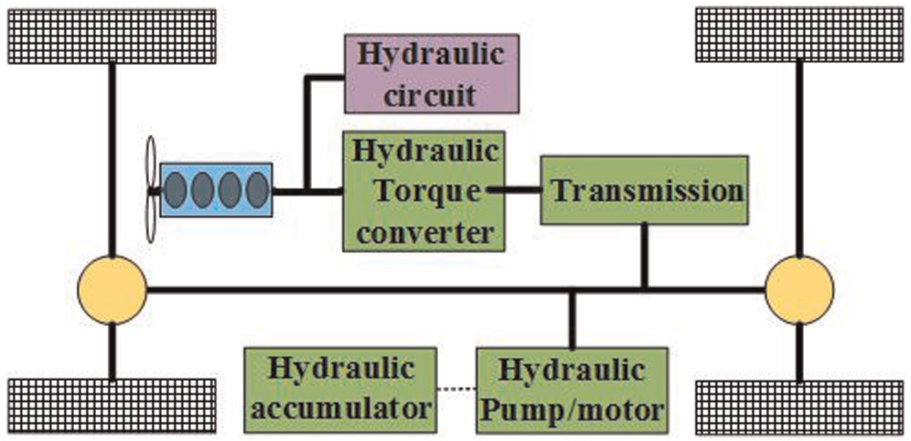
XCMG parallel hybrid hydraulic wheel loader. 16
The transmission system of the series–parallel hybrid wheel loader is driven in parallel, and the hydraulic mechanism is driven in series. The advantage of parallel–series system is that the hydraulic system could work independently from the engine. Therefore, the idle speed of engine could be cancelled. The power required by the working device can be flexibly provided using a working pump, which is driven by the pump motor. So the overflow loss from the drive of pump by engine can be avoided. However, this configuration is still on the researching stage and Liugong has applied a related patent. Liugong uses this configuration as shown in Figure 5. 23
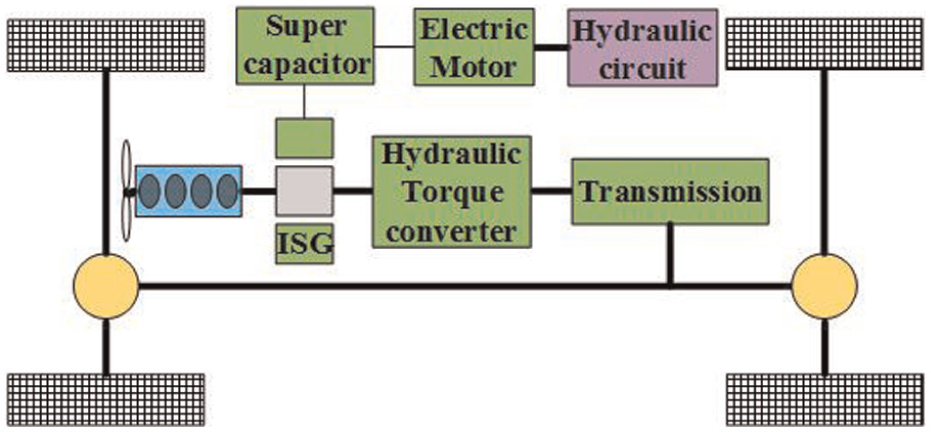
Liugong series–parallel hybrid wheel loader. 23
Hybrid excavator
The excavator is a type of construction machinery that has a larger weight and higher energy consumption. Statistics show that excavators generally complete 65%–70% of earthwork because of its strong multifunction adaptability, whose amount continues to steady increase. 25 Therefore, studying hybrid excavators to promote energy efficiency and decrease gas emissions is significant. A hybrid excavator can typically recycle two energy types, including the braking kinetic energy of swing and gravitational potential energy of booms. 12 Structurally, the hybrid excavator can be grouped as series, parallel, or series–parallel hybrids. Table 3 lists the classification basis and their corresponding advantages and disadvantages of hybrid excavators, and Table 4 lists the outline of present hybrid excavators prototype developed by main construction machinery manufactures.
Classification of hybrid excavators.

ICE: internal combustion engine.
Outline of the hybrid excavators prototype developed by main construction machinery manufacturer.

The engine of a series hybrid excavator drives the generator to work directly which is shown in Figure 6. The generator drives four independent electric motors which drive hydraulic pump and swing, respectively. The greater change of configuration compared to the original one and additional costs of electrical components result in non-commercialization of this configuration. The 6-ton Kobelco series hybrid excavator prototype developed in 2007 uses this configuration.13,26,27

The additional production costs of parallel hybrid excavator is the lowest in these three types of configurations, but its fuel consumption is higher and the time for payback time is longer. 30 The engine of a parallel hybrid excavator drives the hydraulic pump and generator to work in parallel. The hydraulic pump drives the hydraulic circuit of the work device, which is similar to conventional excavators. And the generator drives swing electric motor. Both New Holland and Hitachi apply configurations similar to this one, of which the difference is that hybrid excavator of Hitachi can recycle both the braking kinetic energy of swing and the gravitational potential energy of booms.13,17 The specific structures are shown in Figures 7 and 8.

New Holland parallel hybrid excavator. 13

In the series–parallel hybrid powertrain configuration of an excavator, the engine drives the generator directly. The hydraulic pumps are driven by generator in series, and the swing electric motor is driven by generator and battery or supercapacitor in parallel. 31 Although the fuel consumption of series–parallel hybrid excavator is more than the series structure and the production costs are higher compared with the parallel structure, it offers the shortest cost recovering time. Thus, the series–parallel hybrid excavator is identified as the best solution among existing configurations that consider economy and liability. 30 Komatsu, Kobe Steel and Doosan all adopt configurations similar to this one, which are shown in Figures 9–11 respectively.8,9,29–31


Doosan series–parallel hybrid excavator. 30

Kobe Steel series–parallel hybrid excavator. 31
Other construction machinery manufacturers have also studied hybrid wheel loaders and excavators. However, the present study cannot make us understand their powertrain configurations because related details are not published.32–34 Moreover, it should be specially explained that Hyundai Heavy Industries and Hanyang University published a paper on the feasibility of the power distribution mechanism of a plug-in hybrid excavator. However, plug-in hybrid excavator applications are difficult to apply in practice because of battery technology defects. 35
HCM energy storage devices
The energy utilization efficiency of construction machinery is generally relatively low, and kinetic or potential energy is lost during operation. Therefore, the energy efficiency of the system can be improved by implementing an energy regeneration device that recovers the released energy.36,37 Currently, batteries, supercapacitors, hydraulic accumulator, and flywheel are mainly used as energy storage devices in HCM. Table 5 shows the characteristics of different energy storage devices.

Batteries
Batteries have become the most widely studied energy storage device in hybrid electric vehicles (HEVs). Battery applications in the hybrid power system are divided into three types: Li-ion batteries,43–47 nickel metal hydride batteries48,49 and lead-acid batteries.50,51 Recently, however, Li-ion batteries are considered as highly prospective technology for automotive applications because of their larger storage capacity, wide operational temperature range, better material availability, environmental impact, safety, and promising potential for cost reduction.52–56 Li-ion batteries have the highest energy density. However, these batteries usually take a long time to recover energy because they depend on chemical reactions to store energy. For such HCMs as hybrid excavator, the lowering of the boom only takes about 2–3 s, 11 which lead to the recover efficiency of Li-ion batteries is lower. In addition, Li-ion batteries have lower power density, lower efficiency, lower lifetime, higher vulnerability to environmental temperature, and higher cost compared with other energy storage devices.5,41
Supercapacitors
Supercapacitors have also been regarded as the appropriate energy storage devices of hybrid powertrain systems, which are designed to bridge the gap between batteries and capacitors to form fast-charging energy storage devices of intermediate specific energy. 57 A supercapacitor can be classified as a double-layer capacitor or pseudo-capacitor according to different charge storage modes.58,59 A supercapacitor has the advantages of fast charge/discharge capacity so it can recollect fast potential or regenerative braking energy and deliver larger acceleration.57,59,60 At the same time, it has high power density and provides pulse power of more than 1000 W kg−1 with a cycle life that can reach more than 500,000 cycles. 5 However, its disadvantage is that it has low energy density at typically 2 Wh/kg, which leads to a limited energy storage. Thus, supercapacitors currently are difficult to provide enough energy density for HCMs.
Hydraulic accumulator
Hydraulic accumulator primarily plays one of two roles in hydraulic circuits: (1) lowering pressure fluctuations created by variations in the flow rate or (2) storing energy to improve the system efficiency or enable high power transients. 61 However, its primarily function is as a power-assisted device for HCM. 62 The hydraulic storage approach converts the recoverable energy into hydraulic form, stores it in an accumulator, and releases it using secondary components or auxiliary cylinders.63–66
Compared with an electric hybrid system composed of a battery or supercapacitor, a hydraulic accumulator as an energy storage device for HCM has the following advantages: (1) The hydraulic accumulator systems have an advantage in terms of the power density over an electric system; the hydraulic accumulator energy recovery systems are ideal for cases of frequent and short start–stop cycles in sufficient spaces. 11 (2) The hydraulic motor has higher efficiency than the electric motor at low speeds; this condition is important for HCM. (3) Hydraulic hybrid powertrain systems have higher round-trip efficiency for energy storage devices and lower mechanical losses because of a lower gear ratio in the gear box. 38 However, the application of hydraulic hybrid powertrain systems in HCM still encounters several defects: (1) The impact of the limited energy density is a design tradeoff between the energy storage capacity and volume or weight.61,67,68 (2) The filling process of an accumulator is a nearly adiabatic process, especially when the filling is fast. Thus, the gas temperature increases during the filling, and this heat escapes through the walls to the environment during the storage phase. 37 (3) It requires additional components such as hydraulic pump/motors and transformers to reuse the recovered energy. 12
Flywheel energy storage system
Flywheel energy storage system (FESS) has developed considerably in recent years because of the development of the circuit topology and carbon fiber materials. Thus, this system has become one of the most common energy storage systems for hybrid vehicles.69–73 However, in the HCM field, the research on using FESS as energy storage system is relatively applied in a patent. 74 FESS is composed of the following several parts: motor/generator, bearing system, vacuum chamber, flywheel, power electronics, and other auxiliary items. 75 When in charge, the electric motor drives the flywheel to rotate and store a large amount of kinetic energy (mechanical energy), while in discharge, the flywheel drives the generator to rotate, converting kinetic energy into electric energy. The energy lost in conversion from one form to the other is saved using FESS. 76
FESS has the following advantages: (1) it exhibits high energy density and high power density.77,78 (2) The number of cycles is independent of the temperature and depth of the discharge. Thus, this system has a very long cycle life.72,79 (3) It has a wide range of tolerable temperatures. 80 (4) It exhibits low maintenance. 75 (5) It is lightweight and small. 81 (6) Producing this system is cheaper than producing battery hybrids.82,83 (7) This system has minor environmental concerns. 80 Given these advantages, this system works best at low speeds and in frequently stop/start working condition. 82 However, their drawbacks include their limited storage time. They also demonstrate high standing losses since a significant percentage of their stored capacity is wasted through self-discharge. 84 In light of its advantages and disadvantages, FESS is a potentially energy storage device of HCMs.
HCM energy management strategies
Due to the complexity of the hybrid’s powertrain, control strategy plays a crucial rule in the functionality and performance of HCM. Various energy management strategies are necessary to regulate the power flow to or from different components because of the variations in HCM powertrain configurations and energy storage devices. The published energy management strategies of HCM can be classified as shown in Figure 12. These energy management strategies aim to satisfy several goals for HCMs. The following are the four key goals:2,85 (1) maximum fuel economy, (2) minimum emissions, (3) minimum system cost, and (4) good handling performance.
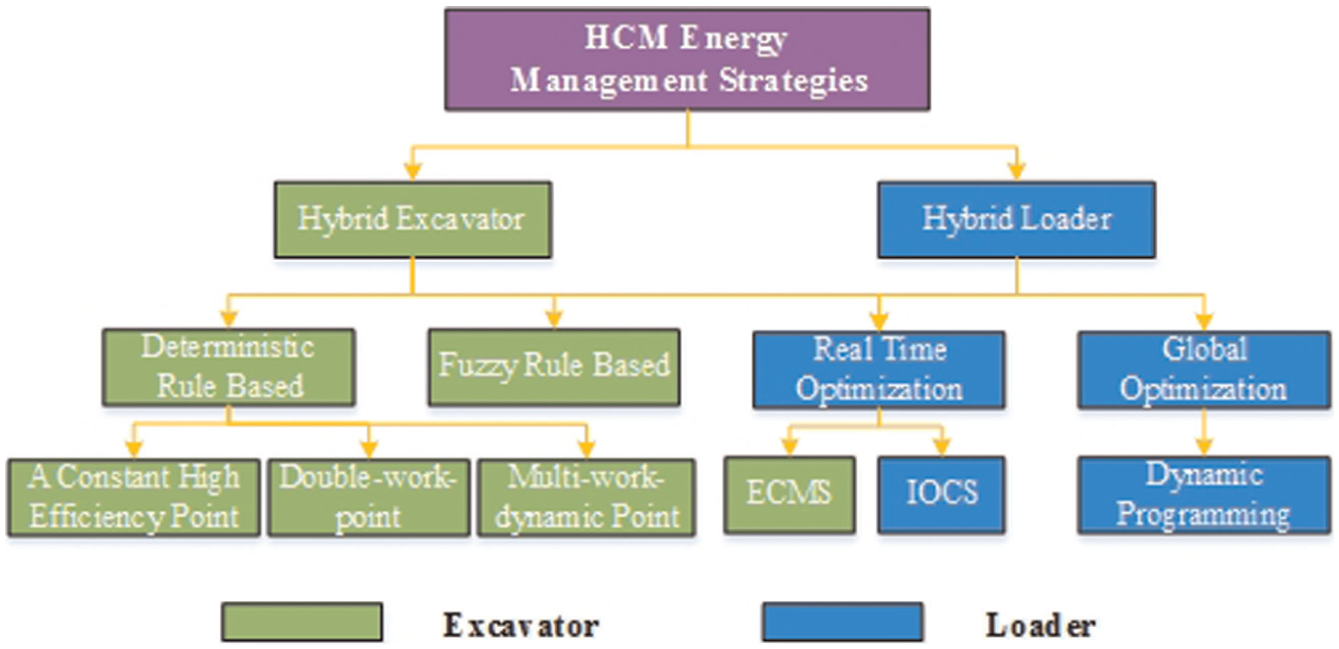
Control strategies classification of HCM.
Energy management strategies for hybrid excavator
The energy management strategies of hybrid excavator mainly include deterministic rule–based strategy, fuzzy rule–based strategy and equivalent consumption minimization strategy (ECMS). Deterministic rule–based strategy and fuzzy rule–based strategy belong to rule-based (RB) control strategies. The main idea of RB strategies is commonly based on the concept of “load leveling” which is shifting the actual internal combustion engine (ICE) operating point as close as possible to the optimal point of efficiency, fuel economy, or emissions at a particular engine speed. 2 ECMS is a kind of optimization-based control strategy. The primary objective of the optimization-based control strategies is to maximize the efficiency of the powertrain while minimizing the power loss. 86
Deterministic rule–based strategy
The hybrid excavator usually uses deterministic rule–based strategies at the beginning of its development because these strategies are simple and practicable strategies.10,87–89 When a hybrid system is implemented, the energy storage devices of the power system absorb the fluctuation of the load power to engine outputs of the averaged load power. Thus, the control strategy of working at a constant high-efficiency point can be realized for the engine with the benefit of increasing the efficiency of the engine and system. However, the state of charge (SOC) of the energy storage devices always fluctuates because the chosen working power of the engine cannot be the same as the average load power. Therefore, the system cannot work normally after a long operation time.
To solve the problem, Zhang et al. 90 employed a double-work-point control strategy for hybrid excavator, which is the engine working at one high-power point and one low-power point in the high-efficiency area. However, the control strategy should switch between the two working points frequently if the assigned working range of the accumulator is narrow. In addition, the efficiency and cycle life of the accumulator deteriorate if the working range of the accumulator SOC is set wide. Thus, Xiao et al. 91 further proposed a dynamic-work-point control strategy to overcome this drawback. Although the dynamic-work-point control strategy makes the system significantly complex and needs more control variables, the engine working points are kept in or near the high-efficiency area, and the capacitor SOC is restrained in a small region. Lin et al. 92 proposed a so-called multiwork-point dynamic control strategy for hybrid hydraulic excavators to overcome the disadvantage of double-work-point control strategy. The simulation result shows that if the working point is suitable for the cur load condition rent, the strategy can keep SOC in a narrow range and bring rapid dynamic response of the speed and torque, which leads to the stable system performance and high fuel efficiency. Although applying of the deterministic rule–based strategy is quite widespread, the main drawbacks include not optimizing the efficiency of the whole drivetrain and not considering the improvement of emissions.
Fuzzy rule–based strategy
In fact, instead of using deterministic rules, the decision-making property of fuzzy logic can be adopted to realize a real-time and suboptimal power split. In other words, the fuzzy logic controller is an extension of the conventional RB controller. The main advantages of fuzzy rule–based methods are the following: (1) robustness, since they are tolerant to imprecise measurements and component variations and (2) adaptation, since the fuzzy rules can be easily tuned, if necessary. 93
Wang et al. 94 proposed fuzzy logic control strategies for a parallel hybrid hydraulic excavator to attain improved energy distribution, low fuel cost, and high efficiency. Moreover, the membership functions of the fuzzy logic controller for the parallel hybrid hydraulic excavator can be optimized using genetic algorithm (GA). The controller could be divided into two levels: high-level controller and low-level controller. In the high-level controller, the fuzzy logic control is embedded, and battery SOC and the required torque of the pumps are considered as the input variables that are received from the plant mode. In the low-level controller, the optimum throttle angle of the engine is delivered into command calculation block, where a set of optimum commands for both engine and motor would be generated accordingly. The results show that the hybrids with the fine-tuned fuzzy logic controller would have higher fuel economy and better system efficiency compared with the conventional RB controller.
ECMS
The ECMS, an instantaneously optimized power management strategy, is one of the real-time optimization strategies.93,95 The control variable in ECMS is the equivalency factor compared with other optimization algorithms. Froberg et al. 96 minimized fuel consumption for an electric power demand given as function of time in hybrid construction equipment by ECMS. The optimization problem can be written as

in which

Energy management strategies for hybrid wheel loader
Currently, the main research direction of energy management strategies of hybrid wheel loader is optimization-based control strategy. The optimization-based control strategies are divided into two types: global optimization and real-time optimization. 2 A global optimization algorithm generally applies to a fixed driving cycle, whereas the real-time optimization applies to definition of an instantaneous cost function.
Global optimization strategy
The purpose of global optimization is to minimize the cumulative energy loss throughout the cycle. 97 The global optimization is noncasual because it finds the minimum fuel consumption using knowledge of future and past power demands. Obviously, this approach cannot be used directly for real-time energy management. However, it might be a basis of designing rules for online implementation or comparison to evaluate the quality of other control strategies. Global optimization control strategies of hybrid vehicles mainly include linear programming, control theory approach, dynamic programming (DP), stochastic DP, game theory, and GA. 2 In the field of hybrid wheel loader, only DP has been used by scholars at present.
Wang et al. 15 optimized the engine operations of the wheel loader via DP, which can handle the nonlinearity that is determined in the dynamics. The focus is on investigating the potential oil saving of the hybrid wheel loader. Therefore, the paper considers power demands from the drivetrain and the load-sensing pump. The cost function to be minimized is defined as follows

where
DP produces an optimal time-varying state-feedback control law. However, the computational complexity of DP leads to a great challenge in the application of this method in actual HCM. Thus, more researches are needed.
Real-time optimization strategy
The global optimization techniques are not directly applied to real-time development, considering the fact that these techniques are casual solutions. In order to develop a cost function used in instantaneous optimization, in addition to a measure for fuel consumption, variations of the stored electrical energy should also be taken into account to guarantee electrical self-sustainability. 93 Instantaneous optimal control strategy (IOCS) is a typical real-time optimization strategy.
Zeng et al.
98
analyzed and compared the energy-saving effects of four strategies in parallel HEWL. The four strategies include engine optimal control strategy (EOCS), minimum motor control strategy (MMCS), motor optimal control strategy (MOCS), and IOCS. IOCS takes the minimum fuel consumption by calculating the comprehensive fuel consumption of all possible combinations of the engine torque

where
The simulation results indicate that EOCS and MMCS are applicable to the development of real control system of parallel HEWL. Although IOCS is theoretically the best and can be used for guiding optimization, it showed poor simulation performance because MOCS and IOCS are difficult to realize the simulation. This difficulty is caused by high dependency of MOCS and IOCS on SOC. Thus, the complete optimal state was not achieved, resulting in higher fuel consumption than expected.
As real-time optimization aims to obtain the lowest equivalent fuel consumption, its theoretical fuel consumption should be the lowest. However, the real demand torque changes frequently, making it hard to apply in a real-time control system, so the fuel consumption is not ideal.
Current challenges and trends
HCM is the promising future construction machinery. However, many obstacles still have to be considered.
Cost challenges and trends
Compared with traditional construction machinery, an additional energy storage device is required and the original powertrain configuration is changed in HCM, which increases initial costs. And initial cost is a key factor for public acceptance and recognition. For example, the price of hybrid excavators is approximately 20%–50% higher than that of a standard excavator so that public is difficult to accept. 13 Although hybrid technology, particularly the energy storage device, is still in its early stage, it is promising in cost reduction as its adaptation to new technologies.44,99 For example, the industry-wide cost of Li-ion battery packs estimates declined by approximately 14% annually between 2007 and 2014, from above US$1000 per kWh to around US$410 per kWh. 100
Powertrain configuration challenges and trends
The research on powertrain configuration of HCMs is relatively limited compared with research on HEVs. For hybrid wheel loaders, published literatures show that construction machinery manufacturers did not conduct in-depth studies on series–parallel and compound hybrid powertrain configuration at present. In addition, to the authors’ knowledge, distributed electric wheel loader is likely to be one of the next step development trend in the future. The distributed electric wheel loader includes two types: front and rear axle independent drive and four-wheel independent drive, which are shown in Figure 13(a) and (b). Since batteries and supercapacitors have their own defects so that they cannot be single driving source for HCMs, distributed electric wheel loaders still have to maintain the ICE as the main driving source. The advantage of distributed electric wheel loader is that it can not only save energy but also control the driving force of front and rear axle or four wheel so as to improve the active safety and operation characteristics of the whole loader. However, in order to achieve this goal, the wheel loader operation environment is first required to be identified, which definitely involves the state estimation of the key parameters for the whole loader. But the researches of state estimation need further development currently on construction machinery.
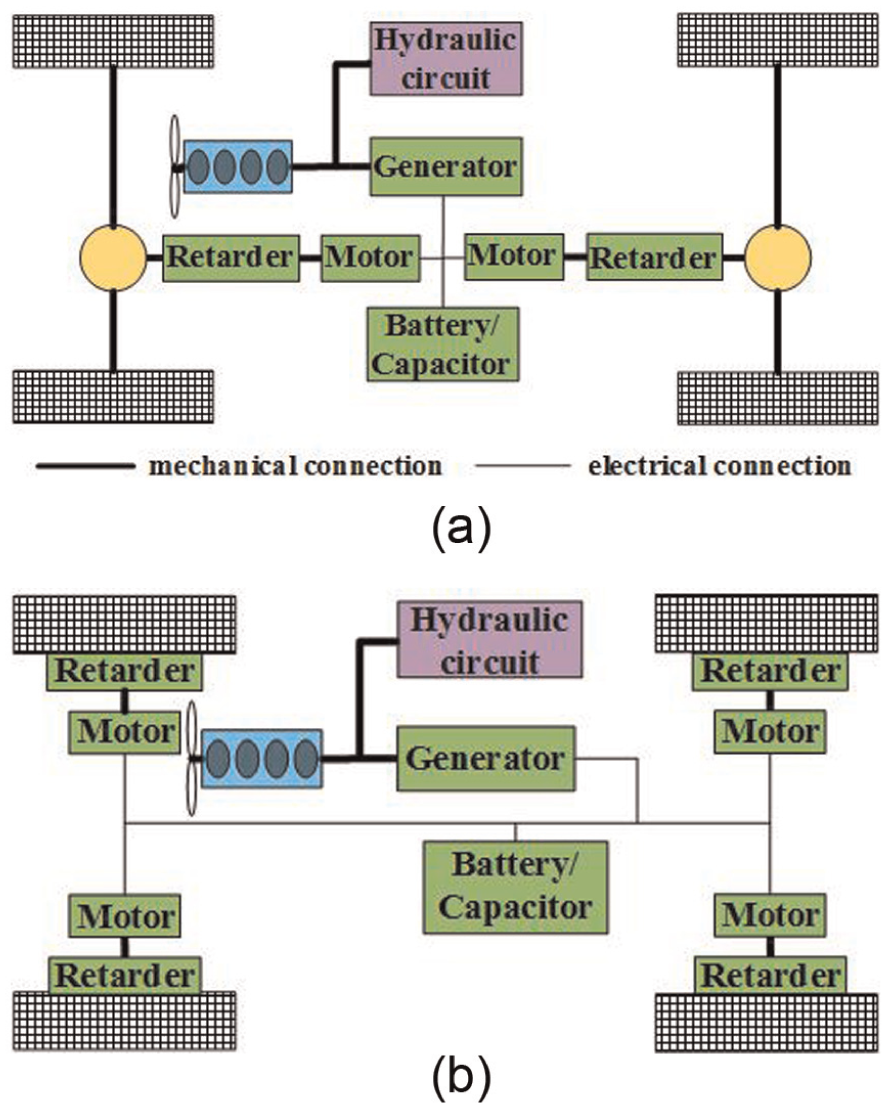
Distributed electric wheel loader: (a) front and rear axle independent drive wheel loader and (b) four-wheel independent drive wheel loader.
For hybrid excavators, the prototype or production model was released by current construction machinery manufacturers. Although these hybrid excavators can recover the braking energy of the swing, few of them can recover gravity potential energy produced by the hydraulic work device.17,33 This problem has been noted by scholars and they have achieved progress.12,13,101 In the three powertrain configurations, the series–parallel hybrid excavator which has the ability to recover braking energy and gravity potential energy may be a trend of development.
Energy storage devices challenges and trends
The existing energy storage devices have some challenges in application for HCMs. Using a single device is difficult to meet the various requirements of HCM before a revolutionary progress. Therefore, hybridization energy storage system that is designed for all types of HCMs is expected to become the development trend of the future. Hybridization energy storage system combines or integrates two or more energy storage devices to enable every energy storage device to show its advantages and compensate for the shortcomings using other energy storage devices. A hybridization energy storage system can be generated in two ways: one way is to combine two or more independent energy storage devices to form a combined energy storage system, and other way is to integrate functions of two or more energy storage devices to form a new integrated energy storage device.
Generally, a combined energy storage system is composed of two basic energy storage devices: one has high specific energy, whereas the other has high specific power. Ehsani et al. 102 presented a type of combined energy storage system composed of a battery and supercapacitor to overcome the shortcomings. Then, Lajunen and Suomela 103 further applied the combined energy storage system in hybrid mining loaders. Three different kinds of combined energy storage system configurations can be used: (1) one battery pack, (2) two or more similar battery packs in parallel or in series, and (3) a combination of one or more battery packs and a supercapacitor unit. Wang et al. 11 designed a new accumulator–motor–generator regeneration system composed of a hydraulic accumulator and a battery. The advantage of this system is that gravitational potential energy can be converted into electrical energy and hydraulic energy at the same time because of the large mass associated with the boom when the actuators go down, and this system has improved the energy recycling time that relies on control strategy. In addition, although the energy recycling time was short, this system can use a battery to replace the supercapacitor and reduce the cost because of the existence of a hydraulic accumulator.
Although studies on integrated energy storage device are relatively rare, they are still meaningful. If some technic progress has been made, this would be promising. Van de Ven 104 proposed an integrated energy storage device, namely, flywheel–accumulator, to solve the low density of hydraulic accumulator energy. This device is integrated by a flywheel and an accumulator, which is shown in Figure 14. This integrated energy storage device makes storing energy simultaneously in both pneumatic and rotating kinetic form possible, thereby increasing the energy density and power density significantly. The simulation results show that the energy storage of a flywheel–accumulator can be 10 times greater than that of a traditional hydraulic accumulator with the same volume (124–1209 kJ).

Diagram of the flywheel–accumulator system. 89
Energy management strategies challenges and trends
Most of the current HCMs employ the RB control strategy because of its high reliability and easy realization. The optimization-based control strategy can obtain an optimal result, but it is inconsistent with the actual situation because many constraints and simplified calculations exist in the process of calculation. In addition, the real-time performance of optimization-based control strategy is not ideal because of the considerable amount of calculation required. Therefore, this strategy is difficult to apply in practice. The control strategy of the future will be likely to develop toward the combination of intelligence and optimization algorithms to improve the effect of optimization and real-time performance through hybrid optimization.
Conclusion
Several conclusions have been obtained from this study. They are summarized as follows:
HCMs can continuously reduce ownership costs and depletion of oil saving, because of the advances in technology and government support. Thus, HCMs have the ability to extend to the construction machinery market in the near future.
There are three types of powertrain configuration used in hybrid wheel loader, that is, series, parallel, and series–parallel. The series hybrid powertrain has mainly been applied to the large-tonnage hybrid wheel loader, and the parallel and series–parallel hybrid configuration are still on the researching stage.
For the powertrain configuration of hybrid excavator, series, parallel, and series–parallel are the most commonly used configurations. The series–parallel configuration is identified as the best solution among existing configurations, considering economy and liability.
In light of batteries, supercapacitors, hydraulic accumulator, and flywheel, these existing energy storage devices require revolutionary progress to promote the rapid development of HCMs.
Combined energy storage system or integrated energy storage device, which enables every energy storage device to show its advantages and compensate for the shortcomings using other energy storage devices, is expected to become the energy storage system development trend of the future for HCMs.
For HCMs energy management strategies, RB control strategy is the most widely used control strategy because of its high reliability and easy realization. While for optimization-based control strategy, it will need to do a lot of researches in order to be applied in practice.
The distributed electric wheel loader is likely to be one of the next step development trend in the future for hybrid wheel loader. However, to realize this goal, a large number of basic researches still need to be conducted.
Footnotes
Academic Editor: Yangmin Li
Declaration of conflicting interests
The author(s) declared no potential conflicts of interest with respect to the research, authorship, and/or publication of this article.
Funding
The author(s) disclosed receipt of the following financial support for the research, authorship, and/or publication of this article: This work was supported by National Natural Science Foundation of China (No. 51375202) and Graduate Innovation Fund of Jilin University (No. 2015135).