




Abstract
Research on structural dynamic response and damage characteristics under blasting vibration is critical in structural safety assessment and blasting design. An orthotropic dynamic damage constitutive model of structural material is proposed in this article to improve the overly simple dynamic damage models of previous studies. A dynamic increase factor is used to assess the strain rate effect, and the dynamic damage stiffness matrix of the unit body is determined using the Sidoroff energy equivalence principle. The Mazars damage evolution model is used to calculate damage variables in the principal axis directions, and the Hoffman yield failure criterion for orthotropic materials is applied. The orthotropic dynamic damage constitutive model is input into dynamic finite element program LS-DYNA as the user subroutine to simulate the dynamic responses of typical masonry structures according to different blasting vibration excitations. The effects of varying particle peak velocity, principal frequency, and duration of blasting vibration on structural dynamic responses and damage are analyzed. The results show that maximal equivalent stress and strain increase positively with the particle peak velocity, structures have a danger frequency band, and structural damage increases with duration.
Introduction
Recently, with the increasing complexity of blasting environments and enhanced awareness of environmental protection and right, the negative consequences of blasting, especially vibration effect, have caused widespread concern. Structural dynamic responses under blasting vibration are very much concerned in the field of engineering blasting. Research on structural dynamic responses and damage characteristics is crucial for the safety assessment of structures and blasting design. Structural building material containing numerous inherent defects is a typical rate-sensitive and anisotropic material. The dynamic constitutive model of structural material which is widely debated in the study of structural dynamics is the most basic and critical instrument. Damage mechanics provides a suitable quantitative basis to measure failure processes and material damage. If a damage index indicating the damage degree is introduced to stress–strain relations and failure criteria, the structural material damage and failure process of building structures will be more accurately simulated.
Studies on the damage and failure of structures under blasting vibration are few. Wu et al., 1 Hao and colleagues,2,3 and Ma et al. 4 designed the three-dimensional continuum damage constitutive model, which considered the orthotropic elastic properties, strength envelope, and damage threshold for brick and analyzed the dynamic responses and damage of typical masonry structures under blasting vibration. The results revealed that damage to first-story columns was more substantial than that to second-story columns, whereas damage to beams was similar for both floors. Bayraktar et al. 5 assessed the safety of structures subjected to blast-induced ground excitation using operational modal analysis and the Drucker–Prager criterion. Blast-induced ground vibration parameters such as frequency, acceleration and particle velocity were evaluated according to some structural hazard criteria by Caylak et al. 6 Faramarzi et al. 7 studied the significance of blast-induced ground vibration and airblast on safety aspects of nearby structures, potential risks, frequency analysis, and human response. Yang and Cui 8 discussed the responses of a six-story frame structure to blasting vibration and earthquake excitation using the nonlinear software DARC and calculated the damage value of the frame structure using a double-parameter damage model and multiparameter failure criteria. Dhakal and Pan 9 performed numerical parametric analyses on a simplified linear structural model to investigate the effects of blasting on structural response. Chen et al. 10 investigated structural responses using data measured on site. The distribution characteristics of the frequency spectrum and the energy and the amplitude variation laws of the structural responses along the height direction to the blasting seismic wave in all directions were studied using wavelet analysis combined with fast Fourier transformation (FFT). Leng et al. 11 calculated concrete multiaxial constitutive relation, yield criterion, failure criterion, and a plastic flow rule in true stress space using thermodynamic principles. Xiao et al. 12 designed a Hsieh–Ting–Chen (HTC) four-parameter model for concrete dynamic testing by introducing strain rate and hydrostatic pressure considerations into an HTC four-parameter static constitutive model of concrete to analyze the earthquake responses of a high arch dam.
Structural building materials, such as concrete and masonry, are typical rate-sensitive and anisotropic materials, and the established constitutive model should consider these properties. However, all previous constitutive models of structural material identified in a literature review failed to account for anisotropy, dynamic characteristics, and damage simultaneously. These models could not precisely determine the cumulative damage process of a structure from damage to failure or the key elements of structural damage. Therefore, these models are not useful in structural damage assessment, seismic strengthening, or guiding blasting design. Establishing an anisotropic dynamic damage constitutive model of structural materials and analyzing the effects of peak value, frequency, and duration of blasting vibration on structural dynamic responses will be of paramount theoretical and practical value, and it can enhance the blasting seismic safety evaluation of buildings around a blast zone and increasing multiparameter blasting vibration safety. This article presents an orthotropic dynamic damage constitutive model to analyze structural vibration damage and key damage parts. The Sidoroff energy equivalence principle, the damage model by Mazars, and Hoffman yield failure criteria are used, and the strain rate effect is considered. Finally, the model is input into dynamic finite element program LS-DYNA as a user subroutine to simulate the dynamic responses of typical masonry structures under different blasting vibration excitations.
Orthotropic dynamic damage constitutive model of structural material
Strain rate effect
Structural material is typical rate-sensitive. The strain rate effect of the material is normally assessed using the dynamic increase factor (DIF), which is generally a summarized empirical formula obtained by comparing stress and strain changes during static and dynamic tests.
The DIF used for concrete 13 in the numerical analysis is


where DIFσ and DIFε are the uniaxial DIFs of stress and strain, respectively;
For brick masonry, 14 the uniaxial DIF is



Therefore, in dynamic conditions

where
Dynamic damage stiffness matrix and damage evolution equation of structural materials
The constitutive model of structural material can be expressed as follows

where

where dλ is the plastic multiplier.
The damage variable in the principal strain direction is used to define material damage. According to Sidoroff’s energy equivalence principle, 15 the elastic complementary energy density of the damaged material is equal to that of the initial undamaged material, namely
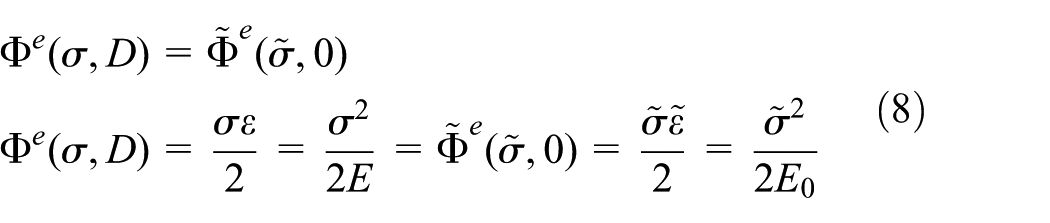
where D is the damage and E and
Assume that (1) the material’s initial state is isotropic and becomes orthotropic with the accumulation of damage under loading; (2) damage reduces material strength and degrades stiffness, and element damage can be described by the damage values of three orthogonal principal strain directions; (3) the damage in whole coordinates can be determined by the transformation of coordinates; (4) the principal axes of material strain and damage are constantly in line; and (5) Poisson’s ratio is unaffected by damage.
The dynamic damage elastic flexibility matrix of elements in the principal axis coordinate system is expressed as 17
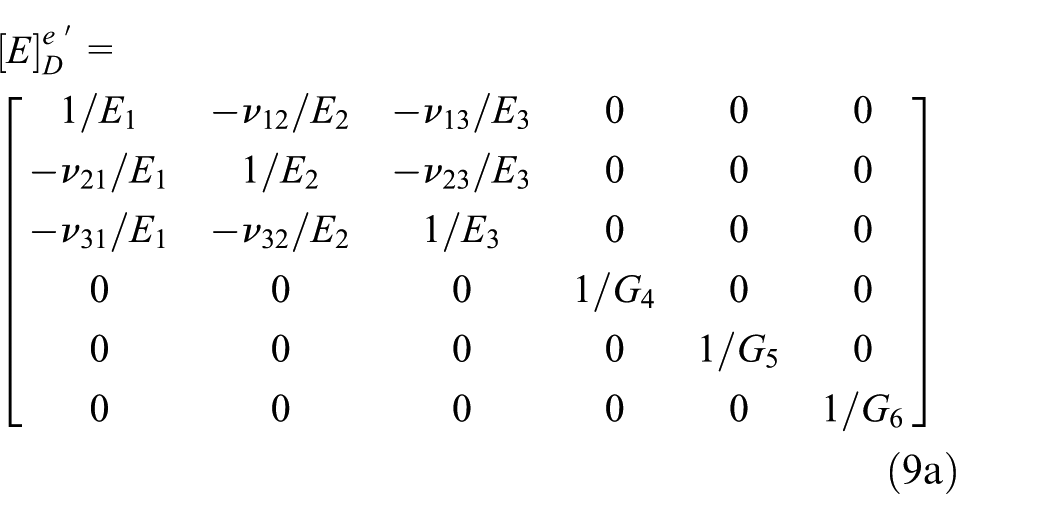

where E,
The stiffness matrix is obtained in the global coordinate system using

where [
The damage model by Mazars is used to describe damage variable

whereas on the uniaxial compressive condition

where
Orthotropic yield and failure criterion of material
For structural materials, the orthotropic yield and failure criterion are less than isotropic yield and failure criterion. Relevant literature reported the following multiaxial failure criterion for evaluating the plastic properties of concrete in a compression state 19
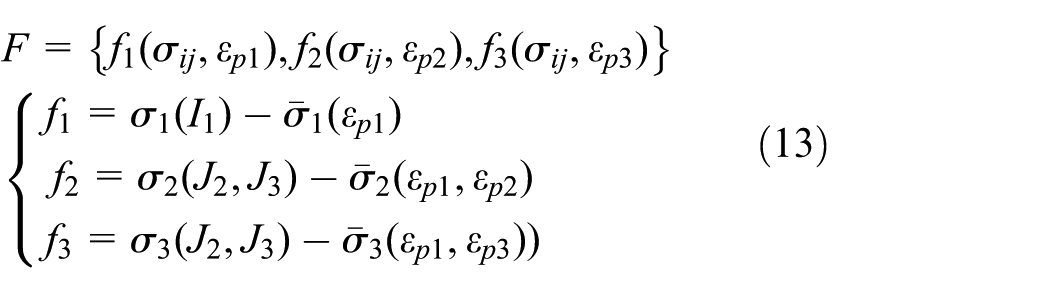
where
For the yield and failure criterion of orthotropic materials, Hoffman presented the following equation, 20 which can be used to determine differences in tensile and compressive strength

where
According to the effects of damage and strain rate, the aforementioned parameters are as follows

where
Experimental verification of established model
The literature 21 used a similar simulation experiment to analyze the response and damage of a two-story reinforced concrete (RC) frame structure under a vertical blasting seismic wave. The test model was fabricated on a 1:12 scale. High-frequency ground shock simulation was achieved using an electromagnetic shaker. The model frames were fabricated using microconcrete (a mixture of cement and coarse sand) and model reinforcement. The model’s main reinforcement was 3-mm threaded rods. The model was tested using a modified input, sy50p, which had a peak ground acceleration (PGA) of 23.7 g, particle peak velocity (PPV) of 1.54 m/s, and frequency band of 5–70 Hz. Severe cracking occurred at the midspan of the beams and near the beam–column joint regions on both floors, and a few circumferential cracks were detected on the first-story columns. Figure 1(a) shows the final cracking pattern.

Experimental and calculated crack distribution (marked with elliptical lines): (a) experimental crack distribution and (b) calculated crack distribution.
To verify the applicability of the model, the constitutive model is input into a finite element program and imported into a DYNA secondary development interface file, and a new solver is then produced. The keyword “MAT_ADD_EROSION” is added to the LS-DYNA keyword files to delete failure elements. The variables “Minimum principal strain at failure (MNEPS)” and “Maximum principal strain at failure (MXEPS)” in keyword “MAT_ADD_EROSION” are used as criteria for failure. The elements are considered as failure elements and deleted from the numerical model when the principal strain in arbitrary principal direction is larger than MXEPS or the principal strains in all three directions are smaller than MNEPS. The simulation of RC uses the integrated model. Table 1 shows the material parameters. Because relevant literature does not include complete signal data, the typical blasting seismic wave, which has a PGA of 23.7 g, PPV of 1.54 m/s, and frequency of 16.32 Hz, is used in the simulation. Table 2 shows the parameters for the damage evolution equations and Figure 1(b) depicts the calculated cracking pattern.
Material properties.

RC: reinforced concrete.
Parameters in damage evolution equations.

The numerical simulation process results show that cracks initially appear in the midspan portion of each beam, and then rapidly appear at the junctions of beams and columns and at the bottom of floor columns. The simulation results in Figure 1 show that the occurrence location of cracks is more consistent with the occurrence locations in the test results, and crack formation is also more consistent with the experimental results, which verify that this material model can effectively simulate structural response and failure under blasting vibration. Due to the lack of complete vibration information in the literature, 21 the damage obtained by numerical simulation is not completely consistent with the test result.
Another example of calculation describes the experimental and numerical results of the simply supported mortar beam containing cracks in midspan under the dynamic loads in the literature. 22 Computational model diagram is shown in Figure 2. (Because the simply supported beam is axisymmetric, only half of the calculation model is used.) The dynamic load is shown in Figure 3. The material parameters are shown in Table 3. The calculation results are plotted in Figure 4. As can be seen, the simulation results are more consistent with the test results.
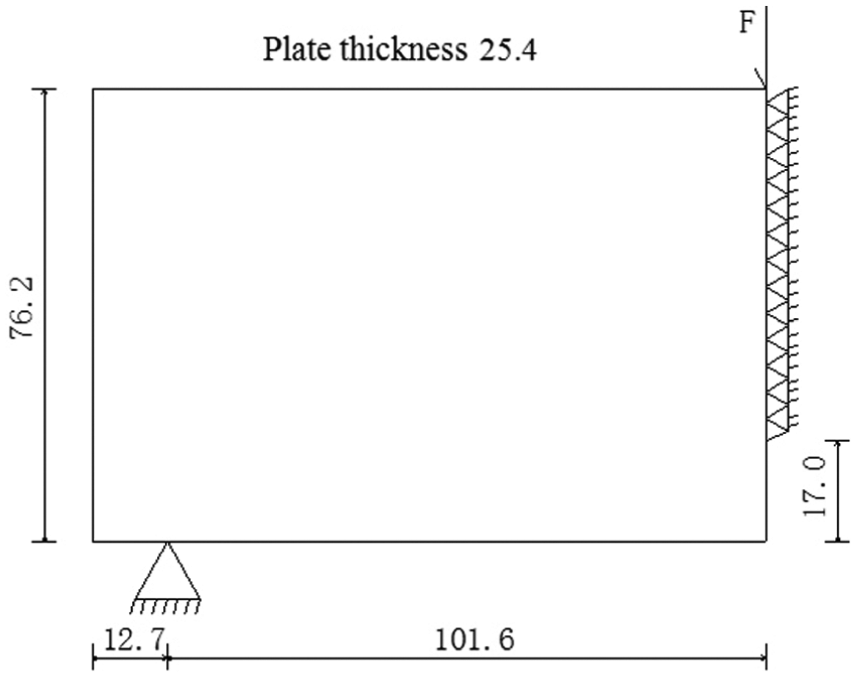
Mortar beam (mm).

Load curve on simply supported beam.
Material parameters of beam.


Deflection–time curve of load point.
Effects of three blasting vibration factors on dynamic responses
Masonry structures have been widely used in civil and industrial engineering. In this article, the typical structure of a two-story, two-cross RC frame infilled with brick masonry is used to discuss the damage and dynamic responses of structures to blasting vibrations. The structure has a length of 6 m × 6 m and a height of 3.6 m per story. The columns and beams have a cross section of 240 mm × 240 mm and 240 mm × 250 mm. The slab thickness is 100 mm and the thickness of the masonry wall is 240 mm. Figure 5 shows the finite element model. The material properties of RC and masonry components are given in Table 1. The mesh dimension ranges from 10 to 12 cm for considering the model size, computer operation capacity, and calculation accuracy. The literature 23 shows that this mesh dimension can meet the calculation accuracy of the structure dynamic response. Table 2 shows the parameters in the damage model by Mazars.

Finite element mesh model of the two-story brick structure.
The vertical blasting vibration velocity of the three directions is high frequency and its amplitude is relatively large, which is quite different from seismic wave. So the vibration load in the vertical direction is often used as the failure criterion for the structure according to the Blasting Safety Regulations. 24 A typical time history of vertical blasting vibration measured by blasting vibration recorder (IDS3850) in a field test is used to analyze the effects of the three essential factors (PPV, principal frequency (PF), and duration) of blasting vibrations on the dynamic responses of the structure in this study. Figure 6 shows the velocity–time history with a PPV of 0.06 m/s, PF of 82 Hz, and duration of 0.11 s.

Velocity–time history curve of blasting vibrations.
In order to simulate the dynamic responses of typical masonry structures under different blasting vibration excitations, the orthotropic dynamic damage constitutive model of structural material presented in this article is input into dynamic finite element program LS-DYNA as a user subroutine. Then the dynamic responses of typical masonry structures are obtained by finite element program LS-DYNA.
PPV effect on structural dynamic responses
The effect of PPV is assessed by ensuring that the PF and duration are the same (0.11 s) while setting the PPV at 6.0, 4.8, and 3.6 cm/s. The calculated results show that the structure is damaged when the PPV is 3.6 cm/s, and that the maximal damage values of 0.46 and 0.95 occur when the PPV is 4.8 and 6.0 cm/s, respectively. Figure 7 shows the damage patterns of the masonry structure when the PPV is 6.0 cm/s. When the PPV is 4.8 cm/s, the damage of the structure occurs only at the bottom of the interior wall and the connection part of the wall and pillar in the middle of the first story. When the PPV is 6.0 cm/s, the first-story wall and the bottom of the wall of the second story are damaged, indicating that damage to the first story is serious.

Damage patterns of masonry structure under excitations when PPV = 6.0 cm/s.
Table 4 shows that the maximal equivalent stress increases linearly with the PPV and the maximal equivalent strain increases more rapidly than the PPV does. In addition, the maximal equivalent stress appears in the RC elements and the maximal equivalent strain appears in masonry wall elements.
Structural responses under different PPVs.

PPV: particle peak velocity; PF: principal frequency.
PF effect on structural dynamic response
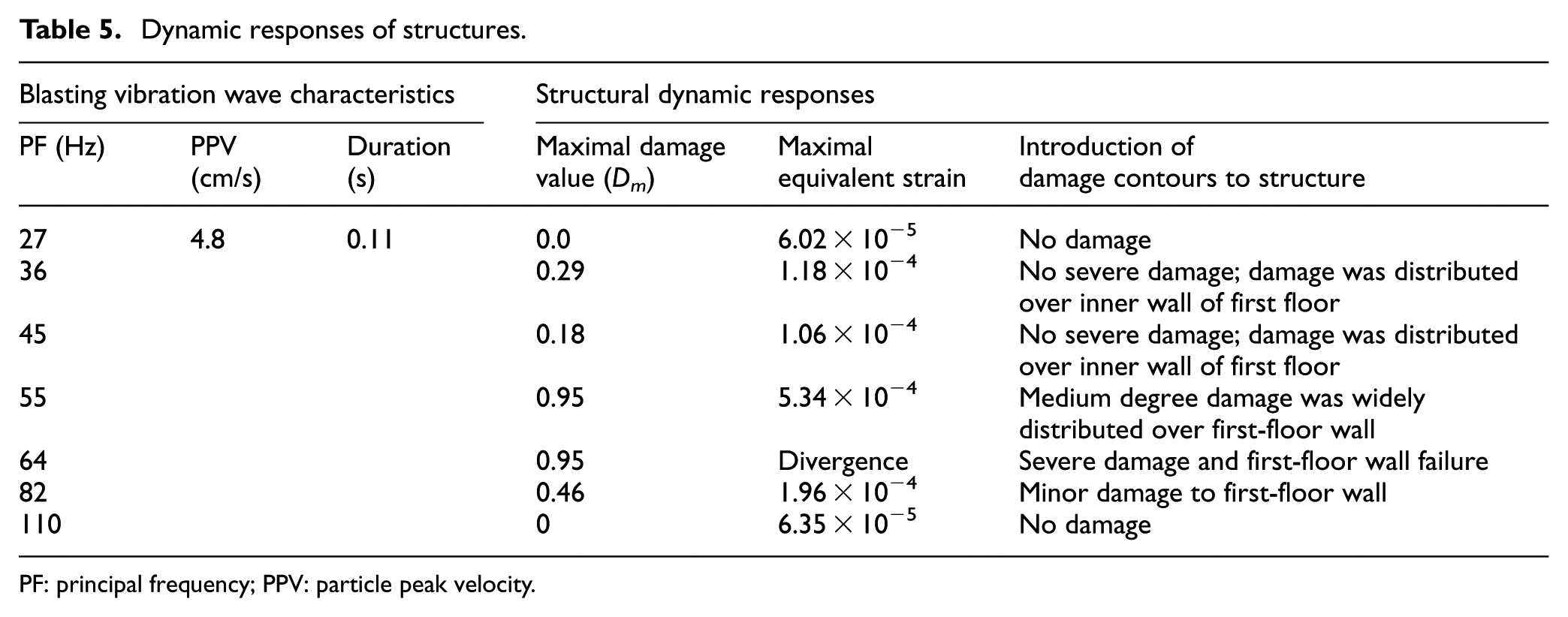
Due to the high frequency of blasting vibration and low structure natural frequency, the high-frequency vibration effect on structure is discussed. Table 5 shows the structural responses according to various PFs when the PPV and duration remained the same.
Dynamic responses of structures.
PF: principal frequency; PPV: particle peak velocity.
As shown in Table 4, the damage and failure to the first story are more severe when the PF is 64 Hz. With the PF increasing or decreasing, structural damage and failure decrease until there is no damage. Structural dynamic responses and damage are also closely related to vibration wave forms. The structure appears to have a danger frequency band in which the largest responses to vertical ground excitation occur, and the danger frequency band exists in a high mode of structure.
Vibration duration effect on structural dynamic responses
The typical blasting vibration shown in Figure 6 is used to determine the dynamic responses of the structure to the durations of vibrations. Figure 8 illustrates the damage patterns of the structure at durations of 0.06 and 0.09 s. The results showed that structural damage increases with duration.
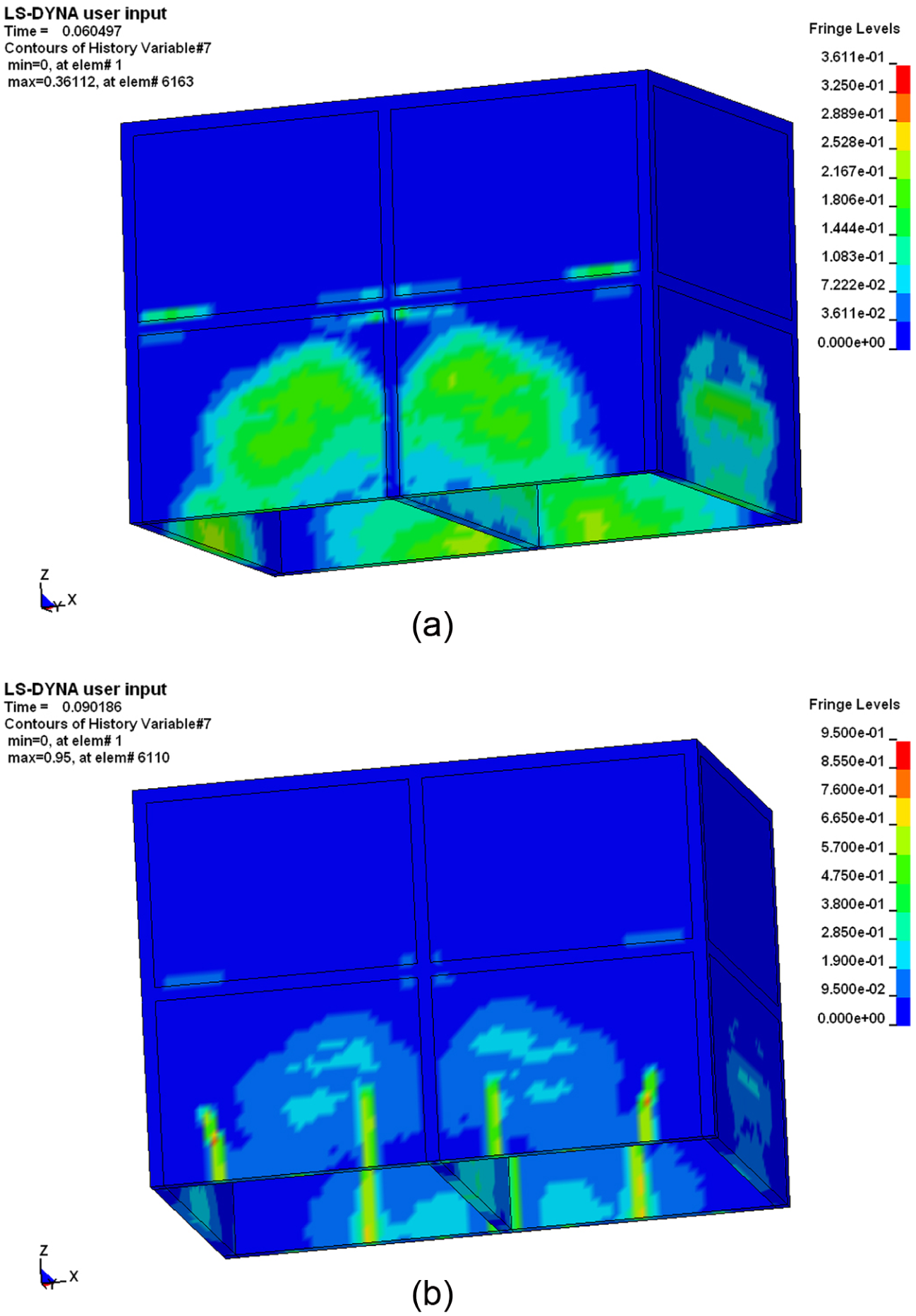
Damage patterns of structure at different durations: (a) damage pattern of structure when t = 0.06 s and (b) damage pattern of structure when t = 0.09 s.
Damage and dynamic responses of four-story masonry structure
To determine the responses of various layers of the structure under the same blasting seismic loads, the damage and dynamic responses of a four-story masonry structure are compared with the responses of the two-story masonry structure. The four types of blasting vibration waves, with frequencies of 27, 45, 64, and 110 Hz, are selected and defined as W1, W2, W3, and W4, respectively. Table 6 shows the results, and Figure 9 shows the damage pattern of the structure.
Dynamic responses of structure when PPV = 7.2 cm/s.

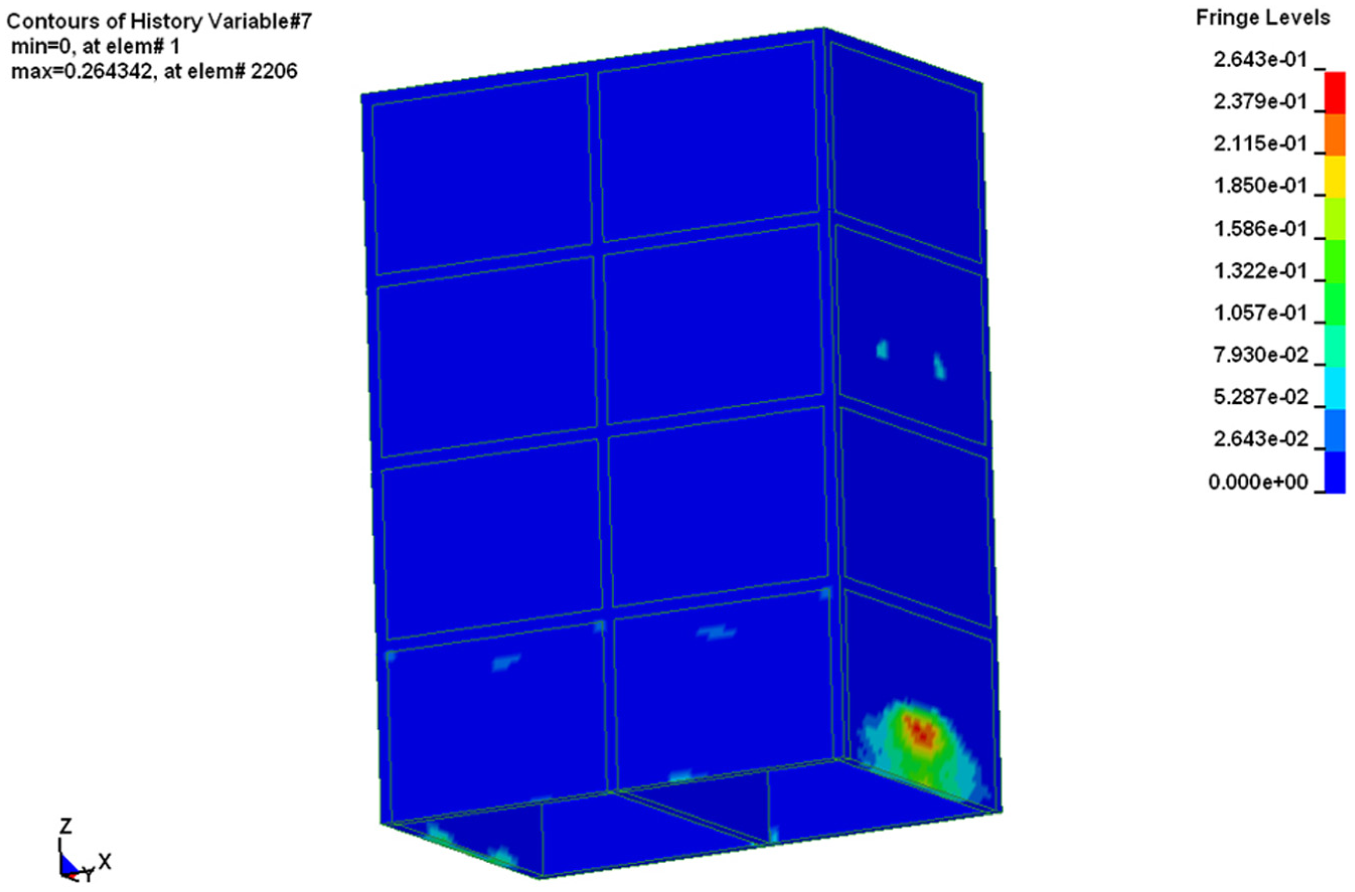
Damage of four-story structure.
Conclusion
An orthotropic dynamic damage constitutive model is proposed according to the equivalent elastic complementary energy theory, Mazars damage model, and Hoffman failure criteria. The damage model is input into LS-DYNA as a user subroutine to analyze structural dynamic responses under blasting vibration. The constitutive model is verified to be effective in evaluating the structural dynamic response. The following conclusions are deduced from the research above:
An increase in the PPV can aggravate structural damage. The stress response develops linearly with the PPV before damage occurs, whereas the strain response appears nonlinearly and increases more rapidly after damage occurs.
The structure has a danger frequency band in which the largest responses to vertical ground excitation occur, and the danger frequency band exists in a high mode of structure.
Blasting vibration duration influences structural responses.
Taller structures experience less damage and fewer dynamic responses than do smaller structures under the same blasting vibration.
Footnotes
Academic Editor: Fakher Chaari
Declaration of conflicting interests
The author(s) declared no potential conflicts of interest with respect to the research, authorship, and/or publication of this article.
Funding
The author(s) disclosed receipt of the following financial support for the research, authorship, and/or publication of this article: This research was supported by the National Nature Science Foundation of China (Grant No. 50878123), the Specialized Research Fund for the Doctoral Program of Higher Education of China (Grant No. 20113718110002), the Fund of the State Key Laboratory of Disaster Prevention & Mitigation of Explosion & Impact (PLA University of Science and Technology) (Grant No. DPMEIKF201307), and Huaqiao University Research Foundation (Grant No. 13BS402).