




Abstract
The non-differentiable solution of the linear and non-linear partial differential equations on Cantor sets is implemented in this article. The reduced differential transform method is considered in the local fractional operator sense. The four illustrative examples are given to show the efficiency and accuracy features of the presented technique to solve local fractional partial differential equations.
Keywords
Introduction
The differential transform scheme is a method for solving a wide range of problems whose mathematical models yield equations or systems of equations classified as algebraic, differential, integral and integro-differential.1–3 The concept of differential transform was first proposed by Zhou, 4 and its main applications therein are solved for both linear and non-linear initial value problems in electric circuit analysis. This method constructs an analytical solution in the form of polynomials. The differential transform method (DTM) is an iterative procedure that is used to obtain analytic Taylor series solutions of differential equations. Thus, this method results in the construction of an analytical solution in the form of polynomials.
The DTM was applied to solve the fractional differential equations and the fractional integro-differential equations.5,6 Elsaid 7 considered the DTM coupling with the Adomian polynomials. Nazari and Shahmorad 8 used the DTM to solve the fractional-order integro-differential equations with non-local boundary conditions. The reduced differential transform method (RDTM) has been introduced by Keskin and Oturanc for solving partial differential equations (PDEs). The advantage of the RDTM is the reduction in the volume of computations when compared to the DTM.5,9
Recently, local fractional derivative and calculus theory has been introduced in Yang. 10 This resides in fractal geometry, which is the best method for describing the non-differential function defined on Cantor sets. The physical explanation of the local fractional derivative can be seen in He and colleagues.11,12 A great deal of research work has been conducted relating to the non-differentiable phenomena in fractal domain concerning the local fractional derivative10–18 (references therein).
The aim of this article is to extend RDTM for the local fractional derivative. Considering this, we also prove those theorems in classical DTM for the local fractional derivative using local fractional Taylor’s theorem.
Local fractional RDTM
In this section, we recall and review briefly the local fractional Taylor’s theorems, and then, we extend RDTM for local fractional derivative.
Theorem 1. 10 (Local fractional Taylor’s theorem)
Suppose that

where
Theorem 2. 10
Suppose that

Definition 1
The local fractional differential transform

where
Definition 2
The local fractional differential inverse transform of

Using equations (3) and (4), the theorems of the local fractional transform method are deduced as follows:
Theorem 3
If

Proof. From (3), we get

Theorem 4
Assume that

where

Proof. From equation (3), we have

Theorem 5
Suppose that

then we obtain

Proof. From equation (4), we get
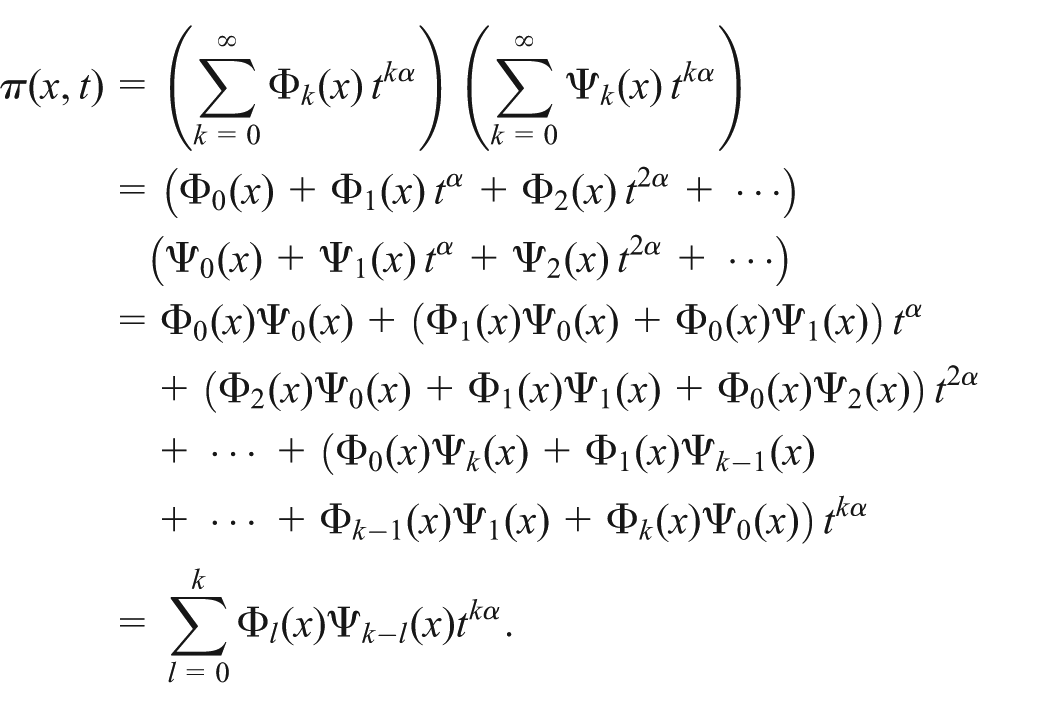
Therefore, we obtain

Theorem 6
Assume that

where

Proof. From equation (3), we obtain

where

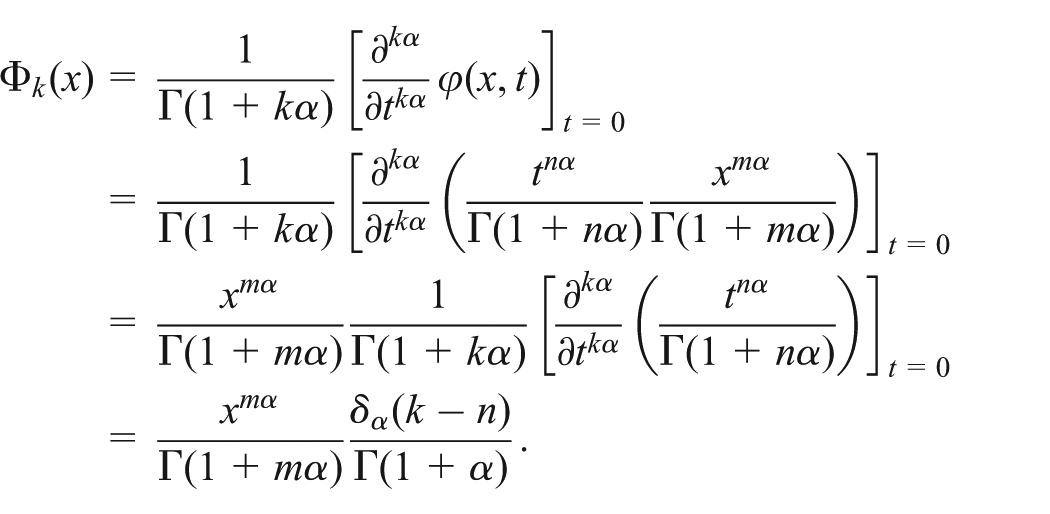
Theorem 7
If

where the local fractional Dirac delta function is

Proof. From equation (3), we have
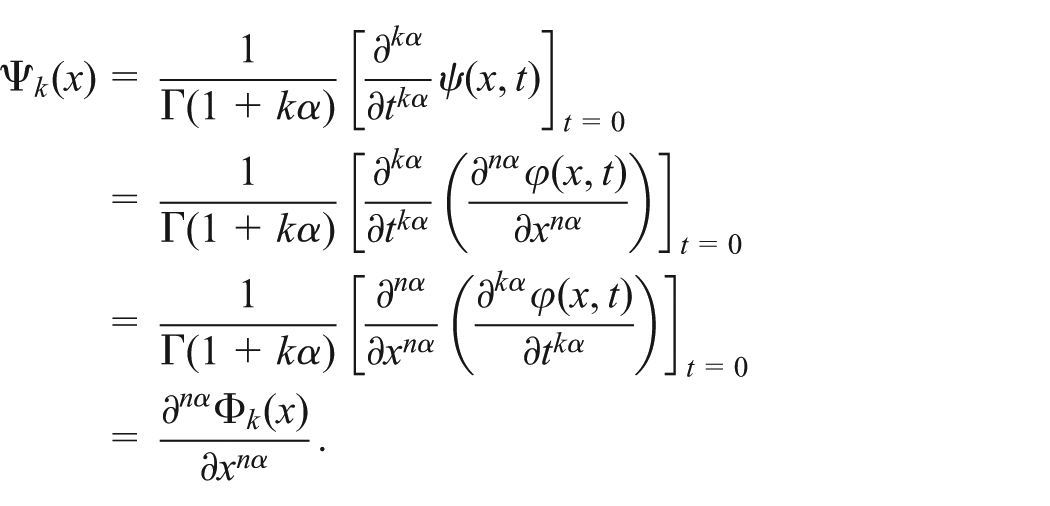
Theorem 8
Suppose that

where

Proof. From equation (7), we have
Numerical applications
Example 1
Consider the following type of linear PDE on cantor sets

with the initial values

To obtain solution of equation (16) using the RDTM, in view of equations (11) and (15), we can transform equation (16) to the following iteration relation

or

From equation (17), we obtain

Therefore, from equations (19) and (20), the components with non-differentiable terms are as follows



and so on. Hence, substituting the above components in equation (4), we find the solution of equation (16) as

Example 2
Consider the following local fractional PDE

subjected to the initial values

In view of equations (11) and (15), the local fractional iteration algorithms can be written as follows

or

From equation (26), we have

Therefore, from equations (28) and (29), we give the components as follows




and so on. Consequently, we obtain

Example 3
Consider the following non-linear PDE on Cantor sets

and its initial value is suggested as follows

By applying the RDTM for equation (36), we have the local fractional iteration algorithms as follows

or

From equation (37), we obtain

Therefore, from equations (39) and (40), we give the components as follows
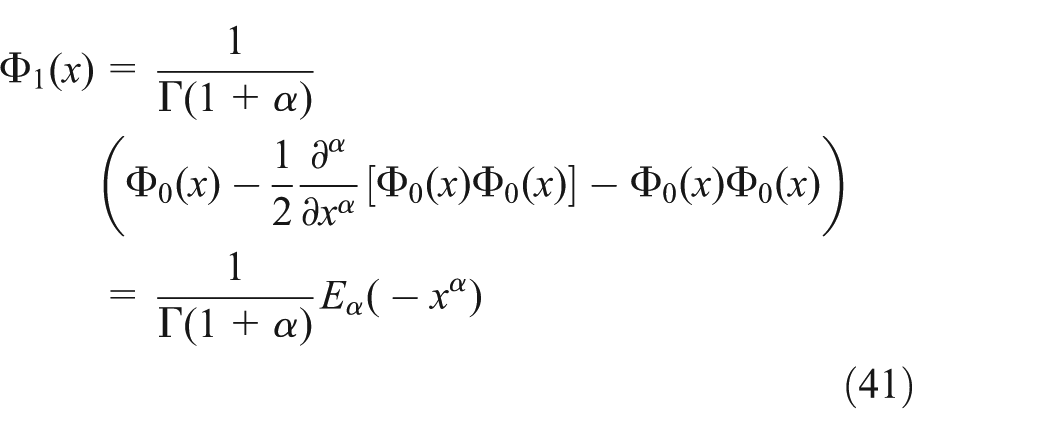


and so on. Hence, the solution of equation (36) is

Example 4
The following PDE on Cantor set is reported as

subjected to the initial value

Applying the local fractional differential transform to both sides of equation (46), we obtain the following iteration relation

or

From equation (47), we get

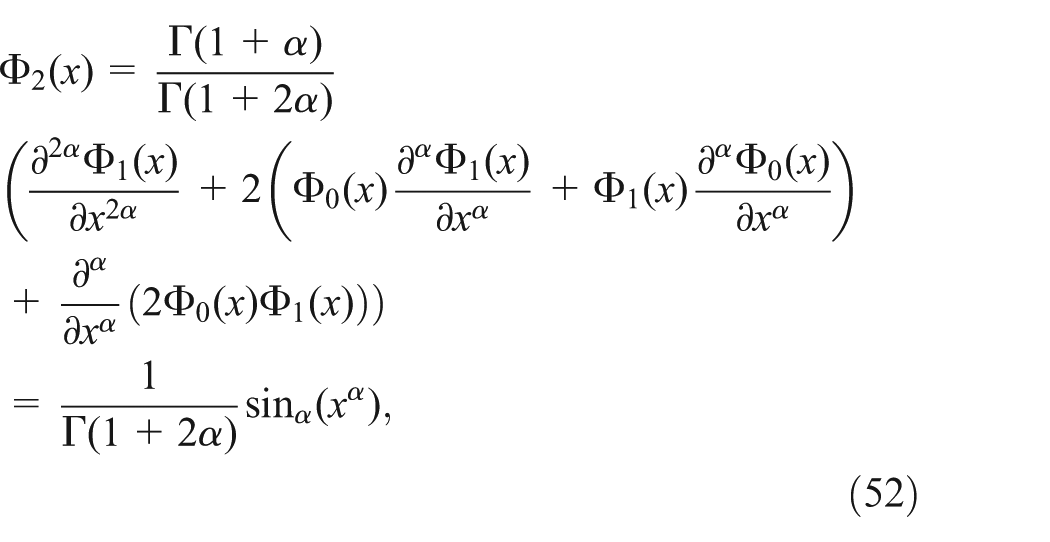
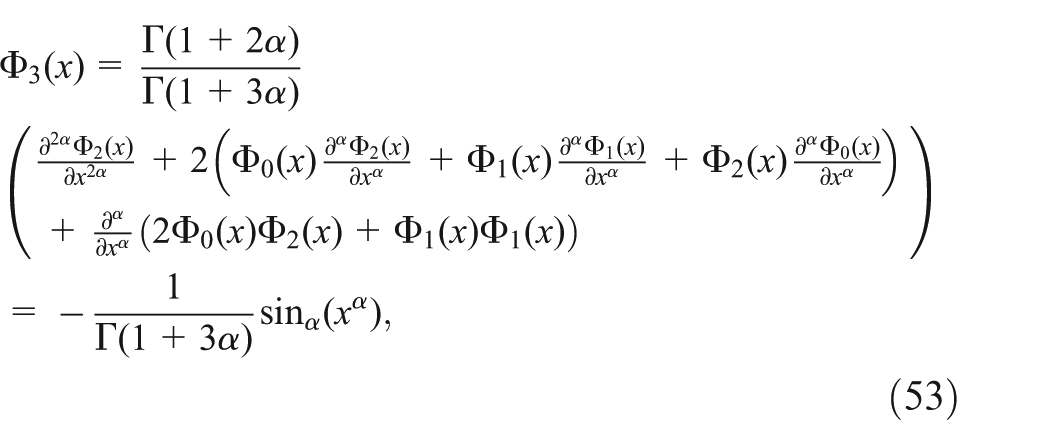
Therefore, using equations (49) and (50), we give the components as follows


and so on. Consequently, we obtain the solution of equation (46) as under

Conclusion
In this work, the RDTM has been successfully employed to solve the PDEs involving local fractional derivatives. The obtained solution is a non-differentiable function, which is defined on Cantor function, and it discontinuously depends on the local fractional derivatives. Comparing the RDTM with DTM for solving this type of equations shows that the volume of computation is reduced in this method.
Footnotes
Acknowledgements
This research project was supported by a grant from the “Research Center of the Female Scientific and Medical Colleges”, Deanship of Scientific Research, King Saud University.
Academic Editor: Xiao-Jun Yang
Declaration of conflicting interests
The author(s) declared no potential conflicts of interest with respect to the research, authorship, and/or publication of this article.
Funding
The author(s) disclosed receipt of the following financial support for the research, authorship, and/or publication of this article: This research project was supported by a grant from the “Research Center of the Female Scientific and Medical Colleges”, Deanship of Scientific Research, King Saud University.