



Abstract
In this study, fuel properties, engine performance, and emission characteristics of diesel fuel, false flax biodiesel, and their blends with butanol have been evaluated. Blend ratios used in this study were diesel–biodiesel–butanol (70% diesel–20% biodiesel–10% butanol and 60% diesel–20% biodiesel–20% butanol by volume) and biodiesel–diesel (20% biodiesel–80% diesel and 100% biodiesel by volume). Experiments showed that 10% alcohol addition to diesel and biodiesel fuels caused a decrease in torque value up to 8.57%. When butanol ratio raised to 20%, torque value decreased to an average of 12.7% and power values decreased to an average of 13.57%. Specific fuel consumption increased to an average of 10.63% and 12.80% with 10% and 20% butanol addition, respectively. Alcohol addiction into conventional diesel and biodiesel fuel slightly increased NOX emissions. Supplement of alcohol decreased CO and CO2 emissions when it was entrained to diesel and increased it when it was added to biodiesel. It means that addition of alcohol to diesel changed CO and CO2 emissions.
Introduction
The increase in the energy demand of transportation in the world has resulted in the consumption of petroleum reserves and led to the development of sustainable and renewable alternative fuels for diesel engines.
Due to the growth of population and energy utilization, dwindling down to fuel and energy resources eventuated in an oil crisis in the late 1970s and early 1980s. Turkey’s energy usage being more than its energy production makes Turkey as an energy importer. 1 So, like other countries, it has catalyzed researchers in Turkey to find greener alternatives for internal combustion engines.
Biodiesel is an alternate energy source on which large number of investigations have been carried out.2–4 It is produced from vegetable oils (such as cottonseed, corn, sunflower, peanut, safflower, coconut, or palm), waste cooking oils, or animal fat that are chemically reacted with alcohol at different proportions and can be directly used in diesel engine without modifying the engine design as it has a higher cetane number and lower sulfur and exhaust emissions than diesels. 5 Therefore, it offers higher combustion efficiency, domestic origin, high flash point, inherent lubricity, and reduces harmful emissions such as SOx, HC, and CO. 6
Combustion of biodiesel alone provides over a 90% reduction in total unburned hydrocarbons (HC) and a 75%–90% reduction in polycyclic aromatic hydrocarbons (PAHs). 7
As a result of longer carbon length, higher viscosity, higher pour point, and lower volatility of biodiesel make problems like slower in-cylinder processes and lower combustion. 8 Therefore, a number of attempts such as alcohol addition to biodiesel have been made to overcome these disadvantages. 9 Several publications highlighted the influence of fuel modifications (alcohols–diesel blends) on the performance, emission, and combustion characteristics of diesel engines.9–12 Xue et al. 13 concluded that small portions of biodiesel blends are applicable as alternative fuel with minor compression ignition (CI) engine modification.
It was observed that using alcohol blends up to 20% does not usually require any important modifications on engine. 14 Besides, 5% alcohol addition to biodiesel fuels decreases hydrocarbon (HC) and carbon monoxide (CO) emissions, whereas 10% and 15% alcohol concentration increases the emissions. 11
In diesel engines, methanol, butanol, ethanol, and propanol are the common alcohols that are used. Ethanol is considered as promising fuel oxygenate, because its high heat of evaporation favors NOX reduction, while its high content favors particulate matter (PM) reduction. 12 Hansen et al. 15 reviewed effect of ethanol–diesel fuel blends for the diesel engine performance, emission and durability. They indicated that ethanol–diesel blends had significant effect on safety, engine performance, durability, and emissions. The addition of ethanol to diesel fuel had a beneficial effect in reducing the PM emissions at least.
Also studying with ethanol, Bilgin et al. 16 aimed to find out the most appropriate ethanol percentage and compression ratio that gives the best performance and efficiency values. Butanol is a feasible alternative fuel or fuel additive for use in CI engines and provides number of desirable properties compared to ethanol and methanol such as, higher cetane number, lower heat of vaporization, higher heating value, no corrosion to pipelines, and better miscibility and intersolubility with diesel fuel. 17 Rakopoulos et al. 18 observed the effect of n-butanol addition into diesel fuel by mixing 8%, 16%, and 24% (by volume) n-butanol with diesel fuel. Zhang and Balasubramanian 19 studied butanol addition into diesel fuel and biodiesel fuel through blending 20% palm oil methyl ester into low sulfur diesel fuel with 5%, 10%, and 15% butanol by volume.
Feng et al. 20 studied on combustion and emissions on motorcycle engine fueled with butanol–gasoline blend. They analyzed engine performance parameters such as power, fuel economy, and emissions. The results showed that engine power, torque, brake, specific energy consumption, and HC, CO, and O2 emissions were better, and NO and COx emissions were higher than pure gasoline.
Usually, due to the higher oxygen content, free aromatic hydrocarbons, and free sulfur content, lower PM, CO, and HC emissions are obtained with blends of biodiesel and alcohol fuels compared with the diesel fuel.
In this experimental study, the effects of butanol additions into diesel and biodiesel fuels were studied. Fuel properties of pure diesel and false flax biodiesel were determined. Diesel engine combustion and emission characteristics of the blend fuels were evaluated in detail and compared with diesel and biodiesel at full-load condition of the test engine.
Material and method
The experiments were carried out in Petroleum Research and Automotive Engineering Laboratories of the Department of Automotive Engineering at Çukurova University, Adana, Turkey. False flax oil is a crude material for biodiesel production, and the samples of false flax were supplied from a local oil company, Gaziantep, Turkey. False flax oil methyl ester (FFME) was produced via the transesterification method within a reaction, where the reactant and catalyst chemicals are methyl alcohol and sodium hydroxide (NaOH) consecutively. These chemicals were supplied from Merck, Kenilworth, NJ, and methanol was purified before use. A spherical glass reactor involving reflux condenser, stirrer, and thermometer was used to perform transesterification reaction in order to identify the optimum production condition terms.
A molar ratio of 6:1 (alcohol to oil) was set during the reaction. The parameters of the reaction were assigned as follows: methanol 20 wt%, sodium hydroxide 0.5 wt%, temperature 60°C, and time 90 min. Sodium methoxide was obtained by the mixture of methanol and sodium hydroxide, where sodium methoxide is mixed with false flax oil in the reactor subsequently. The mixture was kept at 60°C for 90 min by stirring. Following the reaction, the raw methyl ester was kept in separating funnel for 8 h which led to the separation of crude glycerin from methyl ester. The crude methyl ester was washed (with warm water till the water is clear) and dried at 110°C for an hour. Finally, washed and dried methyl ester was passed through a filter. At the end of the transesterification reaction, 97% conversion of oil was obtained. After biodiesel being produced, alcohol blends were prepared with butanol.
Instruments used for analyzing the product were as follows: Zeltex ZX 440 NIR petroleum analyzer with an accuracy of ±0.5 for determining cetane number, Tanaka AFP-102 for cold filter plugging point (CFPP), Tanaka AKV-202 test for measuring the kinematic viscosity, Kyoto electronics DA-130 for determining the density, Tanaka flash point control unit FC-7 to determine the flash point value, and IKA Werke C2000 to measure the heating energy rate.
In determining the blend ratios, target of the European Union (EU) was taken into consideration. According to the EU’s renewable energy target in 2020, ratios of blends were determined as 10% and 20%. In this study, the effects of alcohol additions into diesel and biodiesel were evaluated separately. These fuels are diesel–biodiesel–butanol (70% diesel–20% biodiesel–10% butanol and 60% diesel–20% biodiesel–20% butanol by volume) which are called D70B20A10 and D60B20A20, respectively.
After the preparation, fuel properties of the blends were identified as the performance and emission characteristics of these blend evaluation in detail. Results were compared with diesel and pure biodiesel (B100). Engine performance was measured on a four-cylinder, four-stroke, and naturally aspirated, direct injection diesel engine. All experiments were conducted three times, where the average values of the tests are released. Prepared fuels were tested at revolution per minute values between 1200 and 2600 r/min with the interval of 200 r/min at full load. Technical properties of the engine are given in Table 1.
Technical properties of the engine.

Technical specifications of hydraulic dynamometer and Testo 350-S diesel emission analyzer are shown in Tables 2 and 3, respectively.
Technical specifications of hydraulic dynamometer.

Technical specifications of Testo 350-S diesel emission analyzer.
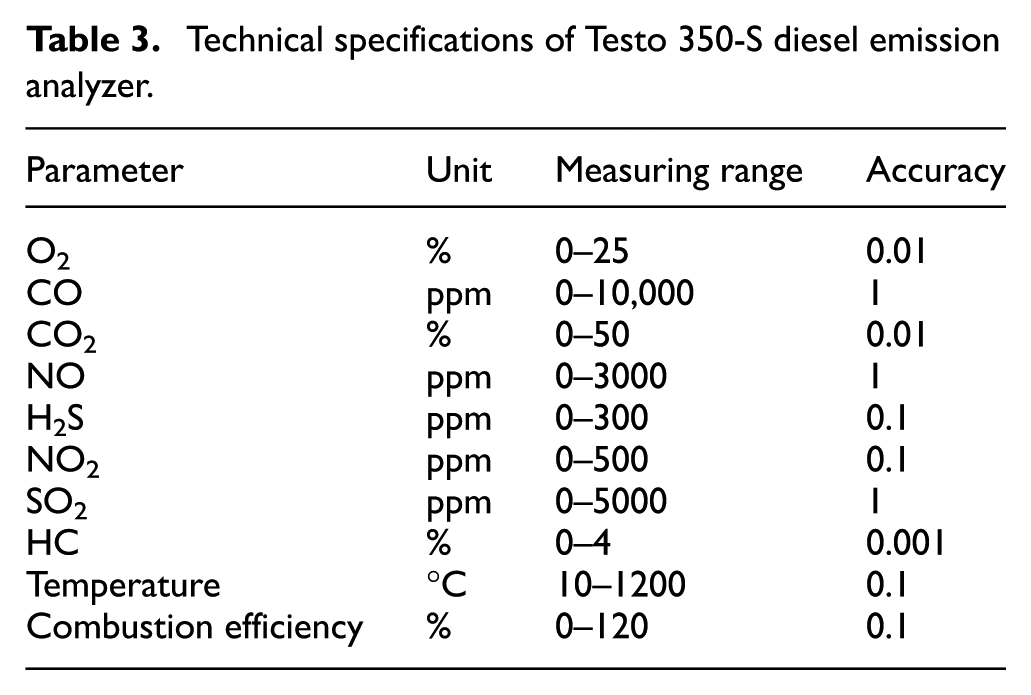
In this experimental study, error analyses for performance and emission equipments were carried out with diesel fuel. Ratios of maximum error values for engine speed, torque, specific fuel consumption (SFC), and CO, CO2, and NOX emissions were 0.06%, 0.75%, 1.1%, and 3.0%, 2.5%, and 2.1%, respectively.
Results and discussion
Fuel properties
Fuel properties of FFME and its blends with diesel fuel and alcohols are shown in Table 4. The density of FFME was higher than that of diesel fuel. Due to the higher density of FFME in accordance with the diesel fuel, blending with FFME caused an increase in the density values. Blend density changes with any change in the ratio of FFME. Density values of all blends meet the European Biodiesel Standard (EN 14214).
Fuel properties of test fuels.

ASTM: American Society for Testing and Materials; CFPP: cold filter plugging point.
As it can be seen in Table 4, cetane numbers B20 and B100 are lower than that of diesel fuel. In addition, cetane numbers D70B20A10 and D60B20A20 can be lower than that of B20 and B100 because of lower cetane number of butanol that is about 17. As a result, the cetane number of all blend fuels is lower than that of diesel fuel. The lower cetane number can increase ignition delay for blend fuels during the combustion process. Long ignition delay can deteriorate engine performance and emission characteristics such as NOX, total hydrocarbon (THC), PM emissions, and knocking.
Analysis revealed that FFME has higher viscosity (4.38 mm2/s) than diesel fuel (2.76 mm2/s), even so it still meets the standards. The heating value and cetane number of FFME are lower than that of diesel fuel. Methyl ester derived from false flax oil has a CFPP of −10°C, which is considerably low when other biodiesel fuels are taken into consideration.
Performance characteristics
It can be seen from Figures 1 and 2 that torque and power of the engine were reduced with biodiesel usage instead of diesel fuel (average of about 3.48% and 5.80% for B20 and B100, respectively). The possible reason for decreasing performance parameters can be explained by lower calorific value of biodiesel.

Torque versus engine speed of experimental fuels.
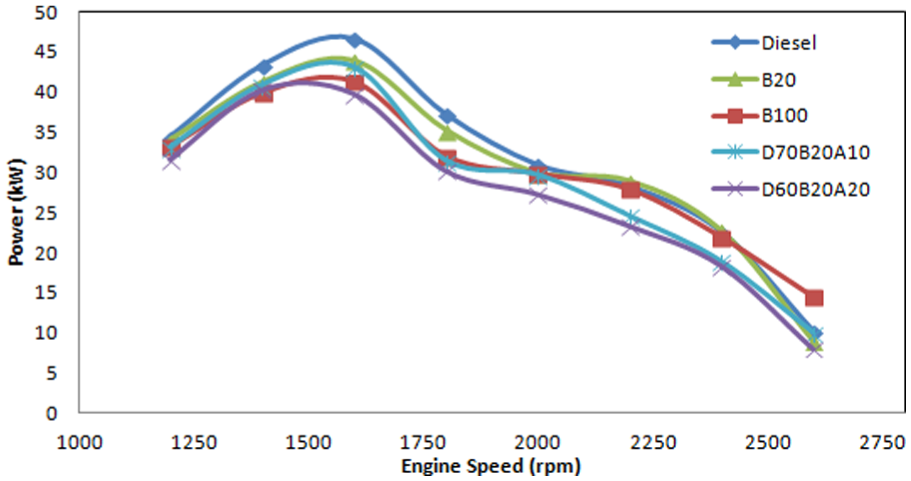
Power versus engine speed of experimental fuels.
Results showed that butanol addition to diesel and biodiesel fuels caused a decrease in terms of torque and power. Torque values were decreased to an average of 8.01%, and the power values were decreased to an average of 8.57% by 10% alcohol addition to diesel–biodiesel blend compared to diesel fuel.
Torque values were decreased to an average of 12.70%, and the power values were decreased to an average of 13.57% when the butanol ratio of the blend raised to 20%. Lower calorific value and higher latent heat of evaporation of butanol are responsible for reduction in torque and power. 21
After 2000 r/min, according to other test fuels, B100 showed better performance values. This could be due to the fuel properties of B100 (high density and oxygen content) and technical specification of the test engine (injection timing, injection characteristic, and air swirling). The fuel properties were compatible with the technical specification of the test engine. In other words, at high engine speed, the better combustion condition of pure biodiesel (B100) is due to higher density and oxygen content which put more fuel into the cylinder and improved combustion; therefore, the test engine generated higher torque/power.
An increment in SFC values was observed due to the usage of biodiesel and butanol, since butanol and biodiesel have lower calorific value. Figure 3 shows the SFC characteristics of test fuels. A total of 0.86% and 3.84% increment in SFC was obtained when B20 and B100 fuels were used instead of diesel fuel. Also, 10% and 20% butanol addition to diesel–biodiesel blends caused 10.63% and 12.80% increase in terms of SFC compared to diesel fuel, respectively.

SFC versus engine speed of experimental fuels.
Emission characteristics
The emission (CO, CO2, and NOX) graphs versus engine speed are presented in Figures 4–6, respectively. The fuel properties of biodiesel lead the way to the improvement of combustion process and exhaust emissions such as carbon monoxide (CO), PM, sulfur oxides (SOx), and unburned hydrocarbons (HC).22–26

CO (%) characteristics of experimental fuels.
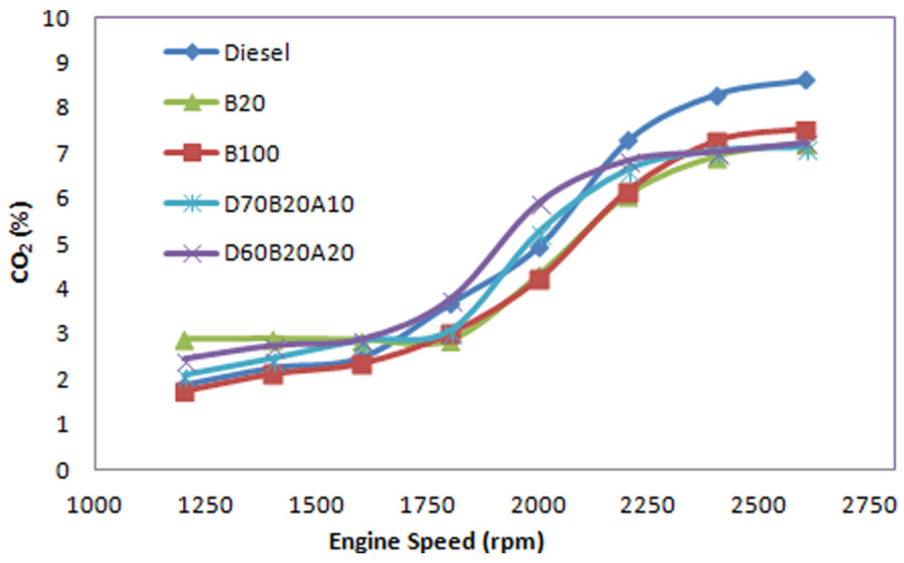
CO2 (%) characteristics of experimental fuels.

NOX (ppm) characteristics of experimental fuels.
Results show that FFME (B100) usage decreased the CO emissions 15.4% in the means of average CO emissions compared to diesel fuel due to additional oxygen and enhanced complete combustion; CO emission generally decreased with biodiesel usage, since butanol contains additional oxygen when compared to diesel; thus, butanol usage leads to decreased CO emission when compared to diesel.
Results indicate that FFME (B100) usage reduced the CO2 emissions 13.8% in the means of average CO2 emissions compared to diesel fuel. CO2 emissions usually decrease depending on the rate of biodiesel in the test fuels due to the lower elemental carbon-to-hydrogen ratio of biodiesel when compared to diesel fuel. 27 From Figure 5, it can be seen that alcohol supplement into diesel decreased CO2 emissions, whereas it increased by adding alcohol into biodiesel. This trend is related with biodiesel–butanol oxygen content values.
Nitrogen oxide emissions strictly depend on end-combustion temperature of cylinder and flame velocity. 28 Experiments show that FFME usage in CI engine increased the NOX emissions 9.6% in the means of average NOX emissions (Figure 6). The higher oxygen content of biodiesel causes an increment in NOX emissions, which leads to a better combustion and a higher combustion temperature as a result. NOX emissions are directly related with combustion temperature; thus, NOX emissions are increased. 29 Adding butanol into diesel and biodiesel decreases NOX emissions. 17 This may be attributed to the engine running overall “leaner” and the temperature lowering effect of the butanol (due to its lower calorific value and its higher heat of evaporation) having the dominant influence against the opposing effect of the lower cetane number (and thus longer ignition delay) of the butanol leading possibly to higher temperatures during the premixed part of combustion. 18
Conclusion
In this study, fuel properties of diesel fuel and false flax biodiesel were determined. Furthermore, engine performance, carbon monoxide, carbon dioxide, and nitric oxide emission values were gathered. The following conclusions were drawn:
Engine power and torque values were decreased using false flax biodiesel instead of diesel fuel. Addition of butanol into diesel and biodiesel further decreased the engine performance.
CO2 emissions were decreased when biodiesel was used instead of diesel fuel. Also, butanol addition to diesel–biodiesel fuel blends improved CO2 emissions compared to diesel fuel.
CO emissions were improved with false flax biodiesel, and also, butanol addition to diesel–biodiesel blend decreased CO emissions compared to diesel fuel.
Biodiesel usage caused increment in terms of NOX emissions compared to diesel fuel, whereas butanol addition to diesel–biodiesel blends decreased NOX emissions compared to biodiesel fuel.
Higher oxygen content of the test fuel improved oxidation during the combustion process. That situation led to decrease in incompleted combustion products and increase in peak temperature of the combustion chamber. In addition, during the combustion, higher oxygen content and higher combustion temperature increased the oxidation of N2 gas which caused higher NOX formation.
Usually, depending on carbon content of test fuels, CO2 emission showed decreasing trend.
Footnotes
Academic Editor: Ibrahim Abdalla
Declaration of conflicting interests
The author(s) declared no potential conflicts of interest with respect to the research, authorship, and/or publication of this article.
Funding
The author(s) received no financial support for the research, authorship, and/or publication of this article.