




Abstract
Climate change is an extremely serious international problem, which is concerned by all the communities in the world. As a major sector of energy consumption and the main source of carbon emissions, it is necessary for the Chinese transportation sector to take on a low carbon development path in order to alleviate the energy consumption and environment pollution and take a positive role in these fields. Under such environment, the supporting and evaluation systems of low carbon transport from four aspects, namely, the efficiency, industry, innovation, guide and society, of low carbon are established in this study. An empirical example from Changsha City, Hunan Province in China is provided as numerical example.
Introduction
A commonly accepted scientific opinion is that change in the global climate has been taking place, mainly due to the increase in carbon emissions. In recent years, China has entered into highly developed urbanized period. Highly developed urbanization is facing the increasing expansion of energy consumption and carbon emissions caused by increasing industries and vehicles.
Transport is the major sector for energy consumption and one of the main sources of emissions in China, which would result in more and more political and economic disputes. 1 Various estimations show that China might become the biggest market country of vehicles in the world in the future.2–5 It causes various serious problems. Energy consumption in transportation sector has grown significantly over the past decades with an annual rate of 14.7%. It is estimated that there were more than 500 million tons of CO2 emissions in 2014 which is more than four times of that in 1990 with an annual growth rate of 7.8%. This emission rate is considered relatively high among the developing countries 6 and equal to the total volume of the United States and European Union. Therefore, it is very necessary for the Chinese energy and environmental policy makers to investigate energy consumption and carbon emissions in transportation sector and establish supporting and evaluation systems for transportation sector.
Xu 7 shows that the construction of low carbon transport is a systematic project. It is necessary for the transport industry to take on a low carbon development path in order to build an eco-friendly society in China. Gui points out that it is urgent for the government to establish a low carbon transport system. However, none of the existing studies provide a complete supporting system or evaluation system mainly for China. 8 The objective of this study is to identify a supporting system of low carbon transport for China and provide an evaluation system based on previous studies. An empirical study in Changsha City, Hunan Province is conducted to support the systems referred in this study. Changsha sits at the northeast of Hunan Province in south-central China. Changsha City is the economic and political capital of Hunan Province. It is well known for its famous history and culture.
Supporting systems of low carbon transport
Low carbon transport is a long-term and complex system which is led by the government, followed by the city dwellers, based on the biological system and supported by scientific innovation system. To contribute the sustainable social development, an objective of this study is to provide supporting and evaluation systems of low carbon transport for China. The supporting system of low carbon transport is as follows.
Industrial supporting system
Winston et al. point that low carbon industry is the one based on low energy consumption and low carbon emission. Transportation industry is one of the major components of globalization and makes an important contribution to the society and economy. However, transportation industry is responsible for a large and growing share of emissions that affects global climate change.9–11 Therefore, the traditional transportation industries of high consumption and carbon emission should carry out low carbon transformation. The auto industry is the first traditional transportation industries that should take actions to reduce energy consumption and CO2 emission. Various kinds of estimations show that China might probably exceed the United States to become the largest market for autos in the world by the year 2020.12,13 In the meanwhile, the air pollution and CO2 emission caused by petroleum consumption used in autos have become more and more serious in China. China has become the second biggest country in the CO2 emission, which would result in more and more serious international environmental, political and economic disputes. Therefore, industrial supporting system is the first subsystem for the low carbon transport system. The transportation industries should be encouraged to carry out technology transform in order to promote carbon reduction. The idea of ‘low carbon’ should be applied to the transformation of transportation industries to achieve whole industry chain development in the field of transportation as well as the promotion of low carbon transportation supporting system.
Infrastructure supporting system
Transportation infrastructure is the main carrier for urban transportation. Transportation infrastructure provides capacity, in the form of traffic lanes and runways, for various transportation sectors such as highway, railway and airline. 9 However, the public transport infrastructure is growing slowly in China. The proportion of investment of urban public transportation only accounts for 22% in the total investment of urban transportation. The slow development of public transport infrastructure restricts the level of public transportation service.12,13 Therefore, it is urgent for the government to strengthen the construction of urban public transportation infrastructure in order to improve the urban environment and achieve the sustainable social development. Therefore, an infrastructure supporting system is a vital subsystem for low carbon transport system. It can improve the urban public transportation system and greatly decrease the carbon emission from transportation sector.
Life supporting system
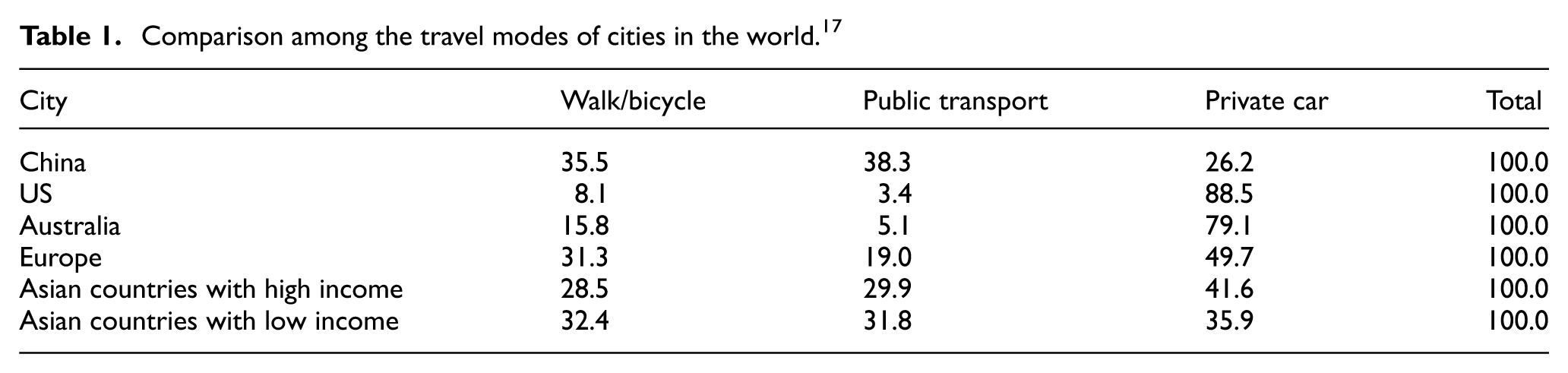
City dwellers are the major participants in the construction of low carbon transport. Their life style and travel mode influence the urban transportation system greatly. Walking and cycling are ideal modes for the construction of low carbon transport system. However, these modes are shrinking mainly because of increasing trip distances in expanding cities, increasing use of private cars and motorcycles as well as worsening of walking and cycling facilities.14–16 Therefore, the life supporting system is an important subsystem in the low carbon transport system. All the city dwellers have the responsibilities for the life supporting system building. The urban travel behaviour mode should be shifted from ‘high emission’ to ‘low emission’ and even from ‘low emission’ to ‘zero emission’. City dweller’s mode should be modified to establish low carbon transport life supporting system. Chinese dwellers are conscious of the importance of low carbon travel mode gradually (see Table 1).
Comparison among the travel modes of cities in the world. 17
Policy supporting system
Meeting the policy goals of energy consumption and reducing emissions from transportation sector is a complex task indeed. Some polices on low carbon transport seem radical at the present, but the political context of Chinese low carbon transport does not meet targets set by the Chinese government. Reducing carbon emissions and energy consumption from transportation sector is a heavy and complex task. Government plays an important role in this system since the government is the guide and participant in the construction of low carbon transport.18,19 Therefore, the policy supporting system is also an important subsystem in the low carbon transport system.
Chinese government has made great efforts to promote low carbon transport system. For example, bus rapid transit (BRT) system is being built or expanded in several cities, which can greatly improve the service level of public transport at relatively low cost.16,20 It is extremely urgent for the government to continue strengthen the low carbon transport policies and establish more effective supporting and evaluation systems for low carbon transport.
Evaluation systems of low carbon transport
The supporting system provides a framework for the evaluation system. Therefore, the evaluation system should include the indices from four fundamental aspects: industrial, infrastructure, life and policy.
Four aspects, namely, low carbon efficiency, low carbon innovation, low carbon guide and low carbon society, based on the above supporting system, clearly shows 10 urban low carbon transport by means of 32 indices (see Table 2). All the aspects in the supporting system include the four fundamental aspects, and the 32 indices covering four fundamental aspects, industry, infrastructure, life and policy, are based on the supporting system. An empirical study from Changsha City, Hunan Province is taken as an example.
Evaluation system of urban low carbon transport.

In order to optimize the evaluation system, several opinions were accepted from experts to improve this system. The original evaluation system has been first sent to 45 specialists, including transport experts, professors in environment, PhD students in energy economy and policy. The arithmetic mean was used for agree coefficient (R), and the variable coefficient was taken as the degree of deviation from experts

The degree of deviation of index j is

According to the statistics results, all the indices indicate good reliability and validity
Empirical study from China
An empirical study in Changsha City is provided in this study. The data are collected from its statistical yearbooks.
Determining weight
The modified Delphi method is used for determining weights

where
From the similarity coefficient, the similar matrix

From

Setting restrictions on

Similarly, weight set for each index

The indices are divided into five levels from very large to very small and assigned the scores of 9, 7, 5, 3 and 1, respectively.
Calculating difference sequence, range, correlation coefficient and correlation degree

The minimum difference value is m, and the maximum difference value is M.
Grey relational coefficient is as follows

Grey correlation degree is as follows

From the grey correlation degree processed by normalization, weight coefficient for each index is obtained. If the weight coefficient for

If the weight coefficient for

According to the standard of evaluation index V, the sample matrix is obtained as follows

Determining grey degree value
The grey degree values are divided into five degrees from very large to very small. The definite weighted functions are as follows:
First grey class (e = 1), grey number
The definite weighted functions

Second grey class (e = 2), grey number
The definite weighted functions

Third grey class (e = 3), grey number
The definite weighted functions
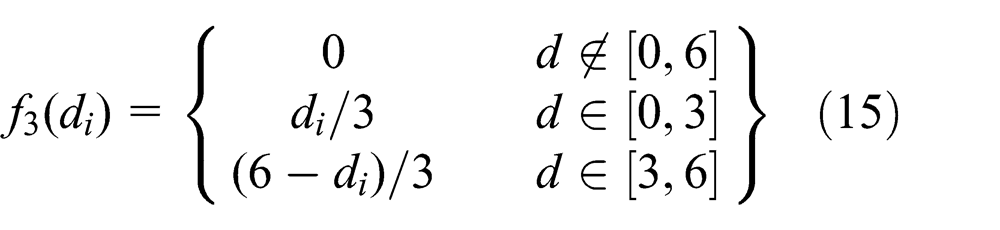
Forth grey class (e = 4), grey number
The definite weighted functions

Fifth grey class (e = 5), grey number
The definite weighted functions

Grey evaluation coefficient
If the grey evaluation coefficient for

The sample evaluation matrix for

Membership calculation and membership matrix determination
By the normalization process of
Similarly, the membership vector for

Fuzzy comprehensive evaluation
One-level fuzzy comprehensive assessment model.
After the evaluation for each index, the fuzzy vector
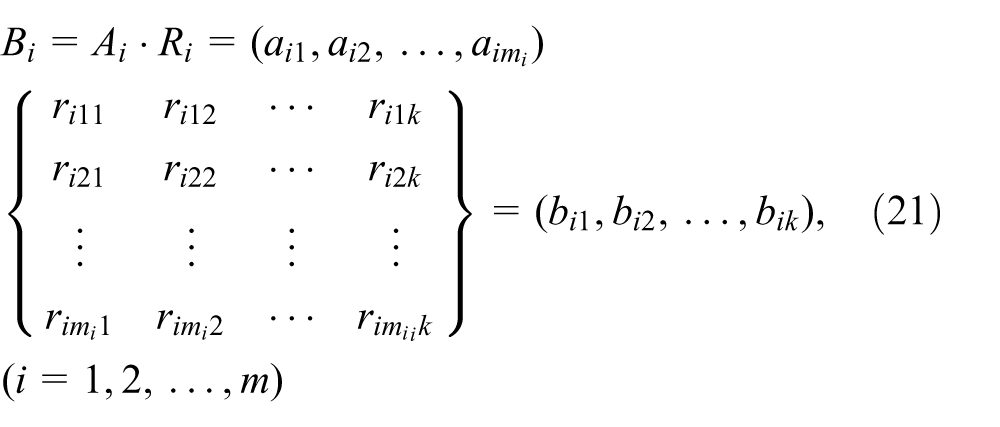
Two-level fuzzy comprehensive assessment model.
One-level fuzzy comprehensive assessment model is the comprehensive evaluation for each index, and two-level fuzzy comprehensive assessment model is the comprehensive evaluation for index set U. The evaluation matrix is

As mentioned above, B is the fuzzy comprehensive evaluation set which takes V as discourse domain.

B is the result of one-level fuzzy comprehensive assessment model,
Weight results.

A total of 15 experts were selected from different scientific and practical fields, including the managers of transportation and logistics companies, experts from the local government, specialists in carbon emission, and professors in environment and energy consumption. The selection was in charged by Transport of Changsha Municipality. The measurement items were taken in a 5-point Likert type scale with ‘5’ being ‘Excellent’ and ‘1’ being ‘Very bad’. In order to improve the quality of the investigation, data were collected through the issuance of paper questionnaire investigation from 1 October to 30 October 2014.
The index evaluations from 15 experts are presented in Table 4. The indices are divided into five degrees from excellent to very bad (100, 80, 60, 40, 20; see Table 4).
Results from experts.

Finally, the membership of low carbon efficiency
Membership of low carbon efficiency (B1).

The membership of energy innovation
Membership of energy innovation (B2).

The membership of low carbon guide
Membership of low carbon guide (B3).

The membership of low carbon society
Membership of low carbon society (B4).

The membership of comprehensive evaluation is given in Table 9.
Membership of comprehensive evaluation.

Results
The maximum membership is good (80). Under the Two-Oriented Society Strategy, Changsha was devoted much time and effort to low carbon transport construction. Public transport has been greatly improved in Changsha City. However, further improvement is still required. From the results of Tables 5–9, the evaluation scores of low carbon society
From Tables 4 and 7, the evaluation scores from the low carbon guide
Conclusion
The problems of transportation energy consumption and environment are the major challenges faced globally and are especially serious in China. The future 20 years is the strategic opportunity period of the transition for Chinese transportation energy and carbon emission reduction.
The four supporting systems of low carbon transport, namely, the supporting system of industry supporting, infrastructure, life and policy, are proposed in this study. Moreover, the evaluation system of low carbon transport from four aspects such as the efficiency, innovation, guide and society of low carbon is established. On the basis of the two systems, a numerical study in Changsha City in Hunan Province is provided to support the supporting and evaluation systems.
From the view of the two systems above, the government should increase the public transport investment, promote reform for low carbon industries and modify the low carbon travel mode. Chinese government plays more and more important role in low carbon policy system under the state of environmental degradation. More environmental-transport policies should be carried out by the Chinese government.
Transportation industry is the performer and participant in the construction of low carbon transport and plays more and more important role in the low carbon transportation supporting system. It should support the technique innovation reform in transportation industries, promote the construction of innovation platform of low carbon techniques in the transportation industries and make the idea of ‘low carbon’ practice in transportation area to achieve the development of whole industry chain.
City dwellers are the main participants in the construction of low carbon transport. However, the realistic behaviour of city dwellers is often not well captured by the government. From the numerical example, the evaluation scores of low carbon society (B4) are the lowest. It is advised that their travel behaviour mode should be modified from ‘high carbon’ to ‘low carbon’ or even ‘zero carbon’. In a word, all the people should be involved in the construction and development of low carbon transport system in China.
Footnotes
Acknowledgements
The authors thank the editors for their valuable advices and assistance. They thank the reviewers for their careful and insightful work on this paper.
Academic Editor: Geert Wets
Declaration of conflicting interests
The author(s) declared no potential conflicts of interest with respect to the research, authorship, and/or publication of this article.
Funding
The author(s) received no financial support for the research, authorship, and/or publication of this article.