




Abstract
Corporate investment decision about engineering projects is a key issue for project management. This article aims to study the process of bidding decision-making in engineering field under the condition of incomplete information and investigating the influence of bidders’ game behaviors on investment decision. With reasonable assumed scenes, this article uses an approach to describe the decision process for bidding. The approach is based on the static game theory. With the proposed model, the effectiveness of game participants and the objective function are put forward, and the characteristics of price quotation and the best strategies of bidders under the equilibrium condition are discussed. The results can give a better understanding of investment decision in engineering management and are helpful for tenderees to avoid excessive competition among bidders.
Introduction
Engineering projects have generally the characteristics of large investing amount, high risk, and irreversible investment. At present, bidding is the most widely used and universally acknowledged as the most standard decision-making mechanism in the procurement of engineering projects in China. By setting a certain selecting rule, the tenderee can make full competition among bidders. With the help of scientific theories and methods, the bidder can make the optimal bidding strategy to win the project. For bidders, a reasonable bidding decision can effectively improve the possibility to win a bidding and bring investment income. A fault decision tends to make a bidder miss an opportunity, or even fall into bankruptcy. Therefore, in-depth research and analysis on project bidding’s characteristics and rules are of great significance for enterprises in investment activities.
Since the implementation of the “tender and Bidding Law” in 1 January 1 2000, the bidding has become the most important and widely used procurement way in the field of engineering in China. Many domestic institutions and scholars applied theories like economics, management, operations research, game theory for studying the characteristics of bidding strategy and got a series of research results, which focus on theories about strategy equilibrium of tendering and bidding mechanism, the impact of risk and internal and external factors on strategies, empirical application of the theories referring to decision-making, and so on.
About the theory of bidding strategy, SP Dozzi et al. 1 proposed the choosing method for quotation which was based on multi-criteria decision-making techniques and reflected the structure of decision-makers’ preference and their risk attitudes; FS Wen and AK David 2 obtained the optimal bidding strategy of power generation companies by calculating the equilibrium of supply function in the model of oligopoly game; DS Drew et al. 3 studied how to balance the cost and the engineering quality in the case of second sealed bids; Z Jin-rong and X Fu-yuan 4 used decision-making method of benefit evaluation for establishing an evaluation model about winning bidding, and put forward the Nash equilibrium strategy under the assumption of homogeneous type among the bidding parties.
About the influence of risk and the internal and external factors on strategies, DKH Chua and D Li 5 used analytic hierarchy process (AHP) to establish a bidding reasoning model, and identified a series of key factors and their relative importance; H Png et al. 6 studied the relationship between the speculative bidding and construction requirements, and explained incentives or restraints of speculative biddings; AK Dixit and RS Pindyck 7 applied the option game theory to study the investment behavior of companies under conditions of uncertain risks; MH Chang 8 proposed that the distribution of return from investment in the market has a finite mean and variance; Y Ying-mei 9 analyzed concretely the bidding strategies of risk neutral tenderees, when they face, respectively, risk aversion tenders, risk neutral tenders, or risk appetite tenders, which based on the model in accordance with symmetric independent private cost (SIPV).
About empirical application of the theories of decision, TR Williams 10 applied treemaps to analyze cost overruns in competitive bidding project; P Bajpai and SN Singh 11 used FAPSO to study bidding of power generation companies with constrained network, analyzed the impact of network constraints and behavior of competitors on this basis, and established an optimal bidding strategy; M Kilic and I Kaya 12 applied TOPSIS method to evaluate questions about bidding of investing project; K Nassar 13 established a simulating game model to study and describe shares in the building market and concepts in the competitive biddings; Z Zhen-sen et al. 14 constructed a game model of dynamic and non-cooperative second-hand car trading, in which owners and contractors trade in building bidding with incomplete information, and explored the characteristics of transaction price in market equilibrium, respectively, under the condition of market success, market failure, and market partial success.
The complexity of economic phenomena and the uncertainty of their influencing factors make it more and more difficult to solve the economic problems using traditional methods. 15 In the process of decision-making about engineering project bidding, it is necessary to analyze specially the influence of bidding parties’ game behavior besides comprehensive estimation of project investment scale, investment structure, project costs and benefits, and other economic evaluation indexes. The most commonly used economic theory in investment decision is the game theory, which is widely used in research on non-cooperative competition and decision, and can effectively measure the cost and benefit of investment decisions.16,17 At present, most of the researches, based on the assumption of a linear function, failed to fit fully game bodies’ decisions in bidding game. On the perspective of bidders, based on reasonable description of their quotation function and target income on the premise of investment preference, this article analyzes and studies bidding behavior in the game, reflects truly the characteristics and regulations of bidding behavior, and provides theoretical reference for designing a more comprehensive and reasonable bidding mechanism.
Game relationships in bidding
Game analysis aims to use game regulations to forecast equilibrium. 18 In the economic analysis, whatever a game structure to describe abstractly the real economic activities, first of all it ought to confirm game participants. In the present domestic buyer’s market, all tenderees know, as long as the conditions of projects are good enough, the market will form immediately a very obvious “replace” effect among bidders, that is, when a bidder cannot win the opportunity, he would likely be “replaced” by his competitors, and the degree of substitution effect is determined by the value of engineering project. Therefore, tenderees can design a mechanism of bidding game, which will give them advantage and help them realize the minimum project cost or purchase cost. It is visible that the main game bodies in the bidding are bidders, and every bidder wants to maximize their expecting earnings. The incomplete information static game reflects well these game characteristics among bidders. Incomplete information means the information asymmetry among game bodies. Specifically, in the bidding game, the bidders know clearly about their own technology, marketing, expecting earnings, and cost, and due to the exclusive competitive relationship between each other, they know nothing about competitors’ quote price. Therefore, we apply incomplete information static game to do bidding strategies with assumption based on the characteristics and regulations of bid activities.
Bidding decision with incomplete information
In bidding, every bidder will take the most suitable strategy they think, which will form a strategy set, namely a game situation. Is there a balance situation that makes bidders reach equilibrium? So the game analysis aims to using game rules to confirm and realize the equilibrium.
Model assumption
In bidding, the game between bidders refers to many aspects, such as technical proposal, project duration, business credit, and performance of similar engineering projects. In essence, the most critical game behavior occurs in the section of tender offer. In order to simplify the process and highlight the key point of bidders’ game behavior, based on the characteristics of bidding, this article supposes in the quotation game: first, each bidder makes quotation decision in advance individually. Because there is a competition between bidders, they will keep the project information they have obtained to themselves. In theory, there is no motivation for colluding bidding to win project. Second, each bidder has only one opportunity to quote price, namely, they have only one game strategy each. Third, the bid opening time is unified, which means the tenderee calls the tenders together, and they will witness all the bidding documents and the bidding quotations at the same time. In order to simplify the analysis further, three assumptions are put forward: first, the transaction cost generated in the bidding game is neglected; second, tender offer is unreserved, namely the tenderee will not set a minimum winning price beforehand; third, the rule is that the lowest quote will win the bidding, namely, after proving qualification of all bidders, the bidder with lowest bidding quotation will be recommend to win the bidding, which is in accordance with the purpose of tenderee pursuing the lowest project cost and procurement cost.
Problem description
Assuming that n bidders take part in the competition of project bidding, and each bidder’s game strategy is their quoted prices, which are based on their, respectively, estimated project cost; the benefit of winning bidder is the benefit from the project, the benefit of losers is 0; because there is competition between bidders, they know nothing about others’ strategies when they choose their own strategy, and they can only quote once, which creates another typical static Bayesian game.
First, we define Ci(Ri) as a bidding function of bidder i in some bidding, in which Ri indicates the project cost that the bidder i estimates. Generally, Ci(Ri) will increase with a rising project cost; hence, (∂Ci(Ri))/∂(Ri) > 0. As the project cost and the expected project benefit increase continually, the profit that the bidder can transfer to the tenderee will increase too. Because risk neutral bidders want to ensure the increasing expected return and tend to enhance the probability of winning bid, the quoted price will increase slower than the cost, and show a trend of more and more significant diminishing marginal. So considering bidders’ investment preference, there is a more special logical relationship between bidding quotation Ci(Ri) and estimated cost Ri

Thus, the function relationship between bidding function and cost evaluation shows a growth index larger than the first-order linear. To simplify the subsequent analysis without loss of generality, under the condition of bidders’ investment preference, the simplest common expression of Ci(Ri) generated from assumption and analysis above could be

In this formula, ai > 0; as a rational bidder, he will not actively choose losses, namely, when there is no cost expected from the project, Ri = 0, and there is Ci(0) = b > 0, so b can be taken as guaranteed project benefit of the bidder.
As analysis above, the bidder i’s project benefits Gi can be simplified as a logical function about quoted price and estimated project cost, so the project benefit Gi can be expressed as following

However, in most researches, the function relationship between bidding function and cost evaluation was usually simply assumed as linear functional relationship, and the bidding function and the project profits were expressed as


In the two formulas, ki > 0 and b can be taken as risk-free return for bidders.
Model inference
We assume that there are n bidders participating in the bidding, and the estimated project cost of each bidder Ri is independent and confidential, and distributes evenly in the interval [0, ξ), where we do the normalized treatment. According to the symmetry, on the premise of bidders’ investment propensity, the bidding competition can turn into a standard static Bayesian game, and we need to find the space of each player’s behaviors. A random bidder has Game payments under three conditions:
When C1(R1) < min{Ci(Ri)}, in which i = 2, …, n, that is, the bidding price function of the bidder is the lowest one among the n bidders, in other words, the bidding price function of the bidder is lower than the lowest one among the other n − 1 bidders, the bidder wins the bidding, there is

When C1(R1) = min{Ci(Ri)}, that is, the cost function of the bidder is equal to the lowest one among the remaining n − 1 bidders (there can be one or x lowest quotes), the winner in the bidding will be decided through a random drawing of lots among the bidder and other bidders who quote the lowest price, and the winning probabilities of those bidders are equal, and the winning probability is 1/(x + 1), there is

When C1(R1) > min{Ci(Ri)}, that is, the cost function of the bidder is not the lowest one among the bidders, so he cannot win the bidding, and other one will win the bidding, so the project benefit of the bidder is counted as 0, namely G1 = 0.
In summary, the expected project benefit of the bidder can be expressed as

where Ω represents the probability of C1(R1) ≤min{Ci(Ri)}.
As rational bidders, they would never offer a higher price than the estimated project benefit. Considering that the game is symmetric, the game strategies of bidders can be taken as the best responding strategies to competitors’ behavior. Thus, the analysis here refers only to the symmetric equilibrium bidding. If the quoted price of bidders distribute continuously in the interval [0, ξ), the probability of a same quoted price is zero, then the best bidding quotation function Ci(Ri) of the bidder should meet

Deducing formula (8) is as follows
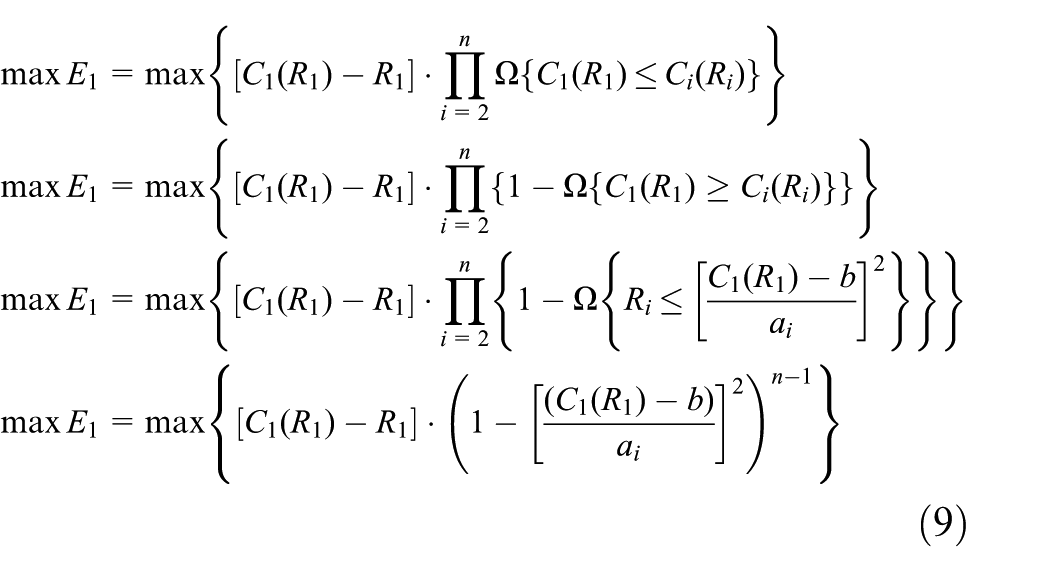
Commanding

There is a deduction as following

Since (C1(R1) − b)/(ai) ≠ 1, we can get the maximum through the first order of formula (10)
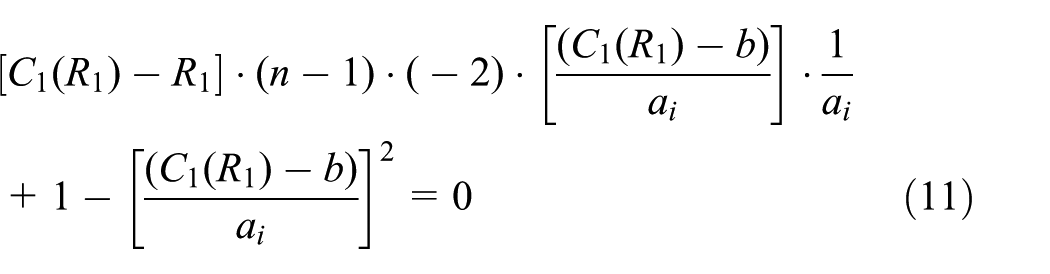
Solving formula (11), we can obtain
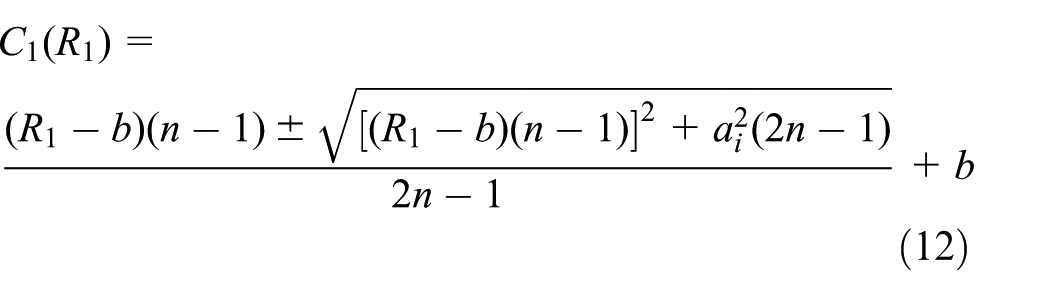
We judge here, as b = Ci(R1 = 0), namely there is no cost of the target project, in full market completion, a big b is impossible. Thus, in most biddings, there is usually R1 − b > 0.
When we choose an equation from formula (13) as the bid quotation function, namely

The bid project benefit is

This game behavior cannot happen to a rational bidder.
From this analysis, the bid quotation function C1(R1) as the equilibrium result of bidders’ game is
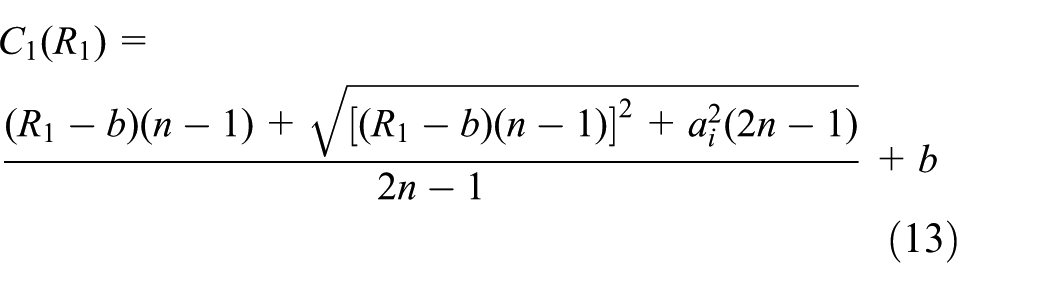
At the same time, the project benefit Gi is

At the same time, inspecting the bidding function and the profit function without considering any investment preference, we can obtain an expression of expected return as following

Through extreme value analysis as above, we can get the following conclusion


So without considering any investment preference, the project profit

Model calculations
Extreme value analysis
In formula (14), we can express project benefit Gi through a function of the number of bidders n, as following
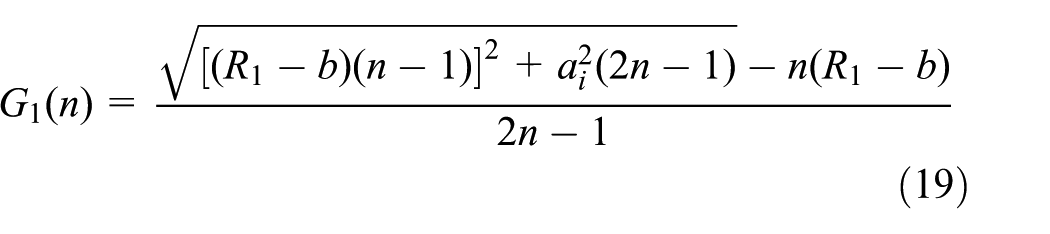
Commanding c = R1 − b, there is

We convert the sequence function G1(n) into a continuous function G1(x) and examine its monotonicity, we can suppose

Using the derivation of formula 21, we get

Commanding

After simplifying formula (23) through transposition, there is

Simplifying the above formula, we obtain

Since ai > 0, c = R1 − b > 0, when ai ≠ c, we can get the extreme value as x = 1/2; therefore, formula (21) has monotone as x < 1/2 or x > 1/2. When x = 1, solving
The calculation results show that under the Bayesian equilibrium, with the increasing number of bidders, a stressing competitive pressure will form, bidders’ expected benefit will show downward trend, and bidders’ bid quotation function and expected benefit function can be, respectively, expressed through formula (13) and formula (14). According to the Article 28 of the Bidding and Tendering Law of the People’s Republic of China, when the number of bidders is less than 3, the subject should be retendered, and according to the Article 44 of Regulations of the people’s Republic of China on the implementation of the tender and bid law, when the number of bidders is less than 3, the bid should not be opened, and the tenderee should retender. In order to ensure adequate competition, the number of bidders should not be less than 3. So bidders’ expected bidding project benefit can achieve the maximum value as n = 3

Especially, when n → +∞, there is

Since

The above result indicates, when the number of bidders tends to infinite, the tenderee can get all the expected bid project benefit. The game situation reflects actually that the bidders face dilemma in the bidding, that is, the lower price they quote, there is more possibility they win the bid, but the less they can expect, and when they quote higher price, they may lose the opportunity in the competition with other bidders.
Building a bidding transaction game model, bidders locate in a similar game to the famous “prisoner’s dilemma.” Under conditions of sufficient competition in the market and a scarcity of projects, bidders must participate in the bidding competition, and exclusive game competition makes it difficult to cooperate and communicate between bidders, and thus bidders can only predict other bidders’ quotes based on their experience. In order to win the bid, the bidder will quote a price close to or equal to their evaluated bid project benefit. This can explain bidders’ some unconventional behaviors in the fierce market competition. For some bidding project with good conditions, or having typical market sense and promoting value, bidders will quote the lowest price, and even they may take some other means, such as building facilities for the tenderee. As a rational bidder, these behaviors are not irrational; conversely, they want to win a priority in the bidding game, and then follow-up with the first-mover advantage in the competition of similar projects coming later. Profit from follow-up projects makes up the loss in the typical project, namely, loss of project benefit today will recover in the future, which is right expectation of a proper result and investment strategy for future based on the current conditions by bidders.
Numerical analysis
In the previous section, we discussed the optimal bidding strategy of bidders with investment preference and the trend of its extreme value. The conclusion can explain reasonably some unusual behavior of bidders. In this section, we will analyze and verify characteristics and laws of bidding strategy with investment preference through numerical examples.
To facilitate the analysis, we assume the sensitivity coefficient of bidding function with or without investment preference as 1, and assume ai = 1, ki = 1, i = 1, …, n, analyze the association between bidders’ expected return and the degree of Game competition, where the degree of Game competition can be reflected by the number of bidders. We assume the estimated cost of a bidder is 1 million, risk-free return is 0.8 million. According to Formulas (9) or (16), (13) or (17), we can obtain a relationship diagram between the optimal expected return and the number of bidders with or without investment preference (Figure 1).

Relationship between the optimal expected return and the number of bidders.
Figure 1 shows, regardless of bidders with or without investment propensity, the optimal expected return decreases as the number of bidders increases, which reflects that the more intense the Game competition is, the lower the expected return is, and the more cautious the bidder is. So the tendency that bidders lower quoted price to win the bidding turns out less obvious. In addition, the diagram also shows that, in a Game competition for a project, when the number of bidders is fixed and the project cost is relatively clear, the optimal expected return of bidders with investment preference is always larger than the optimal expected return of bidders without investment preference. This relates closely to that bidders lower quoted price to enhance the probability to win the bidding, and is consistent with the actual situation and the aforementioned assumptions.
Furthermore, it is worth mentioning that the difference in the optimal expected return between bidders with investment preference and bidders without investment preference turns out first increasing and then decreasing. This reflects, when the number of bidders is too large or too small, that is, a competition is too intense or cannot be formed, as a rational bidder with investment preference, his expected return will be limited, his enthusiasm to participate in the bidding and in the project construction will also be limited, and ultimately the result of the bidding project will be affected. This conclusion makes also positive sense for the tenderee. We can see from the diagram that, when the number of bidders is 5 ≤ n ≤ 15, bidders’ enthusiasm reaches at the highest point. So the tenderee can make the project more successful by laying down some Game rules such as pre-qualification.
Conclusion
In bidding, bidders are in a very disadvantageous position in a non-cooperative game with the tenderee. The more bidders participate in the competition for the bid project, the more conducive the situation is to the tenderee, and the less benefit the bidder can get. On one hand, rational bidders have the willingness that lowering quoted price enhances the probability to win the bidding. On the other hand, if the game competition is excessive, the bidder as the constructor of the bidding project would build the project for very low benefit, even for loss, their enthusiasm will be dampened, and the project would be affected easily by external risks and uncertainties. A little trouble might affect the project quality and construction period, and then it appears a “lose–lose” situation that both bidders and tenderees do not want to see.
Therefore, in the design of a bidding mechanism, it is important to introduce a full competition among bidders, and it is also important to avoid excessive competition among bidders. Theoretical derivation und numerical analysis form a method of concise mathematical analysis, which can help the tenderee to determine the most appropriate number of bidders in a project. Of course, in the rulemaking of a Game, combination of qualitative and quantitative analysis is more effective. So the following measures are recommended: First, the tenderee agrees in advance with bidders in a scope of quotes and strategies. Particularly when the bidding refers to the forefront of technology or high-risk projects, the quoting needs especially a scientific constraint. This can make a price bottom in the bidding competition among bidders, and conditions of a reasonable benefit are guaranteed. Second, through strengthening a series of basic work, such as technology exchange, market research, site survey, pre-qualification, and so on before the bidding, the tenderee deepen bidders’ understanding of the project conditions, minimizing the errors of project evaluation and blindness by bidders.
Footnotes
Academic Editor: Xiaobei Jiang
Declaration of conflicting interests
The author(s) declared no potential conflicts of interest with respect to the research, authorship, and/or publication of this article.
Funding
The author(s) received no financial support for the research, authorship, and/or publication of this article.