



Abstract
This article analyzes the characteristics of evaluating synergy of China’s rail freight transportation system. According to Delphi method, an evaluation indicator system of synergy of the rail freight transportation system is established and the system is in accordance with railway development strategies and synergic targets. Besides, this article builds up an evaluating model for synergy of China’s rail freight transportation system and conducts an empirical study with statistical data from 1995 to 2013. The results indicate that there is an increasing tendency toward the synergy degree of the railway freight system, with a slow growth before the year 2002, and then has a sustained and rapid growth until 2010 as the trends become smooth. The synergy degree of the rail freight transportation system in 2013 has increased nearly 34 times than 1996 from 0.016810995 to 0.57142183. This article concludes that indicators such as synergy in structure, transportation, organization, management, and information have made an outstanding contribution to the synergy degree of the rail freight transportation system.
Keywords
Introduction
Railway freight transportation is based on the realization of added values of the entire rail freight system, while the realization of added values is based on the collaboration between subsystems of the entire freight system. Either of those subsystems occurs to be out of order during the operation, and the overall performance of the entire rail freight system will be affected. It shows that the proper operation of the rail freight system lies in the coordinated development between the subsystems. Therefore, it is of vital importance for the improvement of the entire collaborative cooperation of the rail freight system to evaluate the coordination degree of the rail freight transportation system and seek for the underlying reasons for its poor performance. Hermann 1 defined synergy as that collaboration between all parts of the system that makes the whole system to develop some new structures and characteristics which do not exist in the micro-individual level. Park and Kim, 2 Mehrez, 3 and Nijkamp and Van den Bergh 4 conducted work on the synergy degree, which is mostly carried out in complex systems, to evaluate the synergy degree of each element within. On this basis, Meng and Han, 5 the representative of their research team, analyzed the synergetic characteristic of collaboration in complex system. According to the concepts of compound factors and coordination mechanism from a perspective of systematics, a coordinating measurement model with respect to composite system is worked out, which is widely used in all kinds of fields. Barut et al. 6 conducted research on the synergy degree of supply chain information. Li and Hao 7 put forward the coordination degree model of manufacturing and logistics industry linkage development system. Borek and Sokovic 8 discussed the management of modern enterprises for the implementation of total quality management and the synergistic effect of the general system theory. Schosser and Wittmer 9 researched cost and revenue synergies in airline mergers based on geographical differences.
Adler et al. 10 explored the use of cooperative and distributed multi-agent system to improve dynamic routing and traffic management. Jeong et al. 11 discussed on service chain which exists in relatively centralized flow, and the radial network hub has been widely applied in European freight railroad system, which provided a reference to China’s bulk cargo fast collection and distribution network. Upadhyay and Bolia 12 studied the combined empty and loaded train-scheduling problem for the upcoming dedicated freight corridors in India. Zhang et al. 13 used the data envelopment analysis model to evaluate the synergetic development of city traffic based on the input–output matrix and the index of sustainable development, which provided an approach for evaluating the validity degree of “synergic” and “development” within the city traffic system and among the subsystems. On the macro and micro levels, based on synergy, Habibian and Kermanshah 14 explored interactions between different transportation demand management (TDM) policies. Feng et al. 15 built a synergy evolutionary model of the collecting, distributing, and transporting system of railway heavy haul transportation by introducing synergy-related concepts and applying synergy evolutionary theory. Liu et al. 16 adopted a stochastic evolution-based modeling framework to analyze the coevolution of the world city hierarchy and global air passenger networks between 2000 and 2010/2011. This article aimed to contribute to the literature on the empirical parallels between urban hierarchies and the transport networks supporting and/or reflecting these hierarchies. Feng et al. 17 built an order parameter model for synergetic theory–based railway freight system using the method of least square and the method of external function, which potentially supported the studies on the railway freight system evolution. Compared with previous studies, Feng and colleagues18,19 have done some research focusing on understanding and influencing factors of system collaborative development and investigated multimodal transport system evolution law with the consideration of synergetic theory.
We can see that only few documents have ever conducted research on the synergy degree of the rail freight transportation system This article introduces a synergic measurement model with respect to composite system and makes an evaluation and analysis of the synergy degree of the railway freight system.
Characteristics of evaluating the synergy degree of the rail freight transportation system
The Chinese rail freight transportation system is operated by the Chinese government. Synergy of the rail freight transportation system dynamically combines all the subsystems together for cooperation and work to improve efficiency and effectiveness, in order to enhance its own strength. Improving the synergy degree of every subsystem is a helpful way to improve the efficiency and capacity of the railway freight transportation. What is more, it has a direct effect on railway freight business performance. The improvement of the entire efficacy provides a better prospect and a wide space for development of the railway freight transportation and serves as a strong support to increase market competitiveness of the railway vehicles. It also presents new requirements for the collaborative management and the evaluation of the synergy degree. So it is significant to evaluate the synergy degree of the rail freight transportation system.
There are three characteristics of the synergy degree of the rail freight transportation system, namely, multi-factorial, multi-dimensional, and dynamic nature. Multi-factorial nature signifies that the coordination degree of the system is affected by various factors of different aspects, and multi-dimensional nature requires considerations in all aspects and dimensions before we make an examination and analysis of the synergy degree. In addition, dynamic nature refers to the ever-changing synergy degree due to the multi-factorial degree in an ever-changing circumstance.
The railway freight system is in the process of dynamic development all the time. When it relates to the characteristics of the synergy degree, it is obvious that the evaluation of the railway freight system has its own main characteristics:
Synergy evaluation focuses on the organization’s future development and intensifies feed-forward in collaboration and management of the synergy degree of the rail freight system. Under the circumstance of a dynamic development, the synergy degree of the rail freight system should pay more attention to the evaluation of long-term benefits and development, and equipment with dynamism and real-time.
The evaluation indicators tend to be more integrated. It is better for us to have increasing integrated evaluation indicators because it serves as a better tool to analyze problems from the perspective of synergy within the entire rail freight system, rather than the one to analyze in the aspect of a single subsystem or department. Therefore, it reflects the correlation between various subsystems and also reflects the level of collaborative optimization in the entire rail freight system.
Apart from the basic evaluation of synergy within the entire rail freight system, evaluation of the synergy degree should also consider the collaboration degree between the railway freight system and external circumstances, which can ensure synergy within and beyond the entire system.
Establishment of the evaluation indicator system of synergy degree of the rail freight system
Principles to establish the indicator system
It is a relatively complex process to establish the evaluation indicator system of the synergy degree in the rail freight system. Therefore, the following principles should be followed in the establishment of the system:
Comprehensiveness of the system. The evaluation indicator system must fully reflect comprehensive standards of synergy in the present rail freight system, including all various indicators in the promising future.
Conciseness and science. The size of the evaluation indicator system should be suitable. In other words, we should set a scientific indicator system. If the size is too large, which means excessive levels and much more details, the evaluators will definitely pay more attention to some specific problems. In contrast, if the size is too small and has few levels and indistinct indicators, it will not fully reflect the coordination.
Stability and comparability. The setting of the evaluation indicator system should be easy to compare with other domestic systems. Besides, the evaluation system should be equipped with stable operation, standardized rules, and less subjectivity.
Flexibility and operability. The evaluation indicator system should be flexible enough for enterprises to use according to their own strengths and real conditions. When it comes to the full use of flexibility, on one hand, we should use the currently existing indicators as much as we can, rather than excessive evaluation indicators; we should set simple and easily operated indicators on the premise of meeting the needs of the indicator system. On the other hand, we should choose an easily operated type of indicator system. As we all know, there are three types of indicators in evaluating the synergy degree of the rail freight transportation system, namely, types of calculation, grade, and calculation grade. The first type of indicators, despite strictness, accuracy, and fairness, is hard to operate. The second type in which specialists will play the role of grading is easier to work with, although it is greatly influenced by personal factors. In the last mixed type of indicators, part of it is oriented by humans, namely, graded by specialists, and part of it is described by specialists through statistics.
Expandability. The structure of the indicator system should meet not only the current need of the rail freight transportation but also its need in the future. A set of static indicator system can impossibly work all through the development of the enterprise. Therefore, it requires that the indicator system has advantages of dynamic expandability and can change in different phases with development strategies.
Multi-levels. The indicators in evaluating the synergy degree of the rail freight transportation system are suggested to be analyzed and classified. Those main and strongly generalized indicators are made as the leading ones and should be put in the first level, forming the very core of the performance evaluation, while those poorly generalized and subordinated indicators should be put in the second level and so on. This method helps to explicit the inner relationship between indicators and simplifies the process in evaluation.
Measurability. When choosing the key indicator, it is necessary to follow the principle of measurability. Measurability refers to those evaluation indicators designed for the system to add value to the targets of the enterprise. With quantitative indicators or behaviors, data and information for evaluating these indicators are accessible, easily measured, and identified.
Independence. Those indicators that are at the same level should be self-independent, and relevance between indicators should be as little as possible.
Building of the indicator system in evaluating synergy degree of the rail freight transportation system
Evaluating the synergy degree begins at the strategic target for development in the rail freight transportation system. At present, the world economy develops at a common tendency toward intensive management and scale production, the ultimate goal of which increases efficiency. With its own characteristics of transportation and production, our national bureau of railway has carried out a “two integrations and one construction” strategy, namely, it is to integrate those freight stations with little capacity of transportation and retail businesses for the construction of a strategic loading point. In accordance with the principle of “stable supply of goods, convenient of customers, combining construction with integration and focusing on the construction,” the strategy serves to intensify the industry and makes true the intensive management and scale production. Besides, optimal combination of resources and an improved system of transportation help take full advantage of the productivity of transportation and greatly enhance the transportation efficiency and benefits. Synergy of the rail freight transportation system aims to improve the system and its subsystems’ behaviors so as to enhance the efficiency of the entire rail freight system and ensure the realization of the rail freight strategy.
This article analyzes the rail freight system and finds that the system is composed of equipment of rail freight, railway station, railway line, freight organization method, and the operation and management model. This article combines the strategic target for development with the contents of synergy of rail freight transportation system and classifies synergy evaluation of rail freight transportation system into three parts. Equipment of rail freight, railway station, and railway line constitutes the hardware system, namely, hardware synergy. The freight organization method and the operation and management model constitute the software system, namely, software synergy. Considering the prospects of the development of the railway freight transportation, comprehensive development synergy is composed of sustainable development status of the rail freight system. There is a nonlinear relationship between every part. Software system conducts the operation of hardware one, and the hardware system has direct effect on the realization of transportation production. In addition, module is considered the main thread in this article. Each module is divided into several evaluation subsystems according to the theory of synergy evaluation. Through analyzing the main factor which can influence the subsystems of railway freight, this article uses the Delphi method to establish the indicator system in evaluating synergy of the rail freight transportation system:
Hardware synergy. It mainly includes synergy of rail transportation system layout and synergy of system structure. This module constitutes a top priority of the rail freight transportation system and provides hardware support for the synergic development of rail freight transportation system. The layout synergy mainly presents the synergy in the network of rail freight transportation system, including four indicators, namely, the average distance of rail freight transportation, the average distance between stations, railway mileage, and density of the railway network. The average distance of rail freight transportation represents the degree of integration between rail freight stations, and it indicates the balance in railway transportation. If the distance is too long, the shipper will feel inconvenient. To the opponent, the cost of setting up a station will be very high. Railway mileage incarnates the scale of the railway transportation. The density of the railway network reflects the national network conditions of the entire rail freight transportation system. Synergy of system structure mainly signifies a reasonable degree in the structure of rail freight transportation system, and it results from integration of resources in the system. System structure includes proportion of national double-tracking mileage and proportion of national electrified railways. The proportion of national double-tracking mileage of railways represents the transportation capability, and the proportion of national electrified railways represents modernization degree.
Software synergy. It consists of synergy of transportation organization and management, synergy in supply capacity of transportation, and information synergy. This module, a dynamic synergy, plays the key role in the realization of synergy of rail freight transportation system. Synergy of transportation organization and management is mainly reflected by transportation efficiency and transportation capability. Indicators of transportation efficiency include utilization of freight train load, freight train turnaround time, time of one cargo operation, and labor productivity. Meanwhile, indicators of transportation capability include the average daily number of locomotives in operation, average daily output of freight locomotives, average annual output of owned locomotives, and average daily number of train loadings. Information synergy refers to the sharing extent of the related information in rail freight transportation system. It is represented by the proportion of centralized traffic control. Synergy of transportation supply reflects the synergy capacity of rail freight transportation, and indicators are mostly selected from the aspects of supply capacity and transportation service. The density of freight transportation, average trailing load of freight locomotives, proportion of electric locomotives to all kinds of locomotives in gross ton-kilometer, and average marked loading capacity of freight train represent supply capacity, and transportation service is represented by the speed of freight train, rate of on-time running of trains, and freight market share.
Comprehensive development synergy. Sustainable development synergy is closely linked to the long-term and stable development in the rail freight transportation system. It includes the volume of freight traffic of per 10,000 Yuan gross domestic product (GDP), total energy consumption of unit transportation workload, number of freight liability accident, and indemnity of freight liability accident.
Based on the three modules and six subsystems, this article selects evaluation indicators in each specific system, and Table 1 shows the synergy degree of rail freight transportation system.
Evaluation indicator system of synergy of rail freight transportation system.

GDP: gross domestic product.
Evaluation of synergy of rail freight transportation system
Evaluation model of synergy of rail freight system
According to the principal of synergy’s order parameter and system’s self-organization, a synergy degree evaluation model of rail freight transportation system can be established to calculate the synergy degree, after selecting the evaluation indicators of the synergy degree of rail freight transportation system. The system is composed of some subsystems because there are lots of links in rail freight works, so the synergy in the model stands for the collaboration between the subsystems of rail freight system. The evaluation of rail freight transportation synergy degree can be obtained by analyzing the order degree of this complex system.
The rail freight transportation system is a complex system,

where f is the complex factor of rail freight transportation system.
The order degree of rail freight transportation system and subsystem should be researched by introducing the concept of “order parameter” before the system synergy degree is calculated. The order parameter in synergetic theory is the parameter which describes the order degree of the macroscopic system. It aims to describe which order state the system would be in the course of time, what order construction and performance it could obtain, which model it could run in, and how it changes. There are one or few order parameters reacting with the subsystems and other order parameters; it dominates the order state of the macroscopic system and construction performance and determines phylogeny rate and process. 1
In the process of development of the rail freight transportation subsystem
According to the study of the coordinating measurement model with respect to composite system 5 and the calculation for rail freight transportation synergy degree, Definitions 1–3 can be given as follows:
Definition 1
Definition formula (2) expresses the system order degree of order parameter component
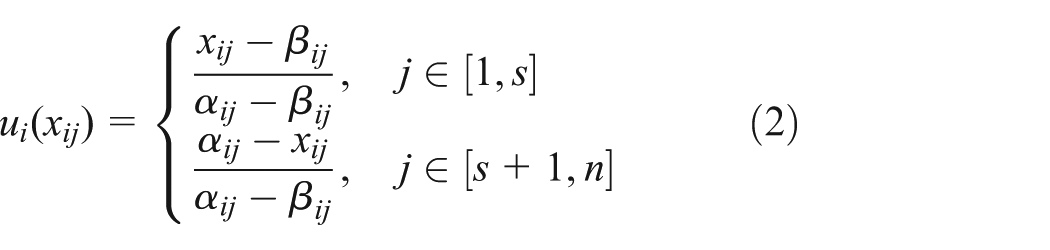
When
From the definition above,
In general, the value of the order parameter component

Definition 2
From Definition 2,
Definition 3
As for the given initial time

In formula (4)

Four explanations about Definition 3 are as follows:
The function of parameter
Definition 3 takes an overall consideration of all the subsystems. If the order degree of one certain subsystem has a greater increase, while the synergy of other subsystems has a smaller one or decrease, the whole system will present in a poor coordination or incoordination state. These will be shown in the model as
This definition can be used to examine the characteristics and trends of the synergy of rail freight transportation system in the investigation period. In accordance with the changes in the system order degree of the order parameters in the subsystems, the definition can manage the synergy of the whole system, which is conducive to the dynamic prediction and analysis of the rail freight transportation system.
Solution to the synergy of rail freight transportation system
After determining the evaluation methods and indicator system, we need to collect and process the indicator data. The evaluation indicators of the synergy of the rail freight transportation system are plenty. Each indicator is the technique index or the rigid index of railway operation situation. According to the evaluation index system of rail freight transportation synergy degree in the above paragraphs, the system is divided into six parts: there are synergy of railway transportation layout, system structure, transportation organization and management, transportation supply, information, and sustainable development. And the synergy of railway transportation includes the average transport distance of freight, average distance between stations, operating mileage of railways, and density of railway network. The synergy of system structure includes the proportion of national double-tracking mileage of railways and electrified railways: utilization of freight train load, freight train turnaround time, average daily number of locomotives in operation, time of one cargo operation, average daily output of freight locomotives, average annual output of owned locomotives, average daily number of train loadings, and labor productivity composed of synergy of transportation organization and management. The subsystem of transportation supply synergy is made up for the density of freight transportation, average trailing load of freight locomotives, proportion of electric locomotives to all kinds of locomotives in gross ton-kilometer, speed of freight train, average marked loading capacity of freight train, rate of on-time running of trains, and freight market share. The proportion of centralized traffic control stands for the synergy of information. And the synergy of sustainable development includes the volume of freight traffic of per 10,000 Yuan GDP, total energy consumption of unit transportation workload, number of freight liability accident, and indemnity of freight liability accident. The data are mainly obtained through the statistical data. And the statistical data come from Rail Statistical Indicators Manual and China Statistical Yearbook 1996–2004.” The data of quantitative indicator are given in Tables 2–4.
Data of quantitative indicators of synergy of rail freight transportation system.

Data sources: Rail Statistical Indicators Manual and China Statistical Yearbook.
Data of quantitative indicators of synergy of rail freight transportation system.

Data sources: Rail Statistical Indicators Manual and China Statistical Yearbook.
Data of quantitative indicators of synergy of rail freight transportation system.
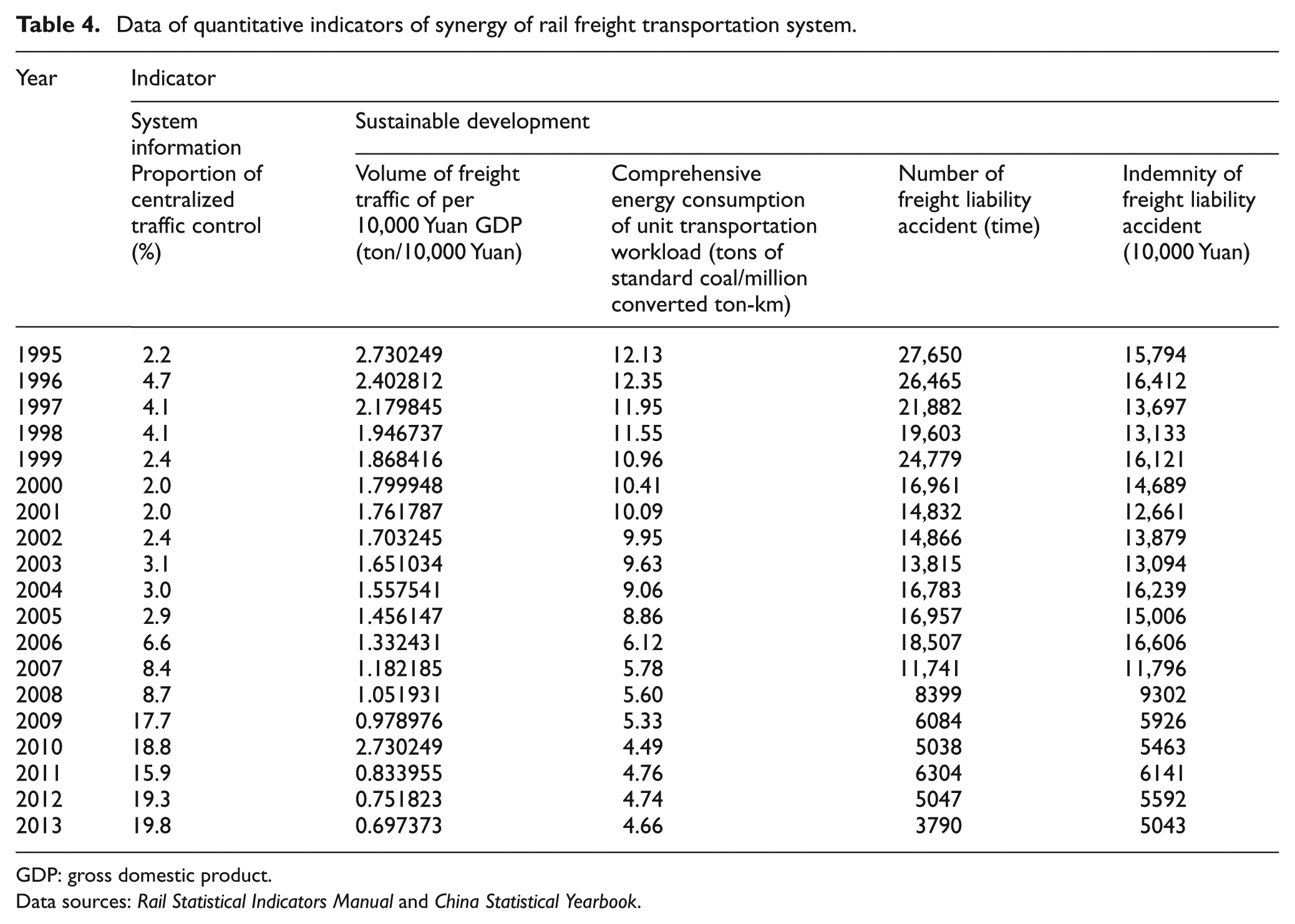
GDP: gross domestic product.
Data sources: Rail Statistical Indicators Manual and China Statistical Yearbook.
Substitute the data of Tables 2–4 into formulas (2) and (3) to get the contribution value of order degree of the six subsystems. The result is given in Table 5 and Figure 1.
Evaluation of synergy of rail freight transportation system—contribution value of order degree of all the subsystems over the years.


Evaluation of synergy of rail freight transportation system—contribution value of order degree of all the subsystems over the years.
Considering 1995 as the initial year, substitute the data of Table 5 into formula (4) to get the synergy of the rail freight system from 1996 to 2013. The result is given in Table 6 and Figure 2.
Synergy of rail freight system from 1996 to 2013.


Synergy of rail freight system from 1996 to 2013.
Analysis of the evaluation results of synergy of rail freight system over the years
From Table 6 and Figure 2, the synergy degree of rail freight transportation presents an overall upward developing trend. Before 2002, the synergy degree of rail freight transportation system presents a trend of slow growth, while after that it presents a dramatical increase until 2010, and then the degree tends to become smooth. These 3 years (1998, 2000, and 2001) witness a negative number of the synergy degree, which shows that the synergy of the 3 years’ rail freight transportation system performs worse than 1995. From Table 5 and Figure 1, the synergy degree of transportation organization and management in 1998 is lower than 1995, and therefore, it presents a negative number, that is, the lower synergy degree of transportation organization and management is the reason for a lower synergy degree. In 2000 and 2001, because of the low proportion of centralized control, the synergy degree of information is lower than 1995. From Table 5, the synergy degree of the subsystem presents an increasing trend, and the synergy degree of transportation organization and management, system structure, and information have developed rapidly in recent years. From Figure 1, synergy of structure, transportation organization, and management of rail freight transportation system make a more prominent contribution to the synergy of the system, which is consistent with the reality. With the development of railway reform, several reforms of system and management structure as well as resource integration make the structure of system, organization, and management of railway system more reasonable, and therefore, the order degree of them presents a steady upward trend. With the development of information and technology (IT), rail freight transportation has enhanced the information construction, thus improving the degree of information sharing. Therefore, synergy of information makes an increasing contribution to the synergy of rail freight transportation system.
On the other hand, the synergy degree of railway transportation layout, supply, and sustainable development make a contribution, but the growth rate is slow, especially the synergy degree of sustainable development. With the development of society and economy, human awareness of environmental conservation is getting stronger and the sustainable development becomes almost mainstream. As the main mode of material circulation, rail freight transportation has pointed out the sustainable development strategy. But the synergy degree of sustainable development presents a decrease in trend sometimes, which is related to the railway strategy management in these years. With the development of technology, the value of total energy consumption of unit transportation workload, number of freight liability accident, and indemnity of freight liability accident have reduced significantly in recent years, but the railway freight transportation market has also suffered from great impacts because of the rapid development in domestic logistics industry. For lack of rail freight service and marketing consciousness, customers are lost largely. The volume of freight traffic of per 10,000 Yuan GDP has decreased year by year and the freight market share shrunk continuously, which is the main reason the synergy of rail freight transportation sustainable development and transportation supply has increased slowly. According to servo theory which H. Hermann mentioned in synergy, fast-relaxing variables follow slow relaxing variables which restrict the system’s coevolution. That means there are short barrel effects during the process of system’s coevolution. From the result of the rail freight transportation synergy degree, we can see that the synergy of sustainable development and transportation supply are the main factors which restrict the coevolution of rail freight system. Therefore, in order to improve synergy, not only the synergy of information, transportation organization, and management and system structure should be improved steadily but also the synergy of railway transportation supply, layout, and sustainable development, in which the volume of freight traffic of per 10,000 Yuan GDP and the freight market share is the key part, should be emphasized.
Conclusion
From 1996 to 2013, the synergy of rail freight transportation system presents an overall upward trend. Before 2002, the synergy degree of rail freight transportation system presents a fluctuation of positive and negative, while after that, it presents a greater increase until 2010, when the degree tends to smooth. The synergy degree has risen to 0.57142183 in 2013 from 0.016810995 in 1996.
The synergy of structure, transportation organization, and management and information of rail freight system make a more prominent contribution to the synergy of the system. With the development of integrated transportation, the contribution of railway transportation layout’s synergy to the synergy of rail freight transportation has been greatly improved.
With a lower degree of synergy of transportation supply and sustainable development, it makes a less contribution to the synergy of rail freight transportation system. With rapid development of logistics industry, the synergy of transportation supply and sustainable development are the main ways to improve the synergy of rail freight transportation system.
Footnotes
Academic Editor: Xiaobei Jiang
Declaration of conflicting interests
The author(s) declared no potential conflicts of interest with respect to the research, authorship, and/or publication of this article.
Funding
The author(s) disclosed receipt of the following financial support for the research, authorship, and/or publication of this article: This research was supported by the Science and Technology Research Development Program of China Railway (Grant No. 2015F024).