




Abstract
The uniform distribution and experimental design is employed to study the thermo-hydraulic characteristics of a heat exchanger, which consists of the rotor-assembled strands mounted in circular smooth tubes. The uniform distribution and experimental design parameters include multiple rotor parameters such as rotor diameters, rotor lead, and height of blade, with the aim of studying their influence on the PEC, that is, (
Keywords
Introduction
Heat exchanger is the equipment to achieve heat exchange of cold and hot fluid in the engineering application, which is widely used in electric power, petrochemical, metallurgy, light industry, and other industries. In order to meet the requirements of heat transfer, reduce the manufacturing costs, and save maintenance costs as much as possible, the transfer tube in the inserts, which has the advantages of enhanced heat transfer, low cost, and easy disassembly and assembly, has attracted increasing attention in recent years.
The structure of the insert has various forms such as winding filaments, helix, ties, and rotor. 1 Ai-Ping and Hong-Juan 2 studied the average surface heat transfer coefficient and fin efficiency in a spiral finned tube. Eiamsa-Ard and Wongcharee 3 investigated heat transfer, friction index, and thermal performance of double twisted-tape inserts in micro-fin tubes and obtained a device with optimal combination. The heat transfer enhancement and pressure drop of the helix in horizontal concentric sleeve were studied by Naphon. 4 Their results showed that the helix has significant effect on reinforcement of heat transfer, especially in the laminar flow area, but the helix reinforcement effect is weakened with the increase in Reynolds number. Pahlavan et al. 5 conducted studies of the heat transfer, resistance, and dirt in the helix and winding filaments, respectively. Compared with smooth tube, helix improves the heat transfer rate by 22.28% on average, while winding filaments raises 163%−174% on average; helix increases resistance coefficient by 46%, and winding filaments increase as far as 500%. In contrast to the spiral spring and helix, the hydraulic turbine is a kind of new technology to strengthen the heat transfer of tube.
Its configuration is similar to screw, which enhances the heat transfer by causing strong shear and transmission. 6 Vortex generator is a widely used device of pipe insert reinforcement, which strengthens heat exchange along the axial distribution of tube. As a result, with the formation of axial attenuation fluid vortex, it has a lower pressure drop than hydraulic turbine and spiral twist. 7 The latest technology, that is, the rotor-assembled, which combines the hydraulic turbine and vortex generator, shows better heat transfer performance. Li et al. 8 and Zhang et al. 9 in the combined rotor turbulence experiments find that, when the Reynolds number ranges from 20,000 to 75,000, the overall heat transfer coefficient increases by 91.4%−178.7%, and the resistance index increases by 158.5%−295.9% in water. Zhang et al. 10 experimentally studied the influence of the assembled mode of Left–Right helical blade rotors. The experimental results revealed that the Nusselt number and friction factor of the tube with helical blade rotors were 77.9e182.2% and 22.1e71.1% higher than that of plain tube, respectively. Jiang et al. 11 presented an experimental study of five different mixed-rotor-assembled strands in a circular tube which included three different number ratios and three total numbers and obtained optimal results. Yang et al. 12 carried out seven different mixed-rotor-assembled strands which are tested in this work. The optimal results and the empirical correlations of the heat transfer, friction factor, and thermal performance factor are reported. Inspection of the literature shows that the parameters of rotor-assembled strand that affects the thermal performance such as the heat exchange coefficient and friction index are analyzed qualitative, but there is no quantitative analysis and the parameter interaction is seldom considered.
Generally, it is designed to use orthogonal experiment to analyze the influence of parameters on the heat exchange. However, as the orthogonal experiment method has its limitations, it can only be used for experiments of multi-factor and low level. If the level number is large, the test number will be squared due to the characteristics of its “neat comparison.” Therefore, a large number of experiments will be needed on the schedule. Fang et al. 13 put forward the basic idea of uniform experimental design method to remove the requirement of “neat comparison” and improve the characteristic of “uniform dispersion.” This method has been widely used in the pharmaceutical industry to optimize the formulation efficiently. However, there is no report about the usage of the method in the heat transfer enhancement area. In this article, we use the uniform experiment to design three factors in 10 levels of rotor-assembled strand experiment, analyze the factors affecting the regularity of heat transfer in-depth, get the empirical formulae, and the obtain optimal effect of heat transfer. As a result, it makes the arrangement of the experiment more representative, greatly reduces the number of experiments, easily arranges more level test, and can effectively analyze the interaction among factors.
Test equipment and test process
Rotor structure
The device installed in the heat exchange tube is shown in Figure 1. The rotors, which are the core components of the device, rotate synchronously, following the principle of least resistance. The interaction between the rotor and fluid enhances the shear of flow boundary layer, making the layer thinner to destroy the velocity condition of dirt growth and strengthen the heat transfer.

Device installed in the heat exchange tube.
In most cases, the temperature of the water flowing through the heat exchanger is in the range of 30°C–60°C and the water is not corrosive, so engineering plastics molding (POM) can satisfy the operating requirement. The materials of rotor and tube’s accessories are made of engineering plastics. The water flowing through the heat exchanger is measured by LWGY-50-type turbine flow meter and XSJ.30-type digital flow totalizer, all with an accuracy level of 0.2. The inlet and outlet water temperatures of heat exchanger are measured by the constantan thermocouple, which is calibrated with a standard thermometer under precision of 0.1°C.
The geometric structure parameters of the rotor have a direct effect on the comprehensive performance of the device. The diameter of the most commonly used heat exchange tube in industry is 24 mm. Based on the analysis of the structure of the combined rotor, three key parameters, that is, rotor diameter Dr, lead p, and rotor blade height hz, are chosen to investigate their influence on the thermal performance. The level numbers of rotor diameter, lead, and blade height are 10, 10, and 5, respectively, as shown in Table 1.
The characteristic size of the combined rotor.

Experimental facilities
Heat transfer and resistance experiment of rotor-assembled strand is carried out in the Heat Transfer Experiment Testing Center of China. The experimental device consists of experimental section, cold water system, hot water system, steam heating system, and heat exchange data acquisition systems. To ensure the inlet flow and temperature stable and reliable, the inlet flow of the experimental section is within ±2% accuracy and imported temperature within ±2°C. The flow is measured using a mass flow meter (0.2 in accuracy) and the temperature measurement is using common benchmark test method. Pressure measurement system tests the outlet pressure of pump and the inlet and outlet pressures of heat exchanger, using a precision spring tube pressure gauge with an accuracy of 0.4 and a range of 0.6 MPa. Hot water starts from the hot water tank, runs through the hot water pump, flow meter, f-JN valve, hot water heater, then into the rotor-assembled strand heat exchanger, and finally returns to the hot water tank, completing a cycle. The size of the outside experimental casing pipe is 45 mm × 35 mm, while the diameter of experimental heat exchange tube is 24 mm.
Experimental arrangement
The level of uniform design table U10 (102 × 5) 14 is chosen for the test, as shown in Table 2. The deviation of the U10, D, is 0.1878. The deviation is so small that 10 times of test are enough to meet the accuracy requirement. However, it needs 100 times if the orthogonal experiment design is chosen. Single-factor experiment method requires 500 times of test. Obviously, uniform design cuts test times significantly.
Level of rotor turbulence factor.

Results of analysis
Pretreatment of experimental data
The disturbed flow strengthening mechanism of the tube side assembled rotor is studied in this article. The empirical formula in Qingyu et al., 6 which is based on the classic convective heat transfer and heat conduction theories, is used to describe the heat exchange of the outside tube. Therefore, indirect fitting method is adopted to define the proportion coefficient as follows 6

where

where

where

Under the condition that the fluid flow in the tube is at the maximum value, the heat transfer convection coefficient of the external side is obtained by changing the annular side fluid flow through the Wilson graphical method. The exponent of

where

From equations (1) to (6), the value of

where
In the case that the annular side fluid flow is at its maximum value (the annular side of the convection heat resistance as lower as possible), the tube side convection heat transfer coefficient is obtained by changing the tube side flow. And then, the resistance index f can be calculated by

where
Method of experiment analysis
Because of fewer test times, the results of the combined rotor experiment research must be studied by regression analysis to investigate the relationship between structure parameters and heat transfer performance. In consideration that the rotor diameter, lead, and blade height may affect the heat exchange and resistance, the dependent variables are selected. Similarly, their items in square and interaction are also selected because they influence the heat exchange and resistance. The performance evaluation criteria (PEC), which is widely used in engineering, is adopted to evaluate the comprehensive performance, and the specific formula is

Then, the PEC when Re = 20,000 is the key evaluation index calculated by SPSS statistical software. The method of stepwise regression is selected to analyze the data, and the results are shown in Table 3.
The regression analysis of uniform design table in rotor-assembled strand heat exchanger.

DOF: degree of freedom.
very significant.
Due to the measurement error and the uniform test table deviation error, in order to ensure regression results represent the internal law of experiments, the variables and regression equation are needed to be examined by t test, R test, and F test. In Table 3, B is the coefficient of regression variables; Std. error is the standard error of the regression variables; and T is the result of the T test, and they are greater than 2.5, implying that the four variables in the regression equation play key roles in equation (10). The rotor diameter and its square (actually the area) have the biggest influence on PEC. The interaction in lead and the blade height of rotor also has a bigger influence on PEC. F test of the regression equation was 163; the value of F0.01 is 11.39, which shows that the regression equation (equation 10) is very significant. Regression effect of the regression equation is expressed by R test and R 2 test. From Table 3, it can be seen that the correlation degree is quite high and the following equation is obtained

Then using MATLAB, the best match of the rotor exchanger is calculated: Ybest = 2.01, x 1 = 21.3 mm, x 2 = 704 mm, and x 3 = 7 mm.
According to the results of the regression, the optimal structure parameters of the rotor which has been made to round off are diameter = 21 mm, lead = 700 mm, and blade height = 7 mm and are identified as 21-700-7. The rotor shows the worst performance in the experiment and has a diameter of 16 mm, a lead of 100 mm, a blade height of 6 mm, and is identified as 16-190-6. Heat transfer performance when the Re are in a broad range from 20,000 to 60,000 is analyzed, and the result is shown in Figure 2 in which the ordinate and abscissa are PEC and Re, respectively. It can be seen that the best match of PEC is 1.99 with Re = 20,000, consistent with the regression calculation results. The 21-700-7 rotor has a higher PEC value than the 16-190-6 when Re changes from 20,000 to 60,000.
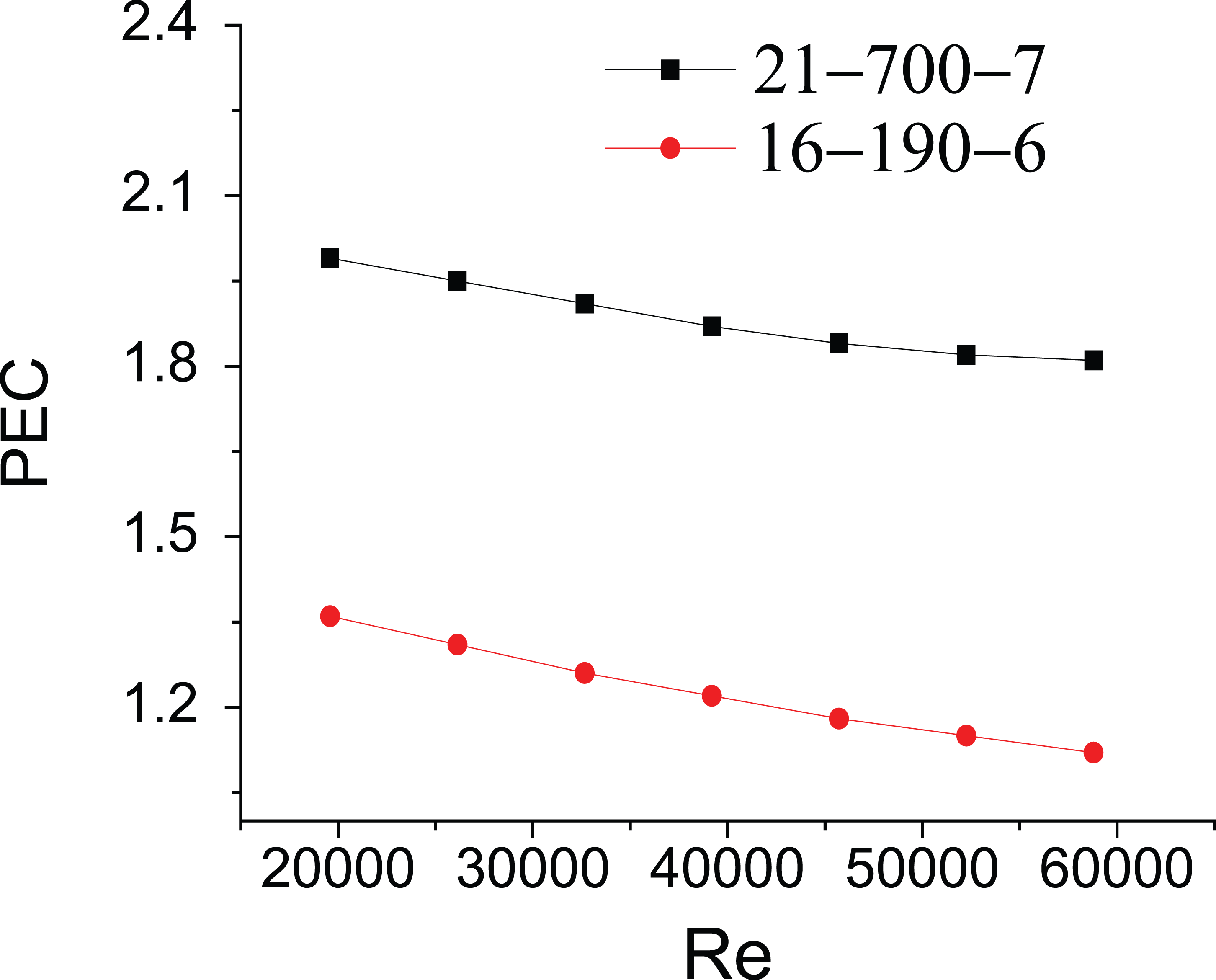
PEC with Reynolds number in a broad range from 20,000 to 60,000 of 21-700-7 and 16-190-6.
Because different structure parameters of the rotor are used in this article and other works, it is difficult to compare our results with those of other published works directly. However, the PEC, a dimensionless parameter, can be used to do the comparison. Based on the experimental results, literature 11 reveals that the best combination of PEC is 1.96 with Re = 20,000, and literature 12 demonstrates that the best combination of PEC is 1.88 with Re = 20,000. It shows our approach can attain the optimal parameters more effectively.
Influence of rotor diameter on heat transfer performance of heat exchanger
In order to investigate the influence of the rotor diameter on heat transfer performance, four rotors with same lead and blade height but different diameter, that is, 22-600-7, 21-600-7, 18-600-7, and 16-600-17, and a smooth tube are analyzed using the f index and Nusselt number (Nu). Nu as a function of Re is shown in Figure 3(a). It can be seen that a larger rotor diameter enhances the heat transfer of turbulence because the increase in rotor diameter can directly expand its disturbance radius. If the disturbance radius extends to the thermal boundary layer, the heat transfer reinforcement effect will be improved significantly. Figure 3(b) shows that with the increase in the diameter, the resistance coefficient f shows a slight increase in the beginning when the rotor diameter increases from 16 to 21 mm. However, when the diameter reaches 22 mm, the resistance coefficient increases rapidly, leading to the benefit of the increase in Nu impaired by the increase in the resistance coefficient f. After the calculation, the PEC is 1.95 at this time, smaller than the results of the rotor 21-700-7, which suggests that when the tube outer diameter is determined, there is a best rotor diameter. The experimental results verify the validity of the uniform design. Meanwhile, the regression equation (10) demonstrates that uniform design is a kind of test method for finding the internal pattern.
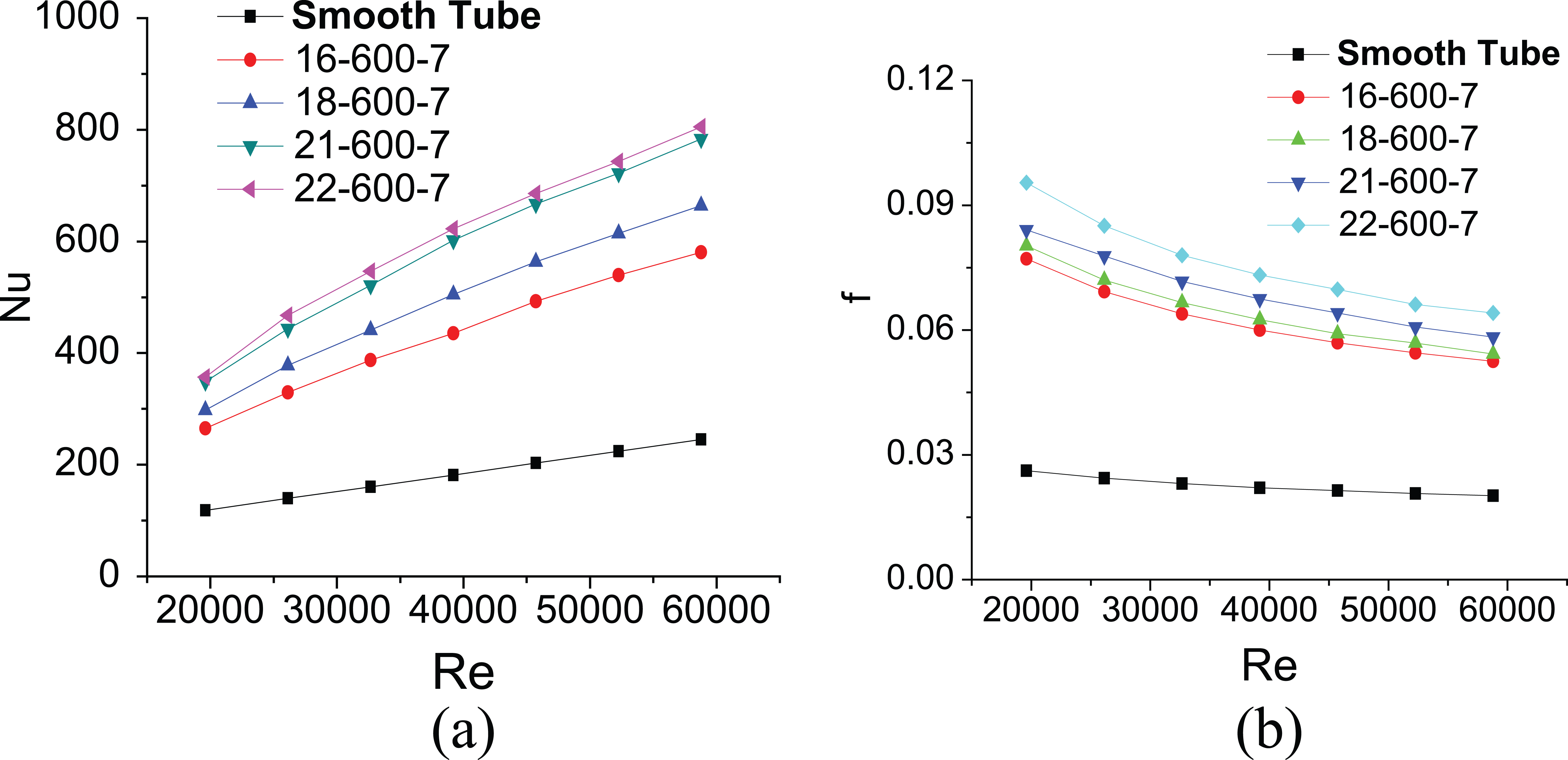
Influence of rotor diameter on heat transfer performance under different Reynolds number.
Influence of leaf blade height on heat transfer performance of heat exchanger
To analyze the influence of different blade height on the heat transfer, three rotors, that is, 21-700-5, 21-700-6, and 21-700-7, and a smooth tube are employed, and the results are shown in Figure 4. The results of the increase in rotor blade height are similar to the increase in the rotor diameter because both cases extend the disturbance radius. But its increased aptitude in Nu is higher than that due to the diameter change in the rotor. Resistance coefficient is also increased with the blade height gradually, but it is not as greater as the resistance coefficient caused by the rotor diameter changes. Generally, if the strength is guaranteed, a larger blade height is preferred. This agrees well with the regression formula: if the diameter and the lead of the rotor are constant, the PEC increases linearly with the increase in blade height.

Influence of blade height on heat transfer performance under different Reynolds number.
Influence of lead on heat transfer performance of heat exchanger
Lead reflects the distortion of leaf blade and the rotating flow intensity, angle, and wavelength of fluid in the tube. The smaller the lead is, the more intense the rotor and fluid rotating flow are. The experiments of 21-100-7, 21-100-7, 21-600-7, and 21-600-7 rotors and a smooth tube are carried out under different Reynolds number. Through Figure 5(a), it can be seen that with the decrease in the lead, the Nu increases gradually, but the increased amplitude is relatively slow. Obviously, in the turbulence zone with higher Reynolds number, although all rotors have a high rotation speed, they can only enhance radial mixing of fluid. So, it has little effect on thinning the thermal boundary layer. Compared with the Nu of 21-100-7 and 21-700-7, its growth rate is less than 10%. Figure 5(b) shows that the resistance coefficient of the 100 mm lead is >30% higher than the 700-mm lead. Apparently, the decrease in lead results in an increase in pressure drop of the tube side, but has little effect on the heat exchange.

Influence of lead on heat transfer performance of heat exchanger under different Reynolds number.
In addition, based on the interaction item, the length of lead is directly linked to the blade height. Different blade height corresponds to the different best lead. According to equation (10), when the height of the blade is 5 mm, the best length of the lead is 530 mm. Therefore, the heat transfer performance of the rotors 21-700-5, 21-500-5, and 21-300-5 is analyzed when the Reynolds number changes from 20,000 to 60,000 and the result is shown in Figure 6. It can be seen that the PEC value is 1.72 when the lead is 500 mm when Re = 20,000, better than that of the rotors with lead of 700 and 300 mm. Moreover, with the increase in the Reynolds number, PEC value of the 500 mm lead rotor is better than those of the 700- or 300-mm lead rotor.

Influence of lead on heat transfer performance of heat exchanger under the blade height of 5 mm.
Conclusion
It is of great significance to analyze the heat transfer enhancement regularity of heat exchanger caused by the rotor diameter, lead, blade height, and their interactions in depth. In this article, the uniform experimental design is employed to arrange the heat transfer and resistance experiment of the assembled rotor. The formula that describes the relationship between rotor diameter, lead, blade height, their interactions, and PEC is obtained by regression analysis. Additionally, the single-factor experiment is used to verify the validity of the uniform experimental design. The following conclusions are drawn:
1. In the heat exchanger with the assembled rotor, the rotor diameter has a great influence on the PEC parameter. On the basis of the experimental research, it is found that the rotor diameter has an optimal size, which is 21 mm in the present heat exchanger. Meanwhile, the heat exchange efficiency improves continuously with the increase in the blade height if its strength can be guaranteed.
The lead mainly affects the rotation rate of the rotor and the pipe vortex. A shorter lead causes a stronger vortex. When Re > 20,000 in the turbulence state, the flow resistance overweighs the heat transfer improvement due to the stronger vortex. In the present experiment, it is shown that the thermo-hydraulic characteristic is best when the lead is 700 mm. The best lead changes with the variation in the blade height as a result of their interaction.
2. Compared with the orthogonal experimental design, the uniform experimental design is more suitable to arrange multiple-level experiments and easy to find the influence of assembled rotor on heat transfer enhancement quantitatively. Additionally, the results obtained by stepwise regression agree well with those through single-factor experiment.
Footnotes
Acknowledgements
The authors would like to sincerely thank and acknowledge the support and constructive comments from the editor and the anonymous reviewers.
Academic Editor: Oronzio Manca
Declaration of conflicting interests
The author(s) declared no potential conflicts of interest with respect to the research, authorship, and/or publication of this article.
Funding
The author(s) disclosed receipt of the following financial support for the research, authorship, and/or publication of this article: The research was supported by the National High Technology Research and Development program (863 program) of China under Grant No. 2014AA0415013 and the National Natural Science Foundation of China under Grant No. 51277116.