




Abstract
Temperature sensitivity of the propellant has significant influence on the interior ballistic performance of guns. Many physical and chemical approaches are employed to decrease this temperature sensitivity of the propellant. In this article, it is proposed that the temperature sensitivity of the propellant is changed by altering the factors required to ignition. A one-dimensional two-phase flow interior ballistic model is established to analyze the relation between ignition factors and temperature sensitivity. The simulation results show that the propellant temperature sensitivity is changed by altering the ignition factors. That is, the interior ballistic performance is affected by altering the size of fire hole, breaking liner pressure, and ignition location. Based on the simulation results, the temperature sensitivity can be controlled by matching of charges and intelligent control ignition system.
Introduction
The interior ballistic performance of guns depends on the initial operating temperature of the system. The muzzle velocity at high temperature is higher than the one at lower temperature and the ballistic efficiency shows the same relation with initial operating temperature. The variation of chamber pressure can be greater than 40%; the muzzle velocity can be greater than 10% in the temperature range of −40°C to+50°C for general rifles. The difference in muzzle velocity is more than 100 m/s at high and low temperatures for some guns. The difference is positively correlated to muzzle velocity. This fact brings in certain difficulties to the weapon designers. The chamber must be designed for a temperature that can yield the highest pressure despite the infrequent usage of the weapon under this condition. This could greatly limit the performance under more commonly encountered circumstances. Weapon system must be designed to operate under a wide range of temperatures and the propelling charge can contribute significantly to performance variations.
The effect of initial operating temperature on the interior ballistic performance is due to propelling charge temperature sensitivity, that is, when the propellant burns, the changing rates of gas evolution are changed with initial operating temperature. The temperature coefficient is defined as the change in peak pressure Δp for a given change in operating temperature ΔT. It can also be defined in terms of velocity change, ΔV/ΔT. If the effect of temperature sensitivity on the gun performance is altered, the decrease in the propellant burning rate caused by the lower temperature must be increased. The ballistic performance includes the muzzle velocity and chamber pressure. The temperature sensitivity is presented in the form of muzzle velocity and chamber pressure. Many physical and chemical approaches are applied to improve the interior ballistic performance of guns. Chemical and physical approaches are used to reduce the effects of temperature on the linear burning rate of the propellant and to control the burning surface area of the propellant, respectively. These approaches have been proved highly successful in small arms. The 19th JANNAF Combustion Working Group Workshop on “Temperature Sensitivity of Gun Propellants” revealed a wide range of ballistic problems associated with gun firings at various temperatures in small arms and large caliber systems. The influence factors of temperature coefficient are analyzed. 1 Yang and colleagues2–4 have established comprehensive numerical analysis of nitroamine or poly(azide glycidyl ether) (GAP) pseudo-propellant combustion to predict the propellant burning rate and detailed combustion wave structure over a broad range of pressure, laser intensity, and propellant composition. The work provides a comprehensive review of recent advances in modeling and simulation of solid propellant ingredient combustion and ignition over a wide range of ambient conditions. 5 The temperature sensitivity is significantly affected by the condensed-phase heat release.5,6 Propellant charge composition comprises individual powder particles of a nitrocellulose propellant coated with an acrylic resin and a process for its preparation. 7 The application of low-temperature sensitivity coefficient of the high-energy nitroamine propellant in a 105-mm gun has been studied theoretically and experimentally. 8
As mentioned above, previous researches mainly focused on the propellant composition. Those methods increase the muzzle velocity, but the chamber pressure does not improve significantly. We propose an idea that the temperature sensitivity is decreased by applying intelligent control ignition system and initiate a program to elucidate the idea by simulating a one-dimensional two-phase flow interior ballistic model. Theoretical analyses are performed to predict decreasing the interior ballistic temperature sensitivity (improving the interior ballistic performance) by altering the ignition system.
Intelligent ignition theory
Except by altering the propellant composition or geometry, the propellant charge of temperature sensitivity can be decreased by the intelligent ignition system, in which the ignition factors can vary with different initial operating temperatures, such as ignition energy, ignition intensity, and fire hole area.
The initial temperature of the propellant affects the interior ballistic performance by altering the energy required to ignite the propellant. If the required ignition energy is high and the igniter output is marginal, the initial temperature may have a substantial effect on the peak pressure by slowing down the flame spread at low temperature and accelerating the process at high temperature. The intelligent ignition is designed to overcome this problem. At low temperature, igniting impulse is large enough to make the flame propagation velocity reach or exceed a critical value, which can improve the interior ballistic performance. The temperature sensitivity can be controlled by matching of the propellant charge and the reliable intelligent control ignition system with short ignition time and low input energy, and the interior ballistic performance will be increased to improve the weapon potentials.
Mathematical model
According to the previous analysis, the effect of the initial operating temperature on the interior ballistic performance is due to that the initial temperature changes the propellant temperature sensitivity. For this reason, the ignition factors are changed for different initial operating temperatures to improve the interior ballistic performance, which indicate that the propellant temperature sensitivity is changed. In this section, the effect of ignition factors on the interior ballistic is analyzed by one-dimensional two-phase flow interior ballistic model simulation, and the results validate the feasibility of changing the propellant temperature sensitivity by altering the ignition factors.
One-dimensional two-phase flow interior ballistic model
In this study, generic gun or propelling charge configuration using one-dimensional two-phase flow interior ballistic model is considered, and the simulation results are compared with experimental data for validation.
The physical and chemical processes taking place in the interior ballistic phenomena are complex and last for a few milliseconds. A simple description for the interior ballistic cycle is given in the following. The hot gas, produced by the combustion of the igniter near the front end of the gun chamber, is forced into the granular bed through several holes. These igniter products cause a compaction of the granular bed and also lead to ignition of the nearby solid propellant through a process of heat transfer to the propellant surface. The ignited propellants release more hot gas to ignite more propellants. Thus, the pressure increases rapidly in the combustion chamber. Once the pressure at the shot base is greater than start pressure, the projectile starts to move. Our study stops when the projectile exits the muzzle.
It is assumed that there are gas phase and solid phase flow in the propellant chamber of the accelerator. The volume of the solid phase decreases with the propellant combustion, and the mass of the gas phase increases. The gas phase is composed of the propellant combustion gas, the igniter combustion gas, and the air, and the solid phase is composed of solid propellant. In a control volume, a given macroscopic volume is divided into the volume of gas and solid. The volume fraction for each phase is used in the Eulerian governing equations for the gas phase. The gas phase is considered as compressible inviscid flow, and the governing equations for the gas phase contain the term of mass and energy generation by solid decomposition. In this section, a one-dimensional two-phase flow interior ballistic model is established, because a reliable simulation model is the basement for experiments. The basic physical processes involved in a gun interior ballistics during the transient period were well described by some articles.9–12
Most importantly, the gas and solid phases are coupled through heat transfer, combustion, and interphase drag, and these processes are modeled using empirical correlations that relate the microphenomena to the average flow properties described by the five governing equations.
The mass conservation equations of the gas and solid phases can be expressed as

The momentum conservation equations of the gas and solid phases take the forms

The energy conservation equations of the gas phase are as follows

where
The governing equations of igniter and the main charge are coupled with combustion mass flow through the igniter side holes. The mass flow rate of black powder gas combustion is governed by the ratio of pressure in the main charge and corresponding pressure in the igniter.
Numerical procedure
The creation of finite differential equations is carried out by the integration of partial differential equations over the finite control volumes. Because of the high degree of nonlinearity of the equations, the calculation must be performed by iterative approach. We have five balance equations that constitute a system of hyperbolic differential equation. We have had success in determining one-dimensional solution by applying implicit two-step scheme of Mac-Cormack to all interior mesh points. When the projectile is stationary, left and right boundaries are fixed, and the reflective boundary condition is used in a boundary point. When the projectile is moving, the left boundary is still fixed, and the two phases at the breech move with the projectile. It is considered that moving boundary condition describes the right boundary point. In this work, the moving control volume method was used.
The kinetic equation of the projectile is as follows

where

The full details of the derivation for the mass, momentum, and energy conservation are shown in the book by Yuan and Zhang. 9
Model verification
The interior ballistic code is applied to 76-mm gun and compared with the experimental data. Charge constitution of the gun is similar to the structure as shown in Figure 1.

Schematic diagram of a charge structure in a gun.
The calculated pressure and porosity distribution on x–t diagram is shown in Figures 2 and 3, respectively. When the jet flow from the igniter penetrates into the propellant bed, the propellant near the broken hole is ignited first to cause a pressure increase in the chamber. Under the action of the pressure gradient, the pressure wave and its associate flame propagate to the unburned region. With the increase in the ignited area, the pressure in the chamber keeps continuously rising. When the pressure at the shot base reaches the start pressure, the projectile starts to move. The pressure in the chamber reaches a maximum value near t = 10.0 ms and then decreases gradually until the interior ballistic cycle ends.

Calculated pressure distribution.

Calculated porosity distribution.
The comparison of the peak pressure and muzzle velocity obtained from simulation and experiments is shown in Table 1. The error probabilities of the two results are less than 1% and the validation shows a good agreement between experimental and computational results.
Comparison between numerical and experimental results.

Effect of ignition factor on the interior ballistic performance
The simulation results of the interior ballistic model show the parameter changing of chamber during the interior ballistic cycle. In this section, we study the effect of ignition factors on the interior ballistic performance. The ignition factors include structural parameters of igniter, ignition energy, nonuniform charging of igniting powder, and multipoint ignition in igniter tube.
The output properties of igniter are flame temperature, pressure, and duration. Structural parameters of igniter have significant influence on the ignition performance. Based on the experience and given propellant charge structure considered, the size of fire hole and pressure of breaking liner are analyzed.
The establishment of pressure field in igniter and ignition intensity is affected by the area of fire hole. In this article, the number of fire hole is given. The effect of different sizes of fire hole on the peak pressure in the chamber and muzzle velocity is shown in Figures 4 and 5.

Distribution of peak pressure with the size of fire hole increasing.

Distribution of muzzle velocity with the size of fire hole increasing.

Distribution of igniting powder: case 1.
As the size of fire hole increases, the peak pressure in the chamber and muzzle velocity increase. As the size of fire hole becomes larger, more products of combustion are expelled into the bed through small holes. If the fire hole size is too large, ignition pressure and flow velocity of hot gas will not be enough. If the fire hole size is too small, the flow flux of hot gas will be low; thus, the propellant surface cannot obtain enough ignition energy. The fire hole size of igniter should be designed in a reasonable range.
Different liner materials have different pressures of breaking liner and affect the ignition strength. Table 2 shows the effect of different pressures of breaking liner on the peak pressure in the chamber and muzzle velocity, respectively.
Effect of pressure on the peak pressure and muzzle velocity in the chamber.

Peak pressure in the chamber and muzzle velocity increase with the increase in the pressure and size of fire hole. Based on a given size of fire hole, if breaking liner pressure is too small, the propellant will not be ignited. However, if pressure of breaking liner is too large, the igniter will be damaged.
Many factors affect peak pressure and muzzle velocity. And the ignition energy is the most important factor. More igniting powder causes stronger stimulus of the propellant bed with the increase in peak pressure. On the contrary, with the decrease in igniting powder, igniting delay time will be longer, leading to lower peak pressure and smaller muzzle velocity. Meanwhile, the muzzle velocity cannot satisfy the interior ballistic performance. Actually, the increase in igniting powder means that the total energy of powder gas increases. The effect of igniting powder mass on the interior ballistic performance is shown in Table 3.
Effect of igniting powder quantity on the interior ballistic performance.

It is apparent that the ignition powder increases peak pressure and muzzle velocity. Under different temperatures, the interior ballistic performance can be controlled by changing igniting powder mass.
Generally, it is proposed that the porosity is even in the numerical simulation. But at different positions, the porosity is always different, for example, powder will accumulate partly because of the free space in the igniter. The distribution of igniting powder is explained in the following. Two theoretical cases are plotted in Figures 7 and 8, although they cannot occur in practice.
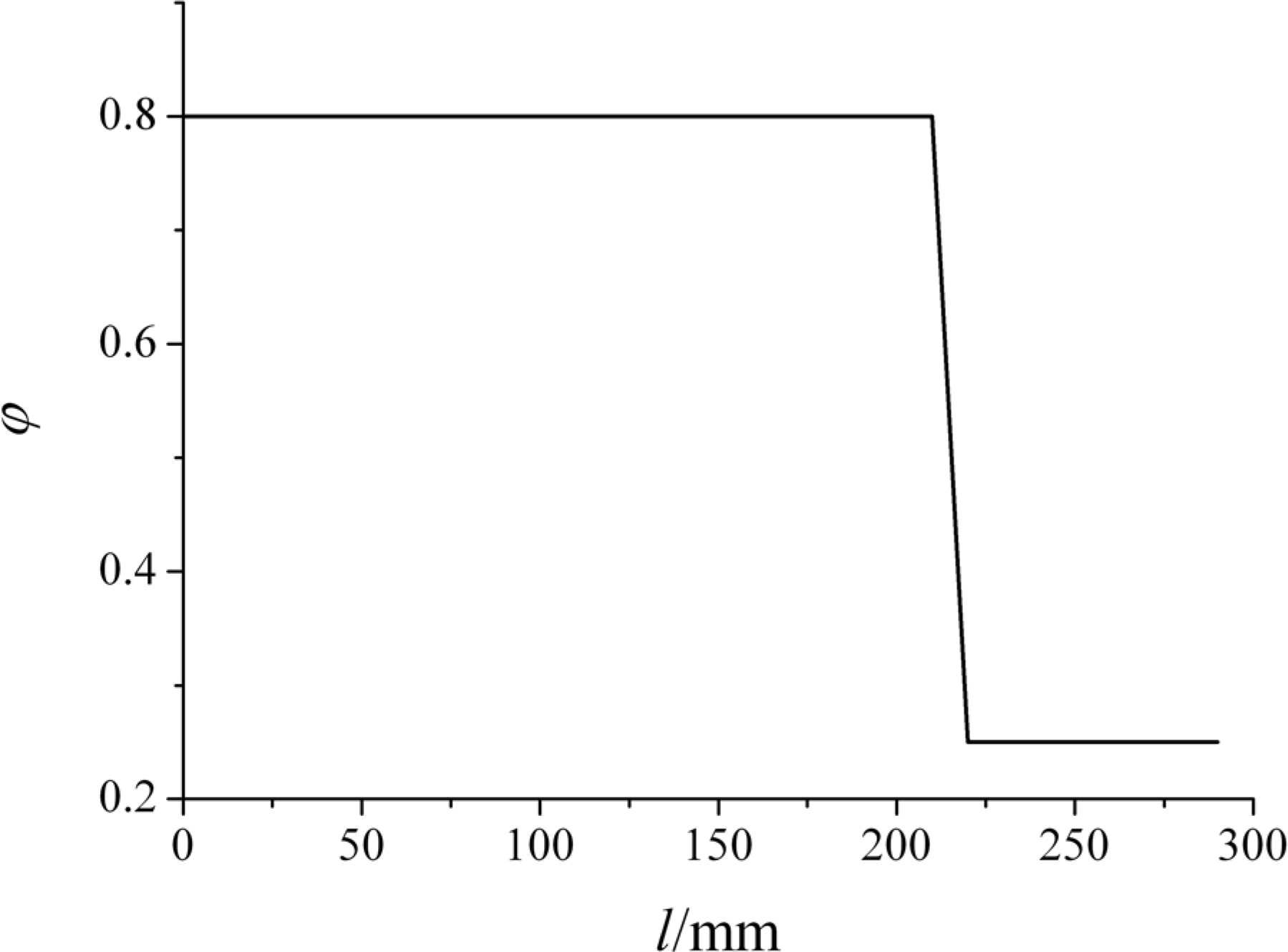
Distribution of igniting powder: case 2.

Distribution of igniting powder: case 3.
The distribution of igniting powder is uniform in the middle of igniter, as shown in Figure 6; the igniting powder almost accumulates at the projectile base, as shown in Figure 7; and the igniting powder mainly accumulates at the breech end, as shown in Figure 8. Table 4 shows the effect of different charge structures on the interior ballistic performance.
Effect of different charge structures on the interior ballistic performance.

From Table 4, it can be observed that if the loading parameters are same, the peak pressure and muzzle velocity are larger when igniting powder accumulates at projectile base, and they are smaller when igniting powder accumulates at breech end or near breech end. Under different temperatures, the performance is controlled by changing charge structure.
Ignition location is an important factor for the interior ballistic performance. The effect of ignition location on the interior ballistic performance is shown in Table 5.
Effect of ignition location on the interior ballistic performance.
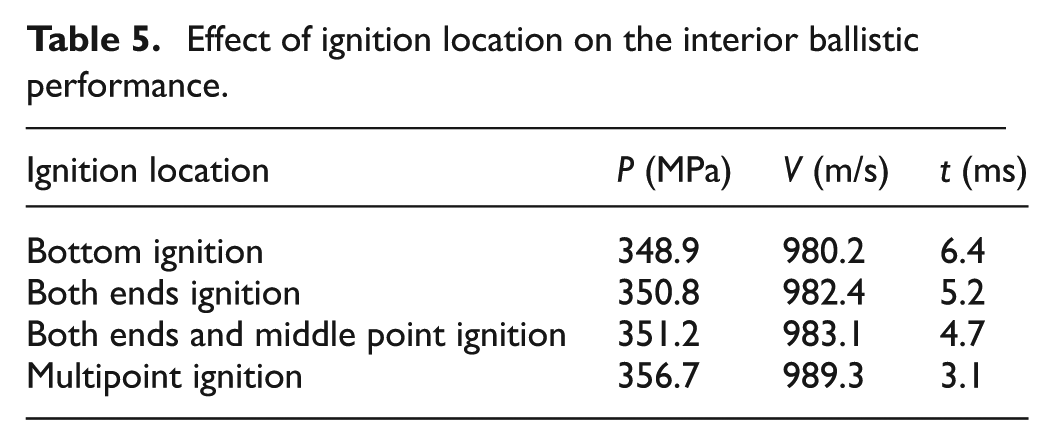
It shows that the muzzle velocity and pressure under the multipoint ignition condition are larger than those under the single-point ignition condition. The ignition delay is lower under the multipoint ignition condition. The interior ballistic performance is controlled by changing ignition location with different temperatures.
Simulation results show that the interior ballistic performance can be influenced by altering the size of fire hole, breaking liner pressure, and ignition location, that is, the size of fire hole is smaller or multipoint ignition at low temperature, while the size of fire hole is larger or single-point ignition at high temperature. It is proved through simulation that the interior ballistic temperature sensitivity can be controlled by altering ignition factors, that is, results indicate that the proposed idea is feasible.
Conclusion
In this article, a discussion based on the one-dimensional two-phase flow theory is described for simulating the effect of ignition factor on the interior ballistic performance in a gun. By means of analyzing temperature sensitivity, the effects of the propellant initial temperature on the ballistic properties and peak pressure by altering the ignition factors are represented. A one-dimensional two-phase flow interior ballistic model is established, and parameters in the interior ballistic process are simulated. The effect of ignition factors on the peak pressure in the chamber and muzzle velocity is studied. Through the matching of charge and intelligent control ignition system, the temperature sensitivity of the interior ballistic can be reduced.
Footnotes
Acknowledgements
We gratefully acknowledge the support given by all colleagues who have helped directly and indirectly in carrying out this work.
Academic Editor: Hua Meng
Declaration of conflicting interests
The author(s) declared no potential conflicts of interest with respect to the research, authorship, and/or publication of this article.
Funding
The author(s) disclosed receipt of the following financial support for the research, authorship, and/or publication of this article: This work was supported by the Changzhou Institute of Technology Foundation (E3-A-1301-13-005), University Science Research Project of Jiangsu Province (14KJD470001), the Natural Science Foundation of Jiangsu Province (BK20131348), and Key Laboratory Fund (grant no. 9140C300206120C30110), People’s Republic of China.