




Abstract
One major focus on the performance researches of pump as turbine is how to enhance the efficiency of energy recovery. While the key point of increasing the efficiency is to improve the performance of the blade profile which is structural basis of the blade geometry. This article presents an optimization method for the blade profile. It contained the parameterization of blade profile, the Latin Hypercube experimental design, the computational fluid dynamics techniques, the back propagation neural network, and genetic algorithm. Specifically, the nonuniform cubic B-spline curve was used to parameterize the blade profile, the Latin Hypercube experimental design method for the acquirement of the sample points of back propagation neural network. The performance analysis of each sample point was accomplished by the computational fluid dynamics techniques. Then, the learning and training of the back propagation neural network was carried out. Finally, the optimization techniques of combining the back propagation neural network and genetic algorithm were used to solve the optimization problems of the blade profile. Based on the above method, the blade profile of a pump as turbine was optimized and improved. The result shows that the efficiency of the optimized pump as turbine under the optimum operating condition was increased by 2.91%, with the constraint condition to ensure that the difference between the head and the initial head of the pump as turbine is less than the specified value. This proves that using the above method to optimize the blade profile is feasible.
Introduction
There exist large amount of high-pressure fluids in the technological process of petroleum, chemical and water desalination, as well as many other processes. These high-pressure fluids need to be depressurized in order to apply to follow-up process. Generally, the reducing valve is used to reduce the pressure of fluids flowing through it, but the pressure energy is wasted in the form of heat eventually. The hydraulic turbine can recover the surplus energy mentioned above and reduce the cost of the entire process.1–3 At present, most of the hydraulic turbines are pumps which operate reversely. The application of pump as turbine (PAT) becomes more and more wide because of its many advantages, such as simple structure, small volume, lower cost, perform reliably, and maintain conveniently. 4 However, the efficiency of the PAT is low, which means its ability of energy recovery is poor.
Yang et al. 5 found that the hydraulic losses in the impeller of the PAT accounted for more than 50% of the total hydraulic losses. It means that the poor performance of the PAT mainly embodied in the impeller, which is due to the inappropriate operation of centrifugal PAT considering part of its geometric parameters. These geometric parameters were designed for the forward direction rotation without considering the inversion situation. So, part of optimization should be done when centrifugal pump running in reverse model as turbine in order to perform better.
A pump is not ideally designed to operate as a turbine. In order to improve the performance of the PAT, the optimization of the PAT, according to the flow of the PAT, is needed. Few research works have been focused on the optimization of the PAT.5–11 For example, a previous literature 5 carried out some numerical studies of the PAT in different wrap blades under different specific speeds, in which the results show that there is an optimal wrap angle for the PAT to acquire the good performance, and the optimal wrap angle of blade decreases with an increasing specific speed. The effect of blade inlet angle on performance of the PAT was studied by a previous literature, 7 in which the results show that it should be more suitable if the value of blade inlet angle is in the range of 25°–35° for the PAT with spiral case. The literature 8 put forward to modify the geometry of the impeller. Modification of the geometry of the impeller was done by rounding the blades’ leading edges, and shroud or hub face can improve the efficiency in all measured points. Blade profile, which is a structural basis of the blade geometry, is a very important parameter for the impeller, and its performance does directly affect the overall performance of the PAT. However, the optimization of the blade profile is mainly aimed at rotating machinery such as centrifugal pumps, compressors, and fans,12–16 and few reports about the PAT can be found. Derakhshan et al. 8 optimized the PAT based on incomplete sensitivity gradient optimization algorithm. The torque, head, and efficiency of the PAT were increased by 4.25%, 1.97%, and 2.2%, respectively, after the optimization. Despite this, there are still some improvable areas of this optimization method. Because of the great dependency of gradient optimization algorithm on the convexity and differentiability of objective function, the resulting solution cannot be guaranteed as the global optimal solution, yet the inner flow of hydraulic is controlled by the Navier–Stokes (N-S) equations, and the performance function of the PAT has the character of nonconvex function and multiple peak values. Nevertheless, genetic algorithm seeks the optimal solution of objective function by mimicking natural selection and genetic mechanism. It can realize the global optimization in probability form effectively without too many mathematic requests on optimization problem. Because the computational fluid dynamics (CFD) calculation of the PAT is very time-consuming during the optimizing period, this article introduces the back propagation (BP) neural network with a relatively strong nonlinear map ability to substitute for the CFD calculation, which develops an optimization method aimed at the blade profile of the PAT by combining the BP neural network and genetic algorithm, and this method was applied for the blade profile optimization in this article’s model.
Main design parameters of the PAT
This article selected a single-stage and single-suction centrifugal pump running in reverse model as hydraulic turbine. The centrifugal pump design parameters are as follows: flow rate Q = 12.5 m3/h, head H = 30.7 m, rotating speed n = 2900 r/min, specific speed ns = 48, the rotating direction of the impeller is clockwise, and the shape of blade is cylindrical. Figure 1 shows the projection of the selected impeller. Table 1 shows the main geometric parameters of centrifugal turbine.

Impeller projection: (a) axial plane projection and (b) plane projection.
Main geometric parameters of centrifugal pump as turbine.

Parameterization of the blade profile
At present, B-spline has already been used in the field of parameterization design of geometrical profile.12,17,18 It is mainly because B-spline not only retains the good features of Bezier curves which are the better properties of end vertex, convexity-preserving, geometrical invariability, and so on but also has the local supportive property, and it overcomes the local weakness because of Bezier curves expressed in the whole. The equation of B-spline is

In this equation,
In this article, the nonuniform B-spline is used to parameterize the blade profile of the PAT. Its key point is reverse computation of nonuniform B-spline control point from the data point of blade profile. Specific process is as follows: first, extracting a group of data from the blade suction surface profile as shown in Figure 1(b) and then interpolating this set of data as nonuniform cubic B-spline. The result is shown as the red curve in Figure 2, in which the black dots are the data points of the initial blade profile. It can be seen from contrasting between the red curve and black dots that the nonuniform B-spline fit the blade profile very well. Finally, the control points were reverse computed by fitting the data dots of this curve.

Blade parameterization.
Establishment of the optimization model of blade profile
The purpose of fluid dynamic optimization of the PAT blade profile is to guarantee a better performance when it is running at the best efficiency point (BEP), thereby increasing its energy recovery ability. Coordinate values of the control points ①–⑧ in Figure 2 were selected as the optimization design variables. The control point ⑨ remains unchanged. In order to facilitate the smooth progress of optimization, we need to control the number of design variables in the acceptable range of the calculation amount but without losing the significance of optimization. In this article, each control point is expressed by polar coordinates

Optimization scheme diagram.
Variation range of the design variables.

In addition, in order to recycle the energy under high-pressure difference as large as possible and to control the difference between the head and the initial head of the PAT less than the specified value, the optimization objective function of the PAT blade profile is defined as follows

where
Numerical investigation
Three-dimensional model of the PAT’s fluid and mesh generation
Codes are edited in MATLAB along with the curve files which can be identified by the three-dimensional (3D) modeling software Pro/E at first and then those blade profiles are imported into Pro/E and then generate the PAT blade. Furthermore, the whole flow field models for numerical calculation are formed. ICEM was used to generate the structured grid of computational domain. Before optimizing, six different sizes of mesh to divide the grid of the initial model are used, namely, grid numbers 506,484; 694,260; 926,242; 1,178,560; 1,368,766; and 1,608,472. Then, the grid sensitivity test was carried out. It shows that when the grid number was about 1.1 million, the variation of the efficiency was within 0.5% as indicated in Figure 4. The final mesh number is 1,178,560. In the optimization process, the mesh number was almost the same for other sample models. Figure 5 shows a view of the centrifugal impeller and the whole flow field meshes.

Effect of the mesh number on the numerical prediction.

Mesh of the impeller and assembly.
Settings of parameters
The ANSYS-FLUENT software is used to calculate the selected model in the numerical method. Parameter settings are as follows: use the Reynolds time-averaged incompressible N-S equations to describe the inner flow of the PAT, set the analysis type of flow condition steady, select the standard k–ε turbulence model, use water in normal temperature as the working medium, set the velocity inlet boundary condition for inlet and pressure condition for outlet, treat the coupling surface between impeller and volute as the interface boundary condition, use standard wall function to define the flow near wall region, and set the convergence criterion as
Optimization method
Genetic algorithm
Genetic algorithm belongs to evolutionary algorithms. This algorithm seeks for the optimal solution of various objective functions which are simple or complex by simulating the selecting and genetic mechanism. It does not need too many mathematic requirements except for guiding the search direction of objective functions and fitness functions. There are three basic operators for genetic algorithm: selection, cross, and variation. The evolutions of three operators in every generation enable the genetic algorithm to search globally in way of possibility. Given the nonlinearity and multimodal characteristics of the objective functions in this article, using genetic algorithm as optimization method is a better choice.
Neural network and experimental design method
When using the genetic algorithm to carry out the optimization, fitness evaluation should be done for each population. Then, the efficiency and head of each individual should be acquired. It is no doubt that using CFD method to calculate one by one will cost high, especially the process of solving N-S equations is time-consuming. So, an approximate model, namely, the BP neural network, was introduced to substitute for CFD calculation in the optimization process and to supply the efficiency and head data of optimization individuals. In order to make sure that the BP neural network has good response characters in the optimization searching space, the Latin Hypercube experimental design method was used to choose sample points as many as possible for the training of BP neural network.
This article designed the Latin Hypercube experimental in the design number of variables and samples 8 and 500. In order to keep the generated blade profile undistorted and the blade backward in every sample, the interior angle of control polygon consisted of control dots should be less than 180°. After the test samples are generated, codes were edited according to the prerequisite, and samples comply this requirement were chosen from 500 samples. Then, CFD calculation was done for the PAT corresponding to each sample point and acquired the performance parameters. The use of batch files of similar models which were processed immediately using each software shortened the optimization time greatly.
Optimization flow
After completing the training of BP neural network and output, the performance optimization of blade profile was carried out. The whole optimization flowchart is shown in Figure 6.

Flowchart of optimization method.
Optimization results and analysis
Comparison of geometry of blade profile between optimized and original blade profiles
According to the above optimization process, the optimization of blade profile was carried out for selected PAT in this article. The optimization parameters’ settings are as follows: population size is 100, evolution is for 60 generations, and crossover probability is set as 0.2. The comparison between optimized and original parameters is shown in Table 3. Geometry comparison between original and optimized blade profiles is shown in Figure 7.
Comparison of blade pattern’s parameter between initial and optimal models.

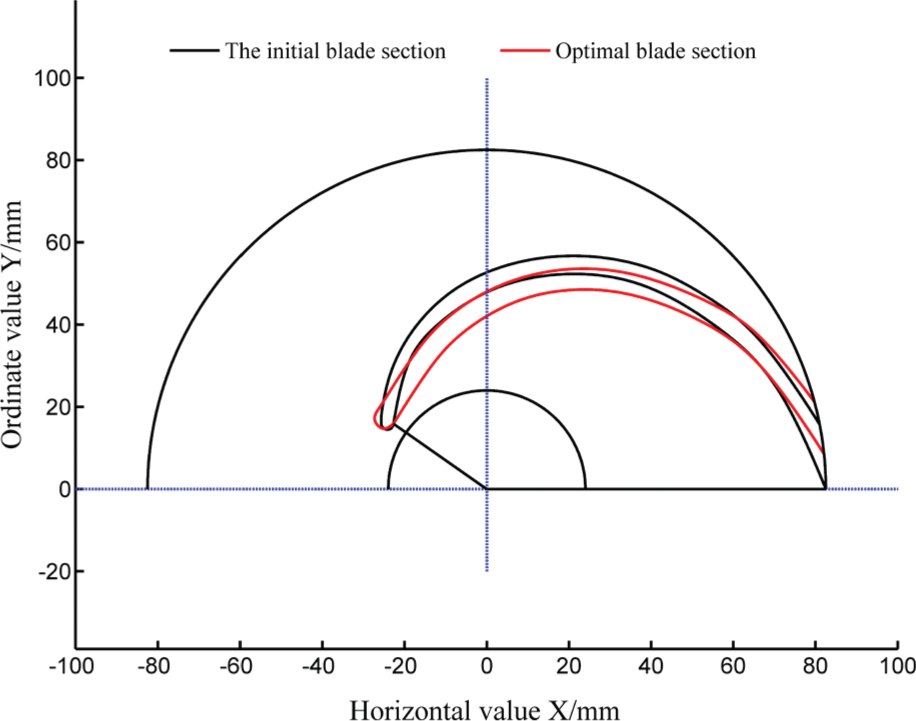
Comparison of blade pattern’s geometry between initial and optimal models.
Comparison of performance curves between initial and optimized blade profiles
In order to compare the performance between original and optimized blade profiles, the CFD numerical calculation was carried out for the original and optimized models. Table 4 shows the efficiency and head value of the PAT before and after optimization under the BEP.
Comparison of performance between initial and optimal models.

From Table 4, it can be seen that the efficiency of the optimized model increased by 2.91% in contrast to the original model. Also, the difference between the head and the initial head of the PAT is less than the specified value.
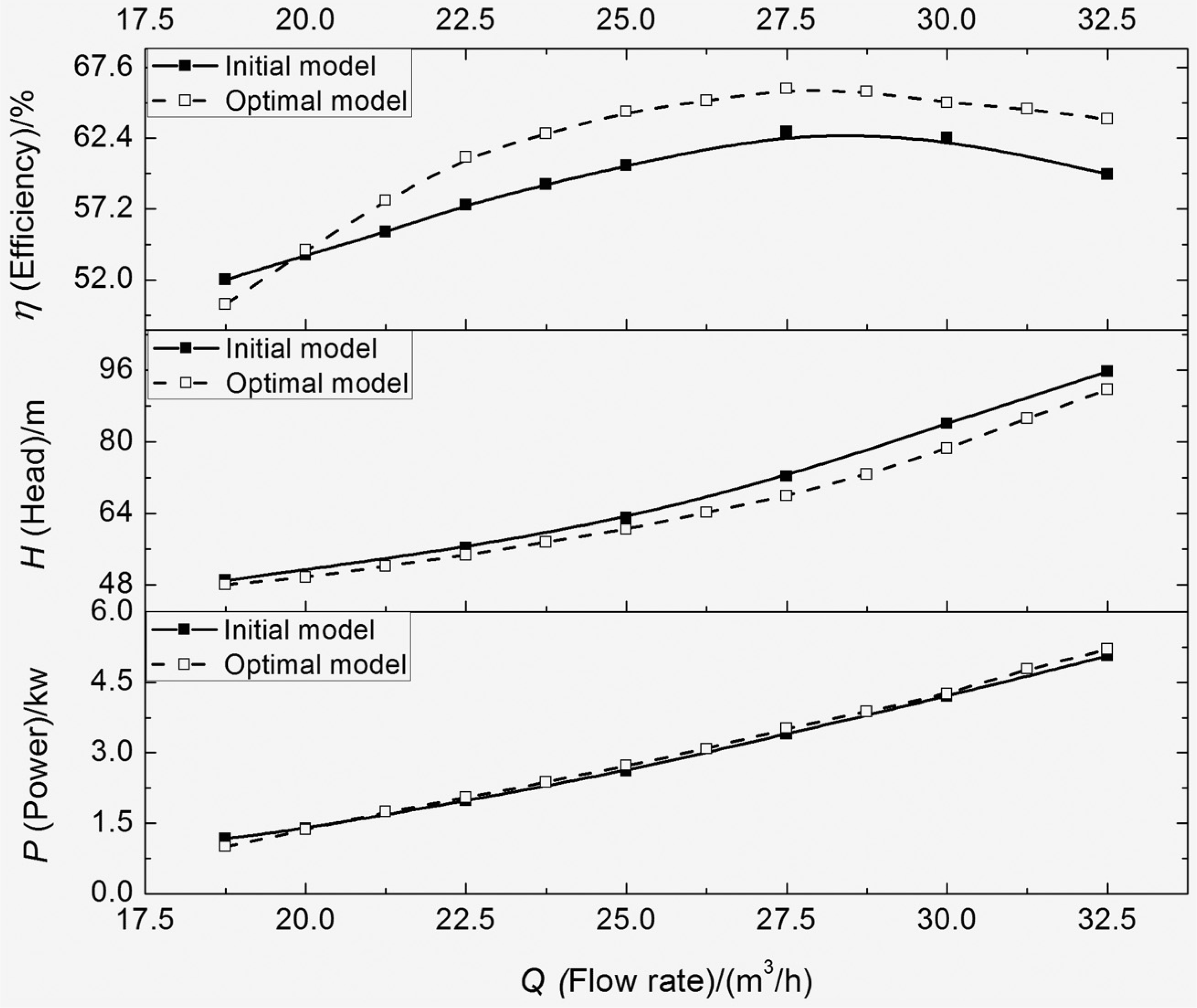
In order to study the performance of the PAT under other operating conditions, additional 11 operating points were added apart from the BEP for optimization, and numerical calculation for these 11 operating points was carried out. The results are shown in Figure 8.
Comparison of performance curves of pump as turbine between initial and optimal models.
From the performance curve in Figure 8, it can be seen that the optimized PAT not only increased in the BEP but also increased in other operating conditions except the first point; meanwhile, the head of the turbine is smaller than the initial model, but the head does not decrease sharply after optimization. The head decreases mainly due to the change in the inlet and outlet angles after optimization. It can be seen from the power curve, the power of every other point is higher than the initial model except the first working condition. Therefore, the power capability of the optimized blade has been improved. So, using the optimization method in this article is very effective, and the PAT has better ability of energy recovery.
Comparison of inner flow field and hydraulic loss between initial and optimized blade profiles
The external characteristic of the PAT is the outward manifest of the internal characteristic. In order to understand the performance difference between initial and optimal models, it is needed to analyze the inner flow field and the components’ hydraulic loss of the PAT. Turbulence intensity is the ratio of turbulence intensity fluctuated standard deviation to average velocity, which is the relative index used to value the level of turbulent. It does not have the explicit correspondence for the efficiency of the PAT, but it can value the velocity fluctuation size and characterize the flow conditions indirectly—when the turbulence intensity is lower, it means that the flow is more stable and vice versa. Figure 9 shows the turbulence intensity distribution of midsection of the PAT. From Figure 9, it can be seen that the internal turbulence intensity of the optimal model is obviously smaller than the initial model; therefore, the flow in the PAT is more stable after optimization, and the flow losses will be smaller. Figure 10 shows the hydraulic loss distribution of the every component of the PAT between initial and optimal models. From Figure 10, it can be observed that hydraulic loss in the impeller occupies the majority loss of the total hydraulic loss, and the second is the volute; the smallest is the outlet pipe. Through the optimization of blade, the hydraulic loss in the impeller decreased obviously, while the hydraulic loss in the volute and outlet pipe has a certain increase, but the total hydraulic loss decreased. Therefore, the optimized turbine has a good energy recovery ability.

Comparison of turbulence kinetic energy between (a) initial and (b) optimal models at their BEP.

Comparison of hydraulic loss of each component between initial and optimal models at the BEP.
Comparison of performance curves of pump between initial and optimized blade profiles
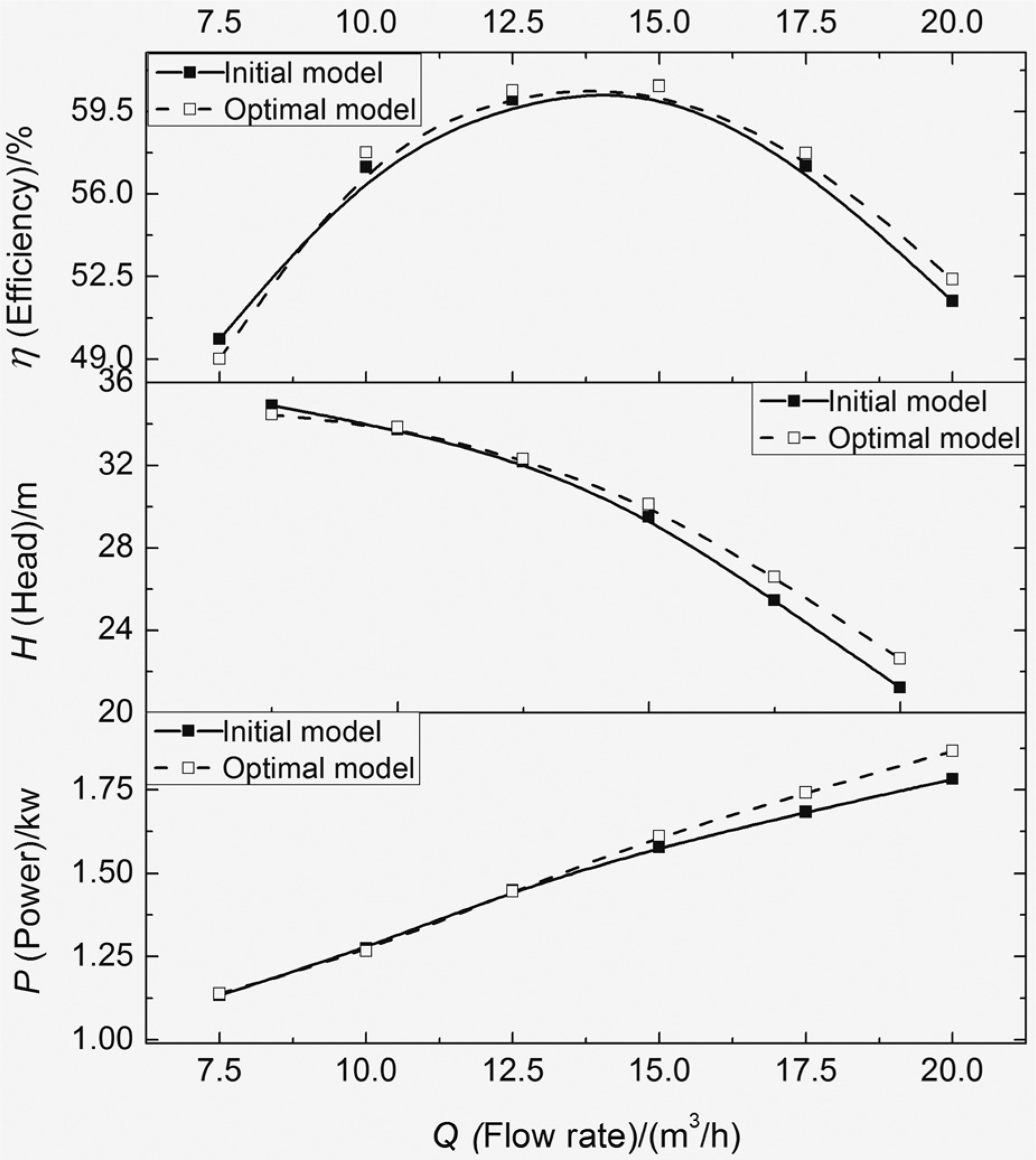
Through the above optimization, it is easy to find that the performance of the PAT has improved. However, it remains unknown whether the performance of the optimal model in the pump mode has also been improved or not. With respect to the insufficient understanding of the effects of blade profile on the pump mode, the method of numerical calculation was used to study it. The result is shown in Figure 11 after the numerical calculation.
Comparison of performance curves of pump between initial and optimal models.
As can be seen from Figure 11, the rest of the efficiency of the pump operating conditions is higher than the initial model except the first operating point. It means that the total hydraulic loss has been reduced after optimization. With the increase in the flow rate, the rate of increase in the head increases gradually. There are two reasons for the change in the head: one reason is that the total hydraulic loss between initial and optimal models is different and another is that the inlet and outlet angles of the blade are changed in the optimization process. The rate of increase in amplification of the power also increases gradually with the increase in flow rate. In short, the performance of the optimized model in the pump mode has been improved.
Conclusion
Parametric fitting of single-curvature blade profile of the PAT was carried out using the nonuniform B-spline. The results show that the fitting precision is relatively high by comparison of blade profile with the original. This method can be used for engineering optimization. Using the BP neural network as a substitute for CFD numerical calculation in the process of optimization shortens the cost of time and increases the efficiency of optimization.
Under the BEP condition, the efficiency of the PAT increased by 2.91% after optimization. And the constraint of the difference between the head and the initial head of the PAT is less than the specified value guaranteed. By optimizing, the flow in the turbine is more stable, the total hydraulic loss decreased in the PAT, and the hydraulic loss in the impeller drops more obvious. These prove that the optimization method used in this article has certain value for blade profile optimization of the PAT.
Through the optimization of the blade profile, the performance of optimal mode is not only improved in the PAT mode but also in the pump mode, so it can also serve as an important interest to pump industry, given the large market of pumps.
Footnotes
Appendix 1
Academic Editor: Hua Meng
Declaration of conflicting interests
The author(s) declared no potential conflicts of interest with respect to the research, authorship, and/or publication of this article.
Funding
This work was financially supported by the National Natural Science Fund Project of China (51169010) and Twelve-Five science and technology support program of China (2012BAA08B05).