



Abstract

Heat transfer enhancement is a significant issue in the research and industry fields. The improvement of heat transfer rates in thermal devices by adopting suitable techniques can result in significant technical advantages and cost savings. These targets could be achieved by the employment of different available techniques, divided into passive and active ones. Passive methods use special surface geometries, like rough surfaces, or fluid additives to achieve the aim of heat transfer enhancement, whereas the active techniques require external power sources, such as mechanical aids, electric or acoustic fields and surface vibration. Among the available passive methods, the employment of ribbed surfaces already covers several commercial applications, but other techniques have recently burst on the scene of engineering research, like the use of nanoparticles as additives in the working fluids in order to improve their thermal conductivity and convective heat transfer coefficients. In recent years, many attempts have been made to minimize the scales and improve the performance of devices. Traditional technologies are becoming unsuitable for heat removal from systems of small size, even of micrometric scale. For this reason, much interest is addressed to heat transfer in microchannels and porous media. The advantages of these consist of ability to produce very high heat transfer coefficients, compactness, high surface-to-volume ratios, and small coolant requirements.
The present volume is the Special Issue on “Advances in Heat Transfer Enhancement.” Due to the large interest on this topic, we hope that it will be the first of a series that periodically enables researchers to highlight their new findings related to heat transfer enhancement.
The large interest on heat transfer enhancement technologies is shown in Figure 1 which shows some recent data on the number of papers from 1993 to 2013 found in SCOPUS under “Heat Transfer Enhancement.” The aim of this Special Issue is to present the recent developments and research efforts on heat transfer enhancement, with the purpose of providing guidelines for future research in this area.
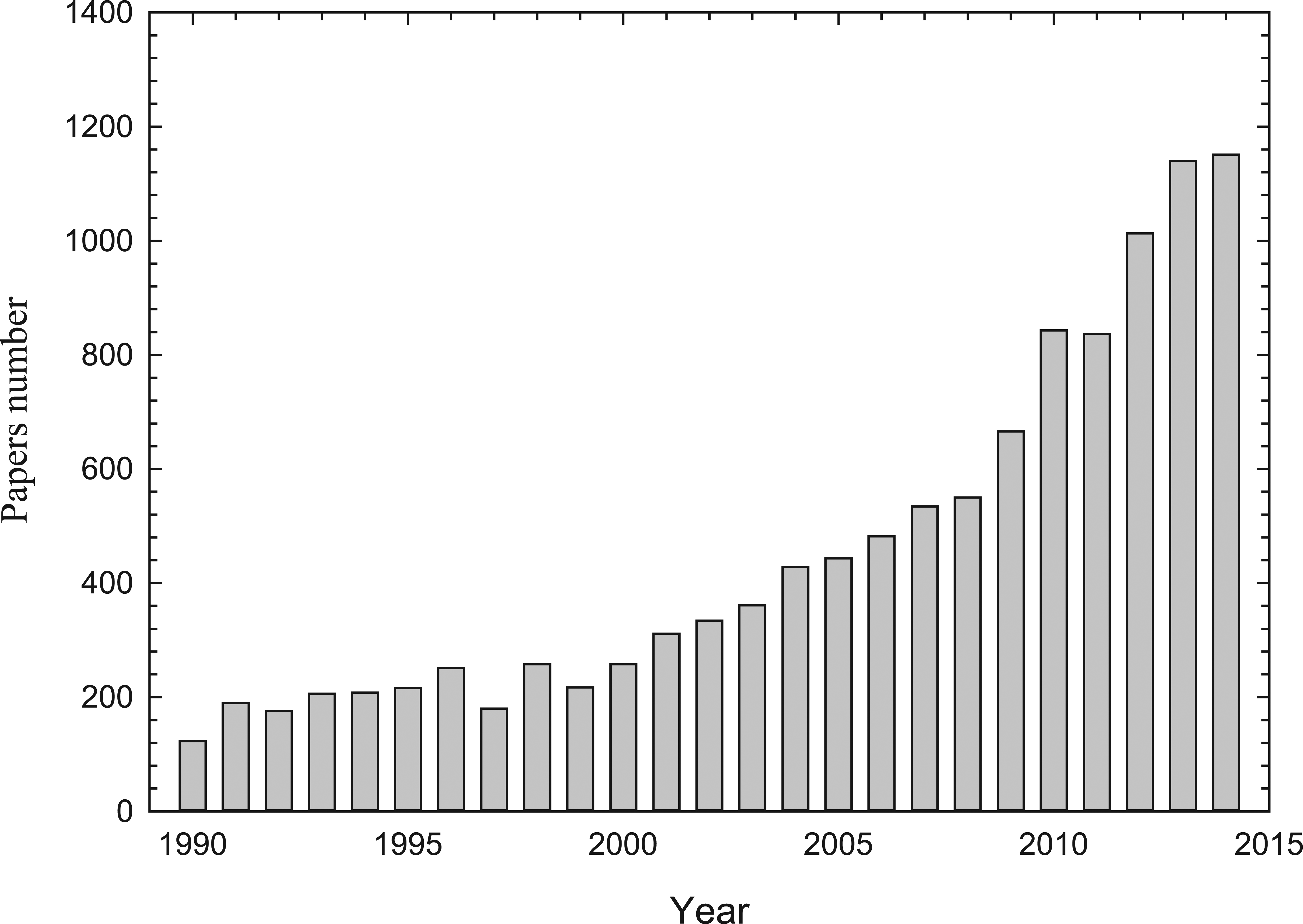
Number of papers published related to heat transfer enhancement.
The present issue includes 13 papers which deal on the more recent research activities on heat transfer enhancement. A numerical study on laminar mixed convection in nanofluids in an equilateral triangular duct, heated by a uniform and constant heat flux, is reported in Manca et al. The simulation result showed the increase of the convective heat transfer coefficients, in particular, for high concentration of nanoparticles and for increasing values of Richardson number. Qi et al. propose a novel design of a top combustion regenerative hot blast stove. A three-dimensional mathematical model has been developed to simulate the associated fluid flow, combustion and heat transfer phenomenon. Its performance was assessed and compared with traditional design using the developed numerical model. The novel design was found to be able to establish more symmetric swirling flow as well as more uniform temperature distribution within the stove and more efficient combustion processes could be obtained. Chen et al. have experimentally investigated how longitudinal vibrations and the condensation section temperatures affect the thermal performance of heat pipes with different inclined angles. The results showed that with the heat pipe placed with the condensation section on top and the evaporation section on bottom, a fairly low and constant thermal resistance was obtained, both with and without heat pipe vibration and regardless of the condensation section temperature. The effects of the nozzle spacing, height, injection pressure and comprehensive factors on the heat transfer characteristics for a new die steel quenching equipment have been numerically studied by Zhu et al. The results are useful for optimization design of the equipment and actual production process. The effects of film-cooling holes arrangement and groove depth on the heat transfer and film-cooling performance of blade tip have been numerically investigated by Tong et al. The results show that the area-averaged film-cooling effectiveness is higher when the holes distribute densely near the leading edge, and the cooling effect of the groove depth with 2.0 mm is obviously high compared with the other two depths. Abdel-Ghany et al. have developed a theoretical model to predict the absorptivity, transmissivity, reflectivity, and emissivity of plastic nets and examine the equality under natural conditions. Numerical models have been developed by Sangtarash and Shokuhmand to simulate the air flow through single dimple, simple, and dimpled louvers in low and medium Reynolds numbers. Experiments have also been conducted to measure the temperature and heat transfer of these geometries. Heat transfer augmentation of 8% has been observed by implying dimples on louver at the same mass flow rate. Yong et al. proposed a new design of thermal management system for lithium ion battery pack using thermoelectric coolers (TEC). The new battery thermal management system (BTMS) can keep a more uniform temperature distribution in the battery pack than common BTMS, which may save the expensive battery equalization system. Tabatabaeikia et al. present an overview about the early studies on the improvement of the performance of thermal systems by using different kinds of inserts. Louvered strip insert had better function in backward flow compared to forward one. In case of using various propeller types, heat transfer enhancement was dependent on higher number of blades and blade angle and lower pitch ratio. An innovative design scheme is proposed by Zhang and Liu for the sandwich panel heat exchanger where it is divided into multiple stages in the flow direction, and the two-dimensional (2D) cellular material in each stage has a specific cell size. The study shows that the maximum heat dissipation of the sandwich panel heat exchanger for a given length can be obtained through the multi-stage configuration of cellular materials with different cell sizes in the direction of flow. Onann et al. have studied a smooth tube and grooved tube in forced convection conditions to determine their heat transfer performance. A computational fluid dynamics (CFD) analysis was performed on both tube types. The evaporation at different temperatures has been also experimentally investigated. Ali et al. present an experimental investigation on forced convection heat transfer applied to a vehicles’ radiator filled with Al2O3 water nanofluid with different concentrations. Results show that heat transfer by the coolant increases as the nanofluid concentration increases up to φ = 0.01 by volume where it reaches its optimum value. An electromagnetic-controlled thermal storage (ECTS) that can be directly implemented in strategies of low-temperature waste heat recovery for energy-consuming equipment is presented by Lee. The investigation shows that the ECTS performed well in both heat charge and heat utilization, and it especially achieved an optimum efficiency of 84.46% at 700 W. The ability of magnetic nanofluid (MNF) to store thermal energy conformed it a candidate for novel applications of waste heat recovery technology.