




Abstract
The conception of sealed hard drives with helium gas mixture has been recently suggested over the current hard drives for achieving higher reliability and less position error. Therefore, it is important to understand the effects of different helium gas mixtures on the slider bearing characteristics in the head–disk interface. In this article, the helium/air and helium/argon gas mixtures are applied as the working fluids and their effects on the bearing characteristics are studied using the direct simulation Monte Carlo method. Based on direct simulation Monte Carlo simulations, the physical properties of these gas mixtures such as mean free path and dynamic viscosity are achieved and compared with those obtained from theoretical models. It is observed that both results are comparable. Using these gas mixture properties, the bearing pressure distributions are calculated under different fractions of helium with conventional molecular gas lubrication models. The outcomes reveal that the molecular gas lubrication results could have relatively good agreement with those of direct simulation Monte Carlo simulations, especially for pure air, helium, or argon gas cases. For gas mixtures, the bearing pressures predicted by molecular gas lubrication model are slightly larger than those from direct simulation Monte Carlo simulation.
Introduction
In the current hard disk drives (HDDs), air bearing sliders are used for positioning the read–write head above the target track of disk accurately for recording data. The distance between the transducer embedded in the head and the disk requires decreasing for higher recording density as small data bits on high density media demand small magnetic spacing to achieve it. At this nanoscale head–disk interface (HDI), a thin layer of air film is formed to support the head float over the disk, which constitutes a successful application of gas lubrication. Currently, HDDs are normally not sealed and filled with the air at ambient pressure. There are some corrosion and reliability issues with using air as a lubricating gas, for instance, higher corrosion tendency from harsh operation environment, and the poor positioning errors due to flow induced vibrations1,2 especially when the head–disk spacing drops below 2 nm.
Sealing the HDDs with a kind of inert gas or gas mixture is a promising way to solve these issues. Previously, Zhou et al. 3 studied the effect of various pure gases on the slider’s flying characteristics using molecular gas lubrication (MGL) model based on Boltzmann equation. They concluded that helium gas is a good candidate as a filling gas for its inert property, lower density, and higher thermal conductivity. However, due to the high cost of manufacturing helium-filled drives, using air–helium mixture instead may be a more cost-effective approach. Liu et al.4,5 investigated effects of various air–helium gas mixtures on the flying performance of a thermal flying-height control (TFC) slider. In these papers, they also used the conventional MGL equation to solve the mixed gas bearing problems with the physical properties of gas mixtures obtained from the theoretical models. Although their efforts to understand the slider’s bearing characteristics under gas mixture conditions are commendable, the applicability of the conventional MGL models in solving such problems still needs to be verified. Besides, there is a necessity to examine the accuracy of traditional theoretical models in predicting the physical properties of gas mixtures. Therefore, we propose to use the direct simulation Monte Carlo (DSMC) method to address these issues.
The DSMC method is a promising tool for micro and nano flow simulations, and it has been validated for computing the gas flow in the air bearing interface by Alexander et al. 6 Previously, there were also some DSMC simulation studies relating with the slider posture effect 7 and heat transfer effect 8 on the air bearing characteristics. However, in these previous publications, pure argon gas was used as a working medium due to the simple monoatomic molecule structure and the ease for calculation. In this article, we use air–helium and argon–helium gas mixtures as the medium and investigate the effects of different gas mixtures on the bearing performances of the slider with the DSMC method. After comparing DSMC results with those calculated by conventional MGL model, we could validate the applicability of MGL model in solving the mixed gas bearing problems.
Numerical methods and models
DSMC method
The DSMC method is a stochastic particle-based technique and a promising tool for highly rarefied gas flow simulations. In the DSMC method, there is no assumption made on the fluid as a continuous medium and continuously distributed variables in simulations. The DSMC algorithm consists of two stages of flow particle evolutions such as movement and collision for each simulation time step. The maximum allowable time step in the simulation must be smaller than the local mean-free time which represents the mean time between succeeding collisions of particles.
In DSMC simulations, the slider air bearing problem is simplified as a two-dimensional, micro-channel flow with a stationary, slightly inclined surface (slider) above a horizontal plane (disk) moving in the x-direction with the tangential velocity Ub as a spinning disk. The simulation model could be set as the two-dimensional layout by assuming that the channel width is extremely larger than the channel height and the flow changes in that direction are negligible. The model geometry of the air bearing slider and disk for the simulations is shown in Figure 1. In this article, this simplified geometry setup is applied in DSMC simulations as our focus is on the physical understanding of the gas mixture effect in the HDI region. At the inflow and outflow boundaries of the interface, a constant ambient temperature of T 0 = 293 K and a pressure of P 0 = 1 atm are placed with the number density of 2.6883 × 1025 m−3 in the flow stream. Both the wall surfaces are assumed fully accommodated and set with diffuse reflection models. The surface temperatures of walls are set as 293 K. The velocity of bottom surface (Ub ) is set at 30 m/s and the flow length (L) is 5 μm. The flow inlet (Hi ) and outlet spacing (Ho ) are 55 and 5 nm, respectively, for all the simulations. Therefore, the Knudsen number, which is defined as the ratio of mean free path of gas or gas mixture (λ) to the outlet spacing (Ho ), will be well beyond the continuum region and the flow becomes highly rarefied.
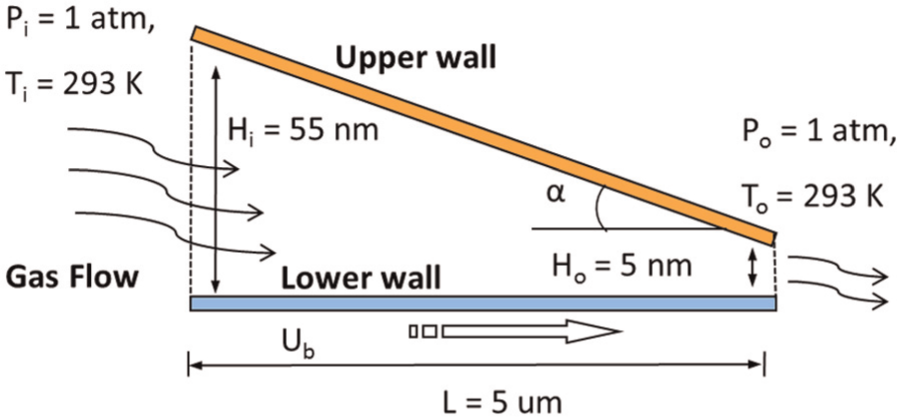
The geometry used in DSMC method representing the slider air bearing in head and disk interface.
The DSMC physical simulation space in our study is divided into 1147 × 21 sampling cells in all cases. Each cell consists of 10 × 10 subcells. The cell size in x-direction is about 4 nm. Therefore, the mean free path to cell size ratio is adequate even if it is the ideal air case which has about 48.6 nm of stream mean free path. The average number of molecules in the whole simulation domain of all cases is about 1.5 million, and the number of molecules per cell is more than 60 which is much more than sufficient number of molecules per cell (>20). In all DSMC cases, the inlet and outlet mean flow velocities are predicted and modified in line with the conservation of flux of molecules passing through the boundaries at one time interval in order to maintain the constant ambient pressure at boundaries. The treatments of boundary conditions of inlet and outlet flows in our DSMC simulations are similar to those applied in Liu and Ng’s 7 paper.
There are four gas species such as argon, helium, oxygen, and nitrogen used in the simulations for different mixed gas simulation studies. The air is designed with only ideal oxygen (21.5%) and ideal nitrogen (78.5%) for simplification of real air and ease of calculation. The simulation assumes variable hard sphere (VHS) particles with the reference diameters of argon, d arg = 4.17 × 10⁻¹⁰ m, helium, d he = 2.33 × 10⁻¹⁰ m, oxygen, d oxy = 4.07 × 10⁻¹⁰ m, and nitrogen, d ni = 4.17 × 10⁻¹⁰ m. Both ideal oxygen and nitrogen gas molecules have two rotational degrees of freedom. The viscosity–temperature exponent of argon, helium, oxygen, and nitrogen are set as 0.81, 0.66, 0.77, and 0.74, respectively. 9 The fractions of species in the flow stream are set accordingly with the percentages of gases in the mixture. The average time step in the following case studies is about 3.35 × 10⁻¹² s.
After conducting DSMC simulations, the mean free path of gas mixture is directly achieved from the results in flow field, but the dynamic viscosity requires to be calculated from the mean free path, gas density, and thermal speed using kinetic theory. The mean free path and dynamic viscosity of gas mixture in each case are obtained by averaging those values at all the cells within the flow domain.
Models for physical properties of gas mixtures
In the present DSMC simulations, the mean free path for a species x molecule is equal to its mean thermal speed

and the mean free path for the gas mixture is

where α is the fraction of gas x and
The dynamic viscosity of gas mixture in DSMC simulations is calculated by using the following expression based on kinetic theory 10

where
The physical properties of mixed gas can also be calculated by using some theoretical models. For example, the mean free path of a gas mixture can be obtained by the following equation 9

where dx
is the diameter of gas molecule x, dy
is the diameter of gas molecule y,
The dynamic viscosity of gas mixture can be theoretically calculated according to Reichenberg’s method, which can be written as

with



where
Simulation results and discussions
The physical gas properties such as mean free path and viscosity of gas mixture are very important for determining nanoscale bearing characteristics under the gas mixture conditions. These properties can be obtained from DSMC simulations or simply some theoretical models as introduced in section “Models for physical properties of gas mixtures.” To examine the accuracy of theoretical models in predicting the physical properties of gas mixtures, we compare mean free path and dynamic viscosity from the theoretical models with those from the DSMC method against various fractions of helium in the air–helium mixture. The results are shown in Figures 2 and 3. We can see that mean free path of the gas mixture increases more than 200% as the fraction of helium in the gas mixture α varies from 0 to 1. The values predicted by the theoretical model and DSMC simulations show good agreement with each other. As for dynamic viscosity, it will increase till α = 0.8 where it starts to drop. The results given by Reichenberg’s method compare well with those from DSMC simulations with relative error less than 5%. Therefore, we can conclude that theoretical models can provide relatively accurate prediction of mean free path and dynamic viscosity for the gas mixtures.
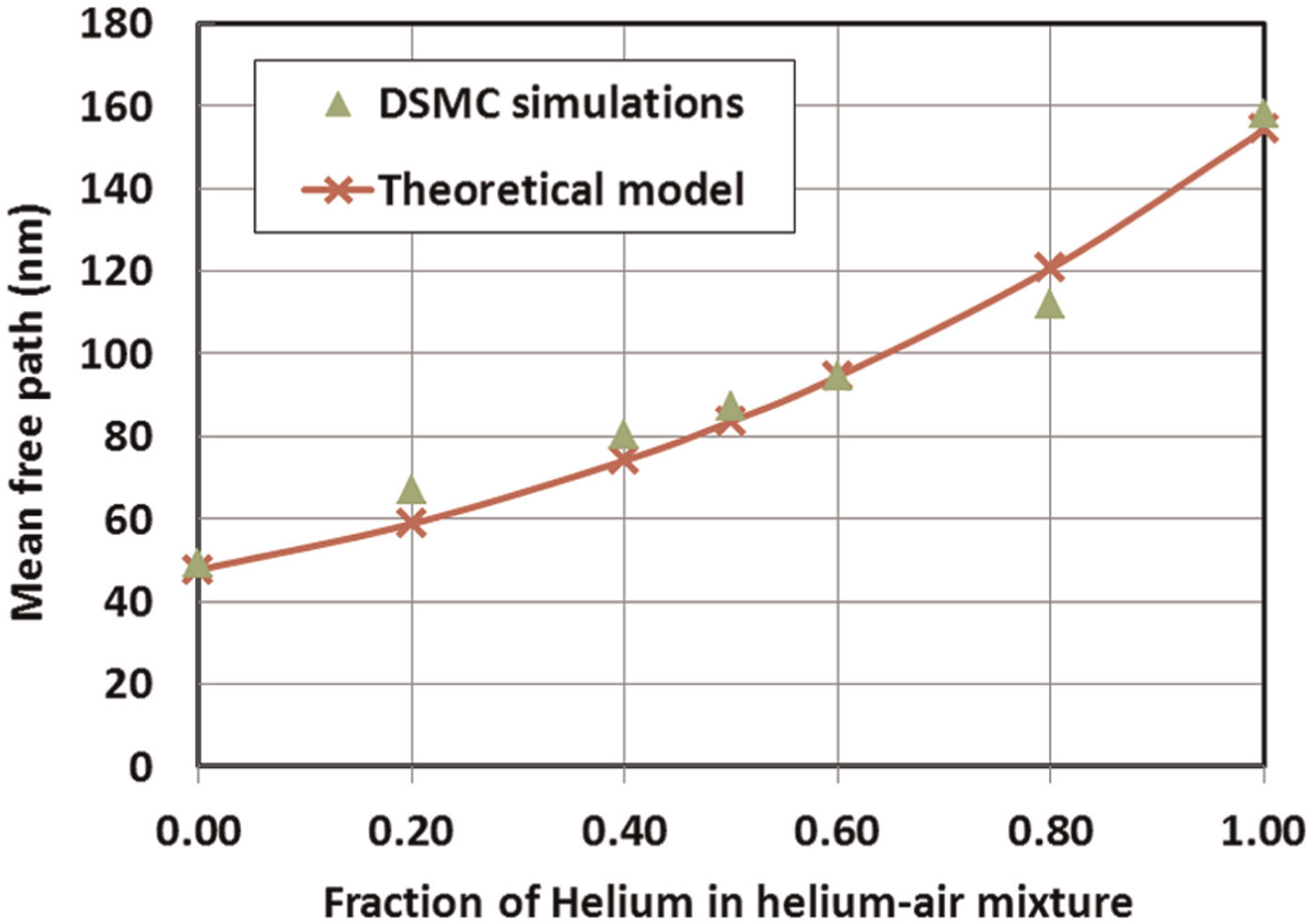
The comparison of the mean free path resulting from theoretical model and DSMC method with different fractions of helium in helium–air mixture.

The comparison of the viscosity coefficient resulting from Reichenberg’s model and DSMC method with different fractions of helium in helium–air mixture.
After obtaining the mean free path and dynamic viscosity for the gas mixtures with DSMC method, these parameter values are applied into the conventional MGL equation to calculate the bearing pressures under different gas mixture conditions. Then, we can compare the results with the pressure outcomes from DSMC simulations to validate the applicability of conventional MGL model in solving mixed gas bearing problems.
The conventional MGL equation, which has been included in our in-house air bearing design software, ABSolution, 3 is normally written as

where P is the normalized pressure by the ambient pressure, H is the normalized gap spacing between the slider and disk,
Figure 4 compares the pressure distributions on the upper wall against the x-direction with MGL model and DSMC method for pure air at outlet spacing of 1, 3, and 5 nm, respectively. This is to examine whether MGL model is applicable in solving practical air bearing problem when the minimum spacing of the current HDI is only about 1–2 nm. The comparison results are quite promising. A good agreement between two methods is observed at various outlet spacing, which verifies the applicability of MGL model in solving real air bearing problem.

The comparison of pressure distributions on the upper wall against the x-direction with MGL model and DSMC method for 100% air at different outlet spacing. The solid lines represent the pressure distributions resulted from MGL model at the respective gap spacing.
Figure 5 compares the pressure distributions on the upper wall against the x-direction with MGL model and DSMC method for 100% of helium, 100% of air and 50% helium and 50% air. The outlet spacing is set at 5 nm instead of 1 nm to save DSMC computing time. A relatively good agreement between two methods is found especially for pure gas cases. For the air/helium gas mixtures, there are some slight deviations in 50% helium and 50% air mixture between using DSMC method and MGL model. This is probably because the mole fraction of helium in the gas mixture actually fluctuates in the DSMC’s computation domain, but in MGL model, it is assumed as a constant anywhere in the gas bearing interface. As for the helium/argon mixture cases, the pressure results of both methods are also comparable as shown in Figure 6. However, DSMC results deviate slightly from those of the MGL equation for impure gas cases.

The comparison of pressure distributions on the upper wall against the x-direction with MGL model and DSMC method for 100% of helium, 100% of air and 50% helium and 50% air. The solid lines represent the pressure distributions resulted from MGL model at the respective gas or gas mixture.
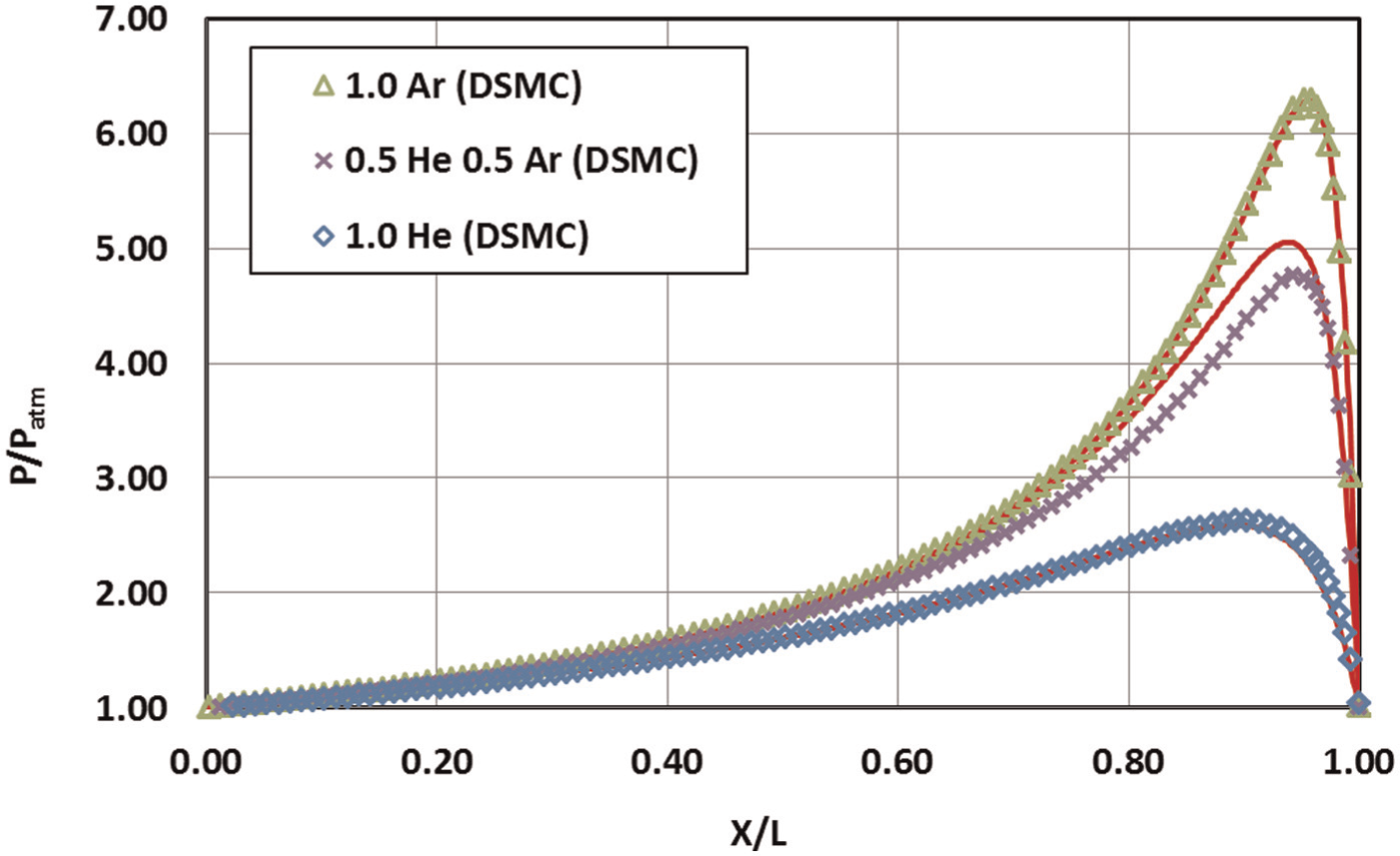
The comparison of pressure distributions on the upper wall against the x-direction with MGL model and DSMC method for 100% of helium, 100% of argon and 50% helium and 50% argon. The solid lines represent the pressure distributions resulted from MGL model at the respective gas or gas mixture.
Furthermore, it is found that when the mole fraction of helium in the air–helium gas mixture increases, the pressure acting upon the upper wall decreases noticeably as shown in Figure 7. In other words, the peak pressure rises up when the fraction of air gas increases in the gas mixture. The same behavior of bearing pressure increments is noted for the argon–helium gas mixture as shown in Figure 8. This is because the mean free path of helium is much longer than those of air and argon. So, the interactions of helium molecules with the upper wall will be much less than those of air and argon molecules, which results in the pressure decrement as the helium percentage in the gas mixture increases. On the other hand, it is also observed that the position of peak pressure shifts toward the flow outlet side with the increment of air or argon percentage, as indicated in Figures 7 and 8, respectively.

The comparison of pressure distributions on the upper wall against the x-direction with DSMC method for different fractions of helium in helium–air gas mixture.

The comparison of pressure distributions on the upper wall against the x-direction with DSMC method for different fractions of helium in helium–argon gas mixture.
Once the pressure distribution on the top wall surface is obtained, we can use the following equation to calculate the total bearing force on this surface

where p and po are gas bearing pressure and ambient pressure, respectively, and S is the small area of the top wall surface.
The total bearing forces acted on the upper wall for different fractions of helium gas in air–helium gas mixture are shown in Figure 9. We can see that the force exerting on the upper wall decreases monotonically as the fraction of helium in the gas mixture increases. This is due to relatively lower pressure distribution on the upper wall when the fraction of helium in the mixture is higher.

The bearing forces acted on the upper wall for different fractions of helium in helium–air gas mixtures using the DSMC method.
Conclusion
In this article, we perform the simulation studies and analysis to understand the effects of helium/air and helium/argon gas mixtures on the bearing performances using the DSMC method. Based on DSMC simulations, the values of some important physical parameters for certain gas mixture, such as the mean free path and dynamic viscosity, can be obtained accordingly. These outcomes are compared with those from some theoretical models and show good agreement. Using these physical property values in the MGL model, the bearing pressure and force are obtained and compared with those from DSMC simulations. Through the case studies, we observe that the results achieved from DSMC method and MGL model are comparable. Therefore, we conclude that conventional MGL models are applicable in solving mixed gas bearing problems, especially for full percentage of certain gas specie. However, it is worth to note that as for some gas mixture cases, MGL model will predict slightly higher pressure than that from DSMC method.
Footnotes
Academic Editor: Ruey-Jen Yang
Declaration of conflicting interests
The authors declare that there is no conflict of interest.
Funding
This research received no specific grant from any funding agency in the public, commercial, or not-for-profit sectors.