




Abstract
The inverter control strategy is the key to pump energy-saving operation and should be established based on the current system configurations and system requirements, which is not the case in practice. As a result, the characteristics of pump system requirements and a combination pump with inverter were studied, and the mathematical models were established. A new model for an optimal inverter control strategy based on the current system configurations and system requirements was then established, and a method combining golden section search and genetic algorithm was formulated to solve this optimal model. This model sets up an optimal inverter control strategy to increase the efficiency of pump operation following a process line near the minimum requirements to improve operation conditions. The implementation difficulty of the control law was also reduced. Finally, the optimized model was applied to an industrial circulating pump system, and the result showed that the model can not only determine the optimal inverter control strategy but also evaluate the current operation situation of the pump configuration and determine the energy-saving potential for the current configuration, which can aid in the subsequent energy-saving reconstruction.
Keywords
Introduction
Pumps are widely used in industrial and service sector applications. Pumps consume approximately 10%−40% of electricity in these sectors.1,2 Pumping systems are found to have a significant potential for energy efficiency improvements; using inverters in pumping applications, variable speed pumping has been shown to be effective in reducing total pumping costs, particularly in systems that require a wide range.3–8
Despite being capable of adjusting the rotation speed of the pump, an inverter cannot achieve energy savings directly. Energy saving can only be achieved through the optimal operation control strategy.5,6,9,10 Energy-saving efforts are affected by the optimization degree of the control strategy and the equipment configuration.9–11 As a result, the pump system should possess an established inverter control law for energy-saving operations.
The variable pressure control law12–15 which followed the system characteristics could achieve the minimum supply for system requirements without throttle loss. However, the present pump configuration tends to promote the practice of sizing pumps conservatively to ensure safety margins for the process, which could cause the pump to operate under low efficiency. This practice results in low operating efficiency and high maintenance costs with high noise. Second, due to the high price of the inverter, not all pumps are equipped with this device, and thus, the adjustment capability of a pump system may be insufficient to enable the pump to operate within the minimum requirements.
The constant pressure control law which keeps the pressure of pump outlet constant through the inverter is the most common control law for pump systems. This approach is easy to implement with closed-loop control. However, the constant pressure mode would cause pressure loss which means energy wastage when operating under small flow requirement, and the pump efficiency is still not considered in actual operation.
Thus, the inverter control strategy should be established based on the current pump system configurations to achieve a supply that is close to minimum system requirements to save energy, as well as to enable the pump to operate in an efficient operation area considering the pump configuration with less switching frequency to prevent difficulty in implementation. However, there are few studies about that, especially lack of the establish methods of the inverter control strategy.
In this work, a new model was established to achieve an optimal inverter control strategy based on the current system configurations and system requirements. This optimal inverter control strategy enables pump operation in an efficient area following a process line near the minimum requirements threshold to improve operation conditions. The difficulty of implementing the control law was also reduced.
Mathematical model of the efficient operation area for pump group
A pump should be operated predominantly close to the best efficiency point in the “preferred operation range.” This mode of operation facilitates the lowest energy and maintenance cost and reduces the risk of system problems because of hydraulic excitation forces and cavitation risk, as shown in Figure 1. Rules are thus needed to define the allowable ranges and modes of operation to reduce the risk of damage and excessive wear.
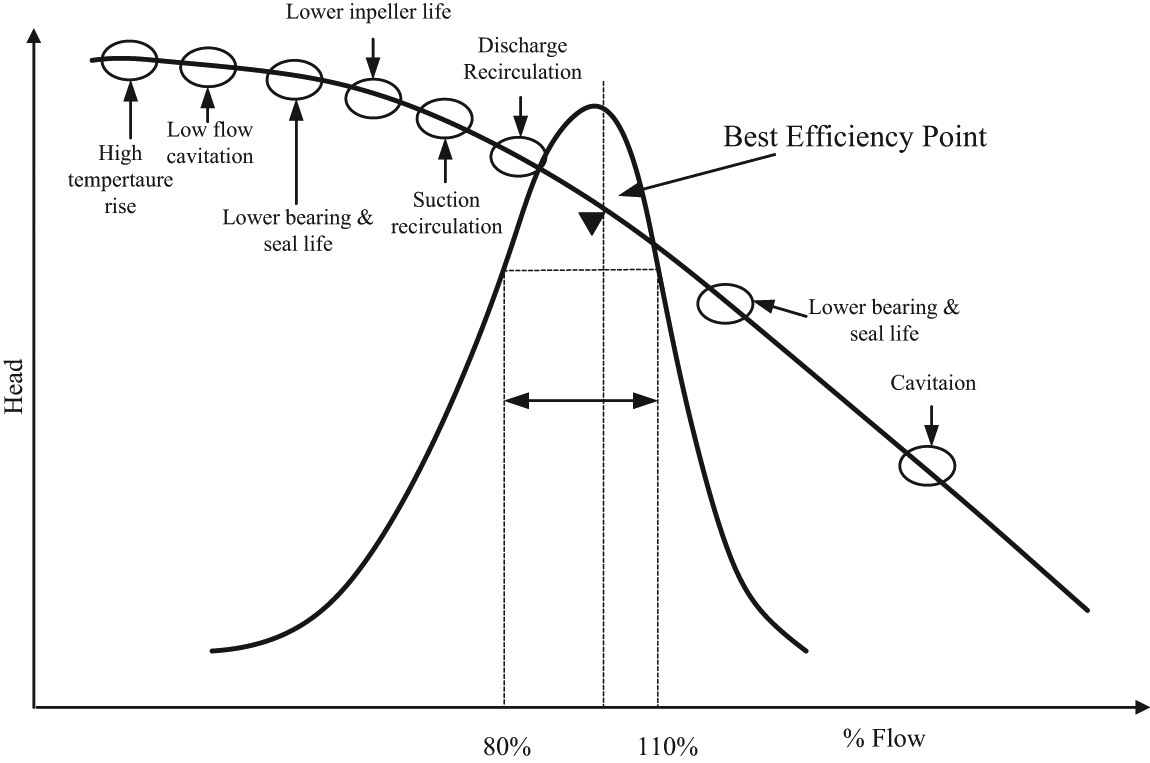
Adverse effects of operating away from the BEP.
Single-pump model
The range of the preferred continuous operation can be defined according to some criteria; for instance, based on the requirement that the efficiency must not fall below 80%−85% of the maximum efficiency of the pump in question. The allowable ranges can be defined by the efficiency must not fall below 70% of the maximum efficiency.
Considering the general centrifugal pump, the Q–H characteristics can be expressed as follows

Thus, the preferred operation range can also be expressed as a curve section

In this interval, with the head H e, the flow range can be recorded as

With the flow Q e, the head range can be recorded as

When the pump is operated by an inverter, the range of speed regulation should be constrained. With an excessive speed range, operation efficiency and reliability will decrease. Thus, considering the factors of operation, the speed regulation range is constrained. The preferred operation range can be expressed as shown in Figure 2.
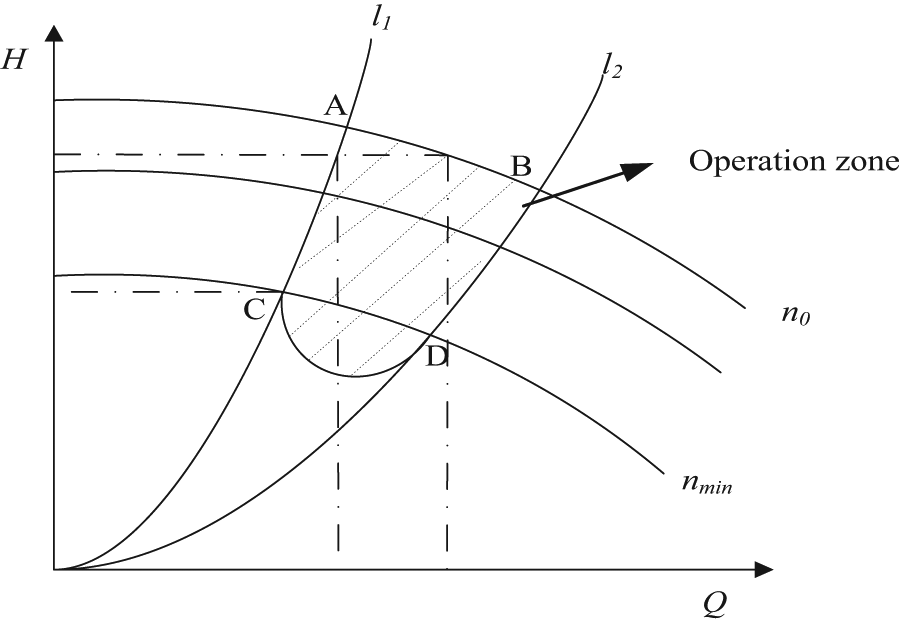
Efficient operation area for the variable speed pump.
According to the affinity law in pump theory, l 1 and l 2 are set as similar lines in Figure 2. A, B, C, and D are the boundaries of the operation zone, and l 1 and l 2 can be expressed as

When the head H e is needed for this water supply system, the boundary can change as
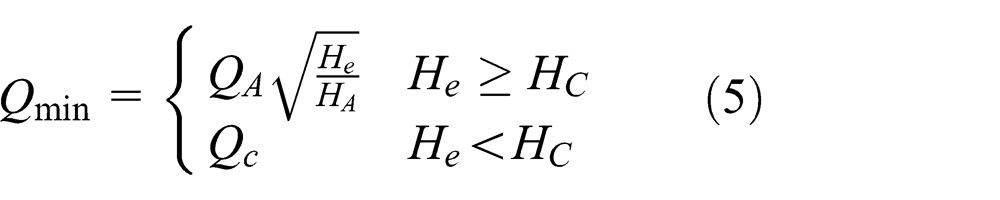
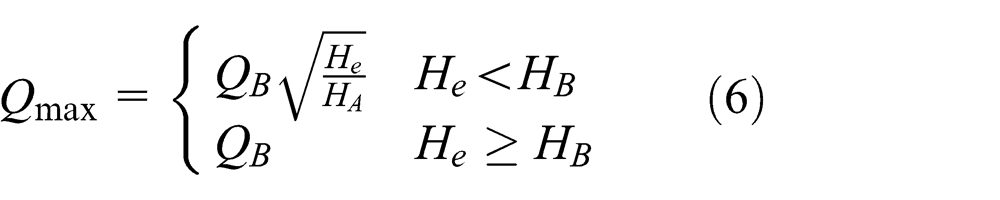
When Q e is needed for this water supply system, the boundary can change as


Parallel operation pump group model
The advantages of multiple pump parallel combinations are flexibility, redundancy, and the capability to meet changing flow needs efficiently in systems. In particular, adjustable speed drive tends to be more efficient solutions to variable demand requirements. As a result, the configuration equipped with an inverter is common in engineering practice.
The operation point of each pump is derived from the intersection of the system characteristic with the combined characteristics of all pumps in operation. In parallel operation, each unit has to pump against the same pressure difference imposed by the system. Thus, the combined characteristic of the pumps is obtained by adding the flow rates of all operating pumps at constant head. This method can also be used for the operation area by adding each single-pump operation area in a head, as shown in Figure 3.

Efficient area of a parallel operation pump group with single inverter.
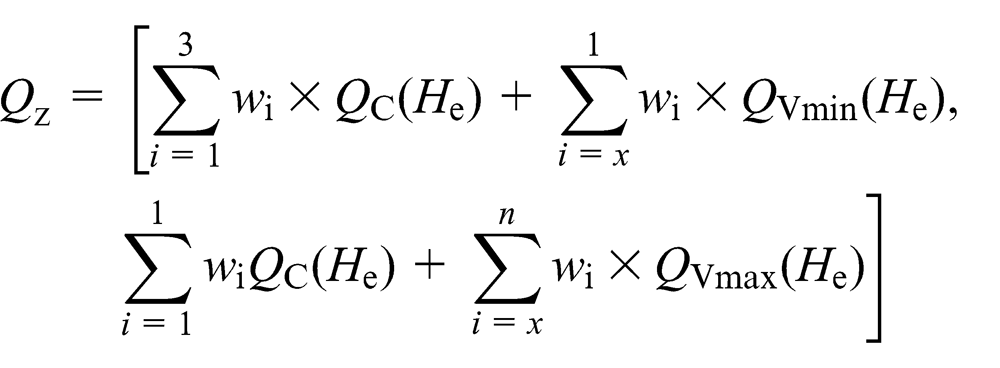
The mathematical model can be shown as follows:
When the head H e is needed for the water supply system, the boundary can be changed according to equations (5) and (6)

where n is the number of pumps, x expresses the constant speed operation pump, i denotes the ith pump, k is the kth type of pump, and w i is the switch vector. In the configuration of the ith pump selection, if the pump is in operation, we use 1; otherwise, the value is 0.
Mathematical model of the operation demand area for a pump system with inverter
A pump system with inverter configuration has strong regulating capability. With increasing speed of the regulating device, the capability of the pump system will be enhanced. A pump system with inverter is likely to be capable of operating at the least demand line, which requires almost no additional energy consumption during regulation. The least demand line is the ideal method for energy saving. The least demand line is often equal to the system characteristic of no throttle loss.
However, not all pump systems with inverter can achieve such ideal conditions. Thus, a pump system cannot supply sufficient energy to support normal system operation if operating at the minimum requirements. As a result, the constant pressure water mode is widely used for its high reliability and easy implementation. Although its energy-saving effect was unremarkable, this application is the bottom line of variable frequency speed control technology for energy saving.
The operation demand area can be represented as a shadow area, as shown in Figure 3. The red line is needed for the constant pressure water supply mode control, which can be expressed as H = H Dmax. The blue curve is the minimum requirement process control line, which can be expressed as H = H st + KQ 2.
The demand area in shadow can be expressed as follows:
To implement the optimal operation strategy successfully, the high efficiency area of the candidate pump should cover the shadow area in the design flow section, as shown in Figure 4. The pump can then be operated to achieve the desired water supply.
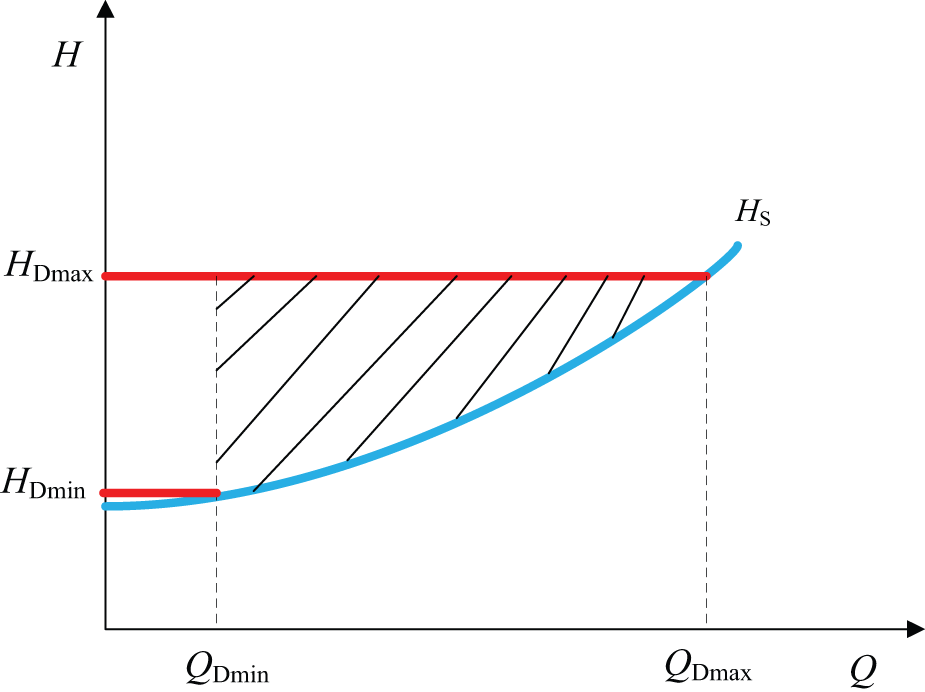
Operation area of the pump system with inverter.
As shown in Figure 5, this relationship can be expressed as follows:
For every flow requirement Q e, the supply boundary can be expressed as


Feasibility relationship between the regional configuration scheme and regional demand.
A static head is an uncommon system characteristic, but some special cases, such as water intake pumping stations, exist. H s2 refers to the system characteristic curve with the minimum design water-level difference, whereas H s1 denotes the system characteristic curve with the maximum design water-level difference. The operating control line within the range of the pump system can almost guarantee that the system will work normally. The minimum system requirements are shown in Figure 6.
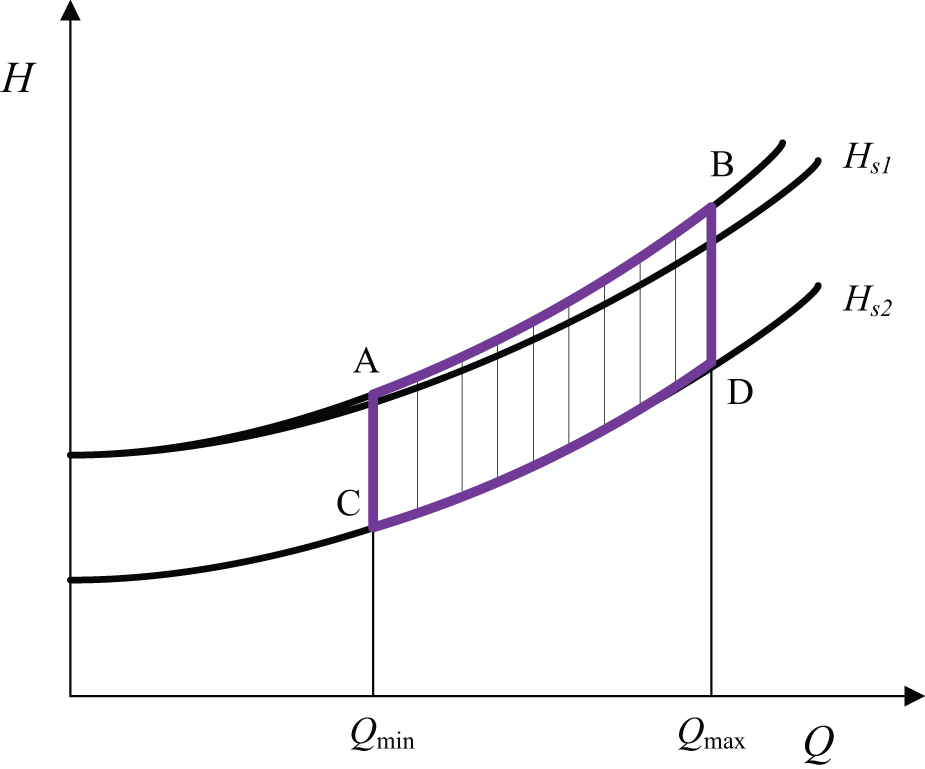
Minimum system requirements with static head change.
Changes in the static head enable the system to meet the demand of water supply successfully. The supply boundary also changes according to equation (10). The pump can then operate at the maximum demand zone, as shown in Figure 7.

Maximum system requirements with static head changed.
This relationship can be expressed as follows

where the H s1 curve is expressed as H s1 = H st1 + KQ 2 and the H s2 curve is expressed as H s2 = H st2 + KQ 2; x expresses the dynamic static head.
Optimized condition selection model
Modeling theoretical basis and model composition
On one hand, the optimization operation principle is to enable the system to operate under different conditions in a highly efficient operation state. On the other hand, the principle is aimed at reducing the energy consumption during regulation, that is, the pump operation control process line should be as close as possible to the minimum requirement line. This condition requires the intersection of the pump high efficient area and the minimum requirement line. Thus, the inverter control law should enable the system to meet the requirements under the high efficient area of the pump.
As shown in Figure 8, the efficient operation area and operation demand area were calculated according to the configuration system and operation characteristics. The optional operating area was then selected to achieve energy-saving and reliable operation.
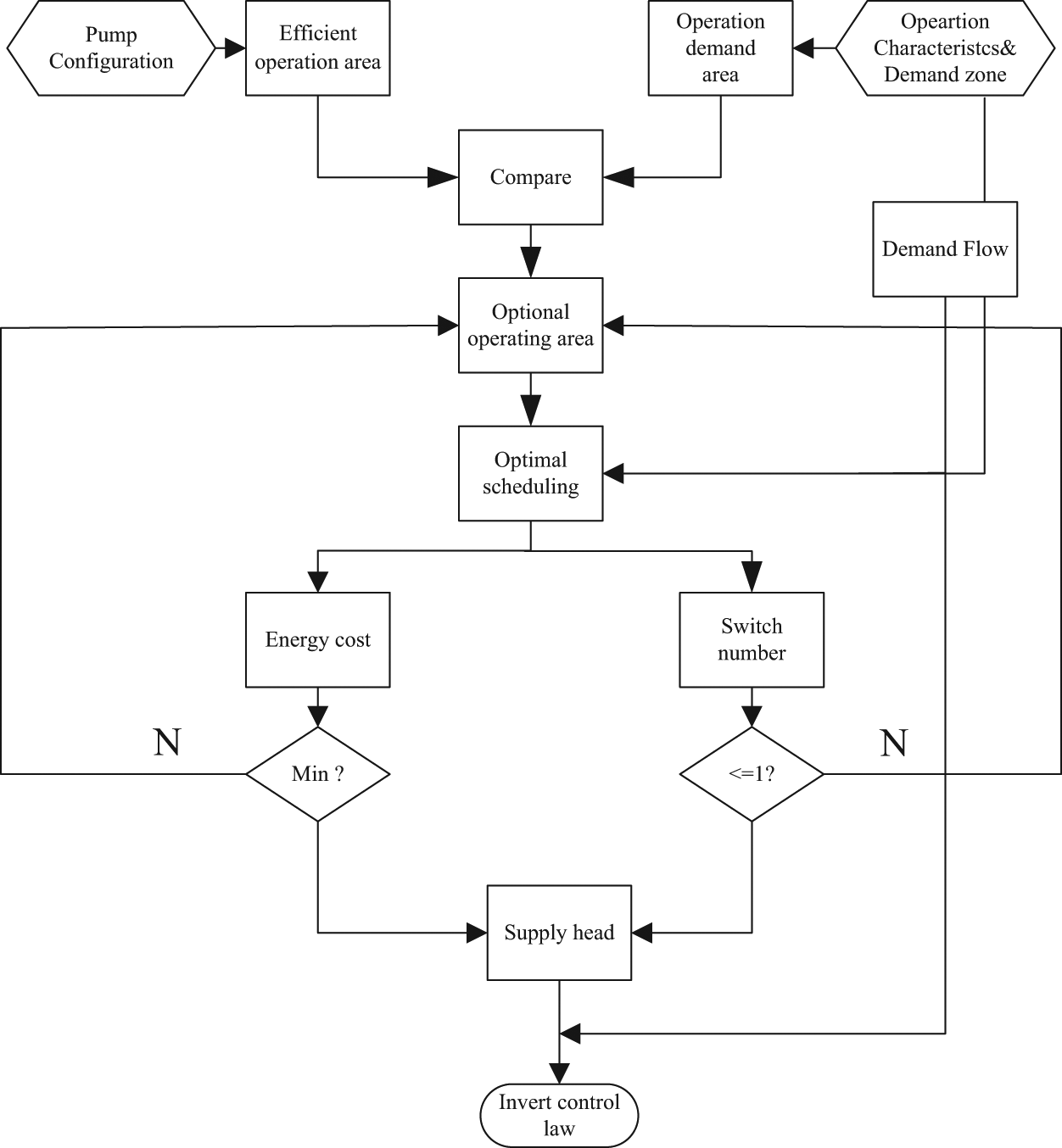
Modeling progress.
Finally, an optimization model was used for optimization selection from the optional operating area based on the energy cost and switch number. The inverter control law was established through the implementation of this process from the maximum to the minimum required flow.
Optimized condition selection mathematical model
Optional operating area calculation model
From the energy-saving and reliable operation perspectives, the optional operation area should meet the following criteria:
Optional operating area must meet the system requirements and ensure that the pump can supply enough head for each required flow point.
Optional operating area should cover the preferred operation range. This mode of operation is suitable to bring about the lowest energy and maintenance cost. If the preferred operation range is unsuitable for the current requirement, then the allowable operation range should be chosen as the main optional area.
Optional operating area should consider the following factors: the difficulty in starting up the pumps, the significant increase in frequency during switching, and the fact that maintenance cost increases as the number of “pump switches” increases.
The optional operation area can be calculated based on these criteria:
Step 1. Determine the flow demand Q
e and the current switch conditions
Step 2. According to the flow demand Q e, the model calculates the available area based on the requirement characteristics, as shown in equations (10) and (11). Finally, the available area H R can be calculated.
Step 3. According to a certain optimization rules, H ei is chosen from H R. The model then calculates the efficient operation area for pump group Q zi and the switch conditions based on equation (9), such that numerous schemes are created.
Step 4. According to the flow demand Q e, the model ensures that the scheme is available. The available switch conditions and the variable control switch schemes suggest that the variable speed pump selection can be expressed as k ij, where 1 indicates that the pump is in operation, and k ij indicates that the jth pump is selected as the variable speed pump.
Step 5. We classify the available state in accordance with the number of pump switches. A value less than 2 is preferred.
The number of pump switches can be expressed as

where I is the number of pumps, wi
is the operating status of pump i for the next step,
Finally, for every H ei ∈ H R, some switch control scheme wij and variable control switch schemes k ij are available.
Optimal evaluation model
Based on the current switch conditions, a lower switch number yields more preferable results. For Q z, the switch conditions are used as inputs by the optimal evaluation model to calculate the current power consumed to prepare for the optimal selection.
Evaluation objective function
In a typical pumping system, an inverter control law focuses on the effect of energy savings. The evaluation objective is the energy consumption of the pump unit. 16
The commonly used model considers the shaft horsepower of the pumps as objective function because the energy consumption of the motor and inverter is significantly less than that of the pump. The objective function can be mathematically expressed as

where f1 is the total shaft horsepower to be minimized; I is number of pumps; and Qi and ki are the discharge flow and pressure head, respectively, of pump i under certain operating conditions. Pi is the shaft horsepower of pump i under this condition, which can be expressed as equation (14) according to the characteristic of the pump and the affinity law. pi is the conversion coefficient

Constraints
To meet some of the water supply requirements for the pump system, 17 the desired water supply index, which is known for the pump system, can be expressed as (H ST, Q e) in a mathematical model. For parallel-connected pump systems, the constraints can be expressed as


For every H i ∈ H R, the switch control scheme wij and variable control switch scheme were used as input in this model. The minimum shaft horsepower of the pumps for every scheme can then be calculated.
Model solution method
The golden section search method was adapted to optimize the supply head. 20 The golden section search is a technique for finding the extreme (minimum or maximum) of a strict function by successively narrowing the range of values inside which the extreme is known to exist. The technique derives its name from the fact that the algorithm maintains the function values for triples of points whose distances form a golden ratio.
In this optimization process, the available area HR was selected as the optimization interval. The minimum shaft horsepower in the selected supply operation point was selected as the objective function value. Thus, in either case, we can construct a narrower search interval that is guaranteed to contain the function minimum to achieve the head optimization selection. The genetic algorithm was selected as the optimization method for the minimum shaft horsepower at the selected supply operation point because of its suitable characteristics for adaptability to complex optimization problems.18,19
In this optimization problem, the single-objective approach developed by Mackle was adopted for its simplicity. The fitness function consists of the energy consumption cost and penalties for the constraints of the system. All these factors were linearly weighted.
Application
Profiles of the pump station
A sample model is a circulating water pumping station, one of the most important facilities in an alumina plant used for the mother liquor evaporation process. Four same-model pumps with single-stage and double-suction combined parallel were initially used in the pumping system. The pump model is shown in Table 1. The 4# pump was used for emergency.
Configuration and the parameters of pumps.

The operation characteristics of these pumps are as follows:
Q–H characteristics

where k is the speed regulation ratio. If the pump operates at constant speed, k is equal to 1.
Q–P characteristics

Only one set of variable devices (inverters) is equipped in the system. The minimum speed regulation range (kmin ) is 0.75. he evaluation objective function can be established based on the Q–P characteristics according to equations (12) and (13).
The pump efficient area mathematical model can be shown as follows:
For a single pump operating at variable speed, if the head H e ∈ [16.4, 60.1] is needed for this water supply system, the boundary can change as
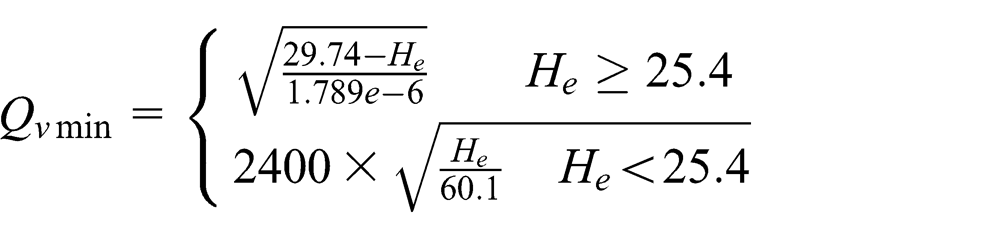

For a single constant speed pump, H e ∈ [38.8, 60.1]

For this pump group, the efficient area can be expressed as
For this pumping system, the basic demand characteristic obeys equation (10), the maximum design flow is 8500 m3, and minimum design flow is 1500 m3

Then as shown in Figure 9, the operation demand model can be expressed as


Operation area of the pump system with inverter.
The annual water law is shown in Figures 10 and 11. These values are obtained from the water demand curve based on historical data.

Annual water demand law.
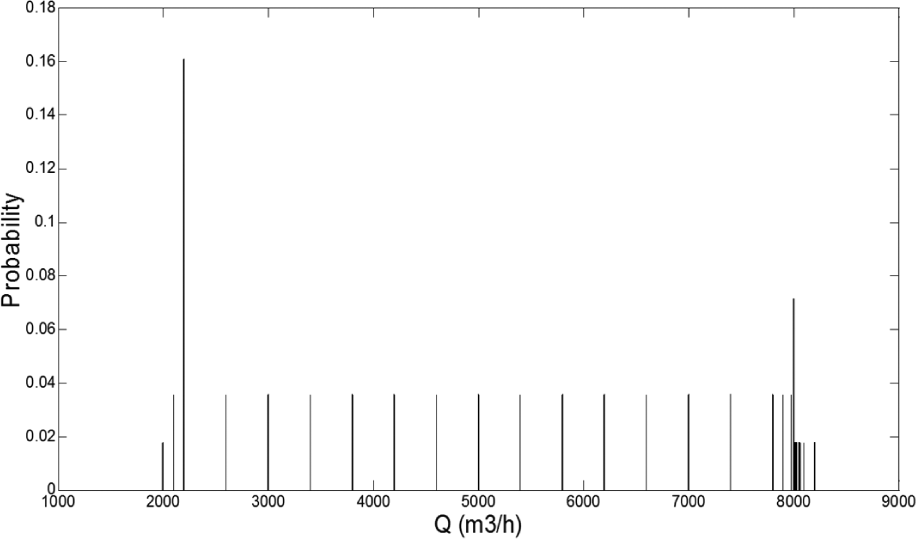
Statistics of water law.
Optimization inverter control law and the result analysis
The pump station is equipped with four units of the same-model pump. Based on the equipment and the optimized condition selection model, the single-inverter control law is shown in Figure 12.

Single inverter with same-model pump control law.
As shown in Figure 12, the efficient area of single-inverter control with the same-model pump can cover the entire operating area, and the non-efficient flow area can be found from 1500 to 1800 m3/h, from 4200 to 5200 m3/h, and from 7026 to 7923 m3/h. According to Figure 11, these three regimes comprise the main operation area. From this point, the equipment is unsuitable for this application.
Through the above situation, the range of efficiency has to be expanded by adopting the following measures:
First, an assembly pump group with two frequency converter configuration conditions may be adopted to achieve better results.
Second, some scholars suggest the addition of a pony pump to increase operation efficiency and operating adjustability.21,22
For the first scheme, two inverters are used for the system. The control law is shown in Figure 13.
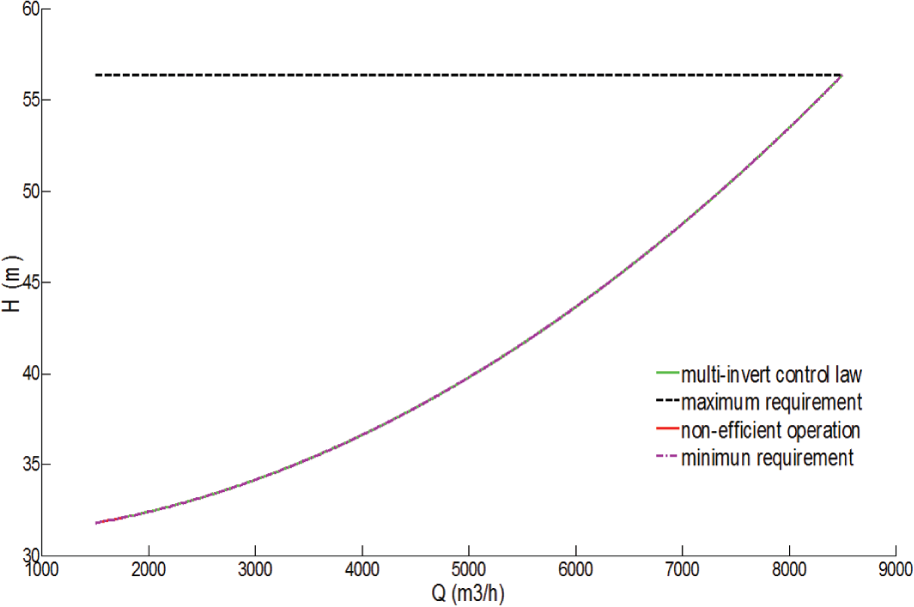
Multi-inverter with same-model pump control law.
As shown in Figure 13, the efficient area of multi-inverter control can cover almost the entire operating area, except [1500, 1800]. This control law can achieve the minimum requirement operation because of its strong regulation capability. Moreover, according to the water law statistics, [1500, 1800] is not the main operation demand. From these points, this scheme may be ideal. For the second solution, a pony pump with half capacity is employed, and the relevant parameters are shown in Table 2.
Configuration and parameters of the pony pump.

The operation characteristics of the pump are as follows:
Q–H characteristics

where k is the speed regulation ratio. If the pump operates at constant speed, k is equal to 1.
Q–P characteristics

For this constant speed pump, H e ∈ [45.4, 60.1]

The operation area should also change. The single-inverter control law with pony pump is shown in Figure 14.

Single inverter with multi-model pump control law.
As shown in Figure 14, the efficient area of single-inverter control with pony pump can cover the entire operating area. From this point, this equipment was applicable for this application. This control law can achieve the minimum requirement operation in the flow area of 4000–6000 m3. Thus, from an energy-saving operation perspective, this approach may not be ideal.
As shown in Figure 15, the shaft power under different flow requirements of the three schemes can be calculated using the optimal control law model. Based on shaft power data shown in Table 3, the multi-inverter control can gain the best energy-saving effect, and the signal inverter with pony pump also has an advantage over the form scheme.

Shaft power of the operation.
Total energy consumption under different schemes.

For the economic analysis, the implementation costs and the energy consumption within a certain period must be calculated according to the flow demand principle of the pumping system. This study uses a 1-year operation condition as shown in Figure 10. Based on Figure 15, the annual power consumption can be computed.
Given that the common industry electrovalence amounts to 0.6 Yuan and that the configuration of the invert with 10 kV and 710 kW amounts to 150 million Yuan, the transition pump, high-voltage electromotor, and installation costs amount to a total of 25 million Yuan. Table 4 shows the general expenses of these different schemes based on the cost–benefit ratio. By assuming that the machine is free from any compromise, the relationship between time and gain can be observed as shown in Figure 16.
Total energy consumption under different schemes.


Relationship between time and gain.
The same figure shows that the single-invert configuration scheme achieves the optimum profit with a working period of less than 5 years. However, the single invert with pony pump configuration achieves the best gain with an operation time that exceeds 20 years. Therefore, the single invert with pony pump configuration is applied in this energy-saving project. Finally, the comprehensive energy-saving rate is 14% by the third-party testing.
Comparative analysis between optimal invert control law with other law
The most popular invert control law is the constant pressure mode and the variable pressure mode followed minimum requirement line. All the invert control laws are shown in Figure 17. As the constant pressure mode would cause lots of waste in pressure, which would cause serious energy waste obviously, as a result, the constant pressure mode was not considered in scheme comparison.
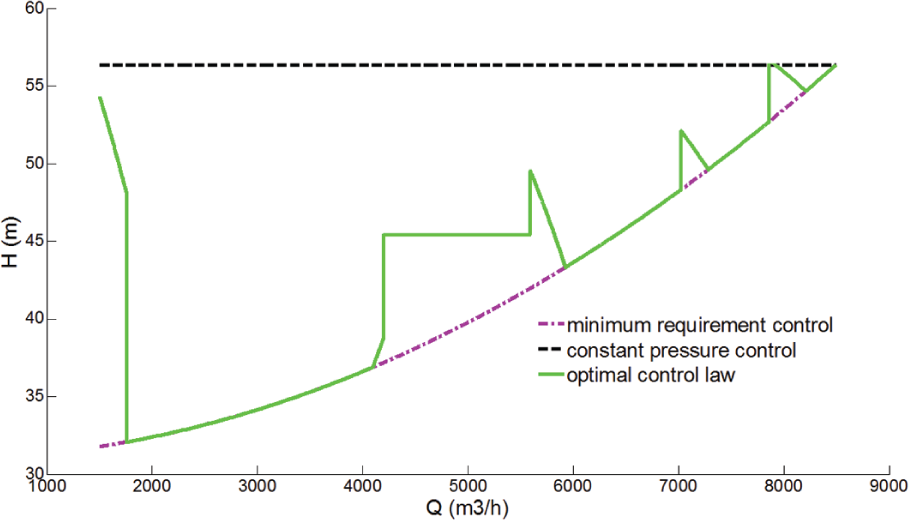
Multi-control laws for single invert with pony pump configuration.
The shaft power under different flow requirements of the three schemes can be calculated using the different control law models as shown in Figure 18. In most operation area, the shaft power was almost the same; however, in some area, the minimum requirement might be smaller than the optimal law.
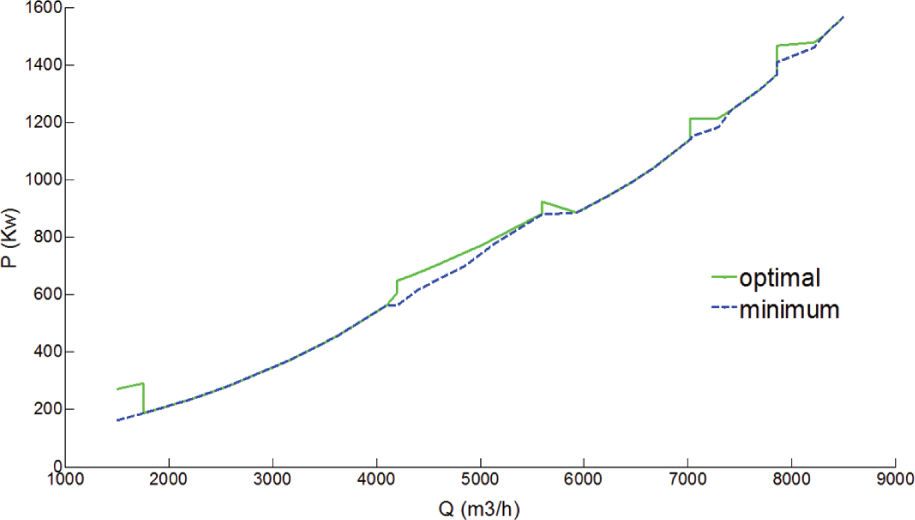
Shaft power of multi-control law with pony pump configuration.
For the economic analysis, the flow demand principle of the pumping system is also shown in Figure 10. Then the annual power consumption is computed in Table 5.
Total energy consumption under different controls.

From Table 5, the minimum requirement control might get better energy-saving effort than optimal invert control law. So it may be ideal for energy saving following minimum requirement control. But the optimal invert control law could also achieve good results. At the same time, the capability for efficient operation in the whole flow range for minimum requirements was just about 61.5%. Which means it could not enable pump to operate in reliable condition, whereas the optimal control law could cover 100% for the whole flow range in efficient and reliable condition as shown in Figure 19. In short, the optimal invert control law could ensure the pump meet the basis of high efficiency, reliable to save energy as far as possible at the same time.

Efficient area operation ability of multi-control law with pony pump configuration: (a) region of efficient operation and (b) ability of efficient operation.
Conclusion
In this work, a new model for an optimal inverter control strategy based on the current system configuration and system requirements is presented. The main conclusions of this study are as follows:
The optimal inverter control strategy should cause the pump operation in an efficient area to follow a process line near the minimum requirement line to improve the operation condition, such that the implementation difficulty of the control law is also reduced. As a result, for different pump system configuration modes or different requirement laws, the inverter control strategy should vary.
By optimizing the model calculations, the optimal inverter control strategy can be obtained, and the current operation situation of the current pump configuration can be evaluated to identify energy-saving potential opportunities for the current configurations and prepare for the subsequent energy-saving reconstruction.
Footnotes
Academic Editor: Duc T Pham
Declaration of conflicting interests
The authors declare that there is no conflict of interests regarding the publication of this article.
Funding
This project was supported by The National Natural Science Fund (No. 51409125 ), the China Postdoctoral Science Foundation (No. 2014M551515), Priority Academic Program Development of Jiangsu Higher Education Institutions, Jiangsu University fund assistance (No. 13JDG082), Jiangsu postdoctoral research grants program (No. 1302026B), and University Natural Science Foundation of Jiangsu Province (No. 14KJB470002).