




Abstract
The noise radiation characteristics of multi-cycle pulse detonation engine with and without ejector were investigated under different operating frequencies utilizing gasoline as fuel and air as oxidizer. The straight cylindrical ejector with convergent inlet geometry was coaxially installed at different axial locations relative to the exit of the detonation tube. In all the experiments, the equivalence ratios of gasoline–air mixture and the fill fraction were 1.2 and 1.0, respectively. The experimental results implied that the addition of ejector could drastically change the far-field acoustic performance of pulse detonation engine exit and the peak sound pressure level of noise radiation was a strong function of the ejector axial position. But the peak sound pressure level was not sensitive to the operating frequencies which varied from 10 to 25 Hz. The pulse sound pressure level, however, increased with the increase in operating frequencies. The far-field jet-noise measurements of the pulse detonation engine-ejector system also showed that ejector could decrease the peak sound pressure level of pulse detonation engine. The maximum reduction was approximately 8.5 dB. For the current pulse detonation engine test conditions, an optimum ejector position was found to be a downstream axial placement of x/DPDE = 0.5.
Introduction
A pulse detonation engine (PDE),1,2 as one of the three most promising and revolutionary propulsion systems in the 21st century, has attracted considerable attention because of its potential advantages over traditional gas turbine engines in thermodynamic cycle efficiency, hardware simplicity, operation stability, and reliability. Despite extensive research in PDE over the past several decades, it has not been used in practical propulsion applications. There are still many key techniques having not been solved. When the detonation products are directly exhausted from the detonation chamber to the ambient environment, a great part of the available internal energy is still not converted into the kinetic energy to produce the propulsive thrust. Furthermore, no propulsion system can endure the loud noise of up to 171 dB which is that of PDE without any noise attenuating measurement. To develop a practical PDE with high performance, many methods are proposed to recover the energy of exhaust jet, including by adding an ejector. 3
An ejector is a coaxial duct that is placed around the exhaust of an engine to direct the entrainment of the surrounding airflow into the engine exhaust stream. The theory and application of steady-flow ejectors have not been well established. For a conventional steady fluid engine, installing an ejector can enhance thrust at low speeds by adding momentum to the entrained airflow, 4 which can reduce the jet noise. In this situation, the mechanism of energy transfer is contributed to viscous shear mixing. However, the application of ejectors to unsteady primary flows is less common. Several studies5–9 have examined unsteady ejectors driven by pulsejets or other non-detonation devices by which the primary airflow was interrupted. The results indicate that unsteady ejectors are dominated by flow mechanisms different from those seen in steady ejectors, and unsteady ejectors tend to produce more thrust augmentation than steady-flow ejectors. Lockwood 5 attributed the unsteady ejector performance to a more efficient energy transfer process between the primary flow and the secondary (entrained) flow. Because of the unsteady nature of PDE, a PDE-driven ejector could have the potential to be highly effective at enhancing the energy exchange between the primary flow and the secondary airflow.
The experimental results10–15 have confirmed that PDE-driven ejectors are extremely effective in thrust augmentation. Allgood et al. 11 made a good summary of those relevant literatures in his article. Both the relative size of the ejector to the primary flow driver and the ejector length-to-diameter ratio are also known to have influences on ejector performance. In this study, some results have shown that ejector performance is extremely sensitive to the axial position of the ejector inlet relative to the detonation tube exit. 16 As for thrust augmentation performance, there existed conflicting results about the installing placement of ejector. Thus, it seemed useful to investigate this phenomenon. Some researchers11–13 have found a maximum thrust augmentation with ejector being downstream of the detonation tube exit, other with it upstream.14,16 A study by Wilson et al. 10 showed that there existed two maxima, one with ejector entrance upstream and one downstream, of the detonation chamber exit. It should be noticed that the maximum thrust augmentation was still located at the upstream of the detonation exit in the whole range of the ejector axial position tested by Wilson et al. Furthermore, previous experiments indicated that many operating parameters such as the PDE cycle frequency10,15 and fill fraction 11 affect the PDE-ejector performance as well. However, the focuses in these previous investigations10–16 were thrust augmentation not acoustic performance. It is expected that the noise radiation performances of PDE by the addition of an ejector will have the similar change trend to ones of thrust augmentation.
Glaser in the University of Cincinnati and Shaw et al. in the Air Force Research Laboratory17–19 performed the Fundamental study on the acoustic performance of PDE. Glaser17,18 made the far-field acoustic measurements of PDE with two classes of exit nozzle geometries and three noise abatement mufflers. The results showed that attenuation levels of about 6.5 dB were obtained. Shaw et al.’s 19 investigate aimed to compare the far-field acoustics of a dual-PDE with that of a single-PDE system. The experimental comparison indicated that overall sound pressure level of two detonation tubes firing out of phase was almost identical to that of one detonation tube, which resulted from the degree of independence of subsequent detonation waves. Beside above studies, there are some other investigations about the effects of fill fraction of each detonation tube, directivity angle of detonation tube exit, and separation distance of the detonation tubes on the noise performances of PDE. But very little data have been published about the noise radiation of PDE-driven ejector, which is a large need to investigate for obtaining the far-field acoustic behavior.
In this article, a preliminary experimental investigation of the far-field jet-noise performance on a multi-cycle gasoline–air PDE was performed, which included the axial location of the ejectors relative to the exit of the detonation chamber and the operation frequency. The ejector acoustic performance was quantified by noise radiation measurements.
Experimental setup
PDE system description
A schematic of the apparatus is illustrated in Figure 1. The experimental system consisted of an oxidizer and fuel supply subsystem, a control and ignition subsystem, a detonation tube, an ejector subsystem, a noise measurement subsystem, a data acquisition and processing subsystem, and so on. The detonation tube was 1.6 m long, with an inner diameter of 60 mm (DPDE ). The detonation tube was closed at one end and opened at the other, which was composed of a thrust wall, a mixing chamber of 150 mm, an ignition section of 150 mm, and a detonation chamber of 1300 mm. The inlet ports of fuel and oxidizer were located at the thrust wall. Liquid gasoline was chosen as the fuel and air as the oxidizer in this study. The air and gasoline entered the mixing chamber through respective pipelines in which an axial mode of air injection and an air atomizing spray nozzle were adopted to enhance the atomization and vaporization of liquid fuel, as well as the mixing of fuel and oxidizer. The one-way valves were used to control intermittent supplies of air and fuel flows. After being injected into PDE, the gasoline and air rapidly mixed in the mixing section, and then were ignited in the ignition section. The spark plug igniter of automobiles was employed, and the ignition energy was as low as 50 mJ. The experiment apparatus allowed the operating parameters such as air and fuel flow rates and the frequency of spark generator to be independently varied. The flow rates were adjusted to supply the desired equivalence ratio and fill fraction which was the ratio of the tube volume with a fuel–air mixture to the overall detonation tube volume. The operation frequency of PDE was controlled by the ignition frequency driven by a signal generator. A Shchelkin spiral was inserted into the front of the detonation chamber, to reduce the deflagration-to-detonation transition (DDT) run-up distance. A dynamic piezoelectric pressure transducer mounted at the thrust wall (Position 0) to record the pressure history at the thrust wall. Two dynamic piezoelectric pressure transducers (Positions 1 and 2) were used to survey the pressure history along the detonation chamber. A 16-channel data acquisition device (DEWE-3020) was used in this study, and the single-channel sampling rate was 2 × 10⁵ samples/s. In all the experiments, the equivalence ratios of gasoline–air mixture and the fill fraction were 1.2 and 1.0, respectively.

Schematic of experimental setup.
Ejector hardware
To investigate the effect of ejector axial position on acoustic performance, one straight cylindrical ejector with convergent inlet was designed. The lip radius of tapered inlet was 50 mm. The inner diameter of ejector was 150 mm, that is, the ejector-to-PDE diameter ratio (Dejector /DPDE ) was 2.5. The ejector was mounted coaxially to the detonation tube at various positions relative to the PDE outlet with the length of 350 mm. Different axial positions of the ejector with respect to the detonation chamber exit were tested to characterize far-field noise-jet performance of PDE. To normalize the parameter, it referred to the overlap position as x/DPDE , with x being the axial distance from the detonation chamber exit to the ejector inlet and DPDE being the inner diameter of the detonation tube. As a convention, it selected a negative x/DPDE factor to represent overlapping of the engine and the ejector in the experiments and positive x/DPDE factor to represent separation. The dimensionless axial position of the ejector inlet (x/DPDE ) was varied from −2 to +2, spaced 1 apart.
All the experiments on the effects of the ejector placements were performed at different operating frequencies. To investigate the effect of operating frequency on acoustic performance, PDE with or without ejector operated at 10, 15, 20, and 25 Hz.
Jet-noise measurements
As shown in Figure 1, the noise measurement system consisted of a high sound pressure level measuring sensor made in G.R.A.S Sound and Vibration Company in Denmark. This system included “40DP-1/8” pressure microphone, RA0063 microphone adapter, 26AC microphone preamplifier, and 12AD power module. The performance parameters of the noise measurement system were as follows: the sensitivity was 0.97 mV/Pa, frequency range was 10 Hz–70 kHz (±1 dB) or 6.5 Hz–140 Hz (±2 dB), the sound measure range was 40–178 dB, and working temperature range was −40 to +150°C. B&K4231 sound calibrator was used to calibrate the whole measuring system before each measurement. The radial distance of microphone relative to the center of PDE outlet was 1000 mm, which was the minimum value for far-field regime of jet-noise acoustics. Blast wave theory also suggests that this radial distance corresponds to the weak shock regime, or “far-field,” for an equivalent spherical explosion of the amount of detonation mixture used in this study. 20
To make sure the reliability of the experimental results, under the same operating conditions, the sound pressure level was measured by at least four times. The average sound pressure level deviations for any two experiments were in the range of ±1 dB. The arithmetic average values were computed as the best estimator of the measurement.
It is noticed that there are two important acoustic parameters for various types of pulse noises, peak sound pressure level (LPSPL ) and pulse sound pressure level (LISPL ), the former is universally considered as the most critical factor for noise-induced hearing loss of human and defined as

In the formula,

In formula (2),
Results and discussions
PDE testing
In this study, a PDE testing without an ejector was made first under different operation frequencies in order to affirm whether the PDE works steadily and reliably. Pressure profiles obtained at two pressure transducer locations along the detonation chamber are shown in Figure 2, where the operation frequency was 20 Hz for PDE without an ejector. At the location of p1, all the pressure spikes were around 1.8 MPa. The experimental results indicated that a fully developed detonation wave had been achieved in the current experiment rig and the PDE ran stably. The experimental result demonstrated that the actual operating frequency of PDE was consistent with the assigned frequency.
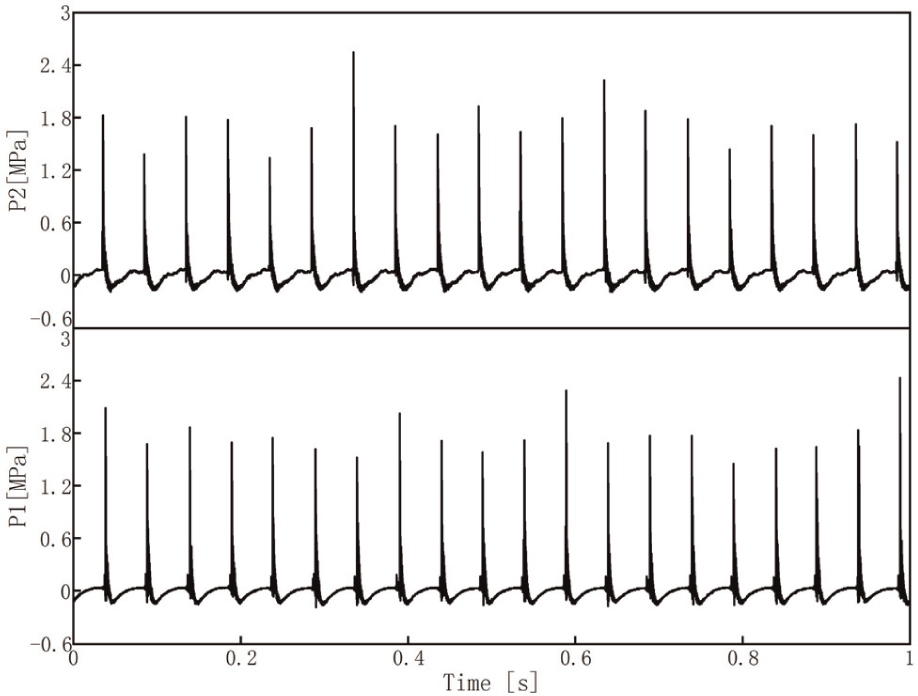
Pressure profiles of detonation combustion chamber without ejector.
In order to compare the changes in far-field jet-noise between the PDE without ejector and PDE with ejector, the baseline acoustic measurements at different operation frequencies were made first in the PDE before the ejector was installed. Figures 3 and 4, respectively, plotted the original sound pressure measured at the detonation chamber exit without and with ejector. After processing the sound pressure data according to formulas (1) and (2), the peak sound pressure level and pulse sound pressure level of PDE at different operation frequencies are shown in Figures 5 and 6, respectively. As shown in Figure 5, the peak sound pressure levels of PDE far-field jet-noise were stabilized at around 171 dB over detonation frequency variation, while the pulse sound pressure levels increased as the detonation frequency went up. The reason for this was that the peak pressures of detonation wave did not vary with the operation frequency when the PDE construction and fuel and oxidant supplied to PDE are fixed. But the increase in pulse sound pressure level with detonation frequency was because of a greater number of detonation waves each second within the PDE, which implied more energy could be released through the noise radiation of detonation exhaust flow.

Sound pressure history of PDE exit at 25 Hz without ejector.

Sound pressure history of PDE exit at 25 Hz with ejector (the position of 1).
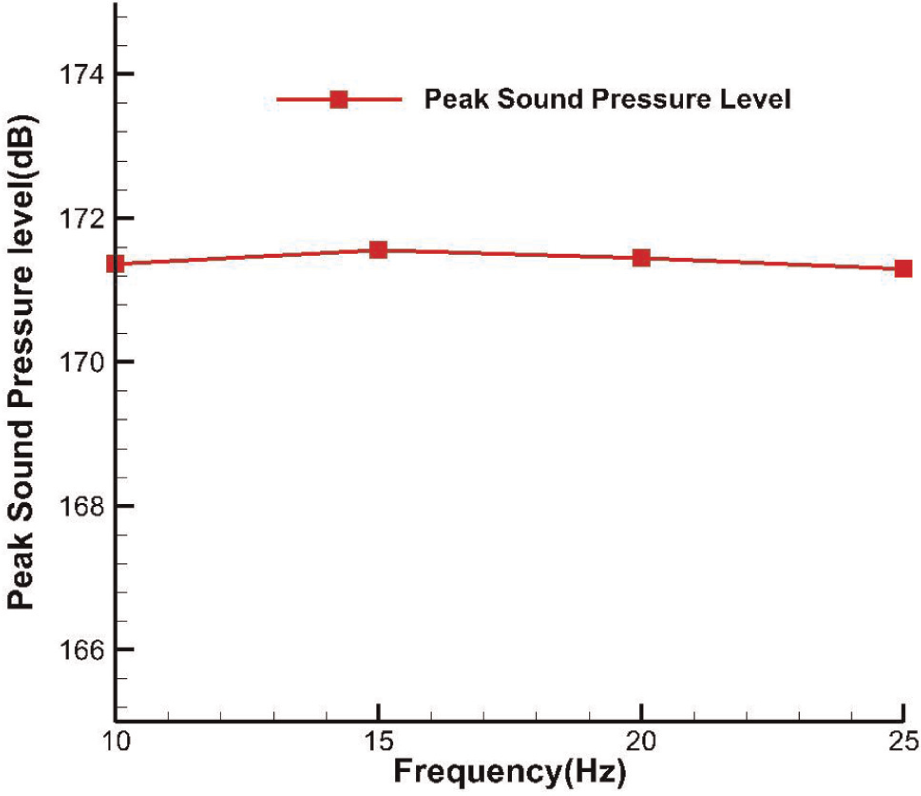
Peak sound pressure level of PDE without ejector at different detonation frequencies.
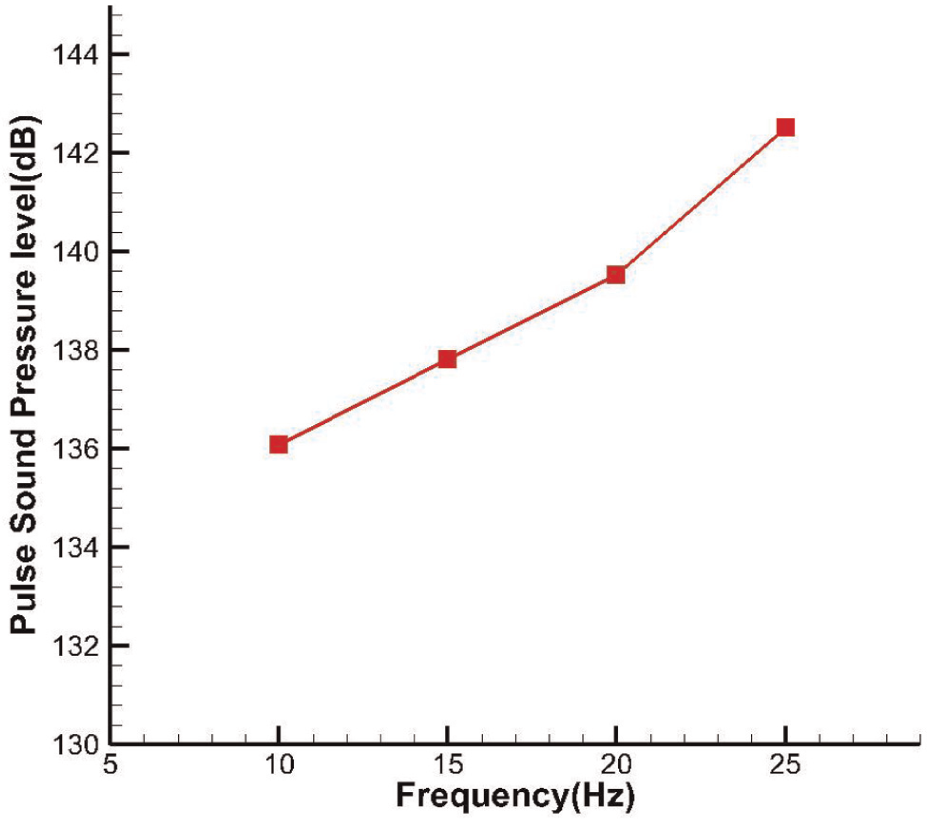
Pulse sound pressure level of PDE without ejector at different detonation frequencies.
Effect of ejector axial position
At different ejector positions, acoustic measurements at PDE exit with an ejector of convergent inlet were made, and the variations in peak sound pressure level and pulse sound pressure level with dimensionless ejector axial position (x/DPDE ) at 20 Hz are plotted in Figures 7 and 8.

Peak sound pressure level of PDE with ejector at different ejector positions.
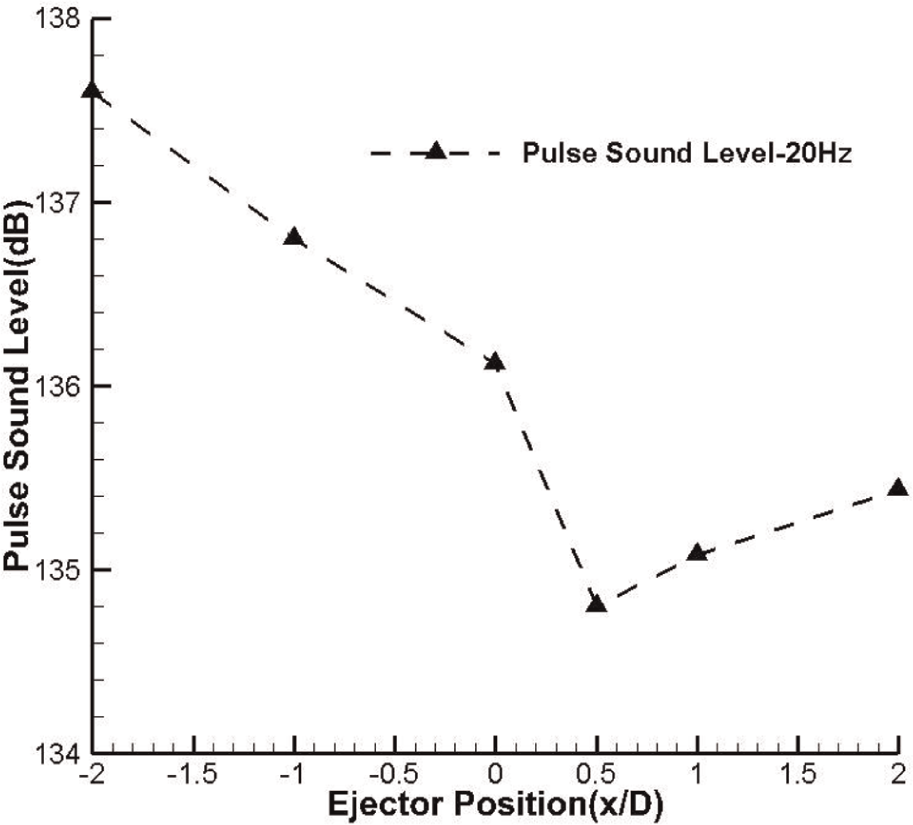
Pulse sound pressure level of PDE with ejector at different ejector positions.
As show in Figures 7 and 8, the installing of an ejector at PDE exit had a significant impact on the sound pressure level measured in the far-field. No matter where the ejector was, the ejector could drastically decrease the noise radiation of PDE far-field. As a whole, the reduction in peak sound pressure level and pulse sound pressure level obtained at the downstream location were both greater than those at upstream location. The minimum value of peak sound pressure level being 163 dB occurred at 0.5 position, which decreased by 8.5 dB from 171.5 dB corresponding to that of PDE without ejector. At the same time, the pulse sound pressure level decreased by about 4.7 dB.
The results may be contributed to the propagation effect of detonation wave discharged from PDE. When the detonation waves were exhausted from the detonation chamber exit, a great part of the available internal energy was still not converted into the kinetic energy. After propagating from the exit of detonation chamber, the detonation wave decayed to a quasi-spherical expanding shock wave. The detonation products exhausted from the detonation chamber were bounded by the quasi-spherical shock wave. As the propagation of the quasi-spherical shock wave, it expanded in all directions, its size continuously increased, and its strength gradually decayed. When the ejector was located at upstream of the PDE exit, a up-running shock wave and a down-running shock wave would occur in the ejector after the quasi-spherical expanding shock wave collided with the interior wall of the ejector. The up-running shock wave propagated to the ejector inlet and an initial upstream flow existed at the ejector inlet. After the up-running shock wave emerged outside of the ejector, it diffracted and then air entered the ejector and established a secondary flow. Therefore, when the ejector was located at upstream position, the initial upstream flow did not entrain a secondary flow as the up-running shock wave propagated upstream. Due to the diminishment of the secondary flow, noise radiation energy released at the negative position was greater than that obtained at the positive location because the secondary flow could extract the energy from the primary flow and decrease the exhaust speed of the mixing flow. Additionally, as the ejector was continually moved upstream from the 0 location, the distance between the ejector exit and the PDE exit was decreased. The shortening of the distance between the ejector exit and the PDE exit affected the mixing of the primary and secondary flows. The mixing flow had been exhausted from the ejector before the primary and secondary flow fully mixed with each other. Therefore, sound pressure level was gradually increased.
On the contrary, when the ejector was located at downstream position, the down-running shock wave acted as a plug to entrain the secondary flow into the ejector which enhanced the mixing of the secondary flow and the core flow. But when the ejector separated gradually from the PDE outlet, down-running shock’s size continuously increased, and its strength gradually decayed, which could result in the shock impacting on the lip of the ejector and in turn decreasing the secondary flow. So the sound pressure level increased when the ejector separated gradually from the PDE outlet. This is the reason why the maximum noise reduction happened at the ejector position of x/D = 0.5. But the change trend of noise radiation performances of PDE by the addition of an ejector was a bit different from the ones of thrust augmentation. Huang et al. 16 showed that the optimum ejector position for thrust augmentation was at upstream location. This may have resulted from the collision between up-running shock wave and interior wall of the ejector. With the increase in the overlap distance between the ejector inlet and detonation tube exit, the up-running shock wave would take more time to collide on the interior wall, which would result in addition noise radiation released. This was the reason why the noise radiation level of PDE with ejector being at upstream was stronger than that of PDE with ejector being at downstream.
Figure 9 shows the pulse sound pressure level of PDE with ejector at different ejector positions and different detonation frequencies. The results implied that the pulse sound pressure level under different detonation frequencies followed the same change rule, which indicated that the optimum placement of ejector relative to the PDE outlet could be applied to all the detonation frequencies for the present experiments. The experimental results showed that the peak sound pressure level had the same trend with pulse sound pressure level at different ejector placements.
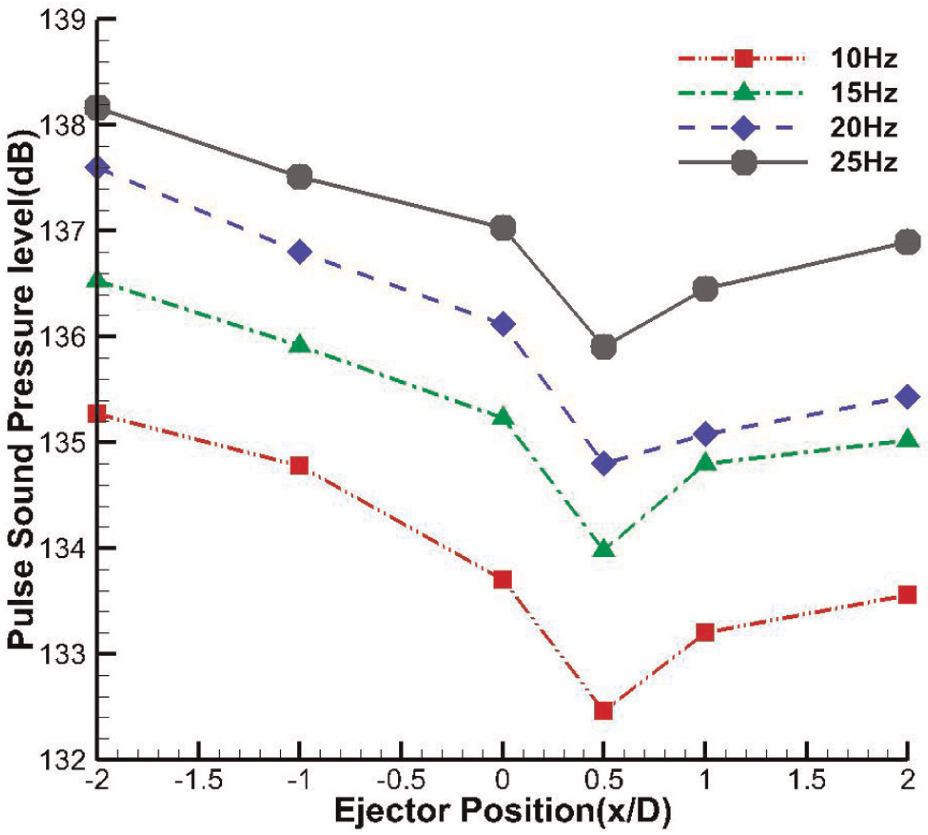
Pulse sound pressure level of PDE with ejector at different ejector positions.
Effect of operating frequency
Figures 10 and 11 plot the variations in peak sound pressure level and pulse sound pressure level of the PDE with ejector and without ejector under different operation frequencies. As shown in Figure 10, whether or not installing an ejector to PDE, pulse sound pressure level almost lineally increased with the rise in operating frequency. But peak sound pressure level was not sensitive to operating frequencies, which seemed to tend to a constant. Under all the tested operating frequencies, installing an ejector could reduce not only the peak sound pressure level but also the pulse sound pressure level. At different operating frequencies, peak sound pressure level of PDE with ejector could decrease by mean 8.5 dB relative to that of PDE without ejector. Tables 1 and 2 show the comparison of sound pressure level between PDE-driven ejector and pure PDE. However, it was seen from Table 2 that the variation trend of pulse sound pressure level was slightly different from those of peak sound pressure level under different detonation frequencies. When the operating frequency was relatively low, the reduction in pulse sound pressure level with the increase in operating frequency was not noticeable. When the operating frequency was increased to 20 Hz, the amount of reduction was up to 4.7 dB from 3.8 dB, due to the increase in the secondary flow being entrained into the ejector. In the range of 20–25 Hz, the effect of ejector on the noise radiation was significantly enhanced with the increase in operating frequency.
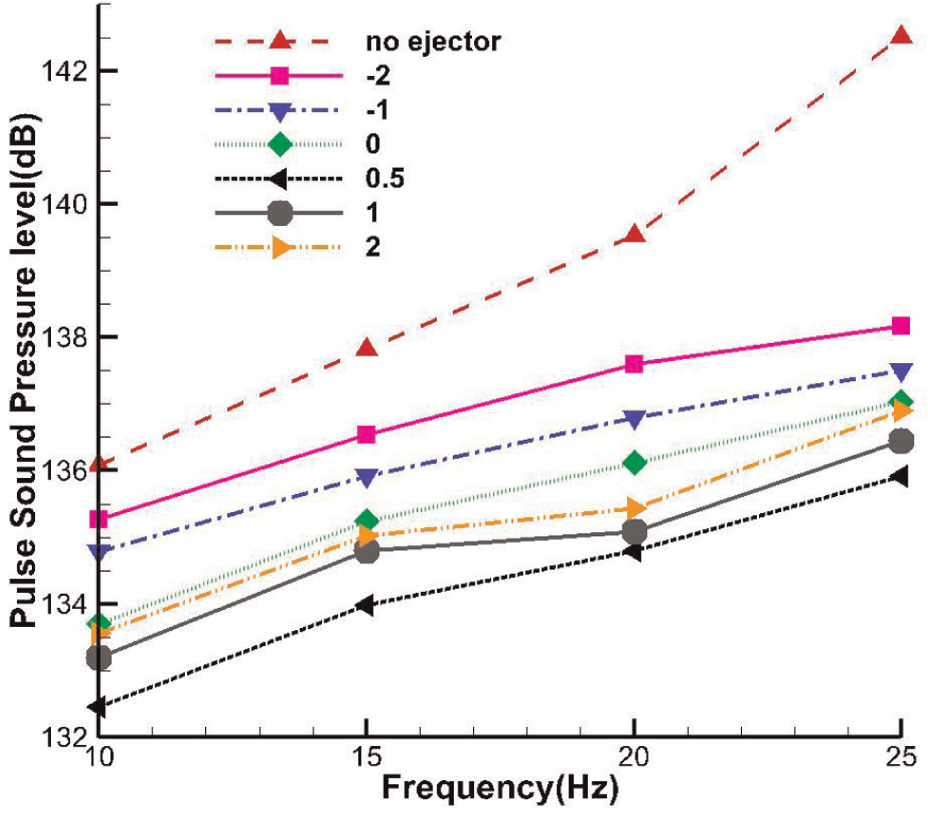
Pulse sound pressure level of PDE with ejector at different detonation frequencies.
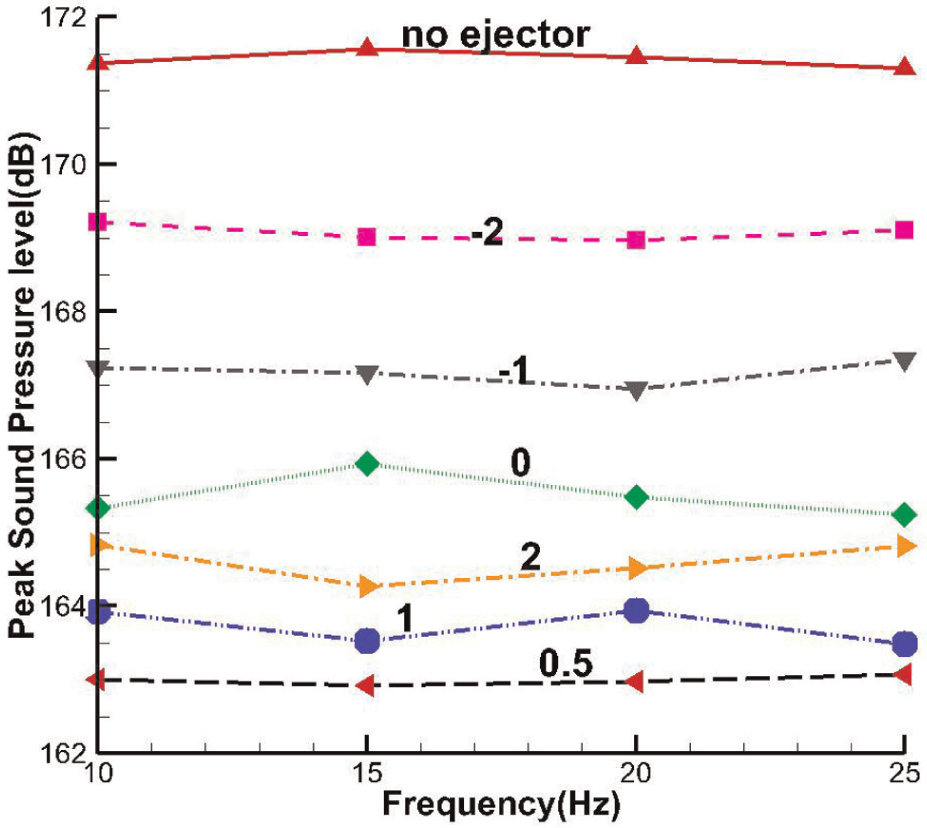
Peak sound pressure level of PDE at different detonation frequencies.
Peak sound pressure level at different detonation frequencies and different ejector positions.

Pulse sound pressure level at different detonation frequencies and different ejector positions.

Conclusion
This work aimed to quantitatively evaluate and compare the far-field acoustics of a PDE-ejector system relative to a single-PDE system. A series of multi-cycle experiments of the gasoline–air PDE were conducted at several operation frequencies and different axial placements of straight cylindrical ejectors with a convergent inlet. Based on the experimental results, it was concluded that:
Installing an ejector to the exit of the detonation tube could noticeably change the far-field acoustic performance produced by PDE. A maximum noise attenuation of peak sound pressure level of PDE with an ejector was approximately 8.5 dB from this work.
Both pulse sound pressure level and peak sound pressure level were a strong function of the ejector axial position. The downstream ejector configurations (x/DPDE > 0) were in general better for noise reduction than the overlapping configurations. The optimum ejector position was found to be at x/DPDE being equal to 0.5, the corresponding maximum noise reduction being approximately 8.5 dB.
Whether or not installing an ejector to the PDE, the operating frequency has an important effect on the pulse sound pressure level. The pulse sound pressure level increased significantly with the increase in the operating frequencies. But peak sound pressure level seemed not being sensitive to the operation frequency.
Footnotes
Appendix 1
Academic Editor: Jose Ramon Serrano
Declaration of conflicting interests
The authors declare that there is no conflict of interest.
Funding
The authors would like to appreciate the financial supports of National Natural Science Foundation of China (51476135) and the Natural Science Foundation of Shaanxi Province, China (2014JM7279).