




Abstract
The purpose of this study is to estimate the wave height located at the front face of the offshore refracted breakwater when the trench is dredged in the exterior region of the breakwater at various depths. The problems that arise with regard to the different obliquely incident wave field involve having two-dimensional planes and having the configuration of the trench region designated by a single horizontal rectangular system. The numerical approach involves applying the Green function based on the boundary integral approach. The results of the present numerical works are illustrated. The ratio of the wave height reduction at the front face of the refracted breakwater is shown to be more than 25% due to the trench’s effect on the seabed. The corner of the refracted breakwater is where the wave energy is concentrated, and through utilizing the trench, the wave energy can be subdued to reduce the damage on the breakwater. The trench brings about a reduction in wave amplitude and wave energy in, around, and directly downstream of the trench.
Introduction
The incident water waves that propagate from the offshore zone concentrate at the corner of the breakwater. Water waves of powerful energy, namely, storm surges and high waves, can damage the breakwater, and therefore, affect the safety of the breakwater. Many researchers are investigating new strategies to reduce these powerful wave energies. Various methods are being applied specifically for the reduction of such energy at the corner of the breakwater. One example would be to construct the section of a corner into a slit type, absorbed type, or a curved type.1–4
The purpose of this study is to reduce the incident wave energy before it reaches the corner of the breakwater by utilizing the dredged region (trench region). When the high-energy sourced waves pass over the trench with discontinuity water depth, the high wave energy level can be reduced.5,6 This study involves investigating the interaction between the trench and the structure and simulating the reduction effect of the wave energy through the trench.
The early pioneers to research on the interaction of incident waves with a dredged region were notably Newman, 7 Hilay, 8 Lee and Ayer, 9 Miles, 10 Kirby and Dalrymple, 11 Ting and Raichlen, 12 and Kirby et al. 13 The x–z vertical two-dimensional (2D) approach was applied to perform all these studies. To deal with cases where a single or multiple trenches are present, Williams, 14 McDougal et al., 5 and Williams and Vazquez 6 presented a numerical model that involved the x–y horizontal planes. Based on Williams’ method, 14 Takezawa et al. 15 used various configurations to investigate diffractions for the trench breakwater and present wave propagation while the trench was dredged at the port’s entrance.
Briggs and Sargent 16 conducted experiments at the field work at the entrance channel. Later, Briggs et al. 17 also assessed the deep draft channel design. To deal with random waves, Kirby 18 proposed several techniques in Barbers Point Harbor, Hawaii. Reniers et al. 19 developed a computer program for the analysis of long waves at the trench region. Recently, Kim 20 and Kim and Lee 21 investigated the modeling wave height of random waves produced by the submarine trench.
This study is, first of all, about the interaction of waves that are propagated over the dredged trench geometry with discontinuity water depth, and second, about the effect of this wave interaction that takes place on the front face and the vicinity of the offshore refracted breakwater systems when the trench is dredged.
There are three boundary interactions presented concerning this wave interaction: the interaction of discontinuity water depth boundary and the trench boundary, the discontinuity water depth boundary within the trench and the refracted breakwater boundary, and the trench boundary and the breakwater boundary. The problem is considered in a 2D plane; the configuration of the dredging region on the seabed with different depths is a single long rectangular type and the configuration of the breakwater is refracted with the same length between both sides of the breakwater. The numerical simulation utilizes the linear wave theory with the boundary integral equation based on the Green function, and the conditions between the exterior and the interior trench regions and the exterior region of refracted breakwater are matched.
To verify the present numerical model, the results of the experimental works of Koji and Mutsuo 22 were compared for the regular wave height at the front face of the refracted breakwater without the trench. The comparing results between the two revealed that the present numerical simulation and the research by Koji and Mutsuo 22 fall into good agreement.
During this study, the scattered wave field in the vicinity of the breakwater due to the trench with discontinuity water depth exhibited decreasing effects. This study can offer vital information to help design a dredge line of the outer breakwater to be more distantly located from the coastal zone. Based on the results, the present numerical model proves to be effective and can be adequately utilized to analyze wave interactions by the trench, and thus be an applicable tool in coastal engineering.
Theoretical development
The geometry of the problem is presented in Figure 1. The fluid domain is divided into two regions: an interior trench region

Definition sketch for fluid domain and boundaries.
Assuming that the fluid region is taken to be inviscid, incompressible, and the flow irrotational, then the fluid motion may be described in terms of velocity potential

It is subjected to the usual boundary conditions on the free surface and seabed


for j = 1, 2, where
The Helmholtz equation must satisfy the equations governed in each fluid region

where the wave numbers

Continuity of pressure and velocity across the fluid interface between the interior region and the exterior region requires the following conditions to be satisfied


For the case without the trench, along the vicinity of refracted breakwater


where

Finally, at large radial distances

Green’s function

where
Applying Green’s second identity to
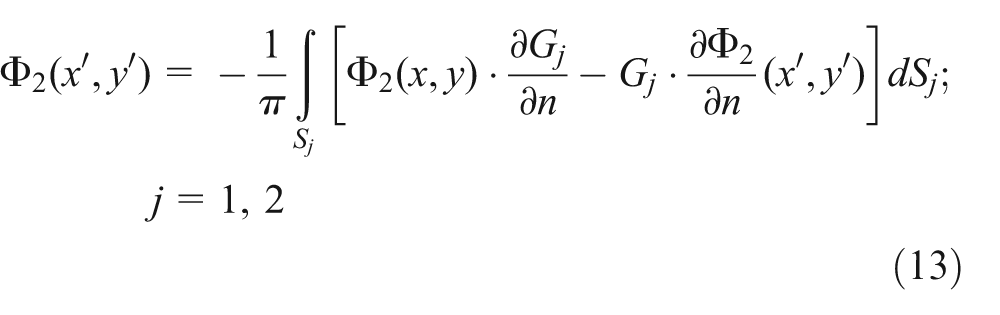

When we apply the boundary conditions (6)–(9) proposed by Williams 14 and McDougal et al. 15 to equations (13) and (14), the following occurs to both equations (15) and (16)
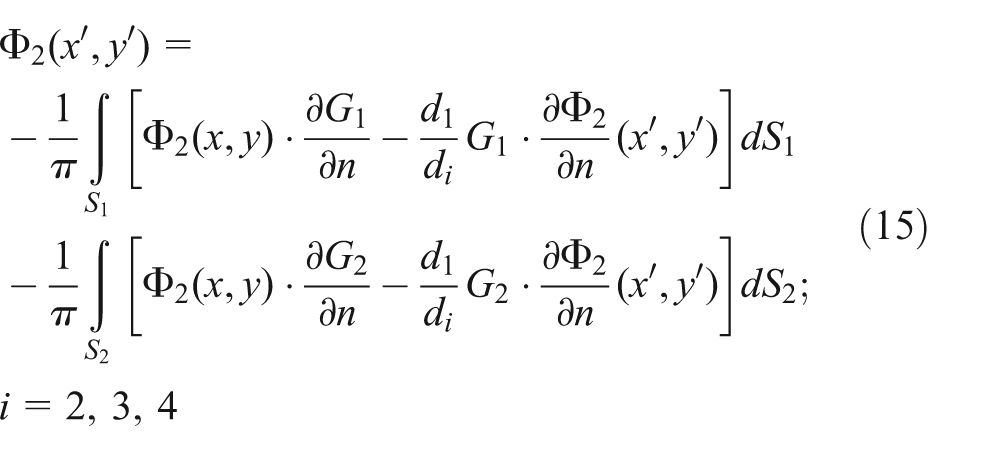

The free surface elevation

Finally, the diffraction coefficient of regular wave,

Validation of the numerical model
Verification of the present numerical model is performed by simulating regular wave diffraction at the vicinity of the breakwater with the trench on the seabed or without the trench. The present numerical results of the wave height at the front face of refracted breakwater were compared with experimental works carried out by Koji and Mutsuo. 22
The conditions of the experimental work and the configuration of the refracted breakwater in regular waves without the trench were set by Koji and Mutsuo
22
and are stated as such; the incident wave angle
The present numerical model and experimental works of Koji and Mutsuo 22 presented the wave height of regular waves for the purpose to compare the results at the front face of the refracted breakwater; this is seen in Figure 2. In comparison with Figure 2, it is noticed that the diffraction coefficient at the front face of breakwater agree well between the two results. It is observed that the present numerical model can be appropriately used for practical applications in order to predict the wave fields inside and outside while the trench is dredged within the marine environment’s vicinity. This is possible due to comparisons made between the results from the numerical performances and experimental model tests for regular wave height.
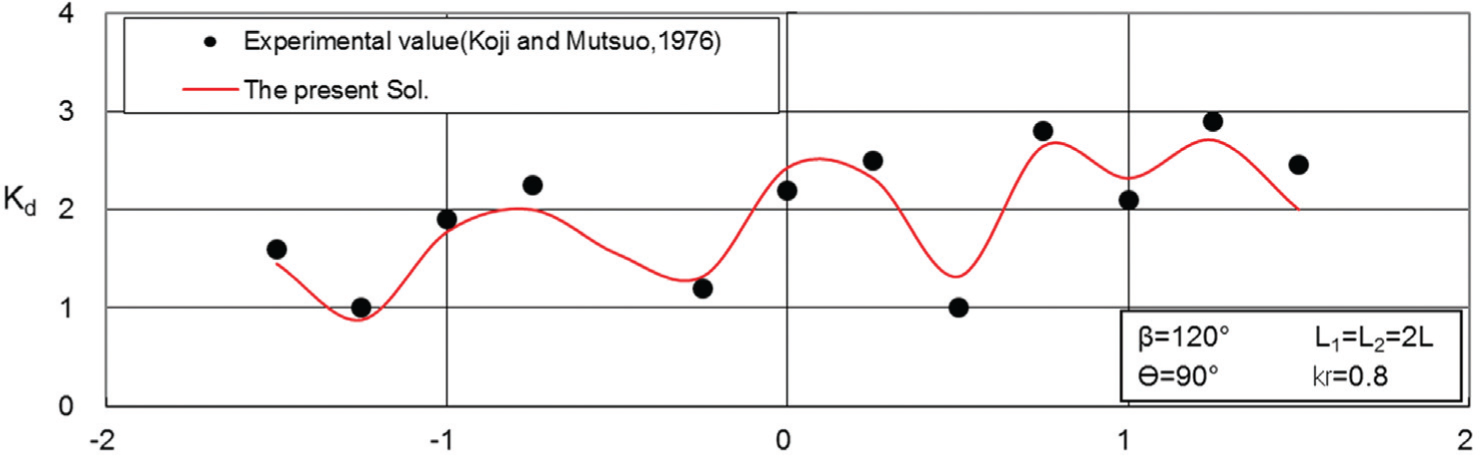
Comparison between the wave diffractions of this study and those of experimental works at the front face of refracted breakwater.
Numerical results and analysis
Numerical examples are presented to investigate the influences of the trench at the front face of refracted breakwater with different incident wave angles and varying depths of the trench on the seabed. The layout of the refracted breakwater and the rectangular trench outside the breakwater are shown in Figure 1. Computer program has been developed based on the theory stated above and numerical simulations were performed with the following conditions: the water depth of the vicinity of breakwater is expressed as

Wave height distributions at the front face of refracted breakwater with or without trench for obliquely incident wave angle: (a)
In the case where the obliquely incident wave angle is
When applying the root mean square (RMS) ratio shown in Table 1, for the cases where the dredging trench is
The reduction ratio of wave height at the front face of refracted breakwater.
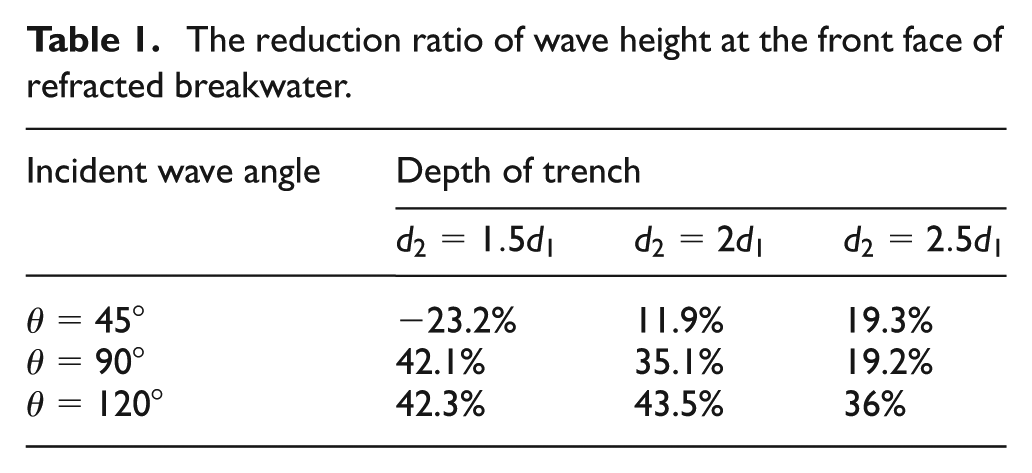
In the case where the obliquely incident wave angle is
As for the case where the inclined wave angle is
As shown in Figure 3, among the three cases of trench depth when
From these analyses, we see that when the trench is appropriately set, the overall reduction of wave height and wave energy can be observed at the vicinity of the breakwater.
Figures 4 and 5 present the contours of the wave height ratios near the breakwaters with and without the presence of the trench. The presence of the trench reduces both the wave amplitude and the wave energy within, around, and directly downstream of the trench. Based on the results, a dredging trench is deduced to provide an excellent means of protection from a wave attack. It seems that a discontinuity in water depth (dredging) weakens wave energy. The numerical simulation for wave diffraction has provided results that show the present model is useful in estimating the wave field at the vicinity of breakwater when a trench is dredged on the offshore seabed.

Wave height contour plots within the vicinity of breakwater with or without trench (where the obliquely incident wave angle is

Wave height contour plots within the vicinity of breakwater with or without trench (where the obliquely incident wave angle is
Figures 6 and 7 present three-dimensional diagrams of the wave height ratios near the breakwaters with and without the presence of the trench. As shown in the figures, the incident wave energy propagating from the offshore passes over the trench and the wave height is reduced by the discontinuity water depth. In addition, in the region between trench and the refracted breakwater, the diffracted wave height is low and thus shows that the trench is helpful for the safety of breakwater. Even afterwards, the reduced wave energy continuously propagates to the leeward of the breakwater and that region remains low. This contributes to the stillness of the fishery ports or harbors.

Three-dimensional diagrams within the vicinity of breakwater with or without trench (where the obliquely incident wave angle is

Three-dimensional diagrams within the vicinity of breakwater with or without trench (where the obliquely incident wave angle is
On the other hand, for the case where the trench is not installed, high wave height distribution is shown in the diagrams and this, as a result, affects the safety of the breakwater. In this case, the peak wave crest is distributed at the front face of the breakwater.
For the case where the trench is present, by the discontinuity of water depth, the wave is reflected toward the offshore direction resulting the wave crest between the trench and breakwater to be mild. Compared to the peak wave crest, this mild wave crest distributes the wave force which is concentrated at the front face of the breakwater, in a more effective manner for the safety of the breakwater.
Conclusion
The objective of this study is to predict the decreasing effects of scattered wave fields around the breakwater when the dredging trench exists at the offshore seabed. This study aims to address the composite wave interaction for the following three problems: dredging boundaries, depth discontinuity of trench, and breakwater boundaries. Boundary conditions are placed and applied to a 2D boundary integral model. The results obtained from the obliquely incident wave conditions are given to highlight the wave height distribution of the wave field near breakwater by the influence of the various trench depths. The results acquired from the present numerical model were compared with those from the previous experiments; the numerical simulations given show excellent consistency with the experimental data for wave height.
Through the present numerical simulations, the reduction in wave height and the weakness of wave energy around the refracted breakwater can be observed when the breakwater exhibits different incident wave angles due to the trench with varying depths at the offshore seabed.
The results from the present developed numerical model proved to provide accurate accounts of the scattered wave height of vicinity of breakwater systems when the trench is dredged on the offshore seabed. Thus, such model can be trusted to be used in the layout of breakwater planning, deepening or widening of a dredge, design applications of harbor, and redevelopment of harbor or port.
Footnotes
Academic Editor: Haitao Yu
Declaration of conflicting interests
The authors declare that there is no conflict of interests regarding the publication of this paper.
Funding
This research was supported by a grant (13RDRP-B066173) from Regional Development Research Program funded by Ministry of Land, Infrastructure, and Transport of Korean government.