




Abstract
The axial heat transfer coefficient during flow boiling of n-hexane was measured using infrared thermography to determine the axial wall temperature in three geometrically similar annular gaps with different widths (s = 1.5 mm, s = 1 mm, s = 0.5 mm). During the design and evaluation process, the methods of statistical experimental design were applied. The following factors/parameters were varied: the heat flux
Introduction
The requirements to realize high heat fluxes, to cool components at defined temperatures, and to minimize the use of hazardous or toxic media lead to simultaneous developments of increasingly smaller devices and an increased use of miniature evaporators. The resulting economic importance leads to numerous scientific studies, particularly in recent years since the work of Lazarek and Black. 1
Knowledge of the heat transfer coefficients of such equipment is of fundamental importance for the constructing engineer. The reviews of Tibiriçá and Ribatski 2 show that—more than 30 years later—there are different and sometimes even conflicting evidence on the effect of the parameters on the heat transfer coefficient.
The resulting need for research requires a large experimental effort to receive secured results at a maximum variation of all known factors. In addition, with this broad variance of the experimental results, the question arises whether all significant factors have already been identified and systematically investigated.
In Table 1, selected experimental works are compiled to test conditions, analysis of priorities, and the key messages. It can be seen that in many researches, the working medium, the heat flux
Flow boiling experiments with hydrocarbons and refrigerants in minichannels.

ES: stainless steel; BSG: borosilicate glass; GL: glass; SI: silicone ;CHF: critical heat flux; ONB: onset of nucleate boiling; →: horizontal; ↑: vertical; □: rectangular channel; ○: tube; ⊚: annular gap; ↯↯: direct electric heating; ↯: electric heating; tube diameter d, respectively, channel width and height in mm, channel length L in m, and wall thickness s in mm.
Methods
Experimental setup
The test rig is designed for heat transfer experiments and visualizations of the two-phase flow. 25 Figure 1 shows the schematic structure of the test stand in the case of the determination of the heat transfer coefficient. The working fluid is conveyed by means of a variable speed micro-dosing pump from an open to the atmosphere reservoir to a Coriolis mass flow meter. The subcooled inlet temperature is then adjusted in a heat exchanger before the medium enters the electrically directly heated test section, as shown in Figure 2. The partially evaporated medium is liquefied and subcooled in a condenser.

Experimental setup.
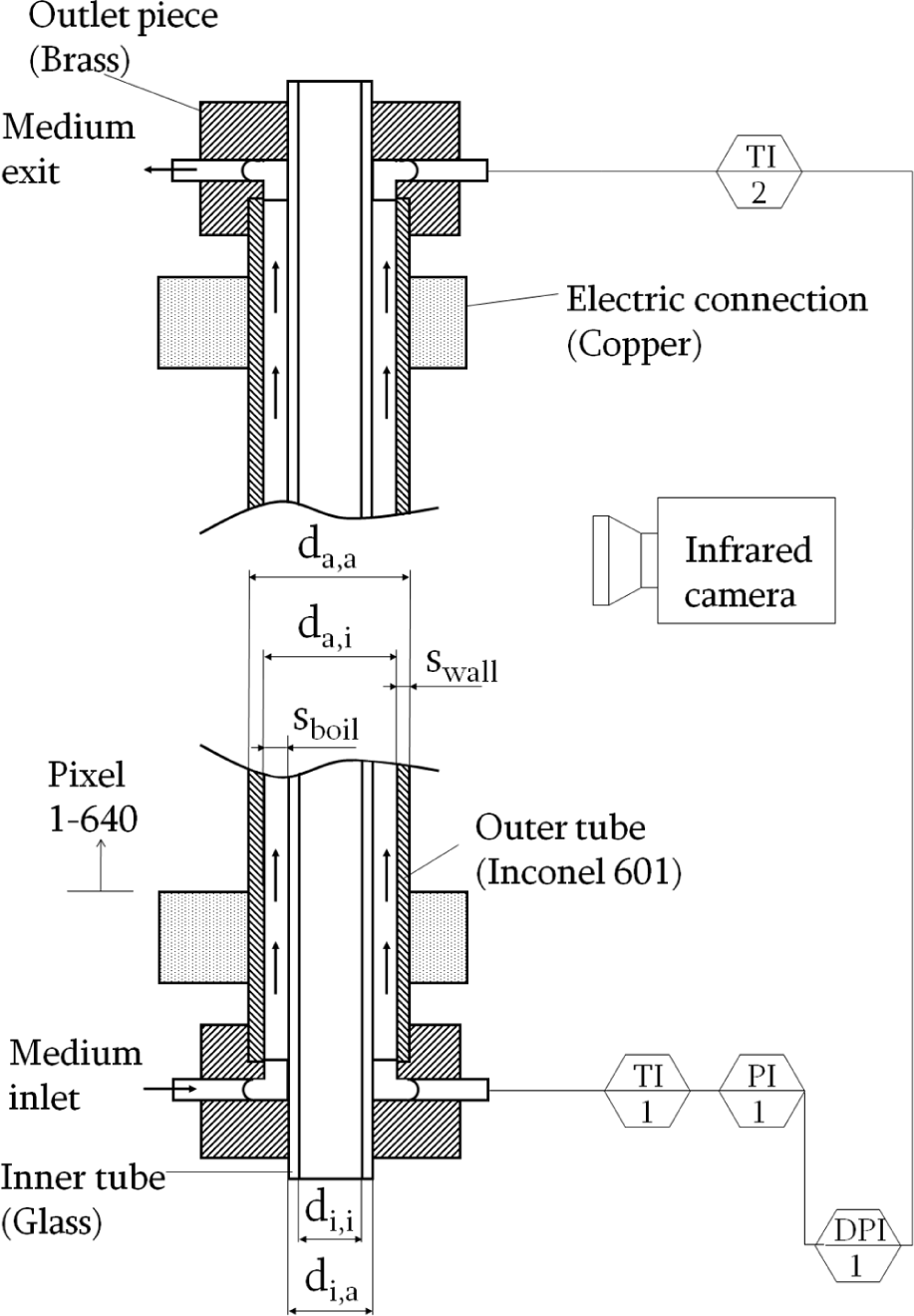
Test section.
At the inlet and outlet of the test section, the temperature is measured by thermocouples and the differential pressure is determined. Together with the measurement of the absolute pressure on the inlet, the pressure-dependent saturation temperature is determined. The analysis of the axial wall temperature profile is realized by an infrared (IR) camera. The experimental evaluation is implemented in LabVIEW and provides a superior in-process analysis of the axial heat transfer coefficient.
Test sections
The test sections are designed as annular gaps. The outer metallic tube is electrically heated directly and made of Inconel 601 which is coated with a thin layer of special black lacquer to provide large values of emissivity. Inconel 601 has a low dependence of the electrical resistivity from the wall temperature and high thermal resistance, so that the evaporation experiments can be carried out approximately at the boundary condition
Dimensions of the test sections with variation of the characteristic length.

The geometric similarity of the different test sections is ensured by the constancy of the diameter ratio da,i /di,a . The heating wall is sWall = 0.5 mm thick in all test sections to ensure comparability of the boiling processes.
The heat losses
The same configuration was used to allow the IR thermographic determination of the metal outside wall temperature, with the difference that the test section was positioned horizontally here to reach a possible homogeneous temperature in the channel. Using the measured inner wall temperature and the known heat losses, it is then possible to determine the metallic wall outside temperature by solving the stationary one-dimensional heat conduction problem with uniformly distributed source. With simultaneous IR thermographic examination, the calculated metal outside wall temperature can then assign a corresponding signal of the IR camera and thus eliminates the inaccuracies resulting from the coating layer.
To verify the measurement setup, single-phase experiments were carried out, and the results of the heat transfer coefficient were compared with numerical solutions from the literature. 26 In order to perform these tests in the parameter ranges which are relevant to the two-phase experiments, n-decane is used as experimental medium. This working medium provides similar physical and thermal properties at a higher boiling temperature. However, the verification measurements showed over a wide range of parameter deviations of less than 10% which increased with decreasing characteristic lengths and heat fluxes, but not above 30%.
All essential calculations are realized online, which means “in-process” during the experiment, resulting in significant advantages compared to the post-process analysis. Among other things, it is possible to effectively study the dynamics of the boiling process after parameter changes, the interaction between the parameters, and their influence on the heat transfer. It also improves the unit safety and minimizes the evaluation costs.
Data reduction
The local heat transfer coefficient α(z) is defined through equation (1)

The heat flux

is aside from the low temperature dependence of the electric resistivity ρel
(z) and the axial changes in heat losses
By solving the stationary one-dimensional heat conduction problem with source using the Fourier’s equation and knowing the metallic wall outside temperature TWa,m (z) and the heat losses to the environment, the inside wall temperature TW,i (z) contained in equation (1) is determined with equation (3)
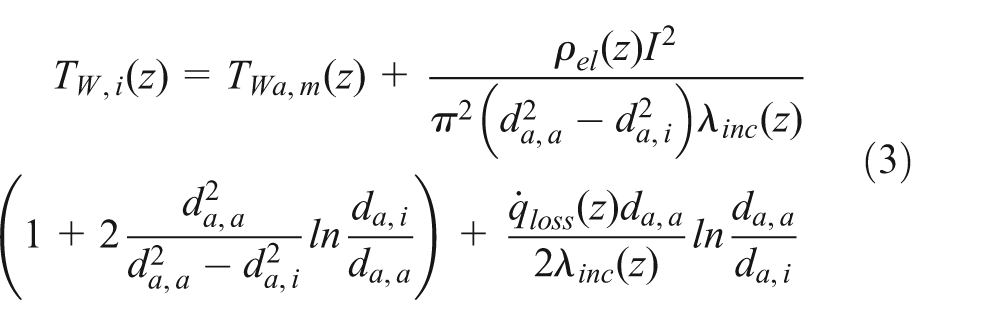
The thermal conductivity λinc
(z) is determined depending on the channel temperature. To calculate the axial fluid temperature Tfl
(z) in single-phase and in the subcooled boiling area, the caloric mean temperature

contained therein, the specific heat capacity
When the caloric fluid mean temperature reaches the pressure-dependent boiling temperature
As a dimensionless coordinate, the theoretical vapor quality

How Díaz and Schmidt
27
showed a two-phase flow can be registered even before

The enthalpy of evaporation ΔhV (z) herein is determined as a function of the local pressure-dependent boiling temperature.
In excerpts, the course of the calculated temperatures and the resulting heat transfer coefficient is shown in Figure 3 for the gap width 0.5 mm and in Figure 4 for the gap width 1.5 mm. It is observed that, due to the nearly constant heat flux, the heat transfer coefficient increases with decreasing difference between the fluid temperature Tfl (z) and the inner wall temperature TW,i (z).

Temperatures and heat transfer coefficient as a function of vapor quality: s = 0.5 mm;

Temperatures and heat transfer coefficient as a function of vapor quality: s = 1.5 mm;
The error estimate is subject to the rules of error propagation law. For analysis at the single-phase preheating and the subcooled boiling, the estimation is done with equation (7)

and equation (8) is used for the area of saturation boiling

The uncertainty in the electrical current measurement is ΔI = 0.4 A and in the mass flux
This study aims to provide a better understanding of two-phase flow and boiling characteristics during the transition from conventional to miniaturized channels. With regard to the problem of fuel evaporation, n-hexane is used as a working medium.
There are problems regarding the parameter settings of which one results from the complex boiling process. In case the heat flux is changed when setting a new test point, the pressure curve, the boiling pressure-dependent subcooled inlet temperature, and the mass flux change at constant pump speed due to the changing boiling process. With regard to these conditions and planning experiments according to the classic principle “one factor at a time”, the mass flux and the subcooled inlet temperature need to be adjusted. In addition to these two parameters influencing each other, a change of measurement result (heat transfer coefficient) cannot be clearly assigned to a change of heat flux, as the boiling pressure also changes. The method of “one factor at a time” is difficult to realize, as the pressure curve, which is a parameter with influence on the boiling process and the two-phase flow, is changed with each parameter change. To better meet these requirements of the complex boiling process, this project uses the method developed by Fisher 28 “Design of Experiments” (DoE).
DoE
Even after intensive research, no publications were found to apply these methods to the study of the flow boiling. The advantages of this approach are, among others, minimal experimental effort and associated costs as well as secure statements that can be made under consistent implementation.
Critical to the quality of the test results are the detailed description of the system to be examined and the influencing parameters (Figure 5) which can be distinguished as parameters that can be selectively altered and those that cannot be specifically altered. With this parameter constellation, system results are obtained.

Description of the system.
For this investigation, the heat and mass flux and the subcooled inlet temperature at evaporator systems with three different gap widths were varied systematically. Parameters are not specifically varied for the inlet pressure and the pressure drop across the channel and other unknown parameters. The results of these parameters applied to the system are the set system responses such as the heat transfer coefficient and the vapor quality.
As shown in Figures 6–8, there is a great local diversity of these system responses. To limit this diversity within first evaluation, Boye
25
gives a definition of the mean heat transfer coefficients for the ranges of single-phase preheating and subcooled boiling
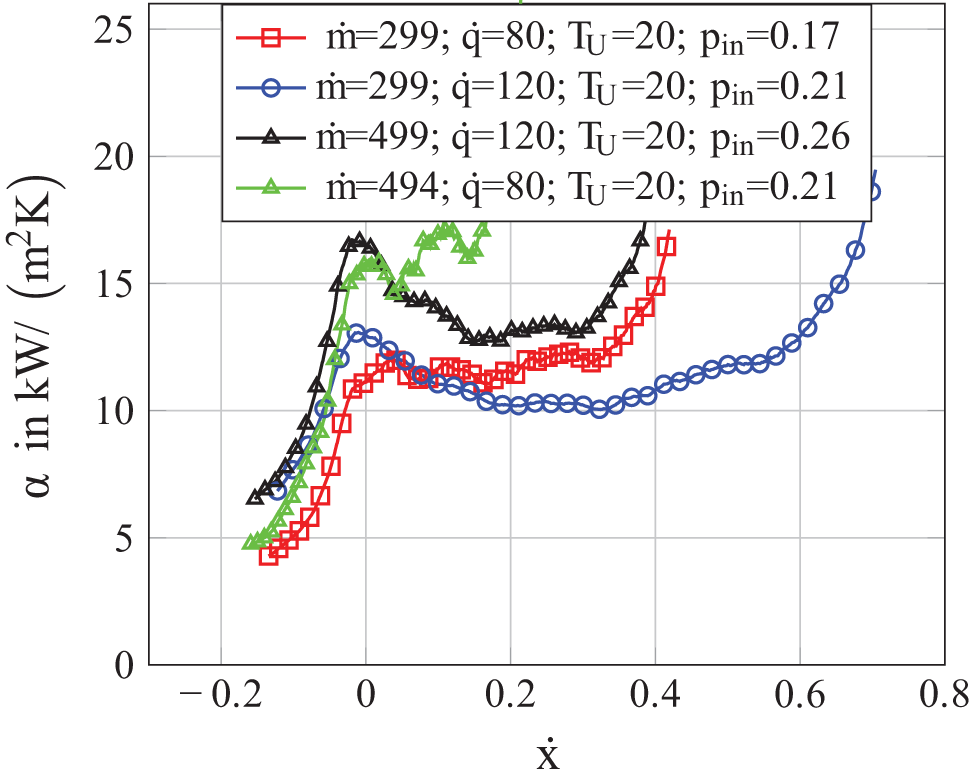
Heat transfer coefficient as a function of vapor quality: s = 0.5 mm;
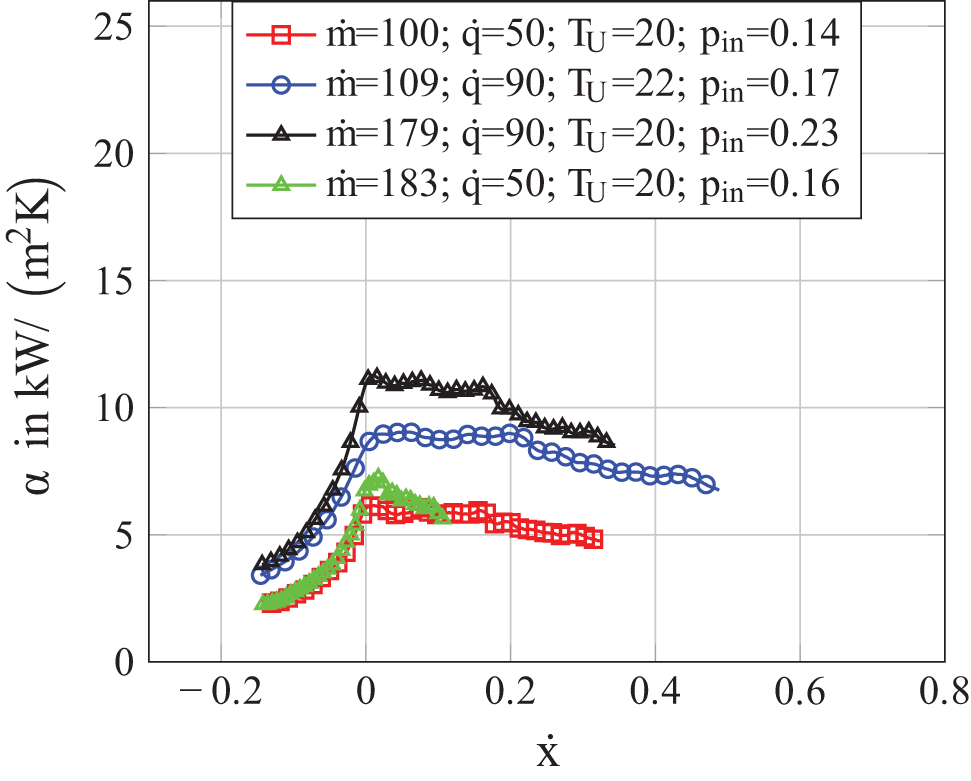
Heat transfer coefficient as a function of vapor quality: s = 1.0 mm;

Heat transfer coefficient as a function of vapor quality: s = 1.5 mm;
The vapor quality is already fully described by the input variables (equations (6) and (5)); therefore, the model for this system response is already known. Since the vapor quality is an important parameter for the characterization of the two-phase flow, it should be considered when modeling the heat transfer coefficient. Kleppmann 29 proposes to model the system response as an input variable if this is advantageous to describe the system. In the following experimental evaluation, the channel length is divided into 60 equidistant areas. Each area has an axial dimension of 10 IR pixels corresponding to around 5 mm of the channel length. For each of these sectors, arithmetically averaged vapor qualities and heat transfer coefficients are calculated as an input variable of the system and as the system response.
The example of a local system response in Figure 6 for the gap width s = 0.5 mm shows a significant increase in the local heat transfer coefficient in the range of subcooled boiling. At the beginning of saturated boiling, it provides a local maximum with a subsequent decrease in the local heat transfer coefficient which then increases again at higher vapor qualities.
Since discontinuity and local extremum are difficult to model, scopes

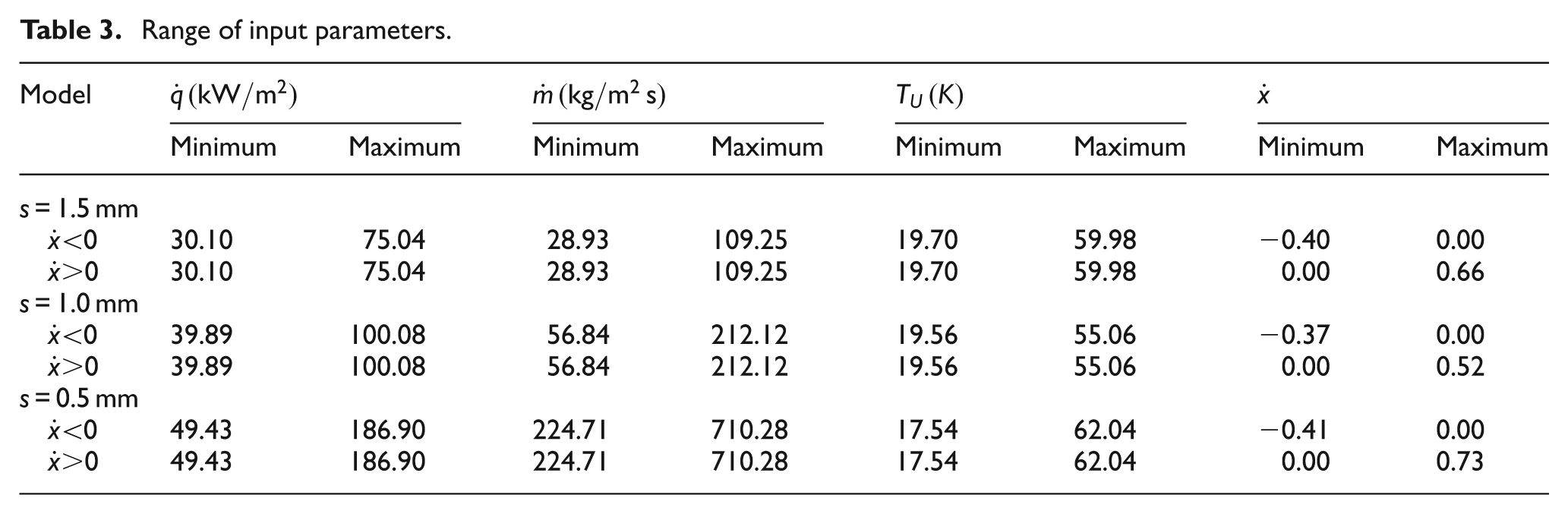
These empirical models (equation (9)) have been developed as a function of normalized operating parameters; thus, the minimum parameter value is assigned with −1 and the maximum parameter value is assigned with +1 (Table 3). The comparisons of the results of these correlations show qualitative and quantitative differences regarding the influences of parameter changes as a function of the gap widths.
Range of input parameters.
Results and discussion
The main objective of this work is the study of the flow boiling heat transfer characteristics under stable operating conditions with variation of geometric and operating parameters. The relevant experimental analysis encounters objective difficulties in necessary overlap of the parameter ranges on variation of the characteristic length. According to the energy balance equation (10)

for a given medium, the function

Influence of the diameter on the operating parameters.
Basically, with regard to the diameter dependence of the heat transfer coefficient in the two-phase flow, it is to expect that this is decreasing when the characteristic length increases. This principle can be confirmed in consideration of Figures 6–8. The trend of the heat transfer coefficients shown for all three test sections are rising α values in the range of subcooled boiling, wherein the level of heat transfer coefficients with smaller gap width and higher heat flux increases significantly and no dependence from the mass flux is noticed. The transition from subcooled flow boiling to saturated flow boiling is characterized by a local maximum in the heat transfer coefficient. Following, the profile of the heat transfer coefficient shows a significant differentiation depending on the characteristic length. For the gap widths of s = 1.0 mm and s = 1.5 mm (Figures 7 and 8), a monotonically decreasing heat transfer coefficient for all parameter constellations can be noticed. Here too, as in the area of subcooled boiling, a low
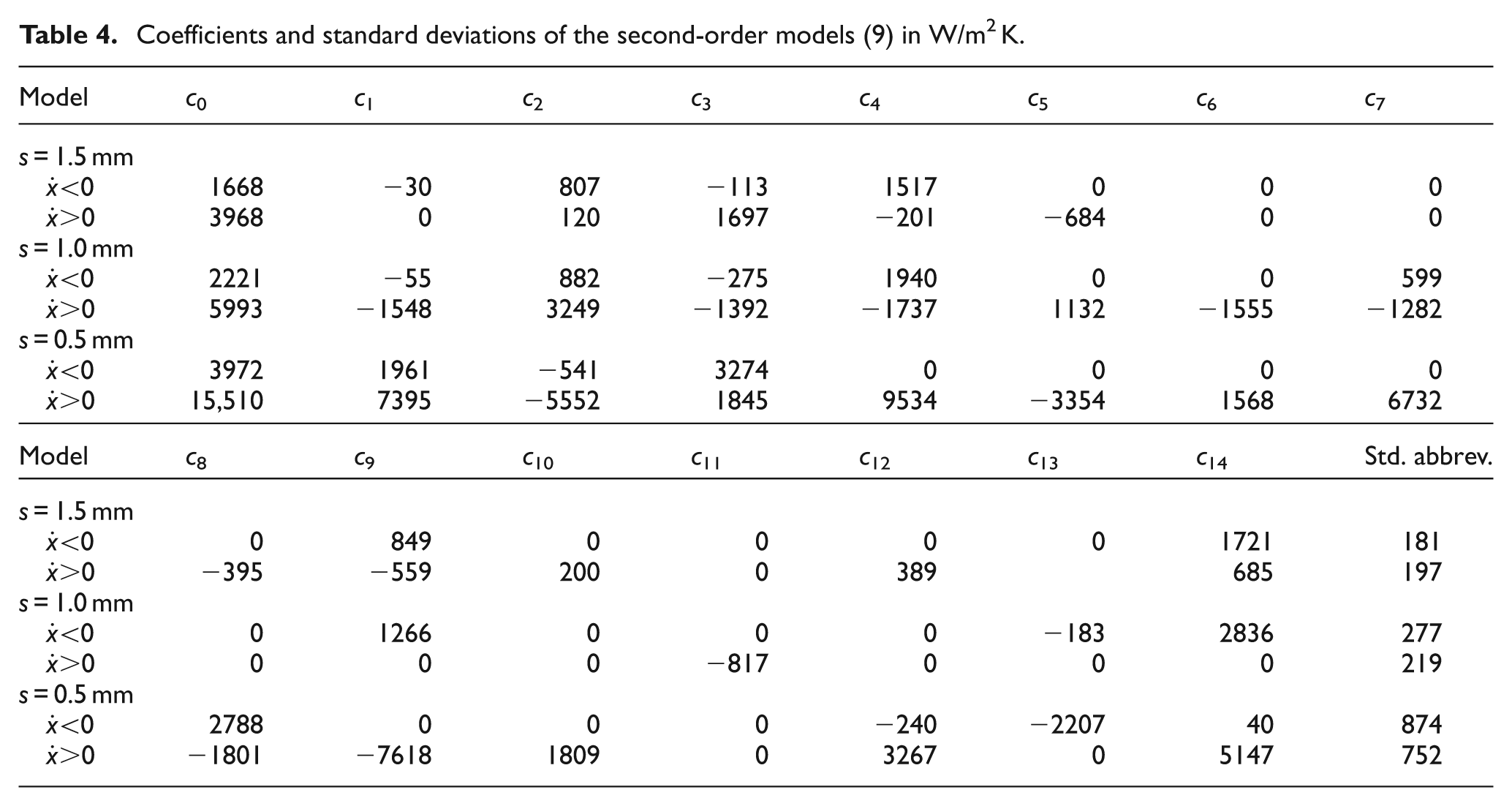
A more detailed insight into the influence of the operating and above all also geometrical parameters can be obtained by modeling the heat transfer coefficient, as given in equation (9). The coefficients contained therein are given in Table 4. As already explained in the “DoE” section, two correlations were determined for each test section, shown in Figure 10(a)–(d) for
Coefficients and standard deviations of the second-order models (9) in W/m2 K.

Results of the correlations for

Results of the correlations for
In these figures, the bright, thin lines are used for small heat fluxes and the dark, thick lines for higher heat fluxes. The dotted lines represent an extrapolated area which is not covered experimentally and should be evaluated with caution as to its validity.
The
The results of the gap width 1.0 and 0.5 mm differ remarkably.
Gap width 1.0 mm. As mentioned, larger heat fluxes at all swept mass fluxes result in increasing heat transfer coefficients. However, the dependence on the mass flux varies as a function of the vapor quality and, to some extent, the subcooled inlet temperature.
While the dependence of the heat transfer coefficients on the mass flux at low vapor qualities and TU
= 20 K is not very pronounced, we already observed that for the larger subcooled inlet temperature (40 K), the heat transfer coefficient decreases with mass flux. This trend is intensified with progressive evaporation of the hydrocarbon
Gap width 0.5 mm. The dependence of the heat transfer coefficient on the operating parameters
The following comparisons are summarized below:
For all gap widths and low vapor qualities
In the boiling range
These effects increase slightly in the test sections with increasing subcooled inlet temperatures.
These significant changes in trends in the swept lch range must be the result of different two-phase flows and distributions of liquid and vapor. In this respect, appropriate visualization results of the flow phenomena would be of high value for the physical interpretation of the boiling mechanism.
Therefore under the same experimental conditions, visualization experiments were carried out using special test sections with the same experimental setup to allow a correlation between the dependences of the heat transfer coefficients in different regimes of the two-phase flow, applying DoE. 25
Conclusion
The DoE is employed as an experimental strategic planning method. It allows using a relatively small experimental effort to determine the effect of the factors on the heat transfer coefficient as system response, even if the effects’ proportional influence differs considerably. Such effects are so-called the main effects, that is, the separate influences that the factors have on the level and trend of the target size. In addition, the DoE method provides quantitative information about the interaction of effects to define the respective influence of an input parameter on the target value when changing another input parameter.
Experimental investigations on flow boiling in a minichannel are conducted, for which n-hexane is used as working fluid. The three directly electrically heated test sections are geometrically similar annular gaps with different widths (s = 1.5 mm, s = 1 mm, s = 0.5 mm). Experimental results are presented up to a quality of 0.7 for mass fluxes of up to 700 kg/m2 s and heat fluxes from 30 to 190 kW/m2 at an outlet pressure of about 0.1 MPa.
The results show an increase in heat transfer coefficients for higher heat fluxes and smaller gap widths at small
To extend the physical basis for the modeling, further information regarding the type of two-phase flow is necessary. With this information, individual flow patterns can be modeled, and thus, the prediction of the expected heat transfer coefficient can be improved. DoE can be used to determine trends in the different regimes of two-phase flow.
Footnotes
Academic Editor: Xiao-Dong Wang
Declaration of conflicting interests
The authors declare that there is no conflict of interests regarding the publication of this paper.
Funding
This study was financially supported by the federal state of Saxony-Anhalt.