




Abstract
Boundary characteristic orthogonal polynomials proposed by the author in 1985 have been used in the Rayleigh Ritz method extensively in order to obtain natural frequencies of vibrating plates with different boundary conditions. The method used products of the characteristic orthogonal polynomials along the two directions of the plate. The first member of the boundary characteristic orthogonal polynomials set satisfied all the boundary conditions of the vibrating beam, including the natural conditions. However, the higher members of the set satisfied only the geometry boundary conditions. In this study, a modified Gram–Schmidt orthogonalization method is presented where all the members of the orthogonal set of polynomials satisfy all the boundary conditions including the natural boundary conditions. Furthermore, the exact solution of the beam differential equation is expressed in the form of a generalized Fourier series in terms of the set of new boundary characteristic orthogonal polynomials which forms an eigenvalue problem that can provide the natural frequencies and the corresponding normal modes of the beam more accurately.
Keywords
Introduction
Boundary characteristic orthogonal polynomials (BCOPs) were proposed as assumed deflection shape functions in the Rayleigh Ritz method to study the vibrations of beams and plates by Bhat. 1 Several publications resulted using the BCOPs, and some of them can be found in Singh and Chakraverty, 2 Lam et al., 3 and Kim, 4 while Chakraverty et al. 5 give research using BCOPs until 1999. Application of the BCOPs to study plate vibration problems can be found in Chakraverty. 6 The advantage of using the orthogonal polynomials as assumed shape functions was that the “mass matrix” was diagonal and the “stiffness matrix” had large diagonal terms, making it easier to compute the natural frequencies and the natural modes.
The first member of the set of BCOPs as constructed in Bhat 1 satisfied all the geometrical boundary conditions; however, it did not guarantee satisfaction of the natural boundary conditions of the higher members of the set. Although the deflection can be expressed as a linear combination of the BCOPs, which is a Generalized Fourier series representation of the deflection, the solution is still approximate since the natural boundary conditions are not satisfied. However, Kim 4 suggested the use of a generating function which will help in the higher polynomials of the set also satisfying the boundary conditions, which can construct the exact solution. His formulation had to be modified by replacing his generating function with an evolution function that is different for different members of the set of BCOPs.
Construction of novel BCOPs satisfying all the boundary conditions
The first member of the BCOP set is chosen as the simplest polynomial that can satisfy four arbitrary beam boundary conditions and can be expressed as

where
The second and the higher members of the BCOP set are obtained as

where

While the member-specific constants
The kth member is dependent on two members immediately below, thus establishing a three-term recurrence relation. Employing the condition that the BCOPs are orthogonal to each other, the constants
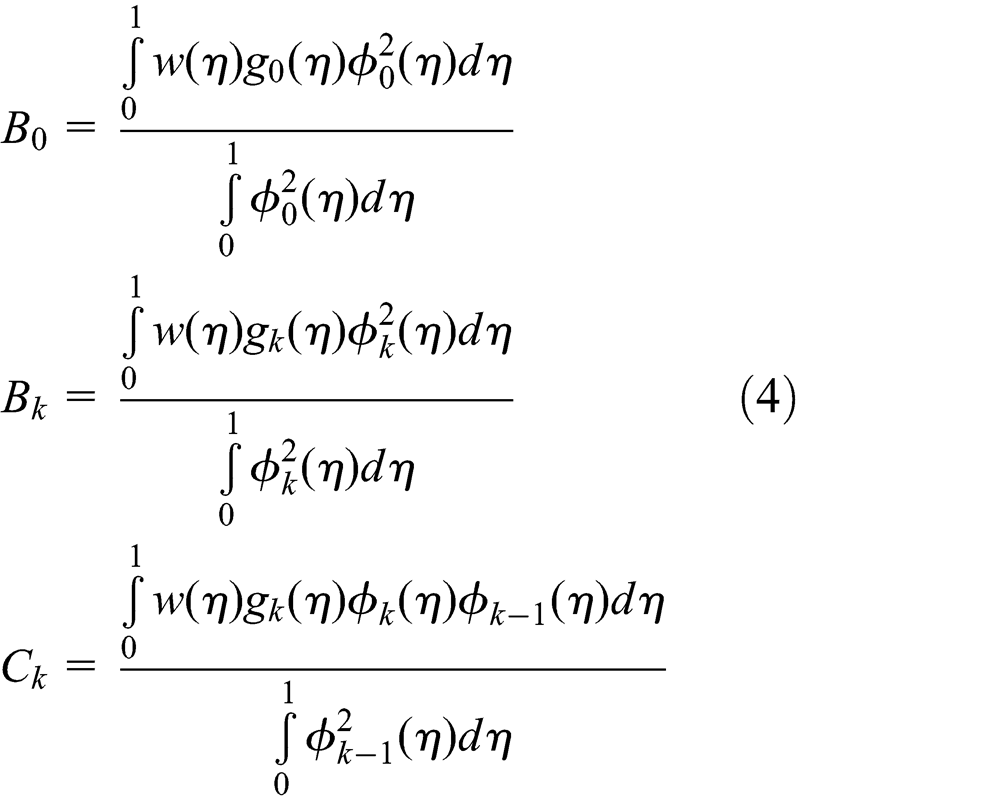
where

The different combinations of the boundary conditions and the corresponding conditions on
Combinations of beam boundary conditions and conditions on
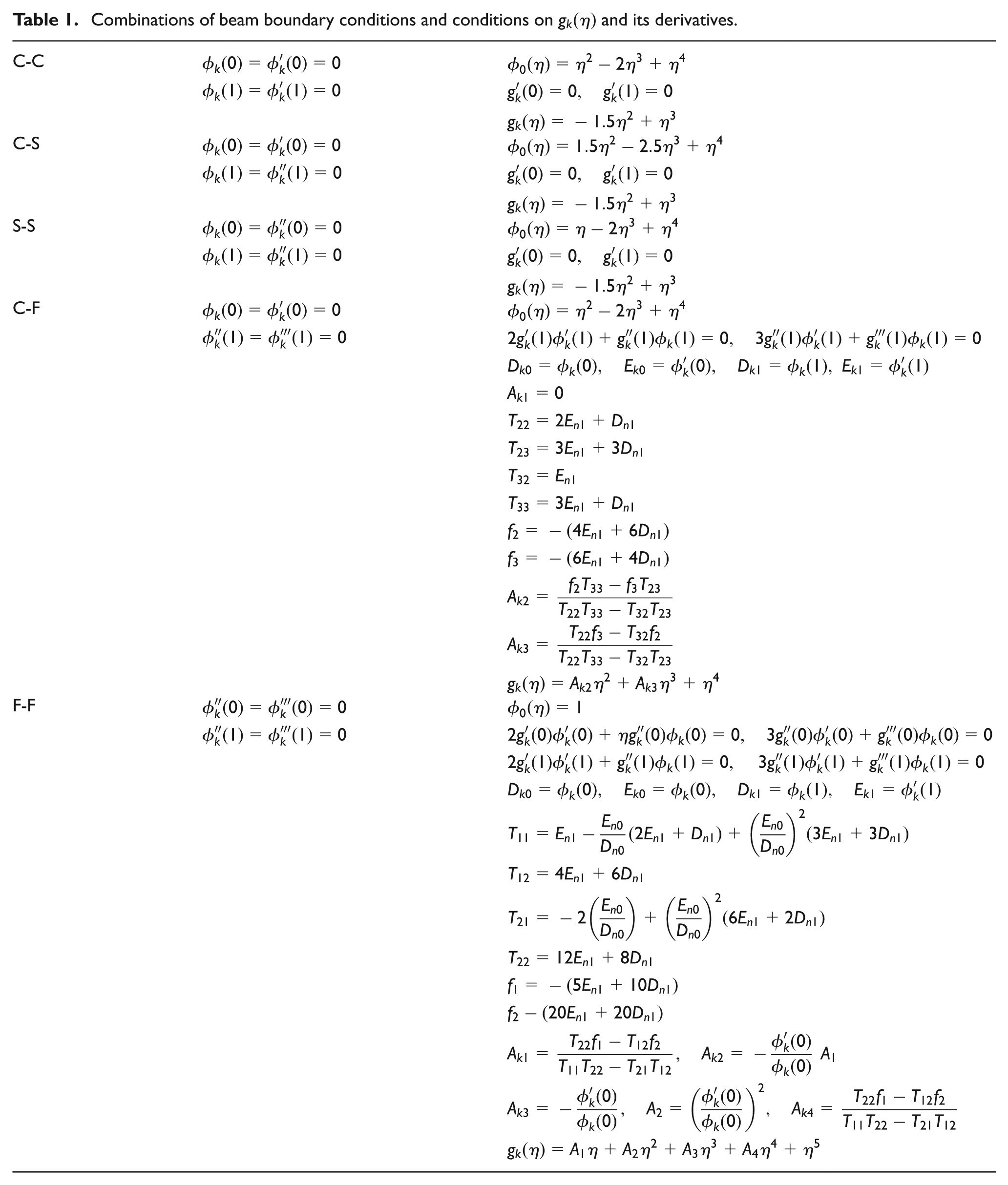
The set of BCOPs must be constructed such that the evolution function
Clamped–Clamped Conditions (C-C)
The boundary conditions are

The first polynomial is the lowest order polynomial that satisfies these conditions and is given by

Corresponding to these boundary conditions on the evolution function are
The evolution function,

Clamped–Simply Supported Conditions (C-S)
The corresponding boundary conditions are

The first polynomial is the lowest order polynomial that satisfies all these conditions and is given by

The corresponding conditions on the evolution function,

The evolution function,

Simply Supported–Simply Supported Conditions (S-S)
The corresponding boundary conditions are

The first polynomial is the lowest order polynomial that satisfies all these conditions and is given by

The corresponding conditions on the evolution function,

and the evolution function is the simplest polynomial that satisfies these conditions and is given by

Clamped–Free Conditions (C-F)
The associated boundary conditions are

The first polynomial is the lowest order polynomial that satisfies all these conditions and is given by

The corresponding conditions on the evolution function,
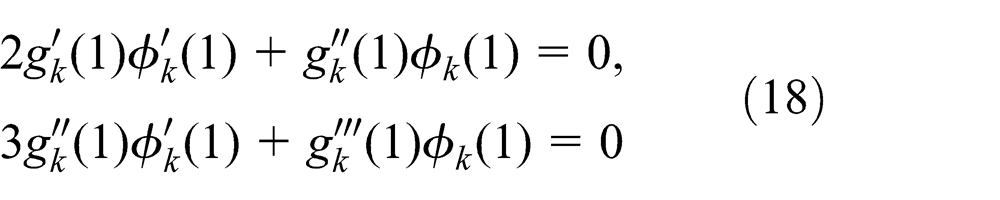
The evolution function,

Free–Free Conditions (F-F)
The associated boundary conditions are

The first polynomial is the lowest order polynomial that satisfies all these conditions and is given by

The corresponding conditions on the evolution function,

The evolution function,

Recurrence relations among orthogonal polynomials
Considering orthogonality between polynomials

The term on the left hand side (LHS) and the last term on the right hand side (RHS) in equation (24) are zero in view of orthogonality between

In view of orthogonality between the members of polynomials
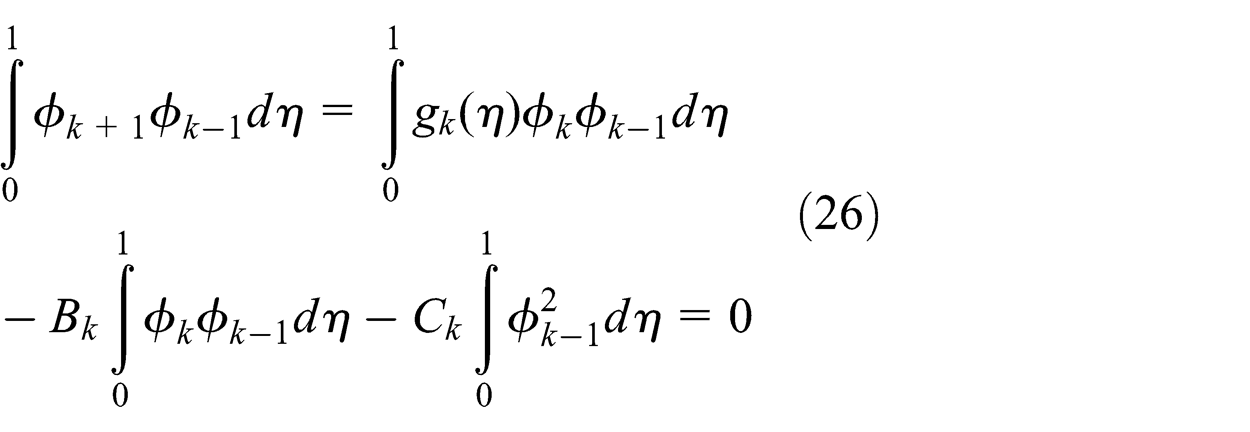
Due to orthogonality between members

Accordingly, we have
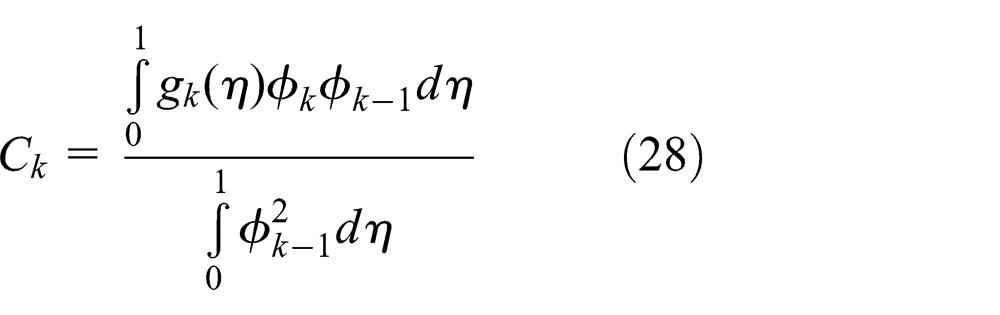
Considering any two consecutive members of the set of orthogonal polynomials, we have
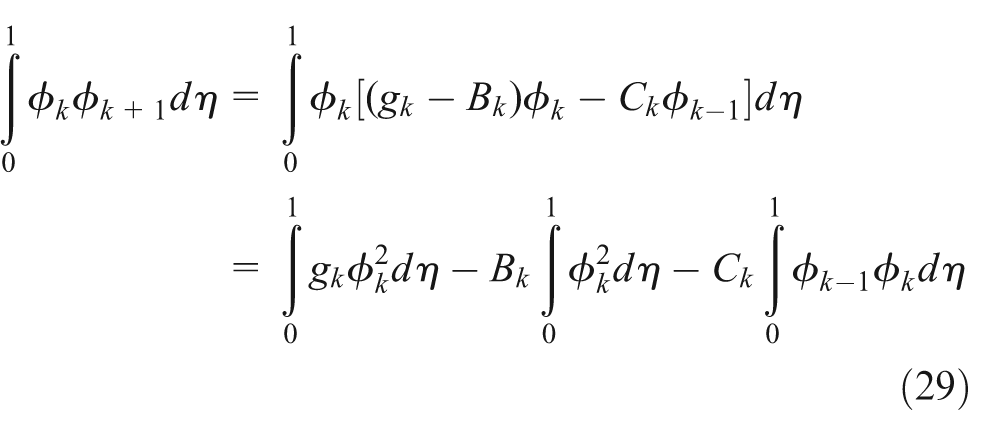
The first two terms on the RHS of equation (29) are zero and hence we have

Extending this recurrence relation, we can write

in view of the orthogonality between

Replacing the subscript k by k + 1 in equation (28) and substituting in equation (32), we have the RHS of equation (32) zero. Hence, three consecutive polynomials are orthogonal to each other. Extending this argument, it is possible to show that n consecutive polynomials are orthogonal to each other.
Solution of the vibrating beam
The differential equation for the beam vibration can be written as

In free vibrations, the response is assumed in the form of a sinusoidal function in time. Accordingly

where the axial coordinate x is non-dimensionalized as

where
Assume the solution of the vibrating beam in the form

which is a generalized Fourier series representation of the solution in terms of the BCOPs, with

The fourth derivative of the assumed shape functions is expressed in Fourier series in terms of the BCOPs as

Multiplying both sides of equation (38) by

where

Substituting equations (36–40) into equation (35) results in

Equation (41) can be reorganized in the form

This can be cast in the form of an eigenvalue problem as

where

and the column vector of generalized coordinates is given by
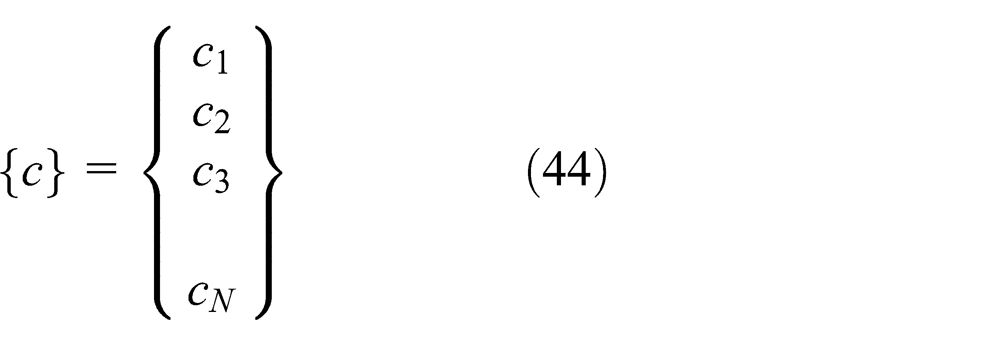
The formulation leads to the same final form as that obtained in a Galerkin solution.
Results and discussion
Since the beam characteristic orthogonal polynomials form a complete set and are also linearly independent in view of equation (2), the solution can be expressed as a generalized Fourier series in terms of the BCOPs. When the beam boundary conditions are applied, solution to the resulting eigenvalue problem provides an “exact” solution to the beam differential equation. While the exponential solution provides an “exact” solution in terms of the sinusoidal and hyperbolic sinusoidal functions, the present method provides “exact” solutions in terms of the BCOPs whose order steadily changes monotonically. The exact results due to Young and Felgar 7 provide up to five modes only, while n = 6 terms are used in computing the results in this study.
Table 2 presents natural frequency coefficients,
Natural frequency coefficients for the different cases of beam boundary conditions.

BCOPs: boundary characteristic orthogonal polynomials.
Conclusion
Beam characteristic orthogonal polynomials are constructed so as to satisfy both the geometrical and natural boundary conditions of the different beam problems. The BCOPs form a complete set that satisfies all the boundary conditions. Expressing the solution in a generalized Fourier series provides an “exact” solution to the beam differential equation. Natural frequency coefficients are obtained for different cases of boundary conditions. The solutions will tend toward the accurate values when sufficiently large number of terms are used in the generalized Fourier series.
Footnotes
Academic Editor: Francisco D Denia
Declaration of conflicting interests
The author declares that there is no conflict of interest.
Funding
This research received no specific grant from any funding agency in the public, commercial, or not-for-profit sectors.