




Abstract
This research article analyzes the resonant reliability at the rotating speed of 6150.0 r/min for low-pressure compressor rotor blade. The aim is to improve the computational efficiency of reliability analysis. This study applies least squares support vector machine to predict the natural frequencies of the low-pressure compressor rotor blade considered. To build a more stable and reliable least squares support vector machine model, leave-one-out cross-validation is introduced to search for the optimal parameters of least squares support vector machine. Least squares support vector machine with leave-one-out cross-validation is presented to analyze the resonant reliability. Additionally, the modal analysis at the rotating speed of 6150.0 r/min for the rotor blade is considered as a tandem system to simplify the analysis and design process, and the randomness of influence factors on frequencies, such as material properties, structural dimension, and operating condition, is taken into consideration. Back-propagation neural network is compared to verify the proposed approach based on the same training and testing sets as least squares support vector machine with leave-one-out cross-validation. Finally, the statistical results prove that the proposed approach is considered to be effective and feasible and can be applied to structural reliability analysis.
Keywords
Introduction
High reliability is usually required for the stabilities of aeronautic and astronautic structures. Especially, resonant reliability plays an important role in the safety operation of low-pressure compressor (LPC) rotor blade. Vibration is inevitable, but high resonant reliability is helpful to improve the structural security. Some research works1–4 on vibration of rotor blade have been carried out based on deterministic analysis, but its resonant reliability was rarely involved. Therefore, it is extremely necessary to analyze the resonant reliability for LPC rotor blade by considering the influence of random factors on vibration characteristic.
In the reliability analysis, the Monte Carlo method (MCM)5–9 is often applied to analyze and calculate structural reliability, but this method possesses low computational efficiency due to the large number of simulations required. Some classical algorithms, such as first-order reliability method (FORM) and second-order reliability method (SORM), possess lower calculation precision for the complicated or implicit limit state functions in the reliability problems. 10 In addition, the classical response surface method (RSM) is the main approach to solve the reliability problem with explicit limit state functions.11,12 However, it is formidable for RSM to fit highly nonlinear response surface for the reliability problem with multiple basic random variables.13–15
In recent years, machine learning algorithms have been successfully applied to structural reliability field, mainly including back-propagation neural network (BPNN) and support vector machine (SVM). In 1995, Cortes and Vapnik 16 proposed a novel machine learning algorithm called SVM, which follows the principle of structure risk minimization in the statistical learning theory.17–19 SVM can acquire the globally optimal solution on the basis of available data. In addition, SVM enjoys the advantage of fitting highly nonlinear response surface and ensuring highly computational efficiency and precision. Accordingly, SVM has been widely adopted in academic research and industrial applications.20–24 The essence of SVM is to solve a convex and quadratic programming problem, and it is time-consuming. 25 Based on the traditional SVM, this article proposes least squares support vector machine (LSSVM),25,26 which converts the process of training a model to solving a linear equation. Consequently, LSSVM can avoid the complex computation for the quadratic programming problem. LSSVM simplifies the calculation process, greatly reduces the computational complexity, and improves the solution speed.27–32
To construct a high-precision LSSVM model, the parameters of LSSVM should be carefully set.30–32 Appropriate parameters ensure the precision and efficiency of the structural reliability analysis. In this article, leave-one-out cross-validation (LOOCV)33–35 is applied to seek the optimal parameters to improve the approximation capability and generalization ability of the LSSVM model, which makes the LSSVM model effectively overcome the appearance of over-learning and under-learning and greatly improves computational accuracy. Then, the parameters and training set are associated to construct the least squares support vector machine with leave-one-out cross-validation (LSSVM-LOOCV) model, and the model is used to predict vibration frequencies. Based on the randomness of the influence factors on frequencies, reliability analysis on resonance for LPC rotor blade is finished. Finally, the proposed method is compared with BPNN and MCM to examine the predictive ability of LSSVM-LOOCV.
LSSVM
LSSVM, an improved SVM, was proposed by Suykens and colleagues25,26 based on regularization theory. LSSVM adopts a least squares linear system to solve classification and estimation problems instead of the quadratic programming method used in the traditional SVM.
Suppose that there is a set of given data

where
Furthermore, the linear regression problem can be expressed as an optimization problem with equality constraints according to the principle of structural risk minimization (synthetically considering the minimization of the Vapnik–Chervonenkis (VC) dimension and empirical risk). The objective function of the optimization problem is given by equation (2)

where
To solve the above optimization problem, the Lagrange multiplier

Based on the Karush–Kuhn–Tucker (KKT) conditions, the following equations are obtained
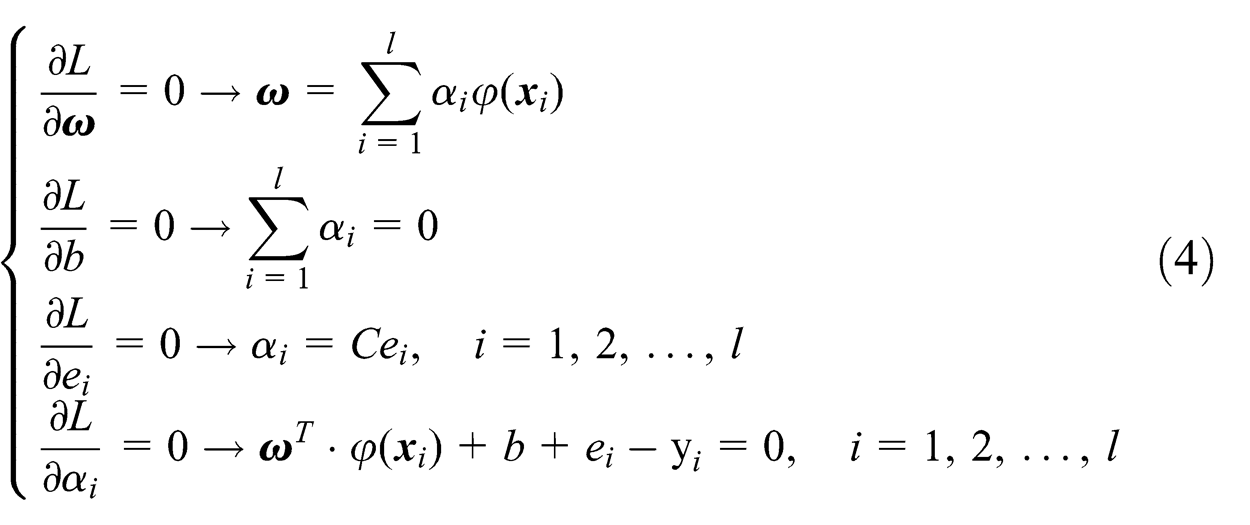
Finally, the regression decision function is written as the following explicit expression

where
Selection of LSSVM parameters
The LSSVM parameters, including the form of kernel function, regularization parameter, and kernel parameter, are the key influence factors on the generalization ability of LSSVM model and fully describe the spatial structure and characteristics of the model. In order to improve the generalization ability of LSSVM, selecting the optimal parameters is indispensable. Specifically, the type of kernel function implicitly confirms the mapped high-dimensional feature space. The regularization parameter can adjust the confidence interval of statistical learning machine, and the kernel parameter implicitly affects the complexity of the distribution of input subspace. In this article, the radial basis function (
LSSVM-LOOCV model
In the process of establishing the LSSVM-LOOCV model, the main issue is to seek an optimal hyper-parameter combination, the regularization parameter
Suppose that the given training set is

The process of establishing the least squares support vector machine with leave-one-out cross-validation (LSSVM-LOOCV) model.
Selection random variables
Modal analysis
This article considered an LPC rotor blade as research object. Figure 2 shows the finite element model with 2445 elements and 13,634 nodes. The mechanical properties of the blade material, Titanium alloy, such as the elastic modulus, the density, and Poisson’s ratio are set to 118 GPa, 4500 kg/m3, and 0.34, respectively. Both the flanks of the dovetail-shaped root were fixed to execute the modal analysis of the rotor blade. Figure 3 shows its profile diagram, where

Blade finite element model.

Blade profile diagram.
To accomplish vibration characteristics analysis, the modal analysis was primarily implemented to calculate the natural frequencies and vibration modes of the rotor blade. In this section, the frequency distribution was calculated under the static state, crawling state, cruising state, and designing state with the rotating speeds of 0, 3737.0, 6150.0, 9916.2, and 11,000.0 r/min. The first four natural frequencies are shown in Table 1.
The first four natural frequencies of the blade.

The Campbell chart is shown in Figure 4, where the horizontal axis represents the engine rotating speed

The Campbell diagram of the blade.
Extensive facts illustrate that resonance caused in the first three modes under the crawling state is the main failure form of the rotor blade. Therefore, the harmonic response analysis at the rotating speed of 6150.0 r/min was performed to test whether the first three modes were in a state of resonance (Figure 5).
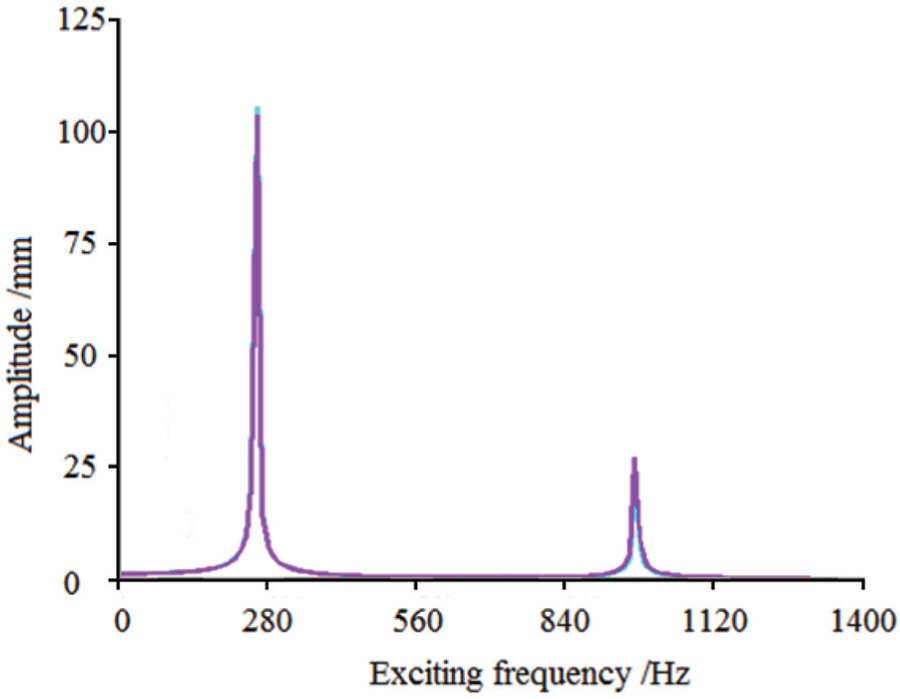
The harmonic response curve of the blade at the rotating speed of 6150.0 r/min.
The curve illustrates that resonance occurs in the first and third modes at the rotating speed of 6150.0 r/min, which is in good agreement with the actual situation.
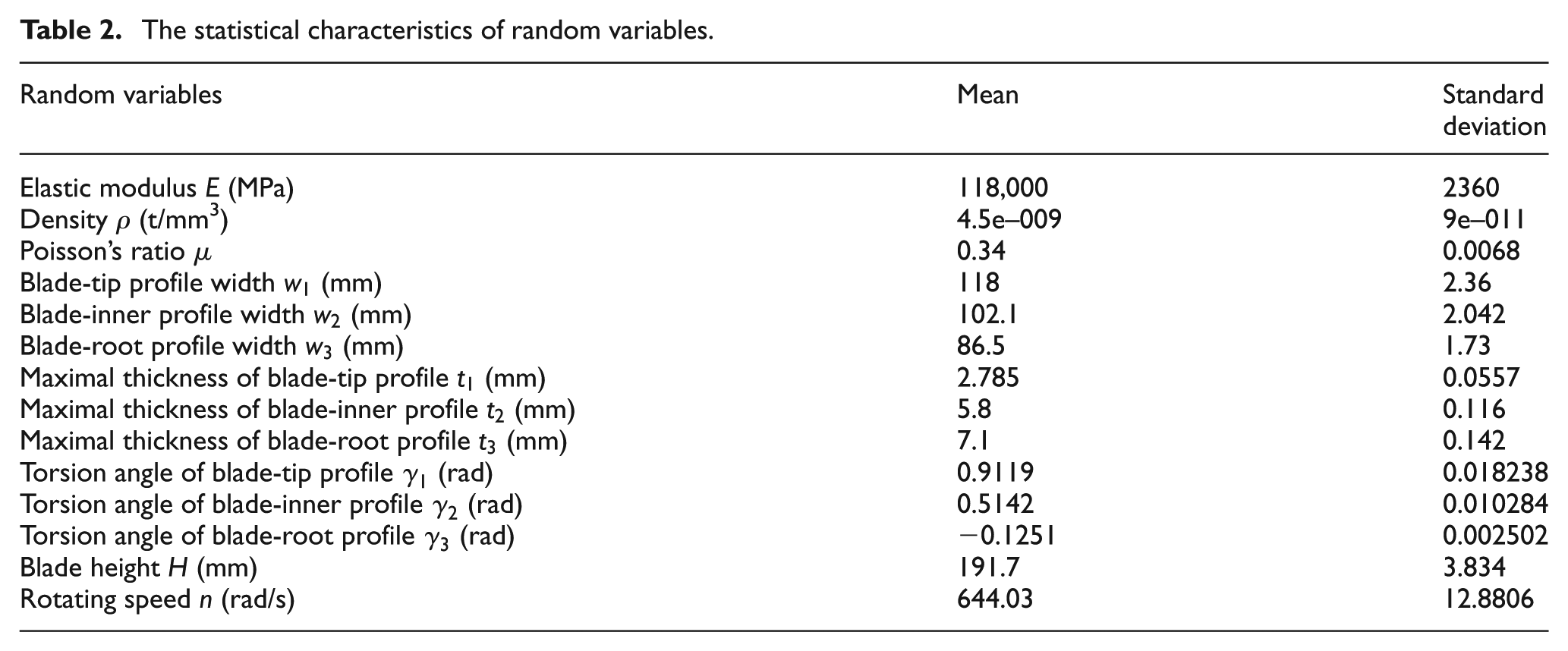
Random variables
The material parameters, structural dimension, and operating condition possess inherent randomness, which possess enormous impact on vibration frequencies. Therefore,
The statistical characteristics of random variables.
Algorithm models
In this section, algorithm models were constructed to predict natural frequencies. This article chose BPNN to compare the feasibility of the proposed method. 24 Some statistical metrics were used to evaluate the estimating performance of the model, such as the mean square error (MSE), mean absolute percentage error (MAPE), and correlation coefficient (R)


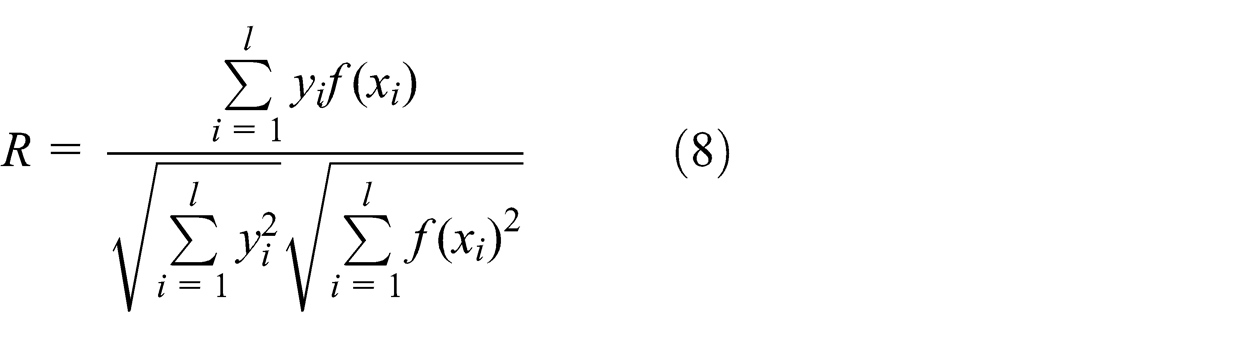
where
LSSVM-LOOCV model
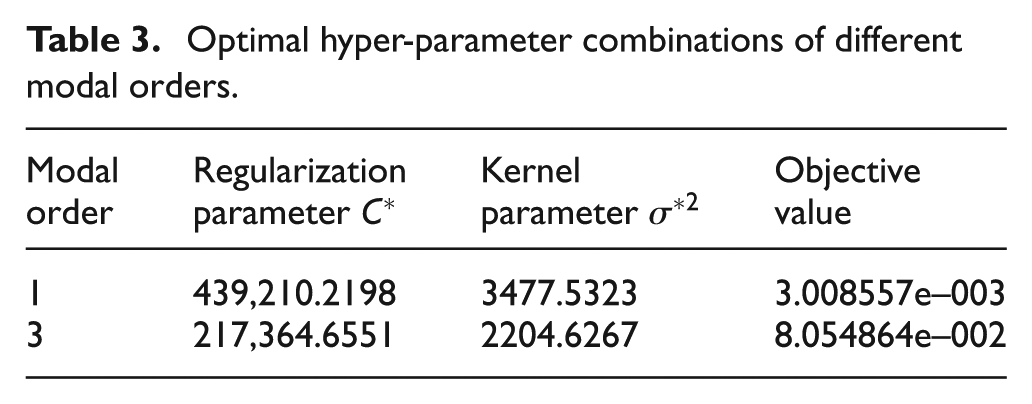
Through some deterministic experiment, 57 groups of sample points and 285 groups of sample pointes were successively obtained, and were respectively considered as training set and testing set. The former was used to acquire the optimal hyper-parameter combination and train the LSSVM-LOOCV model, while the latter was responsible for estimating the generalization ability of the model. According to the principle of LOOCV, the estimates corresponding to the minimal objective value were considered as the optimal hyper-parameters, as shown in Table 3. Then, these parameters were applied to train the support values and the bias term to construct the LSSVM-LOOCV model.
Optimal hyper-parameter combinations of different modal orders.
BPNN model
BPNN 39 mainly consists of the input layer, hidden layer, and output layer. The key issue is to select a proper hidden layer. But so far, there is no good analytic expression to determine the number of hidden nodes. It is generally believed that the number of hidden nodes is directly related to the number of input and output cells. Referring to previous experience, a simple formula is established 40

where
Table 4 shows that the {14-5-1} network structure with learning rate of 0.1 and {14-9-1} network structure with learning rate of 0.04 corresponding to the first- and third-order modes possess the best predictive ability, respectively, where
Analysis results of back-propagation neural network (BPNN) with different hidden layer structure.

MSE: mean square error. The bold value represents the minimum and closest to 0 of all iterations.
Reliability analyses on resonance for LPC rotor blade
Basic theories
When the resonance of a stimulated system occurs at a rotating speed, the system is in failure state or critical failure state. According to the resonant reliability theory, the limit state function can be defined as

where
We assume that the vibration analysis of the rotor blade is a tandem mode,
41
and different modes are mutually independent. Therefore, the security and reliability of the system is based upon each subsystem in the normal working state. The reliability index

So, the resonant reliability of the system is represented as

Numerical analyses
Based on the above algorithm models, the predicting simulation was performed against the testing set. Figures 6 and 7 show the distribution histogram for the first and third predictive frequencies. Table 5 shows the comparison of the simulation results for different methods. Tables 6 and 7 list the comparison of the resonant failure probability of the first and third modes under different reliability indices

The predictive output of least squares support vector machine with leave-one-out cross-validation (LSSVM-LOOCV).

The predictive output of back-propagation neural network (BPNN).
Comparison of the simulation results for different methods.

MSE: mean square error; MAPE: mean absolute percentage error; MCM: Monte Carlo method; LSSVM-LOOCV: least squares support vector machine with leave-one-out cross-validation; BPNN: back-propagation neural network.
Comparison of the resonant failure probability of the first mode for different methods.

MCM: Monte Carlo method; LSSVM-LOOCV: least squares support vector machine with leave-one-out cross-validation; BPNN: back-propagation neural network.
Comparison of the resonant failure probability of the third mode for different methods.

MCM: Monte Carlo method; LSSVM-LOOCV: least squares support vector machine with leave-one-out cross-validation; BPNN: back-propagation neural network.
Comparison of resonant reliability at the rotating speed of 6150.0 r/min for low-pressure compressor (LPC) rotor blade with different methods.

MCM: Monte Carlo method; LSSVM-LOOCV: least squares support vector machine with leave-one-out cross-validation; BPNN: back-propagation neural network.
Figures 6, 7, and Table 5 illustrate that the predictive frequencies follow Gaussian distribution. The above statistics analyses prove that the resonant failure probability of the first and third modes increases, and the resonant reliability at the rotating speed of 6150.0 r/min for LPC rotor blade decreases with the increasing reliability index δ. Compared with MCM, an acceptable estimating performance on few iterations and shorter running time can be obtained by the LSSVM-LOOCV and BPNN models, while the LSSVM-LOOCV model possesses better generalization ability and precision to analyze the reliability on resonance for LPC rotor blade than BPNN.
Conclusion
This study applies LSSVM to analyze the resonant reliability at the rotating speed of 6150.0 r/min for LPC rotor blade. LOOCV is applied to the training set to obtain the optimal hyper-parameter combination so that the better LSSVM-LOOCV model is constructed. Then, considering the randomness of the influence factors on frequencies, the resonant reliability analysis for the rotor blade is achieved with the proposed approach. Additionally, BPNN is introduced to compare the feasibility of the proposed method. The experimental results suggest that the LSSVM-LOOCV model has an excellent nonlinearity approximation capability and better generalization ability than BPNN in cases of fewer sample points, and LSSVM-LOOCV is an excellent algorithm to improve the efficiency of reliability analysis on resonance at the rotating speed of 6150.0 r/min for LPC rotor blade. Some details are explained as follows:
From the solving process, the LSSVM model has lower computational complexity than SVM, because only the linear equations need to be solved instead of the quadratic programming problem. However, due to the loss of sparsity, when the LSSVM model handles massive amounts of data, the amount of computations is huge. Therefore, this research carefully selects 57 groups of experimental data to train the algorithm model. The statistical results prove that the established LSSVM-LOOCV model requires less running time and iteration times to obtain an acceptable result than MCM.
Because the sum of MSE is considered as fitting error in the objective function of the LSSVM model, the solution will be optimal when the errors follow normal distribution. From the above analyses, Figure 8 can be obtained (Figure 8).
The predictive error distribution for least squares support vector machine with leave-one-out cross-validation (LSSVM-LOOCV).
From the distribution figures of the predictive errors, it is seen that the errors basically follow normal distribution. So, the LSSVM-LOOCV model is optimal to improve the computational efficiency of reliability analysis.
Footnotes
Academic Editor: Jia-Jang Wu
Declaration of conflicting interests
The authors declare that there is no conflict of interest.
Funding
This research was supported by the National Natural Science Foundation of China (Grant no. 51335003) and the Specialized Research Fund for the Doctoral Program of Higher Education of China (Grant no. 20111102110011).